Basic knowledge about bend dyeing
Presented by:
Md: Fahimuzzaman
Department of Textile Engineering
Mawlana Bhashani Science and Technology University
What is blends?
Blends are any textile material from fiber through yarn to fabric which
are deliberate combination of chemically or physically different fibrous
polymer.
Cotton and Polyester blend is an example of chemically different blend
Cotton and Viscose is physically different blend because both are
cellulosic
Reason for blending
Economy: The dilution of an expensive fibre by blending with a cheaper
substitute.
Durability: The incorporation of a more durable component to extend the
useful life of a relatively fragile fibre.
Physical properties: A compromise to take advantage of desirable
performance charactristics contribuition by both fibre components.
Color: The development of new fabric design for garments incorporating
multicolor effect.
Appearance: The attainment of attractive appearance & perceptible
qualities using combinations of yarns of different lusture, crimp or denier
which still differ in appearance even when dyed with same color.
Other reasons-
Blending develops fibre properties.
Colorant modification is possible by blending.
Finishing process modification.
Improved moisture absorption, antistatic characteristics, reduced pilling,
improved abrasion resistance.
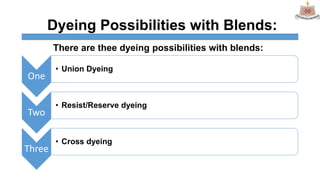
Dyeing Possibilities with Blends:
One
• Union Dyeing
Two
• Resist/Reserve dyeing
Three
• Cross dyeing
There are thee dyeing possibilities with blends:
Union Dyeing
This is suitable for fabrics containing two fibres to dye them in a single
uniform colour, each dye suitable for one kind of fibre in the blend.
Union dyeing is same as cross dyeing except that instead of multi-colour
effects. One solid colour is produced. The dyer accomplishes this by using
two or more classes of dye, each of the same colours.
Different fibres may require different dyes to obtain the same colour; this
may be done by putting the appropriate colour dye that is specific to each
type of fibre in to one dye bath.
For eg: a fabric composed of rayon and acetate can be dyed with a solid
colour green by using a direct dye for the rayon, and a disperse dye of the
same colour for the acetate.
Resist/Reserve dyeing
• In resist dyeing at least one (but not all) of the components of the
blend remains essentially undyed
i.e almost white.
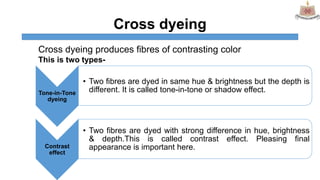
Cross dyeing
Tone-in-Tone
dyeing
• Two fibres are dyed in same hue & brightness but the depth is
different. It is called tone-in-tone or shadow effect.
Contrast
effect
• Two fibres are dyed with strong difference in hue, brightness
& depth.This is called contrast effect. Pleasing final
appearance is important here.
Cross dyeing produces fibres of contrasting color
This is two types-
Thank you

Blend dyeing

  • 1.
    Basic knowledge aboutbend dyeing Presented by: Md: Fahimuzzaman Department of Textile Engineering Mawlana Bhashani Science and Technology University
  • 2.
    What is blends? Blendsare any textile material from fiber through yarn to fabric which are deliberate combination of chemically or physically different fibrous polymer. Cotton and Polyester blend is an example of chemically different blend Cotton and Viscose is physically different blend because both are cellulosic
  • 3.
    Reason for blending Economy:The dilution of an expensive fibre by blending with a cheaper substitute. Durability: The incorporation of a more durable component to extend the useful life of a relatively fragile fibre. Physical properties: A compromise to take advantage of desirable performance charactristics contribuition by both fibre components. Color: The development of new fabric design for garments incorporating multicolor effect. Appearance: The attainment of attractive appearance & perceptible qualities using combinations of yarns of different lusture, crimp or denier which still differ in appearance even when dyed with same color.
  • 4.
    Other reasons- Blending developsfibre properties. Colorant modification is possible by blending. Finishing process modification. Improved moisture absorption, antistatic characteristics, reduced pilling, improved abrasion resistance.
  • 5.
    Dyeing Possibilities withBlends: One • Union Dyeing Two • Resist/Reserve dyeing Three • Cross dyeing There are thee dyeing possibilities with blends:
  • 6.
    Union Dyeing This issuitable for fabrics containing two fibres to dye them in a single uniform colour, each dye suitable for one kind of fibre in the blend. Union dyeing is same as cross dyeing except that instead of multi-colour effects. One solid colour is produced. The dyer accomplishes this by using two or more classes of dye, each of the same colours. Different fibres may require different dyes to obtain the same colour; this may be done by putting the appropriate colour dye that is specific to each type of fibre in to one dye bath. For eg: a fabric composed of rayon and acetate can be dyed with a solid colour green by using a direct dye for the rayon, and a disperse dye of the same colour for the acetate.
  • 7.
    Resist/Reserve dyeing • Inresist dyeing at least one (but not all) of the components of the blend remains essentially undyed i.e almost white.
  • 8.
    Cross dyeing Tone-in-Tone dyeing • Twofibres are dyed in same hue & brightness but the depth is different. It is called tone-in-tone or shadow effect. Contrast effect • Two fibres are dyed with strong difference in hue, brightness & depth.This is called contrast effect. Pleasing final appearance is important here. Cross dyeing produces fibres of contrasting color This is two types-
  • 9.