An Introduction of Six-Sigma
Qian Tong
Qiuzi
June 25, 2004
What is Six-Sigma?
 Developed by Motorola in 1987
 A measure of quality that strives for near
perfection.
 A high criteria: only 3.4 defects per million
opportunities for each product or service
transaction
Key Concepts
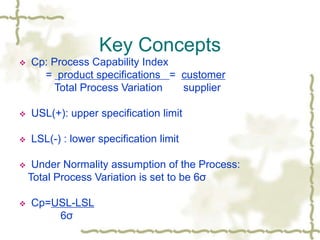
 Cp: Process Capability Index
= product specifications = customer
Total Process Variation supplier
 USL(+): upper specification limit
 LSL(-) : lower specification limit
 Under Normality assumption of the Process:
Total Process Variation is set to be 6σ
 Cp=USL-LSL
6σ
To achieve Six-Sigma
 Cp=2.0
 USL-LSL=12σ
 Defect parts number: 3.4 pm
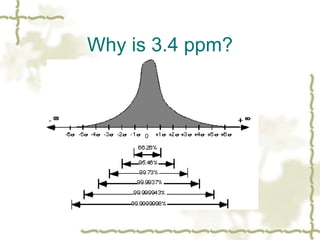
Why is 3.4 ppm?
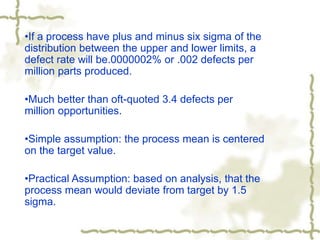
•If a process have plus and minus six sigma of the
distribution between the upper and lower limits, a
defect rate will be.0000002% or .002 defects per
million parts produced.
•Much better than oft-quoted 3.4 defects per
million opportunities.
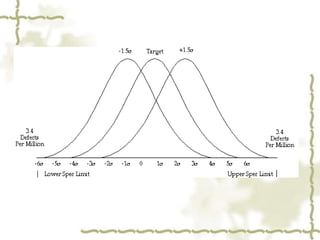
•Simple assumption: the process mean is centered
on the target value.
•Practical Assumption: based on analysis, that the
process mean would deviate from target by 1.5
sigma.
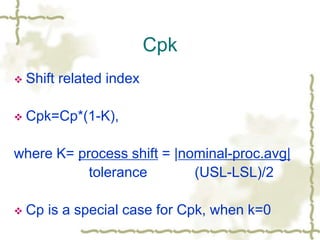
Cpk
 Shift related index
 Cpk=Cp*(1-K),
where K= process shift = |nominal-proc.avg|
tolerance (USL-LSL)/2
 Cp is a special case for Cpk, when k=0
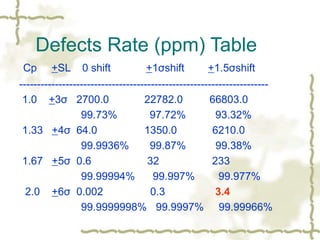
Defects Rate (ppm) Table
Cp +SL 0 shift +1σshift +1.5σshift
----------------------------------------------------------------------
1.0 +3σ 2700.0 22782.0 66803.0
99.73% 97.72% 93.32%
1.33 +4σ 64.0 1350.0 6210.0
99.9936% 99.87% 99.38%
1.67 +5σ 0.6 32 233
99.99994% 99.997% 99.977%
2.0 +6σ 0.002 0.3 3.4
99.9999998% 99.9997% 99.99966%
Cpk and process average shift
No shift +1σshift +1.5σshift
--------------- ------------- ----------------
Cp +SL PPM Cpk PPM Cpk PPM Cpk
-------------------------------------------------------------------
1.33 +4σ 64 1.33 1350 1.0 6210 0.83
1.67 +5σ 0.6 1.67 32 1.33 230 1.17
1.83 +5.5σ 0.02 1.83 3.4 1.5 32 1.33
2.0 +6σ 0.002 2.0 0.3 1.67 3.4 1.5
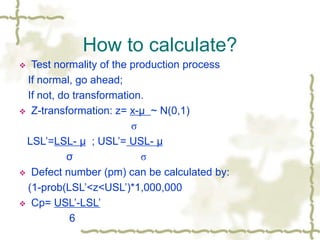
How to calculate?
 Test normality of the production process
If normal, go ahead;
If not, do transformation.
 Z-transformation: z= x-μ ~ N(0,1)
σ
LSL’=LSL- μ ; USL’= USL- μ
σ σ
 Defect number (pm) can be calculated by:
(1-prob(LSL’<z<USL’)*1,000,000
 Cp= USL’-LSL’
6
An example without shift
Specification Process
Nominal Tolerance μ σ %Good Cp Cpk
10.00 +.04 10.00 0.015 99.24 0.89 0.89
Calculation:
USL: 10.00+.04=10.04 ~2.67 ~ 0.38% above
LSL: 10.00 -.04=9.96 ~ -2.67 ~0.38% below
Cp=0.08/(6*0.015)=0.89
Prob=1-2*0.38%=99.24%
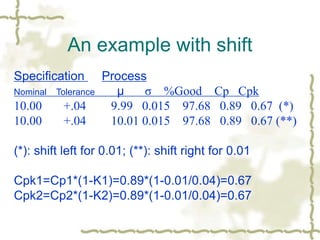
An example with shift
Specification Process
Nominal Tolerance μ σ %Good Cp Cpk
10.00 +.04 9.99 0.015 97.68 0.89 0.67 (*)
10.00 +.04 10.01 0.015 97.68 0.89 0.67 (**)
(*): shift left for 0.01; (**): shift right for 0.01
Cpk1=Cp1*(1-K1)=0.89*(1-0.01/0.04)=0.67
Cpk2=Cp2*(1-K2)=0.89*(1-0.01/0.04)=0.67
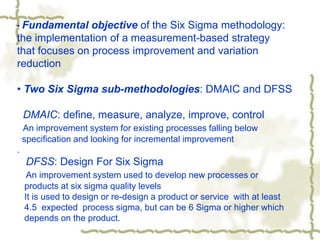
• Fundamental objective of the Six Sigma methodology:
the implementation of a measurement-based strategy
that focuses on process improvement and variation
reduction
• Two Six Sigma sub-methodologies: DMAIC and DFSS
DMAIC: define, measure, analyze, improve, control
An improvement system for existing processes falling below
specification and looking for incremental improvement
.
DFSS: Design For Six Sigma
An improvement system used to develop new processes or
products at six sigma quality levels
It is used to design or re-design a product or service with at least
4.5 expected process sigma, but can be 6 Sigma or higher which
depends on the product.
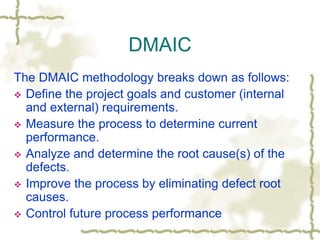
DMAIC
The DMAIC methodology breaks down as follows:
 Define the project goals and customer (internal
and external) requirements.
 Measure the process to determine current
performance.
 Analyze and determine the root cause(s) of the
defects.
 Improve the process by eliminating defect root
causes.
 Control future process performance
From GE's DMAIC Approach
Define
 Define who customers are, what their requirements are for products and services, and
what their expectations are
 Define project boundaries: the stop and start of the process
Measure :.
 Develop a data collection plan for the process
 Collect data from many sources to determine types of defects and metrics
 Compare to customer survey results to determine shortfall
Analyze:
 Identify gaps between current performance and goal performance
 Prioritize opportunities to improve
 Identify sources of variation
Improve:
 Create innovate solutions using technology and discipline
 Develop and deploy implementation plan
Control:
 Prevent reverting back to the "old way"
 Require the development, documentation and implementation of an ongoing monitoring
plan
 Institutionalize the improvements through the modification of systems and structures
(staffing, training, incentives)
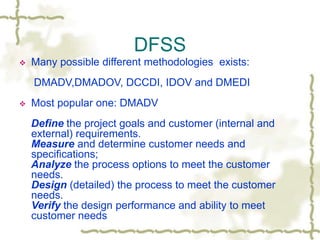
DFSS
 Many possible different methodologies exists:
DMADV,DMADOV, DCCDI, IDOV and DMEDI
 Most popular one: DMADV
Define the project goals and customer (internal and
external) requirements.
Measure and determine customer needs and
specifications;
Analyze the process options to meet the customer
needs.
Design (detailed) the process to meet the customer
needs.
Verify the design performance and ability to meet
customer needs
What is the benefit of using it?
 Motorola reduced manufacturing costs by $1.4
billion from 1987-1994 and totally, it saved
Motorola $15 billion over the last 11 years.
 GE produces annual benefits of over $2.5 billion
across the organization from Six Sigma and saved
$12 billion over five years.
 Honeywell (AlliedSignal) recorded more than $800
million in savings
 …... …… ……
Thank you!

Six sigma11

  • 1.
    An Introduction ofSix-Sigma Qian Tong Qiuzi June 25, 2004
  • 2.
    What is Six-Sigma? Developed by Motorola in 1987  A measure of quality that strives for near perfection.  A high criteria: only 3.4 defects per million opportunities for each product or service transaction
  • 3.
    Key Concepts  Cp:Process Capability Index = product specifications = customer Total Process Variation supplier  USL(+): upper specification limit  LSL(-) : lower specification limit  Under Normality assumption of the Process: Total Process Variation is set to be 6σ  Cp=USL-LSL 6σ
  • 4.
    To achieve Six-Sigma Cp=2.0  USL-LSL=12σ  Defect parts number: 3.4 pm
  • 5.
  • 6.
    •If a processhave plus and minus six sigma of the distribution between the upper and lower limits, a defect rate will be.0000002% or .002 defects per million parts produced. •Much better than oft-quoted 3.4 defects per million opportunities. •Simple assumption: the process mean is centered on the target value. •Practical Assumption: based on analysis, that the process mean would deviate from target by 1.5 sigma.
  • 8.
    Cpk  Shift relatedindex  Cpk=Cp*(1-K), where K= process shift = |nominal-proc.avg| tolerance (USL-LSL)/2  Cp is a special case for Cpk, when k=0
  • 9.
    Defects Rate (ppm)Table Cp +SL 0 shift +1σshift +1.5σshift ---------------------------------------------------------------------- 1.0 +3σ 2700.0 22782.0 66803.0 99.73% 97.72% 93.32% 1.33 +4σ 64.0 1350.0 6210.0 99.9936% 99.87% 99.38% 1.67 +5σ 0.6 32 233 99.99994% 99.997% 99.977% 2.0 +6σ 0.002 0.3 3.4 99.9999998% 99.9997% 99.99966%
  • 10.
    Cpk and processaverage shift No shift +1σshift +1.5σshift --------------- ------------- ---------------- Cp +SL PPM Cpk PPM Cpk PPM Cpk ------------------------------------------------------------------- 1.33 +4σ 64 1.33 1350 1.0 6210 0.83 1.67 +5σ 0.6 1.67 32 1.33 230 1.17 1.83 +5.5σ 0.02 1.83 3.4 1.5 32 1.33 2.0 +6σ 0.002 2.0 0.3 1.67 3.4 1.5
  • 11.
    How to calculate? Test normality of the production process If normal, go ahead; If not, do transformation.  Z-transformation: z= x-μ ~ N(0,1) σ LSL’=LSL- μ ; USL’= USL- μ σ σ  Defect number (pm) can be calculated by: (1-prob(LSL’<z<USL’)*1,000,000  Cp= USL’-LSL’ 6
  • 12.
    An example withoutshift Specification Process Nominal Tolerance μ σ %Good Cp Cpk 10.00 +.04 10.00 0.015 99.24 0.89 0.89 Calculation: USL: 10.00+.04=10.04 ~2.67 ~ 0.38% above LSL: 10.00 -.04=9.96 ~ -2.67 ~0.38% below Cp=0.08/(6*0.015)=0.89 Prob=1-2*0.38%=99.24%
  • 13.
    An example withshift Specification Process Nominal Tolerance μ σ %Good Cp Cpk 10.00 +.04 9.99 0.015 97.68 0.89 0.67 (*) 10.00 +.04 10.01 0.015 97.68 0.89 0.67 (**) (*): shift left for 0.01; (**): shift right for 0.01 Cpk1=Cp1*(1-K1)=0.89*(1-0.01/0.04)=0.67 Cpk2=Cp2*(1-K2)=0.89*(1-0.01/0.04)=0.67
  • 14.
    • Fundamental objectiveof the Six Sigma methodology: the implementation of a measurement-based strategy that focuses on process improvement and variation reduction • Two Six Sigma sub-methodologies: DMAIC and DFSS DMAIC: define, measure, analyze, improve, control An improvement system for existing processes falling below specification and looking for incremental improvement . DFSS: Design For Six Sigma An improvement system used to develop new processes or products at six sigma quality levels It is used to design or re-design a product or service with at least 4.5 expected process sigma, but can be 6 Sigma or higher which depends on the product.
  • 15.
    DMAIC The DMAIC methodologybreaks down as follows:  Define the project goals and customer (internal and external) requirements.  Measure the process to determine current performance.  Analyze and determine the root cause(s) of the defects.  Improve the process by eliminating defect root causes.  Control future process performance
  • 16.
    From GE's DMAICApproach Define  Define who customers are, what their requirements are for products and services, and what their expectations are  Define project boundaries: the stop and start of the process Measure :.  Develop a data collection plan for the process  Collect data from many sources to determine types of defects and metrics  Compare to customer survey results to determine shortfall Analyze:  Identify gaps between current performance and goal performance  Prioritize opportunities to improve  Identify sources of variation Improve:  Create innovate solutions using technology and discipline  Develop and deploy implementation plan Control:  Prevent reverting back to the "old way"  Require the development, documentation and implementation of an ongoing monitoring plan  Institutionalize the improvements through the modification of systems and structures (staffing, training, incentives)
  • 17.
    DFSS  Many possibledifferent methodologies exists: DMADV,DMADOV, DCCDI, IDOV and DMEDI  Most popular one: DMADV Define the project goals and customer (internal and external) requirements. Measure and determine customer needs and specifications; Analyze the process options to meet the customer needs. Design (detailed) the process to meet the customer needs. Verify the design performance and ability to meet customer needs
  • 18.
    What is thebenefit of using it?  Motorola reduced manufacturing costs by $1.4 billion from 1987-1994 and totally, it saved Motorola $15 billion over the last 11 years.  GE produces annual benefits of over $2.5 billion across the organization from Six Sigma and saved $12 billion over five years.  Honeywell (AlliedSignal) recorded more than $800 million in savings  …... …… ……
  • 19.