SIX SIGMA
 Six Sigma is a disciplined, statistical-based,
data-driven approach and continuous
improvement methodology for eliminating
defects in a product, process or service.
BASICS OF SIX SIGMA
 Six Sigma Basics.
 Six Sigma is the most effective methodology
available for improving the performance of
any organization by minimizing the defects in
its products or services.
 The Six Sigma methodology was first
endorsed at Motorola in the mid-1980s.
CONCEPT
 Six Sigma is a disciplined, data-
driven approach and methodology for
eliminating defects (driving
toward six standard deviations between the
mean and the nearest specification limit) in
any process – from manufacturing to
transactional and from product to service.
HOW IT WORKS
 Six Sigma is a disciplined and quantitative
approach involving setting up a system and
process for the improvement of defined
metrics in manufacturing, service, or financial
processes. ...
 Improvement projects follow a disciplined
process defined by a system of four macro
phases: measure, analyze, improve, control
(MAIC).
KEY PRINCIPLES
 Focus on the customer.
 Identify and understand how the work gets
done (the value stream).
 Manage, improve and smooth the process
flow.
 Remove Non-Value-Added steps and waste.
 Manage by fact and reduce variation.
LEVELS OF SIX SIGMA
 “Six Sigma” management has several levels
of certification
 They are:
 Champion
 Yellow/Green Belt
 Brown/Black Belt and
 Master Black Belt.
 A Six Sigma Champion is the most basic form of
Six Sigma certification.
PHASES OF SIX SIGMA
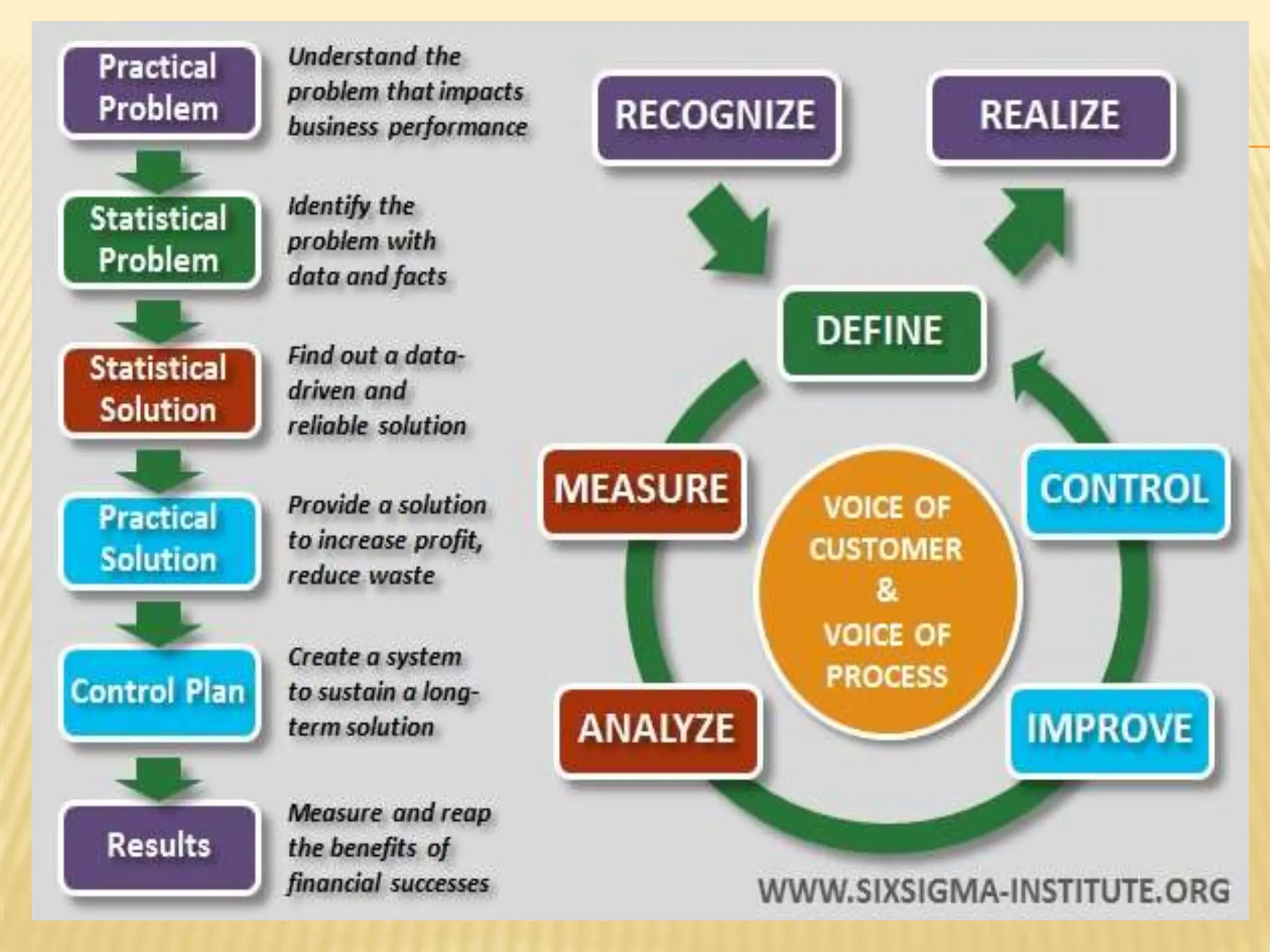
 It consists of five Phases:
 Define
 Measure
 Analyze
 Improve and
 Control.
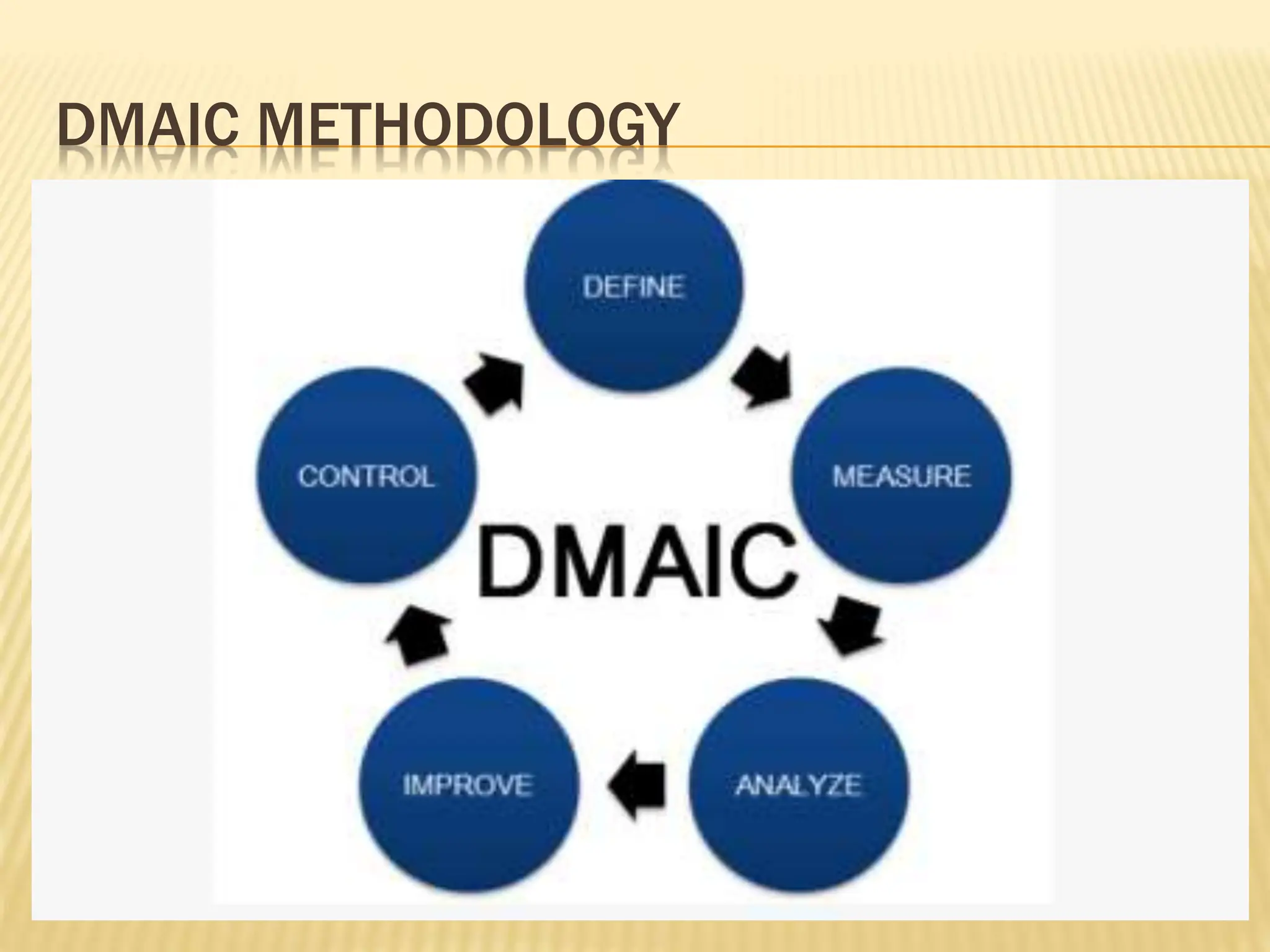
 Its called DMAIC
SIX SIGMA METHODOLOGY
 Six Sigma - Methodology.
 DMAIC − It refers to a data-driven quality
strategy for improving processes.
 This methodology is used to improve an
existing business process.
 DMADV − It refers to a data-driven quality
strategy for designing products & processes.
DMAIC METHODOLOGY
 Define - address the identification of specific
processes to be examined
 Measure - record data and use metrics to track
effectiveness and evaluate efficiencies
 Analyze - utilize critical thinking skills to review data
and clarify goals
 Improve - create changes in business processes
geared toward improvement and better alignment
with corporate goals
 Control - build a system of checks and adjustments
for ongoing improvement in production processes
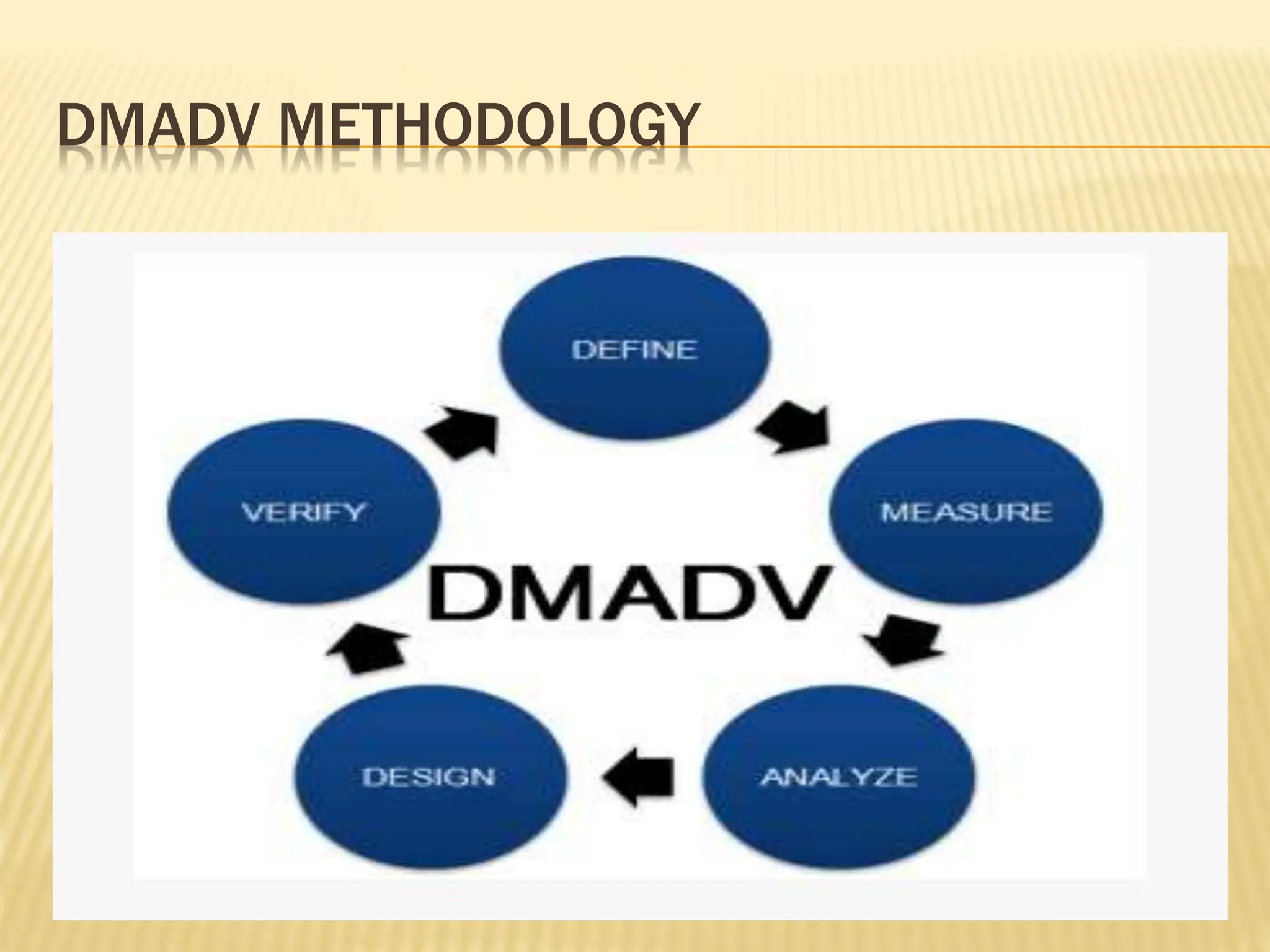
DMADV METHODOLOGY
 Define - address customer needs in relation to a product or
service
 Measure - involve the use of electronic data collection to
measure customer needs, response to product, or review of
services
 Analyze - utilize metrics to evaluate areas where product or
service can be better aligned to customer goals and needs
 Design - overlap the improvement of business processes that
streamline corporate goals to best meet client and customer
needs
 Verify - build a system of tests and models to check that
customer specifications are being met through on-going
improvements
INTRODUCTION
 According to James Harrington, “Six Sigma” is
simply a TQM process that uses process
capability analysis as a way of measuring
progress
 Sigma, is the Greek symbol for the statistical
measurement of dispersion called Standard
Deviation
 It is the best measurement of process variability
because , the smaller the deviation value, the
less variability in the process
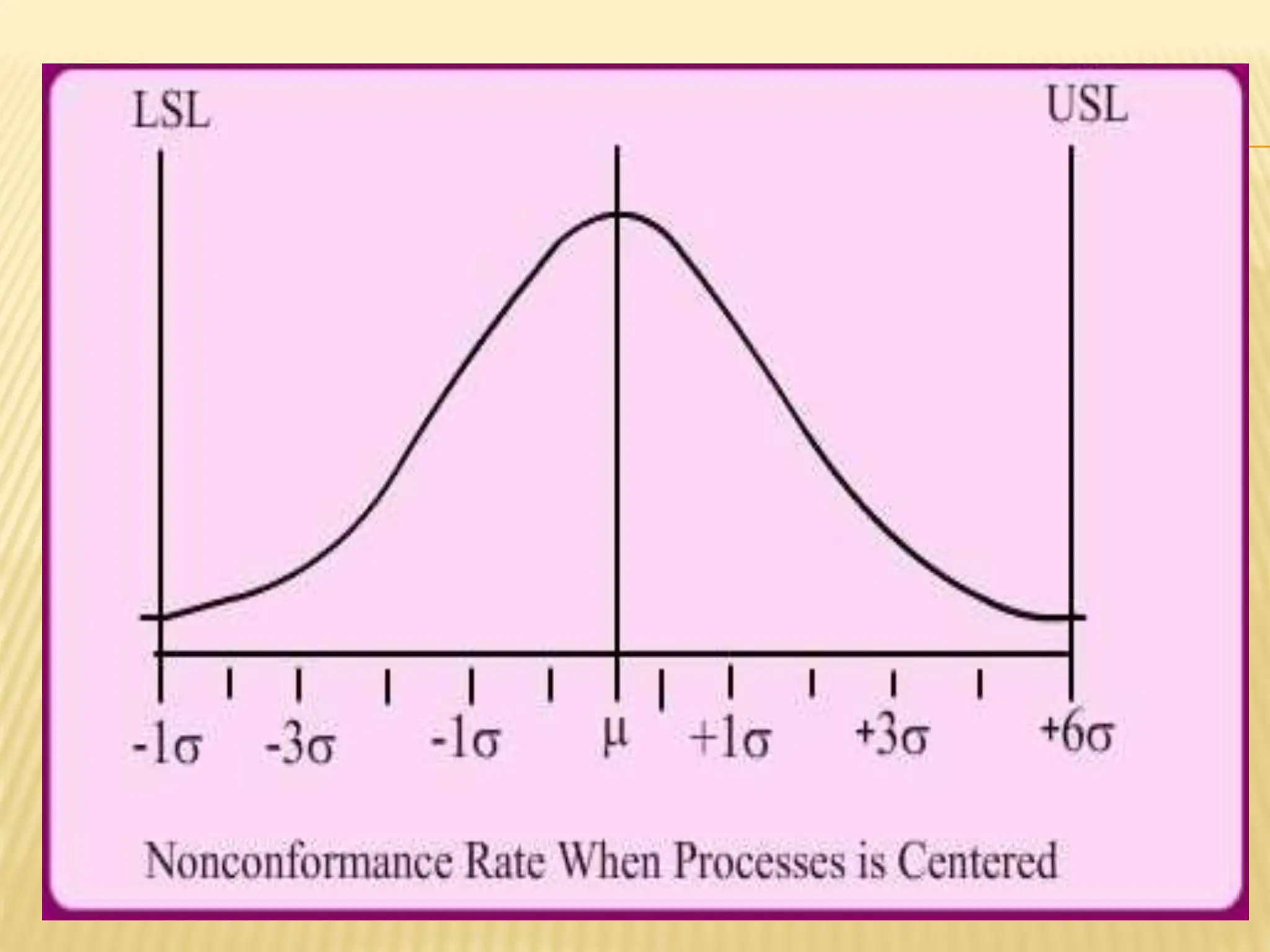
 The following figure shows a process that is
normally distributed and centered with the
upper and lower specifications limit (USL and
LSL) established at ± 6σ
 For the above, 99.9999998% of the product or
service will be between specifications and the
nonconformance rate will be 0.002 parts per
million or 2 per billion
 The above represents a process capability
index(Cp) of 2.0
 A Cp of 1.33 has been a defacto standard
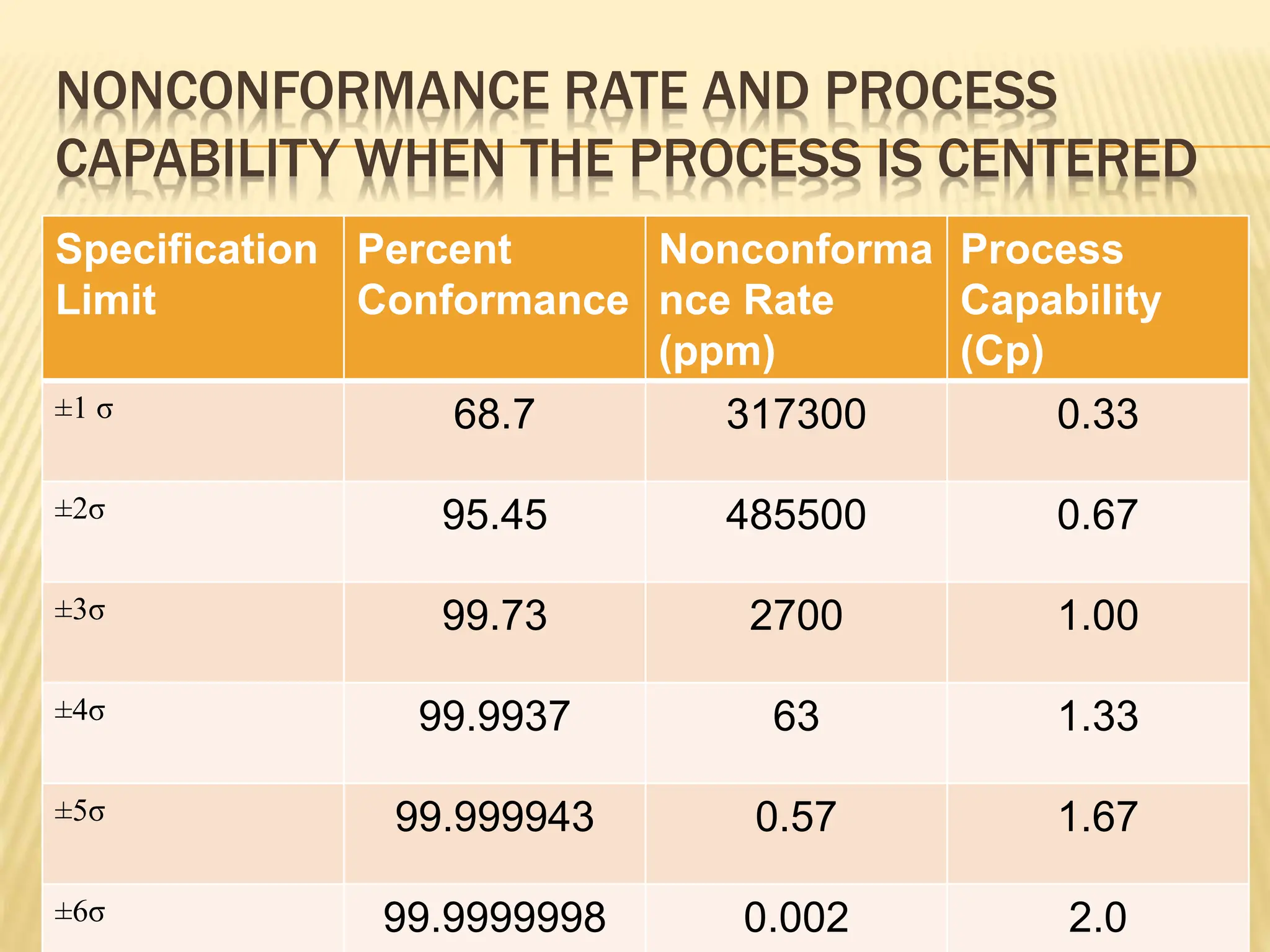
NONCONFORMANCE RATE AND PROCESS
CAPABILITY WHEN THE PROCESS IS CENTERED
Specification
Limit
Percent
Conformance
Nonconforma
nce Rate
(ppm)
Process
Capability
(Cp)
±1 σ 68.7 317300 0.33
±2σ 95.45 485500 0.67
±3σ 99.73 2700 1.00
±4σ 99.9937 63 1.33
±5σ 99.999943 0.57 1.67
±6σ 99.9999998 0.002 2.0
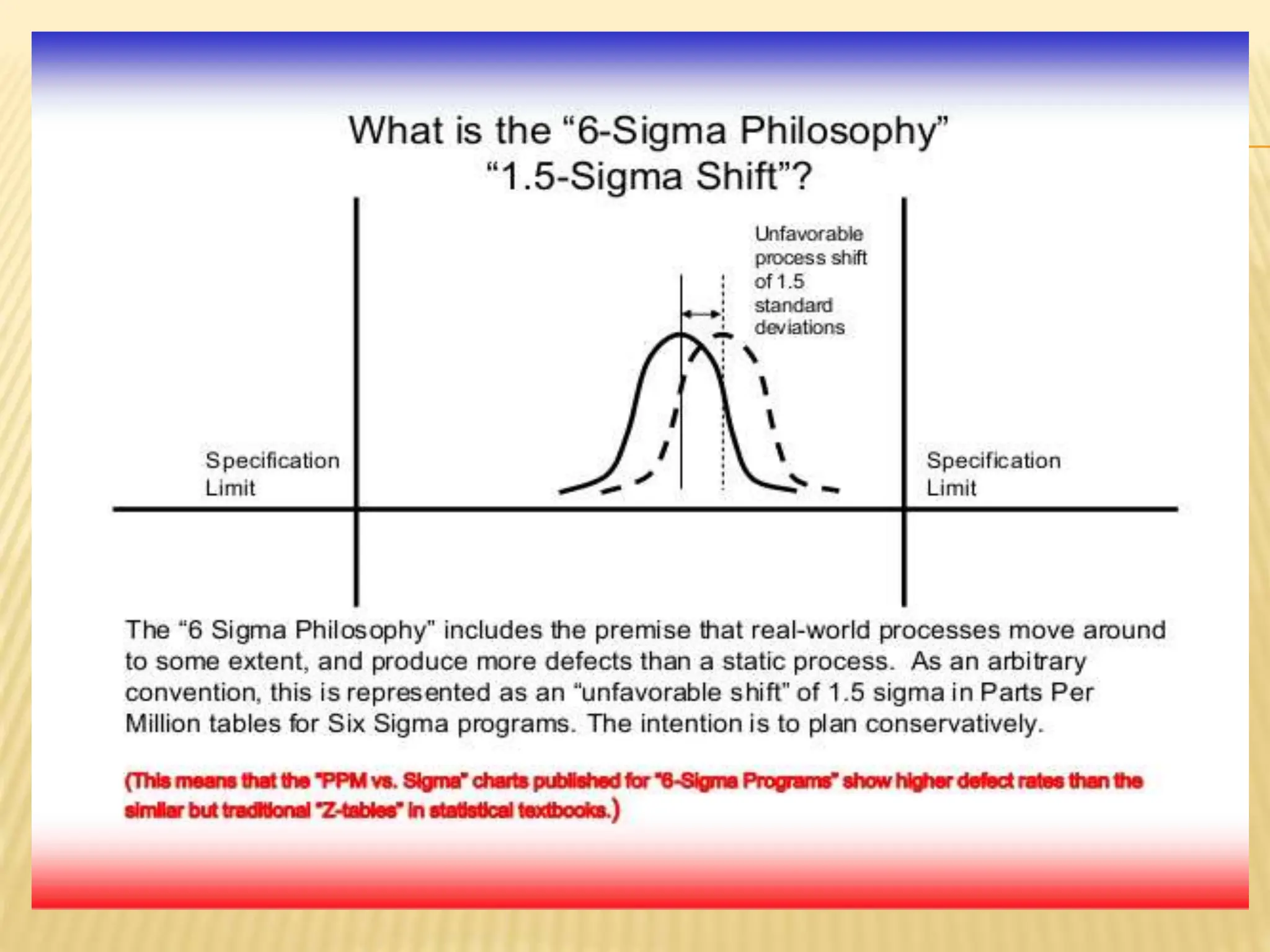
 According to the Six Sigma philosophy,
processes rarely stay centered
 The center tends to shift above and below
the target, μ
 The following fig shows a process that is
normally distributed, but has shifted within a
range of 1.5σ above and 1.5σ below the target
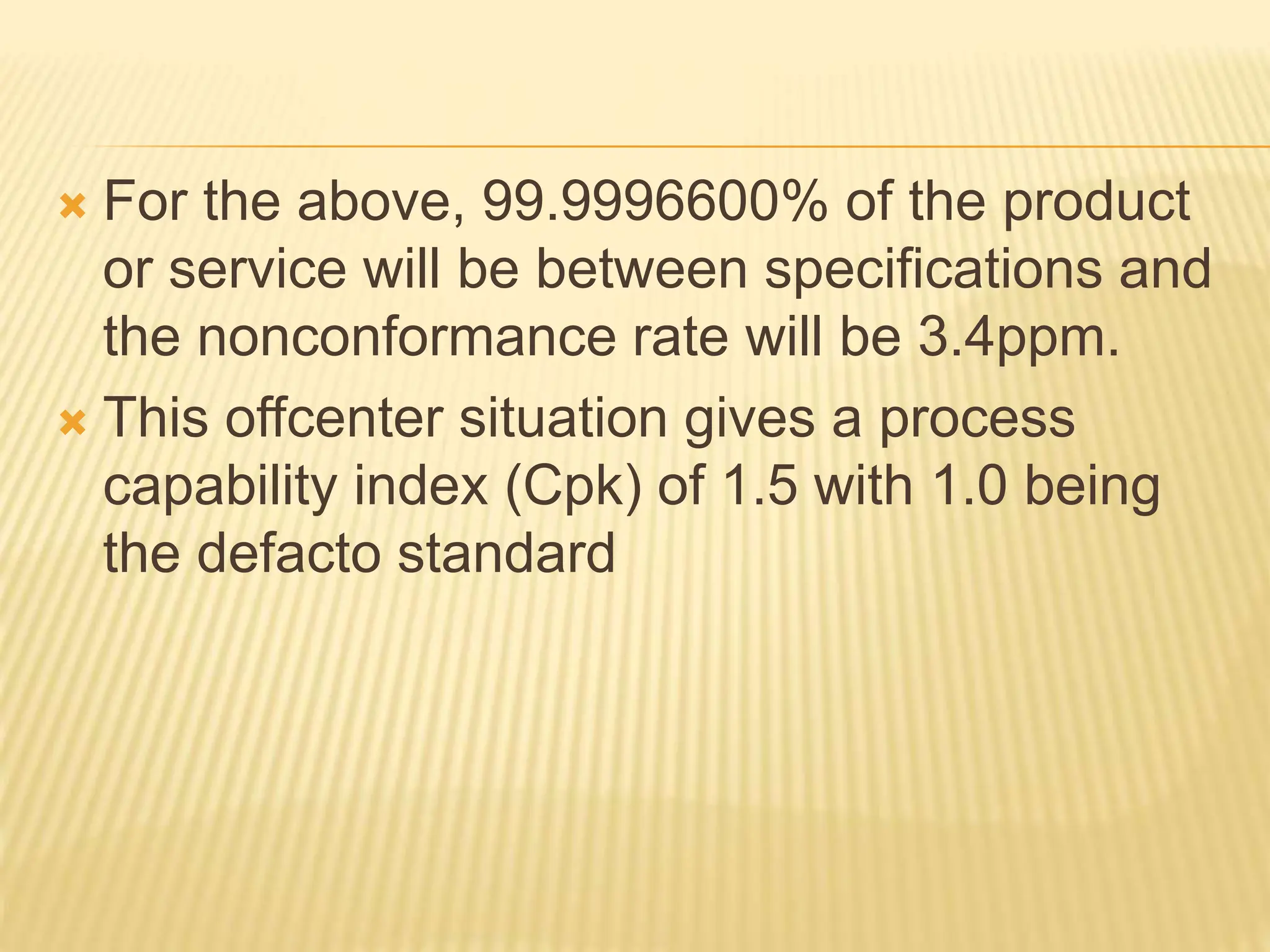
 For the above, 99.9996600% of the product
or service will be between specifications and
the nonconformance rate will be 3.4ppm.
 This offcenter situation gives a process
capability index (Cpk) of 1.5 with 1.0 being
the defacto standard
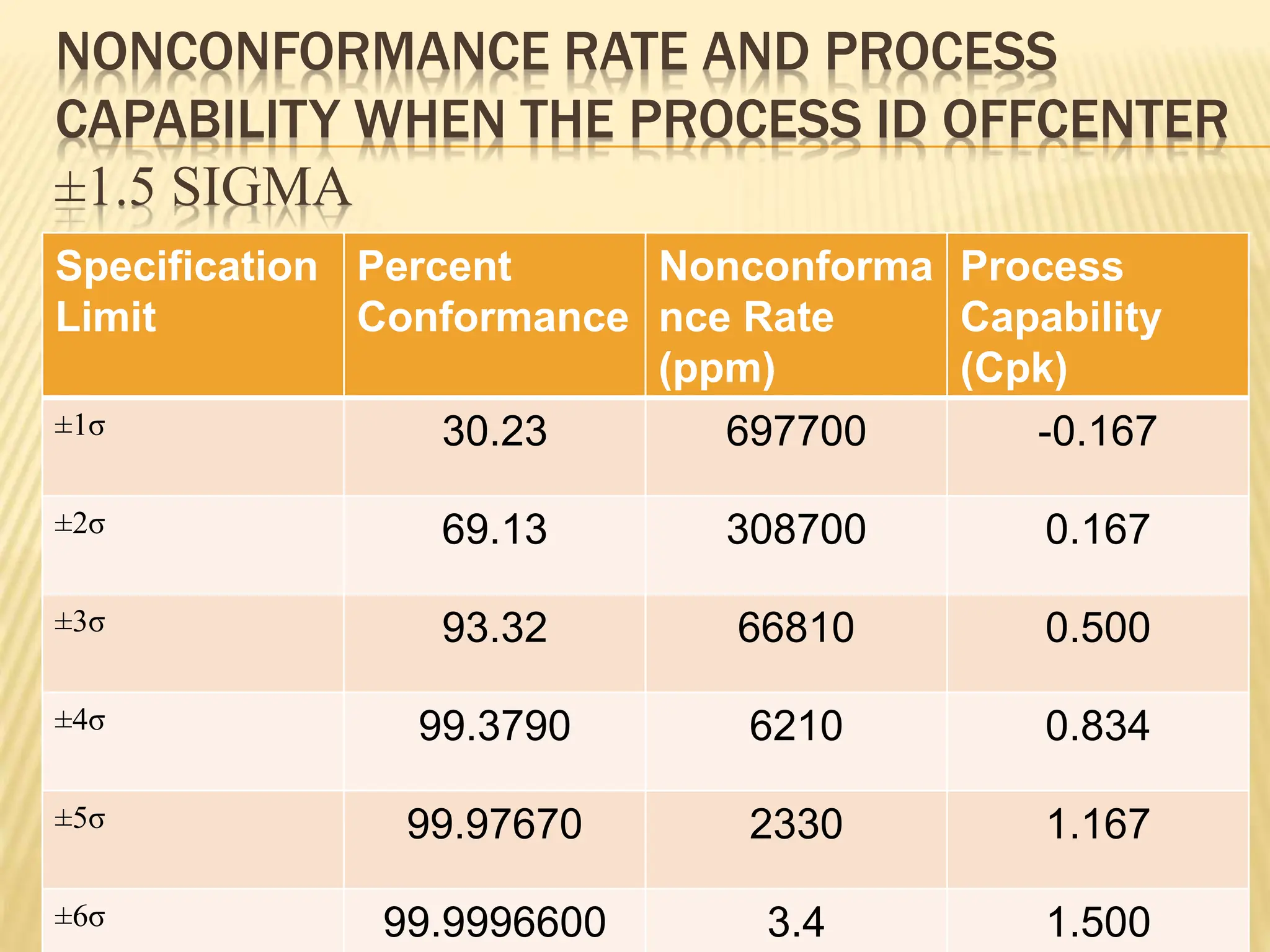
NONCONFORMANCE RATE AND PROCESS
CAPABILITY WHEN THE PROCESS ID OFFCENTER
±1.5 SIGMA
Specification
Limit
Percent
Conformance
Nonconforma
nce Rate
(ppm)
Process
Capability
(Cpk)
±1σ 30.23 697700 -0.167
±2σ 69.13 308700 0.167
±3σ 93.32 66810 0.500
±4σ 99.3790 6210 0.834
±5σ 99.97670 2330 1.167
±6σ 99.9996600 3.4 1.500
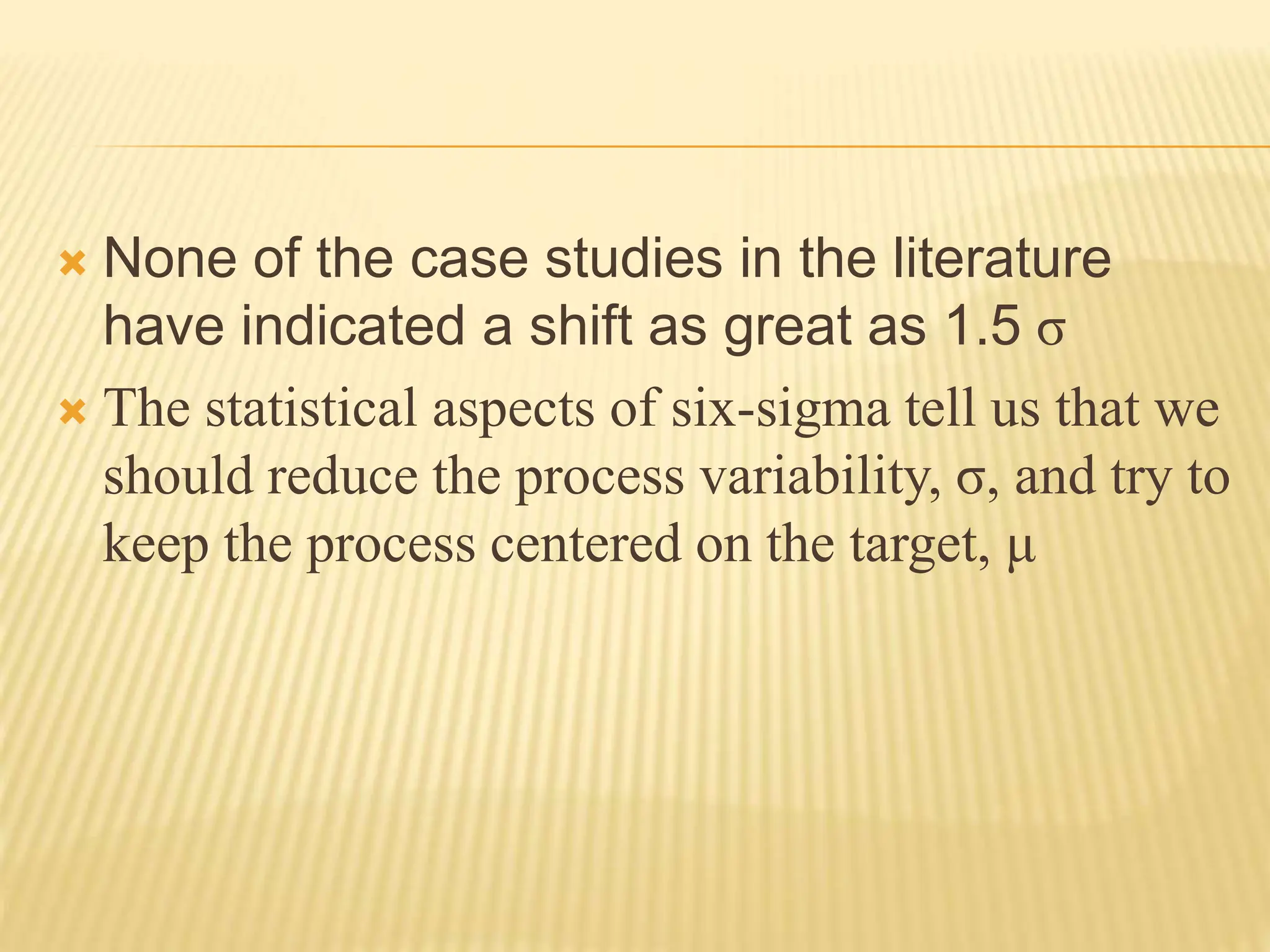
 None of the case studies in the literature
have indicated a shift as great as 1.5 σ
 The statistical aspects of six-sigma tell us that we
should reduce the process variability, σ, and try to
keep the process centered on the target, μ
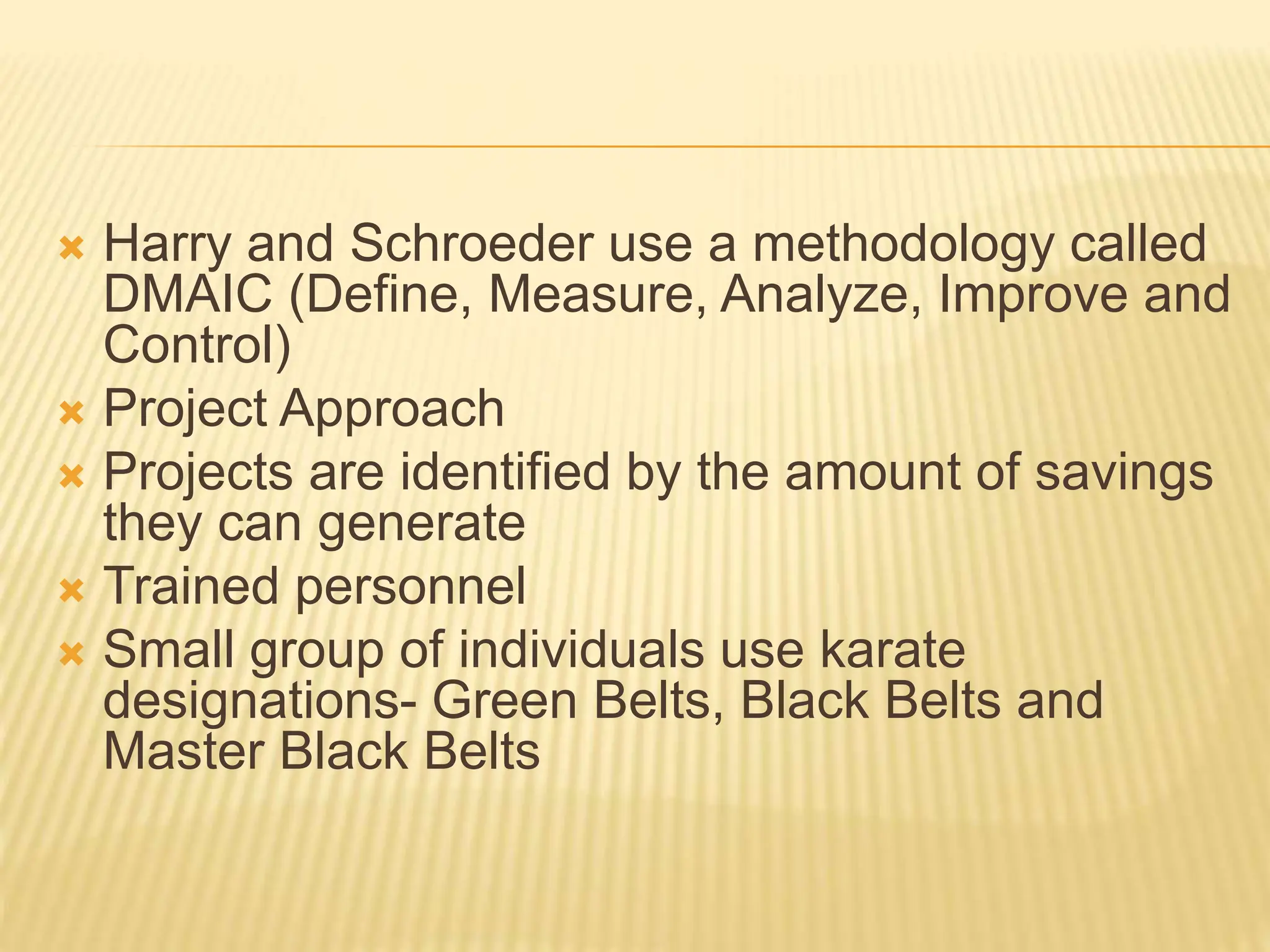
 Harry and Schroeder use a methodology called
DMAIC (Define, Measure, Analyze, Improve and
Control)
 Project Approach
 Projects are identified by the amount of savings
they can generate
 Trained personnel
 Small group of individuals use karate
designations- Green Belts, Black Belts and
Master Black Belts
 Green Belts- Project Leaders- 5 Days of
class room training
 Black Belts- 160 hrs of classroom instruction
and one-on-one coaching from Master Black
Belts- Help Green Belts
 Master Black Belts provide the technical
leadership and much of the training for the
program
PROBLEMS
 Difficult and not very cost effective for small
businesses to develop the required
infrastructure
 High cost of training
 GE- 2 Billion
 In large companies , infrastructure will
become a bureaucracy
INDIAN COMPANIES PRACTICING SIX SIGMA
 WIPRO
 TATA STEEL
 TELCO
 ASIAN PAINTS
 L&T SWITCHGEAR
 RELIANCE PATALGANGA
 TVS SUZUKI
 TATA HONEYWELL
 TATA CONSULTANCY

Six Sigma quality tool in management studies

  • 1.
  • 2.
     Six Sigmais a disciplined, statistical-based, data-driven approach and continuous improvement methodology for eliminating defects in a product, process or service.
  • 3.
    BASICS OF SIXSIGMA  Six Sigma Basics.  Six Sigma is the most effective methodology available for improving the performance of any organization by minimizing the defects in its products or services.  The Six Sigma methodology was first endorsed at Motorola in the mid-1980s.
  • 4.
    CONCEPT  Six Sigmais a disciplined, data- driven approach and methodology for eliminating defects (driving toward six standard deviations between the mean and the nearest specification limit) in any process – from manufacturing to transactional and from product to service.
  • 5.
    HOW IT WORKS Six Sigma is a disciplined and quantitative approach involving setting up a system and process for the improvement of defined metrics in manufacturing, service, or financial processes. ...  Improvement projects follow a disciplined process defined by a system of four macro phases: measure, analyze, improve, control (MAIC).
  • 6.
    KEY PRINCIPLES  Focuson the customer.  Identify and understand how the work gets done (the value stream).  Manage, improve and smooth the process flow.  Remove Non-Value-Added steps and waste.  Manage by fact and reduce variation.
  • 7.
    LEVELS OF SIXSIGMA  “Six Sigma” management has several levels of certification  They are:  Champion  Yellow/Green Belt  Brown/Black Belt and  Master Black Belt.  A Six Sigma Champion is the most basic form of Six Sigma certification.
  • 8.
    PHASES OF SIXSIGMA  It consists of five Phases:  Define  Measure  Analyze  Improve and  Control.  Its called DMAIC
  • 10.
    SIX SIGMA METHODOLOGY Six Sigma - Methodology.  DMAIC − It refers to a data-driven quality strategy for improving processes.  This methodology is used to improve an existing business process.  DMADV − It refers to a data-driven quality strategy for designing products & processes.
  • 11.
  • 12.
     Define -address the identification of specific processes to be examined  Measure - record data and use metrics to track effectiveness and evaluate efficiencies  Analyze - utilize critical thinking skills to review data and clarify goals  Improve - create changes in business processes geared toward improvement and better alignment with corporate goals  Control - build a system of checks and adjustments for ongoing improvement in production processes
  • 13.
  • 14.
     Define -address customer needs in relation to a product or service  Measure - involve the use of electronic data collection to measure customer needs, response to product, or review of services  Analyze - utilize metrics to evaluate areas where product or service can be better aligned to customer goals and needs  Design - overlap the improvement of business processes that streamline corporate goals to best meet client and customer needs  Verify - build a system of tests and models to check that customer specifications are being met through on-going improvements
  • 15.
    INTRODUCTION  According toJames Harrington, “Six Sigma” is simply a TQM process that uses process capability analysis as a way of measuring progress  Sigma, is the Greek symbol for the statistical measurement of dispersion called Standard Deviation  It is the best measurement of process variability because , the smaller the deviation value, the less variability in the process
  • 16.
     The followingfigure shows a process that is normally distributed and centered with the upper and lower specifications limit (USL and LSL) established at ± 6σ  For the above, 99.9999998% of the product or service will be between specifications and the nonconformance rate will be 0.002 parts per million or 2 per billion  The above represents a process capability index(Cp) of 2.0  A Cp of 1.33 has been a defacto standard
  • 18.
    NONCONFORMANCE RATE ANDPROCESS CAPABILITY WHEN THE PROCESS IS CENTERED Specification Limit Percent Conformance Nonconforma nce Rate (ppm) Process Capability (Cp) ±1 σ 68.7 317300 0.33 ±2σ 95.45 485500 0.67 ±3σ 99.73 2700 1.00 ±4σ 99.9937 63 1.33 ±5σ 99.999943 0.57 1.67 ±6σ 99.9999998 0.002 2.0
  • 19.
     According tothe Six Sigma philosophy, processes rarely stay centered  The center tends to shift above and below the target, μ  The following fig shows a process that is normally distributed, but has shifted within a range of 1.5σ above and 1.5σ below the target
  • 21.
     For theabove, 99.9996600% of the product or service will be between specifications and the nonconformance rate will be 3.4ppm.  This offcenter situation gives a process capability index (Cpk) of 1.5 with 1.0 being the defacto standard
  • 22.
    NONCONFORMANCE RATE ANDPROCESS CAPABILITY WHEN THE PROCESS ID OFFCENTER ±1.5 SIGMA Specification Limit Percent Conformance Nonconforma nce Rate (ppm) Process Capability (Cpk) ±1σ 30.23 697700 -0.167 ±2σ 69.13 308700 0.167 ±3σ 93.32 66810 0.500 ±4σ 99.3790 6210 0.834 ±5σ 99.97670 2330 1.167 ±6σ 99.9996600 3.4 1.500
  • 23.
     None ofthe case studies in the literature have indicated a shift as great as 1.5 σ  The statistical aspects of six-sigma tell us that we should reduce the process variability, σ, and try to keep the process centered on the target, μ
  • 24.
     Harry andSchroeder use a methodology called DMAIC (Define, Measure, Analyze, Improve and Control)  Project Approach  Projects are identified by the amount of savings they can generate  Trained personnel  Small group of individuals use karate designations- Green Belts, Black Belts and Master Black Belts
  • 25.
     Green Belts-Project Leaders- 5 Days of class room training  Black Belts- 160 hrs of classroom instruction and one-on-one coaching from Master Black Belts- Help Green Belts  Master Black Belts provide the technical leadership and much of the training for the program
  • 26.
    PROBLEMS  Difficult andnot very cost effective for small businesses to develop the required infrastructure  High cost of training  GE- 2 Billion  In large companies , infrastructure will become a bureaucracy
  • 27.
    INDIAN COMPANIES PRACTICINGSIX SIGMA  WIPRO  TATA STEEL  TELCO  ASIAN PAINTS  L&T SWITCHGEAR  RELIANCE PATALGANGA  TVS SUZUKI  TATA HONEYWELL  TATA CONSULTANCY