
Quality Engineering
Six Sigma
Quak Foo Lee
Quality Engineering – Six Sigma
2
Quotes about Quality
3
4
What is Six Sigma?
5
• Vision
• Philosophy
• Company Strategy
• Method
• Culture
• Tool
The Cost of Poor Quality (COPQ)
6
Engineering change orders
Tangible Quality Costs
Lost Opportunities
Hidden Factory
Lost sales
Late delivery
Long cycle times
Expediting costs
Excess inventory
Lost Customer Loyalty
More Setups
Scrap
Rework
Inspection Warranty
Rejects
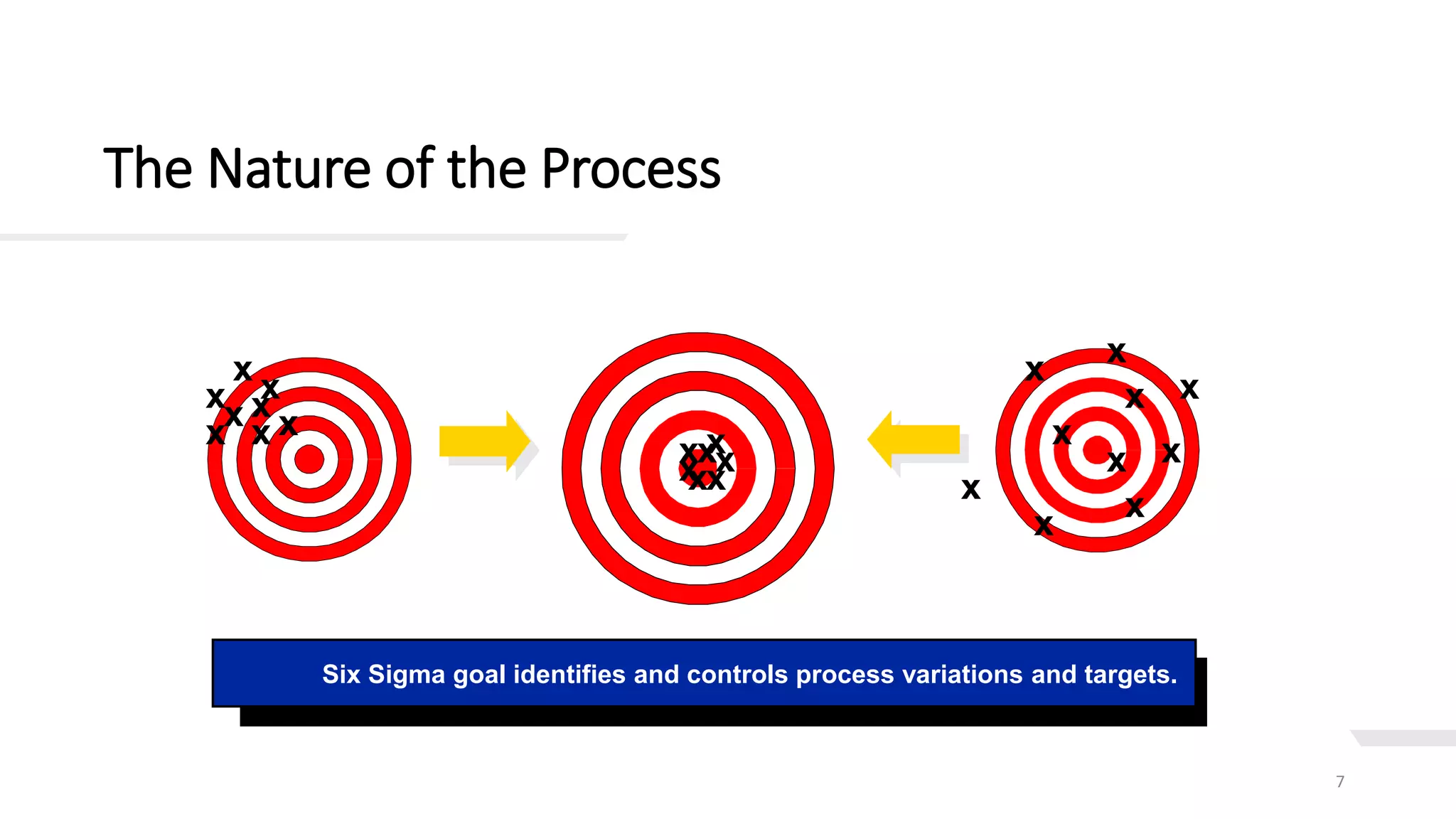
The Nature of the Process
7
On-target,less variation VariationOff-Target
Six Sigma methodology identifies processes that are off-target,
Six Sigma goal identifies and controls process variations and targets.
x
xx
x
x
x
x
x
xx
x x
xx x
x
x
x
x
x
x
x
x
x
x
What is Six Sigma?
8
• Integrates
• Customer focus
• Breakthrough improvement
• Continuous improvement
• People involvement
• Defines goals and performance metrics that yield clear and measurable
business results.
• Applies statistical tools to achieve breakthrough financial gains.
Structure and Roles
9
Executive
Management
Champion
Master Black Belt
Black Belt Black Belt
Green Belt Green Belt Green Belt
What is Sigma?
10
• s (sigma) - A Greek letter
• In statistics - the “standard” deviation from the average/mean
• Assumption of Gaussian/Normal distribution
• Six Sigma Methodology uses s to define the capability of a process
• As the standard deviation of your process decreases, the “sigma level” of
your process increases.
Normal/Gaussian Distribution
11
34.13%
13.06%
2.14%
0.13%
34.13%
13.06%
2.14%
0.13%
68.26%
99.73%
95.46%
68.26% of the population is within +/- 1?? of the?
-3s -2s -1s m 1s 2s 3s
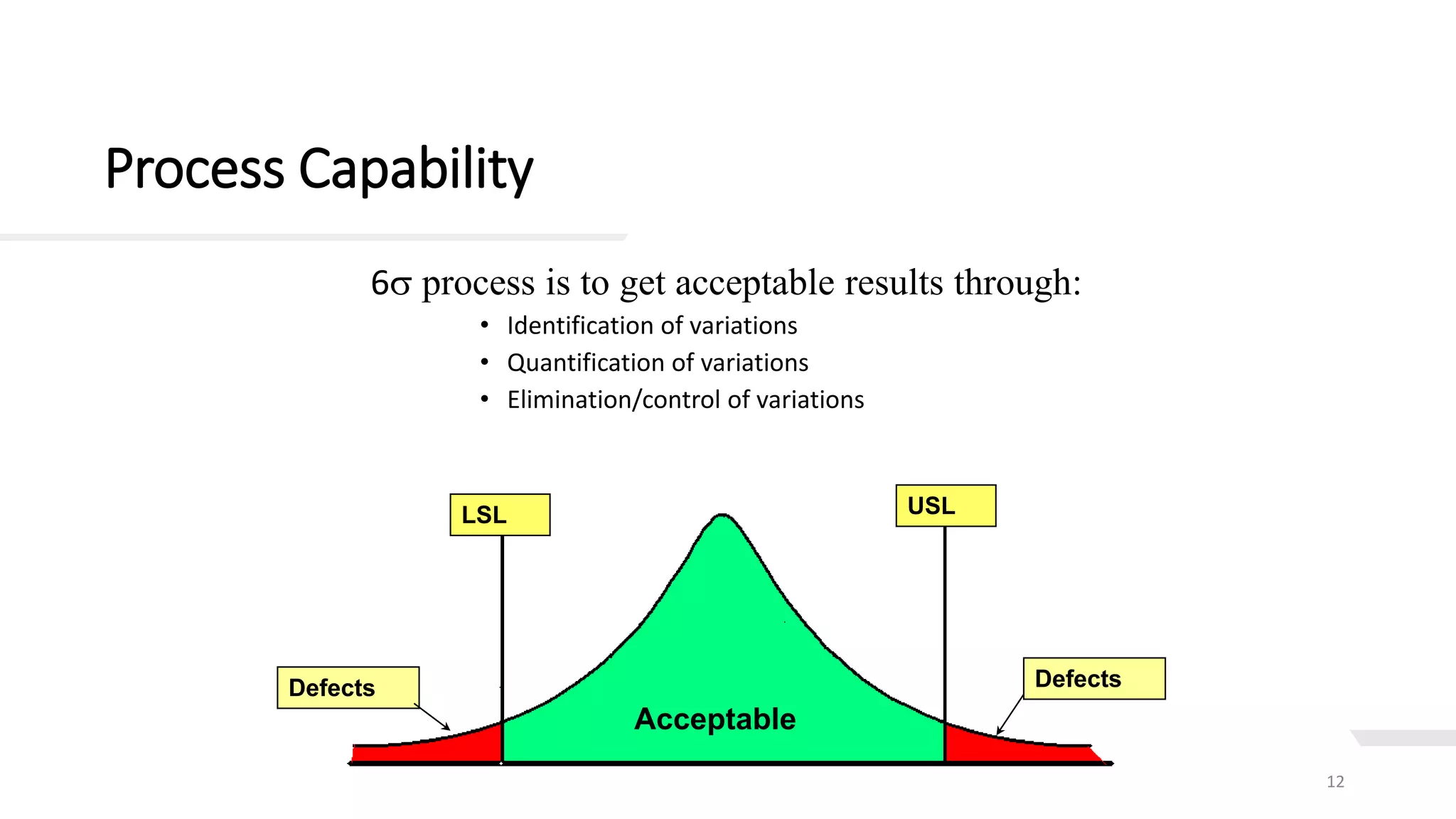
Process Capability
12
6s process is to get acceptable results through:
• Identification of variations
• Quantification of variations
• Elimination/control of variations
Acceptable
USLLSL
DefectsDefects
Six Sigma - Goal
13
2 308,537
3 66,807
4 6,210
5 233
6 3.4
Defects per
Million Opp.
1
s
691,462
Six Sigma – Practice Meaning
14
99.99966% Good (6 Sigma)99% Good (3.8 Sigma)
16,000 lost articles of mail per hour
22,000 checks deducted from the
wrong bank account each hour
500 incorrect surgical operations per
week
2 unsafe plane landings per day at
O’Hare International Airport in Chicago
50 newborn babies dropped at birth
by doctors each day
5.4 articles lost per hour
7.5 checks deducted from the
wrong bank account each hour
1.7 incorrect operations per week
1 unsafe plane landing every
four years
1 newborn baby dropped at
birth by doctors every 2 months
Overall Approach
15
Control
Improve
Analyze
Measure Practical Problem
Statistical Problem
Statistical Solution
Practical Solution
Define Define Problem
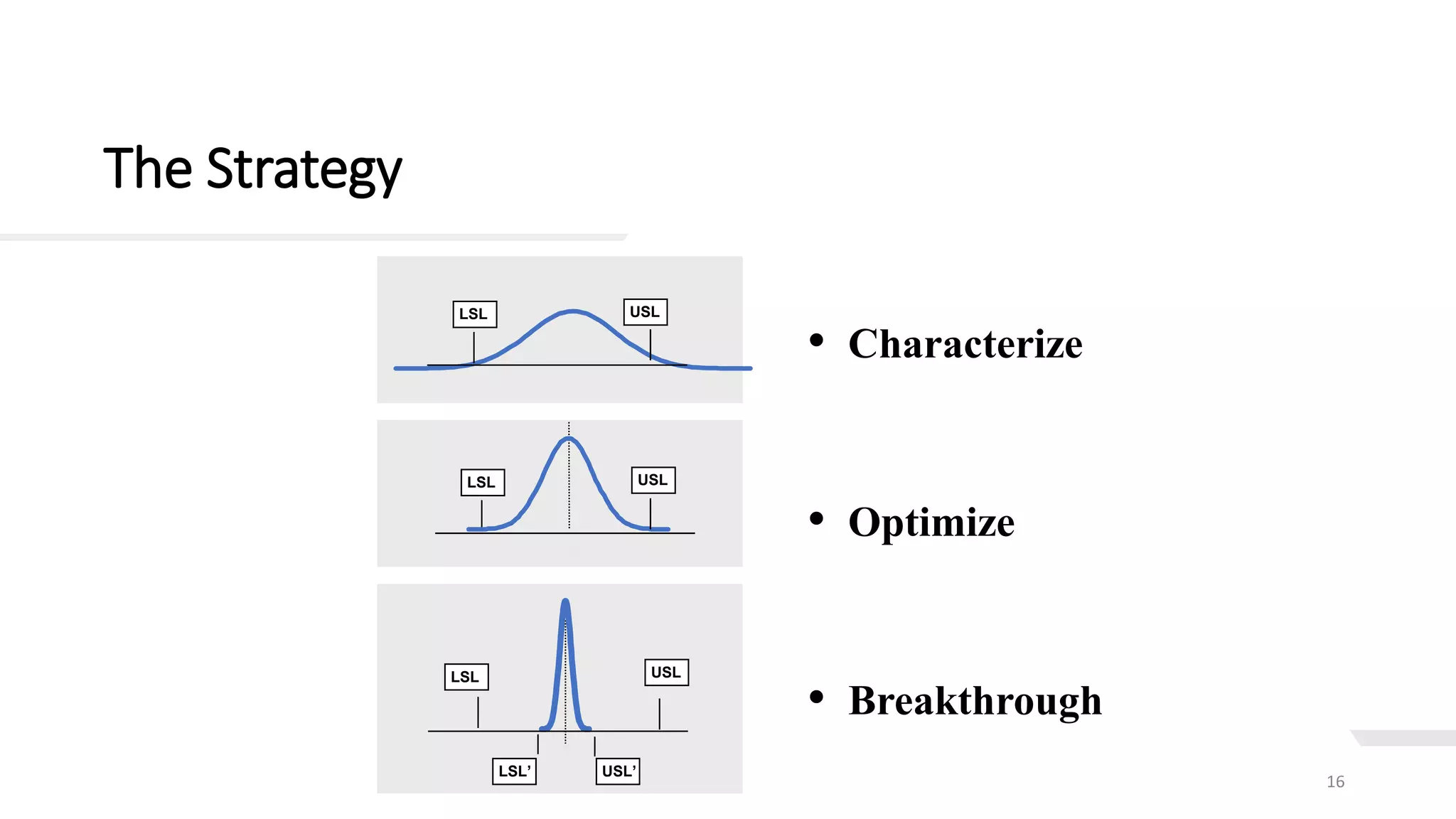
The Strategy
16
• Characterize
• Optimize
• Breakthrough
USL
T
LSL
USL
T
LSL
T
USLLSL
USL’LSL’
The 6 Sigma Breakthrough Method
17
Characterization
D
A
Optimization
I
C
M
Define
Measure
Analyze
Control
Improve
7 Screen Potential Causes
8 Verify Variable Relationships
5 Establish Product Capability
6 Identify Variation Sources
3 Identify key input/outputs variables
4 Identify process capability/
measurement system
9 Validate Measurement System
10 Implement Process Controls
1 Define project and scope
2 Establish process
Defining the Process
18
• Team members who understand the process
• Put together a flow of the process
• A common foundation for team activity
• Identification of outputs for measurement and capability studies
• Estimates of sigma levels at each step
DMAIC
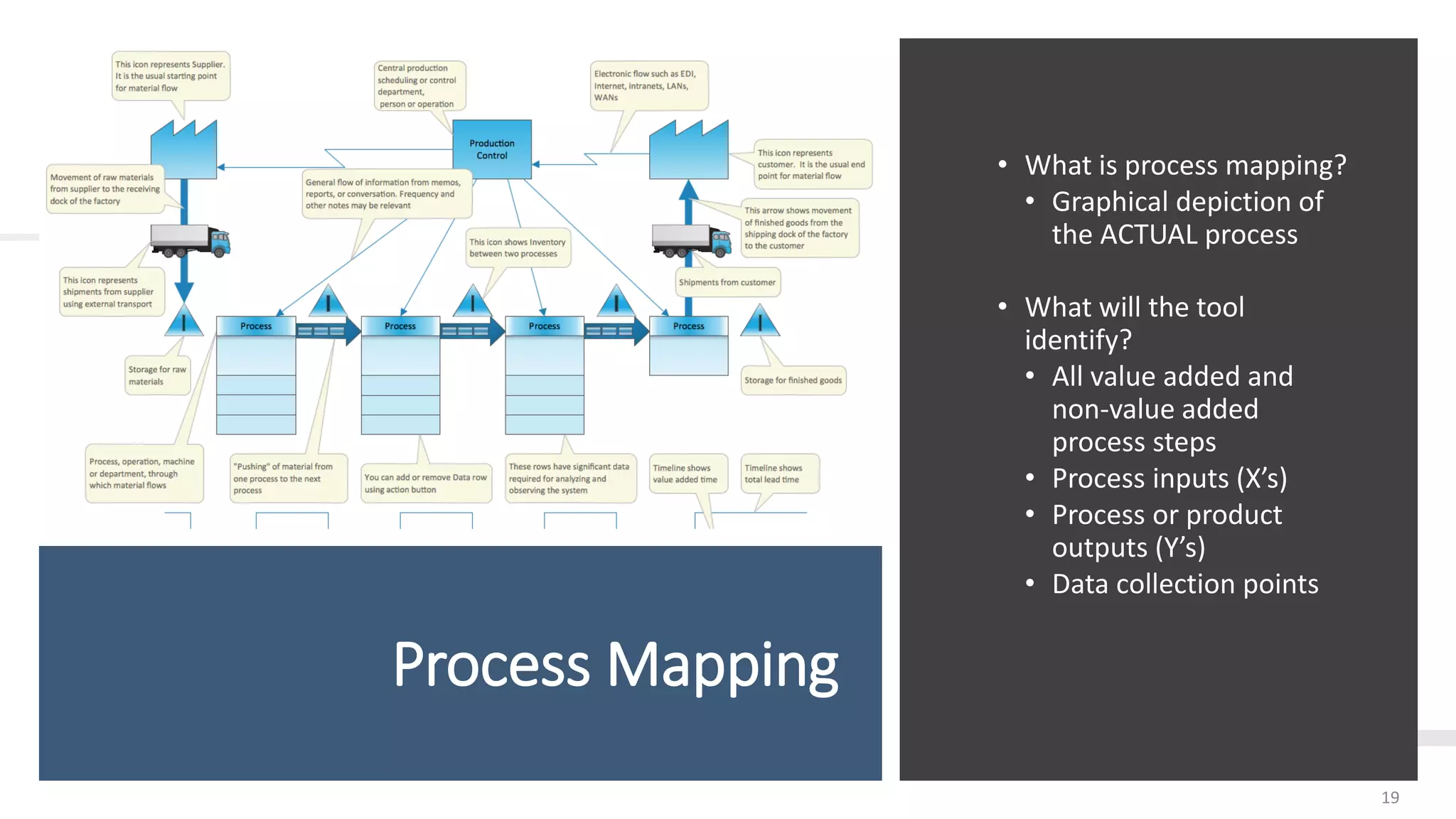
Process Mapping
• What is process mapping?
• Graphical depiction of
the ACTUAL process
• What will the tool
identify?
• All value added and
non-value added
process steps
• Process inputs (X’s)
• Process or product
outputs (Y’s)
• Data collection points
19
Versions of a Process
20
What You Think It Is...
What You Would Like
It To Be...
What It Actually Is...
Start
Start
Yes
No
Start
Preparing the Process Flowchart
21
• Team Effort
• Engineers
• Line Operators
• Line Supervisors
• Maintenance Technicians
• Inputs to Flowcharts
• Brainstorming
• Operator Manuals (SOP’s, AOP’s, etc.)
• Engineering Specifications
• Operator Experience
• 5M’s and an E (Fishbone)
• Machine (Equipment), Method (Procedures), Measurement, Materials, Manpower (People),
Environment
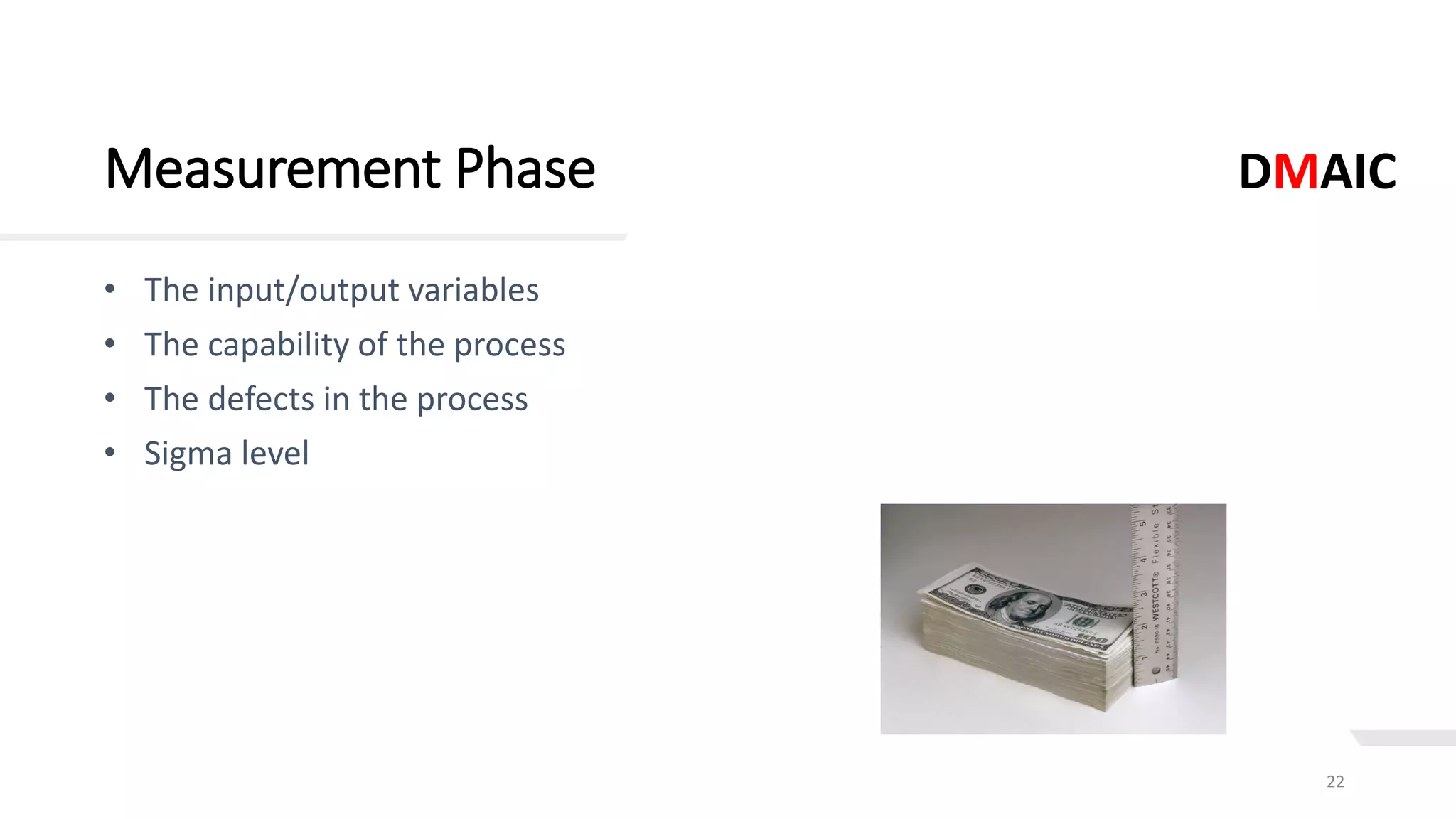
Measurement Phase
22
• The input/output variables
• The capability of the process
• The defects in the process
• Sigma level
DMAIC
Purpose of Measurement Phase
23
• Identify and define defects
• Identify key input variables (X’s) and key output variables (Y’s)
• Document the existing process
• Establish a data collection system for your X’s and Y’s if one does not exist
• Evaluate measurement system for each key output variable using C&E,
FMEA, etc.
The Importance of Defects
24
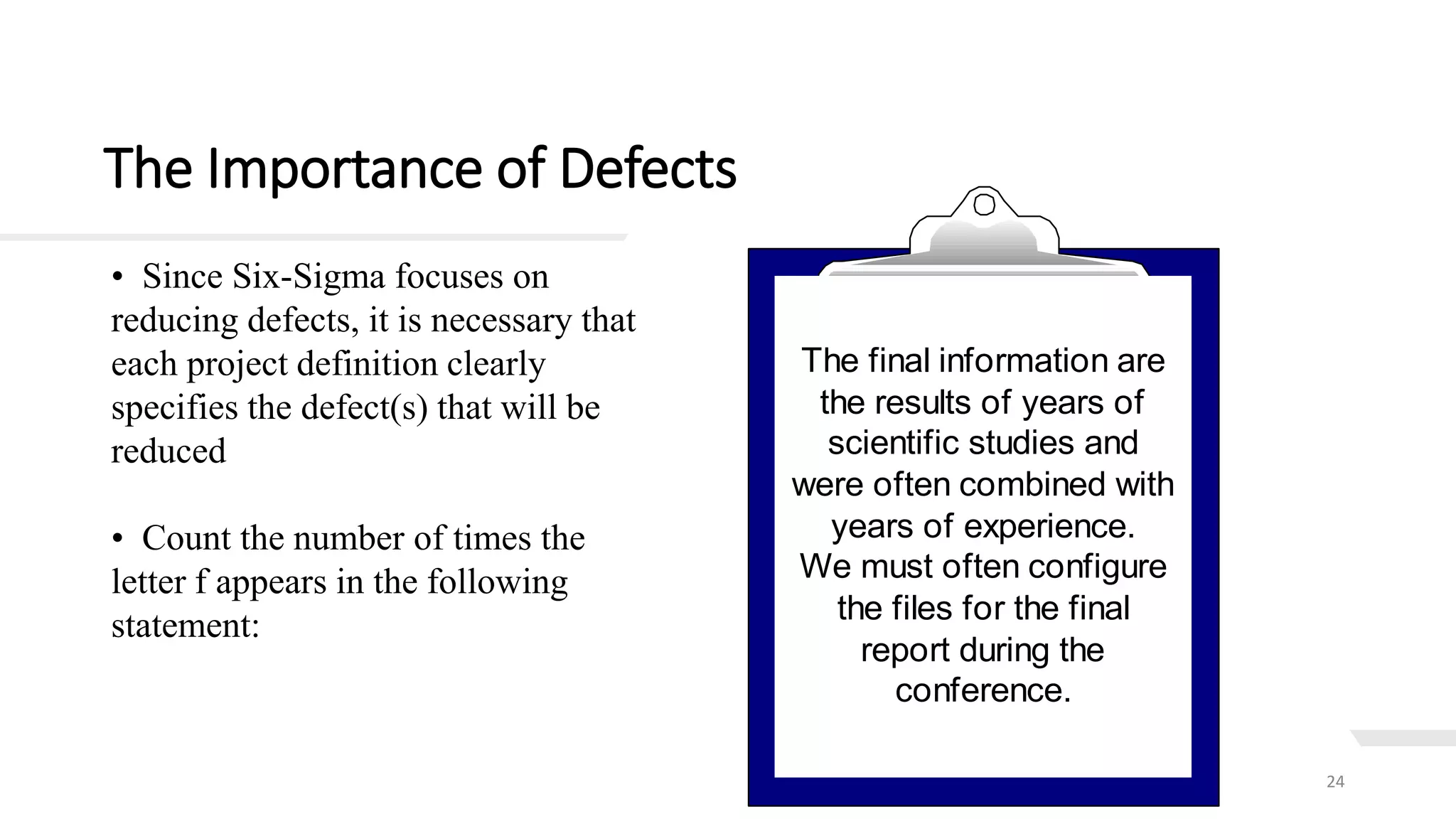
• Count the number of times the
letter f appears in the following
statement:
The final information are
the results of years of
scientific studies and
were often combined with
years of experience.
We must often configure
the files for the final
report during the
conference.
• Since Six-Sigma focuses on
reducing defects, it is necessary that
each project definition clearly
specifies the defect(s) that will be
reduced
A simple test
25
• What was your answer?
The final information are the results
of years of scientific studies and
were often combined with years of
experience. We must often
configure the files for the final
report during the conference.
What Causes Defects?
26
• Variation due to:
• Manufacturing processes
• Supplier (incoming) material variation
• Unreasonably tight specifications (beyond customer
needs)
• Unstable Parts and Materials
• Inadequate training
• Inadequate Design Margin
• Insufficient Process Capability
How Do We Improve Capability
27
• Understand that the Outputs (Y’s) are determined by Inputs (X’s).
• If we know enough about our X’s we can accurately predict Y without
having to measure it.
• If we don’t know much about our X’s, then we have to resort to inspection
and test.
• If can control the X’s, then we reduce the variability in Y, which decreases
defects, and possibly, eliminates/reduces inspection and test.
Y = F (x1, x2, x3,…xn)
Data Collection Plan
28
What to
measure
Type of
measurement
Type of
Data
Operational
Definition
Data
Collection
Form(s)
Sampling Baseline
Six Sigma
Data Collection Data
29
Y-Axis
X-Axis
• Type of Data
• Discrete
• Continuous
• Sampling
• Representative
• Random Sampling
Metrics: What to measure?
30
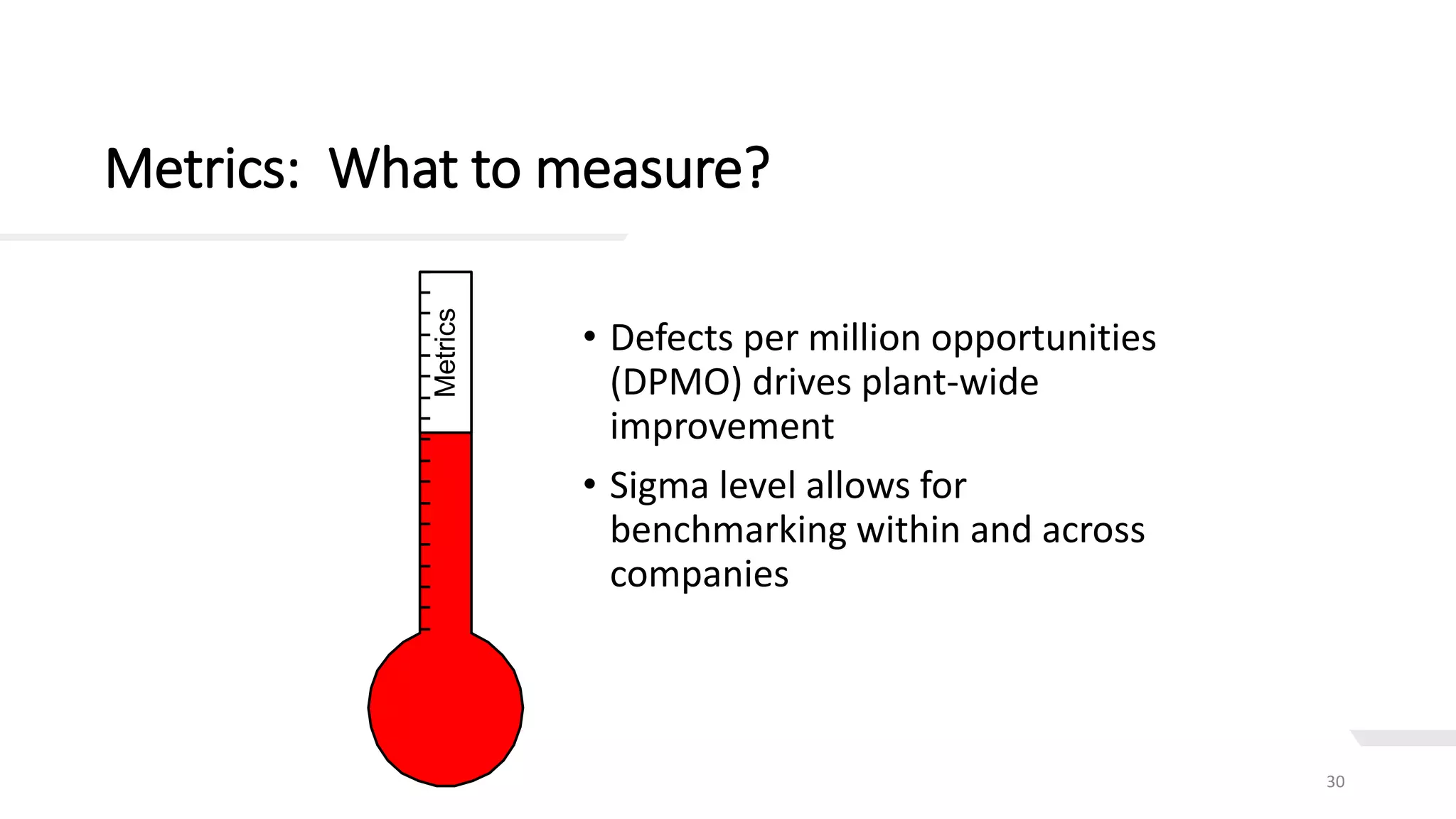
• Defects per million opportunities
(DPMO) drives plant-wide
improvement
• Sigma level allows for
benchmarking within and across
companies
Metrics
Calculating Sigma-Level
31
• Sigma level
• units: item produced or being serviced
• defect: event that does not meet the customer’s requirement
• opportunity: chance for a defect to occur
Total #
• Calculate Defects per Million Opportunities (DPMO):
DPMO =
defects x 1,000,000
(# of Opportunities for Error) x (# of units)
• Go to a Sigma Chart and Estimate the Sigma Level
Tracking Trends in Metrics
32
Our objective is to
track the trends in the
Metrics to establish,
based on fact, our
improvements.
These metrics can be
productivity, defects,
time, yield, etc.
Purpose of the Analysis Phase
33
• Establish baseline capability for key output variables (potential and
overall)
• Examine both the process and data for analysis
• Determine and validate the root causation of project problem
• To reduce the number of process input variables (x’s) to a manageable
number
• To determine the presence of and potential elimination of uncontrolled
variables
DMAIC
Three Sigma Process
34
Centered
LSL USL
1.5 Sigma Shift
LSL USL
Six Sigma Process
35
USLLSL
Centered
1.5 Sigma Shift
USLLSL
Analysis Tools
36
Analyze
Capabilities
Hypothesis
Testing
Multi-Vari ANOVA
Cause/Effect Root Cause
Histogram Pareto
Purpose of the Improvement Phase
37
• Key variables are identified and validated during this process .
• Look to eliminate, reduce or neutralize the effects of the input or root cause.
• Design experiments to manipulate the key input variables (X’s) to determine
their effect on the outputs (Y’s).
• Select the solution that impacts the root cause the most.
DMAIC
Design of Experiment (DOE)
38
• Objective: To reduce consistency variation in Y
• Output: Variation (Lower is Better)
• Full Factorial Inputs:
• RPM (Lo, Hi)
• Speed (Lo, Hi)
• Time (Lo, Hi)
Main Effects Plot
SpeedTimeRPM
16
14
12
10
8
Purpose of the Control Phase
39
• Develop and implement long-term control methods to sustain the gains
identified
• Document the control plan with specific roles identified
• Monitor long-term delivered capability and performance
• Verify benefits and cost savings
DMAIC
Control Tools
40
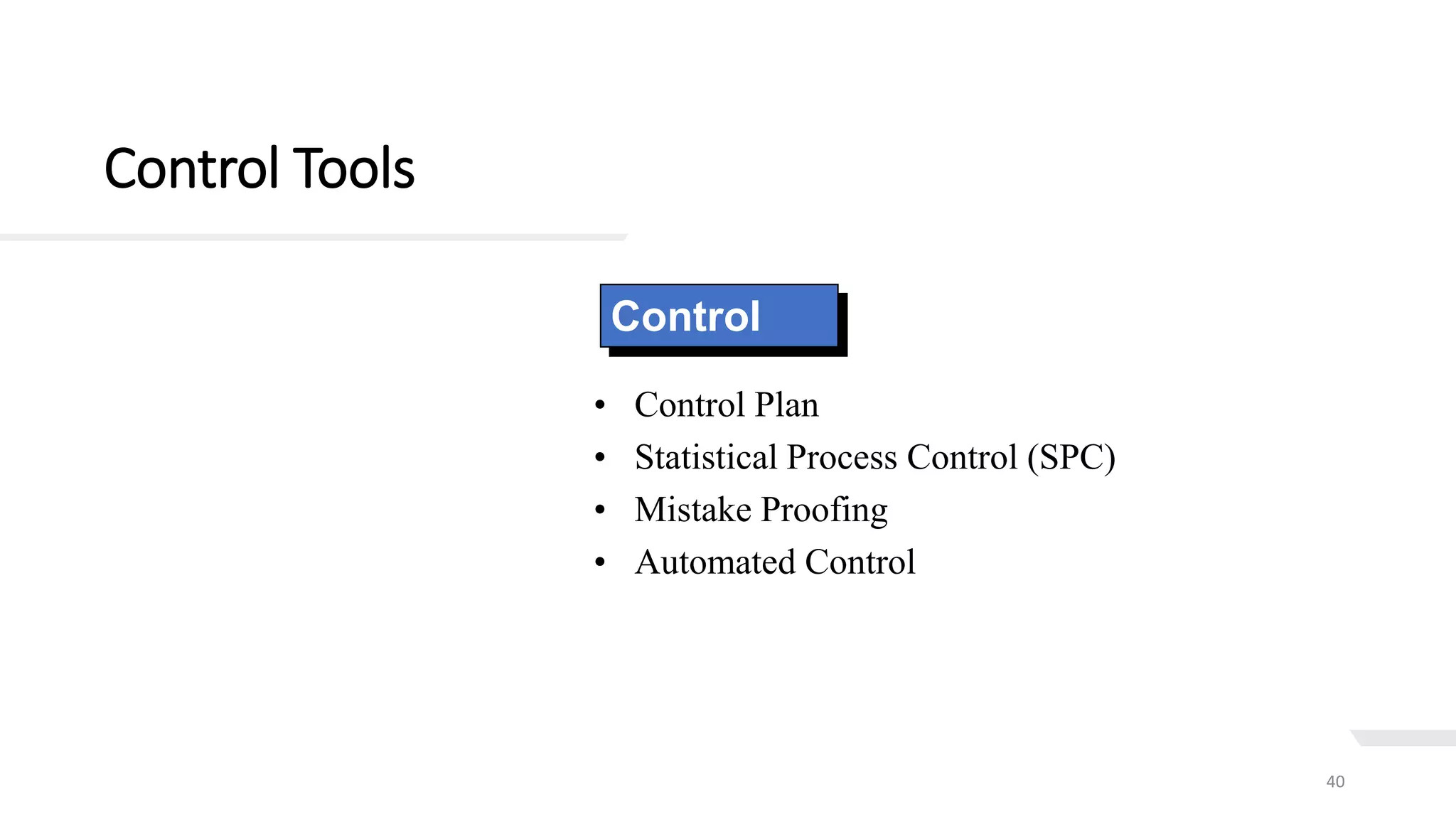
Control
• Control Plan
• Statistical Process Control (SPC)
• Mistake Proofing
• Automated Control
Who needs Six Sigma?
41
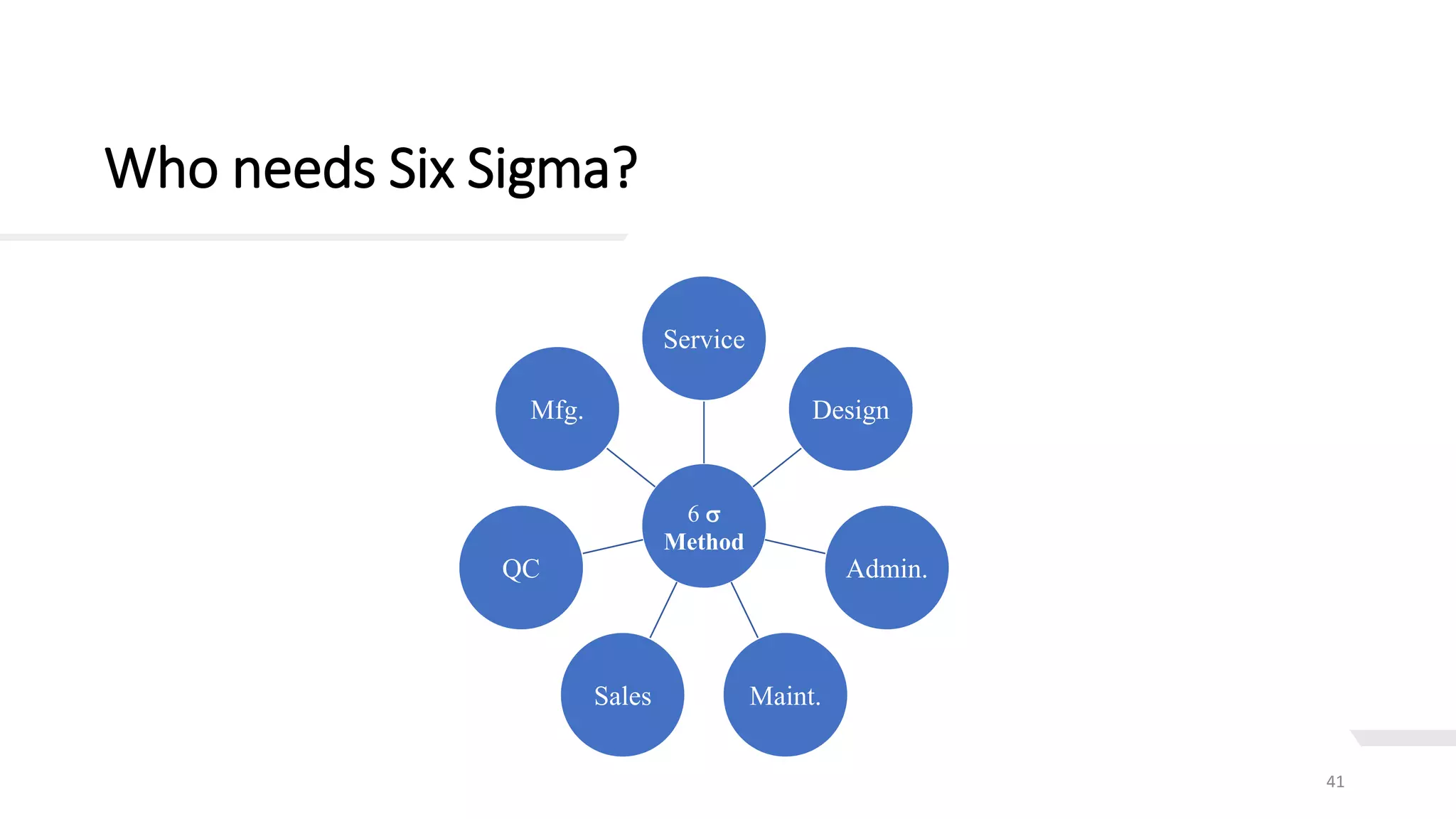
6 s
Method
Service
Design
Admin.
Maint.Sales
QC
Mfg.
Six Sigma Project Consideration
42
• Project is supportive of corporate objectives
• Project is focused on an ongoing process / recurring events that is
causing defects
• A 70% reduction in defects results
• Customer (internal or external) will see or feel the result
• Takes 4-6 months to complete
• Little or no capital required
Possible Six Sigma Projects
43
• Low yield rate
• High operating costs
• High customer
failure/complaints
• High scrap/rework
• High inventory/WIP
• High maintenance costs
• Supplier product quality
problems
• Low productivity
• Long cycle times
• Low machine utilization
• Inaccurate information
• Missing information
• Poor process control
• Frequent set up requirements
• Long set up time
• Unpredictable product
performance
Six Sigma Success
44
Education and training
World-class quality
Recognize and focus on customer needs
Establishing meaningful,
focused metrics
Visible top-down leadership and commitment
DMAIC - Define, Measure, Analyze, Improve & Control
Where to
Start?
45
Thank You
46

Quality engineering

  • 1.
  • 2.
  • 3.
  • 4.
  • 5.
    What is SixSigma? 5 • Vision • Philosophy • Company Strategy • Method • Culture • Tool
  • 6.
    The Cost ofPoor Quality (COPQ) 6 Engineering change orders Tangible Quality Costs Lost Opportunities Hidden Factory Lost sales Late delivery Long cycle times Expediting costs Excess inventory Lost Customer Loyalty More Setups Scrap Rework Inspection Warranty Rejects
  • 7.
    The Nature ofthe Process 7 On-target,less variation VariationOff-Target Six Sigma methodology identifies processes that are off-target, Six Sigma goal identifies and controls process variations and targets. x xx x x x x x xx x x xx x x x x x x x x x x x
  • 8.
    What is SixSigma? 8 • Integrates • Customer focus • Breakthrough improvement • Continuous improvement • People involvement • Defines goals and performance metrics that yield clear and measurable business results. • Applies statistical tools to achieve breakthrough financial gains.
  • 9.
    Structure and Roles 9 Executive Management Champion MasterBlack Belt Black Belt Black Belt Green Belt Green Belt Green Belt
  • 10.
    What is Sigma? 10 •s (sigma) - A Greek letter • In statistics - the “standard” deviation from the average/mean • Assumption of Gaussian/Normal distribution • Six Sigma Methodology uses s to define the capability of a process • As the standard deviation of your process decreases, the “sigma level” of your process increases.
  • 11.
  • 12.
    Process Capability 12 6s processis to get acceptable results through: • Identification of variations • Quantification of variations • Elimination/control of variations Acceptable USLLSL DefectsDefects
  • 13.
    Six Sigma -Goal 13 2 308,537 3 66,807 4 6,210 5 233 6 3.4 Defects per Million Opp. 1 s 691,462
  • 14.
    Six Sigma –Practice Meaning 14 99.99966% Good (6 Sigma)99% Good (3.8 Sigma) 16,000 lost articles of mail per hour 22,000 checks deducted from the wrong bank account each hour 500 incorrect surgical operations per week 2 unsafe plane landings per day at O’Hare International Airport in Chicago 50 newborn babies dropped at birth by doctors each day 5.4 articles lost per hour 7.5 checks deducted from the wrong bank account each hour 1.7 incorrect operations per week 1 unsafe plane landing every four years 1 newborn baby dropped at birth by doctors every 2 months
  • 15.
    Overall Approach 15 Control Improve Analyze Measure PracticalProblem Statistical Problem Statistical Solution Practical Solution Define Define Problem
  • 16.
    The Strategy 16 • Characterize •Optimize • Breakthrough USL T LSL USL T LSL T USLLSL USL’LSL’
  • 17.
    The 6 SigmaBreakthrough Method 17 Characterization D A Optimization I C M Define Measure Analyze Control Improve 7 Screen Potential Causes 8 Verify Variable Relationships 5 Establish Product Capability 6 Identify Variation Sources 3 Identify key input/outputs variables 4 Identify process capability/ measurement system 9 Validate Measurement System 10 Implement Process Controls 1 Define project and scope 2 Establish process
  • 18.
    Defining the Process 18 •Team members who understand the process • Put together a flow of the process • A common foundation for team activity • Identification of outputs for measurement and capability studies • Estimates of sigma levels at each step DMAIC
  • 19.
    Process Mapping • Whatis process mapping? • Graphical depiction of the ACTUAL process • What will the tool identify? • All value added and non-value added process steps • Process inputs (X’s) • Process or product outputs (Y’s) • Data collection points 19
  • 20.
    Versions of aProcess 20 What You Think It Is... What You Would Like It To Be... What It Actually Is... Start Start Yes No Start
  • 21.
    Preparing the ProcessFlowchart 21 • Team Effort • Engineers • Line Operators • Line Supervisors • Maintenance Technicians • Inputs to Flowcharts • Brainstorming • Operator Manuals (SOP’s, AOP’s, etc.) • Engineering Specifications • Operator Experience • 5M’s and an E (Fishbone) • Machine (Equipment), Method (Procedures), Measurement, Materials, Manpower (People), Environment
  • 22.
    Measurement Phase 22 • Theinput/output variables • The capability of the process • The defects in the process • Sigma level DMAIC
  • 23.
    Purpose of MeasurementPhase 23 • Identify and define defects • Identify key input variables (X’s) and key output variables (Y’s) • Document the existing process • Establish a data collection system for your X’s and Y’s if one does not exist • Evaluate measurement system for each key output variable using C&E, FMEA, etc.
  • 24.
    The Importance ofDefects 24 • Count the number of times the letter f appears in the following statement: The final information are the results of years of scientific studies and were often combined with years of experience. We must often configure the files for the final report during the conference. • Since Six-Sigma focuses on reducing defects, it is necessary that each project definition clearly specifies the defect(s) that will be reduced
  • 25.
    A simple test 25 •What was your answer? The final information are the results of years of scientific studies and were often combined with years of experience. We must often configure the files for the final report during the conference.
  • 26.
    What Causes Defects? 26 •Variation due to: • Manufacturing processes • Supplier (incoming) material variation • Unreasonably tight specifications (beyond customer needs) • Unstable Parts and Materials • Inadequate training • Inadequate Design Margin • Insufficient Process Capability
  • 27.
    How Do WeImprove Capability 27 • Understand that the Outputs (Y’s) are determined by Inputs (X’s). • If we know enough about our X’s we can accurately predict Y without having to measure it. • If we don’t know much about our X’s, then we have to resort to inspection and test. • If can control the X’s, then we reduce the variability in Y, which decreases defects, and possibly, eliminates/reduces inspection and test. Y = F (x1, x2, x3,…xn)
  • 28.
    Data Collection Plan 28 Whatto measure Type of measurement Type of Data Operational Definition Data Collection Form(s) Sampling Baseline Six Sigma
  • 29.
    Data Collection Data 29 Y-Axis X-Axis •Type of Data • Discrete • Continuous • Sampling • Representative • Random Sampling
  • 30.
    Metrics: What tomeasure? 30 • Defects per million opportunities (DPMO) drives plant-wide improvement • Sigma level allows for benchmarking within and across companies Metrics
  • 31.
    Calculating Sigma-Level 31 • Sigmalevel • units: item produced or being serviced • defect: event that does not meet the customer’s requirement • opportunity: chance for a defect to occur Total # • Calculate Defects per Million Opportunities (DPMO): DPMO = defects x 1,000,000 (# of Opportunities for Error) x (# of units) • Go to a Sigma Chart and Estimate the Sigma Level
  • 32.
    Tracking Trends inMetrics 32 Our objective is to track the trends in the Metrics to establish, based on fact, our improvements. These metrics can be productivity, defects, time, yield, etc.
  • 33.
    Purpose of theAnalysis Phase 33 • Establish baseline capability for key output variables (potential and overall) • Examine both the process and data for analysis • Determine and validate the root causation of project problem • To reduce the number of process input variables (x’s) to a manageable number • To determine the presence of and potential elimination of uncontrolled variables DMAIC
  • 34.
    Three Sigma Process 34 Centered LSLUSL 1.5 Sigma Shift LSL USL
  • 35.
  • 36.
  • 37.
    Purpose of theImprovement Phase 37 • Key variables are identified and validated during this process . • Look to eliminate, reduce or neutralize the effects of the input or root cause. • Design experiments to manipulate the key input variables (X’s) to determine their effect on the outputs (Y’s). • Select the solution that impacts the root cause the most. DMAIC
  • 38.
    Design of Experiment(DOE) 38 • Objective: To reduce consistency variation in Y • Output: Variation (Lower is Better) • Full Factorial Inputs: • RPM (Lo, Hi) • Speed (Lo, Hi) • Time (Lo, Hi) Main Effects Plot SpeedTimeRPM 16 14 12 10 8
  • 39.
    Purpose of theControl Phase 39 • Develop and implement long-term control methods to sustain the gains identified • Document the control plan with specific roles identified • Monitor long-term delivered capability and performance • Verify benefits and cost savings DMAIC
  • 40.
    Control Tools 40 Control • ControlPlan • Statistical Process Control (SPC) • Mistake Proofing • Automated Control
  • 41.
    Who needs SixSigma? 41 6 s Method Service Design Admin. Maint.Sales QC Mfg.
  • 42.
    Six Sigma ProjectConsideration 42 • Project is supportive of corporate objectives • Project is focused on an ongoing process / recurring events that is causing defects • A 70% reduction in defects results • Customer (internal or external) will see or feel the result • Takes 4-6 months to complete • Little or no capital required
  • 43.
    Possible Six SigmaProjects 43 • Low yield rate • High operating costs • High customer failure/complaints • High scrap/rework • High inventory/WIP • High maintenance costs • Supplier product quality problems • Low productivity • Long cycle times • Low machine utilization • Inaccurate information • Missing information • Poor process control • Frequent set up requirements • Long set up time • Unpredictable product performance
  • 44.
    Six Sigma Success 44 Educationand training World-class quality Recognize and focus on customer needs Establishing meaningful, focused metrics Visible top-down leadership and commitment DMAIC - Define, Measure, Analyze, Improve & Control
  • 45.
  • 46.