PATTERN
PRODUCTION
- SPE Team
Definition:
Pattern production is a fixed schedule
production where set of parts are
arranged in a sequence.
Basic Principles:
i) Fixed time variable quantity
ii) Fixed quantity variable time
Basic Principles:
i) Fixed time variable quantity
ii) Fixed quantity variable time
Fixed time variable quantity
09.00
10.00
10.00
11.00
11.00
12.00
12.00
13.00
13.00
14.00
Fixed
Time
Variable
quantity A -90
Fixed quantity variable time
Fixed
quantity
Variable
time
09.00
10.00
10.00
11.00
11.00
12.00
(Kanban A = 90)
A -100
In this case, wait till the
Kanban qty (A) comes
to 100
In this case, regardless of
qty start at 9.00 am
WHY Pattern Production?
1. Capacity without change over is ok
- Pattern Production not required
1. Capacity without change over is ok
- Pattern Production not required
- Our total load time is less than the shift time
WHY Pattern Production?
1. Capacity without change over is ok
- Pattern Production not required
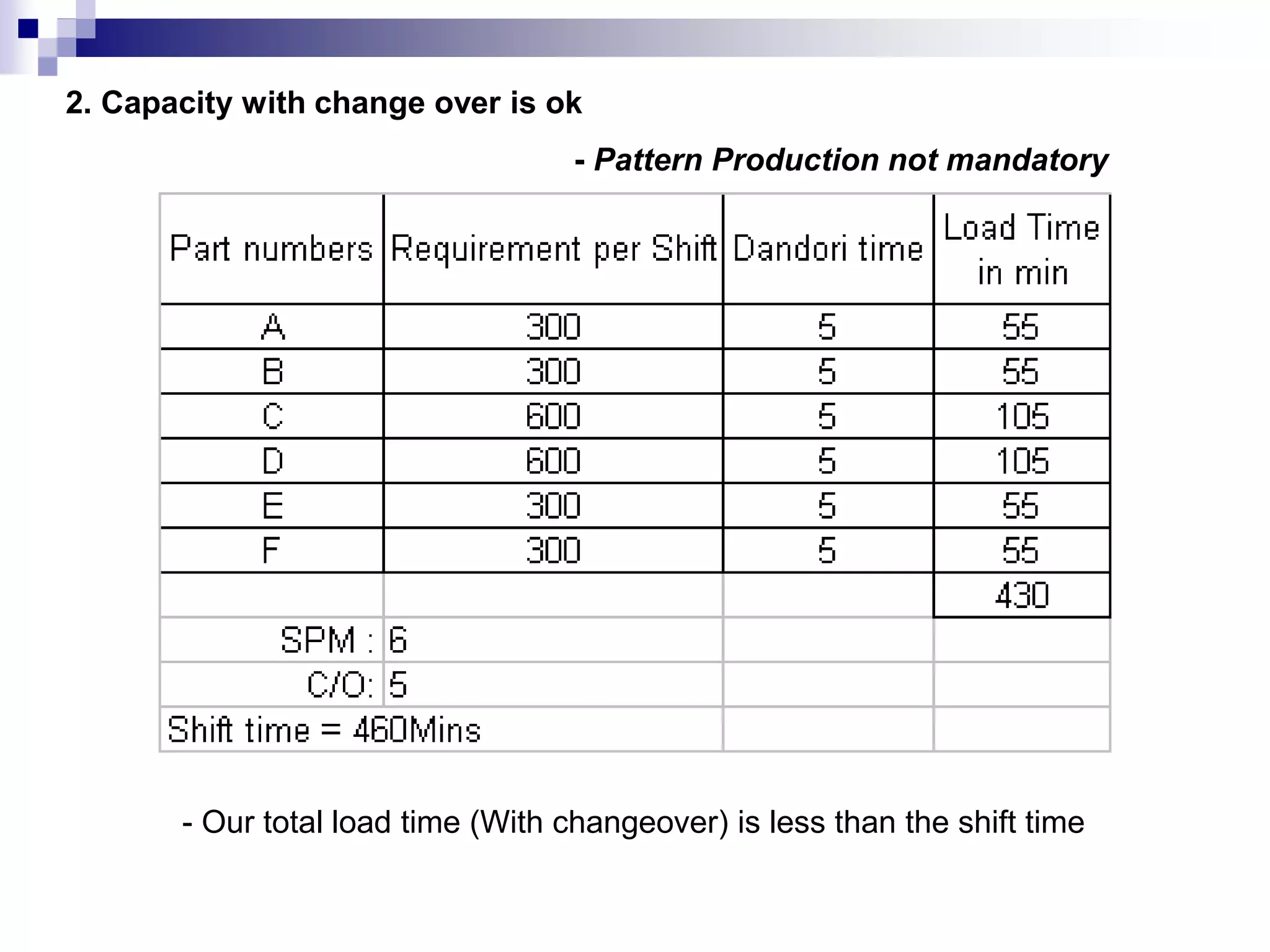
2. Capacity with change over is ok
- Pattern Production not mandatory
2. Capacity with change over is ok
- Pattern Production not mandatory
- Our total load time (With changeover) is less than the shift time
WHY Pattern Production?
1. Capacity without change over is ok
- Pattern Production not required
2. Capacity with change over is ok
- Pattern Production not mandatory
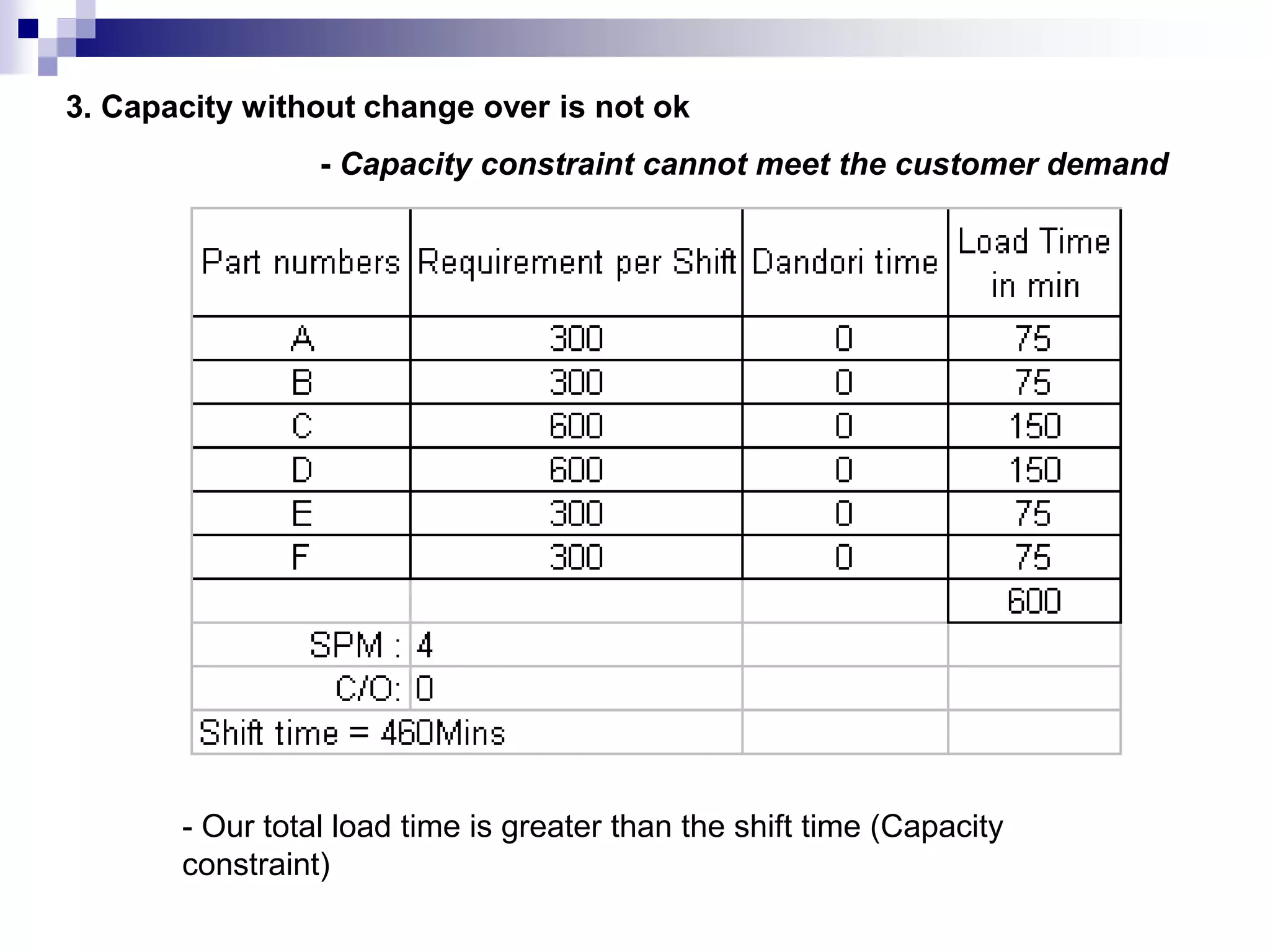
3. Capacity without change over is not ok
- Capacity constraint cannot meet the customer demand
3. Capacity without change over is not ok
- Capacity constraint cannot meet the customer demand
- Our total load time is greater than the shift time (Capacity
constraint)
WHY Pattern Production?
1. Capacity without change over is ok
- Pattern Production not required
2. Capacity with change over is ok
- Pattern Production not mandatory
3. Capacity without change over is not ok
- Capacity constraint cannot meet the customer demand
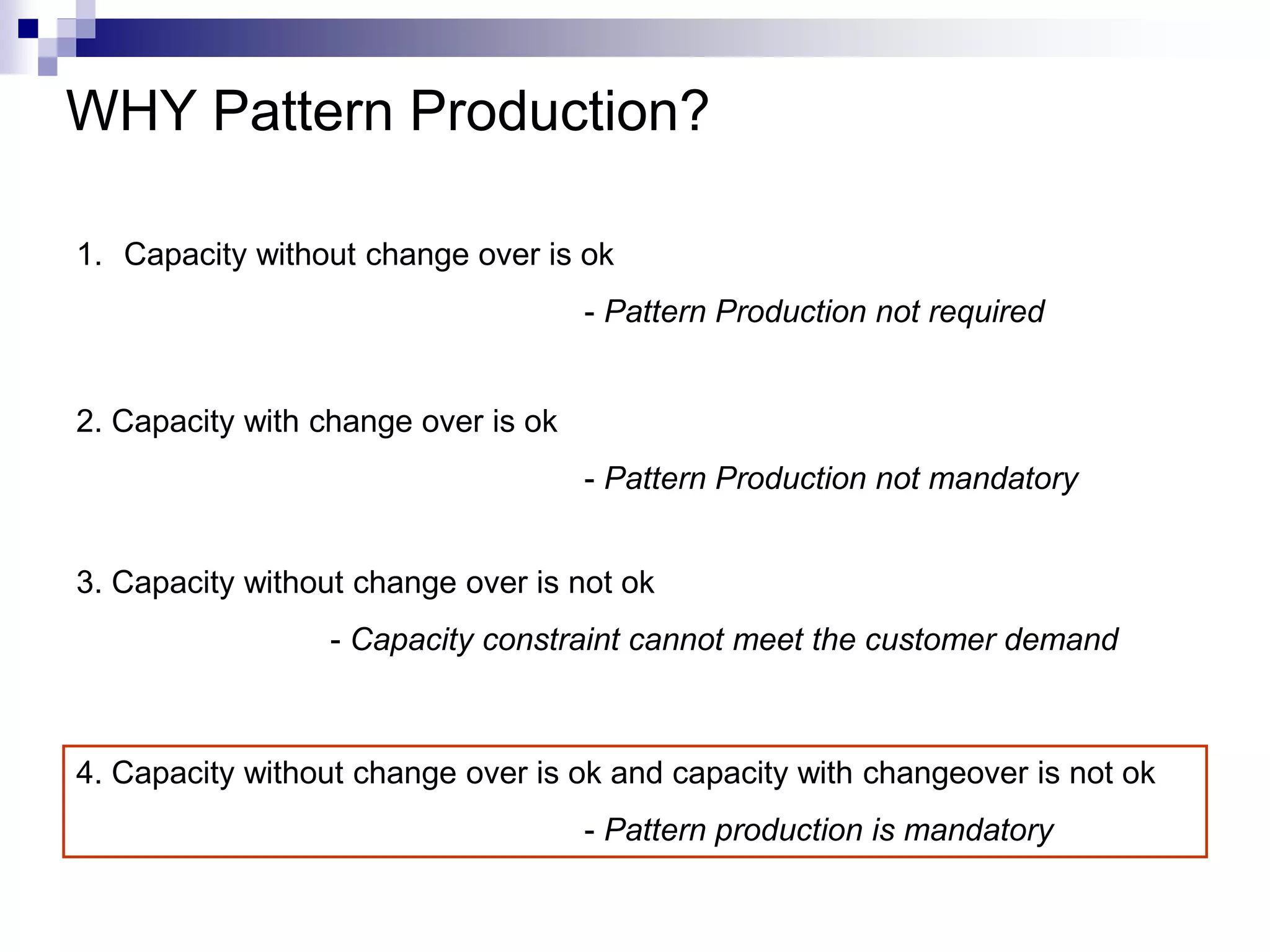
4. Capacity without change over is ok and capacity with changeover is not ok
- Pattern production is mandatory
4. Capacity without change over is ok and capacity with changeover is not ok
- Pattern production is mandatory
Capacity without
changeover is ok
Capacity with
changeover not ok
We should
go for
pattern
Data required for preparing the Pattern production
1. Number of machines
2. Production capacity (SPM)
3. Volume required per day
4. Dandori time and material loading time (Minutes)
5. Total Avl. working time in a day (minutes)
6. Total Part numbers (Models / Variants)
Pattern production
Example:
Capacity without Changeover is ok Capacity with Changeover is not ok
Lot size calculation:
=Requirement per shift X number of patterns
Lot size calculation:
=Requirement per shift X number of patterns
Example:
Going for 01 pattern, SPM is 6 then
A = 300 X 1 =300/6 = 50min (Load time = 50 +30 (dandori))
Going for 02 pattern, SPM is 6
A = 300 X 2 = 600/6 = 100min (Load time = 100 + 30 (dandori))
Similarly do this calculation for all parts and check on which pattern
the load time is less than the shift time.
.
.
.
E & F
parts Not
able to
complete
Trail 1
Trail 3
Able to
satisfy
customer
requirement
Pattern production
Stop time
(can be used for kaizen
and human devp.)
Deciding the store stock for the above example
For 03 pattern how much stock should we keep.
Store Stock:
= Lot size (Req. per shift x no. of patterns) + Safety stock(01 shift qty)
A = (300*3)+300=1200
Min Max for part number A
Max = 1200 and Min = 300
Benefits of Pattern production
 Effective utilization of all resources.
 Elimination of daily production planning.
 Unplanned O.T is eliminated.
 Variation in production in minimized (helps in
maintaining stock)
Pattern production
Pattern production

Pattern production

  • 1.
  • 2.
    Definition: Pattern production isa fixed schedule production where set of parts are arranged in a sequence. Basic Principles: i) Fixed time variable quantity ii) Fixed quantity variable time Basic Principles: i) Fixed time variable quantity ii) Fixed quantity variable time
  • 3.
    Fixed time variablequantity 09.00 10.00 10.00 11.00 11.00 12.00 12.00 13.00 13.00 14.00 Fixed Time Variable quantity A -90 Fixed quantity variable time Fixed quantity Variable time 09.00 10.00 10.00 11.00 11.00 12.00 (Kanban A = 90) A -100 In this case, wait till the Kanban qty (A) comes to 100 In this case, regardless of qty start at 9.00 am
  • 4.
    WHY Pattern Production? 1.Capacity without change over is ok - Pattern Production not required
  • 5.
    1. Capacity withoutchange over is ok - Pattern Production not required - Our total load time is less than the shift time
  • 6.
    WHY Pattern Production? 1.Capacity without change over is ok - Pattern Production not required 2. Capacity with change over is ok - Pattern Production not mandatory
  • 7.
    2. Capacity withchange over is ok - Pattern Production not mandatory - Our total load time (With changeover) is less than the shift time
  • 8.
    WHY Pattern Production? 1.Capacity without change over is ok - Pattern Production not required 2. Capacity with change over is ok - Pattern Production not mandatory 3. Capacity without change over is not ok - Capacity constraint cannot meet the customer demand
  • 9.
    3. Capacity withoutchange over is not ok - Capacity constraint cannot meet the customer demand - Our total load time is greater than the shift time (Capacity constraint)
  • 10.
    WHY Pattern Production? 1.Capacity without change over is ok - Pattern Production not required 2. Capacity with change over is ok - Pattern Production not mandatory 3. Capacity without change over is not ok - Capacity constraint cannot meet the customer demand 4. Capacity without change over is ok and capacity with changeover is not ok - Pattern production is mandatory
  • 11.
    4. Capacity withoutchange over is ok and capacity with changeover is not ok - Pattern production is mandatory Capacity without changeover is ok Capacity with changeover not ok We should go for pattern
  • 12.
    Data required forpreparing the Pattern production 1. Number of machines 2. Production capacity (SPM) 3. Volume required per day 4. Dandori time and material loading time (Minutes) 5. Total Avl. working time in a day (minutes) 6. Total Part numbers (Models / Variants)
  • 13.
    Pattern production Example: Capacity withoutChangeover is ok Capacity with Changeover is not ok Lot size calculation: =Requirement per shift X number of patterns
  • 14.
    Lot size calculation: =Requirementper shift X number of patterns Example: Going for 01 pattern, SPM is 6 then A = 300 X 1 =300/6 = 50min (Load time = 50 +30 (dandori)) Going for 02 pattern, SPM is 6 A = 300 X 2 = 600/6 = 100min (Load time = 100 + 30 (dandori)) Similarly do this calculation for all parts and check on which pattern the load time is less than the shift time.
  • 15.
    . . . E & F partsNot able to complete Trail 1 Trail 3 Able to satisfy customer requirement Pattern production Stop time (can be used for kaizen and human devp.)
  • 16.
    Deciding the storestock for the above example For 03 pattern how much stock should we keep. Store Stock: = Lot size (Req. per shift x no. of patterns) + Safety stock(01 shift qty) A = (300*3)+300=1200 Min Max for part number A Max = 1200 and Min = 300
  • 17.
    Benefits of Patternproduction  Effective utilization of all resources.  Elimination of daily production planning.  Unplanned O.T is eliminated.  Variation in production in minimized (helps in maintaining stock)