

Technical College Of Engineering
Petroleum and Energy Engineering Department
Physical Laboratory
1st
stage
(2016-2017)
Lab # 2(excrement number two )
(thermal conductivity )
Prepare By:Zanyar nawzad hama ali
Date : 14/3/2017
Group : A
INTRODUCTION:
Conduction is defined as the transfer of energy from more energetic
particles to adjacent less energetic particles as a result of interactions
between the particles. In solids, conduction is the combined result of
molecular vibration and free electron mobility. Metals typically have high
free electron mobility, which explains why they are good heat conductors.
Conduction can be easily understood if we imagine two blocks, one very
hot and the other cool. If we put these blocks in contact with one another
but insulate them from the surrounding, thermal energy will be
transferred from the hot to the cool block, as evidenced by the increase in
temperature of the coolblock.
This mode of heat transfers between the two solid blocks is termed
conduction.
We can define the material when we using in this experiment .
WL 376 gun t: brand machine which was an experimental machine or
device that could usefor testing a conductivity of a nonmetallic
materials such cork, wood armaflex ,etc. here are the definitions of each;
Arma flex material was used in the lab experiment so here is a brief
definition of fin.
Armaflex: it is a flexible elastomeric thermal insulation with black color,
it is foamshita smooth on one side which for the outer exposed
insulation surface.
Cork : the elastic tough outer tissue of the cork oak that is used
especially for stoppers and insulation
The aim of this experiment:
The aim of this excrement is to measurement liner thermal along Z
Direction conductivity and to investing and verify Fourier is law for liner
heat conductionalong Z direction.
Theory :
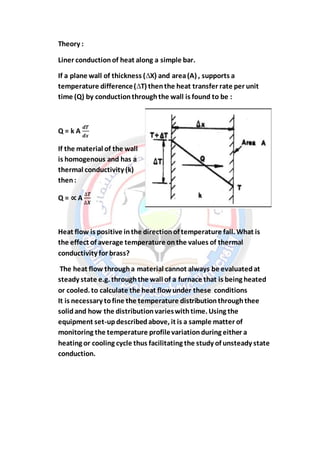
Liner conductionof heat along a simple bar.
If a plane wall of thickness (∆X) and area(A) , supports a
temperature difference(∆T) thenthe heat transfer rate per unit
time (Q) by conductionthroughthe wall is found to be :
Q = k A
𝒅𝑻
𝒅𝒙
If the material of the wall
is homogenous and has a
thermal conductivity (k)
then:
Q = ∝ A
∆𝑻
∆𝑿
Heat flow is positive inthe directionof temperature fall. What is
the effect of average temperature onthe values of thermal
conductivity for brass?
The heat flow througha material cannot always be evaluatedat
steady state e.g. throughthe wall of a furnace that is being heated
or cooled. to calculate the heat flow under these conditions
It is necessary tofine the temperature distributionthroughthee
solidand how the distributionvarieswithtime. Using the
equipment set-updescribedabove, it is a sample matter of
monitoring the temperature profilevariationduring either a
heating or cooling cycle thus facilitating the study of unsteady state
conduction.
Procedure :
1- Install the insert andadjust the cooling water flow rate and the
heater power.
2- Switchon the unit and adjust the desiredtemperaturedrop
throughthe power setting onthe control and display unit.
3- When the thermal conductionprocess has reacheda steady state
conditioni.e. The temperature at individual measuring points are
stable note the measurement results at the individual measuring
points and the electrical power suppliedtothe heater
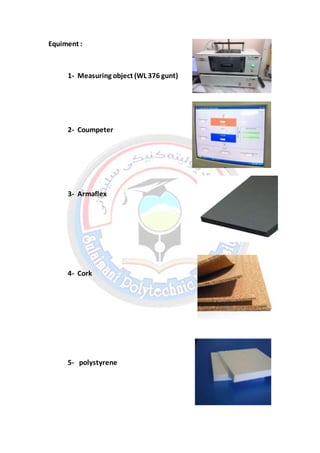
Equiment :
1- Measuring object (WL 376 gunt)
2- Coumpeter
3- Armaflex
4- Cork
5- polystyrene
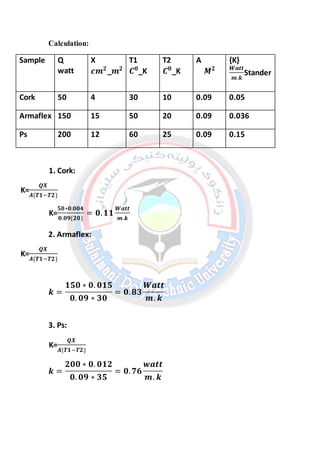
Calculation:
{K}
𝑾𝒂𝒕𝒕
𝒎.𝒌
Stander
A
𝑴 𝟐
T2
𝑪 𝟎
_K
T1
𝑪 𝟎
_K
X
𝒄𝒎 𝟐
_𝒎 𝟐
Q
watt
Sample
0.050.091030450Cork
0.0360.09205015150Armaflex
0.150.09256012200Ps
1. Cork:
K=
𝑸𝑿
𝑨{𝑻𝟏−𝑻𝟐}
K=
𝟓𝟎∗𝟎.𝟎𝟎𝟒
𝟎.𝟎𝟗{𝟐𝟎}
= 𝟎. 𝟏𝟏
𝑾𝒂𝒕𝒕
𝒎.𝒌
2. Armaflex:
K=
𝑸𝑿
𝑨{𝑻𝟏−𝑻𝟐}
𝒌 =
𝟏𝟓𝟎 ∗ 𝟎. 𝟎𝟏𝟓
𝟎. 𝟎𝟗 ∗ 𝟑𝟎
= 𝟎. 𝟖𝟑
𝑾𝒂𝒕𝒕
𝒎. 𝒌
3. Ps:
K=
𝑸𝑿
𝑨{𝑻𝟏−𝑻𝟐}
𝒌 =
𝟐𝟎𝟎 ∗ 𝟎. 𝟎𝟏𝟐
𝟎. 𝟎𝟗 ∗ 𝟑𝟓
= 𝟎. 𝟕𝟔
𝒘𝒂𝒕𝒕
𝒎. 𝒌
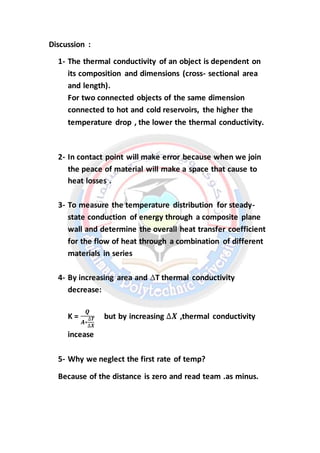
Discussion :
1- The thermal conductivity of an object is dependent on
its composition and dimensions (cross- sectional area
and length).
For two connected objects of the same dimension
connected to hot and cold reservoirs, the higher the
temperature drop , the lower the thermal conductivity.
2- In contact point will make error because when we join
the peace of material will make a space that cause to
heat losses .
3- To measure the temperature distribution for steady-
state conduction of energy through a composite plane
wall and determine the overall heat transfer coefficient
for the flow of heat through a combination of different
materials in series
4- By increasing area and ∆T thermal conductivity
decrease:
K =
𝑸
𝑨∗
∆𝑻
∆𝑿
but by increasing ∆𝑿 ,thermal conductivity
incease
5- Why we neglect the first rate of temp?
Because of the distance is zero and read team .as minus.
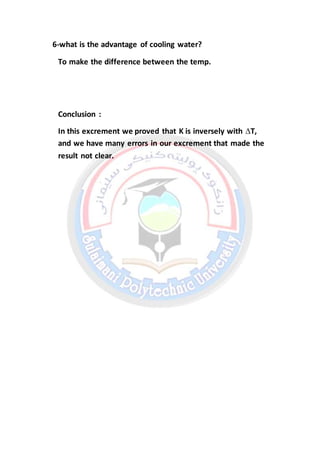
6-what is the advantage of cooling water?
To make the difference between the temp.
Conclusion :
In this excrement we proved that K is inversely with ∆T,
and we have many errors in our excrement that made the
result not clear.
Thermal Conductivity

Thermal Conductivity

  • 1.
    Technical College OfEngineering Petroleum and Energy Engineering Department Physical Laboratory 1st stage (2016-2017) Lab # 2(excrement number two ) (thermal conductivity ) Prepare By:Zanyar nawzad hama ali Date : 14/3/2017 Group : A
  • 2.
    INTRODUCTION: Conduction is definedas the transfer of energy from more energetic particles to adjacent less energetic particles as a result of interactions between the particles. In solids, conduction is the combined result of molecular vibration and free electron mobility. Metals typically have high free electron mobility, which explains why they are good heat conductors. Conduction can be easily understood if we imagine two blocks, one very hot and the other cool. If we put these blocks in contact with one another but insulate them from the surrounding, thermal energy will be transferred from the hot to the cool block, as evidenced by the increase in temperature of the coolblock. This mode of heat transfers between the two solid blocks is termed conduction. We can define the material when we using in this experiment . WL 376 gun t: brand machine which was an experimental machine or device that could usefor testing a conductivity of a nonmetallic materials such cork, wood armaflex ,etc. here are the definitions of each; Arma flex material was used in the lab experiment so here is a brief definition of fin. Armaflex: it is a flexible elastomeric thermal insulation with black color, it is foamshita smooth on one side which for the outer exposed insulation surface. Cork : the elastic tough outer tissue of the cork oak that is used especially for stoppers and insulation
  • 3.
    The aim ofthis experiment: The aim of this excrement is to measurement liner thermal along Z Direction conductivity and to investing and verify Fourier is law for liner heat conductionalong Z direction.
  • 4.
    Theory : Liner conductionofheat along a simple bar. If a plane wall of thickness (∆X) and area(A) , supports a temperature difference(∆T) thenthe heat transfer rate per unit time (Q) by conductionthroughthe wall is found to be : Q = k A 𝒅𝑻 𝒅𝒙 If the material of the wall is homogenous and has a thermal conductivity (k) then: Q = ∝ A ∆𝑻 ∆𝑿 Heat flow is positive inthe directionof temperature fall. What is the effect of average temperature onthe values of thermal conductivity for brass? The heat flow througha material cannot always be evaluatedat steady state e.g. throughthe wall of a furnace that is being heated or cooled. to calculate the heat flow under these conditions It is necessary tofine the temperature distributionthroughthee solidand how the distributionvarieswithtime. Using the equipment set-updescribedabove, it is a sample matter of monitoring the temperature profilevariationduring either a heating or cooling cycle thus facilitating the study of unsteady state conduction.
  • 5.
    Procedure : 1- Installthe insert andadjust the cooling water flow rate and the heater power. 2- Switchon the unit and adjust the desiredtemperaturedrop throughthe power setting onthe control and display unit. 3- When the thermal conductionprocess has reacheda steady state conditioni.e. The temperature at individual measuring points are stable note the measurement results at the individual measuring points and the electrical power suppliedtothe heater
  • 6.
    Equiment : 1- Measuringobject (WL 376 gunt) 2- Coumpeter 3- Armaflex 4- Cork 5- polystyrene
  • 7.
    Calculation: {K} 𝑾𝒂𝒕𝒕 𝒎.𝒌 Stander A 𝑴 𝟐 T2 𝑪 𝟎 _K T1 𝑪𝟎 _K X 𝒄𝒎 𝟐 _𝒎 𝟐 Q watt Sample 0.050.091030450Cork 0.0360.09205015150Armaflex 0.150.09256012200Ps 1. Cork: K= 𝑸𝑿 𝑨{𝑻𝟏−𝑻𝟐} K= 𝟓𝟎∗𝟎.𝟎𝟎𝟒 𝟎.𝟎𝟗{𝟐𝟎} = 𝟎. 𝟏𝟏 𝑾𝒂𝒕𝒕 𝒎.𝒌 2. Armaflex: K= 𝑸𝑿 𝑨{𝑻𝟏−𝑻𝟐} 𝒌 = 𝟏𝟓𝟎 ∗ 𝟎. 𝟎𝟏𝟓 𝟎. 𝟎𝟗 ∗ 𝟑𝟎 = 𝟎. 𝟖𝟑 𝑾𝒂𝒕𝒕 𝒎. 𝒌 3. Ps: K= 𝑸𝑿 𝑨{𝑻𝟏−𝑻𝟐} 𝒌 = 𝟐𝟎𝟎 ∗ 𝟎. 𝟎𝟏𝟐 𝟎. 𝟎𝟗 ∗ 𝟑𝟓 = 𝟎. 𝟕𝟔 𝒘𝒂𝒕𝒕 𝒎. 𝒌
  • 8.
    Discussion : 1- Thethermal conductivity of an object is dependent on its composition and dimensions (cross- sectional area and length). For two connected objects of the same dimension connected to hot and cold reservoirs, the higher the temperature drop , the lower the thermal conductivity. 2- In contact point will make error because when we join the peace of material will make a space that cause to heat losses . 3- To measure the temperature distribution for steady- state conduction of energy through a composite plane wall and determine the overall heat transfer coefficient for the flow of heat through a combination of different materials in series 4- By increasing area and ∆T thermal conductivity decrease: K = 𝑸 𝑨∗ ∆𝑻 ∆𝑿 but by increasing ∆𝑿 ,thermal conductivity incease 5- Why we neglect the first rate of temp? Because of the distance is zero and read team .as minus.
  • 9.
    6-what is theadvantage of cooling water? To make the difference between the temp. Conclusion : In this excrement we proved that K is inversely with ∆T, and we have many errors in our excrement that made the result not clear.