Technical College Of Engineering
Petroleum and Energy Engineering Department
Physical Laboratory
1st
stage
(2016-2017)
Lab # 3(exprement number three )
(thermal convection )
Prepare By:Zanyar nawzad hama ali
Date : 17/3/2017
Group : A
INTRODUCTION :
Convection is one of the three basic types of heat transfer.
The heat transport is substance-bound. In the convection
process, the whole fluid is moving. So-called bulks of fluid
move (and thus transfer heat) from warm zones into cold
zones. The different temperatures lead to density differences
in the fluid so that a flow develops. In the case of free
convection, the density differences result in a rather slow flow
of the fluid with a more intensive heat transfer. In the case of
forced convection, the flow is generated by a fan or pump. In
this case, the heat transfer to fluid particles is lower, but more
heat is transported than with free convection due to the much
larger mass flow.
The core element of the WL 352 experimental unit is a vertical
duct into which a heating element is inserted. Air flows past
the heating element and absorbs heat in the process. Three
heating elements with different surfaces are available: a flat
plate, a tube bundle or fins. For experiments on forced
convection, an additional fan has to be activated.
Sensors record the flow velocity of the air, the heating power
and the temperatures at all relevant points. The measured
values can be read on digital displays. At the same time, the
measured values can also be transmitted directly to a PC via
USB. The data acquisition software is included.
The well-structured instructional material sets out the
fundamentals and provides a step-by-step guide through the
experiments.
The aim of this experiment :
This experimental unit is designed for free and forced
Convection. Air is fed through a duct and heated at heater
elements with different shaped surfaces. Three
Interchangeable heater elements are provided. A fan can be
switched on for experiments on forced convection. The
temperature and air velocity are measured using sensors.
Theory :
Heat transfer froman object can be improve by increasing the
surface areain contact with the air by adding fins or pins normal to
the surface. This can be seenin Newton’s Law of Cooling that states
that the rate of heat loss of a body is proportional to the difference
in temperaturesbetweenthe body and its surroundings, which
defines the convectionheat transfer rate.
The constant of proportionality his termedthe convectionheat-
transfer coefficient. The heat transfer coefficient his afunction of
the fluidflow, so, it is influencedby the surface geometry, the fluid
motion inthe boundary layer and the fluidproperties as well. The
effect of the surfaces can be demonstrated by comparing finned
and unfinned surfaces witha flat plate under the same conditions
of power and flow.
A heatedsurface dissipates heat tothe surrounding fluidprimarily
througha process calledconvection. Heat is alsodissipatedby
conductionand radiation, however these effectsare not considered
in this experiment. Air incontact withthe hot surface is heatedby
the surface and rises due toreductionin density. The heatedair is
replacedby cooler air, whichis in turn heatedby the surface, and
rises. This process is calledfree convection.
Convectionheat transfer froman object can be improvedby
increasing the surface area incontact withthe air. In practical it
may be difficult toincrease the size of the body to suit. In these
circumstances the surface areaincontact withthe air may be
increasedby adding fins or pins normal to the surface. These
features are calledextendedsurfaces. A typical example is the use
of fins on the cylinder andhead on an air-cooledpetrol engine. The
effect of extendedsurfaces can be demonstrated by comparing
finnedand pinnedsurfaces witha flat under the same conditions of
power input and airflow.
Procedure :
The first step of this lab is attach the cables of the
equipment after that turn on all electronic equipment
which includes the small fan , the Display and control unit
to preheat the heat element. Once the "Flat plate" heating
element is at the determined level of temperature, place
the thermocouple concrete object on the "Flat plate"
heating element. While the concrete is heating up, start up
the recording of the thermocouple on the display. We will
need increase the volume of heating for heating up to 3
trial for each plate. for each trial we Attach thermocouple
wiring to the center and the outer ridge of the plate , for
each time we must waiting on the thermocouple reader on
the display until the record is still . Then record the initial
temperature and surface temperature read off from the
thermocouple. Now a display will record the temperature
of the concrete at a designated time. Once the desired time
is reached, redo all of the steps again, but now with a
Finned" heating element. Make sure to record the
dimensions of the cylinders with calipers. Finally, turn off
all electronic equipment which includes the small fan, the
Display and control unit
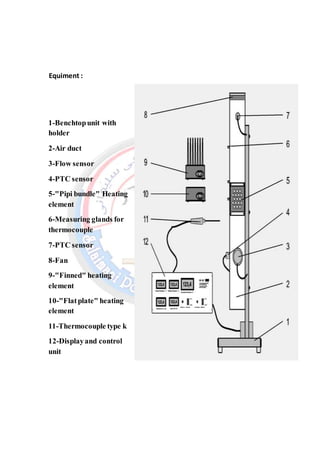
Equiment :
1-Benchtopunit with
holder
2-Air duct
3-Flow sensor
4-PTC sensor
5-"Pipi bundle" Heating
element
6-Measuring glands for
thermocouple
7-PTC sensor
8-Fan
9-"Finned" heating
element
10-"Flatplate" heating
element
11-Thermocouple type k
12-Displayand control
unit
Calculation:
Part 1:
{h}
𝑾𝒂𝒕𝒕
𝒎 𝟐.𝒌
A
𝑴 𝟐
T∞
𝑪 𝟎
_K
Tw
𝑪 𝟎
_K
Q
watt
Sample
1670.01417.732.735flat
1330.01417.74551flat
1080.01417.789108flat
1. flat:
h =
𝑸
𝑨{𝑻𝒘−𝑻∞}
h =
𝟑𝟓
𝟎.𝟎𝟏𝟒{𝟑𝟐.𝟕−𝟏𝟕.𝟕}
= 𝟏𝟔𝟕
𝑾𝒂𝒕𝒕
𝒎 𝟐.𝒌
2. flat:
h =
𝑸
𝑨{𝑻𝒘−𝑻∞}
𝒉 =
𝟓𝟏
𝟎. 𝟎𝟏𝟒{𝟒𝟓 − 𝟏𝟕. 𝟕}
= 𝟏𝟑𝟑
𝑾𝒂𝒕𝒕
𝒎 𝟐. 𝒌
3. flat:
h =
𝑸
𝑨{ 𝑻𝒘−𝑻∞}
𝒉 =
𝟏𝟎𝟖
𝟎. 𝟎𝟏𝟒{𝟖𝟗 − 𝟏𝟕. 𝟕}
= 𝟏𝟎𝟖
𝒘𝒂𝒕𝒕
𝒎 𝟐. 𝒌
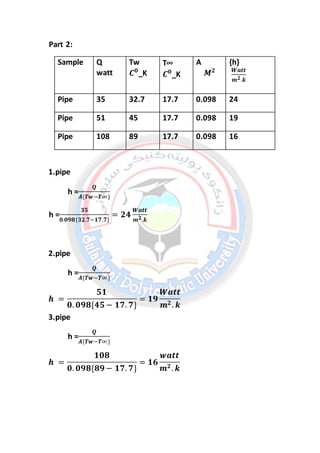
Part 2:
{h}
𝑾𝒂𝒕𝒕
𝒎 𝟐.𝒌
A
𝑴 𝟐
T∞
𝑪 𝟎
_K
Tw
𝑪 𝟎
_K
Q
watt
Sample
240.09817.732.735Pipe
190.09817.74551Pipe
160.09817.789108Pipe
1.pipe
h =
𝑸
𝑨{𝑻𝒘−𝑻∞}
h =
𝟑𝟓
𝟎.𝟎𝟗𝟖{𝟑𝟐.𝟕−𝟏𝟕.𝟕}
= 𝟐𝟒
𝑾𝒂𝒕𝒕
𝒎 𝟐.𝒌
2.pipe
h =
𝑸
𝑨{𝑻𝒘−𝑻∞}
𝒉 =
𝟓𝟏
𝟎. 𝟎𝟗𝟖{𝟒𝟓 − 𝟏𝟕. 𝟕}
= 𝟏𝟗
𝑾𝒂𝒕𝒕
𝒎 𝟐. 𝒌
3.pipe
h =
𝑸
𝑨{𝑻𝒘−𝑻∞}
𝒉 =
𝟏𝟎𝟖
𝟎. 𝟎𝟗𝟖{𝟖𝟗 − 𝟏𝟕. 𝟕}
= 𝟏𝟔
𝒘𝒂𝒕𝒕
𝒎 𝟐. 𝒌
Part: 3
{h}
𝑾𝒂𝒕𝒕
𝒎 𝟐.𝒌
A
𝑴 𝟐
T∞
𝑪 𝟎
_K
Tw
𝑪 𝟎
_K
Q
watt
Sample
170.1417.732.735fin
13.30.1417.74551fin
110.1417.789108fin
1.fin
h =
𝑸
𝑨{𝑻𝒘−𝑻∞}
h =
𝟑𝟓
𝟎.𝟏𝟒{𝟑𝟐.𝟕−𝟏𝟕.𝟕}
= 𝟏𝟕
𝑾𝒂𝒕𝒕
𝒎 𝟐.𝒌
2.fin
h =
𝑸
𝑨{𝑻𝒘−𝑻∞}
𝒉 =
𝟓𝟏
𝟎. 𝟏𝟒{𝟒𝟓 − 𝟏𝟕. 𝟕}
= 𝟏𝟑. 𝟑
𝑾𝒂𝒕𝒕
𝒎 𝟐. 𝒌
3.fin
h =
𝑸
𝑨{𝑻𝒘−𝑻∞}
𝒉 =
𝟏𝟎𝟖
𝟎. 𝟏𝟒{𝟖𝟗 − 𝟏𝟕. 𝟕}
= 𝟏𝟏
𝒘𝒂𝒕𝒕
𝒎 𝟐. 𝒌
Discussion :
Why does hot air rise and cold air sink?
Cool air is more dense that warm air .
Why are place beneath hot water tanks in people is home?
Hot water rise .so when the boiler heat the water , and the
hot water rises, the water tank is filled with hot water.
 different between Free and forced convection
When the mixing motion of the fluid particles is the result
of the density difference caused by a temperature gradient,
the process of heat transfer is called natural or convection.
When the mixing motion is created by an artificial mean (by
some external agent), the process of heat transfer is called
forced convection, it is essential to have knowledge of the
characteristic of fluid flow. Since the effectiveness of heat
transfer by convection depends largely on the mixing.
Conclusion :
Heat is a common phenomenon that occurs everywhere,
especially in petroleum engineering as a whole. With all of the
different applications that heat is involved in, it is obvious
cooling is necessary. It is applied to numerous different
materials, but the main points of focus are metal and
polymer. We are calculate (h) value by 3 method with three
different plate also we getting 3 different result These values
helped in determining flat plate had a low heat transfer
coefficient and fin plate element has a high heat transfer
coefficient. Knowing the heat transfer coefficient for any type
of material will help in determining how long it can take for a
material to cool from the inside out.

Thermal convection

  • 1.
    Technical College OfEngineering Petroleum and Energy Engineering Department Physical Laboratory 1st stage (2016-2017) Lab # 3(exprement number three ) (thermal convection ) Prepare By:Zanyar nawzad hama ali Date : 17/3/2017 Group : A
  • 2.
    INTRODUCTION : Convection isone of the three basic types of heat transfer. The heat transport is substance-bound. In the convection process, the whole fluid is moving. So-called bulks of fluid move (and thus transfer heat) from warm zones into cold zones. The different temperatures lead to density differences in the fluid so that a flow develops. In the case of free convection, the density differences result in a rather slow flow of the fluid with a more intensive heat transfer. In the case of forced convection, the flow is generated by a fan or pump. In this case, the heat transfer to fluid particles is lower, but more heat is transported than with free convection due to the much larger mass flow. The core element of the WL 352 experimental unit is a vertical duct into which a heating element is inserted. Air flows past the heating element and absorbs heat in the process. Three heating elements with different surfaces are available: a flat plate, a tube bundle or fins. For experiments on forced convection, an additional fan has to be activated. Sensors record the flow velocity of the air, the heating power and the temperatures at all relevant points. The measured values can be read on digital displays. At the same time, the measured values can also be transmitted directly to a PC via USB. The data acquisition software is included. The well-structured instructional material sets out the fundamentals and provides a step-by-step guide through the experiments.
  • 3.
    The aim ofthis experiment : This experimental unit is designed for free and forced Convection. Air is fed through a duct and heated at heater elements with different shaped surfaces. Three Interchangeable heater elements are provided. A fan can be switched on for experiments on forced convection. The temperature and air velocity are measured using sensors.
  • 4.
    Theory : Heat transferfroman object can be improve by increasing the surface areain contact with the air by adding fins or pins normal to the surface. This can be seenin Newton’s Law of Cooling that states that the rate of heat loss of a body is proportional to the difference in temperaturesbetweenthe body and its surroundings, which defines the convectionheat transfer rate. The constant of proportionality his termedthe convectionheat- transfer coefficient. The heat transfer coefficient his afunction of the fluidflow, so, it is influencedby the surface geometry, the fluid motion inthe boundary layer and the fluidproperties as well. The effect of the surfaces can be demonstrated by comparing finned and unfinned surfaces witha flat plate under the same conditions of power and flow. A heatedsurface dissipates heat tothe surrounding fluidprimarily througha process calledconvection. Heat is alsodissipatedby conductionand radiation, however these effectsare not considered in this experiment. Air incontact withthe hot surface is heatedby the surface and rises due toreductionin density. The heatedair is replacedby cooler air, whichis in turn heatedby the surface, and rises. This process is calledfree convection. Convectionheat transfer froman object can be improvedby increasing the surface area incontact withthe air. In practical it may be difficult toincrease the size of the body to suit. In these circumstances the surface areaincontact withthe air may be increasedby adding fins or pins normal to the surface. These features are calledextendedsurfaces. A typical example is the use of fins on the cylinder andhead on an air-cooledpetrol engine. The effect of extendedsurfaces can be demonstrated by comparing finnedand pinnedsurfaces witha flat under the same conditions of power input and airflow.
  • 5.
    Procedure : The firststep of this lab is attach the cables of the equipment after that turn on all electronic equipment which includes the small fan , the Display and control unit to preheat the heat element. Once the "Flat plate" heating element is at the determined level of temperature, place the thermocouple concrete object on the "Flat plate" heating element. While the concrete is heating up, start up the recording of the thermocouple on the display. We will need increase the volume of heating for heating up to 3 trial for each plate. for each trial we Attach thermocouple wiring to the center and the outer ridge of the plate , for each time we must waiting on the thermocouple reader on the display until the record is still . Then record the initial temperature and surface temperature read off from the thermocouple. Now a display will record the temperature of the concrete at a designated time. Once the desired time is reached, redo all of the steps again, but now with a Finned" heating element. Make sure to record the dimensions of the cylinders with calipers. Finally, turn off all electronic equipment which includes the small fan, the Display and control unit
  • 6.
    Equiment : 1-Benchtopunit with holder 2-Airduct 3-Flow sensor 4-PTC sensor 5-"Pipi bundle" Heating element 6-Measuring glands for thermocouple 7-PTC sensor 8-Fan 9-"Finned" heating element 10-"Flatplate" heating element 11-Thermocouple type k 12-Displayand control unit
  • 7.
    Calculation: Part 1: {h} 𝑾𝒂𝒕𝒕 𝒎 𝟐.𝒌 A 𝑴𝟐 T∞ 𝑪 𝟎 _K Tw 𝑪 𝟎 _K Q watt Sample 1670.01417.732.735flat 1330.01417.74551flat 1080.01417.789108flat 1. flat: h = 𝑸 𝑨{𝑻𝒘−𝑻∞} h = 𝟑𝟓 𝟎.𝟎𝟏𝟒{𝟑𝟐.𝟕−𝟏𝟕.𝟕} = 𝟏𝟔𝟕 𝑾𝒂𝒕𝒕 𝒎 𝟐.𝒌 2. flat: h = 𝑸 𝑨{𝑻𝒘−𝑻∞} 𝒉 = 𝟓𝟏 𝟎. 𝟎𝟏𝟒{𝟒𝟓 − 𝟏𝟕. 𝟕} = 𝟏𝟑𝟑 𝑾𝒂𝒕𝒕 𝒎 𝟐. 𝒌 3. flat: h = 𝑸 𝑨{ 𝑻𝒘−𝑻∞} 𝒉 = 𝟏𝟎𝟖 𝟎. 𝟎𝟏𝟒{𝟖𝟗 − 𝟏𝟕. 𝟕} = 𝟏𝟎𝟖 𝒘𝒂𝒕𝒕 𝒎 𝟐. 𝒌
  • 8.
    Part 2: {h} 𝑾𝒂𝒕𝒕 𝒎 𝟐.𝒌 A 𝑴𝟐 T∞ 𝑪 𝟎 _K Tw 𝑪 𝟎 _K Q watt Sample 240.09817.732.735Pipe 190.09817.74551Pipe 160.09817.789108Pipe 1.pipe h = 𝑸 𝑨{𝑻𝒘−𝑻∞} h = 𝟑𝟓 𝟎.𝟎𝟗𝟖{𝟑𝟐.𝟕−𝟏𝟕.𝟕} = 𝟐𝟒 𝑾𝒂𝒕𝒕 𝒎 𝟐.𝒌 2.pipe h = 𝑸 𝑨{𝑻𝒘−𝑻∞} 𝒉 = 𝟓𝟏 𝟎. 𝟎𝟗𝟖{𝟒𝟓 − 𝟏𝟕. 𝟕} = 𝟏𝟗 𝑾𝒂𝒕𝒕 𝒎 𝟐. 𝒌 3.pipe h = 𝑸 𝑨{𝑻𝒘−𝑻∞} 𝒉 = 𝟏𝟎𝟖 𝟎. 𝟎𝟗𝟖{𝟖𝟗 − 𝟏𝟕. 𝟕} = 𝟏𝟔 𝒘𝒂𝒕𝒕 𝒎 𝟐. 𝒌
  • 9.
    Part: 3 {h} 𝑾𝒂𝒕𝒕 𝒎 𝟐.𝒌 A 𝑴𝟐 T∞ 𝑪 𝟎 _K Tw 𝑪 𝟎 _K Q watt Sample 170.1417.732.735fin 13.30.1417.74551fin 110.1417.789108fin 1.fin h = 𝑸 𝑨{𝑻𝒘−𝑻∞} h = 𝟑𝟓 𝟎.𝟏𝟒{𝟑𝟐.𝟕−𝟏𝟕.𝟕} = 𝟏𝟕 𝑾𝒂𝒕𝒕 𝒎 𝟐.𝒌 2.fin h = 𝑸 𝑨{𝑻𝒘−𝑻∞} 𝒉 = 𝟓𝟏 𝟎. 𝟏𝟒{𝟒𝟓 − 𝟏𝟕. 𝟕} = 𝟏𝟑. 𝟑 𝑾𝒂𝒕𝒕 𝒎 𝟐. 𝒌 3.fin h = 𝑸 𝑨{𝑻𝒘−𝑻∞} 𝒉 = 𝟏𝟎𝟖 𝟎. 𝟏𝟒{𝟖𝟗 − 𝟏𝟕. 𝟕} = 𝟏𝟏 𝒘𝒂𝒕𝒕 𝒎 𝟐. 𝒌
  • 10.
    Discussion : Why doeshot air rise and cold air sink? Cool air is more dense that warm air . Why are place beneath hot water tanks in people is home? Hot water rise .so when the boiler heat the water , and the hot water rises, the water tank is filled with hot water.  different between Free and forced convection When the mixing motion of the fluid particles is the result of the density difference caused by a temperature gradient, the process of heat transfer is called natural or convection. When the mixing motion is created by an artificial mean (by some external agent), the process of heat transfer is called forced convection, it is essential to have knowledge of the characteristic of fluid flow. Since the effectiveness of heat transfer by convection depends largely on the mixing.
  • 11.
    Conclusion : Heat isa common phenomenon that occurs everywhere, especially in petroleum engineering as a whole. With all of the different applications that heat is involved in, it is obvious cooling is necessary. It is applied to numerous different materials, but the main points of focus are metal and polymer. We are calculate (h) value by 3 method with three different plate also we getting 3 different result These values helped in determining flat plate had a low heat transfer coefficient and fin plate element has a high heat transfer coefficient. Knowing the heat transfer coefficient for any type of material will help in determining how long it can take for a material to cool from the inside out.