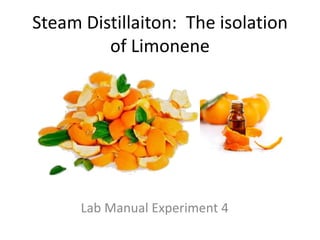
Steam Distillaiton: The isolation
of Limonene
Lab Manual Experiment 4
Important Terms
• Terpene = a compound whose carbon
skeleton can be divided into two or more units
identical with the carbon skeleton of isoprene.
• Isoprene = 5 carbon compound
with a specific skeletal structure.
• Limonene =
Overview of the lab
• Peel a large orange (or two) and remove the pith.
• Grind the peels in a in a blender containing distilled water
until a uniform slurry is obtained.
• Distill an “essential oil,” called limonene, from the resulting
solution.
• Isolate the limonene using the liquid/liquid extraction (like
last week)
• Characterize the limonene using gas chromatography.
Intro to Distillation
• Distillation is the process of heating a liquid until
it boils, capturing and cooling the resultant hot
vapors and then collecting the condensed
vapors.
• Technique has been used for thousands of years
(they have found evidence that goes back to
3500 BC)
Why are distillations used?
• Identification of a compound’s boiling point
– Important physical property of any compound,
can be used to help identify an unknown
compound
• Purification of a compound by separating it
from a non-volatile or less-volatile material
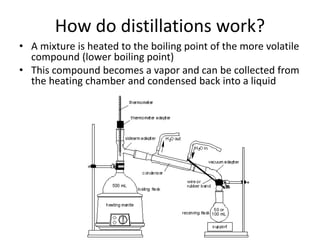
How do distillations work?
• A mixture is heated to the boiling point of the more volatile
compound (lower boiling point)
• This compound becomes a vapor and can be collected from
the heating chamber and condensed back into a liquid
More terms
• Distilling = technique to separate liquids based on their
boiling points.
• Refluxing = boiling = the boiling of a liquid at its boiling point
• Rounded bottom flask = self-explanatory?!
• Condenser = jacketed glass tube to allow cold water to pass
through it and condense the vapors.
• Forerun = the first substance to distill over (often at a lower
boiling point and thrown away).
• Distillate = the substance collected from the distillation.
• Pot residue = the substance leftover in the boiling flask.
Steam Distillation
• Special type of distillation used for materials that
are sensitive to high temperatures
– Many organic compounds (like natural aromatic
compounds) decompose at high sustained
temperatures so cannot be separated by normal
distillation
• Addition of water vapor into apparatus can allow
for lower temperatures
– Limonene bp is 176oC but it will boil at a temperature
close to 100oC using a steam distillation.
Boiling point
• Temperature at which something boils….yes,
but that’s not all of it
– Boiling occurs when the vapor pressure of the
liquid becomes equal to the pressure of its
external pressure.
• Vapor Pressure:
• Think of boiling
water at high
elevation
Vapor pressure of different liquids
• The vapor pressure of a liquid is principally determined by
the strength of the intermolecular forces of the liquid.
• Liquids in which the intermolecular forces are strong have
relatively low vapor pressures (and high boiling points).
Vapor Pressure and Temperature
• Vapor pressure increases significantly with
temperature.
Temperature Dependence of Vapor
Pressure
• Vaporization requires input of energy to overcome the
intermolecular attractions between molecules.
– Only a small fraction of the molecules in a liquid have
enough kinetic energy to escape.
– By increasing the temperature, the fraction of the
molecules with “escape energy” or kinetic energy
increases.
• The higher the temperature, the faster the rate of
evaporation by the high-energy molecules at the
surface of the liquid.
Vapor Pressures Increases with
Temperature
• As a compound is heated,
its vapor pressure increases
rapidly
• normal boiling point –
temp at which a liquids
vapor pressure equals 1
atm.
• Does water have a higher or
lower boiling point at higher
elevation?
Things to do Before the Distillation
• Add boiling chips to your orange peel slurry. Boiling chips
work by providing nucleation sites so the liquid boils smoothly
without becoming superheated or bumping.
• Make sure the joints of your distillation apparatus are
lubricated and sealed.
• Start flowing water through your condenser. ASK YOUR TA TO
CHECK YOUR SETUP BEFORE STARTING THE FLOW OF WATER.
• Wrap your rounded bottom flask and distillation adaptor with
aluminum foil to prevent heat loss. This will shorten the time
it takes to complete the distillation.
Things to do After Finishing the
Distillation
• After distillation, the round-bottom flask must be removed from the
heat completely. Just turning the heat off is not enough, the
remaining water will be evaporated and the pulp will bake inside
the flask, and be nearly impossible to get it out.
• Transfer the distillate into a 125-mL separatory funnel and extract
the aqueous mixture twice using dichloromethane.
• Combine the dichloromethane extracts and dry them with sufficient
amounts of MgSO4.
• Gravity filer the dichloromethane to remove the MgSO4.
• Remove the dichloromethane using a rotary evaporator
• Analyze the product by GC
Common Organic Solvents for Extractions
Density (g/mL)
Hexane 0.6594
Diethyl ether 0.7133
Toluene 0.8669
Ethyl acetate 0.9006
Dichloromethane 1.326
Immiscible with water (density 0.9982 g/mL)
Density (g/mL)
Ethanol 0.7892
Acetone 0.7900
Methanol 0.7913
Tetrahydrofuran 0.888
Miscible with water (density 0.9982 g/mL)
organic layer on bottom
organic layer on top
Vacuum Distillations
• Vacuum distillation is distillation at a reduced pressure.
• Since the boiling point of a compound is lower at a lower
external pressure, the compound will not have to be heated to
as high a temperature in order for it to boil.
17
• Vacuum distillation is used to
distill compounds that have
a high boiling point or any
compound which might
undergo decomposition on
heating at atmospheric
pressure.
• The vacuum is provided
either by a water aspirator or
by a mechanical pump.
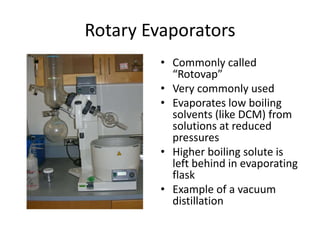
Rotary Evaporators
• Commonly called
“Rotovap”
• Very commonly used
• Evaporates low boiling
solvents (like DCM) from
solutions at reduced
pressures
• Higher boiling solute is
left behind in evaporating
flask
• Example of a vacuum
distillation
1. Add a bump trap onto the rotavapor. Use a green clip to fix it.
2. Attach your round-bottom ed flask to the bump trap.
3. Turn on the rotavap motor and adjust the speed.
4. Close the vent
5. Turn on the vacuum
6. Put your flask into the warm water bath
7. Solvents will be collected
8. Turn off the vacuum
9. Open the vent
10. Adjust the speed to 0 and turn off the
rotavap motor
11. Take the round-
bottomed flask off the
rotavap 20
• Another separation method in which molecules either stick to the
stationary phase or move with the mobile phase (gas).
• Separation is done entirely in the gas phase.
• Separation is based on boiling point for molecules of similar
polarity.
• Usually used for analysis rather than preparative purification.
Gas Chromatography (GC)
21
• Another separation method in which molecules either stick to the
stationary phase or move with the mobile phase (gas).
• Separation is done entirely in the gas phase.
• Separation is based on boiling point for molecules of similar
polarity.
• Usually used for analysis rather than preparative purification.
Gas Chromatography (GC)
22
Four components:
How does GC work?
• A heated cavity that keeps compounds in the gas phase.
• GC column is coated with a stationary phase that
separates the compounds.
4. A detector
• Where the sample is injected with a microsyringe.
• Heated, so that the sample is immediately vaporized.
2. A column inside the oven.
1. An injection port.
3. Carrier gas (helium).
• Inert; no interaction with other compounds.
• Responds to thermal conductivity or ionization.
• We will be using a standard non-polar GC column
Common stationary phases are:
• Cyanopropylphenyl dimethyl polysiloxane
• Carbowax polyethyleneglycol
• Biscyanopropyl cyanopropylphenyl polysiloxane
• Diphenyl dimethyl polysiloxane
Column: the Heart of the System
24
• Visualization
 Concentration-dependent detector: detect the
concentration of solute
Detector
25
Factors That Affect GC Separation
• Volatility of the compound (bp)
 higher bp = longer retention times
• Carrier gas flow rate and temperature
 lower temps and flow rates = longer retention times
• Length of column
 longer column = longer retention times 26
Varying these
parameters can
improve
separation
Factors that effect retention time on a standard non-polar GC column
• Remove dichloromethane with rotary evaporator and dissolve
the residue in 0.5 mL of dichloromethane
• Show your diluted sample to your TA who will check for dryness
• Stockroom attendant or TA will inject 1 microliter onto the GC
• Check that you are happy with the results; you may have to re-
inject another sample.
Injection of Limonene into the GC
27
First compound to elute has a lower retention time.
Major component of a mixture should have a larger area under the
curve.
A
B
28
compound with
lower boiling point
compound with
higher boiling point

Steam distillaiton

  • 1.
    Steam Distillaiton: Theisolation of Limonene Lab Manual Experiment 4
  • 2.
    Important Terms • Terpene= a compound whose carbon skeleton can be divided into two or more units identical with the carbon skeleton of isoprene. • Isoprene = 5 carbon compound with a specific skeletal structure. • Limonene =
  • 3.
    Overview of thelab • Peel a large orange (or two) and remove the pith. • Grind the peels in a in a blender containing distilled water until a uniform slurry is obtained. • Distill an “essential oil,” called limonene, from the resulting solution. • Isolate the limonene using the liquid/liquid extraction (like last week) • Characterize the limonene using gas chromatography.
  • 4.
    Intro to Distillation •Distillation is the process of heating a liquid until it boils, capturing and cooling the resultant hot vapors and then collecting the condensed vapors. • Technique has been used for thousands of years (they have found evidence that goes back to 3500 BC)
  • 5.
    Why are distillationsused? • Identification of a compound’s boiling point – Important physical property of any compound, can be used to help identify an unknown compound • Purification of a compound by separating it from a non-volatile or less-volatile material
  • 6.
    How do distillationswork? • A mixture is heated to the boiling point of the more volatile compound (lower boiling point) • This compound becomes a vapor and can be collected from the heating chamber and condensed back into a liquid
  • 7.
    More terms • Distilling= technique to separate liquids based on their boiling points. • Refluxing = boiling = the boiling of a liquid at its boiling point • Rounded bottom flask = self-explanatory?! • Condenser = jacketed glass tube to allow cold water to pass through it and condense the vapors. • Forerun = the first substance to distill over (often at a lower boiling point and thrown away). • Distillate = the substance collected from the distillation. • Pot residue = the substance leftover in the boiling flask.
  • 8.
    Steam Distillation • Specialtype of distillation used for materials that are sensitive to high temperatures – Many organic compounds (like natural aromatic compounds) decompose at high sustained temperatures so cannot be separated by normal distillation • Addition of water vapor into apparatus can allow for lower temperatures – Limonene bp is 176oC but it will boil at a temperature close to 100oC using a steam distillation.
  • 9.
    Boiling point • Temperatureat which something boils….yes, but that’s not all of it – Boiling occurs when the vapor pressure of the liquid becomes equal to the pressure of its external pressure. • Vapor Pressure: • Think of boiling water at high elevation
  • 10.
    Vapor pressure ofdifferent liquids • The vapor pressure of a liquid is principally determined by the strength of the intermolecular forces of the liquid. • Liquids in which the intermolecular forces are strong have relatively low vapor pressures (and high boiling points).
  • 11.
    Vapor Pressure andTemperature • Vapor pressure increases significantly with temperature.
  • 12.
    Temperature Dependence ofVapor Pressure • Vaporization requires input of energy to overcome the intermolecular attractions between molecules. – Only a small fraction of the molecules in a liquid have enough kinetic energy to escape. – By increasing the temperature, the fraction of the molecules with “escape energy” or kinetic energy increases. • The higher the temperature, the faster the rate of evaporation by the high-energy molecules at the surface of the liquid.
  • 13.
    Vapor Pressures Increaseswith Temperature • As a compound is heated, its vapor pressure increases rapidly • normal boiling point – temp at which a liquids vapor pressure equals 1 atm. • Does water have a higher or lower boiling point at higher elevation?
  • 14.
    Things to doBefore the Distillation • Add boiling chips to your orange peel slurry. Boiling chips work by providing nucleation sites so the liquid boils smoothly without becoming superheated or bumping. • Make sure the joints of your distillation apparatus are lubricated and sealed. • Start flowing water through your condenser. ASK YOUR TA TO CHECK YOUR SETUP BEFORE STARTING THE FLOW OF WATER. • Wrap your rounded bottom flask and distillation adaptor with aluminum foil to prevent heat loss. This will shorten the time it takes to complete the distillation.
  • 15.
    Things to doAfter Finishing the Distillation • After distillation, the round-bottom flask must be removed from the heat completely. Just turning the heat off is not enough, the remaining water will be evaporated and the pulp will bake inside the flask, and be nearly impossible to get it out. • Transfer the distillate into a 125-mL separatory funnel and extract the aqueous mixture twice using dichloromethane. • Combine the dichloromethane extracts and dry them with sufficient amounts of MgSO4. • Gravity filer the dichloromethane to remove the MgSO4. • Remove the dichloromethane using a rotary evaporator • Analyze the product by GC
  • 16.
    Common Organic Solventsfor Extractions Density (g/mL) Hexane 0.6594 Diethyl ether 0.7133 Toluene 0.8669 Ethyl acetate 0.9006 Dichloromethane 1.326 Immiscible with water (density 0.9982 g/mL) Density (g/mL) Ethanol 0.7892 Acetone 0.7900 Methanol 0.7913 Tetrahydrofuran 0.888 Miscible with water (density 0.9982 g/mL) organic layer on bottom organic layer on top
  • 17.
    Vacuum Distillations • Vacuumdistillation is distillation at a reduced pressure. • Since the boiling point of a compound is lower at a lower external pressure, the compound will not have to be heated to as high a temperature in order for it to boil. 17 • Vacuum distillation is used to distill compounds that have a high boiling point or any compound which might undergo decomposition on heating at atmospheric pressure. • The vacuum is provided either by a water aspirator or by a mechanical pump.
  • 18.
    Rotary Evaporators • Commonlycalled “Rotovap” • Very commonly used • Evaporates low boiling solvents (like DCM) from solutions at reduced pressures • Higher boiling solute is left behind in evaporating flask • Example of a vacuum distillation
  • 20.
    1. Add abump trap onto the rotavapor. Use a green clip to fix it. 2. Attach your round-bottom ed flask to the bump trap. 3. Turn on the rotavap motor and adjust the speed. 4. Close the vent 5. Turn on the vacuum 6. Put your flask into the warm water bath 7. Solvents will be collected 8. Turn off the vacuum 9. Open the vent 10. Adjust the speed to 0 and turn off the rotavap motor 11. Take the round- bottomed flask off the rotavap 20
  • 21.
    • Another separationmethod in which molecules either stick to the stationary phase or move with the mobile phase (gas). • Separation is done entirely in the gas phase. • Separation is based on boiling point for molecules of similar polarity. • Usually used for analysis rather than preparative purification. Gas Chromatography (GC) 21
  • 22.
    • Another separationmethod in which molecules either stick to the stationary phase or move with the mobile phase (gas). • Separation is done entirely in the gas phase. • Separation is based on boiling point for molecules of similar polarity. • Usually used for analysis rather than preparative purification. Gas Chromatography (GC) 22
  • 23.
    Four components: How doesGC work? • A heated cavity that keeps compounds in the gas phase. • GC column is coated with a stationary phase that separates the compounds. 4. A detector • Where the sample is injected with a microsyringe. • Heated, so that the sample is immediately vaporized. 2. A column inside the oven. 1. An injection port. 3. Carrier gas (helium). • Inert; no interaction with other compounds. • Responds to thermal conductivity or ionization.
  • 24.
    • We willbe using a standard non-polar GC column Common stationary phases are: • Cyanopropylphenyl dimethyl polysiloxane • Carbowax polyethyleneglycol • Biscyanopropyl cyanopropylphenyl polysiloxane • Diphenyl dimethyl polysiloxane Column: the Heart of the System 24
  • 25.
    • Visualization  Concentration-dependentdetector: detect the concentration of solute Detector 25
  • 26.
    Factors That AffectGC Separation • Volatility of the compound (bp)  higher bp = longer retention times • Carrier gas flow rate and temperature  lower temps and flow rates = longer retention times • Length of column  longer column = longer retention times 26 Varying these parameters can improve separation Factors that effect retention time on a standard non-polar GC column
  • 27.
    • Remove dichloromethanewith rotary evaporator and dissolve the residue in 0.5 mL of dichloromethane • Show your diluted sample to your TA who will check for dryness • Stockroom attendant or TA will inject 1 microliter onto the GC • Check that you are happy with the results; you may have to re- inject another sample. Injection of Limonene into the GC 27
  • 28.
    First compound toelute has a lower retention time. Major component of a mixture should have a larger area under the curve. A B 28 compound with lower boiling point compound with higher boiling point