Distillation
COMPILED BY:
Mr. M. R. NASIT
LECTURER IN CHEMICAL ENGINEERING DEPARTMENT
GOVERNMENT POLYTECHNIC VALSAD
Distillation……?
 Separation of components from a liquid mixture depends on the
differences in boiling points of the individual components.
 Distillation is used separate 2 or more miscible substances based n
their relative volatility. (Ex: Ethanol & Water)
 It increases purity of substance present in the mixture (Both Ethanol &
Water).
 It uses vaporization and condensation method for purification.
A. Vaporization and Condensation
1. For any liquid, the individual molecules within the liquid are continuously in
motion
2. A small percentage of these molecules attain enough kinetic energy to leave
the liquid phase
3. This exerts an opposing pressure on the atmosphere above the solution
known as the vapor pressure, P
Vapor Pressure, P
Atmospheric pressure, Patm
Distillation - Theory
A. Vaporization and Condensation
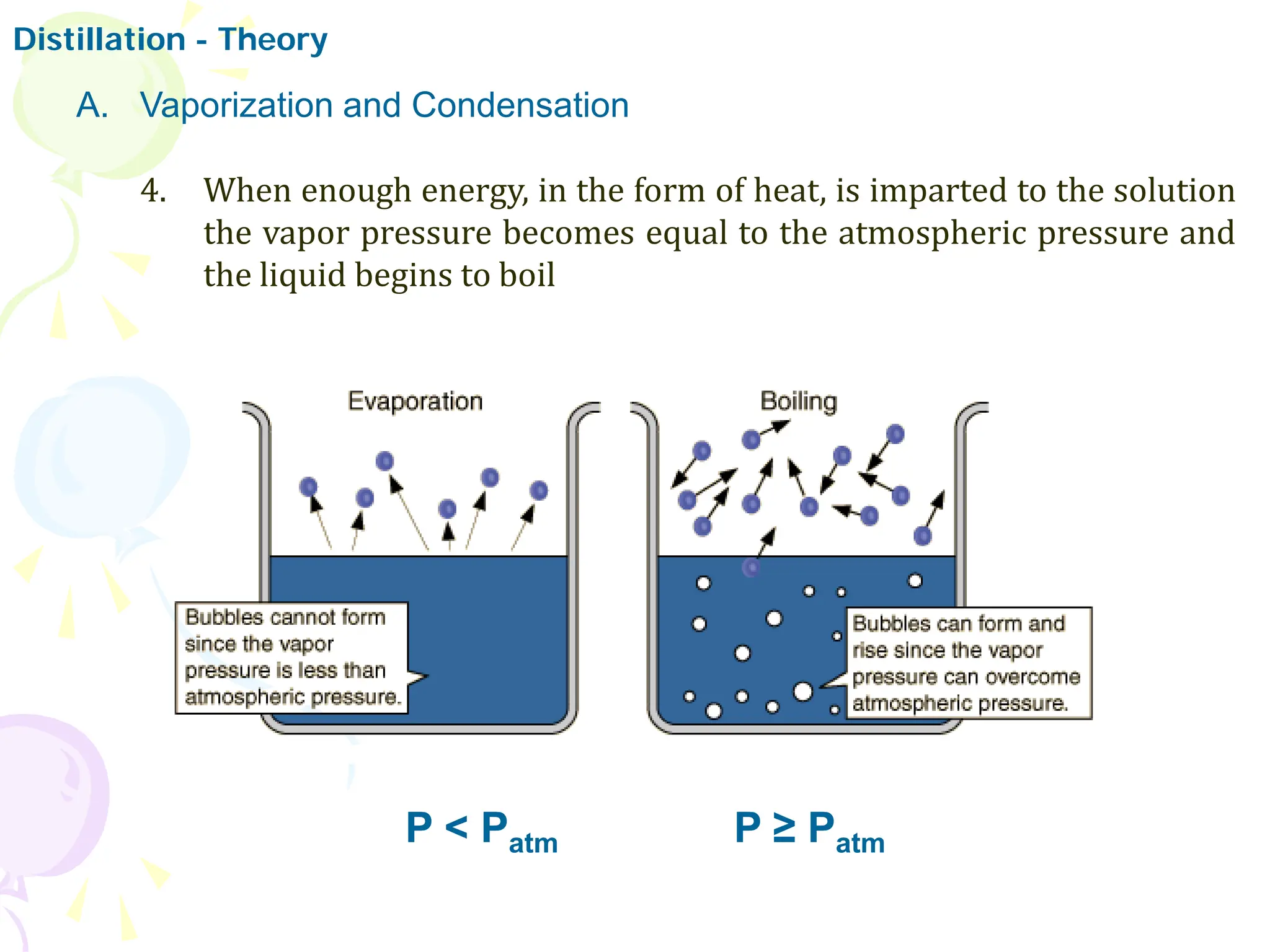
4. When enough energy, in the form of heat, is imparted to the solution
the vapor pressure becomes equal to the atmospheric pressure and
the liquid begins to boil
P < Patm P ≥ Patm
Distillation - Theory
The vapor
obtained
from a boiling
liquid, once
cooled, will
re-condense
to a liquid
known as the
distillate
The complete
process is
called a
distillation
Therefore, distillation processes depends on the vapour pressure
characteristics of liquid mixtures.
VAPOUR LIQUID EQUILIBRIA
The boiling point diagram shows how the equilibrium compositions
of the components in a liquid mixture vary with temperature at a fixed
pressure.
Consider an example of a liquid mixture containing 2 components (A
and B) - a binary mixture. This has the following boiling point diagram.
The boiling point of A is that at which the mole fraction of A is 1.
The boiling point of B is that at which the mole fraction of A is 0.
In this example, A is the more volatile component and therefore has a
lower boiling point than B.
The upper curve in the diagram is called the dew-point curve while
the lower one is called the bubble-point curve.
The dew-point is the temperature at which the saturated vapour
starts to condense.
The bubble-point is the temperature at which the liquid starts to boil.
The region above the dew-point curve shows the equilibrium
composition of the superheated vapour while the region below the
bubble-point curve shows the equilibrium composition of the subcooled
liquid.
For example, when a subcooled liquid with mole fraction of A=0.4
(point A) is heated, its concentration remains constant until it reaches
the bubble-point (point B), when it starts to boil. The vapours evolved
during the boiling has the equilibrium composition given by point C,
approximately 0.8 mole fraction A. This is approximately 50% richer in A
than the original liquid.
This difference between liquid and vapour compositions is the basis
for distillation operations.
The Boiling Point Diagram
At Constant Pressure
The vapour pressure of a liquid
at a particular temperature is
the equilibrium pressure exerted
by molecules leaving and
entering the liquid surface.
7
Boiling-point diagram for system benzene (A)-toluene (B) at a total pressure
of 101.32 kPa.
Boiling-Point Diagrams and xy Plots
Dew point is the temperature at which
the saturated vapour starts to condense.
Bubble-point is the temperature at
which the liquid starts to boil.
The difference between liquid and
vapour compositions is the basis for
distillation operations.
A common method of plotting the equilibrium data is shown in Figure
where yA is plotted versus xA for the benzene-toluene system.
Figure: Equilibrium diagram for system benzene(A) – toluene(B) at 101.32
kPa (1atm).
VAPOUR LIQUID EQUILIBRIA: Non-ideal systems
This particular VLE plot shows a binary mixture that
has a uniform vapour-liquid equilibrium that is
relatively easy to separate.
These two VLE plots on the other hand, shows
non-ideal systems which will present more difficult
separations.
This type of VLE curves are generated by azeotropic
systems.
An azeotrope is a liquid mixture which when
vaporised, produces the same composition as the
liquid.
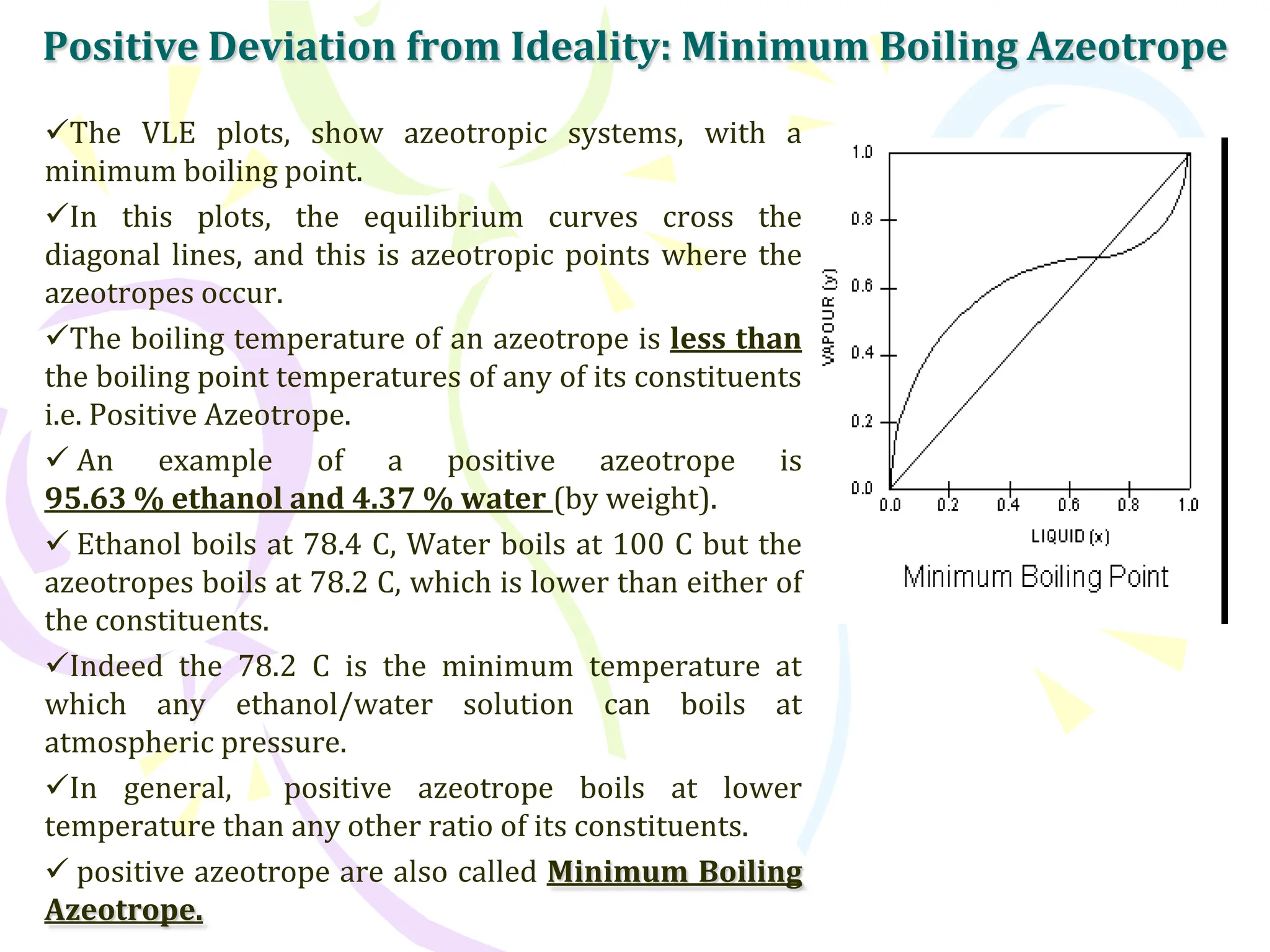
Positive Deviation from Ideality: Minimum Boiling Azeotrope
The VLE plots, show azeotropic systems, with a
minimum boiling point.
In this plots, the equilibrium curves cross the
diagonal lines, and this is azeotropic points where the
azeotropes occur.
The boiling temperature of an azeotrope is less than
the boiling point temperatures of any of its constituents
i.e. Positive Azeotrope.
 An example of a positive azeotrope is
95.63 % ethanol and 4.37 % water (by weight).
 Ethanol boils at 78.4 C, Water boils at 100 C but the
azeotropes boils at 78.2 C, which is lower than either of
the constituents.
Indeed the 78.2 C is the minimum temperature at
which any ethanol/water solution can boils at
atmospheric pressure.
In general, positive azeotrope boils at lower
temperature than any other ratio of its constituents.
 positive azeotrope are also called Minimum Boiling
Azeotrope.
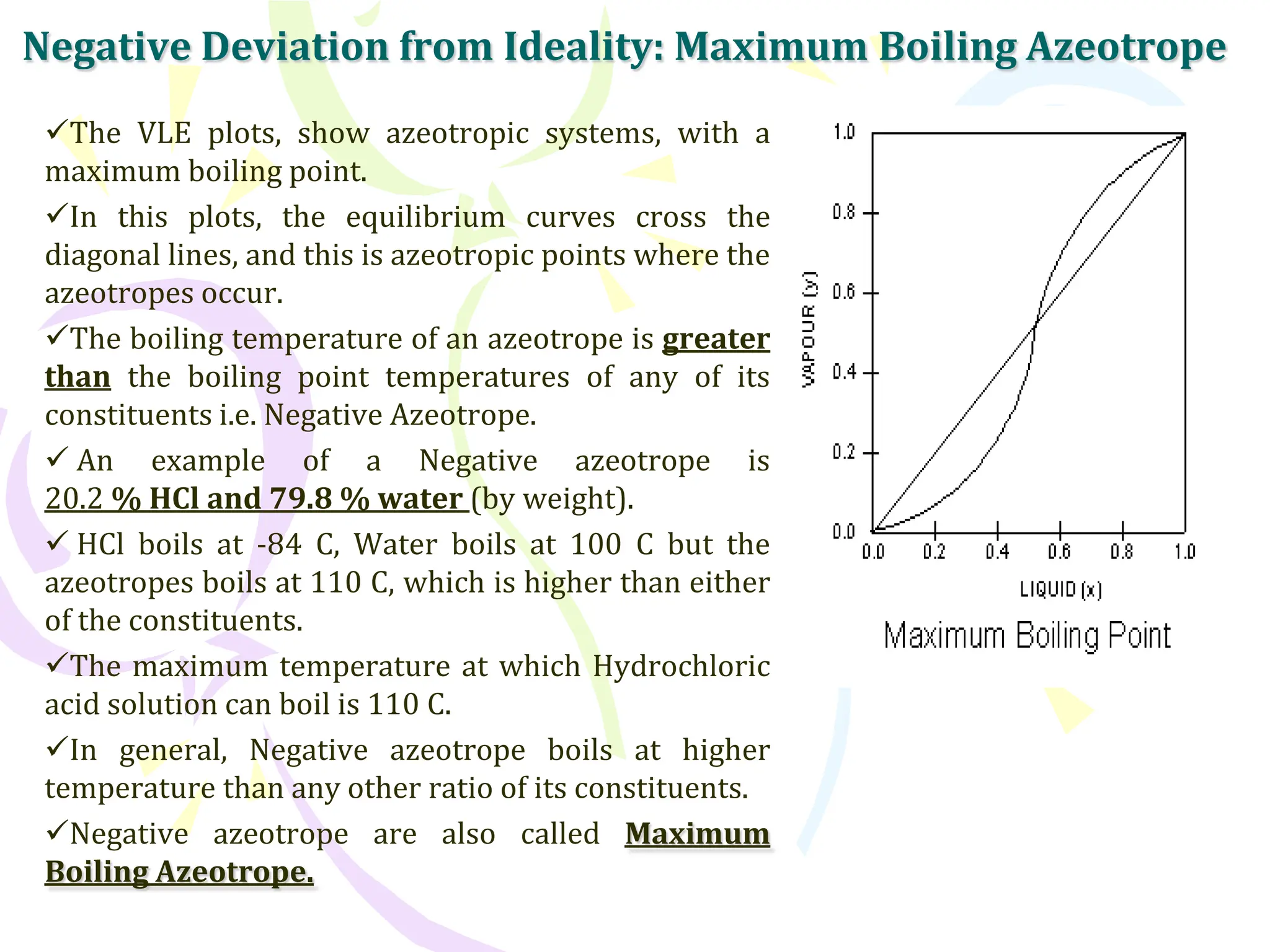
Negative Deviation from Ideality: Maximum Boiling Azeotrope
The VLE plots, show azeotropic systems, with a
maximum boiling point.
In this plots, the equilibrium curves cross the
diagonal lines, and this is azeotropic points where the
azeotropes occur.
The boiling temperature of an azeotrope is greater
than the boiling point temperatures of any of its
constituents i.e. Negative Azeotrope.
 An example of a Negative azeotrope is
20.2 % HCl and 79.8 % water (by weight).
 HCl boils at -84 C, Water boils at 100 C but the
azeotropes boils at 110 C, which is higher than either
of the constituents.
The maximum temperature at which Hydrochloric
acid solution can boil is 110 C.
In general, Negative azeotrope boils at higher
temperature than any other ratio of its constituents.
Negative azeotrope are also called Maximum
Boiling Azeotrope.
Vapor-Liquid Equilibrium Relations
Raoult’s Law ( For Ideal Solutions)
It states that the partial pressure of an ideal solution is directly
dependent on the vapour pressure of each chemical component and
the mole fraction of the component present in the solution
Where
pA* is the partial pressure of component A in the vapor in Pa (atm)
PA is the vapor pressure of pure A in Pa (atm)
xA is the mole fraction of A in the liquid.
A
A
A x
P
p =
*
B
A x
x +
=
1
B
A y
y +
=
1
Composition in liquid:
Composition in vapor:
(1)
(2)
(3)
Henry’s Law (for gases)
Henry's Law: The partial pressure of a gas is proportional
to its mole fraction.
At constant temperature, the amount of a given gas dissolved in a given type
and volume of liquid is directly proportional to the partial pressure of that gas
in equilibrium with that liquid. This is known as Henry's Law.
C = kPgas
where
C is the solubility of a gas at a fixed temperature in a particular solvent
k is Henry's law constant
Pgas is the partial pressure of the gas.
Relative Volatility (α )
Relative volatility is a measure of the differences in volatility between 2
components, and hence their boiling points.
It indicates how easy or difficult a particular separation will be.
The relative volatility of component ‘i’ with respect to component ‘j’ is
defined as
yi = mole fraction of component ‘i’ in the vapour
xi = mole fraction of component ‘i’ in the liquid
Thus if the relative volatility between 2 components is very close to 1. It is an indication that
they have very similar vapour pressure characteristics. This means that they have very similar
boiling points and therefore, it will be difficult to separate the two components via distillation.
Differential distillation
 Consider a binary mixture of A (more
volatile) and B (less volatile).
 The set-up is as shown in the Figure.
 The system consist of a batch of liquid
(fixed quantity) inside a kettle (or still)
fitted with heating element or steam jacket,
and a condenser to condense the vapour
produced.
 The condensed vapour is known as the
distillate. The distillate is collected in a
condensate receiver.
 The liquid remaining in the still is known as
the residual.
 The composition of the material collected in
the receiver varies with time, so the
composition of the product is an average of
all the material collected.
Therefore. y*dL = L dx + x dL
y*dL – x dL = L dx
(y* – x) dL = L dx
(dL/L) = (1/ y*- x) dx
Now. integrating from F to W, and from XF TO XW, we obtain the Rayleigh Equation:
∫
∫ −
=






= ∗
F
w
x
x
F
W
x
y
dx
W
F
L
dL
ln
The pot is filled with liquid mixture and heated.
Vapour flows upwards though the column and
condenses at the top.
Nothing is added or withdrawn from the still until the run
is completed.
Let, F = moles of feed
W = Moles of residue
xF = mole fraction of A in feed
xW= mole fraction of A in residue
Derivation of Rayleigh Equation
(Material Balance: Differential distillation)
Total material component A
Moles in 0 0
Moles out dD y* dD
Moles accumulation dL d(Lx) = Ldx + xdL
In-out = Accumulation 0-dD = dL 0-y*dD = d(Lx) = Ldx+ xdL
Flash Vaporization
A single-stage continuous operation where a liquid mixture is partially
vaporized: the vapour produced and the residual liquid are in
equilibrium, which are then separated and removed.
Consider a binary mixture of A (MVC) and B (LVC).
The feed is preheated before entering the separator.
As such, part of the feed may be vaporized.
The heated mixture then flows through a pressure-reducing valve to
the separator.
In the separator, separation between the vapour and liquid takes
place.
How much of A is produced in the vapour (and remained in the
liquid) depends on the condition of the feed, i.e. how much of the feed is
entering as vapour state, which in turn is controlled by the amount of
heating.
In other words, the degree of vapourization affects the concentration
(distribution) of A in vapour phase and liquid phase.
There is thus a certain relationship between the degree of heating
(vapourization) and mole fraction of A in vapour and liquid (y and x).
This relationship is known as the Operating Line Equation
Operating Line Equation for Flash Distillation:
Material Balance
Let,
f = molal fraction of the feed that is vaporized and withdrawn continuously as vapour
(1- f) = is the molal fraction of the feed that leaves continuously as liquid.
yD = mole fraction of A in vapour leaving
xB = mole fraction of A in liquid leaving
xF = mole fraction of A in feed entering
From material balance for the more volatile component (A):
xF = f yD + (1 - f) xB
f yD = xF - (1 - f) xB
Re-arrange into the form y = f(x):
( Y = mX + C )
Where, -(1-f)/f = the slope of operating line.
For f = 1 , Slope -(1-f)/f = 0
f = 0, Slope -(1-f)/f = Infinite
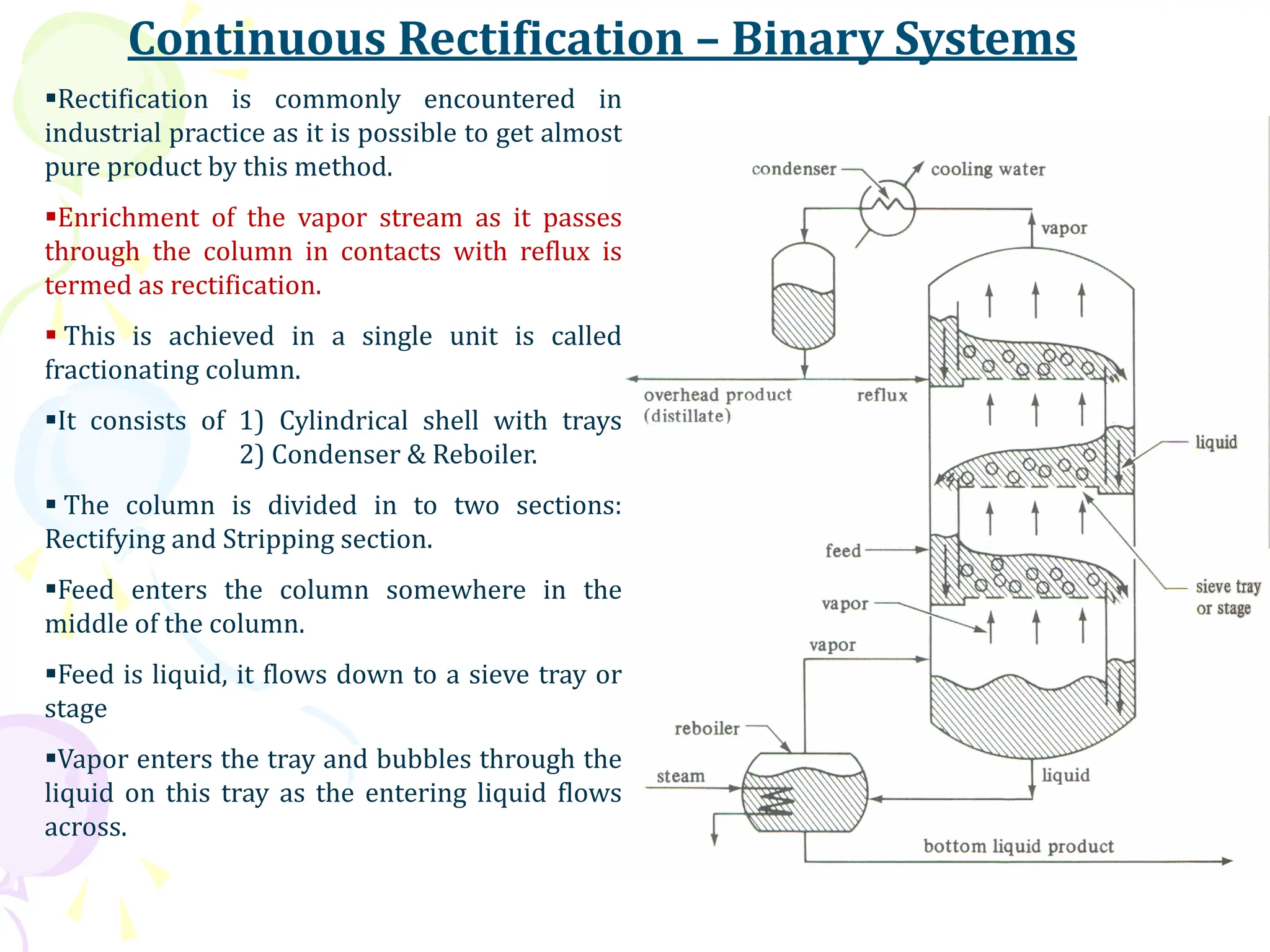
Continuous Rectification – Binary Systems
Rectification is commonly encountered in
industrial practice as it is possible to get almost
pure product by this method.
Enrichment of the vapor stream as it passes
through the column in contacts with reflux is
termed as rectification.
 This is achieved in a single unit is called
fractionating column.
It consists of 1) Cylindrical shell with trays
2) Condenser & Reboiler.
 The column is divided in to two sections:
Rectifying and Stripping section.
Feed enters the column somewhere in the
middle of the column.
Feed is liquid, it flows down to a sieve tray or
stage
Vapor enters the tray and bubbles through the
liquid on this tray as the entering liquid flows
across.
The vapor and liquid leaving the tray are
essentially in equilibrium.
The vapor continues up to the next tray or stage,
where it is again contacted with a down flowing
liquid.
The concentration of the more volatile component
is being increased in the vapor form each stage
going upward and decreased in the liquid from
each stage going downwards.
The final vapor product coming overhead is
condensed in a condenser and a portion of the
liquid product (distillate) is removed, which
contains a high concentration of A.
 The part of the condensed liquid is returned back
as a reflux to top tray.
The liquid leaving the bottom tray enters a
reboiler, where it partially vaporized, and the
remaining liquid, which is lean in A or rich in B, is
withdrawn as liquid product.
The vapor from the reboiler is sent back to the
bottom stage or trays is much greater.
Continuous Rectification: Overall Enthalpy Balance
The molar ratio of reflux to withdrawn
distillates is the reflux ratio:
R = Lo/D
Total M.B. around Condenser:
G1 = D + Lo
Or G1 = D + RD = D ( R+1 )
For Substance A:
G1 y1= D zD+ Loxo
The Enthalpy balance around Condenser:
G1HG1 = Qc + DHD + LoHLo
Qc = D {( R+1 ) HG1 – HD – RHLo }
Provides the heat load over a Condenser .
The reboiler heat is then obtained by
complete enthalpy balance of entire
column:
QB = DHD + WHW + QC + QL – FHF
McCABE-THIELE DESIGN METHOD
It is graphical procedure of obtaining theoretical
plates.
It assumes constant molar overflow and this implies
that:
 Constant Molal heat of vaporization (For every
mole of vapour condensed, 1 mole of liquid is
vaporised)
No heat losses
 No heat of mixing
The operating line for the rectifying section becomes:
The operating line for the stripping section becomes:
1
1 +
+
+
=
R
X
X
R
R
y D
W
L
WXw
X
W
L
L
x
−
−
−
=
'
'
'
Stepwise Procedure for obtaining Theoretical Trays by McCabe-Thiele Method
1. By material balance, evaluate the terms D, W, L etc.
2. Draw the equilibrium curve and diagonal with the help of x-y data given. If the
relative volatility is given generate x-y data using the relative value provided. ( y
= αx/(1+ (α-1)x)).
3. Draw the operating line of rectifying section through point (XD, XD) on the
diagonal and with the intercept equal to XD/(R+1) or DXD/ (L+D) or slope =
R/(R+1).
4. Draw the operating line of stripping section through point (Xw, Xw) on the
diagonal and with a slope equal to L’/(L’+W’).
5. Starting from the (XD, XD) on diagonal, draw a horizontal line to meet the
equilibrium curve and drop a vertical from that point to meet the operating
line.
6. Proceed in this way, that is constructing the triangles between equilibrium
curve and operating line of rectifying section and stripping section.
7. Proceed in the same manner till we reach/across the point (Xw, Xw).
8. Count the number of triangles constructed between XD and Xw. Each triangles
on the x-y diagram represents a theoretical plate.
9. If the no. of triangles are ‘n’ then ‘n’ represents the theoretical no. of plates
including reboiler and ‘n-1’ represents the no. of theoretical plates in a column.
Stepwise Procedure for obtaining Theoretical Trays by McCabe-Thiele Method
Introduction of Feed : the q-line
Consider the section of the distillation column ( see the Figure below) at the tray where
the feed is introduced (known as the feed tray location), say tray f :
The feed may consists of liquid, vapour or a mixture of both. The quantities of the
liquid stream and vapour stream in the rectifying and stripping sections may change
abruptly because of the addition of the feed stream.
q = Energy to convert 1 mole of feed to saturated vapour
Molal latent heat of vaporization.
The value of q can be controlled by adjusting the amount of preheat the feed stream is
subjected to before entering the column.
For different feed conditions, q has the following numerical limits :
· Cold feed (below bubble point) q > 1
· Feed at bubble point (saturated liquid) q = 1
· Feed partially vapour 0 < q < 1
· Feed at dew point (saturated vapour) q = 0
· Feed superheated vapour q < 0
Location of Feed Tray
Optimum location would be the one represented by the triangle that
has one corner on the rectifying line and the other corner on the
stripping line.
As can be seen from the Figure below, the optimum feed location is
stage no.5 that results in the least number of stages. Any other
location would have resulted in more than 5 trays.
Reflux Ratio (R = L/D):
A part of distillate material is recycle back to
top of the distillation column is known as
reflux ratio.
Total Reflux Ratio (R =D):
A enough distillate material is recycle back
to top of the distillation column under total
reflux.
As R increases, the Rectifying Operating
Line (ROL) rotates downward around (XD,
XD), and the number of theoretical stages
required for separation decreases.
At very large value of R ( as R approaches
infinity), the slope approaches 1.0 and the
intercept approaches 0. The ROL (thus the
SOL as well) coincides with the 45o diagonal
line. This is shown in the Figure.
Minimum trays are required under total
reflux conditions, i.e. there is no withdrawal
of distillate.
Minimum Reflux Ratio (Rm):
As the reflux ratio is reduced, the distance between the operating line and the
equilibrium curve becomes smaller.
The minimum reflux ratio Rm is the limiting reflux where the operating line either
touches the equilibrium curve or intersects the equilibrium curve at the q-line.
The minimum reflux ratio will require an infinite number of trays to attain the
specified separation of XD and XB.
Optimum Reflux Ratio
Any reflux ratio between infinite reflux ratio and
minimum reflux ratio which requires finite stages for
the desired degree of separation.
At minimum reflux ratio, infinite no. of trays are
required , fixed cost is also infinite while the cost of
heat duty of reboiler and condenser coolant is
minimum.
As the reflux ratio is increased, the no. of plates
decreases and the fixed cost decreases at first, passes
through minimum and then increases with higher
reflux ratio, diameter of the column and sizes of
reboiler and condenser.
The operating cost is continuously increases as it is
directly proportional to the reflux ratio.
The total cost is sum of the fixed cost and operating
cost also decreases to a minimum and then increases
with reflux ratio.
The optimum reflux ratio occurs at a point where
total cost is minimum.
The optimum reflux ratio usually lies in the range of
1.2 to 1.5 times the minimum reflux ratio.
Molecular Distillation
It is a thermal separation technique operating at a process pressures in the range of 1 to
0,001 mbar.
It lowers the boiling temperature and is an excellent method for gentle thermal treatment
of heat sensitive products.
Molecular distillation consists of vertically mounted walled vacuum chamber with a central
inner condenser.
Feed is continuously fed on a rotating distributing plate at top.
Separation depends on the difference of molecular mean free path to separate different
matters. Molecular mean free path means the path between a molecule striking two times.
When the mixture liquid flows along the heating board and is heated, light
and heavy molecule will become into vapor phase.
Light and heavy molecule will have different moving distance when they are in
vapor phase because they have different mean free path.
Supposing that we put a condensation board at the proper position, light molecule can
reach the board and will be condensed, then be guided along the condensation board; while
the heavy molecule can not reach the condensation board and
will be guided along the heating board. In this way, the objective of separation has been
made.
Application of molecular distillation:
Separation of vitamin E.
Separation of monoglyceride.
Deacidification of ricebran oil and palm oil.
Molecular Distillation
Characteristics of
molecular distillation
technology:
1. Operation temperature is
low (lower than boiling
point), with reduced
pressure (lower than
1Pa), heating time is
short (several seconds)
and the efficiency of
separation is high.
2. Removing odor , color and
impurities of mixture.
3. The separation degree is
higher than the
traditional distillation.
4. Operating at a process
pressures in the range of
0,001 mbar.
Azeotropic Distillation
This is the special case of multi component distillation used for the
separation of binary mixture. If the relative volatility of binary mixture is very
low, it may form binary azeotrope. Under these circumstances a third
component called entrainer, may be added to the binary mixture to form a
new low-boiling azeotrope with one of the original constituents.
As an example, consider the operation of the azeotropic distillation of acetic
acid-water mixture using n-butyl acetate (a type of ester) as the entrainer, as
shown in the Figure. The boiling point of pure acetic acid is 118.1oC, and for
water 100oC.
Addition of n-butyl acetate will result in the formation of a minimum-boiling
azeotrope with water (boiling point 90.2oC). The azeotropic mixture therefore
will be distilled over as vapour product from the high-boiling acetic acid, which
leaves as bottoms product.
When the overhead vapour is condensed and collected in a decanter, it forms
two insoluble layers: top layer of nearly pure butyl acetate saturated with
water, and a bottom layer of nearly pure water saturated with butyl acetate.
The liquid from the top layer is returned to the distillation column as reflux
and source of entrainer. The liquid from the bottom layer is sent to another
column for the recovery of the entrainer by removing the water using steam
stripping.
Azeotropic Distillation
Extractive Distillation
This process is very similar to azeotropic distillation.
In extractive distillation third component called solvent added to binary mixture
which alters the relative volatilities of components.
As an example, consider the simplified system shown in the Figure for separation of
toluene and iso-octane using phenol as the solvent.
The separation of toluene (boiling point 110.8 oC) from iso-octane (boiling point 99.3
oC) is difficult using conventional distillation.
Addition of phenol (boiling point 181.4 oC) results in the formation of phenol-toluene
mixture that leaves the extractive distillation column as bottoms, while relatively
iso-octane is recovered as overhead product.
The phenol-toluene mixture is further separated in a second column (solvent
recovery column) whereby toluene appears as distillate and the bottoms product,
phenol, is recycled back to the first column.
In the above example, when the solvent is added to the original feed mixture it forms
a new mixture with one of the feed components by "absorbing" that component. This
new mixture has a much higher boiling point than the other feed component that is not
absorbed so that it leaves as bottoms product from the extractive distillation column.
The unabsorbed feed component then leaves as the overhead product.
The absence of azeotropes plus the fact that the solvent can be recovered by simple
distillation makes extractive distillation a less complex and more widely useful process
than azeotropic distillation
Extractive Distillation
Types of Reboilers
Reboilers are heat exchangers typically used
to provide heat to the bottom of industrial
distillation columns.
They boil the liquid from the bottom of a
distillation column to generate vapors which are
returned to the column to drive the distillation
separation.
Several types of reboilers are available.
Jacketed kettle type used in small fractionator
for pilot plant work, but heat transfer surface and
vapor capacity will necessarily be small.
The internal tubular type reboiler built into the
bottom of the tower which provides larger
surface but cleaning requires a shut down of the
distillation operation.
Kettle type reboiler with heating medium
inside the tubes, provides a vapor to the tower
essentially in equilibrium with the residue
product and then behaves like a theoretical
stages.
The vertical thermosiphon reboiler with
heating medium outside the tubes, so as to
vaporize all the liquid entering it to produce a
vapor of the same composition as the residue
product.

Distillation-1.vapour liquid equilibrium

  • 1.
    Distillation COMPILED BY: Mr. M.R. NASIT LECTURER IN CHEMICAL ENGINEERING DEPARTMENT GOVERNMENT POLYTECHNIC VALSAD
  • 2.
    Distillation……?  Separation ofcomponents from a liquid mixture depends on the differences in boiling points of the individual components.  Distillation is used separate 2 or more miscible substances based n their relative volatility. (Ex: Ethanol & Water)  It increases purity of substance present in the mixture (Both Ethanol & Water).  It uses vaporization and condensation method for purification.
  • 3.
    A. Vaporization andCondensation 1. For any liquid, the individual molecules within the liquid are continuously in motion 2. A small percentage of these molecules attain enough kinetic energy to leave the liquid phase 3. This exerts an opposing pressure on the atmosphere above the solution known as the vapor pressure, P Vapor Pressure, P Atmospheric pressure, Patm Distillation - Theory
  • 4.
    A. Vaporization andCondensation 4. When enough energy, in the form of heat, is imparted to the solution the vapor pressure becomes equal to the atmospheric pressure and the liquid begins to boil P < Patm P ≥ Patm Distillation - Theory
  • 5.
    The vapor obtained from aboiling liquid, once cooled, will re-condense to a liquid known as the distillate The complete process is called a distillation Therefore, distillation processes depends on the vapour pressure characteristics of liquid mixtures.
  • 6.
    VAPOUR LIQUID EQUILIBRIA Theboiling point diagram shows how the equilibrium compositions of the components in a liquid mixture vary with temperature at a fixed pressure. Consider an example of a liquid mixture containing 2 components (A and B) - a binary mixture. This has the following boiling point diagram. The boiling point of A is that at which the mole fraction of A is 1. The boiling point of B is that at which the mole fraction of A is 0. In this example, A is the more volatile component and therefore has a lower boiling point than B. The upper curve in the diagram is called the dew-point curve while the lower one is called the bubble-point curve. The dew-point is the temperature at which the saturated vapour starts to condense. The bubble-point is the temperature at which the liquid starts to boil. The region above the dew-point curve shows the equilibrium composition of the superheated vapour while the region below the bubble-point curve shows the equilibrium composition of the subcooled liquid. For example, when a subcooled liquid with mole fraction of A=0.4 (point A) is heated, its concentration remains constant until it reaches the bubble-point (point B), when it starts to boil. The vapours evolved during the boiling has the equilibrium composition given by point C, approximately 0.8 mole fraction A. This is approximately 50% richer in A than the original liquid. This difference between liquid and vapour compositions is the basis for distillation operations. The Boiling Point Diagram At Constant Pressure The vapour pressure of a liquid at a particular temperature is the equilibrium pressure exerted by molecules leaving and entering the liquid surface.
  • 7.
    7 Boiling-point diagram forsystem benzene (A)-toluene (B) at a total pressure of 101.32 kPa. Boiling-Point Diagrams and xy Plots Dew point is the temperature at which the saturated vapour starts to condense. Bubble-point is the temperature at which the liquid starts to boil. The difference between liquid and vapour compositions is the basis for distillation operations.
  • 8.
    A common methodof plotting the equilibrium data is shown in Figure where yA is plotted versus xA for the benzene-toluene system. Figure: Equilibrium diagram for system benzene(A) – toluene(B) at 101.32 kPa (1atm).
  • 9.
    VAPOUR LIQUID EQUILIBRIA:Non-ideal systems This particular VLE plot shows a binary mixture that has a uniform vapour-liquid equilibrium that is relatively easy to separate. These two VLE plots on the other hand, shows non-ideal systems which will present more difficult separations. This type of VLE curves are generated by azeotropic systems. An azeotrope is a liquid mixture which when vaporised, produces the same composition as the liquid.
  • 10.
    Positive Deviation fromIdeality: Minimum Boiling Azeotrope The VLE plots, show azeotropic systems, with a minimum boiling point. In this plots, the equilibrium curves cross the diagonal lines, and this is azeotropic points where the azeotropes occur. The boiling temperature of an azeotrope is less than the boiling point temperatures of any of its constituents i.e. Positive Azeotrope.  An example of a positive azeotrope is 95.63 % ethanol and 4.37 % water (by weight).  Ethanol boils at 78.4 C, Water boils at 100 C but the azeotropes boils at 78.2 C, which is lower than either of the constituents. Indeed the 78.2 C is the minimum temperature at which any ethanol/water solution can boils at atmospheric pressure. In general, positive azeotrope boils at lower temperature than any other ratio of its constituents.  positive azeotrope are also called Minimum Boiling Azeotrope.
  • 11.
    Negative Deviation fromIdeality: Maximum Boiling Azeotrope The VLE plots, show azeotropic systems, with a maximum boiling point. In this plots, the equilibrium curves cross the diagonal lines, and this is azeotropic points where the azeotropes occur. The boiling temperature of an azeotrope is greater than the boiling point temperatures of any of its constituents i.e. Negative Azeotrope.  An example of a Negative azeotrope is 20.2 % HCl and 79.8 % water (by weight).  HCl boils at -84 C, Water boils at 100 C but the azeotropes boils at 110 C, which is higher than either of the constituents. The maximum temperature at which Hydrochloric acid solution can boil is 110 C. In general, Negative azeotrope boils at higher temperature than any other ratio of its constituents. Negative azeotrope are also called Maximum Boiling Azeotrope.
  • 12.
    Vapor-Liquid Equilibrium Relations Raoult’sLaw ( For Ideal Solutions) It states that the partial pressure of an ideal solution is directly dependent on the vapour pressure of each chemical component and the mole fraction of the component present in the solution Where pA* is the partial pressure of component A in the vapor in Pa (atm) PA is the vapor pressure of pure A in Pa (atm) xA is the mole fraction of A in the liquid. A A A x P p = * B A x x + = 1 B A y y + = 1 Composition in liquid: Composition in vapor: (1) (2) (3)
  • 13.
    Henry’s Law (forgases) Henry's Law: The partial pressure of a gas is proportional to its mole fraction. At constant temperature, the amount of a given gas dissolved in a given type and volume of liquid is directly proportional to the partial pressure of that gas in equilibrium with that liquid. This is known as Henry's Law. C = kPgas where C is the solubility of a gas at a fixed temperature in a particular solvent k is Henry's law constant Pgas is the partial pressure of the gas.
  • 14.
    Relative Volatility (α) Relative volatility is a measure of the differences in volatility between 2 components, and hence their boiling points. It indicates how easy or difficult a particular separation will be. The relative volatility of component ‘i’ with respect to component ‘j’ is defined as yi = mole fraction of component ‘i’ in the vapour xi = mole fraction of component ‘i’ in the liquid Thus if the relative volatility between 2 components is very close to 1. It is an indication that they have very similar vapour pressure characteristics. This means that they have very similar boiling points and therefore, it will be difficult to separate the two components via distillation.
  • 15.
    Differential distillation  Considera binary mixture of A (more volatile) and B (less volatile).  The set-up is as shown in the Figure.  The system consist of a batch of liquid (fixed quantity) inside a kettle (or still) fitted with heating element or steam jacket, and a condenser to condense the vapour produced.  The condensed vapour is known as the distillate. The distillate is collected in a condensate receiver.  The liquid remaining in the still is known as the residual.  The composition of the material collected in the receiver varies with time, so the composition of the product is an average of all the material collected.
  • 16.
    Therefore. y*dL =L dx + x dL y*dL – x dL = L dx (y* – x) dL = L dx (dL/L) = (1/ y*- x) dx Now. integrating from F to W, and from XF TO XW, we obtain the Rayleigh Equation: ∫ ∫ − =       = ∗ F w x x F W x y dx W F L dL ln The pot is filled with liquid mixture and heated. Vapour flows upwards though the column and condenses at the top. Nothing is added or withdrawn from the still until the run is completed. Let, F = moles of feed W = Moles of residue xF = mole fraction of A in feed xW= mole fraction of A in residue Derivation of Rayleigh Equation (Material Balance: Differential distillation) Total material component A Moles in 0 0 Moles out dD y* dD Moles accumulation dL d(Lx) = Ldx + xdL In-out = Accumulation 0-dD = dL 0-y*dD = d(Lx) = Ldx+ xdL
  • 17.
    Flash Vaporization A single-stagecontinuous operation where a liquid mixture is partially vaporized: the vapour produced and the residual liquid are in equilibrium, which are then separated and removed.
  • 18.
    Consider a binarymixture of A (MVC) and B (LVC). The feed is preheated before entering the separator. As such, part of the feed may be vaporized. The heated mixture then flows through a pressure-reducing valve to the separator. In the separator, separation between the vapour and liquid takes place. How much of A is produced in the vapour (and remained in the liquid) depends on the condition of the feed, i.e. how much of the feed is entering as vapour state, which in turn is controlled by the amount of heating. In other words, the degree of vapourization affects the concentration (distribution) of A in vapour phase and liquid phase. There is thus a certain relationship between the degree of heating (vapourization) and mole fraction of A in vapour and liquid (y and x). This relationship is known as the Operating Line Equation
  • 19.
    Operating Line Equationfor Flash Distillation: Material Balance Let, f = molal fraction of the feed that is vaporized and withdrawn continuously as vapour (1- f) = is the molal fraction of the feed that leaves continuously as liquid. yD = mole fraction of A in vapour leaving xB = mole fraction of A in liquid leaving xF = mole fraction of A in feed entering From material balance for the more volatile component (A): xF = f yD + (1 - f) xB f yD = xF - (1 - f) xB Re-arrange into the form y = f(x): ( Y = mX + C ) Where, -(1-f)/f = the slope of operating line. For f = 1 , Slope -(1-f)/f = 0 f = 0, Slope -(1-f)/f = Infinite
  • 21.
    Continuous Rectification –Binary Systems Rectification is commonly encountered in industrial practice as it is possible to get almost pure product by this method. Enrichment of the vapor stream as it passes through the column in contacts with reflux is termed as rectification.  This is achieved in a single unit is called fractionating column. It consists of 1) Cylindrical shell with trays 2) Condenser & Reboiler.  The column is divided in to two sections: Rectifying and Stripping section. Feed enters the column somewhere in the middle of the column. Feed is liquid, it flows down to a sieve tray or stage Vapor enters the tray and bubbles through the liquid on this tray as the entering liquid flows across.
  • 22.
    The vapor andliquid leaving the tray are essentially in equilibrium. The vapor continues up to the next tray or stage, where it is again contacted with a down flowing liquid. The concentration of the more volatile component is being increased in the vapor form each stage going upward and decreased in the liquid from each stage going downwards. The final vapor product coming overhead is condensed in a condenser and a portion of the liquid product (distillate) is removed, which contains a high concentration of A.  The part of the condensed liquid is returned back as a reflux to top tray. The liquid leaving the bottom tray enters a reboiler, where it partially vaporized, and the remaining liquid, which is lean in A or rich in B, is withdrawn as liquid product. The vapor from the reboiler is sent back to the bottom stage or trays is much greater.
  • 23.
    Continuous Rectification: OverallEnthalpy Balance The molar ratio of reflux to withdrawn distillates is the reflux ratio: R = Lo/D Total M.B. around Condenser: G1 = D + Lo Or G1 = D + RD = D ( R+1 ) For Substance A: G1 y1= D zD+ Loxo The Enthalpy balance around Condenser: G1HG1 = Qc + DHD + LoHLo Qc = D {( R+1 ) HG1 – HD – RHLo } Provides the heat load over a Condenser . The reboiler heat is then obtained by complete enthalpy balance of entire column: QB = DHD + WHW + QC + QL – FHF
  • 24.
    McCABE-THIELE DESIGN METHOD Itis graphical procedure of obtaining theoretical plates. It assumes constant molar overflow and this implies that:  Constant Molal heat of vaporization (For every mole of vapour condensed, 1 mole of liquid is vaporised) No heat losses  No heat of mixing The operating line for the rectifying section becomes: The operating line for the stripping section becomes: 1 1 + + + = R X X R R y D W L WXw X W L L x − − − = ' ' '
  • 25.
    Stepwise Procedure forobtaining Theoretical Trays by McCabe-Thiele Method 1. By material balance, evaluate the terms D, W, L etc. 2. Draw the equilibrium curve and diagonal with the help of x-y data given. If the relative volatility is given generate x-y data using the relative value provided. ( y = αx/(1+ (α-1)x)). 3. Draw the operating line of rectifying section through point (XD, XD) on the diagonal and with the intercept equal to XD/(R+1) or DXD/ (L+D) or slope = R/(R+1). 4. Draw the operating line of stripping section through point (Xw, Xw) on the diagonal and with a slope equal to L’/(L’+W’). 5. Starting from the (XD, XD) on diagonal, draw a horizontal line to meet the equilibrium curve and drop a vertical from that point to meet the operating line. 6. Proceed in this way, that is constructing the triangles between equilibrium curve and operating line of rectifying section and stripping section. 7. Proceed in the same manner till we reach/across the point (Xw, Xw). 8. Count the number of triangles constructed between XD and Xw. Each triangles on the x-y diagram represents a theoretical plate. 9. If the no. of triangles are ‘n’ then ‘n’ represents the theoretical no. of plates including reboiler and ‘n-1’ represents the no. of theoretical plates in a column.
  • 26.
    Stepwise Procedure forobtaining Theoretical Trays by McCabe-Thiele Method
  • 27.
    Introduction of Feed: the q-line Consider the section of the distillation column ( see the Figure below) at the tray where the feed is introduced (known as the feed tray location), say tray f : The feed may consists of liquid, vapour or a mixture of both. The quantities of the liquid stream and vapour stream in the rectifying and stripping sections may change abruptly because of the addition of the feed stream. q = Energy to convert 1 mole of feed to saturated vapour Molal latent heat of vaporization. The value of q can be controlled by adjusting the amount of preheat the feed stream is subjected to before entering the column. For different feed conditions, q has the following numerical limits : · Cold feed (below bubble point) q > 1 · Feed at bubble point (saturated liquid) q = 1 · Feed partially vapour 0 < q < 1 · Feed at dew point (saturated vapour) q = 0 · Feed superheated vapour q < 0
  • 29.
    Location of FeedTray Optimum location would be the one represented by the triangle that has one corner on the rectifying line and the other corner on the stripping line. As can be seen from the Figure below, the optimum feed location is stage no.5 that results in the least number of stages. Any other location would have resulted in more than 5 trays.
  • 30.
    Reflux Ratio (R= L/D): A part of distillate material is recycle back to top of the distillation column is known as reflux ratio. Total Reflux Ratio (R =D): A enough distillate material is recycle back to top of the distillation column under total reflux. As R increases, the Rectifying Operating Line (ROL) rotates downward around (XD, XD), and the number of theoretical stages required for separation decreases. At very large value of R ( as R approaches infinity), the slope approaches 1.0 and the intercept approaches 0. The ROL (thus the SOL as well) coincides with the 45o diagonal line. This is shown in the Figure. Minimum trays are required under total reflux conditions, i.e. there is no withdrawal of distillate.
  • 31.
    Minimum Reflux Ratio(Rm): As the reflux ratio is reduced, the distance between the operating line and the equilibrium curve becomes smaller. The minimum reflux ratio Rm is the limiting reflux where the operating line either touches the equilibrium curve or intersects the equilibrium curve at the q-line. The minimum reflux ratio will require an infinite number of trays to attain the specified separation of XD and XB.
  • 32.
    Optimum Reflux Ratio Anyreflux ratio between infinite reflux ratio and minimum reflux ratio which requires finite stages for the desired degree of separation. At minimum reflux ratio, infinite no. of trays are required , fixed cost is also infinite while the cost of heat duty of reboiler and condenser coolant is minimum. As the reflux ratio is increased, the no. of plates decreases and the fixed cost decreases at first, passes through minimum and then increases with higher reflux ratio, diameter of the column and sizes of reboiler and condenser. The operating cost is continuously increases as it is directly proportional to the reflux ratio. The total cost is sum of the fixed cost and operating cost also decreases to a minimum and then increases with reflux ratio. The optimum reflux ratio occurs at a point where total cost is minimum. The optimum reflux ratio usually lies in the range of 1.2 to 1.5 times the minimum reflux ratio.
  • 33.
    Molecular Distillation It isa thermal separation technique operating at a process pressures in the range of 1 to 0,001 mbar. It lowers the boiling temperature and is an excellent method for gentle thermal treatment of heat sensitive products. Molecular distillation consists of vertically mounted walled vacuum chamber with a central inner condenser. Feed is continuously fed on a rotating distributing plate at top. Separation depends on the difference of molecular mean free path to separate different matters. Molecular mean free path means the path between a molecule striking two times. When the mixture liquid flows along the heating board and is heated, light and heavy molecule will become into vapor phase. Light and heavy molecule will have different moving distance when they are in vapor phase because they have different mean free path. Supposing that we put a condensation board at the proper position, light molecule can reach the board and will be condensed, then be guided along the condensation board; while the heavy molecule can not reach the condensation board and will be guided along the heating board. In this way, the objective of separation has been made. Application of molecular distillation: Separation of vitamin E. Separation of monoglyceride. Deacidification of ricebran oil and palm oil.
  • 34.
    Molecular Distillation Characteristics of moleculardistillation technology: 1. Operation temperature is low (lower than boiling point), with reduced pressure (lower than 1Pa), heating time is short (several seconds) and the efficiency of separation is high. 2. Removing odor , color and impurities of mixture. 3. The separation degree is higher than the traditional distillation. 4. Operating at a process pressures in the range of 0,001 mbar.
  • 35.
    Azeotropic Distillation This isthe special case of multi component distillation used for the separation of binary mixture. If the relative volatility of binary mixture is very low, it may form binary azeotrope. Under these circumstances a third component called entrainer, may be added to the binary mixture to form a new low-boiling azeotrope with one of the original constituents. As an example, consider the operation of the azeotropic distillation of acetic acid-water mixture using n-butyl acetate (a type of ester) as the entrainer, as shown in the Figure. The boiling point of pure acetic acid is 118.1oC, and for water 100oC. Addition of n-butyl acetate will result in the formation of a minimum-boiling azeotrope with water (boiling point 90.2oC). The azeotropic mixture therefore will be distilled over as vapour product from the high-boiling acetic acid, which leaves as bottoms product. When the overhead vapour is condensed and collected in a decanter, it forms two insoluble layers: top layer of nearly pure butyl acetate saturated with water, and a bottom layer of nearly pure water saturated with butyl acetate. The liquid from the top layer is returned to the distillation column as reflux and source of entrainer. The liquid from the bottom layer is sent to another column for the recovery of the entrainer by removing the water using steam stripping.
  • 36.
  • 37.
    Extractive Distillation This processis very similar to azeotropic distillation. In extractive distillation third component called solvent added to binary mixture which alters the relative volatilities of components. As an example, consider the simplified system shown in the Figure for separation of toluene and iso-octane using phenol as the solvent. The separation of toluene (boiling point 110.8 oC) from iso-octane (boiling point 99.3 oC) is difficult using conventional distillation. Addition of phenol (boiling point 181.4 oC) results in the formation of phenol-toluene mixture that leaves the extractive distillation column as bottoms, while relatively iso-octane is recovered as overhead product. The phenol-toluene mixture is further separated in a second column (solvent recovery column) whereby toluene appears as distillate and the bottoms product, phenol, is recycled back to the first column. In the above example, when the solvent is added to the original feed mixture it forms a new mixture with one of the feed components by "absorbing" that component. This new mixture has a much higher boiling point than the other feed component that is not absorbed so that it leaves as bottoms product from the extractive distillation column. The unabsorbed feed component then leaves as the overhead product. The absence of azeotropes plus the fact that the solvent can be recovered by simple distillation makes extractive distillation a less complex and more widely useful process than azeotropic distillation
  • 38.
  • 39.
    Types of Reboilers Reboilersare heat exchangers typically used to provide heat to the bottom of industrial distillation columns. They boil the liquid from the bottom of a distillation column to generate vapors which are returned to the column to drive the distillation separation. Several types of reboilers are available. Jacketed kettle type used in small fractionator for pilot plant work, but heat transfer surface and vapor capacity will necessarily be small. The internal tubular type reboiler built into the bottom of the tower which provides larger surface but cleaning requires a shut down of the distillation operation. Kettle type reboiler with heating medium inside the tubes, provides a vapor to the tower essentially in equilibrium with the residue product and then behaves like a theoretical stages. The vertical thermosiphon reboiler with heating medium outside the tubes, so as to vaporize all the liquid entering it to produce a vapor of the same composition as the residue product.