Silica Safety Requirements
Presented by:
Michael Downey
Downey Consulting, Inc
Goals of Program
• Give attendees an understanding of the
new Requirements.
• Know how to address issues at the jobsite
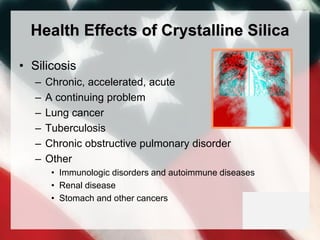
Health Effects of Crystalline Silica
• Silicosis
– Chronic, accelerated, acute
– A continuing problem
– Lung cancer
– Tuberculosis
– Chronic obstructive pulmonary disorder
– Other
• Immunologic disorders and autoimmune diseases
• Renal disease
• Stomach and other cancers
Symptoms and Signs of Chronic
Silicosis
NOTE: There may be no symptoms in
the early stages.
• As the disease progresses
– Cough
− Breathlessness
− Weakness
• Significant X-ray changes
after 15-20 years of exposure
Symptoms of Related Illnesses
(such as Tuberculosis)
 Fever
• Weight loss
• Night sweats
• Chest pains
• Respiratory failure
These symptoms can become worse over
time, leading to death.
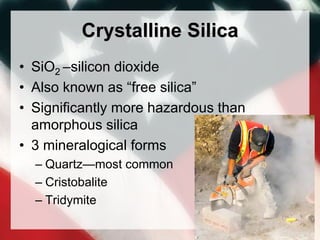
Crystalline Silica
• SiO2 –silicon dioxide
• Also known as “free silica”
• Significantly more hazardous than
amorphous silica
• 3 mineralogical forms
– Quartz—most common
– Cristobalite
– Tridymite
Table 1 Activities
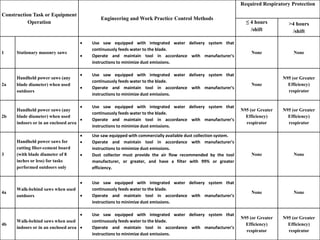
• Table 1 was created by OSHA and shows
activities that if followed require no
additional monitoring
• All activities include wet methods of
abatement or the use of HEPA vacuums to
reduce/eliminate dust
• All aspects of Table 1 must be followed or
the company will be cited.
Construction Task or Equipment
Operation
Engineering and Work Practice Control Methods
Required Respiratory Protection
≤ 4 hours
/shift
>4 hours
/shift
1 Stationary masonry saws
 Use saw equipped with integrated water delivery system that
continuously feeds water to the blade.
 Operate and maintain tool in accordance with manufacturer's
instructions to minimize dust emissions.
None None
2a
Handheld power saws (any
blade diameter) when used
outdoors
 Use saw equipped with integrated water delivery system that
continuously feeds water to the blade.
 Operate and maintain tool in accordance with manufacturer's
instructions to minimize dust emissions.
None
N95 (or Greater
Efficiency)
respirator
2b
Handheld power saws (any
blade diameter) when used
indoors or in an enclosed area
 Use saw equipped with integrated water delivery system that
continuously feeds water to the blade.
 Operate and maintain tool in accordance with manufacturer's
instructions to minimize dust emissions.
N95 (or Greater
Efficiency)
respirator
N95 (or Greater
Efficiency)
respirator
3
Handheld power saws for
cutting fiber-cement board
(with blade diameter of 8
inches or less) for tasks
performed outdoors only
 Use saw equipped with commercially available dust collection system.
 Operate and maintain tool in accordance with manufacturer's
instructions to minimize dust emissions.
 Dust collector must provide the air flow recommended by the tool
manufacturer, or greater, and have a filter with 99% or greater
efficiency.
None None
4a
Walk-behind saws when used
outdoors
 Use saw equipped with integrated water delivery system that
continuously feeds water to the blade.
 Operate and maintain tool in accordance with manufacturer's
instructions to minimize dust emissions.
None None
4b
Walk-behind saws when used
indoors or in an enclosed area
 Use saw equipped with integrated water delivery system that
continuously feeds water to the blade.
 Operate and maintain tool in accordance with manufacturer's
instructions to minimize dust emissions.
N95 (or Greater
Efficiency)
respirator
N95 (or Greater
Efficiency)
respirator
Alternative Exposure Control
Methods
• OSHA is assuming an overexposure for all
activities that involve dry cutting with no
dust capture system.
• Companies have to have data collected
from an accredited testing company that
shows the actual amount of respirable
silica the employee(s) are exposed to.
• Respiratory protection will then be
selected based on this number
Action Level and PEL
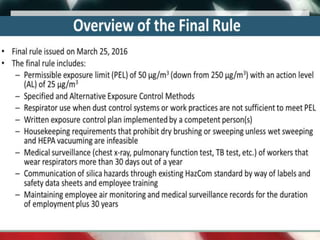
• Employees who are above the Permissible
Exposure Level (50 μg/m3) must be
protected.
• Employees who are or may reasonably
expected to be above the Action Level (25
μg/m3) must have their exposure assessed
• Employees at or above these levels must
have a Written exposure control plan
Action Level
• If initial monitoring shows exposures below
the action level, testing may be
discontinued
• If monitoring indicates that exposures are
above the AL but at or below the PEL, the
employer will repeat the monitoring within
6 months of the most recent monitoring.
• Employer may discontinue monitoring if
two consecutive measurements are found
to be below the AL.
Permissible Exposure Level
• If levels are above the PEL, the employer
must repeat monitoring within three
months of the most recent monitoring.
Notification of Testing
• OSHA requires that employees are
notified within 5 days of the employer’s
receipt of testing results.
• The notification must be in writing or
posted in an area that is accessible to all
affected employees.
• If the levels are above the PEL, the
employer must describe the corrective
action(s) taken to reduce the affected
employee(s) exposure below the PEL
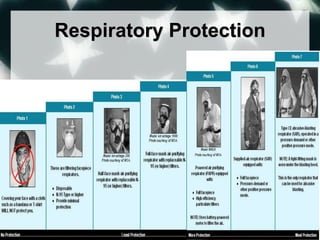
Respiratory Protection
• Employees cannot just wear disposable
respirators when exposed to silica
• The TWA (time weighted average) must
be determined and an appropriate
respirator selected based on the Assigned
Protection Factor.
• Disposable Respirators—APF 10
• Half Mask Respirators—APF 10
• Full Face Respirators—APF 50
Respiratory Protection
• Employees who are required to wear a
respirator by the standard (even
disposable respirators) for more than 30
days a year are required to be put into a
medical surveillance program
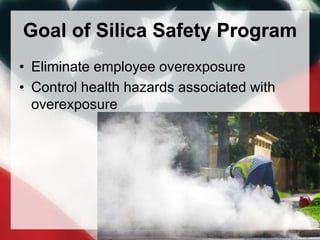
Goal of Silica Safety Program
• Eliminate employee overexposure
• Control health hazards associated with
overexposure
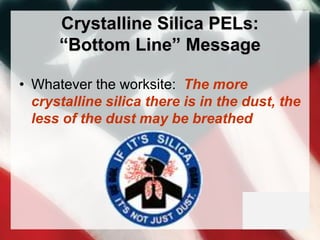
Crystalline Silica PELs:
“Bottom Line” Message
• Whatever the worksite: The more
crystalline silica there is in the dust, the
less of the dust may be breathed
Ways to Reduce Exposure
• Substitute materials that have no
crystalline silica
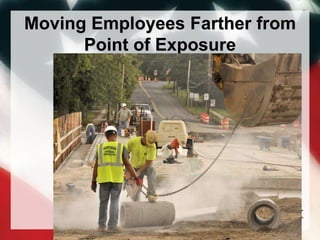
• Locate employees as far as possible from
dust-generation source
• Isolate employees OR the source
– Control rooms
– Enclosures
– Barriers
Moving Employees Farther from
Point of Exposure
Ways to Reduce Exposure (cont’d)
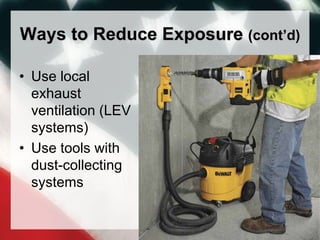
• Use local
exhaust
ventilation (LEV
systems)
• Use tools with
dust-collecting
systems
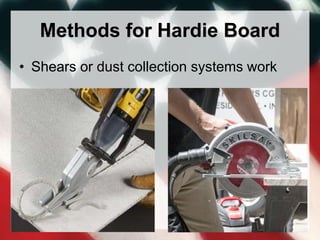
Methods for Hardie Board
• Shears or dust collection systems work
Ways to Reduce Exposure (cont’d)
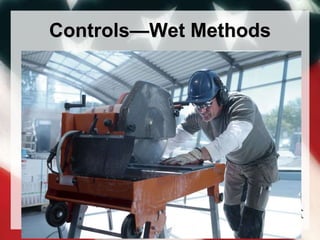
• Use wet methods
– Cutting
– Chipping
– Drilling
– Sawing
– Grinding
• Use Floor sweeping compound
• Clean surfaces with HEPA vacuums or
wet sweeping—no compressed air!
Controls—Wet Methods
Ways to Reduce Exposure (cont’d)
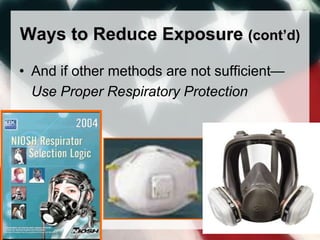
• And if other methods are not sufficient—
Use Proper Respiratory Protection
Respiratory Protection
Management of Subs
• Subs who generate silica
– Masonry Contractors
– Finishers
– Concrete Cutters
– Caulkers
• Do not allow dry cutting, open cabs, leaf
blowers
• Separate these activities from other
workers
Training
• Employers are to designate a person who
is in charge of the Silica program
• Employers must ensure that employees
can “demonstrate knowledge and
understanding” of the Silica program
• OSHA states that the employer must even
ensure that the health care providers they
use for anything related to Silca have the
OSHA standards
Summary
• Exposure to Silica can be dangerous
• Dry methods of abrasive cutting, drilling or
blasting are pretty much against OSHA
• A program/plan must be implemented by
each company that has exposure to Silica
• Training is required for all workers who are
exposed.
Questions?

Silica Safety Requirements

  • 1.
    Silica Safety Requirements Presentedby: Michael Downey Downey Consulting, Inc
  • 2.
    Goals of Program •Give attendees an understanding of the new Requirements. • Know how to address issues at the jobsite
  • 4.
    Health Effects ofCrystalline Silica • Silicosis – Chronic, accelerated, acute – A continuing problem – Lung cancer – Tuberculosis – Chronic obstructive pulmonary disorder – Other • Immunologic disorders and autoimmune diseases • Renal disease • Stomach and other cancers
  • 5.
    Symptoms and Signsof Chronic Silicosis NOTE: There may be no symptoms in the early stages. • As the disease progresses – Cough − Breathlessness − Weakness • Significant X-ray changes after 15-20 years of exposure
  • 6.
    Symptoms of RelatedIllnesses (such as Tuberculosis)  Fever • Weight loss • Night sweats • Chest pains • Respiratory failure These symptoms can become worse over time, leading to death.
  • 7.
    Crystalline Silica • SiO2–silicon dioxide • Also known as “free silica” • Significantly more hazardous than amorphous silica • 3 mineralogical forms – Quartz—most common – Cristobalite – Tridymite
  • 10.
    Table 1 Activities •Table 1 was created by OSHA and shows activities that if followed require no additional monitoring • All activities include wet methods of abatement or the use of HEPA vacuums to reduce/eliminate dust • All aspects of Table 1 must be followed or the company will be cited.
  • 11.
    Construction Task orEquipment Operation Engineering and Work Practice Control Methods Required Respiratory Protection ≤ 4 hours /shift >4 hours /shift 1 Stationary masonry saws  Use saw equipped with integrated water delivery system that continuously feeds water to the blade.  Operate and maintain tool in accordance with manufacturer's instructions to minimize dust emissions. None None 2a Handheld power saws (any blade diameter) when used outdoors  Use saw equipped with integrated water delivery system that continuously feeds water to the blade.  Operate and maintain tool in accordance with manufacturer's instructions to minimize dust emissions. None N95 (or Greater Efficiency) respirator 2b Handheld power saws (any blade diameter) when used indoors or in an enclosed area  Use saw equipped with integrated water delivery system that continuously feeds water to the blade.  Operate and maintain tool in accordance with manufacturer's instructions to minimize dust emissions. N95 (or Greater Efficiency) respirator N95 (or Greater Efficiency) respirator 3 Handheld power saws for cutting fiber-cement board (with blade diameter of 8 inches or less) for tasks performed outdoors only  Use saw equipped with commercially available dust collection system.  Operate and maintain tool in accordance with manufacturer's instructions to minimize dust emissions.  Dust collector must provide the air flow recommended by the tool manufacturer, or greater, and have a filter with 99% or greater efficiency. None None 4a Walk-behind saws when used outdoors  Use saw equipped with integrated water delivery system that continuously feeds water to the blade.  Operate and maintain tool in accordance with manufacturer's instructions to minimize dust emissions. None None 4b Walk-behind saws when used indoors or in an enclosed area  Use saw equipped with integrated water delivery system that continuously feeds water to the blade.  Operate and maintain tool in accordance with manufacturer's instructions to minimize dust emissions. N95 (or Greater Efficiency) respirator N95 (or Greater Efficiency) respirator
  • 12.
    Alternative Exposure Control Methods •OSHA is assuming an overexposure for all activities that involve dry cutting with no dust capture system. • Companies have to have data collected from an accredited testing company that shows the actual amount of respirable silica the employee(s) are exposed to. • Respiratory protection will then be selected based on this number
  • 13.
    Action Level andPEL • Employees who are above the Permissible Exposure Level (50 μg/m3) must be protected. • Employees who are or may reasonably expected to be above the Action Level (25 μg/m3) must have their exposure assessed • Employees at or above these levels must have a Written exposure control plan
  • 14.
    Action Level • Ifinitial monitoring shows exposures below the action level, testing may be discontinued • If monitoring indicates that exposures are above the AL but at or below the PEL, the employer will repeat the monitoring within 6 months of the most recent monitoring. • Employer may discontinue monitoring if two consecutive measurements are found to be below the AL.
  • 15.
    Permissible Exposure Level •If levels are above the PEL, the employer must repeat monitoring within three months of the most recent monitoring.
  • 16.
    Notification of Testing •OSHA requires that employees are notified within 5 days of the employer’s receipt of testing results. • The notification must be in writing or posted in an area that is accessible to all affected employees. • If the levels are above the PEL, the employer must describe the corrective action(s) taken to reduce the affected employee(s) exposure below the PEL
  • 17.
    Respiratory Protection • Employeescannot just wear disposable respirators when exposed to silica • The TWA (time weighted average) must be determined and an appropriate respirator selected based on the Assigned Protection Factor. • Disposable Respirators—APF 10 • Half Mask Respirators—APF 10 • Full Face Respirators—APF 50
  • 18.
    Respiratory Protection • Employeeswho are required to wear a respirator by the standard (even disposable respirators) for more than 30 days a year are required to be put into a medical surveillance program
  • 19.
    Goal of SilicaSafety Program • Eliminate employee overexposure • Control health hazards associated with overexposure
  • 20.
    Crystalline Silica PELs: “BottomLine” Message • Whatever the worksite: The more crystalline silica there is in the dust, the less of the dust may be breathed
  • 21.
    Ways to ReduceExposure • Substitute materials that have no crystalline silica • Locate employees as far as possible from dust-generation source • Isolate employees OR the source – Control rooms – Enclosures – Barriers
  • 22.
    Moving Employees Fartherfrom Point of Exposure
  • 23.
    Ways to ReduceExposure (cont’d) • Use local exhaust ventilation (LEV systems) • Use tools with dust-collecting systems
  • 24.
    Methods for HardieBoard • Shears or dust collection systems work
  • 25.
    Ways to ReduceExposure (cont’d) • Use wet methods – Cutting – Chipping – Drilling – Sawing – Grinding • Use Floor sweeping compound • Clean surfaces with HEPA vacuums or wet sweeping—no compressed air!
  • 26.
  • 27.
    Ways to ReduceExposure (cont’d) • And if other methods are not sufficient— Use Proper Respiratory Protection
  • 28.
  • 29.
    Management of Subs •Subs who generate silica – Masonry Contractors – Finishers – Concrete Cutters – Caulkers • Do not allow dry cutting, open cabs, leaf blowers • Separate these activities from other workers
  • 30.
    Training • Employers areto designate a person who is in charge of the Silica program • Employers must ensure that employees can “demonstrate knowledge and understanding” of the Silica program • OSHA states that the employer must even ensure that the health care providers they use for anything related to Silca have the OSHA standards
  • 31.
    Summary • Exposure toSilica can be dangerous • Dry methods of abrasive cutting, drilling or blasting are pretty much against OSHA • A program/plan must be implemented by each company that has exposure to Silica • Training is required for all workers who are exposed.
  • 32.