FactSheet
OSHA’s Crystalline Silica Rule:
Construction
OSHA is issuing two standards to protect workers from exposure to respirable
crystalline silica—one for construction, and the other for general industry and
maritime—in order to allow employers to tailor solutions to the specific conditions
in their workplaces.
Who is affected by the construction
standard?
About two million construction workers are
exposed to respirable crystalline silica in over
600,000 workplaces. OSHA estimates that more
than 840,000 of these workers are exposed to
silica levels that exceed the new permissible
exposure limit (PEL).
Exposure to respirable crystalline silica can
cause silicosis, lung cancer, other respiratory
diseases, and kidney disease. Exposure can occur
during common construction tasks such as using
masonry saws, grinders, drills, jackhammers
and handheld powered chipping tools; operating
vehicle-mounted drilling rigs; milling; operating
crushing machines; and using heavy equipment
for demolition or certain other tasks.
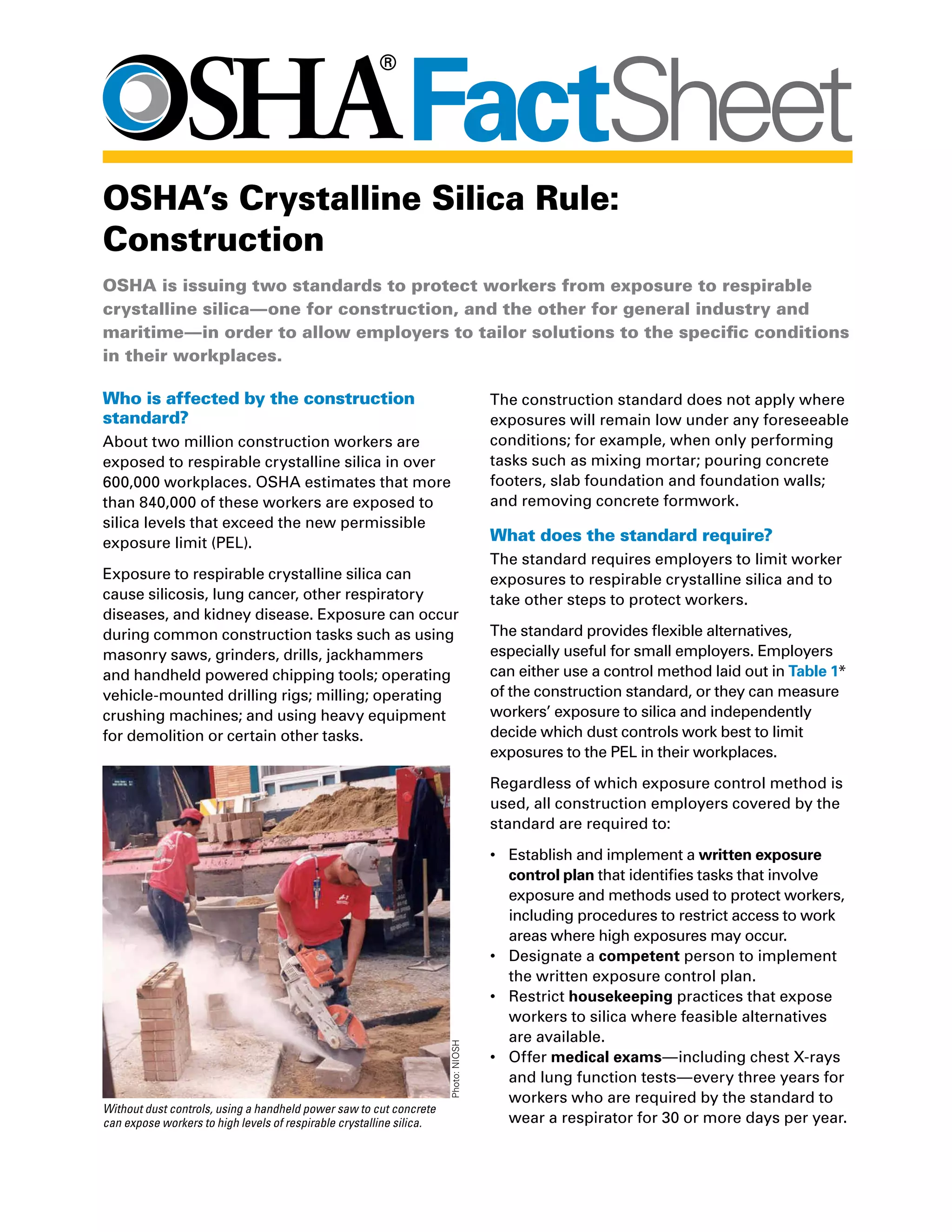
Without dust controls, using a handheld power saw to cut concrete
can expose workers to high levels of respirable crystalline silica.
Photo:NIOSH
The construction standard does not apply where
exposures will remain low under any foreseeable
conditions; for example, when only performing
tasks such as mixing mortar; pouring concrete
footers, slab foundation and foundation walls;
and removing concrete formwork.
What does the standard require?
The standard requires employers to limit worker
exposures to respirable crystalline silica and to
take other steps to protect workers.
The standard provides flexible alternatives,
especially useful for small employers. Employers
can either use a control method laid out in Table 1*
of the construction standard, or they can measure
workers’ exposure to silica and independently
decide which dust controls work best to limit
exposures to the PEL in their workplaces.
Regardless of which exposure control method is
used, all construction employers covered by the
standard are required to:
•	 Establish and implement a written exposure
control plan that identifies tasks that involve
exposure and methods used to protect workers,
including procedures to restrict access to work
areas where high exposures may occur.
•	 	Designate a competent person to implement
the written exposure control plan.
•	 Restrict housekeeping practices that expose
workers to silica where feasible alternatives
are available.
•	 Offer medical exams—including chest X-rays
and lung function tests—every three years for
workers who are required by the standard to
wear a respirator for 30 or more days per year.
•	 Train workers on work operations that result
in silica exposure and ways to limit exposure.
•	 Keep records of workers’ silica exposure and
medical exams.
What is Table 1?
Table 1 matches common construction tasks with
dust control methods, so employers know exactly
what they need to do to limit worker exposures
to silica. The dust control measures listed in the
table include methods known to be effective, like
using water to keep dust from getting into the
air or using ventilation to capture dust. In some
operations, respirators may also be needed.
Employers who follow Table 1 correctly are not
required to measure workers’ exposure to silica
and are not subject to the PEL.
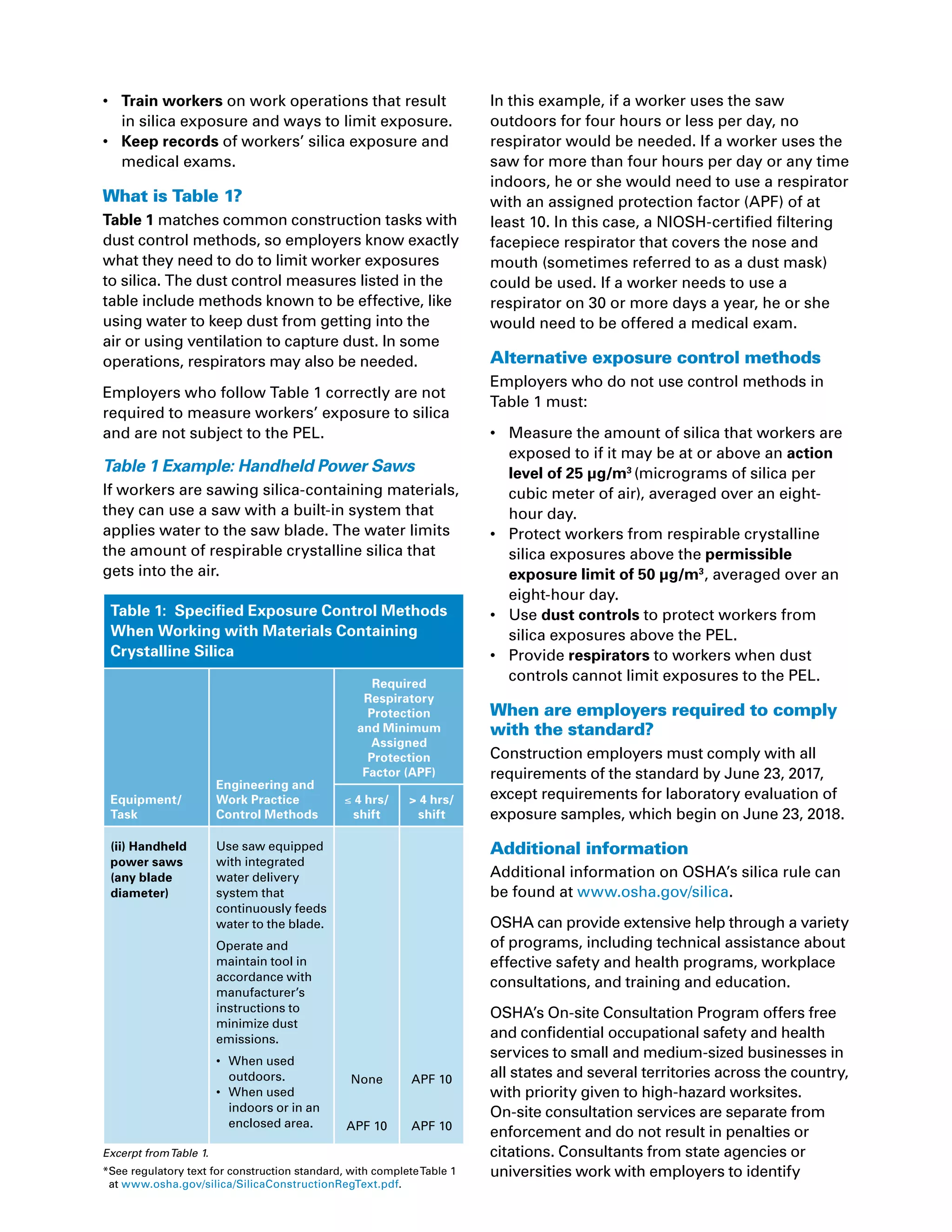
Table 1 Example: Handheld Power Saws
If workers are sawing silica-containing materials,
they can use a saw with a built-in system that
applies water to the saw blade. The water limits
the amount of respirable crystalline silica that
gets into the air.
Table 1: Specified Exposure Control Methods
When Working with Materials Containing
Crystalline Silica
Equipment/
Task
Engineering and
Work Practice
Control Methods
Required
Respiratory
Protection
and Minimum
Assigned
Protection
Factor (APF)
≤ 4 hrs/
shift
> 4 hrs/
shift
(ii) Handheld
power saws
(any blade
diameter)
Use saw equipped
with integrated
water delivery
system that
continuously feeds
water to the blade.
Operate and
maintain tool in
accordance with
manufacturer’s
instructions to
minimize dust
emissions.
•	 When used
outdoors.
•	 When used
indoors or in an
enclosed area.
None
APF 10
APF 10
APF 10
Excerpt fromTable 1.
*See regulatory text for construction standard, with completeTable 1
at www.osha.gov/silica/SilicaConstructionRegText.pdf.
In this example, if a worker uses the saw
outdoors for four hours or less per day, no
respirator would be needed. If a worker uses the
saw for more than four hours per day or any time
indoors, he or she would need to use a respirator
with an assigned protection factor (APF) of at
least 10. In this case, a NIOSH-certified filtering
facepiece respirator that covers the nose and
mouth (sometimes referred to as a dust mask)
could be used. If a worker needs to use a
respirator on 30 or more days a year, he or she
would need to be offered a medical exam.
Alternative exposure control methods
Employers who do not use control methods in
Table 1 must:
•	 Measure the amount of silica that workers are
exposed to if it may be at or above an action
level of 25 μg/m3
(micrograms of silica per
cubic meter of air), averaged over an eight-
hour day.
•	 Protect workers from respirable crystalline
silica exposures above the permissible
exposure limit of 50 μg/m3
, averaged over an
eight-hour day.
•	 Use dust controls to protect workers from
silica exposures above the PEL.
•	 Provide respirators to workers when dust
controls cannot limit exposures to the PEL.
When are employers required to comply
with the standard?
Construction employers must comply with all
requirements of the standard by June 23, 2017,
except requirements for laboratory evaluation of
exposure samples, which begin on June 23, 2018.
Additional information
Additional information on OSHA’s silica rule can
be found at www.osha.gov/silica.
OSHA can provide extensive help through a variety
of programs, including technical assistance about
effective safety and health programs, workplace
consultations, and training and education.
OSHA’s On-site Consultation Program offers free
and confidential occupational safety and health
services to small and medium-sized businesses in
all states and several territories across the country,
with priority given to high-hazard worksites.
On-site consultation services are separate from
enforcement and do not result in penalties or
citations. Consultants from state agencies or
universities work with employers to identify
workplace hazards, provide advice on compliance
with OSHA standards, and assist in establishing
and improving safety and health management
systems. To locate the OSHA On-site Consultation
Program nearest you, call 1-800-321-OSHA (6742)
or visit www.osha.gov/dcsp/smallbusiness.
For more information on this and other health-
related issues impacting workers, to report an
emergency, fatality, inpatient hospitalization, or to
file a confidential complaint, contact your nearest
OSHA office, visit www.osha.gov, or call OSHA at
1-800-321-OSHA (6742), TTY 1-877-889-5627.
This is one in a series of informational fact sheets highlighting OSHA programs, policies or
standards. It does not impose any new compliance requirements. For a comprehensive list of
compliance requirements of OSHA standards or regulations, refer toTitle 29 of the Code of Federal
Regulations.This information will be made available to sensory-impaired individuals upon request.
The voice phone is (202) 693-1999; teletypewriter (TTY) number: (877) 889-5627.
DSG FS-3681 03/2016

OSHA Fact Sheet: OSHA's Crystalline Silica Rule: Construction

  • 1.
    FactSheet OSHA’s Crystalline SilicaRule: Construction OSHA is issuing two standards to protect workers from exposure to respirable crystalline silica—one for construction, and the other for general industry and maritime—in order to allow employers to tailor solutions to the specific conditions in their workplaces. Who is affected by the construction standard? About two million construction workers are exposed to respirable crystalline silica in over 600,000 workplaces. OSHA estimates that more than 840,000 of these workers are exposed to silica levels that exceed the new permissible exposure limit (PEL). Exposure to respirable crystalline silica can cause silicosis, lung cancer, other respiratory diseases, and kidney disease. Exposure can occur during common construction tasks such as using masonry saws, grinders, drills, jackhammers and handheld powered chipping tools; operating vehicle-mounted drilling rigs; milling; operating crushing machines; and using heavy equipment for demolition or certain other tasks. Without dust controls, using a handheld power saw to cut concrete can expose workers to high levels of respirable crystalline silica. Photo:NIOSH The construction standard does not apply where exposures will remain low under any foreseeable conditions; for example, when only performing tasks such as mixing mortar; pouring concrete footers, slab foundation and foundation walls; and removing concrete formwork. What does the standard require? The standard requires employers to limit worker exposures to respirable crystalline silica and to take other steps to protect workers. The standard provides flexible alternatives, especially useful for small employers. Employers can either use a control method laid out in Table 1* of the construction standard, or they can measure workers’ exposure to silica and independently decide which dust controls work best to limit exposures to the PEL in their workplaces. Regardless of which exposure control method is used, all construction employers covered by the standard are required to: • Establish and implement a written exposure control plan that identifies tasks that involve exposure and methods used to protect workers, including procedures to restrict access to work areas where high exposures may occur. • Designate a competent person to implement the written exposure control plan. • Restrict housekeeping practices that expose workers to silica where feasible alternatives are available. • Offer medical exams—including chest X-rays and lung function tests—every three years for workers who are required by the standard to wear a respirator for 30 or more days per year.
  • 2.
    • Train workerson work operations that result in silica exposure and ways to limit exposure. • Keep records of workers’ silica exposure and medical exams. What is Table 1? Table 1 matches common construction tasks with dust control methods, so employers know exactly what they need to do to limit worker exposures to silica. The dust control measures listed in the table include methods known to be effective, like using water to keep dust from getting into the air or using ventilation to capture dust. In some operations, respirators may also be needed. Employers who follow Table 1 correctly are not required to measure workers’ exposure to silica and are not subject to the PEL. Table 1 Example: Handheld Power Saws If workers are sawing silica-containing materials, they can use a saw with a built-in system that applies water to the saw blade. The water limits the amount of respirable crystalline silica that gets into the air. Table 1: Specified Exposure Control Methods When Working with Materials Containing Crystalline Silica Equipment/ Task Engineering and Work Practice Control Methods Required Respiratory Protection and Minimum Assigned Protection Factor (APF) ≤ 4 hrs/ shift > 4 hrs/ shift (ii) Handheld power saws (any blade diameter) Use saw equipped with integrated water delivery system that continuously feeds water to the blade. Operate and maintain tool in accordance with manufacturer’s instructions to minimize dust emissions. • When used outdoors. • When used indoors or in an enclosed area. None APF 10 APF 10 APF 10 Excerpt fromTable 1. *See regulatory text for construction standard, with completeTable 1 at www.osha.gov/silica/SilicaConstructionRegText.pdf. In this example, if a worker uses the saw outdoors for four hours or less per day, no respirator would be needed. If a worker uses the saw for more than four hours per day or any time indoors, he or she would need to use a respirator with an assigned protection factor (APF) of at least 10. In this case, a NIOSH-certified filtering facepiece respirator that covers the nose and mouth (sometimes referred to as a dust mask) could be used. If a worker needs to use a respirator on 30 or more days a year, he or she would need to be offered a medical exam. Alternative exposure control methods Employers who do not use control methods in Table 1 must: • Measure the amount of silica that workers are exposed to if it may be at or above an action level of 25 μg/m3 (micrograms of silica per cubic meter of air), averaged over an eight- hour day. • Protect workers from respirable crystalline silica exposures above the permissible exposure limit of 50 μg/m3 , averaged over an eight-hour day. • Use dust controls to protect workers from silica exposures above the PEL. • Provide respirators to workers when dust controls cannot limit exposures to the PEL. When are employers required to comply with the standard? Construction employers must comply with all requirements of the standard by June 23, 2017, except requirements for laboratory evaluation of exposure samples, which begin on June 23, 2018. Additional information Additional information on OSHA’s silica rule can be found at www.osha.gov/silica. OSHA can provide extensive help through a variety of programs, including technical assistance about effective safety and health programs, workplace consultations, and training and education. OSHA’s On-site Consultation Program offers free and confidential occupational safety and health services to small and medium-sized businesses in all states and several territories across the country, with priority given to high-hazard worksites. On-site consultation services are separate from enforcement and do not result in penalties or citations. Consultants from state agencies or universities work with employers to identify
  • 3.
    workplace hazards, provideadvice on compliance with OSHA standards, and assist in establishing and improving safety and health management systems. To locate the OSHA On-site Consultation Program nearest you, call 1-800-321-OSHA (6742) or visit www.osha.gov/dcsp/smallbusiness. For more information on this and other health- related issues impacting workers, to report an emergency, fatality, inpatient hospitalization, or to file a confidential complaint, contact your nearest OSHA office, visit www.osha.gov, or call OSHA at 1-800-321-OSHA (6742), TTY 1-877-889-5627. This is one in a series of informational fact sheets highlighting OSHA programs, policies or standards. It does not impose any new compliance requirements. For a comprehensive list of compliance requirements of OSHA standards or regulations, refer toTitle 29 of the Code of Federal Regulations.This information will be made available to sensory-impaired individuals upon request. The voice phone is (202) 693-1999; teletypewriter (TTY) number: (877) 889-5627. DSG FS-3681 03/2016