Hazards of Silica Dust Exposure
for Fracking Workers
Group 13: Marisol Chavez, Nicholas Ellinwood, Andres Guerrero, Amy
Klapheke, Mikaela Miller
EHOH 6614
April 7, 2014
Outline
● What is fracking?
● Who are the fracking workers?
● How are they exposed to silica dust?
● What are the health consequences of this exposure?
● Findings from NIOSH Article
● What is being done to address this issue?
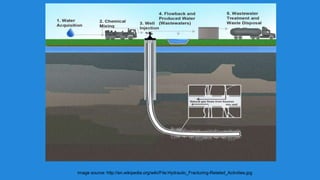
image source: http://en.wikipedia.org/wiki/File:Hydraulic_Fracturing-Related_Activities.jpg
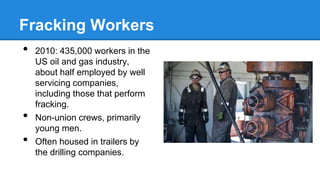
Fracking Workers
• 2010: 435,000 workers in the
US oil and gas industry,
about half employed by well
servicing companies,
including those that perform
fracking.
• Non-union crews, primarily
young men.
• Often housed in trailers by
the drilling companies.
Fracking Workers
• Fracking operations are exempt from most clean air and water laws
• Most health and safety concerns have been focused on the environment–
especially groundwater contamination
• Due to lack of attention on workers’ health NIOSH initiated the Field Effort
to Assess Chemical Exposures in Oil and Gas Extraction Workers:
o Goal: develop partnerships with oil and gas industry to identify and
control workplace exposures
• Finding that workers are at risk of serious health issues due to exposures
at fracking sites– crystalline silica exposure
Crystalline Silica Exposure
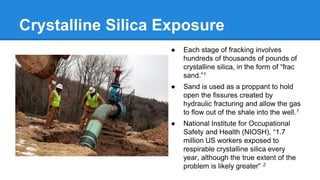
● Each stage of fracking involves
hundreds of thousands of pounds of
crystalline silica, in the form of “frac
sand.”1
● Sand is used as a proppant to hold
open the fissures created by
hydraulic fracturing and allow the gas
to flow out of the shale into the well.1
● National Institute for Occupational
Safety and Health (NIOSH), “1.7
million US workers exposed to
respirable crystalline silica every
year, although the true extent of the
problem is likely greater” 2
Crystalline Silica Exposure
● The NIOSH recommended exposure limit (REL) is 0.05 milligrams
of respirable silica per cubic meter of air (mg/m3) as a time-
weighted average (TWA) for up to a 10hr day to reduce silica
related diseases.
● In 2012, OSHA issued a hazard alert for silica after NIOSH found
excessive silica exposure at 11 sites in 5 states2
● “Inhalation of respirable crystalline silica can cause silicosis, lung
cancer, autoimmune disorders, kidney disease, and an increased
risk of tuberculosis”3
Crystalline Silica Health Effects
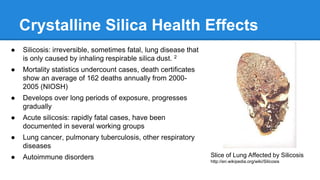
● Silicosis: irreversible, sometimes fatal, lung disease that
is only caused by inhaling respirable silica dust. 2
● Mortality statistics undercount cases, death certificates
show an average of 162 deaths annually from 2000-
2005 (NIOSH)
● Develops over long periods of exposure, progresses
gradually
● Acute silicosis: rapidly fatal cases, have been
documented in several working groups
● Lung cancer, pulmonary tuberculosis, other respiratory
diseases
● Autoimmune disorders Slice of Lung Affected by Silicosis
http://en.wikipedia.org/wiki/Silicosis
Occupational Exposures to Respirable Crystalline
Silica During Hydraulic Fracturing Article
● August 2010- September 2011, NIOSH collected 111 personal breathing samples at
11 sites in 5 states to evaluate worker exposures to respirable crystalline silica
during hydraulic fracking.
● Workers from 15 different job titles volunteered to participate for 3 consecutive
days.
● At each 11 sites, full-shift samples exceeded OSHA REL or the ACGIH TLV by 10
or more times.
○ 93 of 111 (83.8%) of the samples exceeded the TLV.
○ 76 (68.5%) exceeded the REL.
○ 57 (51.4%) exceeded a calculated PEL for respirable dust containing silica.
Occupational Exposures to Respirable Crystalline
Silica During Hydraulic Fracturing Article
1. Dust ejected from thief hatches (access ports) on top of the sand movers during refilling
operations while the machines are running (hot loading).
2. Dust ejected and pulsed through open side fill ports on the sand movers during refilling
operations
3. Dust generated by on-site vehicle traffic.
4. Dust released from the transfer belt under the sand movers.
5. Dust created as sand drops into, or is agitated in, the blender hopper and on transfer belts.
6. Dust released from operations of transfer belts between the sand mover and the blender;
7. Dust released from the top of the end of the sand transfer belt (dragon’s tail) on sand movers.
Occupational Exposures to Respirable Crystalline
Silica During Hydraulic Fracturing Article
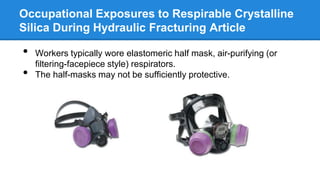
• Workers typically wore elastomeric half mask, air-purifying (or
filtering-facepiece style) respirators.
• The half-masks may not be sufficiently protective.
Addressing Silica Exposure
What can be done in the workplace?
Hierarchy of controls
What can agencies do?
OSHA, NIOSH, National STEPS
Hierarchy of Controls
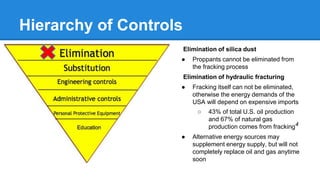
Elimination of silica dust
● Proppants cannot be eliminated from
the fracking process
Elimination of hydraulic fracturing
● Fracking itself can not be eliminated,
otherwise the energy demands of the
USA will depend on expensive imports
○ 43% of total U.S. oil production
and 67% of natural gas
production comes from fracking4
● Alternative energy sources may
supplement energy supply, but will not
completely replace oil and gas anytime
soon
Hierarchy of Controls
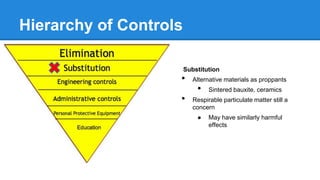
Substitution
• Alternative materials as proppants
• Sintered bauxite, ceramics
• Respirable particulate matter still a
concern
● May have similarly harmful
effects
Hierarchy of Controls
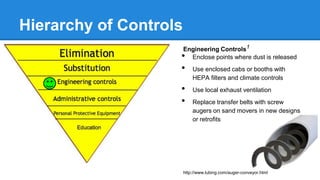
Engineering Controls1
• Enclose points where dust is released
• Use enclosed cabs or booths with
HEPA filters and climate controls
• Use local exhaust ventilation
• Replace transfer belts with screw
augers on sand movers in new designs
or retrofits
http://www.lubing.com/auger-conveyor.html
Hierarchy of Controls
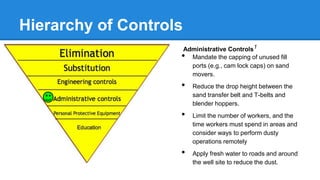
Administrative Controls1
• Mandate the capping of unused fill
ports (e.g., cam lock caps) on sand
movers.
• Reduce the drop height between the
sand transfer belt and T-belts and
blender hoppers.
• Limit the number of workers, and the
time workers must spend in areas and
consider ways to perform dusty
operations remotely
• Apply fresh water to roads and around
the well site to reduce the dust.
Hierarchy of Controls
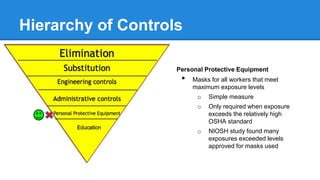
Personal Protective Equipment
• Masks for all workers that meet
maximum exposure levels
o Simple measure
o Only required when exposure
exceeds the relatively high
OSHA standard
o NIOSH study found many
exposures exceeded levels
approved for masks used
Hierarchy of Controls
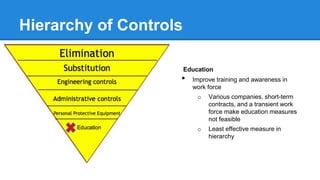
Education
• Improve training and awareness in
work force
o Various companies, short-term
contracts, and a transient work
force make education measures
not feasible
o Least effective measure in
hierarchy
Addressing Silica Exposure
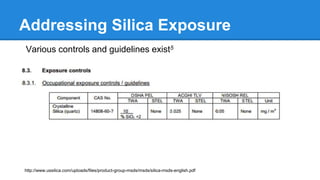
Various controls and guidelines exist5
http://www.ussilica.com/uploads/files/product-group-msds/msds/silica-msds-english.pdf
Addressing Silica Exposure
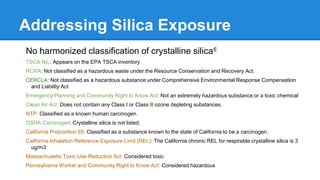
No harmonized classification of crystalline silica6
TSCA No.: Appears on the EPA TSCA inventory
RCRA: Not classified as a hazardous waste under the Resource Conservation and Recovery Act.
CERCLA: Not classified as a hazardous substance under Comprehensive Environmental Response Compensation
and Liability Act
Emergency Planning and Community Right to Know Act: Not an extremely hazardous substance or a toxic chemical
Clean Air Act: Does not contain any Class I or Class II ozone depleting substances.
NTP: Classified as a known human carcinogen.
OSHA Carcinogen: Crystalline silica is not listed.
California Proposition 65: Classified as a substance known to the state of California to be a carcinogen.
California Inhalation Reference Exposure Limit (REL): The California chronic REL for respirable crystalline silica is 3
ug/m3
Massachusetts Toxic Use Reduction Act: Considered toxic
Pennsylvania Worker and Community Right to Know Act: Considered hazardous
Addressing Silica Exposure
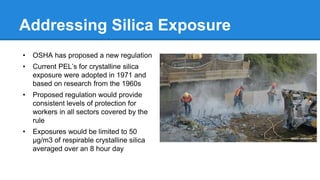
• OSHA has proposed a new regulation
• Current PEL’s for crystalline silica
exposure were adopted in 1971 and
based on research from the 1960s
• Proposed regulation would provide
consistent levels of protection for
workers in all sectors covered by the
rule
• Exposures would be limited to 50
µg/m3 of respirable crystalline silica
averaged over an 8 hour day
Conclusion
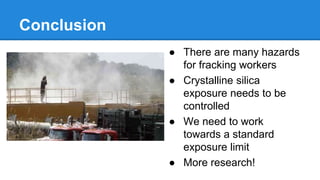
● There are many hazards
for fracking workers
● Crystalline silica
exposure needs to be
controlled
● We need to work
towards a standard
exposure limit
● More research!
Resources
OSHA. (2012). Worker Exposure to Crystalline Silica During Hydraulic Fracturing. Retrieved from
https://www.osha.gov/dts/hazardalerts/hydraulic_frac_hazard_alert.html1
Grossman, E. (2013). Silica exposure in fracking: Over 60 percent of workers may be excessively exposed. The
Pump Handle. 2
Esswein, J. E., Breitenstein, M., Snawder, J., Kiefer, M., and Sieber, K. W. (2013). Occupational Exposures to
Respirable Crystalline Silica During Hydraulic Fracturing. Journal of Occupational and Environmental Hygiene. 10:
347-356.3
US Dept. of Energy. (2013). How is Shale Gas Produced? Retrieved from
http://energy.gov/sites/prod/files/2013/04/f0/how_is_shale_gas_produced.pdf.4
Proppant Specialists, LLC. (2008). Silica Sand [Material Safety and Data Sheet]. Retrieved from
http://oilandgas.ohiodnr.gov/portals/oilgas/_MSDS/fractech/Silica_Sand.pdf.5
U.S. Silica Company. (2012). Silica Sand and Ground Sand [Material Safety and Data Sheet]. Retrieved from
http://www.ussilica.com/uploads/files/product-group-msds/msds/silica-msds-english.pdf.6

Group13 fracking

  • 1.
    Hazards of SilicaDust Exposure for Fracking Workers Group 13: Marisol Chavez, Nicholas Ellinwood, Andres Guerrero, Amy Klapheke, Mikaela Miller EHOH 6614 April 7, 2014
  • 2.
    Outline ● What isfracking? ● Who are the fracking workers? ● How are they exposed to silica dust? ● What are the health consequences of this exposure? ● Findings from NIOSH Article ● What is being done to address this issue?
  • 3.
  • 4.
    Fracking Workers • 2010:435,000 workers in the US oil and gas industry, about half employed by well servicing companies, including those that perform fracking. • Non-union crews, primarily young men. • Often housed in trailers by the drilling companies.
  • 5.
    Fracking Workers • Frackingoperations are exempt from most clean air and water laws • Most health and safety concerns have been focused on the environment– especially groundwater contamination • Due to lack of attention on workers’ health NIOSH initiated the Field Effort to Assess Chemical Exposures in Oil and Gas Extraction Workers: o Goal: develop partnerships with oil and gas industry to identify and control workplace exposures • Finding that workers are at risk of serious health issues due to exposures at fracking sites– crystalline silica exposure
  • 6.
    Crystalline Silica Exposure ●Each stage of fracking involves hundreds of thousands of pounds of crystalline silica, in the form of “frac sand.”1 ● Sand is used as a proppant to hold open the fissures created by hydraulic fracturing and allow the gas to flow out of the shale into the well.1 ● National Institute for Occupational Safety and Health (NIOSH), “1.7 million US workers exposed to respirable crystalline silica every year, although the true extent of the problem is likely greater” 2
  • 7.
    Crystalline Silica Exposure ●The NIOSH recommended exposure limit (REL) is 0.05 milligrams of respirable silica per cubic meter of air (mg/m3) as a time- weighted average (TWA) for up to a 10hr day to reduce silica related diseases. ● In 2012, OSHA issued a hazard alert for silica after NIOSH found excessive silica exposure at 11 sites in 5 states2 ● “Inhalation of respirable crystalline silica can cause silicosis, lung cancer, autoimmune disorders, kidney disease, and an increased risk of tuberculosis”3
  • 8.
    Crystalline Silica HealthEffects ● Silicosis: irreversible, sometimes fatal, lung disease that is only caused by inhaling respirable silica dust. 2 ● Mortality statistics undercount cases, death certificates show an average of 162 deaths annually from 2000- 2005 (NIOSH) ● Develops over long periods of exposure, progresses gradually ● Acute silicosis: rapidly fatal cases, have been documented in several working groups ● Lung cancer, pulmonary tuberculosis, other respiratory diseases ● Autoimmune disorders Slice of Lung Affected by Silicosis http://en.wikipedia.org/wiki/Silicosis
  • 9.
    Occupational Exposures toRespirable Crystalline Silica During Hydraulic Fracturing Article ● August 2010- September 2011, NIOSH collected 111 personal breathing samples at 11 sites in 5 states to evaluate worker exposures to respirable crystalline silica during hydraulic fracking. ● Workers from 15 different job titles volunteered to participate for 3 consecutive days. ● At each 11 sites, full-shift samples exceeded OSHA REL or the ACGIH TLV by 10 or more times. ○ 93 of 111 (83.8%) of the samples exceeded the TLV. ○ 76 (68.5%) exceeded the REL. ○ 57 (51.4%) exceeded a calculated PEL for respirable dust containing silica.
  • 10.
    Occupational Exposures toRespirable Crystalline Silica During Hydraulic Fracturing Article 1. Dust ejected from thief hatches (access ports) on top of the sand movers during refilling operations while the machines are running (hot loading). 2. Dust ejected and pulsed through open side fill ports on the sand movers during refilling operations 3. Dust generated by on-site vehicle traffic. 4. Dust released from the transfer belt under the sand movers. 5. Dust created as sand drops into, or is agitated in, the blender hopper and on transfer belts. 6. Dust released from operations of transfer belts between the sand mover and the blender; 7. Dust released from the top of the end of the sand transfer belt (dragon’s tail) on sand movers.
  • 11.
    Occupational Exposures toRespirable Crystalline Silica During Hydraulic Fracturing Article • Workers typically wore elastomeric half mask, air-purifying (or filtering-facepiece style) respirators. • The half-masks may not be sufficiently protective.
  • 12.
    Addressing Silica Exposure Whatcan be done in the workplace? Hierarchy of controls What can agencies do? OSHA, NIOSH, National STEPS
  • 13.
    Hierarchy of Controls Eliminationof silica dust ● Proppants cannot be eliminated from the fracking process Elimination of hydraulic fracturing ● Fracking itself can not be eliminated, otherwise the energy demands of the USA will depend on expensive imports ○ 43% of total U.S. oil production and 67% of natural gas production comes from fracking4 ● Alternative energy sources may supplement energy supply, but will not completely replace oil and gas anytime soon
  • 14.
    Hierarchy of Controls Substitution •Alternative materials as proppants • Sintered bauxite, ceramics • Respirable particulate matter still a concern ● May have similarly harmful effects
  • 15.
    Hierarchy of Controls EngineeringControls1 • Enclose points where dust is released • Use enclosed cabs or booths with HEPA filters and climate controls • Use local exhaust ventilation • Replace transfer belts with screw augers on sand movers in new designs or retrofits http://www.lubing.com/auger-conveyor.html
  • 16.
    Hierarchy of Controls AdministrativeControls1 • Mandate the capping of unused fill ports (e.g., cam lock caps) on sand movers. • Reduce the drop height between the sand transfer belt and T-belts and blender hoppers. • Limit the number of workers, and the time workers must spend in areas and consider ways to perform dusty operations remotely • Apply fresh water to roads and around the well site to reduce the dust.
  • 17.
    Hierarchy of Controls PersonalProtective Equipment • Masks for all workers that meet maximum exposure levels o Simple measure o Only required when exposure exceeds the relatively high OSHA standard o NIOSH study found many exposures exceeded levels approved for masks used
  • 18.
    Hierarchy of Controls Education •Improve training and awareness in work force o Various companies, short-term contracts, and a transient work force make education measures not feasible o Least effective measure in hierarchy
  • 19.
    Addressing Silica Exposure Variouscontrols and guidelines exist5 http://www.ussilica.com/uploads/files/product-group-msds/msds/silica-msds-english.pdf
  • 20.
    Addressing Silica Exposure Noharmonized classification of crystalline silica6 TSCA No.: Appears on the EPA TSCA inventory RCRA: Not classified as a hazardous waste under the Resource Conservation and Recovery Act. CERCLA: Not classified as a hazardous substance under Comprehensive Environmental Response Compensation and Liability Act Emergency Planning and Community Right to Know Act: Not an extremely hazardous substance or a toxic chemical Clean Air Act: Does not contain any Class I or Class II ozone depleting substances. NTP: Classified as a known human carcinogen. OSHA Carcinogen: Crystalline silica is not listed. California Proposition 65: Classified as a substance known to the state of California to be a carcinogen. California Inhalation Reference Exposure Limit (REL): The California chronic REL for respirable crystalline silica is 3 ug/m3 Massachusetts Toxic Use Reduction Act: Considered toxic Pennsylvania Worker and Community Right to Know Act: Considered hazardous
  • 21.
    Addressing Silica Exposure •OSHA has proposed a new regulation • Current PEL’s for crystalline silica exposure were adopted in 1971 and based on research from the 1960s • Proposed regulation would provide consistent levels of protection for workers in all sectors covered by the rule • Exposures would be limited to 50 µg/m3 of respirable crystalline silica averaged over an 8 hour day
  • 22.
    Conclusion ● There aremany hazards for fracking workers ● Crystalline silica exposure needs to be controlled ● We need to work towards a standard exposure limit ● More research!
  • 23.
    Resources OSHA. (2012). WorkerExposure to Crystalline Silica During Hydraulic Fracturing. Retrieved from https://www.osha.gov/dts/hazardalerts/hydraulic_frac_hazard_alert.html1 Grossman, E. (2013). Silica exposure in fracking: Over 60 percent of workers may be excessively exposed. The Pump Handle. 2 Esswein, J. E., Breitenstein, M., Snawder, J., Kiefer, M., and Sieber, K. W. (2013). Occupational Exposures to Respirable Crystalline Silica During Hydraulic Fracturing. Journal of Occupational and Environmental Hygiene. 10: 347-356.3 US Dept. of Energy. (2013). How is Shale Gas Produced? Retrieved from http://energy.gov/sites/prod/files/2013/04/f0/how_is_shale_gas_produced.pdf.4 Proppant Specialists, LLC. (2008). Silica Sand [Material Safety and Data Sheet]. Retrieved from http://oilandgas.ohiodnr.gov/portals/oilgas/_MSDS/fractech/Silica_Sand.pdf.5 U.S. Silica Company. (2012). Silica Sand and Ground Sand [Material Safety and Data Sheet]. Retrieved from http://www.ussilica.com/uploads/files/product-group-msds/msds/silica-msds-english.pdf.6