OCCUPATIONAL
NOISE
AMI Environmental
Environmental Health & Safety
Dan Taylor
www.amienvironmental.com
BIO
AMI Environmental
 AMI Environmental is a full-service environmental consulting and
remediation firm, specializing in facility-based environmental problems
affecting facility operations, renovation and demolition activities.
Established in 1986 and headquartered in Omaha, Nebraska, AMI
services clients nationally and internationally.
 Dan Taylor, CEO
 Over 25 years Environmental Health &
Safety Experience
www.amienvironmental.com
SUMMARY
How We Got Here
 1969-DOL issued the Walsh-Healey noise standard 90 dBA for 8
exp. Federal contracts of $10,000 or more.
 1970- DOL issues Bulletin 334. “Continuous, Effective
Conservation Program”
 1970 Congress passes OSH Act. “Every Man and Women”
 1971-OSHA made the Walsh-Healey noise standard an OSHA
standard.
www.amienvironmental.com
DID YOU KNOW?
Noise induced hearing loss is the most common
occupational hazard for American workers.
Hearing loss from noise is slow and painless; you
can develop a disability before you notice it.
If you must raise your voice to speak
with someone only 3 feet away, you are
in high (hazardous) noise.
It is 100% preventable.
www.amienvironmental.com
WHAT IS NOISE?
 Noise is defined as:
• Sound or a sound that is
loud, unpleasant, unexpected, or undesired.
• By product of many industrial processes (ex.
operating machinery)
• Exposure to high levels of
noise may lead to
hearing loss
www.amienvironmental.com
HOW MUCH NOISE IS TOO MUCH?
 85 Decibels (dB) - the "Action Level" where hearing
protection is required.
 90 dB - the OSHA, 8 hour average exposure limit.
 100 dB - exposures longer than 15 minutes are not
recommended.
 110 dB - regular exposure of more than 1 minute
risks permanent hearing loss
www.amienvironmental.com
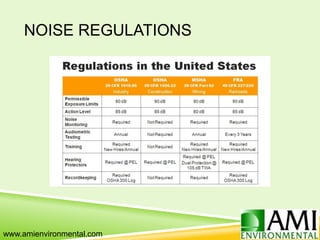
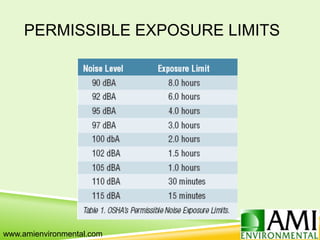
NOISE PERMISSIBLE EXPOSURE
LIMITS
(PEL)
• Utilize administrative or engineering controls
when sound levels exceed Noise
permissible Exposure Levels.
(8 hours permitted duration per workday for
90 dBA sound level)
• Provide hearing protection if above controls
fail to reduce sound levels within
Permissible exposure levels
www.amienvironmental.com
NOISE REGULATIONS
www.amienvironmental.com
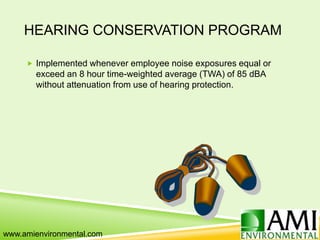
HEARING CONSERVATION PROGRAM
 Implemented whenever employee noise exposures equal or
exceed an 8 hour time-weighted average (TWA) of 85 dBA
without attenuation from use of hearing protection.
www.amienvironmental.com
ELEMENTS OF HEARING
CONSERVATION PROGRAM
 Noise Monitoring
 Hearing Protection
 Audiometric Testing
 Training
 Record Keeping
HEARING CONSERVATION PROGRAM GUIDELINE
OSHA Noise Standard and Hearing Conservation Amendment 29
CFR 1910.95
www.amienvironmental.com
RULE OF THUMB
When you feel the need to shout
in order to be heard 3 feet
away, the noise levels are
probably 85 dB or more and
hearing protection is
recommended.
www.amienvironmental.com
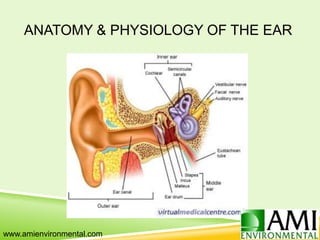
ANATOMY & PHYSIOLOGY OF THE EAR
www.amienvironmental.com
SOUND PRESSURE LEVEL
Definition: the local pressure deviation from the ambient (average, or equilibrium)
atmospheric pressure caused by a sound wave.
 Sound waves are energy produced by vibrating objects
 The larynx vibrates to produce the voice
 The vibrations create a pattern, which the ear translates
into sound
 As you double the distance from a noise source loudness
decreased by half
 Strong vibrations from very loud noises can damage the ear
www.amienvironmental.com
HOW WE HEAR SOUNDS
 Sound waves enter the ear canal striking the eardrum.
 When the eardrum vibrates, ossicles conduct vibrations to the
cochlea.
 Tiny hair like cells in cochlea respond to vibrations by generating
nerve impulses.
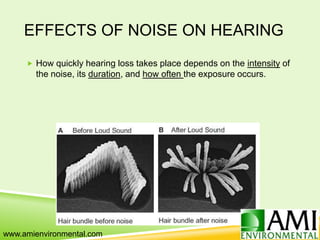
Healthy hair cells are the key to good hearing. Although, some die off
naturally as you age, many more are killed early from unprotected
exposure to hazardous noise.
www.amienvironmental.com
EFFECTS OF NOISE ON HEARING
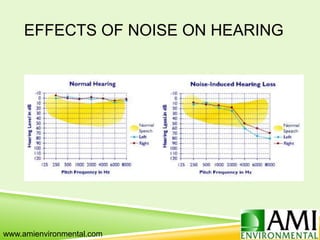
 How quickly hearing loss takes place depends on the intensity of
the noise, its duration, and how often the exposure occurs.
www.amienvironmental.com
SYMPTOMS OF OVEREXPOSURE TO
NOISE
 Temporary Threshold Shift
 Muffled sound after noise exposure
 If continued overexposure, this can worsen and become permanent.
 Tinnitus
 Ringing in the ears
 If continued overexposure, this can become permanent.
www.amienvironmental.com
HOW HEARING IS DAMAGED
 Hair like cells are flattened
 You don’t get used to noise; you gradually loose your hearing
 Once hearing is damaged it can not be repaired.
www.amienvironmental.com
SIGNS OF HEARING LOSS
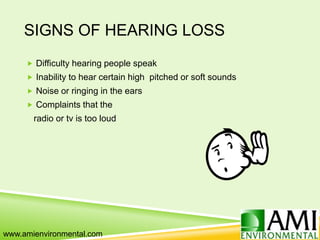
 Difficulty hearing people speak
 Inability to hear certain high pitched or soft sounds
 Noise or ringing in the ears
 Complaints that the
radio or tv is too loud
www.amienvironmental.com
TYPES OF HEARING LOSS
 Conductive
 Caused by something that stops sound from reaching the outer
or middle ear (infection, foreign
bodies, fluid, earwax, malformation of ear)
 Sensorineural
 Hearing loss that occurs when there is a problem with the
nerve in the middle ear.
 Caused by birth injury, disease, noise exposure, trauma, and
ageing
 Mixed
 Hearing loss that includes both conductive and sensorineural
www.amienvironmental.com
NOISE INDUCED HEARING LOSS
 Noise induced hearing loss occurs from exposure to loud noises.
 Constant exposure over a period of time
 Exposed to sound levels over 140 dBA
 Tinnitus
 Age induced hearing loss
 Hereditary
 Nerve damage
 Exposure to high sound levels
www.amienvironmental.com
OCCUPATIONAL/NON OCCUPATIONAL
HEARING LOSS
 Occupational Hearing Loss
 Results from constant exposure to sound levels above 85 dBA
TWA
 Damage to hair cells in cochlea
 Non-Occupational Hearing Loss
 Results from constant exposure to sound levels above 85 dBA
TWA
 Results from damage to outer, middle or inner
ear, hereditary, ototoxic drugs
www.amienvironmental.com
STATISTICS ON OCCUPATIONAL
HEARING LOSS
 Four million workers go to work each day in damaging noise. Ten
million people in the U.S. have a noise-related hearing loss. Twenty-
two million workers are exposed to potentially damaging noise each
year.
 In 2008, approximately 2 million U.S. workers were exposed to noise
levels at work that put them at risk of hearing loss.
 In 2007, approximately 23,000 cases were reported of occupational
hearing loss that was great enough to cause hearing impairment.
Reported cases of hearing loss accounted for 14% of occupational
illness in 2007.
 In 2007, approximately 82% of the cases involving occupational
hearing loss were reported among workers in the manufacturing
sector.
www.amienvironmental.com
EFFECTS OF NOISE ON HEARING
www.amienvironmental.com
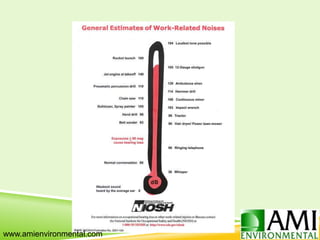
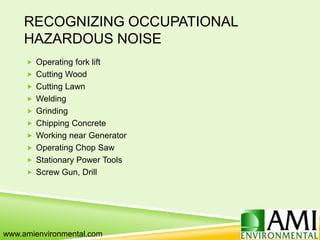
RECOGNIZING OCCUPATIONAL
HAZARDOUS NOISE
 Operating fork lift
 Cutting Wood
 Cutting Lawn
 Welding
 Grinding
 Chipping Concrete
 Working near Generator
 Operating Chop Saw
 Stationary Power Tools
 Screw Gun, Drill
www.amienvironmental.com
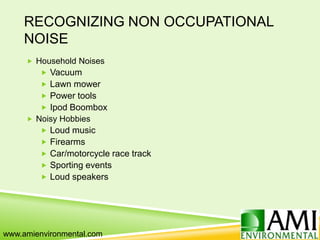
RECOGNIZING NON OCCUPATIONAL
NOISE
 Household Noises
 Vacuum
 Lawn mower
 Power tools
 Ipod Boombox
 Noisy Hobbies
 Loud music
 Firearms
 Car/motorcycle race track
 Sporting events
 Loud speakers
www.amienvironmental.com
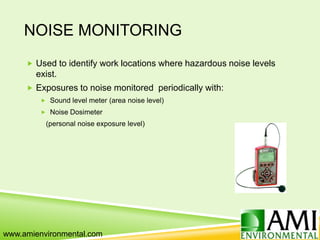
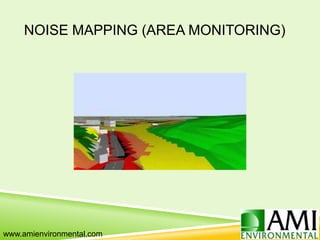
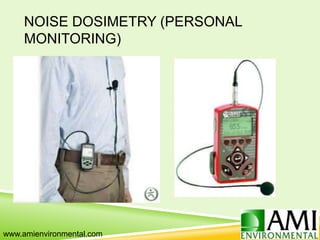
NOISE MONITORING
 Used to identify work locations where hazardous noise levels
exist.
 Exposures to noise monitored periodically with:
 Sound level meter (area noise level)
 Noise Dosimeter
(personal noise exposure level)
www.amienvironmental.com
NOISE MAPPING (AREA MONITORING)
www.amienvironmental.com
NOISE DOSIMETRY (PERSONAL
MONITORING)
www.amienvironmental.com
PERMISSIBLE EXPOSURE LIMITS
www.amienvironmental.com
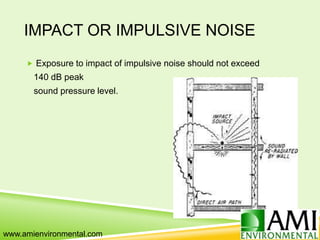
IMPACT OR IMPULSIVE NOISE
 Exposure to impact of impulsive noise should not exceed
140 dB peak
sound pressure level.
www.amienvironmental.com
AFFECTED EMPLOYEES
 Employees subjected to noise exceeding permissible noise limits
shall be provided hearing protection devices, if feasible
administrative or engineering controls failed to reduce noise
levels.
 Employee exposed to noise at or above the 8 hour TWA of 85
dB, or equivalently, a dose of 50% shall be notified and enrolled in
HCP.
www.amienvironmental.com
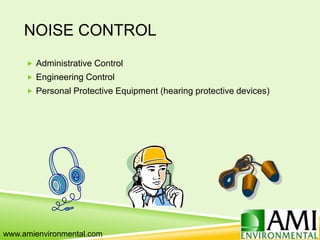
NOISE CONTROL
 Administrative Control
 Engineering Control
 Personal Protective Equipment (hearing protective devices)
www.amienvironmental.com
ADMINISTRATIVE CONTROL
 Operate noisy equipment on second or third shifts.
 Rotate employees through high noise areas.
 Modify existing machinery
 Place noise limit specs on new equipment
 Maintain equipment, keep in good condition
 Report noisy equipment to supervisor for repair.
www.amienvironmental.com
ENGINEERING CONTROLS
 Reduce noise at the source
 Interrupt the noise path
 Reduce reverberation and structural vibration
www.amienvironmental.com
PERSONAL PROTECTIVE EQUIPMENT
(HEARING PROTECTION DEVICES HPD)
 Employers shall provide employees exposed to 8 hr TWA of 85
dB at no cost.
 Employers shall ensure being worn:
 By employees exposed to 8 hr TWA of 90 dB or greater
 By employees exposed to 8 hr TWA of 85 dB or greater and
 Whose baseline audiogram has not been established
 Who have experienced a threshold shift
www.amienvironmental.com
HEARING PROTECTION DEVICE HPD
NOISE REDUCTION
 HPD must reduce employee noise exposure below PEL (8 hr
TWA of 90 dB)
 Employees with standard threshold shift (STS) HPD must reduce
employees noise exposure below an 8 hr TWA of 85 dB.
www.amienvironmental.com
HEARING PROTECTION USE
 Voluntary Use
 Exposed to an 8 hr TWA of 85 dB
 Mandatory Use
 Exposed to an 8 hr TWA of 90 dB
 Exposed to an 8 hr TWA of 85 dB but have not had a baseline hearing test
 Employees who have suffered STS hearing loss an dare exposed to an 8 hr
TWA of 85 dBA
www.amienvironmental.com
EMPLOYEE RESPONSIBILITY
 Understand the need for hearing protection devices
 Wear HPDs and seek replacements
 Encourage co workers to wear HPDs
 Communicate problems to supervisors
www.amienvironmental.com
MANAGEMENT RESPONSIBILITY
 Provide occupational noise training
 Provide hearing protection devices
 Demonstrate commitment (wear HPDs)
 Enforce the use of HPDS
 Keep up to date with HPD selection and use.
 Encourage questions and resolve problems.
www.amienvironmental.com
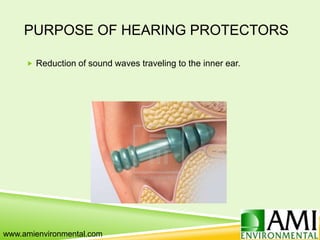
PURPOSE OF HEARING PROTECTORS
 Reduction of sound waves traveling to the inner ear.
www.amienvironmental.com
ADVANTAGES AND DISADVANTAGES
OF DIFFERENT TYPES OF HEARING
PROTECTORS
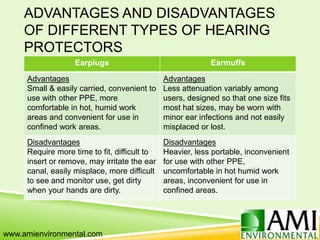
Earplugs Earmuffs
Advantages
Small & easily carried, convenient to
use with other PPE, more
comfortable in hot, humid work
areas and convenient for use in
confined work areas.
Advantages
Less attenuation variably among
users, designed so that one size fits
most hat sizes, may be worn with
minor ear infections and not easily
misplaced or lost.
Disadvantages
Require more time to fit, difficult to
insert or remove, may irritate the ear
canal, easily misplace, more difficult
to see and monitor use, get dirty
when your hands are dirty.
Disadvantages
Heavier, less portable, inconvenient
for use with other PPE,
uncomfortable in hot humid work
areas, inconvenient for use in
confined areas.
www.amienvironmental.com
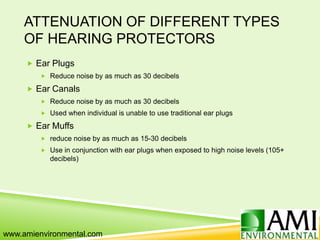
ATTENUATION OF DIFFERENT TYPES
OF HEARING PROTECTORS
 Ear Plugs
 Reduce noise by as much as 30 decibels
 Ear Canals
 Reduce noise by as much as 30 decibels
 Used when individual is unable to use traditional ear plugs
 Ear Muffs
 reduce noise by as much as 15-30 decibels
 Use in conjunction with ear plugs when exposed to high noise levels (105+
decibels)
www.amienvironmental.com
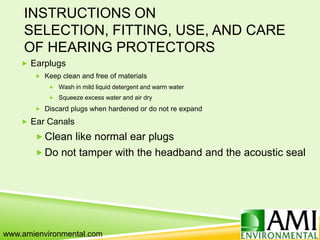
INSTRUCTIONS ON
SELECTION, FITTING, USE, AND CARE
OF HEARING PROTECTORS
 Earplugs
 Keep clean and free of materials
 Wash in mild liquid detergent and warm water
 Squeeze excess water and air dry
 Discard plugs when hardened or do not re expand
 Ear Canals
 Clean like normal ear plugs
 Do not tamper with the headband and the acoustic seal
www.amienvironmental.com
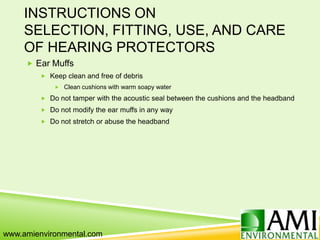
INSTRUCTIONS ON
SELECTION, FITTING, USE, AND CARE
OF HEARING PROTECTORS
 Ear Muffs
 Keep clean and free of debris
 Clean cushions with warm soapy water
 Do not tamper with the acoustic seal between the cushions and the headband
 Do not modify the ear muffs in any way
 Do not stretch or abuse the headband
www.amienvironmental.com
TRAINING
 Provide annually to employees who are exposed to noise at or
above 8 hr TWA of 85 dB.
 Topics must include
 Effects of Noise on Hearing
 Purpose of Hearing protectors
 Advantages and Disadvantages of Different Types of Hearing Protectors
 Instruction on Selection, Fitting, Use, of Hearing Protectors
 Purpose of Audiometric Testing
www.amienvironmental.com
QUESTIONS & ANSWERS
Q & A
www.amienvironmental.com

Occupational Noise

  • 1.
    OCCUPATIONAL NOISE AMI Environmental Environmental Health& Safety Dan Taylor www.amienvironmental.com
  • 2.
    BIO AMI Environmental  AMIEnvironmental is a full-service environmental consulting and remediation firm, specializing in facility-based environmental problems affecting facility operations, renovation and demolition activities. Established in 1986 and headquartered in Omaha, Nebraska, AMI services clients nationally and internationally.  Dan Taylor, CEO  Over 25 years Environmental Health & Safety Experience www.amienvironmental.com
  • 3.
    SUMMARY How We GotHere  1969-DOL issued the Walsh-Healey noise standard 90 dBA for 8 exp. Federal contracts of $10,000 or more.  1970- DOL issues Bulletin 334. “Continuous, Effective Conservation Program”  1970 Congress passes OSH Act. “Every Man and Women”  1971-OSHA made the Walsh-Healey noise standard an OSHA standard. www.amienvironmental.com
  • 4.
    DID YOU KNOW? Noiseinduced hearing loss is the most common occupational hazard for American workers. Hearing loss from noise is slow and painless; you can develop a disability before you notice it. If you must raise your voice to speak with someone only 3 feet away, you are in high (hazardous) noise. It is 100% preventable. www.amienvironmental.com
  • 5.
    WHAT IS NOISE? Noise is defined as: • Sound or a sound that is loud, unpleasant, unexpected, or undesired. • By product of many industrial processes (ex. operating machinery) • Exposure to high levels of noise may lead to hearing loss www.amienvironmental.com
  • 6.
    HOW MUCH NOISEIS TOO MUCH?  85 Decibels (dB) - the "Action Level" where hearing protection is required.  90 dB - the OSHA, 8 hour average exposure limit.  100 dB - exposures longer than 15 minutes are not recommended.  110 dB - regular exposure of more than 1 minute risks permanent hearing loss www.amienvironmental.com
  • 7.
    NOISE PERMISSIBLE EXPOSURE LIMITS (PEL) •Utilize administrative or engineering controls when sound levels exceed Noise permissible Exposure Levels. (8 hours permitted duration per workday for 90 dBA sound level) • Provide hearing protection if above controls fail to reduce sound levels within Permissible exposure levels www.amienvironmental.com
  • 8.
  • 9.
    HEARING CONSERVATION PROGRAM Implemented whenever employee noise exposures equal or exceed an 8 hour time-weighted average (TWA) of 85 dBA without attenuation from use of hearing protection. www.amienvironmental.com
  • 10.
    ELEMENTS OF HEARING CONSERVATIONPROGRAM  Noise Monitoring  Hearing Protection  Audiometric Testing  Training  Record Keeping HEARING CONSERVATION PROGRAM GUIDELINE OSHA Noise Standard and Hearing Conservation Amendment 29 CFR 1910.95 www.amienvironmental.com
  • 11.
  • 12.
    RULE OF THUMB Whenyou feel the need to shout in order to be heard 3 feet away, the noise levels are probably 85 dB or more and hearing protection is recommended. www.amienvironmental.com
  • 13.
    ANATOMY & PHYSIOLOGYOF THE EAR www.amienvironmental.com
  • 14.
    SOUND PRESSURE LEVEL Definition:the local pressure deviation from the ambient (average, or equilibrium) atmospheric pressure caused by a sound wave.  Sound waves are energy produced by vibrating objects  The larynx vibrates to produce the voice  The vibrations create a pattern, which the ear translates into sound  As you double the distance from a noise source loudness decreased by half  Strong vibrations from very loud noises can damage the ear www.amienvironmental.com
  • 15.
    HOW WE HEARSOUNDS  Sound waves enter the ear canal striking the eardrum.  When the eardrum vibrates, ossicles conduct vibrations to the cochlea.  Tiny hair like cells in cochlea respond to vibrations by generating nerve impulses. Healthy hair cells are the key to good hearing. Although, some die off naturally as you age, many more are killed early from unprotected exposure to hazardous noise. www.amienvironmental.com
  • 16.
    EFFECTS OF NOISEON HEARING  How quickly hearing loss takes place depends on the intensity of the noise, its duration, and how often the exposure occurs. www.amienvironmental.com
  • 17.
    SYMPTOMS OF OVEREXPOSURETO NOISE  Temporary Threshold Shift  Muffled sound after noise exposure  If continued overexposure, this can worsen and become permanent.  Tinnitus  Ringing in the ears  If continued overexposure, this can become permanent. www.amienvironmental.com
  • 18.
    HOW HEARING ISDAMAGED  Hair like cells are flattened  You don’t get used to noise; you gradually loose your hearing  Once hearing is damaged it can not be repaired. www.amienvironmental.com
  • 19.
    SIGNS OF HEARINGLOSS  Difficulty hearing people speak  Inability to hear certain high pitched or soft sounds  Noise or ringing in the ears  Complaints that the radio or tv is too loud www.amienvironmental.com
  • 20.
    TYPES OF HEARINGLOSS  Conductive  Caused by something that stops sound from reaching the outer or middle ear (infection, foreign bodies, fluid, earwax, malformation of ear)  Sensorineural  Hearing loss that occurs when there is a problem with the nerve in the middle ear.  Caused by birth injury, disease, noise exposure, trauma, and ageing  Mixed  Hearing loss that includes both conductive and sensorineural www.amienvironmental.com
  • 21.
    NOISE INDUCED HEARINGLOSS  Noise induced hearing loss occurs from exposure to loud noises.  Constant exposure over a period of time  Exposed to sound levels over 140 dBA  Tinnitus  Age induced hearing loss  Hereditary  Nerve damage  Exposure to high sound levels www.amienvironmental.com
  • 22.
    OCCUPATIONAL/NON OCCUPATIONAL HEARING LOSS Occupational Hearing Loss  Results from constant exposure to sound levels above 85 dBA TWA  Damage to hair cells in cochlea  Non-Occupational Hearing Loss  Results from constant exposure to sound levels above 85 dBA TWA  Results from damage to outer, middle or inner ear, hereditary, ototoxic drugs www.amienvironmental.com
  • 23.
    STATISTICS ON OCCUPATIONAL HEARINGLOSS  Four million workers go to work each day in damaging noise. Ten million people in the U.S. have a noise-related hearing loss. Twenty- two million workers are exposed to potentially damaging noise each year.  In 2008, approximately 2 million U.S. workers were exposed to noise levels at work that put them at risk of hearing loss.  In 2007, approximately 23,000 cases were reported of occupational hearing loss that was great enough to cause hearing impairment. Reported cases of hearing loss accounted for 14% of occupational illness in 2007.  In 2007, approximately 82% of the cases involving occupational hearing loss were reported among workers in the manufacturing sector. www.amienvironmental.com
  • 24.
    EFFECTS OF NOISEON HEARING www.amienvironmental.com
  • 25.
    RECOGNIZING OCCUPATIONAL HAZARDOUS NOISE Operating fork lift  Cutting Wood  Cutting Lawn  Welding  Grinding  Chipping Concrete  Working near Generator  Operating Chop Saw  Stationary Power Tools  Screw Gun, Drill www.amienvironmental.com
  • 26.
    RECOGNIZING NON OCCUPATIONAL NOISE Household Noises  Vacuum  Lawn mower  Power tools  Ipod Boombox  Noisy Hobbies  Loud music  Firearms  Car/motorcycle race track  Sporting events  Loud speakers www.amienvironmental.com
  • 27.
    NOISE MONITORING  Usedto identify work locations where hazardous noise levels exist.  Exposures to noise monitored periodically with:  Sound level meter (area noise level)  Noise Dosimeter (personal noise exposure level) www.amienvironmental.com
  • 28.
    NOISE MAPPING (AREAMONITORING) www.amienvironmental.com
  • 29.
  • 30.
  • 31.
    IMPACT OR IMPULSIVENOISE  Exposure to impact of impulsive noise should not exceed 140 dB peak sound pressure level. www.amienvironmental.com
  • 32.
    AFFECTED EMPLOYEES  Employeessubjected to noise exceeding permissible noise limits shall be provided hearing protection devices, if feasible administrative or engineering controls failed to reduce noise levels.  Employee exposed to noise at or above the 8 hour TWA of 85 dB, or equivalently, a dose of 50% shall be notified and enrolled in HCP. www.amienvironmental.com
  • 33.
    NOISE CONTROL  AdministrativeControl  Engineering Control  Personal Protective Equipment (hearing protective devices) www.amienvironmental.com
  • 34.
    ADMINISTRATIVE CONTROL  Operatenoisy equipment on second or third shifts.  Rotate employees through high noise areas.  Modify existing machinery  Place noise limit specs on new equipment  Maintain equipment, keep in good condition  Report noisy equipment to supervisor for repair. www.amienvironmental.com
  • 35.
    ENGINEERING CONTROLS  Reducenoise at the source  Interrupt the noise path  Reduce reverberation and structural vibration www.amienvironmental.com
  • 36.
    PERSONAL PROTECTIVE EQUIPMENT (HEARINGPROTECTION DEVICES HPD)  Employers shall provide employees exposed to 8 hr TWA of 85 dB at no cost.  Employers shall ensure being worn:  By employees exposed to 8 hr TWA of 90 dB or greater  By employees exposed to 8 hr TWA of 85 dB or greater and  Whose baseline audiogram has not been established  Who have experienced a threshold shift www.amienvironmental.com
  • 37.
    HEARING PROTECTION DEVICEHPD NOISE REDUCTION  HPD must reduce employee noise exposure below PEL (8 hr TWA of 90 dB)  Employees with standard threshold shift (STS) HPD must reduce employees noise exposure below an 8 hr TWA of 85 dB. www.amienvironmental.com
  • 38.
    HEARING PROTECTION USE Voluntary Use  Exposed to an 8 hr TWA of 85 dB  Mandatory Use  Exposed to an 8 hr TWA of 90 dB  Exposed to an 8 hr TWA of 85 dB but have not had a baseline hearing test  Employees who have suffered STS hearing loss an dare exposed to an 8 hr TWA of 85 dBA www.amienvironmental.com
  • 39.
    EMPLOYEE RESPONSIBILITY  Understandthe need for hearing protection devices  Wear HPDs and seek replacements  Encourage co workers to wear HPDs  Communicate problems to supervisors www.amienvironmental.com
  • 40.
    MANAGEMENT RESPONSIBILITY  Provideoccupational noise training  Provide hearing protection devices  Demonstrate commitment (wear HPDs)  Enforce the use of HPDS  Keep up to date with HPD selection and use.  Encourage questions and resolve problems. www.amienvironmental.com
  • 41.
    PURPOSE OF HEARINGPROTECTORS  Reduction of sound waves traveling to the inner ear. www.amienvironmental.com
  • 42.
    ADVANTAGES AND DISADVANTAGES OFDIFFERENT TYPES OF HEARING PROTECTORS Earplugs Earmuffs Advantages Small & easily carried, convenient to use with other PPE, more comfortable in hot, humid work areas and convenient for use in confined work areas. Advantages Less attenuation variably among users, designed so that one size fits most hat sizes, may be worn with minor ear infections and not easily misplaced or lost. Disadvantages Require more time to fit, difficult to insert or remove, may irritate the ear canal, easily misplace, more difficult to see and monitor use, get dirty when your hands are dirty. Disadvantages Heavier, less portable, inconvenient for use with other PPE, uncomfortable in hot humid work areas, inconvenient for use in confined areas. www.amienvironmental.com
  • 43.
    ATTENUATION OF DIFFERENTTYPES OF HEARING PROTECTORS  Ear Plugs  Reduce noise by as much as 30 decibels  Ear Canals  Reduce noise by as much as 30 decibels  Used when individual is unable to use traditional ear plugs  Ear Muffs  reduce noise by as much as 15-30 decibels  Use in conjunction with ear plugs when exposed to high noise levels (105+ decibels) www.amienvironmental.com
  • 44.
    INSTRUCTIONS ON SELECTION, FITTING,USE, AND CARE OF HEARING PROTECTORS  Earplugs  Keep clean and free of materials  Wash in mild liquid detergent and warm water  Squeeze excess water and air dry  Discard plugs when hardened or do not re expand  Ear Canals  Clean like normal ear plugs  Do not tamper with the headband and the acoustic seal www.amienvironmental.com
  • 45.
    INSTRUCTIONS ON SELECTION, FITTING,USE, AND CARE OF HEARING PROTECTORS  Ear Muffs  Keep clean and free of debris  Clean cushions with warm soapy water  Do not tamper with the acoustic seal between the cushions and the headband  Do not modify the ear muffs in any way  Do not stretch or abuse the headband www.amienvironmental.com
  • 46.
    TRAINING  Provide annuallyto employees who are exposed to noise at or above 8 hr TWA of 85 dB.  Topics must include  Effects of Noise on Hearing  Purpose of Hearing protectors  Advantages and Disadvantages of Different Types of Hearing Protectors  Instruction on Selection, Fitting, Use, of Hearing Protectors  Purpose of Audiometric Testing www.amienvironmental.com
  • 47.
    QUESTIONS & ANSWERS Q& A www.amienvironmental.com
  • 48.