Understanding Material Safety
     Data Sheets (MSDS)
Ralph Quiazon               03/04/11
What’s it for?
• A Material Safety Data Sheet (MSDS) is
  designed to tell you everything you need to
  know about a chemical and how to use it
  safely
Why Keep It Around?
• Occupational Safety & Health Administration
  (OSHA) …yea, it’s a Federal Agency
  – Hazardous Communication Standard
     • Every hazardous material (listed on the chemical
       hazard inventory) must have a corresponding MSDS
       provided by the chemical supplier (at least on first
       shipment)
  – Laboratory Standard
     • MSDS sheets must be kept on hand and be accessible
       to personnel during work hours
The Eight Main Sections
1.   Product Identification
2.   Hazardous Ingredients
3.   Physical Attributes
4.   Fire & Explosion Hazard Data
5.   Reactivity
6.   Health Hazards
7.   Usage, Handling, Storage & Disposal
8.   Special Protection & Precautions
Product Identification
•   Product name
•   Other known names
•   Date MSDS is prepares
•   Name & address of manufacturer
•   Emergency phone number
•   Chemical family
•   Chemical formula
•   CAS#
Hazardous Ingredients
• Percent composition
• Chemicals present
• Exposure limits/threshold
Physical Attributes
• Pertinent properties
  – Boiling/melting point
  – Specific gravity
  – Appearance/odor
  – Evaporation Rate
  – Etc…
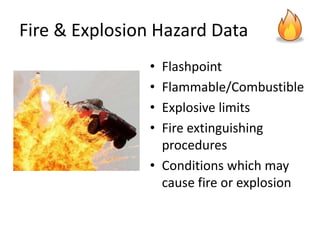
Fire & Explosion Hazard Data
               • Flashpoint
               • Flammable/Combustible
               • Explosive limits
               • Fire extinguishing
                 procedures
               • Conditions which may
                 cause fire or explosion
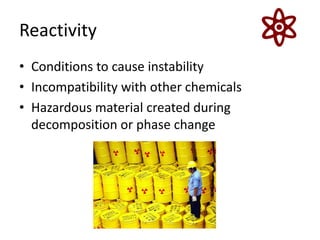
Reactivity
• Conditions to cause instability
• Incompatibility with other chemicals
• Hazardous material created during
  decomposition or phase change
Health Hazards
• Dangers or symptoms caused by exposure
• Dangers for people with medical conditions
• Emergency & first aid procedures
Usage, Handling, Storage, & Disposal
•   Cleanup of spills (small & large)
•   Appropriate Waste Disposal
•   Handling of chemical
•   Proper storage
Special Protection, Precautions
              • Personal Protective
                Equipment (PPE) that
                should be used
              • Other equipment that
                may be needed
              • Ventilation
              • Signs that should be
                posted
MSDS Safety

MSDS Safety

  • 1.
    Understanding Material Safety Data Sheets (MSDS) Ralph Quiazon 03/04/11
  • 2.
    What’s it for? •A Material Safety Data Sheet (MSDS) is designed to tell you everything you need to know about a chemical and how to use it safely
  • 3.
    Why Keep ItAround? • Occupational Safety & Health Administration (OSHA) …yea, it’s a Federal Agency – Hazardous Communication Standard • Every hazardous material (listed on the chemical hazard inventory) must have a corresponding MSDS provided by the chemical supplier (at least on first shipment) – Laboratory Standard • MSDS sheets must be kept on hand and be accessible to personnel during work hours
  • 4.
    The Eight MainSections 1. Product Identification 2. Hazardous Ingredients 3. Physical Attributes 4. Fire & Explosion Hazard Data 5. Reactivity 6. Health Hazards 7. Usage, Handling, Storage & Disposal 8. Special Protection & Precautions
  • 5.
    Product Identification • Product name • Other known names • Date MSDS is prepares • Name & address of manufacturer • Emergency phone number • Chemical family • Chemical formula • CAS#
  • 6.
    Hazardous Ingredients • Percentcomposition • Chemicals present • Exposure limits/threshold
  • 7.
    Physical Attributes • Pertinentproperties – Boiling/melting point – Specific gravity – Appearance/odor – Evaporation Rate – Etc…
  • 8.
    Fire & ExplosionHazard Data • Flashpoint • Flammable/Combustible • Explosive limits • Fire extinguishing procedures • Conditions which may cause fire or explosion
  • 9.
    Reactivity • Conditions tocause instability • Incompatibility with other chemicals • Hazardous material created during decomposition or phase change
  • 10.
    Health Hazards • Dangersor symptoms caused by exposure • Dangers for people with medical conditions • Emergency & first aid procedures
  • 11.
    Usage, Handling, Storage,& Disposal • Cleanup of spills (small & large) • Appropriate Waste Disposal • Handling of chemical • Proper storage
  • 12.
    Special Protection, Precautions • Personal Protective Equipment (PPE) that should be used • Other equipment that may be needed • Ventilation • Signs that should be posted