Smart Power Grid
Monitoring System
Case Study
                            Talk by
                                  Isma Hadji
                             Imane Hafnaoui

    University of M’Hamed Bouguara - IGEE
Outlines
• Introduction
• Smart grids
• Phasor Measurment Units (PMUs)
• Monitoring
• Power system stability monitoring
• Out-of-step stability
• Conclusion
Introduction
• Traditionally, electrical grids mainly consisted of
  power stations, transmission lines and transformers.
• Nowadays, grids are growing bigger and they are
  becoming smart grids, implementing virtually all the
  processing and management needed by a power
  system from monitoring, through control to
  protection.
• One of the most important elements of modern
  energy management systems is monitoring of the
  state of the power system from real-time
  measurements.
• This is today done using PMUs and WAMS
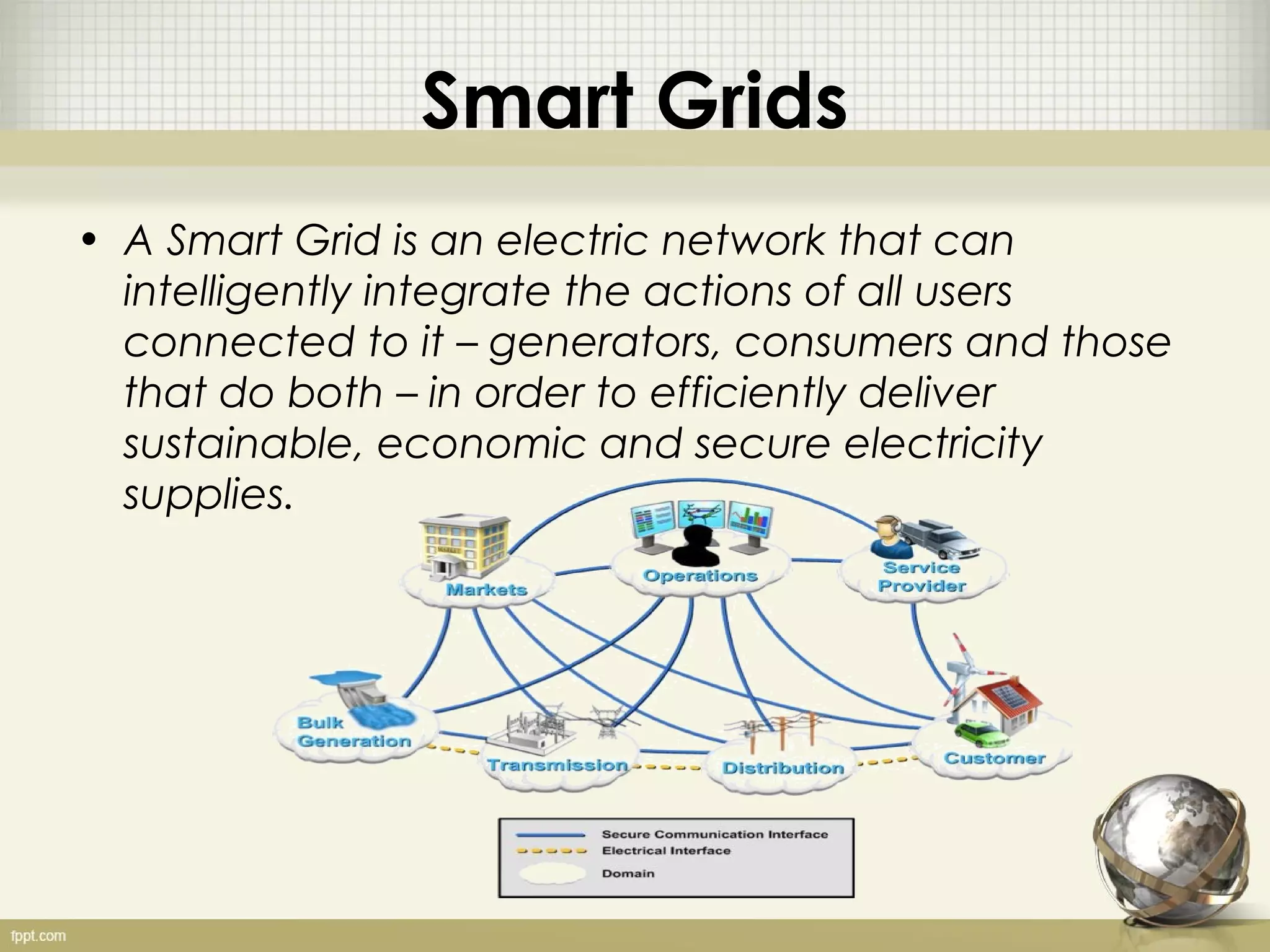
Smart Grids
• A Smart Grid is an electric network that can
  intelligently integrate the actions of all users
  connected to it – generators, consumers and those
  that do both – in order to efficiently deliver
  sustainable, economic and secure electricity
  supplies.
Phasor Measurement Units
• Phasor Measurement Units (PMU) provide real-time
  measurement of positive sequence voltages and
  currents at power system substations in real time.

• Electrical Quantities recorded by PMUs
   –   Bus voltages
   –   Three-phase line currents for every critical line.
   –   Frequency
   –   Megawatts and Mega-vars
Phasor Measurement Units

Disturbance Recording

  – PMUs are placed at key locations on the system
  – Depending on the type of trigger, a PMU will
    record when a power system fault is observed at
    its location.
  – The captured phasors are time tagged based on
    the time of the UTC Time Reference.
Phasor Measurement Units

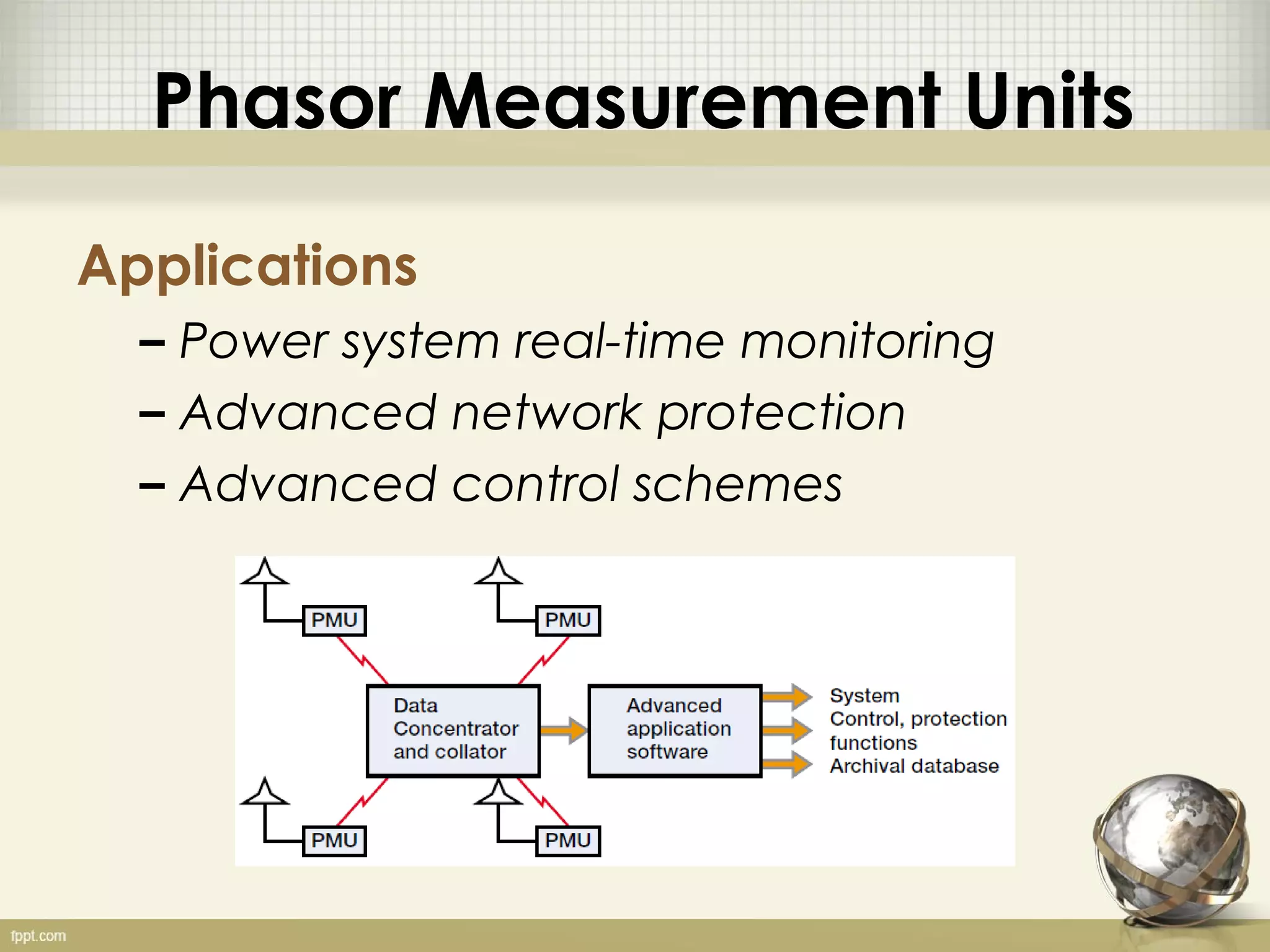
Applications
  – Power system real-time monitoring
  – Advanced network protection
  – Advanced control schemes
Monitoring
• Energy monitoring is primarily a management
  technique that gathers energy information that will
  be used as a basis to eliminate losses, reduce and
  control current levels of energy use and improve
  the existing operating procedures. It builds on the
  principle “you can’t manage what you don’t
  measure”.
• In today’s large scale systems there are plenty
  phenomena that need to be detected and
  monitored to keep them working at their best.
• Monitoring represents the first line of protection for
  any power system.
Monitoring

The Imperatives of Monitoring
• Power assurance
• Visibility into power conditions
• Energy efficiency
• Energy cost allocations
• Proactive planning
Monitored Phenomena
Islanding Detection
      Islanding refers to the condition in which a
 distributed generator (DG) continues to power a
 location even though electrical grid power from the
 electric utility is no longer present.
 Example: a solar panel in a blackout scenario.
 Detection: At the substation, voltage and angle are
 measured and time stamped before being sent to
 the receiver at the DER-plant. It can there easily be
 determined if the DER-plant is synchronized with the
 grid or not.
Monitored Phenomena
Line Thermal Monitoring
   Loose connections or deterioration of contact surfaces result in local
temperature rise which may result in possible forced outages. It is wise
to say that temperature monitoring is necessary.
   This type of monitoring plays as a congestion manager as it
improves power flow control.

  Detection
  •The voltage and current phasors measured at both ends of a line
are collected using PMUs
  •Actual impedance and shunt admittance of a line are computed.
  •Resistance of the line/cable is extracted.
  •Based on the known properties of the conductor material, the
actual average temperature of the line is determined.
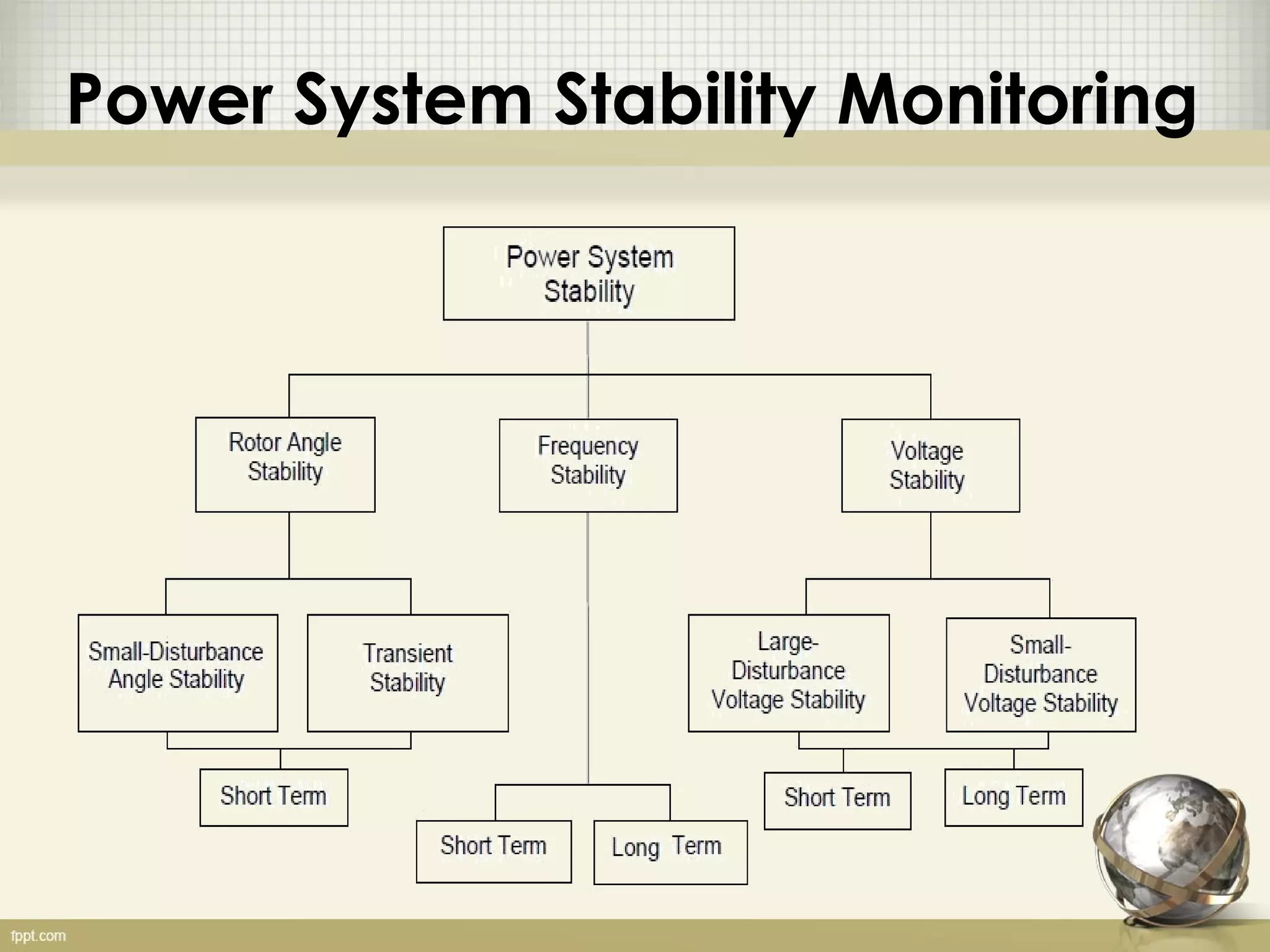
Power System Stability Monitoring

• Power systems are subjected to a wide range of
  small or larger disturbances during operating
  conditions.
• The power system must adjust to these changing
  conditions and continue to operate satisfactorily
  and within the desired bounds of voltage and
  frequency.
• For this reason monitoring power system stability is of
  paramount importance in any power system.
Power System Stability Monitoring

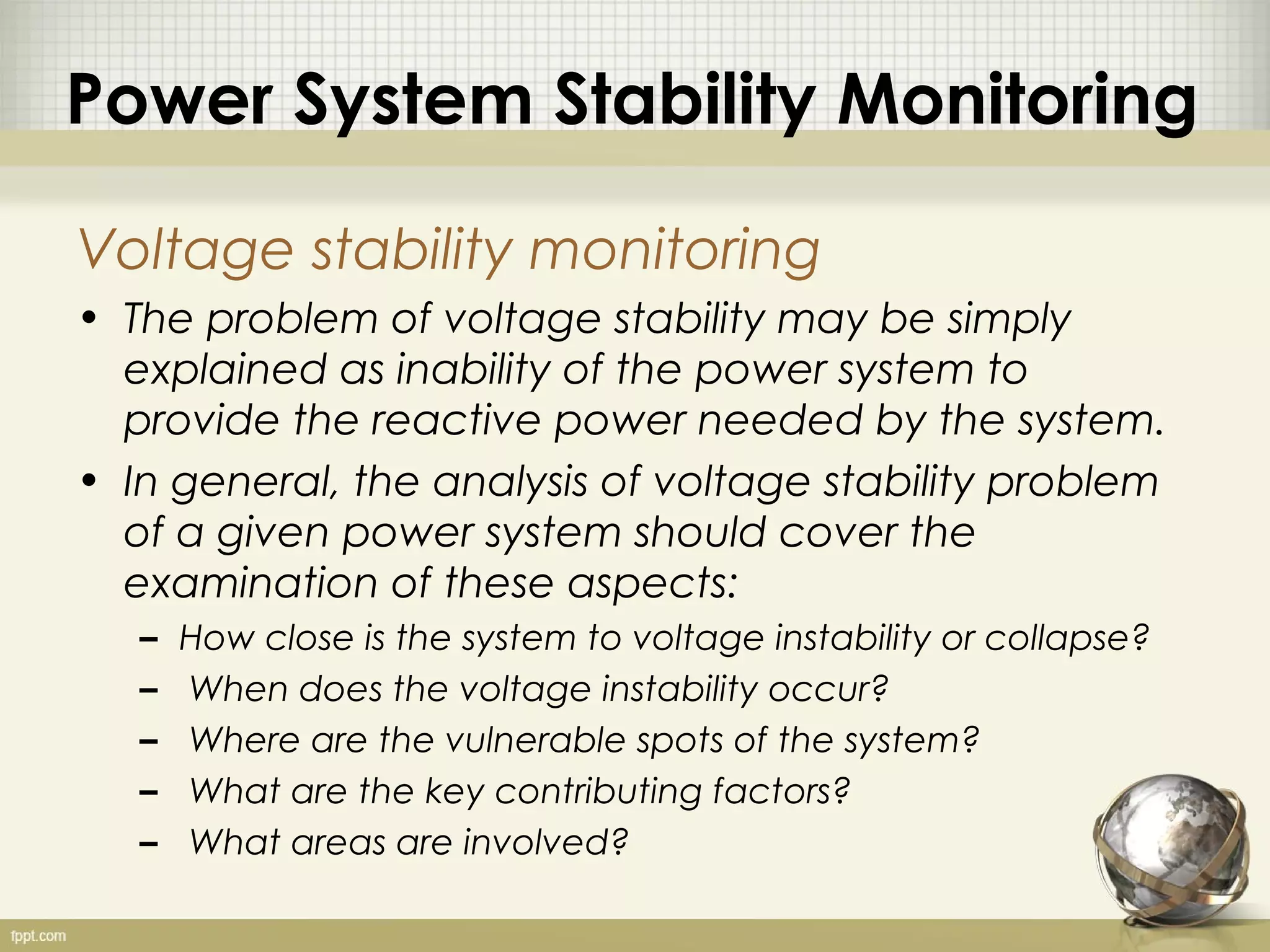
Voltage stability monitoring
• The problem of voltage stability may be simply
  explained as inability of the power system to
  provide the reactive power needed by the system.
• In general, the analysis of voltage stability problem
  of a given power system should cover the
  examination of these aspects:
   –   How close is the system to voltage instability or collapse?
   –   When does the voltage instability occur?
   –   Where are the vulnerable spots of the system?
   –   What are the key contributing factors?
   –   What areas are involved?
Power System Stability Monitoring

Angle stability monitoring
• When the system is operating under
  unforeseen conditions or under unusually
  high stress, the system can experience angle
  instability. In that case, the system breaks up
  into many islands, resulting in large loss of
  loads and generations and a potential
  blackout scenario.
Power System Stability Monitoring

Power oscillation monitoring
Power oscillation monitoring is concerned with the detection of
  power swings in a high voltage power system.
Low-frequency oscillations occur when an individual or group of
  generators swing against other generators operating
  synchronously on the same system, caused by controls
  attempting to maintain an exact frequency.

• Synchrophasor data are critical to detect potential and
  actual oscillations; which require the high-speed PMUs.
    – Examining bus voltages and frequencies will allow
      observation of inter-area oscillations.
    – The energy of power oscillations indicates whether
      oscillations are growing or dissipating.
Out-of-Step Stability
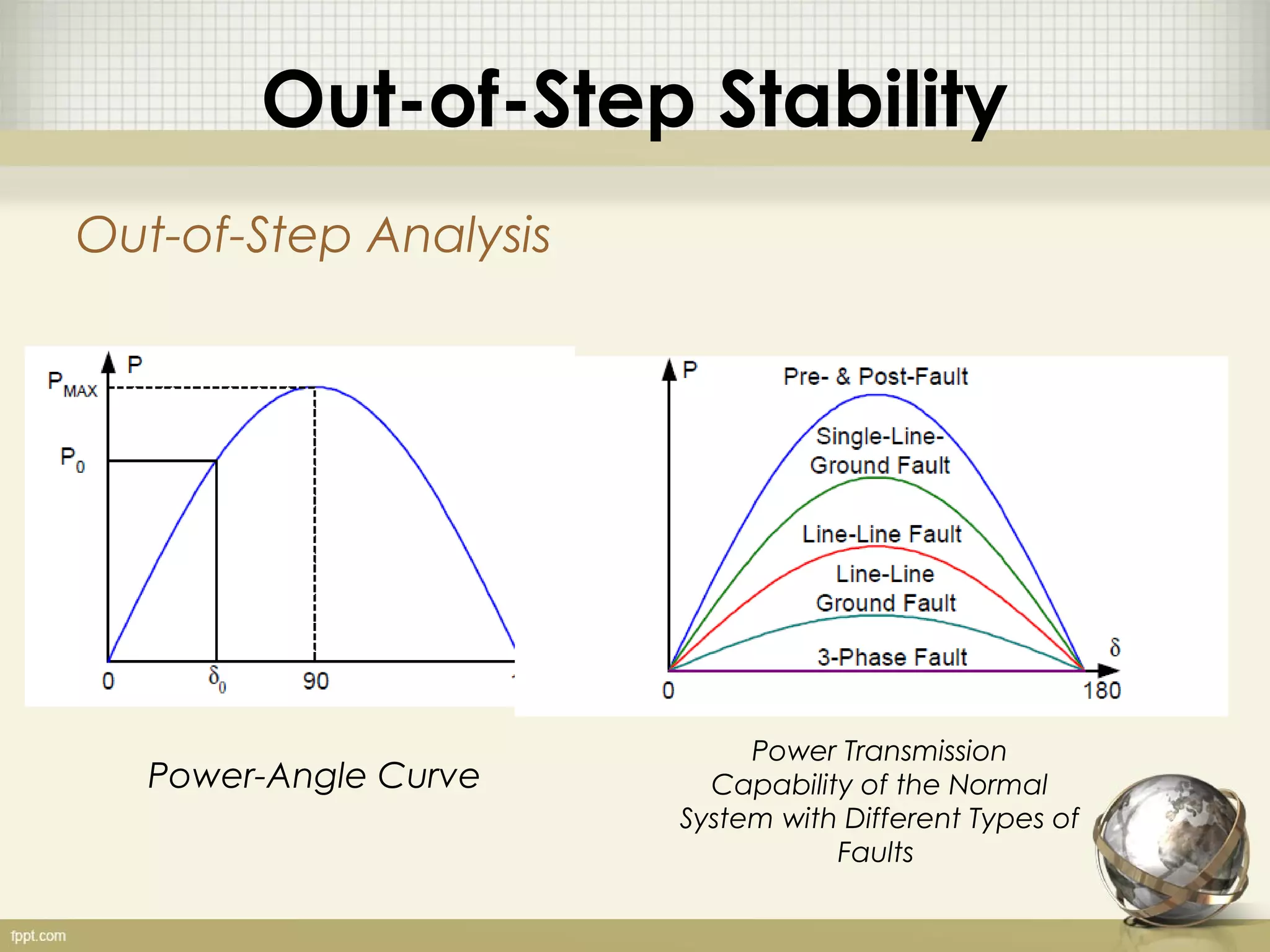
Out-of-Step Analysis


                            Power Transmission
   Power-Angle Curve     Capability of the Normal
                       System with Different Types of
                                  Faults
Out-of-Step Stability
Equal Area Criterion
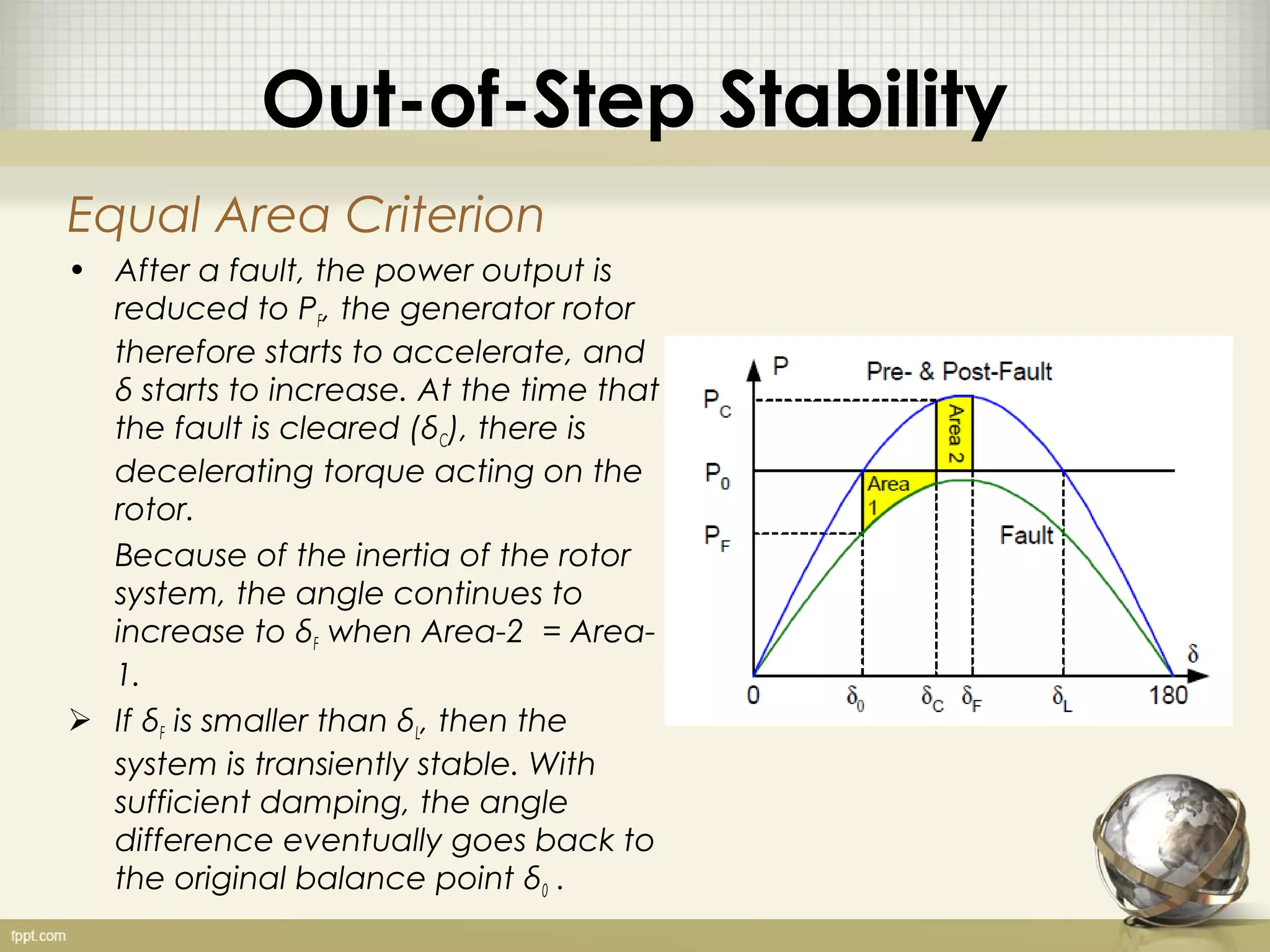
• After a fault, the power output is
  reduced to PF, the generator rotor
  therefore starts to accelerate, and
  δ starts to increase. At the time that
  the fault is cleared (δC), there is
  decelerating torque acting on the
  rotor.
  Because of the inertia of the rotor
  system, the angle continues to
  increase to δF when Area-2 = Area-
  1.
 If δF is smaller than δL, then the
  system is transiently stable. With
  sufficient damping, the angle
  difference eventually goes back to
  the original balance point δ0 .
Out-of-Step Stability
Equal Area Criterion
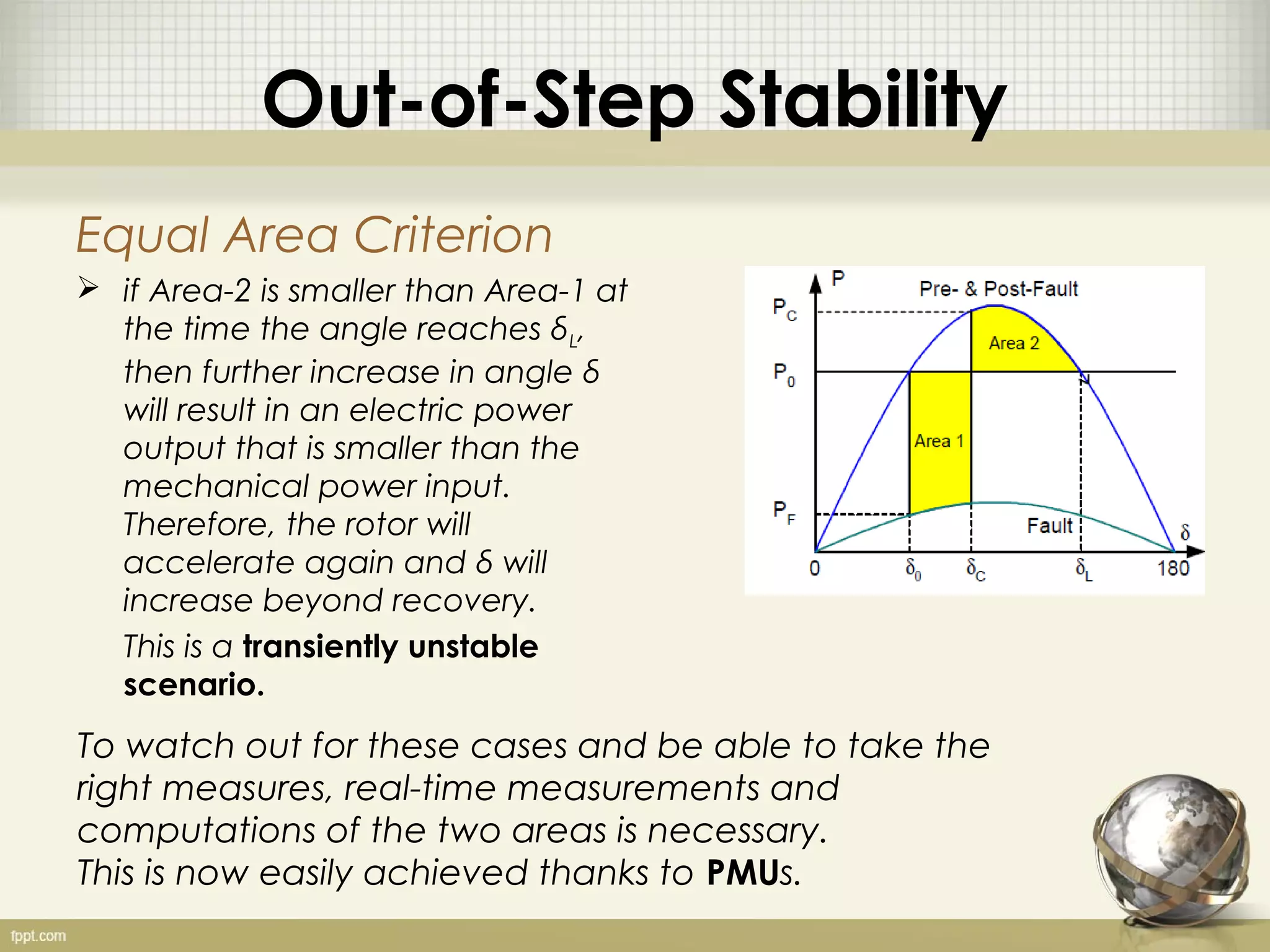
 if Area-2 is smaller than Area-1 at
  the time the angle reaches δL,
  then further increase in angle δ
  will result in an electric power
  output that is smaller than the
  mechanical power input.
  Therefore, the rotor will
  accelerate again and δ will
  increase beyond recovery.
  This is a transiently unstable
  scenario.
To watch out for these cases and be able to take the
right measures, real-time measurements and
computations of the two areas is necessary.
This is now easily achieved thanks to PMUs.
Conclusion
• The concept of modern smart power grids was
  introduced. Power monitoring and management deliver
  confidence that power systems are doing what they
  should, that personnel will be immediately notified of
  alert conditions in time to resolve, not just react, and the
  confidence of being able to predict and prevent
  problems before they occur.

• Placement of PMUs in power systems to easily support
  wide area recording with synchronized data, and that
  for enhancement of power system stability such as rotor
  angle stability, power system oscillations, and voltage
  stability in an integrated power system network.
THANK YOU

Smart Power Grid Monitoring System

  • 1.
    Smart Power Grid MonitoringSystem Case Study Talk by Isma Hadji Imane Hafnaoui University of M’Hamed Bouguara - IGEE
  • 2.
    Outlines • Introduction • Smartgrids • Phasor Measurment Units (PMUs) • Monitoring • Power system stability monitoring • Out-of-step stability • Conclusion
  • 3.
    Introduction • Traditionally, electricalgrids mainly consisted of power stations, transmission lines and transformers. • Nowadays, grids are growing bigger and they are becoming smart grids, implementing virtually all the processing and management needed by a power system from monitoring, through control to protection. • One of the most important elements of modern energy management systems is monitoring of the state of the power system from real-time measurements. • This is today done using PMUs and WAMS
  • 4.
    Smart Grids • ASmart Grid is an electric network that can intelligently integrate the actions of all users connected to it – generators, consumers and those that do both – in order to efficiently deliver sustainable, economic and secure electricity supplies.
  • 5.
    Phasor Measurement Units •Phasor Measurement Units (PMU) provide real-time measurement of positive sequence voltages and currents at power system substations in real time. • Electrical Quantities recorded by PMUs – Bus voltages – Three-phase line currents for every critical line. – Frequency – Megawatts and Mega-vars
  • 6.
    Phasor Measurement Units DisturbanceRecording – PMUs are placed at key locations on the system – Depending on the type of trigger, a PMU will record when a power system fault is observed at its location. – The captured phasors are time tagged based on the time of the UTC Time Reference.
  • 7.
    Phasor Measurement Units Applications – Power system real-time monitoring – Advanced network protection – Advanced control schemes
  • 8.
    Monitoring • Energy monitoringis primarily a management technique that gathers energy information that will be used as a basis to eliminate losses, reduce and control current levels of energy use and improve the existing operating procedures. It builds on the principle “you can’t manage what you don’t measure”. • In today’s large scale systems there are plenty phenomena that need to be detected and monitored to keep them working at their best. • Monitoring represents the first line of protection for any power system.
  • 9.
    Monitoring The Imperatives ofMonitoring • Power assurance • Visibility into power conditions • Energy efficiency • Energy cost allocations • Proactive planning
  • 10.
    Monitored Phenomena Islanding Detection Islanding refers to the condition in which a distributed generator (DG) continues to power a location even though electrical grid power from the electric utility is no longer present. Example: a solar panel in a blackout scenario. Detection: At the substation, voltage and angle are measured and time stamped before being sent to the receiver at the DER-plant. It can there easily be determined if the DER-plant is synchronized with the grid or not.
  • 11.
    Monitored Phenomena Line ThermalMonitoring Loose connections or deterioration of contact surfaces result in local temperature rise which may result in possible forced outages. It is wise to say that temperature monitoring is necessary. This type of monitoring plays as a congestion manager as it improves power flow control. Detection •The voltage and current phasors measured at both ends of a line are collected using PMUs •Actual impedance and shunt admittance of a line are computed. •Resistance of the line/cable is extracted. •Based on the known properties of the conductor material, the actual average temperature of the line is determined.
  • 12.
    Power System StabilityMonitoring • Power systems are subjected to a wide range of small or larger disturbances during operating conditions. • The power system must adjust to these changing conditions and continue to operate satisfactorily and within the desired bounds of voltage and frequency. • For this reason monitoring power system stability is of paramount importance in any power system.
  • 13.
  • 14.
    Power System StabilityMonitoring Voltage stability monitoring • The problem of voltage stability may be simply explained as inability of the power system to provide the reactive power needed by the system. • In general, the analysis of voltage stability problem of a given power system should cover the examination of these aspects: – How close is the system to voltage instability or collapse? – When does the voltage instability occur? – Where are the vulnerable spots of the system? – What are the key contributing factors? – What areas are involved?
  • 15.
    Power System StabilityMonitoring Angle stability monitoring • When the system is operating under unforeseen conditions or under unusually high stress, the system can experience angle instability. In that case, the system breaks up into many islands, resulting in large loss of loads and generations and a potential blackout scenario.
  • 16.
    Power System StabilityMonitoring Power oscillation monitoring Power oscillation monitoring is concerned with the detection of power swings in a high voltage power system. Low-frequency oscillations occur when an individual or group of generators swing against other generators operating synchronously on the same system, caused by controls attempting to maintain an exact frequency. • Synchrophasor data are critical to detect potential and actual oscillations; which require the high-speed PMUs. – Examining bus voltages and frequencies will allow observation of inter-area oscillations. – The energy of power oscillations indicates whether oscillations are growing or dissipating.
  • 17.
    Out-of-Step Stability Out-of-Step Analysis Power Transmission Power-Angle Curve Capability of the Normal System with Different Types of Faults
  • 18.
    Out-of-Step Stability Equal AreaCriterion • After a fault, the power output is reduced to PF, the generator rotor therefore starts to accelerate, and δ starts to increase. At the time that the fault is cleared (δC), there is decelerating torque acting on the rotor. Because of the inertia of the rotor system, the angle continues to increase to δF when Area-2 = Area- 1.  If δF is smaller than δL, then the system is transiently stable. With sufficient damping, the angle difference eventually goes back to the original balance point δ0 .
  • 19.
    Out-of-Step Stability Equal AreaCriterion  if Area-2 is smaller than Area-1 at the time the angle reaches δL, then further increase in angle δ will result in an electric power output that is smaller than the mechanical power input. Therefore, the rotor will accelerate again and δ will increase beyond recovery. This is a transiently unstable scenario. To watch out for these cases and be able to take the right measures, real-time measurements and computations of the two areas is necessary. This is now easily achieved thanks to PMUs.
  • 20.
    Conclusion • The conceptof modern smart power grids was introduced. Power monitoring and management deliver confidence that power systems are doing what they should, that personnel will be immediately notified of alert conditions in time to resolve, not just react, and the confidence of being able to predict and prevent problems before they occur. • Placement of PMUs in power systems to easily support wide area recording with synchronized data, and that for enhancement of power system stability such as rotor angle stability, power system oscillations, and voltage stability in an integrated power system network.
  • 21.

Editor's Notes

  • #19 After a fault, the power output is reduced to P F , the generator rotor therefore starts to accelerate, and δ starts to increase. At the time that the fault is cleared when the angle difference reaches δ C , there is decelerating torque acting on the rotor because the electric power output P C at the angle δ C is larger than the mechanical power input P 0 . However, because of the inertia of the rotor system, the angle does not start to go back to δ 0 immediately. Rather, the angle continues to increase to δ F when the energy lost during deceleration in Area-2 is equal to the energy gained during acceleration in Area-1. This is the so-called Equal-Area Criterion .