

 
BUILDING MATERIAL AND BUILDING CONTRUCTION
DONE BY:
K GANESH PRAVEEN 31810610103
G. RAKESH KUMAR 318106101007
 Shuttering in concrete construction is used as a mould
for a structure in which fresh concrete is poured to
harden subsequently curing
 It is a part of formwork, or you may call it as derivative of
formwork. Shuttering is a vertical temporary
arrangement which is arranged to bring concrete in a
desired shape.
or
Formwork which supports vertical arrangement is known
as shuttering.
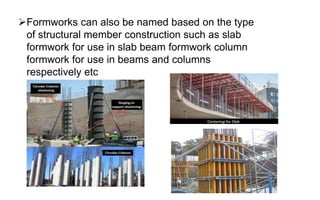
Formworks can also be named based on the type
of structural member construction such as slab
formwork for use in slab beam formwork column
formwork for use in beams and columns
respectively etc
 Formwork failures are the cause of many damages and
building failures that occur during concrete construction,
usually when fresh concrete is being filled. Generally, some
unexpected event causes one member to fail, then others
become overloaded or misaligned, and the entire formwork
structure collapses. The main causes of formwork failure
are given under below :
1. Improper Stripping and Shore Removal
2. Inadequate Bracing
3. Inadequate Control of Concrete
Placement
4. Vibration and Impact
5. Unstable Soil under Mudsills and Out of
Plumb Shores
6. Lack of Attention to Formwork Details
7. When Formwork Is Not at Fault
TYPES OF FAILURES
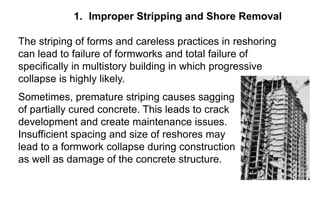
1. Improper Stripping and Shore Removal
The striping of forms and careless practices in reshoring
can lead to failure of formworks and total failure of
specifically in multistory building in which progressive
collapse is highly likely.
Sometimes, premature striping causes sagging
of partially cured concrete. This leads to crack
development and create maintenance issues.
Insufficient spacing and size of reshores may
lead to a formwork collapse during construction
as well as damage of the concrete structure.
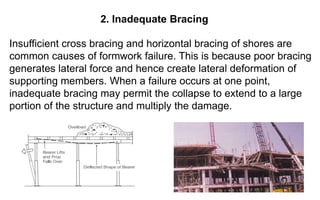
2. Inadequate Bracing
Insufficient cross bracing and horizontal bracing of shores are
common causes of formwork failure. This is because poor bracing
generates lateral force and hence create lateral deformation of
supporting members. When a failure occurs at one point,
inadequate bracing may permit the collapse to extend to a large
portion of the structure and multiply the damage.
3. Inadequate Control of Concrete
Placement
Failure to regulate properly the rate and order of
placing concrete on horizontal formwork introduce
unbalanced loadings and consequent failures of
formwork as known as control of concrete placement
If concrete temperature drops during construction
operations, the rate of concrete placement needs
to be decreased to avoid a buildup of lateral
pressure overloading the formworks.
4. Vibration and Impact
Vibration and impact due to passing traffic,
movement of workers and equipment on formwork,
and vibration because of concrete consolidation can
displace supporting shores or jacks of formwork
system and cause total failure of the forms.
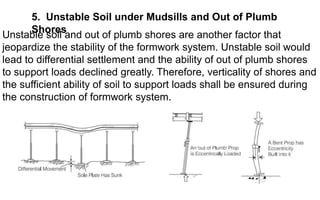
5. Unstable Soil under Mudsills and Out of Plumb
Shores
Unstable soil and out of plumb shores are another factor that
jeopardize the stability of the formwork system. Unstable soil would
lead to differential settlement and the ability of out of plumb shores
to support loads declined greatly. Therefore, verticality of shores and
the sufficient ability of soil to support loads shall be ensured during
the construction of formwork system.
6. Lack of Attention to Formwork Details
Assemblage errors such as insufficient nailing, failure to
tighten the locking devices on metal shores, inadequate
provisions to prevent rotation of beam forms where slab
forms frame into them on one side, inadequate anchorage
against uplift for sloping form faces, and lack of bracing or
tying at corners can cause failure of formworks even if its
design is completed in the best possible way. So, skilled and
trained labor shall assemble the formwork system under
great supervision.
7. When Formwork Is Not at
Fault
There are cases in which the failure of the formwork
system during building construction is not related to
formwork faults. Factors such as incorrect assumption
regarding types of soil in design stage, inadequate shear
reinforcement placement, and placement of ducts at high
stress region in slabs are reported to be the causes of
failures.
Various Place of Formwork Failure
The position of failure in the formwork(shuttering) system
based on actions is subdivided into two types.
Enabling Events:-These events are the actions which
cause failure inside the formwork system. The place where
the failure occurs is in the(base) foundation, Props,
Auxiliary members (bracing or lacing)
(Props), Timber Shore, Platforms, Timber Joist
(Beam), Slab, Wall forms, Base Plate, Form ties, Sprit
Level and Rust, Column, Span, Runners.
 Triggering Events:
These events are the event that reason behind the failure of
formwork outwardly. Mostly they are due to heavy rain (high
current of water flow)/river flow rush causing foundation failure,
Concentrated/extreme load due to construction material, lateral
movement, Effects from concreting operation, vibration, Impact
load while concrete filling, unintentional load from construction
machinery, shaking from nearby equipment, Effects of improper
or premature formwork removal, unskilled worker, faulty Design
and Lack of maintenance/repair works.
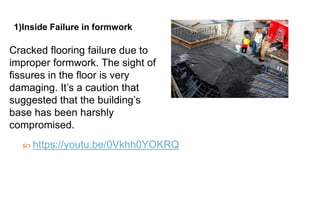
1)Inside Failure in formwork
Cracked flooring failure due to
improper formwork. The sight of
fissures in the floor is very
damaging. It’s a caution that
suggested that the building’s
base has been harshly
compromised.
 https://youtu.be/0Vkhh0YOKRQ
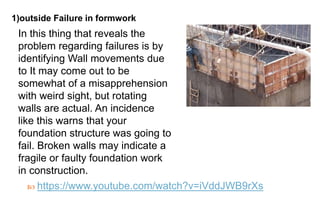
1)outside Failure in formwork
In this thing that reveals the
problem regarding failures is by
identifying Wall movements due
to It may come out to be
somewhat of a misapprehension
with weird sight, but rotating
walls are actual. An incidence
like this warns that your
foundation structure was going to
fail. Broken walls may indicate a
fragile or faulty foundation work
in construction.
 https://www.youtube.com/watch?v=iVddJWB9rXs
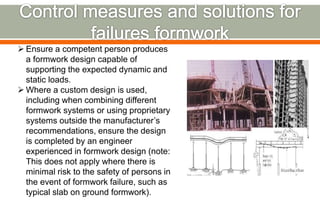
 Ensure a competent person produces
a formwork design capable of
supporting the expected dynamic and
static loads.
 Where a custom design is used,
including when combining different
formwork systems or using proprietary
systems outside the manufacturer’s
recommendations, ensure the design
is completed by an engineer
experienced in formwork design (note:
This does not apply where there is
minimal risk to the safety of persons in
the event of formwork failure, such as
typical slab on ground formwork).
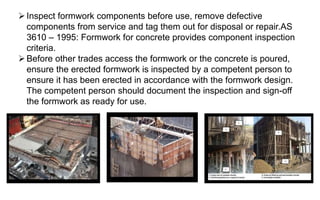
Inspect formwork components before use, remove defective
components from service and tag them out for disposal or repair.AS
3610 – 1995: Formwork for concrete provides component inspection
criteria.
Before other trades access the formwork or the concrete is poured,
ensure the erected formwork is inspected by a competent person to
ensure it has been erected in accordance with the formwork design.
The competent person should document the inspection and sign-off
the formwork as ready for use.
Pouring concrete
•Ensure the structural integrity of the formwork has been verified before starting the
concrete pour.
•Establish an appropriate exclusion zone to prevent people accessing the area under
the formwork during the concrete pour and maintain the zone until the concrete reaches
adequate strength.
•Monitor the formwork during the concrete pour to identify any early signs of failure. The
monitors should not access areas under the formwork unless a risk assessment has
been undertaken to determine it is safe to do so.
•Ensure the formwork is not overloaded during the concrete pouring operation.
https://youtu.be/kufScLUm86I
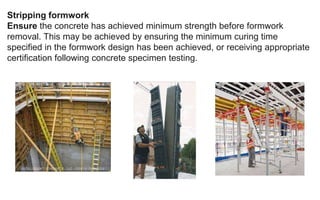
Stripping formwork
Ensure the concrete has achieved minimum strength before formwork
removal. This may be achieved by ensuring the minimum curing time
specified in the formwork design has been achieved, or receiving appropriate
certification following concrete specimen testing.
A good formwork should satisfy the following requirements:
1. It should be strong enough to withstand all types of dead and live
loads.
2. It should be rigidly constructed and efficiently propped and braced
both horizontally and vertically, so as to retain its shape.
3. The joints in the formwork should be tight against leakage of cement
grout.
4. Construction of formwork should permit removal of various parts in
desired sequences without damage to the concrete.
5. The material of the formwork should be cheap, easily available and
should be suitable for reuse.
6. The formwork should be set accurately to the desired line and levels
should have plane surface. 7. It should be as light as possible.
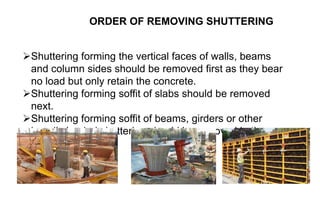
ORDER OF REMOVING SHUTTERING
Shuttering forming the vertical faces of walls, beams
and column sides should be removed first as they bear
no load but only retain the concrete.
Shuttering forming soffit of slabs should be removed
next.
Shuttering forming soffit of beams, girders or other
heavily loaded shuttering should be removed in the
end.
 https://www.youtube.com/watch?v=iVddJWB9rXs
 https://youtu.be/0Vkhh0YOKRQ
 https://youtu.be/dhnJQfTNfZ4
 https://youtu.be/kufScLUm86I
 https://civiljungle.com/what-is-formwork-failure/
 https://www.worksafe.vic.gov.au/safety-alerts/preventing-
formwork-failures
 https://www.slideshare.net/fenilcj/shuttering-162541799
 https://theconstructor.org/building/formwork-
shuttering/causes-formwork-failures/35478/



Shuttering (Formwork)

  • 1.
      BUILDING MATERIALAND BUILDING CONTRUCTION DONE BY: K GANESH PRAVEEN 31810610103 G. RAKESH KUMAR 318106101007
  • 2.
     Shuttering inconcrete construction is used as a mould for a structure in which fresh concrete is poured to harden subsequently curing  It is a part of formwork, or you may call it as derivative of formwork. Shuttering is a vertical temporary arrangement which is arranged to bring concrete in a desired shape. or Formwork which supports vertical arrangement is known as shuttering.
  • 3.
    Formworks can alsobe named based on the type of structural member construction such as slab formwork for use in slab beam formwork column formwork for use in beams and columns respectively etc
  • 4.
     Formwork failuresare the cause of many damages and building failures that occur during concrete construction, usually when fresh concrete is being filled. Generally, some unexpected event causes one member to fail, then others become overloaded or misaligned, and the entire formwork structure collapses. The main causes of formwork failure are given under below :
  • 5.
    1. Improper Strippingand Shore Removal 2. Inadequate Bracing 3. Inadequate Control of Concrete Placement 4. Vibration and Impact 5. Unstable Soil under Mudsills and Out of Plumb Shores 6. Lack of Attention to Formwork Details 7. When Formwork Is Not at Fault TYPES OF FAILURES
  • 6.
    1. Improper Strippingand Shore Removal The striping of forms and careless practices in reshoring can lead to failure of formworks and total failure of specifically in multistory building in which progressive collapse is highly likely. Sometimes, premature striping causes sagging of partially cured concrete. This leads to crack development and create maintenance issues. Insufficient spacing and size of reshores may lead to a formwork collapse during construction as well as damage of the concrete structure.
  • 7.
    2. Inadequate Bracing Insufficientcross bracing and horizontal bracing of shores are common causes of formwork failure. This is because poor bracing generates lateral force and hence create lateral deformation of supporting members. When a failure occurs at one point, inadequate bracing may permit the collapse to extend to a large portion of the structure and multiply the damage.
  • 8.
    3. Inadequate Controlof Concrete Placement Failure to regulate properly the rate and order of placing concrete on horizontal formwork introduce unbalanced loadings and consequent failures of formwork as known as control of concrete placement If concrete temperature drops during construction operations, the rate of concrete placement needs to be decreased to avoid a buildup of lateral pressure overloading the formworks.
  • 9.
    4. Vibration andImpact Vibration and impact due to passing traffic, movement of workers and equipment on formwork, and vibration because of concrete consolidation can displace supporting shores or jacks of formwork system and cause total failure of the forms.
  • 10.
    5. Unstable Soilunder Mudsills and Out of Plumb Shores Unstable soil and out of plumb shores are another factor that jeopardize the stability of the formwork system. Unstable soil would lead to differential settlement and the ability of out of plumb shores to support loads declined greatly. Therefore, verticality of shores and the sufficient ability of soil to support loads shall be ensured during the construction of formwork system.
  • 11.
    6. Lack ofAttention to Formwork Details Assemblage errors such as insufficient nailing, failure to tighten the locking devices on metal shores, inadequate provisions to prevent rotation of beam forms where slab forms frame into them on one side, inadequate anchorage against uplift for sloping form faces, and lack of bracing or tying at corners can cause failure of formworks even if its design is completed in the best possible way. So, skilled and trained labor shall assemble the formwork system under great supervision.
  • 12.
    7. When FormworkIs Not at Fault There are cases in which the failure of the formwork system during building construction is not related to formwork faults. Factors such as incorrect assumption regarding types of soil in design stage, inadequate shear reinforcement placement, and placement of ducts at high stress region in slabs are reported to be the causes of failures.
  • 13.
    Various Place ofFormwork Failure The position of failure in the formwork(shuttering) system based on actions is subdivided into two types. Enabling Events:-These events are the actions which cause failure inside the formwork system. The place where the failure occurs is in the(base) foundation, Props, Auxiliary members (bracing or lacing) (Props), Timber Shore, Platforms, Timber Joist (Beam), Slab, Wall forms, Base Plate, Form ties, Sprit Level and Rust, Column, Span, Runners.
  • 14.
     Triggering Events: Theseevents are the event that reason behind the failure of formwork outwardly. Mostly they are due to heavy rain (high current of water flow)/river flow rush causing foundation failure, Concentrated/extreme load due to construction material, lateral movement, Effects from concreting operation, vibration, Impact load while concrete filling, unintentional load from construction machinery, shaking from nearby equipment, Effects of improper or premature formwork removal, unskilled worker, faulty Design and Lack of maintenance/repair works.
  • 15.
    1)Inside Failure informwork Cracked flooring failure due to improper formwork. The sight of fissures in the floor is very damaging. It’s a caution that suggested that the building’s base has been harshly compromised.  https://youtu.be/0Vkhh0YOKRQ
  • 16.
    1)outside Failure informwork In this thing that reveals the problem regarding failures is by identifying Wall movements due to It may come out to be somewhat of a misapprehension with weird sight, but rotating walls are actual. An incidence like this warns that your foundation structure was going to fail. Broken walls may indicate a fragile or faulty foundation work in construction.  https://www.youtube.com/watch?v=iVddJWB9rXs
  • 17.
     Ensure acompetent person produces a formwork design capable of supporting the expected dynamic and static loads.  Where a custom design is used, including when combining different formwork systems or using proprietary systems outside the manufacturer’s recommendations, ensure the design is completed by an engineer experienced in formwork design (note: This does not apply where there is minimal risk to the safety of persons in the event of formwork failure, such as typical slab on ground formwork).
  • 18.
    Inspect formwork componentsbefore use, remove defective components from service and tag them out for disposal or repair.AS 3610 – 1995: Formwork for concrete provides component inspection criteria. Before other trades access the formwork or the concrete is poured, ensure the erected formwork is inspected by a competent person to ensure it has been erected in accordance with the formwork design. The competent person should document the inspection and sign-off the formwork as ready for use.
  • 19.
    Pouring concrete •Ensure thestructural integrity of the formwork has been verified before starting the concrete pour. •Establish an appropriate exclusion zone to prevent people accessing the area under the formwork during the concrete pour and maintain the zone until the concrete reaches adequate strength. •Monitor the formwork during the concrete pour to identify any early signs of failure. The monitors should not access areas under the formwork unless a risk assessment has been undertaken to determine it is safe to do so. •Ensure the formwork is not overloaded during the concrete pouring operation. https://youtu.be/kufScLUm86I
  • 20.
    Stripping formwork Ensure theconcrete has achieved minimum strength before formwork removal. This may be achieved by ensuring the minimum curing time specified in the formwork design has been achieved, or receiving appropriate certification following concrete specimen testing.
  • 21.
    A good formworkshould satisfy the following requirements: 1. It should be strong enough to withstand all types of dead and live loads. 2. It should be rigidly constructed and efficiently propped and braced both horizontally and vertically, so as to retain its shape. 3. The joints in the formwork should be tight against leakage of cement grout. 4. Construction of formwork should permit removal of various parts in desired sequences without damage to the concrete. 5. The material of the formwork should be cheap, easily available and should be suitable for reuse. 6. The formwork should be set accurately to the desired line and levels should have plane surface. 7. It should be as light as possible.
  • 22.
    ORDER OF REMOVINGSHUTTERING Shuttering forming the vertical faces of walls, beams and column sides should be removed first as they bear no load but only retain the concrete. Shuttering forming soffit of slabs should be removed next. Shuttering forming soffit of beams, girders or other heavily loaded shuttering should be removed in the end.
  • 23.
     https://www.youtube.com/watch?v=iVddJWB9rXs  https://youtu.be/0Vkhh0YOKRQ https://youtu.be/dhnJQfTNfZ4  https://youtu.be/kufScLUm86I
  • 24.
     https://civiljungle.com/what-is-formwork-failure/  https://www.worksafe.vic.gov.au/safety-alerts/preventing- formwork-failures https://www.slideshare.net/fenilcj/shuttering-162541799  https://theconstructor.org/building/formwork- shuttering/causes-formwork-failures/35478/
  • 25.