
GOVERNMENT ENGINEERING COLLEGE
Dairy Circle, katihalli Hassan,karnataka-573202.
A Technical Seminar
on
“ADVANCED TECHNIQUES IN CONSTRUCTIONS IN
HIGH RISE BUILDINGS”
BY
ASHOK KUMAR TIWARY
Date : 27-11-2017 Place : GECH, HASSAN
UNDER THE GUIDENCE OF
Mr. HARSHA. H. N
Assistent Professor,
Dept. of Civil, GECH.
CONTENT:-
 Introduction.
 High rise is defined differently by different bodies.
 Need for high rise buildings in construction.
 Construction methods and techniques.
 Main Equipment.
 Advantages.
 Disadvantages.
 Conclusion.
 References.
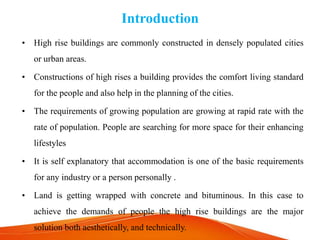
Introduction
• High rise buildings are commonly constructed in densely populated cities
or urban areas.
• Constructions of high rises a building provides the comfort living standard
for the people and also help in the planning of the cities.
• The requirements of growing population are growing at rapid rate with the
rate of population. People are searching for more space for their enhancing
lifestyles
• It is self explanatory that accommodation is one of the basic requirements
for any industry or a person personally .
• Land is getting wrapped with concrete and bituminous. In this case to
achieve the demands of people the high rise buildings are the major
solution both aesthetically, and technically.
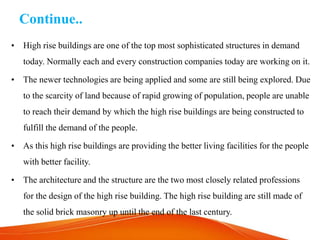
Continue..
• High rise buildings are one of the top most sophisticated structures in demand
today. Normally each and every construction companies today are working on it.
• The newer technologies are being applied and some are still being explored. Due
to the scarcity of land because of rapid growing of population, people are unable
to reach their demand by which the high rise buildings are being constructed to
fulfill the demand of the people.
• As this high rise buildings are providing the better living facilities for the people
with better facility.
• The architecture and the structure are the two most closely related professions
for the design of the high rise building. The high rise building are still made of
the solid brick masonry up until the end of the last century.
 Emporis standards -“A multi-story structure between 35- 100 meters tall, or a
building of unknown height from 12-39 floors is termed as high rise.
 Building code of Hyderabad,India - A high-rise building is one with four
floors or more, or one 15 meters or more in height.
 The International Conference on Fire Safety- "any structure where the height
can have a serious impact on evacuation“
 Massachusetts, United States General Laws – A high-rise is being higher than
70 feet (21 m).
 National Building Code (Part 4) – Fire and Life Safety - all buildings 15m
and above in height shall be considered as high rise buildings.
High rise is defined differently by different
bodies:-
 Scarcity of land in urban areas.
 Increasing demand for business and residential space.
 Economic growth.
 Technological advancements.
 Innovation in structural system.
 Desire for aesthetic in urban setting.
 Concept of city skyline.
 Cultural significance and prestige.
 Human aspiration to build higher.
Need for high rise buildings in construction:-
Construction methods and techniques:-
1. Slip form
2. Jump form
3. Climbing formwork
4.Table form/ flying form
5. Column system formwork
6. Tunnel form
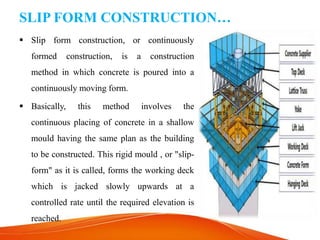
SLIP FORM CONSTRUCTION…
 Slip form construction, or continuously
formed construction, is a construction
method in which concrete is poured into a
continuously moving form.
 Basically, this method involves the
continuous placing of concrete in a shallow
mould having the same plan as the building
to be constructed. This rigid mould , or "slip-
form" as it is called, forms the working deck
which is jacked slowly upwards at a
controlled rate until the required elevation is
reached.
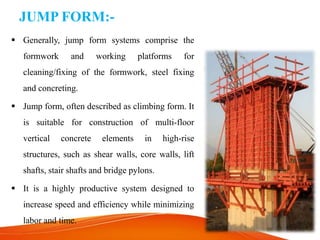
JUMP FORM:-
 Generally, jump form systems comprise the
formwork and working platforms for
cleaning/fixing of the formwork, steel fixing
and concreting.
 Jump form, often described as climbing form. It
is suitable for construction of multi-floor
vertical concrete elements in high-rise
structures, such as shear walls, core walls, lift
shafts, stair shafts and bridge pylons.
 It is a highly productive system designed to
increase speed and efficiency while minimizing
labor and time.
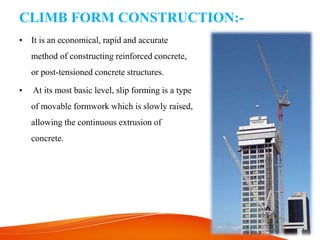
CLIMB FORM CONSTRUCTION:-
• It is an economical, rapid and accurate
method of constructing reinforced concrete,
or post-tensioned concrete structures.
• At its most basic level, slip forming is a type
of movable formwork which is slowly raised,
allowing the continuous extrusion of
concrete.
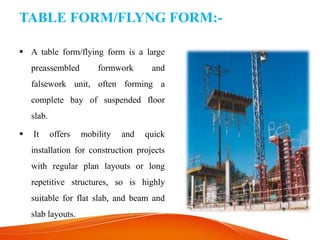
TABLE FORM/FLYNG FORM:-
 A table form/flying form is a large
preassembled formwork and
falsework unit, often forming a
complete bay of suspended floor
slab.
 It offers mobility and quick
installation for construction projects
with regular plan layouts or long
repetitive structures, so is highly
suitable for flat slab, and beam and
slab layouts.
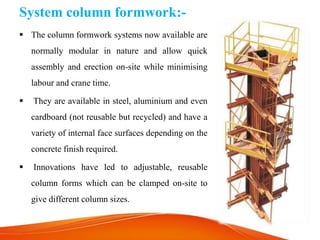
System column formwork:-
 The column formwork systems now available are
normally modular in nature and allow quick
assembly and erection on-site while minimising
labour and crane time.
 They are available in steel, aluminium and even
cardboard (not reusable but recycled) and have a
variety of internal face surfaces depending on the
concrete finish required.
 Innovations have led to adjustable, reusable
column forms which can be clamped on-site to
give different column sizes.
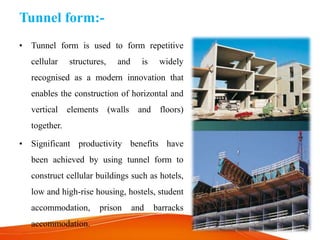
Tunnel form:-
• Tunnel form is used to form repetitive
cellular structures, and is widely
recognised as a modern innovation that
enables the construction of horizontal and
vertical elements (walls and floors)
together.
• Significant productivity benefits have
been achieved by using tunnel form to
construct cellular buildings such as hotels,
low and high-rise housing, hostels, student
accommodation, prison and barracks
accommodation.
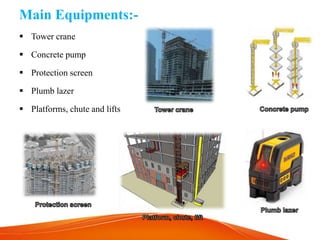
Main Equipments:-
 Tower crane
 Concrete pump
 Protection screen
 Plumb lazer
 Platforms, chute and lifts
Advantages:-
 Accommodates large number of families and business houses.
 They reduce the distance to be travelled by occupants saving their
time.
 Permit more open space around the building.
 Provide more sunlight and pure air.
 Vertical expansion results in curtailment of cost of various services
such as water supply electrification.
 Saves land which can be used further.
 Pressure coefficients should need little adjustment for different
upwind terrain types .
 Existing meteorological data on wind gusts is used directly.
Disadvantages:-
 Construction cost increases.
 Difficult for children and old people to go up when elevators
fails.
 Enjoying the charm of private garden cannot be obtained.
 The approach is not suitable for very large structures, or for
those with significant dynamic response.
 The response characteristics of the gust anemometers and the
natural variability of the peak gusts tend to be incorporated into
the wind load estimates.
Conclusion:-
 The construction technique and the requirement for the high rise building is
most important for the proper management and for the strength of building.
 It is not a good building if there is not a good structure.
 The structure correspond to the material that are used for the construction
 The uses of the materials that are required for the construction of high rise
building and the management of the waste product and the treatment of the
waste water for the reuse is most important.
 The high rise building possess of there specific development background. Along
the rapid grow of people, there a lot of demand of the high rise building and
also the requirements in the design.
 The construction will start only if there is a proper planning and with the quality
control method. Without planning it will seems like the man without leg.
References:-
1. Li, tang, study of high rise building in japan, phd thesis, tongji university,
shanghai, 2006.
2. Zhao yuqin, hebi college vocation and technology.
3. Indian standard, fir safety of building (general): details of construction
code of practice (first revision), is 1642:1989.
4. Arthur w t leung, divison of building and technology, city university of
hong kong
5. Dr. C m tam, department of building and construction, city university of
hong kong.
6. Orange city fire department, fire prevention division.
7. Rober gifford, department of psychology and school of environmental
studies, university of victoria.
.

ADVANCED TECHNIQUES IN CONSTRUCTIONS IN HIGH RISE BUILDINGS

  • 1.
    GOVERNMENT ENGINEERING COLLEGE DairyCircle, katihalli Hassan,karnataka-573202. A Technical Seminar on “ADVANCED TECHNIQUES IN CONSTRUCTIONS IN HIGH RISE BUILDINGS” BY ASHOK KUMAR TIWARY Date : 27-11-2017 Place : GECH, HASSAN UNDER THE GUIDENCE OF Mr. HARSHA. H. N Assistent Professor, Dept. of Civil, GECH.
  • 2.
    CONTENT:-  Introduction.  Highrise is defined differently by different bodies.  Need for high rise buildings in construction.  Construction methods and techniques.  Main Equipment.  Advantages.  Disadvantages.  Conclusion.  References.
  • 3.
    Introduction • High risebuildings are commonly constructed in densely populated cities or urban areas. • Constructions of high rises a building provides the comfort living standard for the people and also help in the planning of the cities. • The requirements of growing population are growing at rapid rate with the rate of population. People are searching for more space for their enhancing lifestyles • It is self explanatory that accommodation is one of the basic requirements for any industry or a person personally . • Land is getting wrapped with concrete and bituminous. In this case to achieve the demands of people the high rise buildings are the major solution both aesthetically, and technically.
  • 4.
    Continue.. • High risebuildings are one of the top most sophisticated structures in demand today. Normally each and every construction companies today are working on it. • The newer technologies are being applied and some are still being explored. Due to the scarcity of land because of rapid growing of population, people are unable to reach their demand by which the high rise buildings are being constructed to fulfill the demand of the people. • As this high rise buildings are providing the better living facilities for the people with better facility. • The architecture and the structure are the two most closely related professions for the design of the high rise building. The high rise building are still made of the solid brick masonry up until the end of the last century.
  • 5.
     Emporis standards-“A multi-story structure between 35- 100 meters tall, or a building of unknown height from 12-39 floors is termed as high rise.  Building code of Hyderabad,India - A high-rise building is one with four floors or more, or one 15 meters or more in height.  The International Conference on Fire Safety- "any structure where the height can have a serious impact on evacuation“  Massachusetts, United States General Laws – A high-rise is being higher than 70 feet (21 m).  National Building Code (Part 4) – Fire and Life Safety - all buildings 15m and above in height shall be considered as high rise buildings. High rise is defined differently by different bodies:-
  • 6.
     Scarcity ofland in urban areas.  Increasing demand for business and residential space.  Economic growth.  Technological advancements.  Innovation in structural system.  Desire for aesthetic in urban setting.  Concept of city skyline.  Cultural significance and prestige.  Human aspiration to build higher. Need for high rise buildings in construction:-
  • 7.
    Construction methods andtechniques:- 1. Slip form 2. Jump form 3. Climbing formwork 4.Table form/ flying form 5. Column system formwork 6. Tunnel form
  • 8.
    SLIP FORM CONSTRUCTION… Slip form construction, or continuously formed construction, is a construction method in which concrete is poured into a continuously moving form.  Basically, this method involves the continuous placing of concrete in a shallow mould having the same plan as the building to be constructed. This rigid mould , or "slip- form" as it is called, forms the working deck which is jacked slowly upwards at a controlled rate until the required elevation is reached.
  • 9.
    JUMP FORM:-  Generally,jump form systems comprise the formwork and working platforms for cleaning/fixing of the formwork, steel fixing and concreting.  Jump form, often described as climbing form. It is suitable for construction of multi-floor vertical concrete elements in high-rise structures, such as shear walls, core walls, lift shafts, stair shafts and bridge pylons.  It is a highly productive system designed to increase speed and efficiency while minimizing labor and time.
  • 10.
    CLIMB FORM CONSTRUCTION:- •It is an economical, rapid and accurate method of constructing reinforced concrete, or post-tensioned concrete structures. • At its most basic level, slip forming is a type of movable formwork which is slowly raised, allowing the continuous extrusion of concrete.
  • 11.
    TABLE FORM/FLYNG FORM:- A table form/flying form is a large preassembled formwork and falsework unit, often forming a complete bay of suspended floor slab.  It offers mobility and quick installation for construction projects with regular plan layouts or long repetitive structures, so is highly suitable for flat slab, and beam and slab layouts.
  • 12.
    System column formwork:- The column formwork systems now available are normally modular in nature and allow quick assembly and erection on-site while minimising labour and crane time.  They are available in steel, aluminium and even cardboard (not reusable but recycled) and have a variety of internal face surfaces depending on the concrete finish required.  Innovations have led to adjustable, reusable column forms which can be clamped on-site to give different column sizes.
  • 13.
    Tunnel form:- • Tunnelform is used to form repetitive cellular structures, and is widely recognised as a modern innovation that enables the construction of horizontal and vertical elements (walls and floors) together. • Significant productivity benefits have been achieved by using tunnel form to construct cellular buildings such as hotels, low and high-rise housing, hostels, student accommodation, prison and barracks accommodation.
  • 14.
    Main Equipments:-  Towercrane  Concrete pump  Protection screen  Plumb lazer  Platforms, chute and lifts
  • 15.
    Advantages:-  Accommodates largenumber of families and business houses.  They reduce the distance to be travelled by occupants saving their time.  Permit more open space around the building.  Provide more sunlight and pure air.  Vertical expansion results in curtailment of cost of various services such as water supply electrification.  Saves land which can be used further.  Pressure coefficients should need little adjustment for different upwind terrain types .  Existing meteorological data on wind gusts is used directly.
  • 16.
    Disadvantages:-  Construction costincreases.  Difficult for children and old people to go up when elevators fails.  Enjoying the charm of private garden cannot be obtained.  The approach is not suitable for very large structures, or for those with significant dynamic response.  The response characteristics of the gust anemometers and the natural variability of the peak gusts tend to be incorporated into the wind load estimates.
  • 17.
    Conclusion:-  The constructiontechnique and the requirement for the high rise building is most important for the proper management and for the strength of building.  It is not a good building if there is not a good structure.  The structure correspond to the material that are used for the construction  The uses of the materials that are required for the construction of high rise building and the management of the waste product and the treatment of the waste water for the reuse is most important.  The high rise building possess of there specific development background. Along the rapid grow of people, there a lot of demand of the high rise building and also the requirements in the design.  The construction will start only if there is a proper planning and with the quality control method. Without planning it will seems like the man without leg.
  • 18.
    References:- 1. Li, tang,study of high rise building in japan, phd thesis, tongji university, shanghai, 2006. 2. Zhao yuqin, hebi college vocation and technology. 3. Indian standard, fir safety of building (general): details of construction code of practice (first revision), is 1642:1989. 4. Arthur w t leung, divison of building and technology, city university of hong kong 5. Dr. C m tam, department of building and construction, city university of hong kong. 6. Orange city fire department, fire prevention division. 7. Rober gifford, department of psychology and school of environmental studies, university of victoria.
  • 19.