ASSALAMUALAIKUM & GOOD MORNING
PSPEAK THE TRUTH AND BE A KIND PERSON
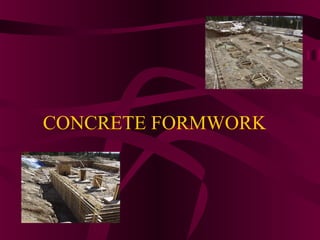
CONCRETE FORMWORK
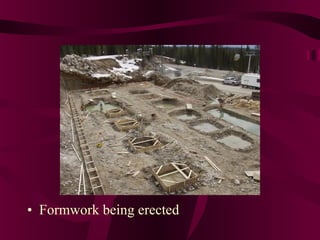
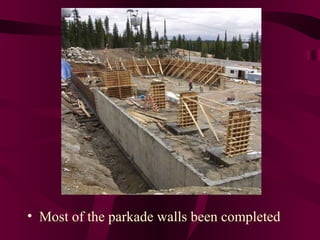
• Formwork being erected
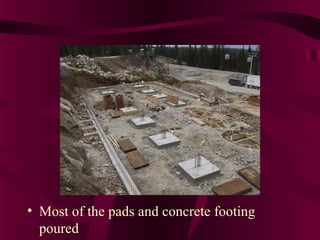
• Most of the pads and concrete footing
poured
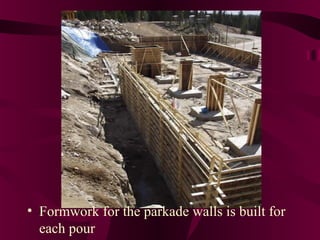
• Formwork for the parkade walls is built for
each pour
• Most of the parkade walls been completed
2 TYPES OF FORMWORK
Temporary Structure
- Temporary structure required to safely
support concrete until it reaches adequate
strength.
Permanent Structure
DEFINITION:
FORMWORKS FOR IN-SITU
CONCRETE WORK
“ A mould or box into which wet concrete can
be poured and compacted so that it will flow
and finally set to the inner profile of the box
or mould.”
 Forms mold the concrete to desired size and
shape and control its position and alignment
 Formworks also act as a temporary structure
that support:
a) it’s own weight +
b) The freshly placed concrete
c) Construction live loads (material ,
human, logistic)
FUNCTION
Formwork is a classic temporary structure in a
sense that:
a) It can be erected quickly
b) Highly loaded for a few hours during the
concrete placement
c) And within a few days it is disassembled
for future use
A good formwork would have the following
characteristics that is:
a)Safe
b)Cost effective or economical
c)High Quality – finished concrete surface is
of acceptable quality
- in the correct location
- able to produce the
required shape and surface
FORMWORK DESIGN
Loads include in design process are as follows
a) Fresh concrete
b) Rebar
c) Formwork material
d) Wind and lateral loads
e) Live loads due to – Formwork construction
- Reinforcing installation
- Concrete placement
MATERIAL FOR FORMWORK
CONSTRUCTION
Among the material that can be used for
construction of formwork:
a) Timber
b) Steel
c) Glass Reinforced Plastic
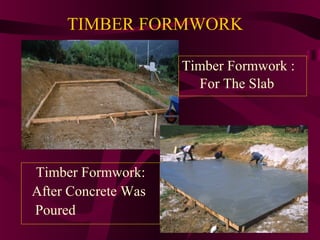
TIMBER FORMWORK
Timber Formwork:
After Concrete Was
Poured
Timber Formwork :
For The Slab
ADVANTAGES OF TIMBER FORMWORK
Among the advantages of timber formwork are
as follow:
a) Easy handling because it’s light weight
b) Easy to disassemble
c) Damaged parts can be replaced with new one
d) Very flexible
DISADVANTAGES OF TIMBER
FORMWORK
Among the advantages of steel formwork are as follow:
a) Can’t be used for long. Have limited re-use. Can only
be re-used 5 or 6 times
b) If the timber is dry, it will absorb moisture from wet
concrete which could weaken the resultant concrete
member.
c) Timber with high moisture content (more than 20 %
moisture content), wet concrete will shrink & cup
leading to open joints & leakage of grout.
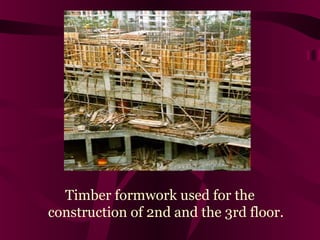
Timber formwork used for the
construction of 2nd and the 3rd floor.
ADVANTAGES OF STEEL FORMWORK
Among the advantages of steel formwork are
as follow:
a) Very strong and able to carry heavy load
b) Easy to be fixed
c) Uniform size and surface
d) Can be used for a very long time
DISADVANTAGES OF STEEL
FORMWORK
Among disadvantages of steel formwork are
as follow:
a) Limited size or shape
b) Excessive loss of heat
c) A very smooth surface will be produced
which would give problems for finishing
process
d) Limited fixing (Pemasangan terhad)
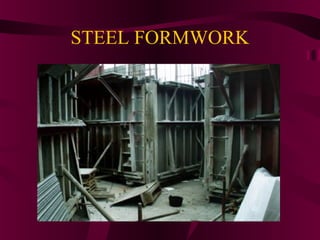
STEEL FORMWORK
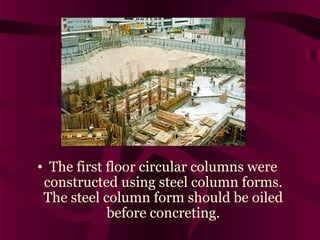
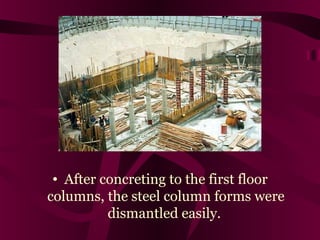
• The first floor circular columns were
constructed using steel column forms.
The steel column form should be oiled
before concreting.
• After concreting to the first floor
columns, the steel column forms were
dismantled easily.
ADVANTAGES OF GLASS REINFORCED
PLASTIC FORMWORK
Among the advantages of glass reinforced
plastic formwork are as follow:
a) Very useful for complex shape and special
features
b) Easy to disassemble
c) Light (not heavy)
d) Damages on the formwork can be easily
be repaired
DISADVANTAGES OF GLASS
REINFORCED PLASTIC FORMWORK
Among the disadvantages of glass reinforced
plastic formwork are as follow:
a) Expensive at first
CAUSES OF FORMWORK
FAILURE
• Formwork failures are the cause of many
accidents and failures that occur during
concrete construction which usually happen
when fresh concrete is placed
• Generally some unexpected event causes
one member to fail, then others become
overloaded or misaligned and the entire
formwork structure collapses
Causes of Formwork Failure
Improper stripping and shore removal
Inadequate bracing
Vibration
Unstable soil under mudsills, shoring not
plumb
Inadequate control of concrete placement
Lack of attention to formwork details
Inadequate bracing
More frequent causes of formwork failure
Inadequate cross bracing and horizontal
bracing of shores is one of the factors most
frequently involved in formwork accidents.

Vibration
Forms sometime collapse when their
shores/ jack are displaced by the vibration
caused
 passing traffic
 movement of workers & equipment on the
formwork
 the effect of vibrating concrete to
consolidate it
Unstable Soil Under Mudsills,
Shoring Not Plumb
Formwork should be safe if it is adequately
braced and constructed so all loads are
carried to solid ground through vertical
members.
Site drainage must be adequate to prevent a
washout of soil supporting the mudsills.

SAFETY PRECAUTION
Among the precautions that can be taken to
ensure formwork function as it suppose to be
are as follow:
 Material used for the construction of
formwork must fulfill the specification.
 Formwork is fixed firmly & properly
 Construction area must be protected to
prevent vandalism of formwork.
 Warning sign must be put up at the area
where the formwork is fixed to prevent
entrance of people that may damage the
formwork.
 The formwork must be inspected before the
concrete is poured.
PERMANENT FORMWORK
Permanent Formwork
It’s a part of the permanent
structure of the building.
Permanent formwork is a
structural element that is used to
contain the placed concrete, mould
it to the required dimensions and
remain in place for the life of the
structure.
Among the Advantages
• Reducing the skill level needed on
site.
• Increasing the potential for
standardisation and repetition.
• Permitting off-site fabrication in
factory conditions followed by
scheduled and appropriate
deliveries.
• Speeding up erection times,
particularly in building works.
4) Eliminating the need to strike
formwork and falsework.
5) Allowing early access for
following or concurrent
operations.
6) Eliminating the programme
limitations of reuse of formwork.
Use of Permanent Formwork:
1) reduce construction and
maintenance costs
2) shorten construction time
3) improve safety by reducing
hazards during construction.
4) reduces construction waste
generation during construction.
SYUKRAN JAZILAN = THANK YOU
WORK HARD AND PRAY FOR YOUR SUCCESS

Concrete framework

  • 1.
    ASSALAMUALAIKUM & GOODMORNING PSPEAK THE TRUTH AND BE A KIND PERSON
  • 2.
  • 3.
  • 4.
    • Most ofthe pads and concrete footing poured
  • 5.
    • Formwork forthe parkade walls is built for each pour
  • 6.
    • Most ofthe parkade walls been completed
  • 7.
    2 TYPES OFFORMWORK Temporary Structure - Temporary structure required to safely support concrete until it reaches adequate strength. Permanent Structure
  • 8.
    DEFINITION: FORMWORKS FOR IN-SITU CONCRETEWORK “ A mould or box into which wet concrete can be poured and compacted so that it will flow and finally set to the inner profile of the box or mould.”
  • 9.
     Forms moldthe concrete to desired size and shape and control its position and alignment  Formworks also act as a temporary structure that support: a) it’s own weight + b) The freshly placed concrete c) Construction live loads (material , human, logistic) FUNCTION
  • 10.
    Formwork is aclassic temporary structure in a sense that: a) It can be erected quickly b) Highly loaded for a few hours during the concrete placement c) And within a few days it is disassembled for future use
  • 11.
    A good formworkwould have the following characteristics that is: a)Safe b)Cost effective or economical c)High Quality – finished concrete surface is of acceptable quality - in the correct location - able to produce the required shape and surface
  • 12.
    FORMWORK DESIGN Loads includein design process are as follows a) Fresh concrete b) Rebar c) Formwork material d) Wind and lateral loads e) Live loads due to – Formwork construction - Reinforcing installation - Concrete placement
  • 13.
    MATERIAL FOR FORMWORK CONSTRUCTION Amongthe material that can be used for construction of formwork: a) Timber b) Steel c) Glass Reinforced Plastic
  • 14.
    TIMBER FORMWORK Timber Formwork: AfterConcrete Was Poured Timber Formwork : For The Slab
  • 15.
    ADVANTAGES OF TIMBERFORMWORK Among the advantages of timber formwork are as follow: a) Easy handling because it’s light weight b) Easy to disassemble c) Damaged parts can be replaced with new one d) Very flexible
  • 16.
    DISADVANTAGES OF TIMBER FORMWORK Amongthe advantages of steel formwork are as follow: a) Can’t be used for long. Have limited re-use. Can only be re-used 5 or 6 times b) If the timber is dry, it will absorb moisture from wet concrete which could weaken the resultant concrete member. c) Timber with high moisture content (more than 20 % moisture content), wet concrete will shrink & cup leading to open joints & leakage of grout.
  • 17.
    Timber formwork usedfor the construction of 2nd and the 3rd floor.
  • 18.
    ADVANTAGES OF STEELFORMWORK Among the advantages of steel formwork are as follow: a) Very strong and able to carry heavy load b) Easy to be fixed c) Uniform size and surface d) Can be used for a very long time
  • 19.
    DISADVANTAGES OF STEEL FORMWORK Amongdisadvantages of steel formwork are as follow: a) Limited size or shape b) Excessive loss of heat c) A very smooth surface will be produced which would give problems for finishing process d) Limited fixing (Pemasangan terhad)
  • 20.
  • 21.
    • The firstfloor circular columns were constructed using steel column forms. The steel column form should be oiled before concreting.
  • 22.
    • After concretingto the first floor columns, the steel column forms were dismantled easily.
  • 23.
    ADVANTAGES OF GLASSREINFORCED PLASTIC FORMWORK Among the advantages of glass reinforced plastic formwork are as follow: a) Very useful for complex shape and special features b) Easy to disassemble c) Light (not heavy) d) Damages on the formwork can be easily be repaired
  • 24.
    DISADVANTAGES OF GLASS REINFORCEDPLASTIC FORMWORK Among the disadvantages of glass reinforced plastic formwork are as follow: a) Expensive at first
  • 25.
    CAUSES OF FORMWORK FAILURE •Formwork failures are the cause of many accidents and failures that occur during concrete construction which usually happen when fresh concrete is placed • Generally some unexpected event causes one member to fail, then others become overloaded or misaligned and the entire formwork structure collapses
  • 27.
    Causes of FormworkFailure Improper stripping and shore removal Inadequate bracing Vibration Unstable soil under mudsills, shoring not plumb Inadequate control of concrete placement Lack of attention to formwork details
  • 28.
    Inadequate bracing More frequentcauses of formwork failure Inadequate cross bracing and horizontal bracing of shores is one of the factors most frequently involved in formwork accidents.
  • 29.
    Vibration Forms sometime collapsewhen their shores/ jack are displaced by the vibration caused  passing traffic  movement of workers & equipment on the formwork  the effect of vibrating concrete to consolidate it
  • 30.
    Unstable Soil UnderMudsills, Shoring Not Plumb Formwork should be safe if it is adequately braced and constructed so all loads are carried to solid ground through vertical members. Site drainage must be adequate to prevent a washout of soil supporting the mudsills.
  • 31.
    SAFETY PRECAUTION Among theprecautions that can be taken to ensure formwork function as it suppose to be are as follow:  Material used for the construction of formwork must fulfill the specification.  Formwork is fixed firmly & properly  Construction area must be protected to prevent vandalism of formwork.
  • 32.
     Warning signmust be put up at the area where the formwork is fixed to prevent entrance of people that may damage the formwork.  The formwork must be inspected before the concrete is poured.
  • 33.
  • 34.
    Permanent Formwork It’s apart of the permanent structure of the building. Permanent formwork is a structural element that is used to contain the placed concrete, mould it to the required dimensions and remain in place for the life of the structure.
  • 35.
    Among the Advantages •Reducing the skill level needed on site. • Increasing the potential for standardisation and repetition. • Permitting off-site fabrication in factory conditions followed by scheduled and appropriate deliveries. • Speeding up erection times, particularly in building works.
  • 36.
    4) Eliminating theneed to strike formwork and falsework. 5) Allowing early access for following or concurrent operations. 6) Eliminating the programme limitations of reuse of formwork.
  • 37.
    Use of PermanentFormwork: 1) reduce construction and maintenance costs 2) shorten construction time 3) improve safety by reducing hazards during construction. 4) reduces construction waste generation during construction.
  • 38.
    SYUKRAN JAZILAN =THANK YOU WORK HARD AND PRAY FOR YOUR SUCCESS