1
Computer Communication &
Networks
Lecture 12
Datalink Layer: Multiple Access
http://web.uettaxila.edu.pk/CMS/coeCCNbsSp09/index.asp
Waleed Ejaz
waleed.ejaz@uettaxila.edu.pk
2
Data Link Layer
3
Data Link Layer Topics to Cover
Error Detection and Correction
Data Link Control and Protocols
Multiple Access
Local Area Networks
Wireless LANs
4
Multiple access problem
 Example:
 Cocktail party – many people gather together in
a large room
 Broadcast medium – air
 Another example: a classroom
 Human protocols:
 “Give everyone a chance to speak”
 “Don’t speak until you are spoken to”
 “Don’t monopolize the conversation”
 “Raise your hand if you have a question”
 “Don’t interrupt when someone is speaking”

“Don’t fall asleep when someone else is talking”
5
Multiple access protocols
 In LANs, WiFi, satellite networks, cocktail party
 If more than 2 users send @ the same time -
collision
 All collided packets are lost -> waste of bandwidth
 Ideally, the MAC protocol for a broadcast channel
with the bit-rate R bps should satisfy:
 if only 1 node is sending than the throughput is R
 when M nodes have data to send than the throughput is
R/M
 decentralized protocol – no master
 simple & inexpensive to implement
6
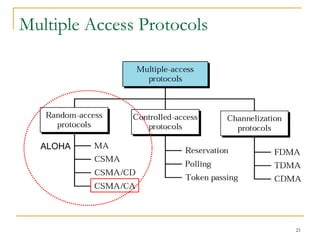
Taxonomy of Multiple-Access Protocols
7
Random Access Protocols
 In
In random access
random access or
or contention
contention methods, no
methods, no
station is superior to another station and
none is assigned the control over another. No
station permits, or does not permit, another
station to send. At each instance, a station
that has data to send uses a procedure
defined by the protocol to make a decision on
whether or not to send.
8
ALOHA Network
 Developed by Norm Abramson at the Univ. of Hawaii
 the guy had interest in surfing and packet switching
 mountainous islands → land-based network difficult to install
 fully decentralized protocol
ACK
ACK ACK
ACK
9
Pure Aloha
 The node immediately transmits its frame completely
 If the frame is collided it retransmits the frame again (after
completely transmitting its collided frame) with the
probability p
10
Slotted Aloha
 Assumptions
 all frames same size
 time is divided into equal
size slots, time to transmit 1
frame
 nodes start to transmit
frames only at beginning of
slots
 nodes are synchronized
 if 2 or more nodes transmit
in slot, all nodes detect
collision
Operation
 when node obtains fresh
frame, it transmits in next slot
 no collision, node can send
new frame in next slot
 if collision, node retransmits
frame in each subsequent slot
with prob. p until success
11
Frames in a Slotted ALOHA Network
12
Slotted Aloha
 Pros
 single active node can
continuously transmit at
full rate of channel
 highly decentralized: only
slots in nodes need to be
in sync
 simple
Cons
 collisions, wasting slots
 idle slots
 nodes may be able to
detect collision in less
than time to transmit
packet
 clock synchronization
13
Multiple Access Protocols
ALOHA
14
Carrier Sense Multiple Access
 Invented to minimize collisions and increase the
performance
 A station now “follows” the activity of other stations
 Simple rules for a polite human conversation
 Listen before talking
 If someone else begins talking at the same time as you,
stop talking
 CSMA:
 A node should not send if another node is already sending
 carrier sensing
 CD (collision detection):
 A node should stop transmission if there is interference
 collision detection
15
Carrier Sense Multiple Access
 If everyone is sensing the medium how come that
collisions still occur?
channel
propagation
delay
16
CSMA (cnt’d)
 Reduces the chance of collisions
 reduces the efficiency
 increases the chance for collisions
 1-persistant
 p-persistant
 Decreases the chance for collisions
 Improves efficiency
17
Multiple Access Protocols
ALOHA
18
19
CSMA with Collision Detection
(CSMA/CD)
 CSMA/CD can be in one of the three states:
contention, transmission, or idle.
 Example of CSMA/CD: Ethernet
 How long does it take before stations realize that there has
been a collision?
20
Collision Detection
 How the station detects a collision?
 There are many collision detection methods!
 Most of them are analog processes.
 Examples:
 detecting voltage level on the line
 detecting power level
 detecting simultaneous transmission & reception
21
Multiple Access Protocols
ALOHA
22
CSMA with Collision Avoidance
-CSMA/CA-
• no collisions
23
Readings
 Chapter 12 (B.A Forouzan)
 Section 12.1
 (Cover only those contents which are related to topics
covered in class)
24

Datalink Layer data communication and networking fourth edition

  • 1.
    1 Computer Communication & Networks Lecture12 Datalink Layer: Multiple Access http://web.uettaxila.edu.pk/CMS/coeCCNbsSp09/index.asp Waleed Ejaz waleed.ejaz@uettaxila.edu.pk
  • 2.
  • 3.
    3 Data Link LayerTopics to Cover Error Detection and Correction Data Link Control and Protocols Multiple Access Local Area Networks Wireless LANs
  • 4.
    4 Multiple access problem Example:  Cocktail party – many people gather together in a large room  Broadcast medium – air  Another example: a classroom  Human protocols:  “Give everyone a chance to speak”  “Don’t speak until you are spoken to”  “Don’t monopolize the conversation”  “Raise your hand if you have a question”  “Don’t interrupt when someone is speaking”  “Don’t fall asleep when someone else is talking”
  • 5.
    5 Multiple access protocols In LANs, WiFi, satellite networks, cocktail party  If more than 2 users send @ the same time - collision  All collided packets are lost -> waste of bandwidth  Ideally, the MAC protocol for a broadcast channel with the bit-rate R bps should satisfy:  if only 1 node is sending than the throughput is R  when M nodes have data to send than the throughput is R/M  decentralized protocol – no master  simple & inexpensive to implement
  • 6.
  • 7.
    7 Random Access Protocols In In random access random access or or contention contention methods, no methods, no station is superior to another station and station is superior to another station and none is assigned the control over another. No none is assigned the control over another. No station permits, or does not permit, another station permits, or does not permit, another station to send. At each instance, a station station to send. At each instance, a station that has data to send uses a procedure that has data to send uses a procedure defined by the protocol to make a decision on defined by the protocol to make a decision on whether or not to send. whether or not to send.
  • 8.
    8 ALOHA Network  Developedby Norm Abramson at the Univ. of Hawaii  the guy had interest in surfing and packet switching  mountainous islands → land-based network difficult to install  fully decentralized protocol ACK ACK ACK ACK
  • 9.
    9 Pure Aloha  Thenode immediately transmits its frame completely  If the frame is collided it retransmits the frame again (after completely transmitting its collided frame) with the probability p
  • 10.
    10 Slotted Aloha  Assumptions all frames same size  time is divided into equal size slots, time to transmit 1 frame  nodes start to transmit frames only at beginning of slots  nodes are synchronized  if 2 or more nodes transmit in slot, all nodes detect collision Operation  when node obtains fresh frame, it transmits in next slot  no collision, node can send new frame in next slot  if collision, node retransmits frame in each subsequent slot with prob. p until success
  • 11.
    11 Frames in aSlotted ALOHA Network
  • 12.
    12 Slotted Aloha  Pros single active node can continuously transmit at full rate of channel  highly decentralized: only slots in nodes need to be in sync  simple Cons  collisions, wasting slots  idle slots  nodes may be able to detect collision in less than time to transmit packet  clock synchronization
  • 13.
  • 14.
    14 Carrier Sense MultipleAccess  Invented to minimize collisions and increase the performance  A station now “follows” the activity of other stations  Simple rules for a polite human conversation  Listen before talking  If someone else begins talking at the same time as you, stop talking  CSMA:  A node should not send if another node is already sending  carrier sensing  CD (collision detection):  A node should stop transmission if there is interference  collision detection
  • 15.
    15 Carrier Sense MultipleAccess  If everyone is sensing the medium how come that collisions still occur? channel propagation delay
  • 16.
    16 CSMA (cnt’d)  Reducesthe chance of collisions  reduces the efficiency  increases the chance for collisions  1-persistant  p-persistant  Decreases the chance for collisions  Improves efficiency
  • 17.
  • 18.
  • 19.
    19 CSMA with CollisionDetection (CSMA/CD)  CSMA/CD can be in one of the three states: contention, transmission, or idle.  Example of CSMA/CD: Ethernet  How long does it take before stations realize that there has been a collision?
  • 20.
    20 Collision Detection  Howthe station detects a collision?  There are many collision detection methods!  Most of them are analog processes.  Examples:  detecting voltage level on the line  detecting power level  detecting simultaneous transmission & reception
  • 21.
  • 22.
    22 CSMA with CollisionAvoidance -CSMA/CA- • no collisions
  • 23.
    23 Readings  Chapter 12(B.A Forouzan)  Section 12.1  (Cover only those contents which are related to topics covered in class)
  • 24.