Shape Context

           Rocío Cabrera u1908272
           Vanya Valindria u1908259


06/05/12                              1
Introduction
            Can you guess what number it is?


 05/06/12                                      2
Objectives


       “Have descriptors that can be computed in
       one image and used to find corresponding
       points, if visible, in another image.”

       “Given a query model image, to develop an
       algorithm capable of retrieving similar-
       shaped images from an extensive database”


 05/06/12                                          3
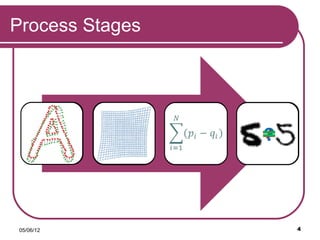
Process Stages


      Solve the           Use the
                                                         Evaluate the
                    correspondences      Compute the
  correspondence
          .
  problem between
   the two shapes
                             .
                     to estimate an
                         aligning
                        transform
                                      distance between
                                       the two shapes        ?
                                                         distance and
                                                         classify the
                                                            shape


05/06/12                                                                4
SHAPE CONTEXT
   “A novel approach to measuring similarities between shapes and
   exploit it for object classification/recognition”


05/06/12                                                            5
Shape Context Computation
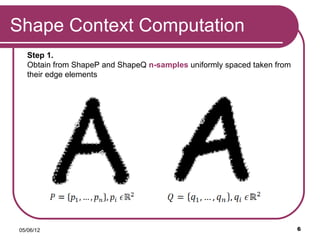
   Step 1.
   Obtain from ShapeP and ShapeQ n-samples uniformly spaced taken from
   their edge elements


05/06/12                                                                 6
Shape Context Computation
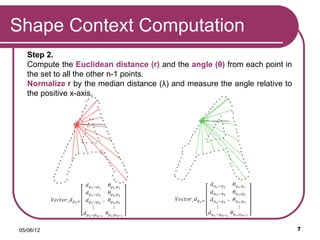
   Step 2.
   Compute the Euclidean distance (r) and the angle (θ) from each point in
   the set to all the other n-1 points.
   Normalize r by the median distance (λ) and measure the angle relative to
   the positive x-axis.


05/06/12                                                                      7
Shape Context Computation


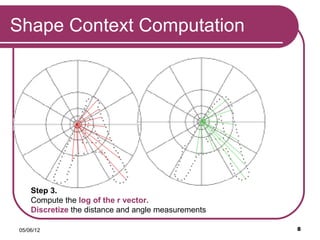
    Step 3.
    Compute the log of the r vector.
    Discretize the distance and angle measurements

05/06/12                                             8
Shape Context Computation
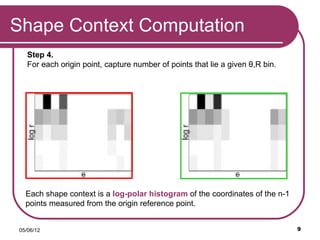
   Step 4.
   For each origin point, capture number of points that lie a given θ,R bin.


  Each shape context is a log-polar histogram of the coordinates of the n-1
  points measured from the origin reference point.


05/06/12                                                                       9
Shape Context Computation
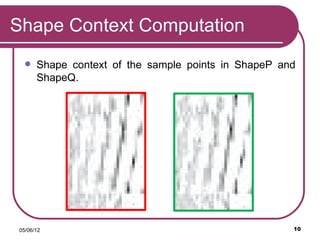
     Shape context of the sample points in ShapeP and
      ShapeQ.


05/06/12                                             10
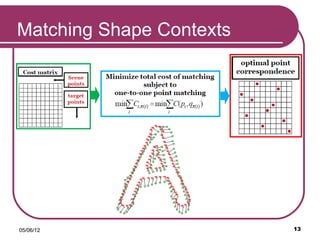
Matching Shape Contexts
     How can we assign the sample points of ShapeP to
      correspond to those of ShapeQ?

     Determining shape correspondences such that:

           l   Corresponding points have very similar descriptors

           l   The correspondences are unique


05/06/12                                                            11
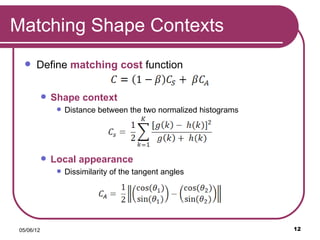
Matching Shape Contexts
     Define matching cost function

              Shape context
                   Distance between the two normalized histograms


              Local appearance
                   Dissimilarity of the tangent angles


05/06/12                                                             12
Matching Shape Contexts


05/06/12                  13
Modeling Transformation
      Given a set of correspondences, estimate a
       transformation that maps the model into the target

               Euclidean transformation

               Affine model

               Thin Plate Spline (TPS)


 05/06/12                                               14
Classification/Recognition
      This enables a measure of shape similarity
               The dissimilarity between two shapes can be computed
                as the sum of matching errors between corresponding
                points, together with a term measuring the magnitude
                of the aligning transform


      Given a dissimilarity measure, a k-NN technique can
       be used for object classification/recognition


 05/06/12                                                          15
Method Evaluation
Advantages                        Drawbacks
   Incorporates invariance to:      Sensitive local distortion or
                                      blurred edges
          Translation
                                     Problems      in    cluttered
          Scale                      background
          Rotation

          Occlusions


05/06/12                                                         16
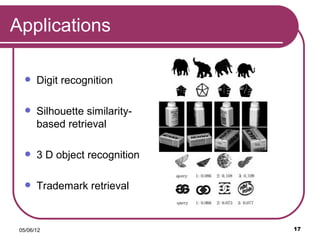
Applications

      Digit recognition

      Silhouette similarity-
       based retrieval

      3 D object recognition

      Trademark retrieval


 05/06/12                       17
Database for Digit Recognition

   MNIST datasets of
    handwritten digits:

   60,000 training and
    10,000 test digits

Links:
http://yann.lecun.com/exdb/mnist/


 05/06/12                           18
Database for Silhouette
      MPEG-7 shape silhouette
       database (Core Experiment
       CE-Shape-1 part B)

      1400 images: 70 shapes
       categories and 20 images per
       category

     Links:
   http://mpeg.chiariglione.org/standards/mpeg-7/mpeg-7.htm


 05/06/12                                                     19
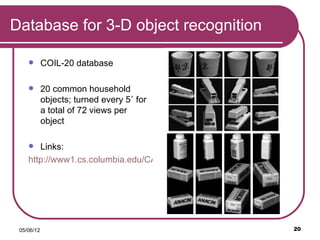
Database for 3-D object recognition

           COIL-20 database

           20 common household
            objects; turned every 5˚ for
            a total of 72 views per
            object

      Links:
    http://www1.cs.columbia.edu/CAVE/software/softlib/coil-20.php


 05/06/12                                                           20
Database for Trademark retrieval


     300 different real-
      world trademark


 05/06/12                          21
MATLAB DEMO


05/06/12         22
Conclusions

     The shape context method is simple to implement
      yet it is a rich shape descriptor

     The methodology makes it invariant to translation,
      scale and rotation

     Useful tool for shape matching and recognition


05/06/12                                               23

Shape context

  • 1.
    Shape Context Rocío Cabrera u1908272 Vanya Valindria u1908259 06/05/12 1
  • 2.
    Introduction Can you guess what number it is? 05/06/12 2
  • 3.
    Objectives “Have descriptors that can be computed in one image and used to find corresponding points, if visible, in another image.” “Given a query model image, to develop an algorithm capable of retrieving similar- shaped images from an extensive database” 05/06/12 3
  • 4.
    Process Stages Solve the Use the Evaluate the correspondences Compute the correspondence . problem between the two shapes . to estimate an aligning transform distance between the two shapes ? distance and classify the shape 05/06/12 4
  • 5.
    SHAPE CONTEXT “A novel approach to measuring similarities between shapes and exploit it for object classification/recognition” 05/06/12 5
  • 6.
    Shape Context Computation Step 1. Obtain from ShapeP and ShapeQ n-samples uniformly spaced taken from their edge elements 05/06/12 6
  • 7.
    Shape Context Computation Step 2. Compute the Euclidean distance (r) and the angle (θ) from each point in the set to all the other n-1 points. Normalize r by the median distance (λ) and measure the angle relative to the positive x-axis. 05/06/12 7
  • 8.
    Shape Context Computation Step 3. Compute the log of the r vector. Discretize the distance and angle measurements 05/06/12 8
  • 9.
    Shape Context Computation Step 4. For each origin point, capture number of points that lie a given θ,R bin. Each shape context is a log-polar histogram of the coordinates of the n-1 points measured from the origin reference point. 05/06/12 9
  • 10.
    Shape Context Computation  Shape context of the sample points in ShapeP and ShapeQ. 05/06/12 10
  • 11.
    Matching Shape Contexts  How can we assign the sample points of ShapeP to correspond to those of ShapeQ?  Determining shape correspondences such that: l Corresponding points have very similar descriptors l The correspondences are unique 05/06/12 11
  • 12.
    Matching Shape Contexts  Define matching cost function  Shape context  Distance between the two normalized histograms  Local appearance  Dissimilarity of the tangent angles 05/06/12 12
  • 13.
  • 14.
    Modeling Transformation  Given a set of correspondences, estimate a transformation that maps the model into the target  Euclidean transformation  Affine model  Thin Plate Spline (TPS) 05/06/12 14
  • 15.
    Classification/Recognition  This enables a measure of shape similarity  The dissimilarity between two shapes can be computed as the sum of matching errors between corresponding points, together with a term measuring the magnitude of the aligning transform  Given a dissimilarity measure, a k-NN technique can be used for object classification/recognition 05/06/12 15
  • 16.
    Method Evaluation Advantages Drawbacks  Incorporates invariance to:  Sensitive local distortion or blurred edges  Translation  Problems in cluttered  Scale background  Rotation  Occlusions 05/06/12 16
  • 17.
    Applications  Digit recognition  Silhouette similarity- based retrieval  3 D object recognition  Trademark retrieval 05/06/12 17
  • 18.
    Database for DigitRecognition  MNIST datasets of handwritten digits:  60,000 training and 10,000 test digits Links: http://yann.lecun.com/exdb/mnist/ 05/06/12 18
  • 19.
    Database for Silhouette  MPEG-7 shape silhouette database (Core Experiment CE-Shape-1 part B)  1400 images: 70 shapes categories and 20 images per category  Links: http://mpeg.chiariglione.org/standards/mpeg-7/mpeg-7.htm 05/06/12 19
  • 20.
    Database for 3-Dobject recognition  COIL-20 database  20 common household objects; turned every 5˚ for a total of 72 views per object  Links: http://www1.cs.columbia.edu/CAVE/software/softlib/coil-20.php 05/06/12 20
  • 21.
    Database for Trademarkretrieval  300 different real- world trademark 05/06/12 21
  • 22.
  • 23.
    Conclusions  The shape context method is simple to implement yet it is a rich shape descriptor  The methodology makes it invariant to translation, scale and rotation  Useful tool for shape matching and recognition 05/06/12 23