2022-04-21
Sangmin Woo
Computational Intelligence Lab.
School of Electrical Engineering
Korea Advanced Institute of Science and Technology (KAIST)
Masked Autoencoders
Are Scalable Vision Learners
Kaiming He, Xinlei Chen, Saining Xie, Yanghao Li, Piotr Dollár, Ross Girshick
Facebook AI Research (FAIR)
Submitted to CVPR 2022
Video: https://www.youtube.com/watch?v=Dp6iICL2dVI
2
In a nutshell…
Masked Autoencoder (MAE)
 MAE are scalable self-supervised learners for computer vision
 Mask random patches of the input image and reconstruct the missing
pixels
 Asymmetric Encoder-Decoder Architecture
• Visible subset of patches (without mask tokens) → Encoder
• Latent representation & Mask tokens → Decoder (lightweight)
 Masking high proportion of the input image, e.g., 75%, yields a non-trivial
and meaningful self-supervisory task
 Accelerate training (by 3× or more) and improves accuracy
 Learning high-capacity models that generalizes well
• Vanilla ViT-H [] achieves the best accuracy (87.8%) among methods
that use only ImageNet-1K data
 Transfer performance in downstream tasks outperforms supervised pre-
training and shows promising scaling behavior
[1] He, Kaiming, et al. "Masked autoencoders are scalable vision learners." arXiv 2021.
3
Background
Masked Language Modeling
 Success of self-supervised pre-training in NLP
 Masked language modeling (e.g., BERT [])
 Autoregressive language modeling (e.g., GPT [])
 Method: remove a portion of the input sequence and learn to
predict the missing content
 These methods have been shown to scale excellently
 These pre-trained representations generalize well to various
downstream tasks
[1] He, Kaiming, et al. "Masked autoencoders are scalable vision learners." arXiv 2021.
[2]
4
Background
Autoencoder
 Encoder maps an input to a latent representation
 Decoder reconstructs the input
 E.g., PCA and k-means are autoencoders
 Denoising autoencoders (DAE) [1] are a class of autoencoders that corrupt an
input signal and learn to reconstruct the original, uncorrupted signal
 A series of methods can be thought of as a generalized DAE under different
corruptions, e.g., masking pixels or removing color channels
Masked Image Encoding
 DAE [1] presents masking as a noise type
 Convolution-based
 Context Encoder [2] inpaints large missing regions
 Transformer-based
 iGPT [3] operates on sequences of pixels and predicts unknown pixels
 The ViT [4] studies masked patch prediction for self-supervised learning
 Most recently, BEiT [5] proposes to predict discrete tokens
[1] He, Kaiming, et al. "Masked autoencoders are scalable vision learners." arXiv 2021.
[2]
[3]
[4]
[5]
5
Background
Self-supervised Learning
 Early self-supervised learning approaches often focused on different
pretext tasks [] for pre-training
 Contrastive learning [] has been popular, e.g., [], which models image
similarity and dissimilarity (or only similarity []) between two or more views
 Contrastive and related methods strongly depend on data augmentation []
 Autoencoding pursues a conceptually different direction, and it exhibits
different behaviors
[1] Vaswani, Ashish, et al. "Attention is all you need." NeurIPS 2017.
[2] Xiaolong Wang, Ross Girshick, Abhinav Gupta, and Kaiming He. “Non-local neural networks.” CVPR 2018.
[3] Yue Cao, Jiarui Xu, Stephen Lin, Fangyun Wei, and Han Hu. “Gcnet: Non-local networks meet squeeze-excitation networks and beyond.” ICCVW
2019.
[4] Prajit Ramachandran, et al. “Stand-alone self-attention in vision models.” NeurIPS 2019.
[5] Hengshuang Zhao, Jiaya Jia, and Vladlen Koltun. “Exploring self-attention for image recognition.” CVPR 2020..
[6] Nicolas Carion, et al. “End-to-end object detection with Transformers.” ECCV 2020.
[7] Alexey Dosovitskiy, et al. “An image is worth 16x16 words: Transformers for image recognition at scale.” ICLR 2021.
6
What makes masked autoencoding
different between vision and language?
Architectural Gap
 Convolutions typically operate on regular grids
 It is not straightforward to integrate ‘indicators’ such as mask tokens or positional embeddings
into convolutional networks
 Solution: ViT [1]
Information Density
 Language: human-generated signals, highly semantic, information-dense, Need sophisticated
language understanding to train a model to predict only a few missing words per sentence
 Images: natural signals, heavy spatial redundancy, A missing patch can be recovered from
neighboring patches with little high-level understanding of parts, objects, and scenes
 Solution: masking a very high portion of random patches
 This strategy largely reduces redundancy and creates a challenging self-supervisory task that
requires holistic understanding beyond low-level image statistics
The Role of Autoencoder’s Decoder
 Language: decoder predicts missing words that contain rich semantic information
 Image: decoder reconstructs pixels, hence its output is of a lower semantic level than common
recognition tasks
 Decoder design plays a key role in determining the semantic level of the learned latent
representations for images
He, Kaiming, et al. "Masked autoencoders are scalable vision learners." arXiv 2021.
7
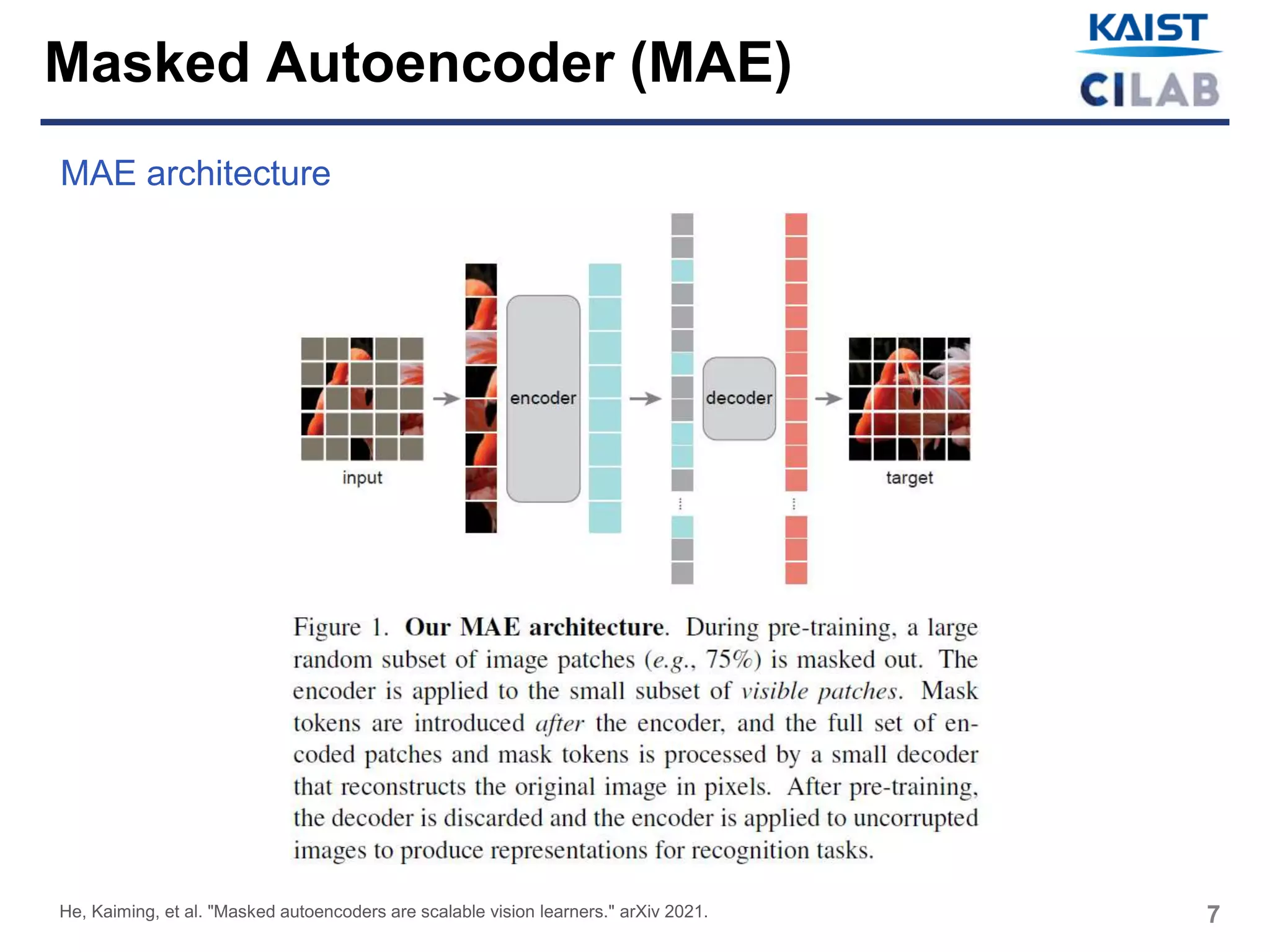
Masked Autoencoder (MAE)
MAE architecture
He, Kaiming, et al. "Masked autoencoders are scalable vision learners." arXiv 2021.
8
MAE: A Simple, Effective, and Scalable Self-supervised Learner
 MAE masks random patches from the input image and reconstructs the missing
patches in the pixel space
 Asymmetric encoder-decoder design
 Encoder operates only on the visible subset of patches (without mask tokens)
 (Lightweight) Decoder reconstructs the input from the latent representation along with
mask tokens
 Shifting the mask tokens to the small decoder results in a large reduction in computation
 A very high masking ratio (e.g., 75%) can achieve a win-win scenario
 It optimizes accuracy while allowing the encoder to process only a small portion (e.g.,
25%) of patches
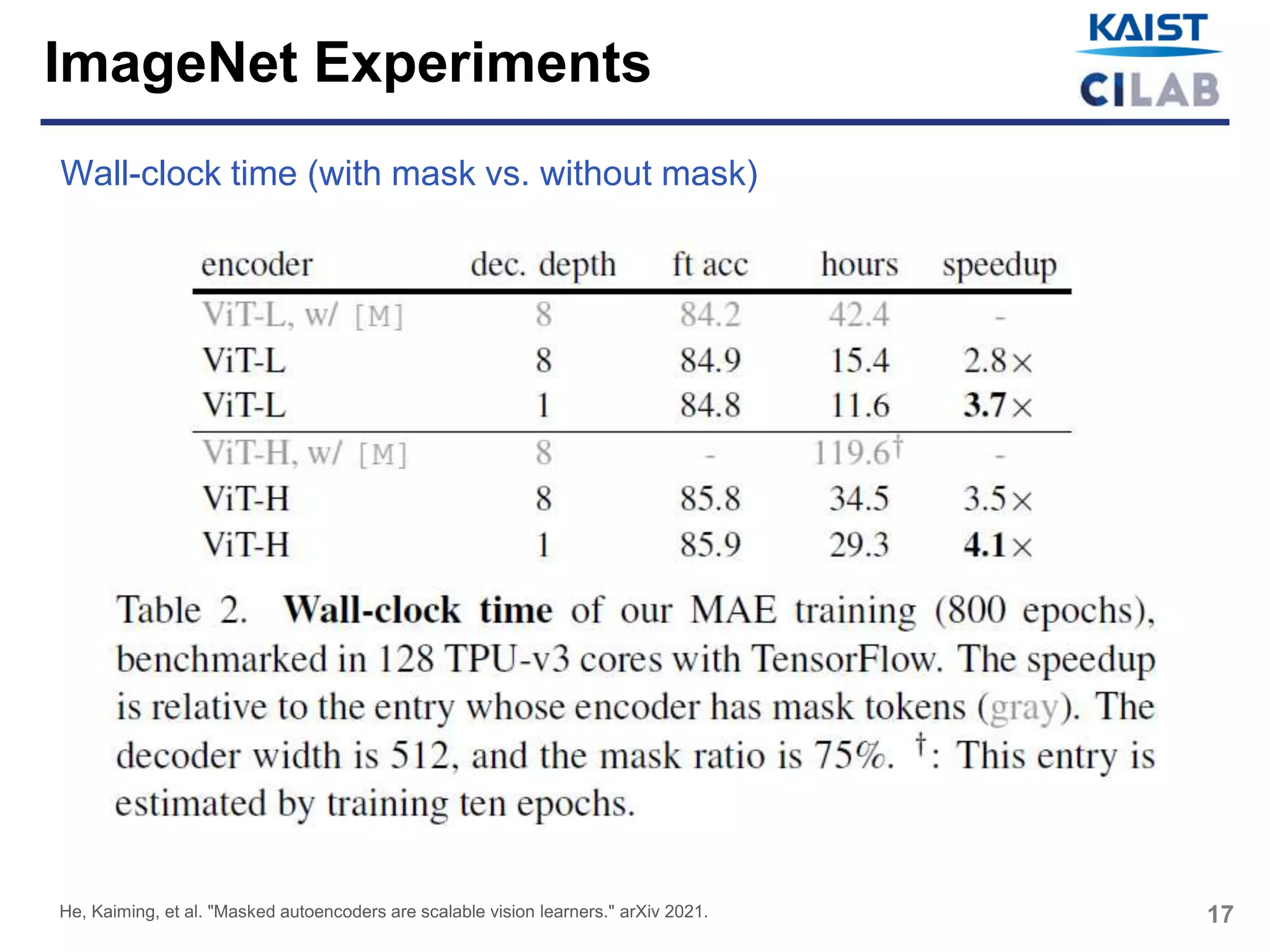
 This can reduce overall pre-training time by 3 × or more and likewise reduce memory
consumption, enabling us to easily scale our MAE to large models
 With MAE pre-training,
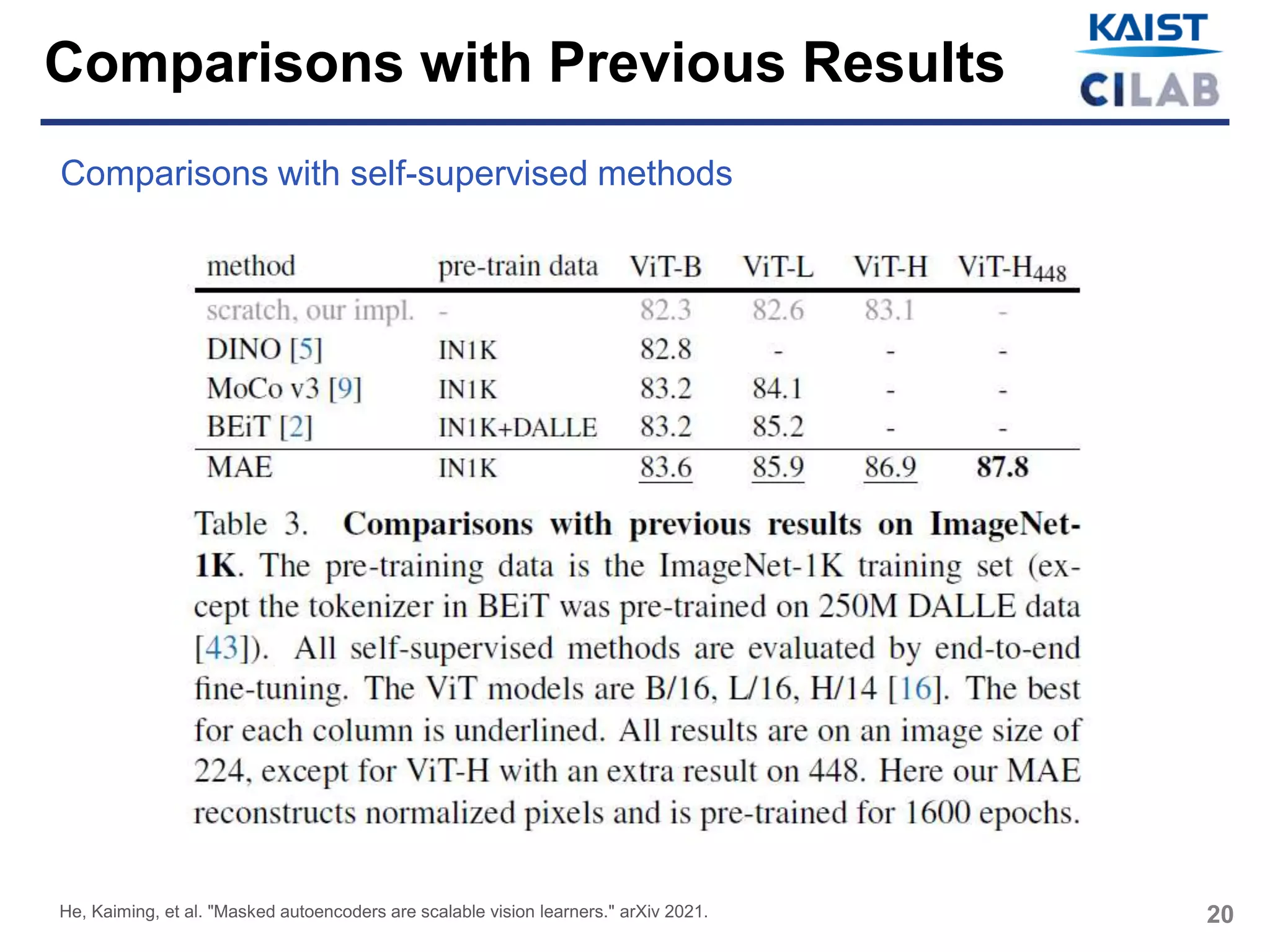
 Vanilla ViT-H achieves 87.8% accuracy when fine-tuned on ImageNet-1K
 Transfer Learning on object detection, instance segmentation, semantic segmentation
achieve better results than its supervised pre-training counterparts
 Significant gains by scaling up models
He, Kaiming, et al. "Masked autoencoders are scalable vision learners." arXiv 2021.
Masked Autoencoder (MAE)
9
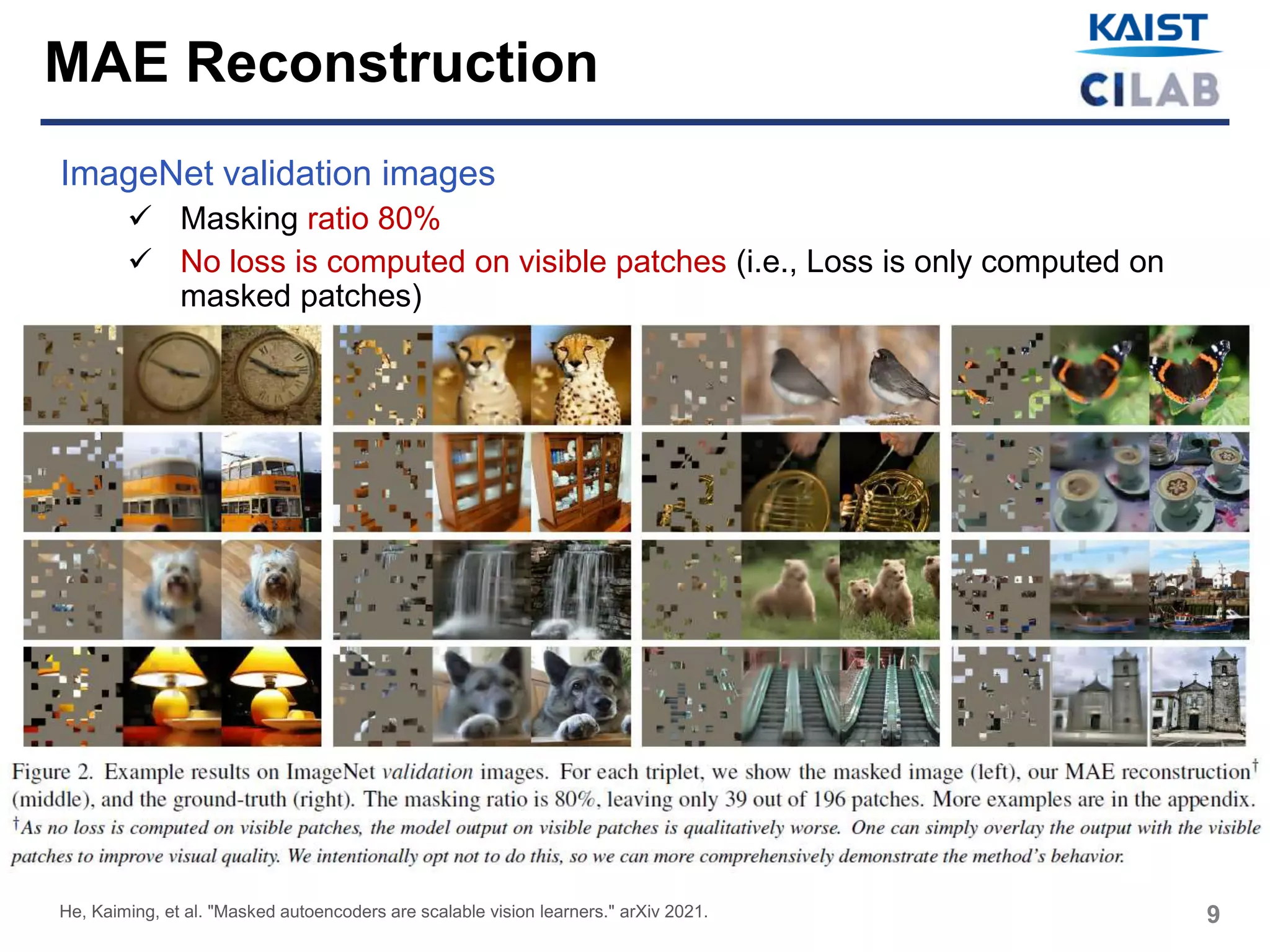
ImageNet validation images
 Masking ratio 80%
 No loss is computed on visible patches (i.e., Loss is only computed on
masked patches)
He, Kaiming, et al. "Masked autoencoders are scalable vision learners." arXiv 2021.
MAE Reconstruction
10
COCO validation images
 MAE trained on ImageNet
He, Kaiming, et al. "Masked autoencoders are scalable vision learners." arXiv 2021.
MAE Reconstruction
11
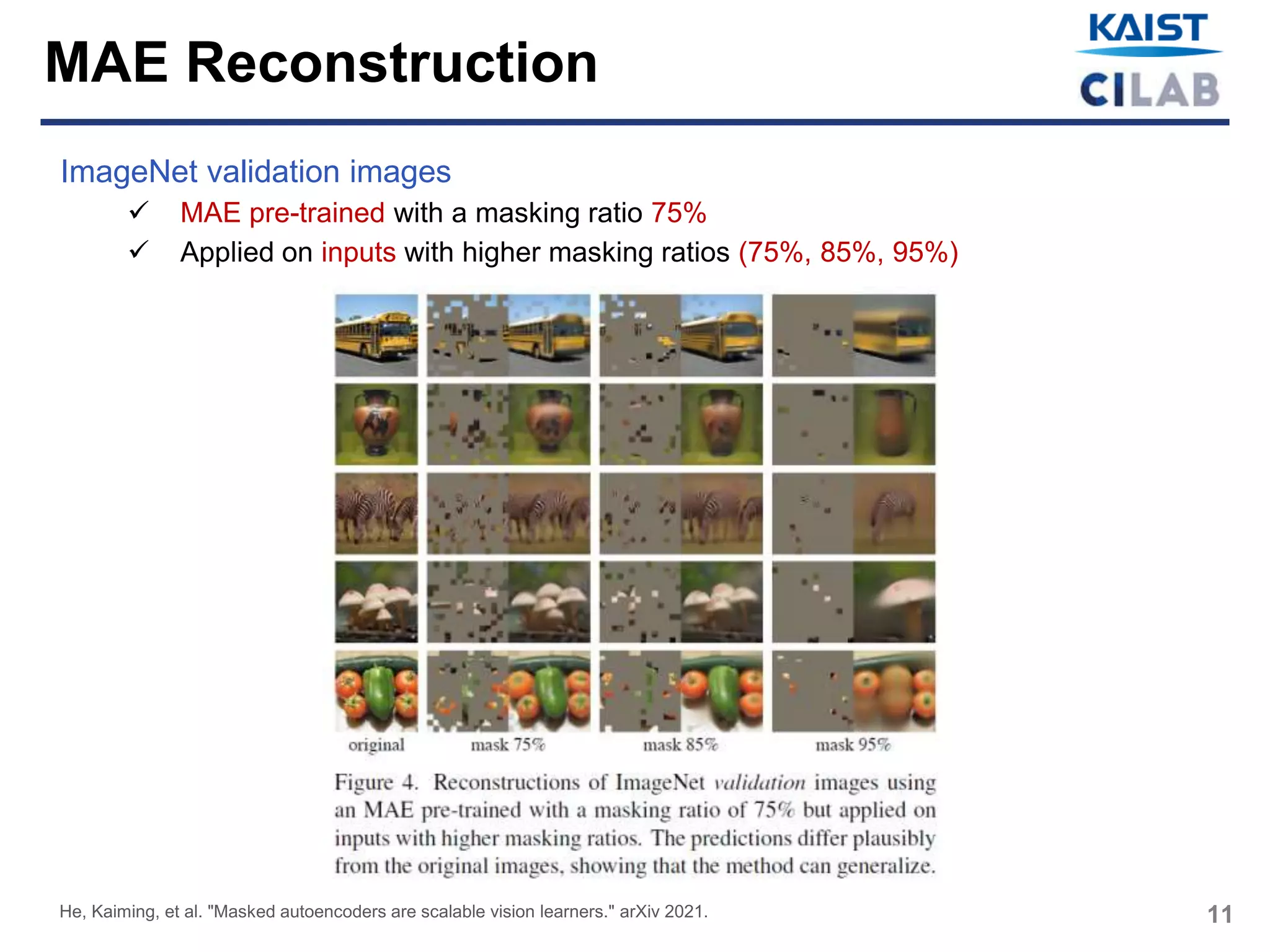
ImageNet validation images
 MAE pre-trained with a masking ratio 75%
 Applied on inputs with higher masking ratios (75%, 85%, 95%)
He, Kaiming, et al. "Masked autoencoders are scalable vision learners." arXiv 2021.
MAE Reconstruction
12
Masking
 Image is divided into regular non-overlapping patches
 Sample a subset of patches and mask (i.e., remove) the remaining ones
 High masking ratio (e.g., 75%)
MAE encoder
 Encoder is a ViT [] but applied only on visible, unmasked patches
 Encoder only operates on a small subset (e.g., 25%) of the full set
 Masked patches are removed; No mask tokens are used
 This allows us to train very large encoders with only a fraction of compute and
memory
MAE decoder
 The input to the MAE decoder is the full set of tokens consisting of encoded visible
patches and mask tokens
 Positional embeddings are added to all tokens in this full set
 MAE decoder is only used during pre-training to perform the image reconstruction
task (only the encoder is used to produce image representations for recognition)
 Decoder has <10% computation per token vs. the encoder
He, Kaiming, et al. "Masked autoencoders are scalable vision learners." arXiv 2021.
Masked Autoencoder (MAE)
13
Reconstruction Target
 MAE reconstructs the input by predicting the pixel values for each
masked patch
 Loss function computes the MSE between reconstructed and original
images in the pixel space
 Loss is only computed on masked patches, similar to BERT []
 masks random patches from the input image and reconstructs the
missing patches in the pixel space
Simple Implementation
1. Generate a token for every input patch
2. Randomly shuffle the list of tokens and remove the last portion of the list
3. After encoding, mask tokens are appended to the list of encoded patches,
and unshuffle the full list (inverting the random shuffle operation)
4. The decoder is applied to this full list (with positional embeddings added)
He, Kaiming, et al. "Masked autoencoders are scalable vision learners." arXiv 2021.
Masked Autoencoder (MAE)
14
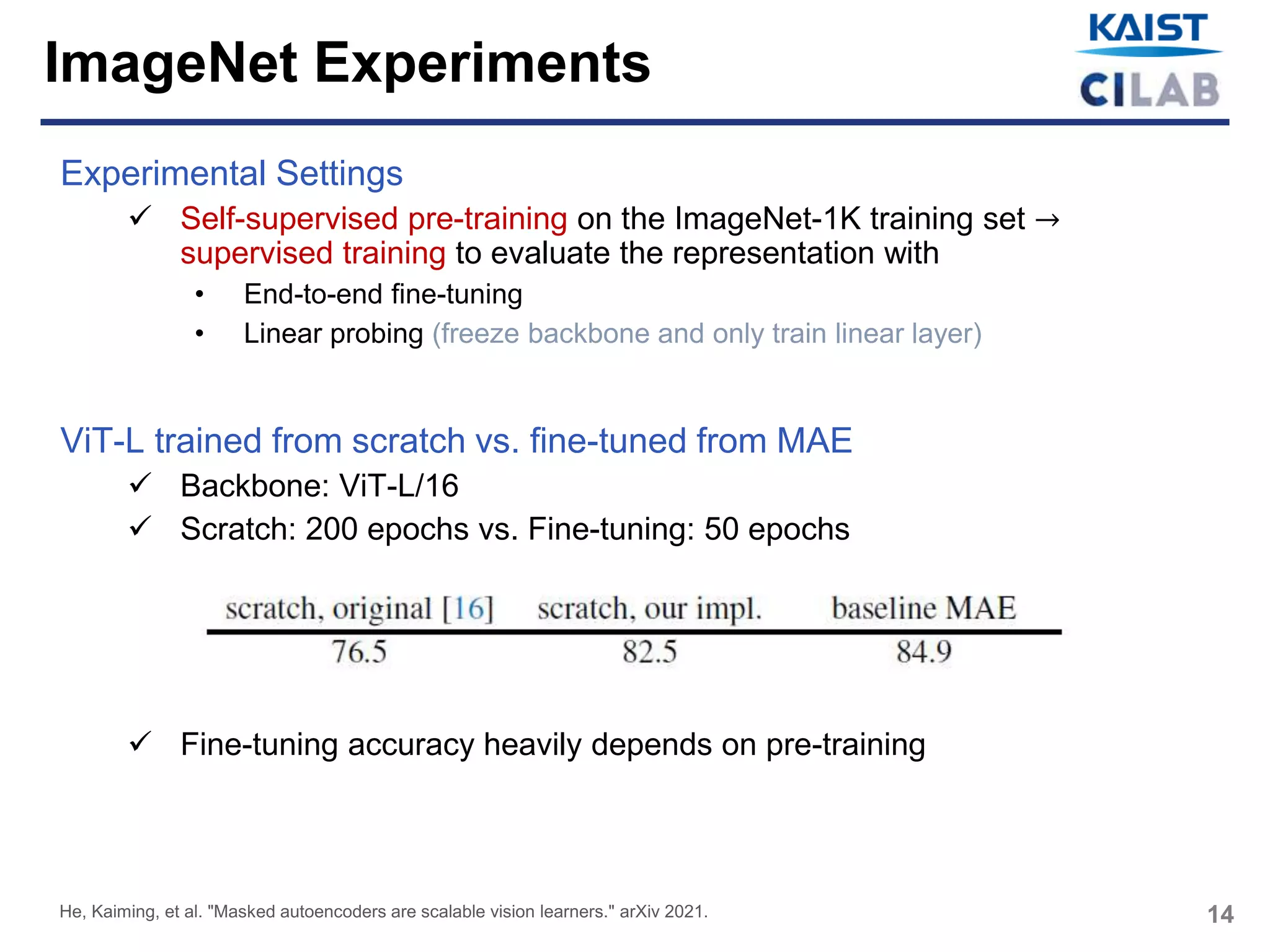
Experimental Settings
 Self-supervised pre-training on the ImageNet-1K training set →
supervised training to evaluate the representation with
• End-to-end fine-tuning
• Linear probing (freeze backbone and only train linear layer)
ViT-L trained from scratch vs. fine-tuned from MAE
 Backbone: ViT-L/16
 Scratch: 200 epochs vs. Fine-tuning: 50 epochs
 Fine-tuning accuracy heavily depends on pre-training
He, Kaiming, et al. "Masked autoencoders are scalable vision learners." arXiv 2021.
ImageNet Experiments
15
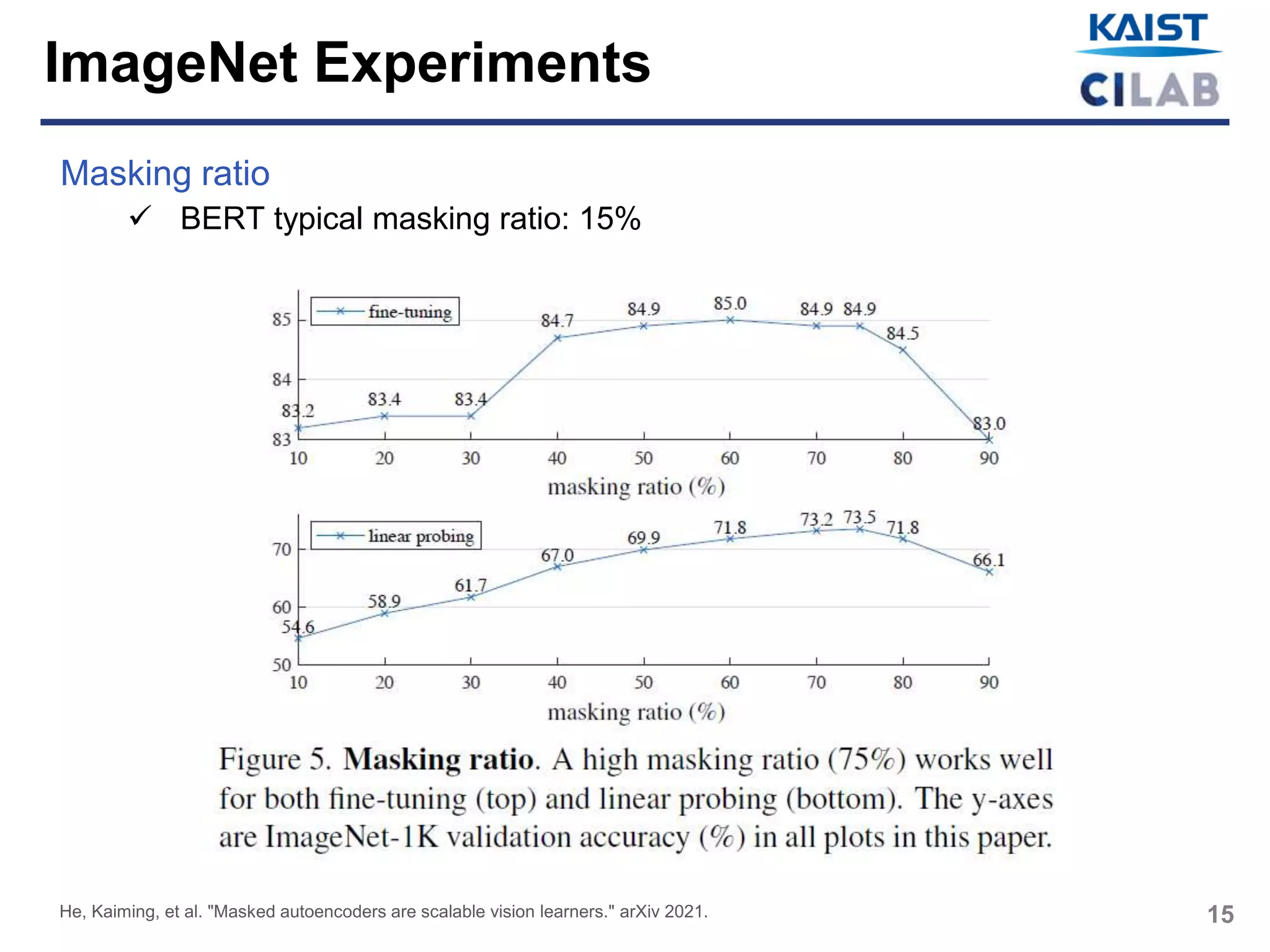
Masking ratio
 BERT typical masking ratio: 15%
He, Kaiming, et al. "Masked autoencoders are scalable vision learners." arXiv 2021.
ImageNet Experiments
16
Ablations
He, Kaiming, et al. "Masked autoencoders are scalable vision learners." arXiv 2021.
ImageNet Experiments
17
Wall-clock time (with mask vs. without mask)
He, Kaiming, et al. "Masked autoencoders are scalable vision learners." arXiv 2021.
ImageNet Experiments
18
Mask sampling strategies (random vs. block vs. grid)
He, Kaiming, et al. "Masked autoencoders are scalable vision learners." arXiv 2021.
ImageNet Experiments
19
Training Schedules
 Not observed saturation of linear probing accuracy even at 1600 epochs
 MoCo v3 saturates at 300 epochs for ViT-L
He, Kaiming, et al. "Masked autoencoders are scalable vision learners." arXiv 2021.
ImageNet Experiments
20
Comparisons with self-supervised methods
He, Kaiming, et al. "Masked autoencoders are scalable vision learners." arXiv 2021.
Comparisons with Previous Results
21
Comparisons with supervised pre-training
He, Kaiming, et al. "Masked autoencoders are scalable vision learners." arXiv 2021.
Comparisons with Previous Results
22
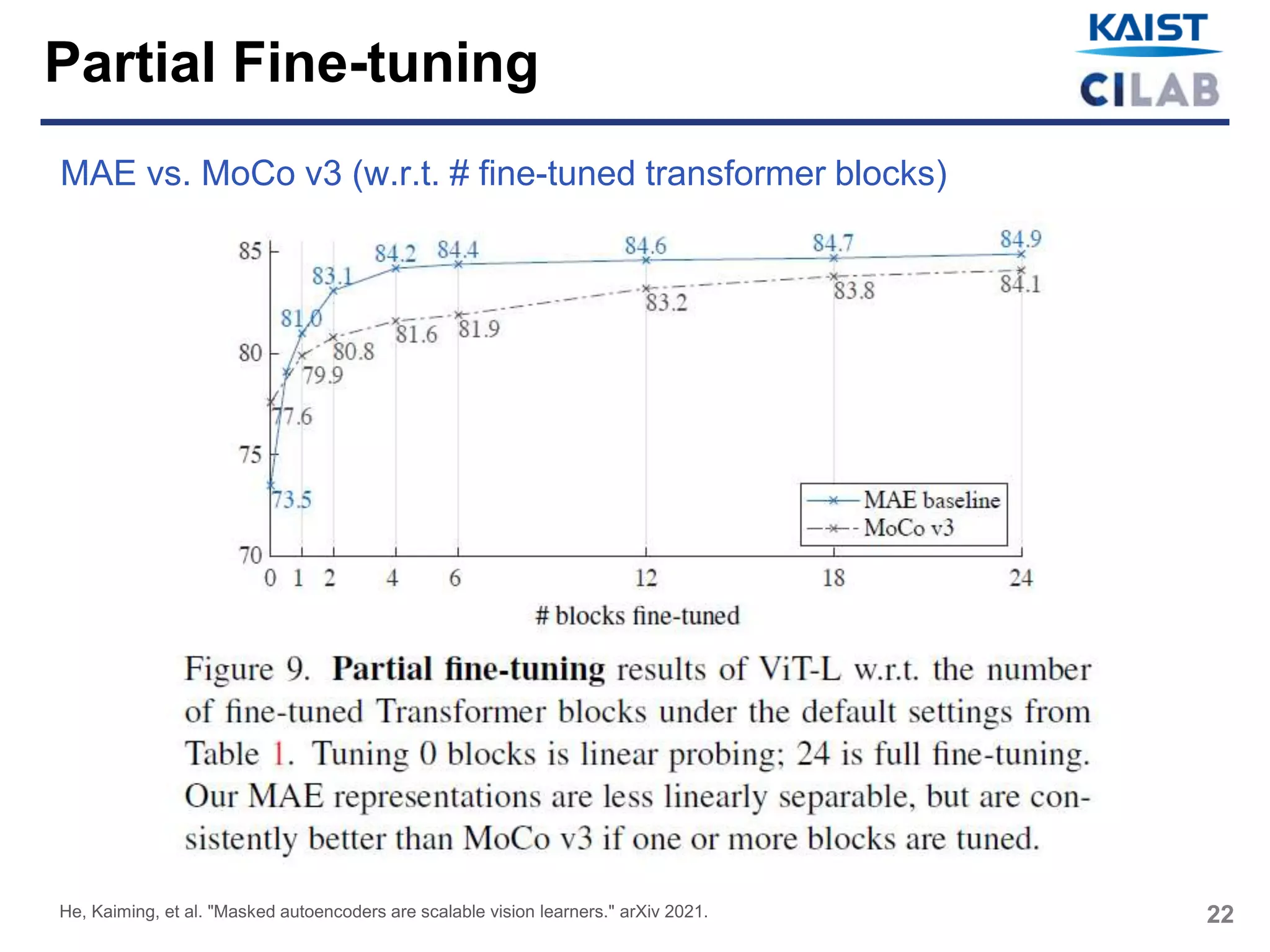
MAE vs. MoCo v3 (w.r.t. # fine-tuned transformer blocks)
He, Kaiming, et al. "Masked autoencoders are scalable vision learners." arXiv 2021.
Partial Fine-tuning
23
Object Detection and Segmentation
He, Kaiming, et al. "Masked autoencoders are scalable vision learners." arXiv 2021.
Transfer Learning Experiments
24
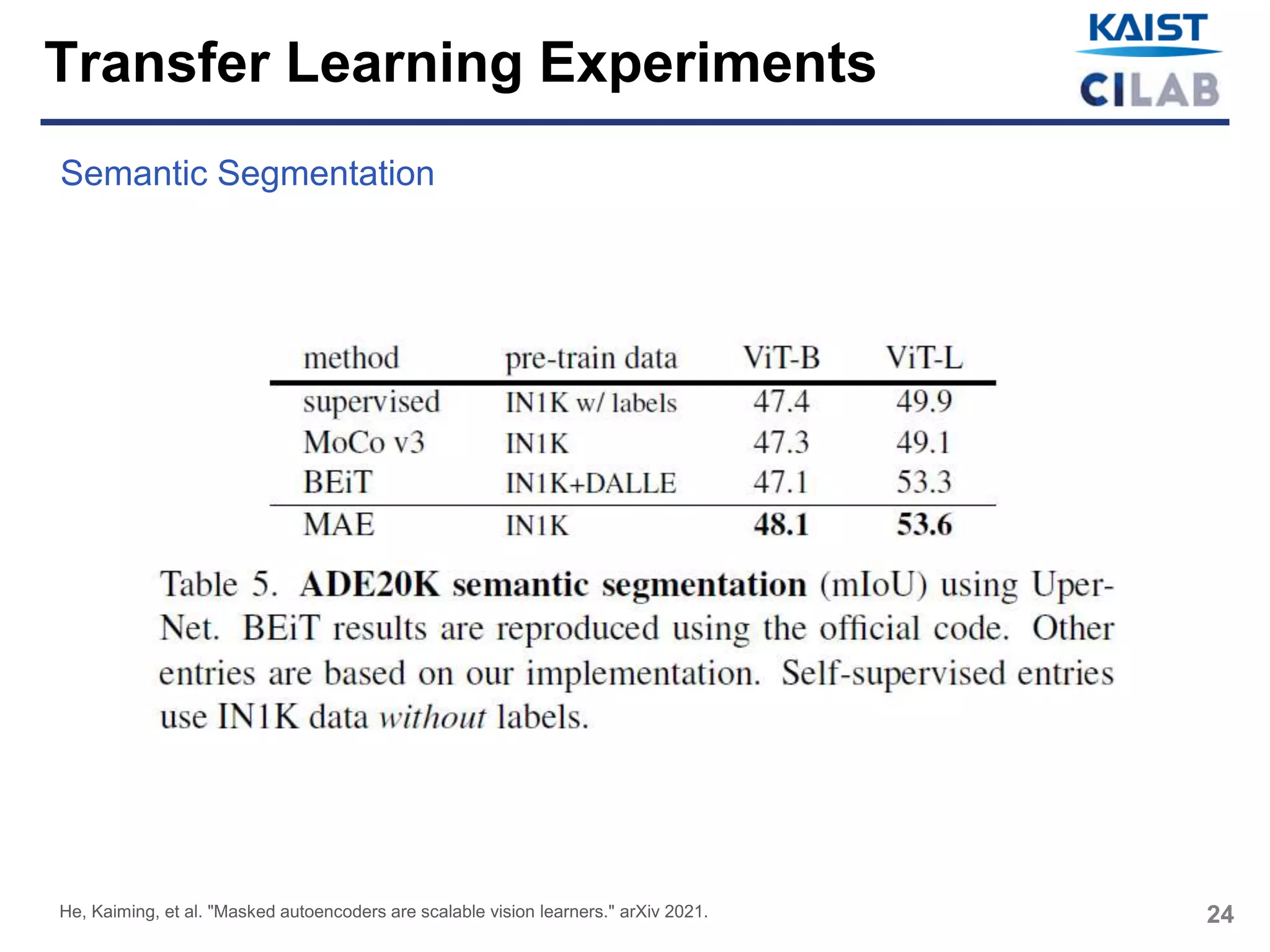
Semantic Segmentation
He, Kaiming, et al. "Masked autoencoders are scalable vision learners." arXiv 2021.
Transfer Learning Experiments
25
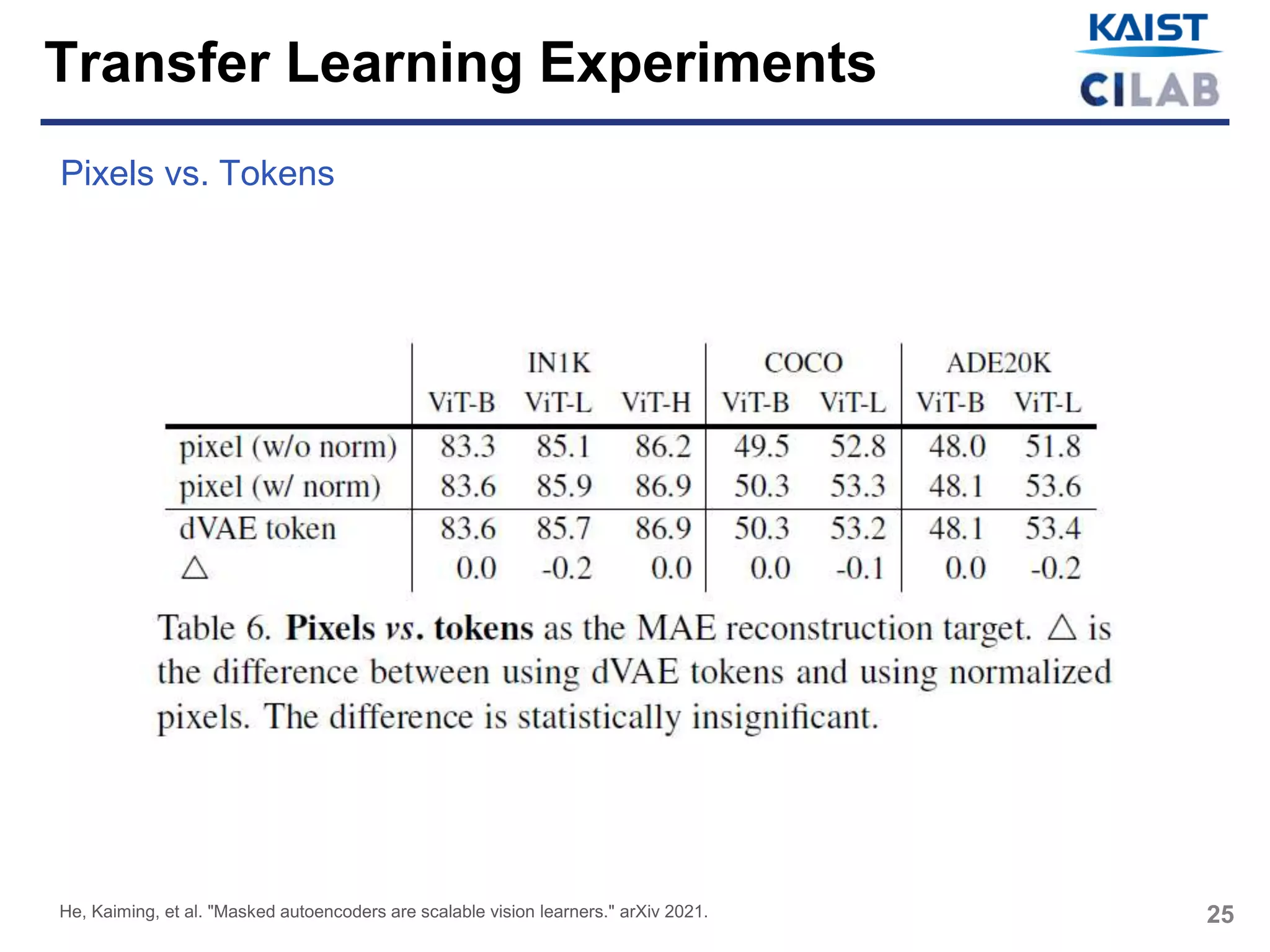
Pixels vs. Tokens
He, Kaiming, et al. "Masked autoencoders are scalable vision learners." arXiv 2021.
Transfer Learning Experiments
26
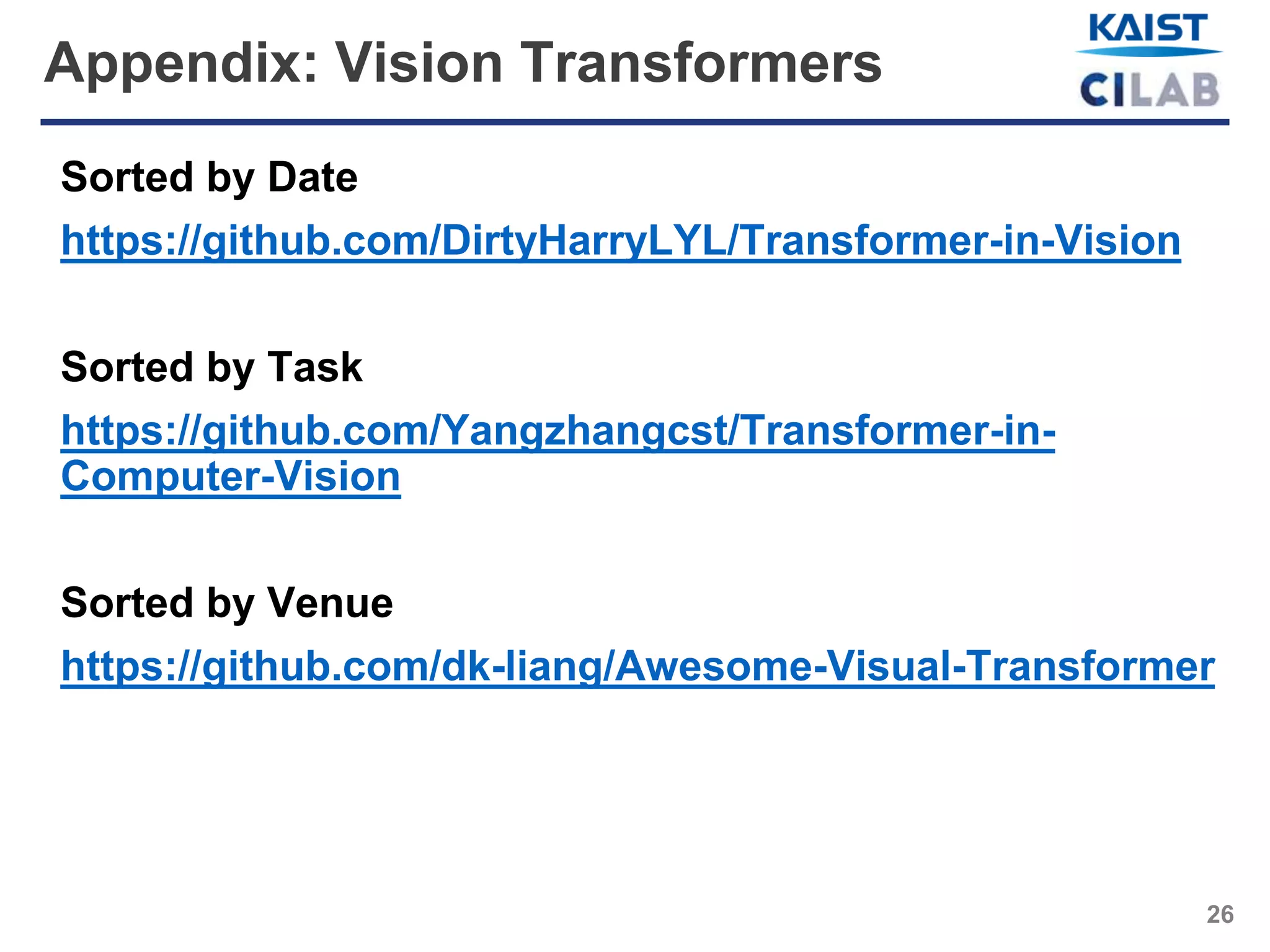
Appendix: Vision Transformers
Sorted by Date
https://github.com/DirtyHarryLYL/Transformer-in-Vision
Sorted by Task
https://github.com/Yangzhangcst/Transformer-in-
Computer-Vision
Sorted by Venue
https://github.com/dk-liang/Awesome-Visual-Transformer
Thank You!
Sangmin Woo
sangminwoo.github.i
o
smwoo95@kaist.ac.k
Q&A

Masked Autoencoders Are Scalable Vision Learners.pptx

  • 1.
    2022-04-21 Sangmin Woo Computational IntelligenceLab. School of Electrical Engineering Korea Advanced Institute of Science and Technology (KAIST) Masked Autoencoders Are Scalable Vision Learners Kaiming He, Xinlei Chen, Saining Xie, Yanghao Li, Piotr Dollár, Ross Girshick Facebook AI Research (FAIR) Submitted to CVPR 2022 Video: https://www.youtube.com/watch?v=Dp6iICL2dVI
  • 2.
    2 In a nutshell… MaskedAutoencoder (MAE)  MAE are scalable self-supervised learners for computer vision  Mask random patches of the input image and reconstruct the missing pixels  Asymmetric Encoder-Decoder Architecture • Visible subset of patches (without mask tokens) → Encoder • Latent representation & Mask tokens → Decoder (lightweight)  Masking high proportion of the input image, e.g., 75%, yields a non-trivial and meaningful self-supervisory task  Accelerate training (by 3× or more) and improves accuracy  Learning high-capacity models that generalizes well • Vanilla ViT-H [] achieves the best accuracy (87.8%) among methods that use only ImageNet-1K data  Transfer performance in downstream tasks outperforms supervised pre- training and shows promising scaling behavior [1] He, Kaiming, et al. "Masked autoencoders are scalable vision learners." arXiv 2021.
  • 3.
    3 Background Masked Language Modeling Success of self-supervised pre-training in NLP  Masked language modeling (e.g., BERT [])  Autoregressive language modeling (e.g., GPT [])  Method: remove a portion of the input sequence and learn to predict the missing content  These methods have been shown to scale excellently  These pre-trained representations generalize well to various downstream tasks [1] He, Kaiming, et al. "Masked autoencoders are scalable vision learners." arXiv 2021. [2]
  • 4.
    4 Background Autoencoder  Encoder mapsan input to a latent representation  Decoder reconstructs the input  E.g., PCA and k-means are autoencoders  Denoising autoencoders (DAE) [1] are a class of autoencoders that corrupt an input signal and learn to reconstruct the original, uncorrupted signal  A series of methods can be thought of as a generalized DAE under different corruptions, e.g., masking pixels or removing color channels Masked Image Encoding  DAE [1] presents masking as a noise type  Convolution-based  Context Encoder [2] inpaints large missing regions  Transformer-based  iGPT [3] operates on sequences of pixels and predicts unknown pixels  The ViT [4] studies masked patch prediction for self-supervised learning  Most recently, BEiT [5] proposes to predict discrete tokens [1] He, Kaiming, et al. "Masked autoencoders are scalable vision learners." arXiv 2021. [2] [3] [4] [5]
  • 5.
    5 Background Self-supervised Learning  Earlyself-supervised learning approaches often focused on different pretext tasks [] for pre-training  Contrastive learning [] has been popular, e.g., [], which models image similarity and dissimilarity (or only similarity []) between two or more views  Contrastive and related methods strongly depend on data augmentation []  Autoencoding pursues a conceptually different direction, and it exhibits different behaviors [1] Vaswani, Ashish, et al. "Attention is all you need." NeurIPS 2017. [2] Xiaolong Wang, Ross Girshick, Abhinav Gupta, and Kaiming He. “Non-local neural networks.” CVPR 2018. [3] Yue Cao, Jiarui Xu, Stephen Lin, Fangyun Wei, and Han Hu. “Gcnet: Non-local networks meet squeeze-excitation networks and beyond.” ICCVW 2019. [4] Prajit Ramachandran, et al. “Stand-alone self-attention in vision models.” NeurIPS 2019. [5] Hengshuang Zhao, Jiaya Jia, and Vladlen Koltun. “Exploring self-attention for image recognition.” CVPR 2020.. [6] Nicolas Carion, et al. “End-to-end object detection with Transformers.” ECCV 2020. [7] Alexey Dosovitskiy, et al. “An image is worth 16x16 words: Transformers for image recognition at scale.” ICLR 2021.
  • 6.
    6 What makes maskedautoencoding different between vision and language? Architectural Gap  Convolutions typically operate on regular grids  It is not straightforward to integrate ‘indicators’ such as mask tokens or positional embeddings into convolutional networks  Solution: ViT [1] Information Density  Language: human-generated signals, highly semantic, information-dense, Need sophisticated language understanding to train a model to predict only a few missing words per sentence  Images: natural signals, heavy spatial redundancy, A missing patch can be recovered from neighboring patches with little high-level understanding of parts, objects, and scenes  Solution: masking a very high portion of random patches  This strategy largely reduces redundancy and creates a challenging self-supervisory task that requires holistic understanding beyond low-level image statistics The Role of Autoencoder’s Decoder  Language: decoder predicts missing words that contain rich semantic information  Image: decoder reconstructs pixels, hence its output is of a lower semantic level than common recognition tasks  Decoder design plays a key role in determining the semantic level of the learned latent representations for images He, Kaiming, et al. "Masked autoencoders are scalable vision learners." arXiv 2021.
  • 7.
    7 Masked Autoencoder (MAE) MAEarchitecture He, Kaiming, et al. "Masked autoencoders are scalable vision learners." arXiv 2021.
  • 8.
    8 MAE: A Simple,Effective, and Scalable Self-supervised Learner  MAE masks random patches from the input image and reconstructs the missing patches in the pixel space  Asymmetric encoder-decoder design  Encoder operates only on the visible subset of patches (without mask tokens)  (Lightweight) Decoder reconstructs the input from the latent representation along with mask tokens  Shifting the mask tokens to the small decoder results in a large reduction in computation  A very high masking ratio (e.g., 75%) can achieve a win-win scenario  It optimizes accuracy while allowing the encoder to process only a small portion (e.g., 25%) of patches  This can reduce overall pre-training time by 3 × or more and likewise reduce memory consumption, enabling us to easily scale our MAE to large models  With MAE pre-training,  Vanilla ViT-H achieves 87.8% accuracy when fine-tuned on ImageNet-1K  Transfer Learning on object detection, instance segmentation, semantic segmentation achieve better results than its supervised pre-training counterparts  Significant gains by scaling up models He, Kaiming, et al. "Masked autoencoders are scalable vision learners." arXiv 2021. Masked Autoencoder (MAE)
  • 9.
    9 ImageNet validation images Masking ratio 80%  No loss is computed on visible patches (i.e., Loss is only computed on masked patches) He, Kaiming, et al. "Masked autoencoders are scalable vision learners." arXiv 2021. MAE Reconstruction
  • 10.
    10 COCO validation images MAE trained on ImageNet He, Kaiming, et al. "Masked autoencoders are scalable vision learners." arXiv 2021. MAE Reconstruction
  • 11.
    11 ImageNet validation images MAE pre-trained with a masking ratio 75%  Applied on inputs with higher masking ratios (75%, 85%, 95%) He, Kaiming, et al. "Masked autoencoders are scalable vision learners." arXiv 2021. MAE Reconstruction
  • 12.
    12 Masking  Image isdivided into regular non-overlapping patches  Sample a subset of patches and mask (i.e., remove) the remaining ones  High masking ratio (e.g., 75%) MAE encoder  Encoder is a ViT [] but applied only on visible, unmasked patches  Encoder only operates on a small subset (e.g., 25%) of the full set  Masked patches are removed; No mask tokens are used  This allows us to train very large encoders with only a fraction of compute and memory MAE decoder  The input to the MAE decoder is the full set of tokens consisting of encoded visible patches and mask tokens  Positional embeddings are added to all tokens in this full set  MAE decoder is only used during pre-training to perform the image reconstruction task (only the encoder is used to produce image representations for recognition)  Decoder has <10% computation per token vs. the encoder He, Kaiming, et al. "Masked autoencoders are scalable vision learners." arXiv 2021. Masked Autoencoder (MAE)
  • 13.
    13 Reconstruction Target  MAEreconstructs the input by predicting the pixel values for each masked patch  Loss function computes the MSE between reconstructed and original images in the pixel space  Loss is only computed on masked patches, similar to BERT []  masks random patches from the input image and reconstructs the missing patches in the pixel space Simple Implementation 1. Generate a token for every input patch 2. Randomly shuffle the list of tokens and remove the last portion of the list 3. After encoding, mask tokens are appended to the list of encoded patches, and unshuffle the full list (inverting the random shuffle operation) 4. The decoder is applied to this full list (with positional embeddings added) He, Kaiming, et al. "Masked autoencoders are scalable vision learners." arXiv 2021. Masked Autoencoder (MAE)
  • 14.
    14 Experimental Settings  Self-supervisedpre-training on the ImageNet-1K training set → supervised training to evaluate the representation with • End-to-end fine-tuning • Linear probing (freeze backbone and only train linear layer) ViT-L trained from scratch vs. fine-tuned from MAE  Backbone: ViT-L/16  Scratch: 200 epochs vs. Fine-tuning: 50 epochs  Fine-tuning accuracy heavily depends on pre-training He, Kaiming, et al. "Masked autoencoders are scalable vision learners." arXiv 2021. ImageNet Experiments
  • 15.
    15 Masking ratio  BERTtypical masking ratio: 15% He, Kaiming, et al. "Masked autoencoders are scalable vision learners." arXiv 2021. ImageNet Experiments
  • 16.
    16 Ablations He, Kaiming, etal. "Masked autoencoders are scalable vision learners." arXiv 2021. ImageNet Experiments
  • 17.
    17 Wall-clock time (withmask vs. without mask) He, Kaiming, et al. "Masked autoencoders are scalable vision learners." arXiv 2021. ImageNet Experiments
  • 18.
    18 Mask sampling strategies(random vs. block vs. grid) He, Kaiming, et al. "Masked autoencoders are scalable vision learners." arXiv 2021. ImageNet Experiments
  • 19.
    19 Training Schedules  Notobserved saturation of linear probing accuracy even at 1600 epochs  MoCo v3 saturates at 300 epochs for ViT-L He, Kaiming, et al. "Masked autoencoders are scalable vision learners." arXiv 2021. ImageNet Experiments
  • 20.
    20 Comparisons with self-supervisedmethods He, Kaiming, et al. "Masked autoencoders are scalable vision learners." arXiv 2021. Comparisons with Previous Results
  • 21.
    21 Comparisons with supervisedpre-training He, Kaiming, et al. "Masked autoencoders are scalable vision learners." arXiv 2021. Comparisons with Previous Results
  • 22.
    22 MAE vs. MoCov3 (w.r.t. # fine-tuned transformer blocks) He, Kaiming, et al. "Masked autoencoders are scalable vision learners." arXiv 2021. Partial Fine-tuning
  • 23.
    23 Object Detection andSegmentation He, Kaiming, et al. "Masked autoencoders are scalable vision learners." arXiv 2021. Transfer Learning Experiments
  • 24.
    24 Semantic Segmentation He, Kaiming,et al. "Masked autoencoders are scalable vision learners." arXiv 2021. Transfer Learning Experiments
  • 25.
    25 Pixels vs. Tokens He,Kaiming, et al. "Masked autoencoders are scalable vision learners." arXiv 2021. Transfer Learning Experiments
  • 26.
    26 Appendix: Vision Transformers Sortedby Date https://github.com/DirtyHarryLYL/Transformer-in-Vision Sorted by Task https://github.com/Yangzhangcst/Transformer-in- Computer-Vision Sorted by Venue https://github.com/dk-liang/Awesome-Visual-Transformer
  • 27.

Editor's Notes

  • #13 [Masking] High masking ratio (e.g., 75%) largely eliminates redundancy, thus creating a task that cannot be easily solved by extrapolation from visible neighboring patches Highly sparse input creates an opportunity for designing an efficient encoder [MAE encoder] The full set is handled by a lightweight decoder [MAE decoder] Each mask token is a shared, learned vector that indicates the presence of a missing patch to be predicted Positional embeddings are added to all tokens in this full set; without this, mask tokens would have no information about their location in the image the decoder architecture can be flexibly designed in a manner that is independent of the encoder design.
  • #28 Thank you.