Literature Review of Image Processing
Methods for Myocardial Infarction Studies in
             MRI and CT-Scan


                      By:
                Vanya Vabrina V
                   Rui Hua


                    VIBOT 4

                     2 0 11
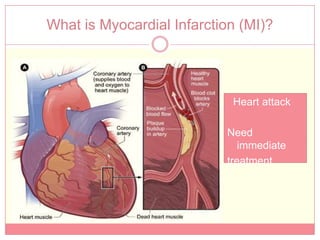
What is Myocardial Infarction (MI)?


                            Heart attack

                           Need
                              immediate
                           treatment
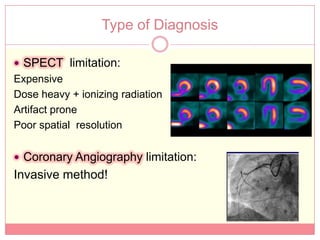
Type of Diagnosis

 SPECT limitation:
Expensive
Dose heavy + ionizing radiation
Artifact prone
Poor spatial resolution


 Coronary Angiography limitation:
Invasive method!
Non-Invasive Solutions:

CT-Scan and MRI
  Perfusion Imaging
     MI  limited flow
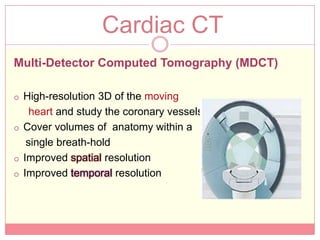
Cardiac CT
Multi-Detector Computed Tomography (MDCT)

o High-resolution 3D of the moving
    heart and study the coronary vessels
o Cover volumes of anatomy within a
   single breath-hold
o Improved spatial resolution
o Improved temporal resolution
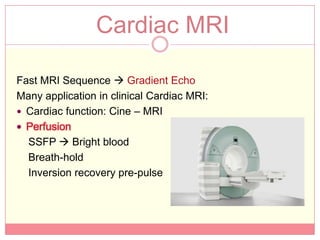
Cardiac MRI

Fast MRI Sequence  Gradient Echo
Many application in clinical Cardiac MRI:
 Cardiac function: Cine – MRI
 Perfusion
  SSFP  Bright blood
  Breath-hold
  Inversion recovery pre-pulse
CT – Perfusion Imaging
Pharmacologic
 Stress agent : Adenosine
 Contrast agent : Iodine based (e.g, Visipaque)
  [concentration ~ x-ray absorbtion]
 Signal-density-time curve ~ CT attenuation over time
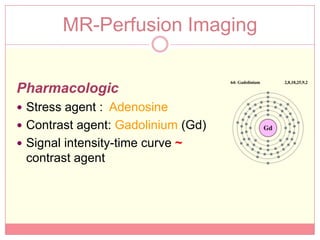
MR-Perfusion Imaging


Pharmacologic
 Stress agent : Adenosine
 Contrast agent: Gadolinium (Gd)
 Signal intensity-time curve ~
 contrast agent
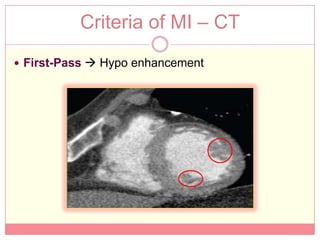
Criteria of MI – CT
 First-Pass  Hypo enhancement
Criteria of MI – MRI


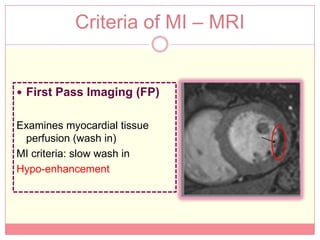
 First Pass Imaging (FP)


Examines myocardial tissue
 perfusion (wash in)
MI criteria: slow wash in
Hypo-enhancement
Criteria of MI – MRI

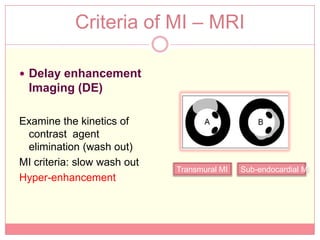
 Delay enhancement
  Imaging (DE)

Examine the kinetics of
 contrast agent
 elimination (wash out)
MI criteria: slow wash out
                             Transmural MI   Sub-endocardial MI
Hyper-enhancement
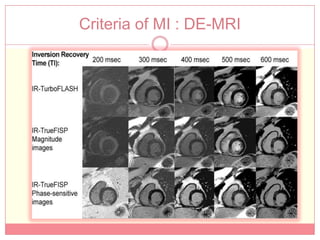
Criteria of MI : DE-MRI
Image Post-Processing

   …of MI Diagnosis in
CT Scan and MRI Perfusion
        Imaging
CT MYOCARDIAL PERFUSION ANALYSIS
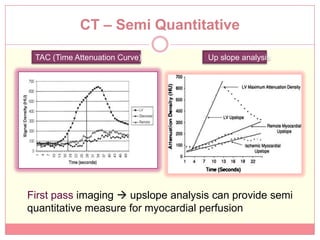
CT – Semi Quantitative

 TAC (Time Attenuation Curve)       Up slope analysis


First pass imaging  upslope analysis can provide semi
quantitative measure for myocardial perfusion
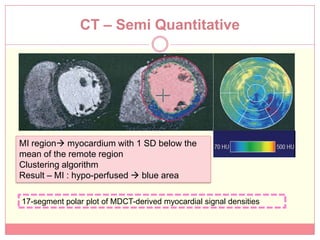
CT – Semi Quantitative


MI region myocardium with 1 SD below the
mean of the remote region
Clustering algorithm
Result – MI : hypo-perfused  blue area

17-segment polar plot of MDCT-derived myocardial signal densities
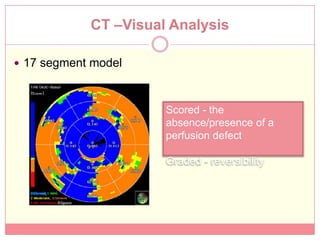
CT –Visual Analysis

 17 segment model


                      Scored - the
                      absence/presence of a
                      perfusion defect

                      Graded - reversibility
MRI MYOCARDIAL PERFUSION ANALYSIS


 Qualitative


Visual assessment
MRI MYOCARDIAL PERFUSION ANALYSIS

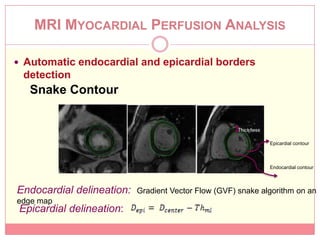
 Automatic endocardial and epicardial borders
 detection
   Snake Contour


                                                      Thickness

                                                                  Epicardial contour


                                                                  Endocardial contour


Endocardial delineation:   Gradient Vector Flow (GVF) snake algorithm on an
edge map
 Epicardial delineation:
MRI MYOCARDIAL PERFUSION ANALYSIS

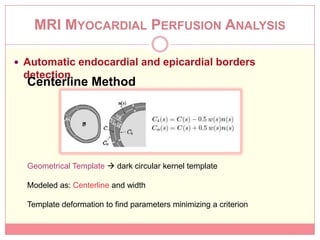
 Automatic endocardial and epicardial borders
 detection
  Centerline Method


  Geometrical Template  dark circular kernel template

  Modeled as: Centerline and width

  Template deformation to find parameters minimizing a criterion
MRI – FIRST PASS IMAGING

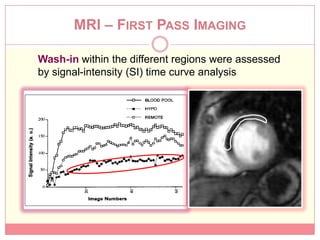
Wash-in within the different regions were assessed
by signal-intensity (SI) time curve analysis
MRI – DELAY ENHANCED IMAGING

 Quantitative
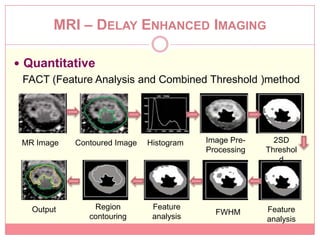
  FACT (Feature Analysis and Combined Threshold )method


 MR Image   Contoured Image   Histogram   Image Pre-     2SD
                                          Processing   Threshol
                                                          d


   Output       Region         Feature                 Feature
                                            FWHM
               contouring      analysis                analysis
MRI – DELAY ENHANCED IMAGING

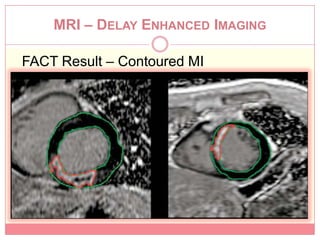
FACT Result – Contoured MI
MRI – DELAY ENHANCED IMAGING

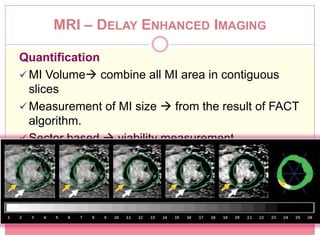
Quantification
 MI Volume combine all MI area in contiguous
  slices
 Measurement of MI size  from the result of FACT
  algorithm.
 Sector based  viability measurement
MRI – DELAY ENHANCED IMAGING


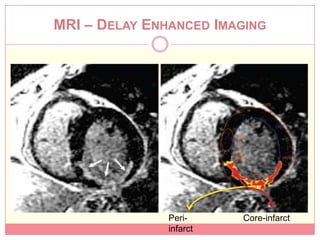
               Peri-     Core-infarct
               infarct
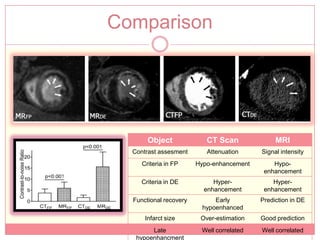
Comparison


       Object              CT Scan              MRI
  Contrast assesment       Attenuation     Signal intensity
     Criteria in FP     Hypo-enhancement       Hypo-
                                            enhancement
     Criteria in DE          Hyper-            Hyper-
                          enhancement       enhancement
  Functional recovery        Early         Prediction in DE
                         hypoenhanced
      Infarct size       Over-estimation   Good prediction
        Late             Well correlated   Well correlated
   hypoenhancment
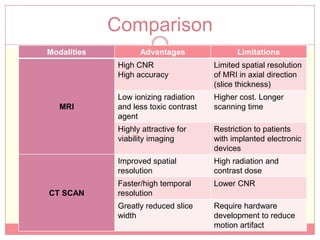
Comparison
Modalities          Advantages                Limitations
              High CNR                  Limited spatial resolution
              High accuracy             of MRI in axial direction
                                        (slice thickness)
              Low ionizing radiation    Higher cost. Longer
   MRI        and less toxic contrast   scanning time
              agent
              Highly attractive for     Restriction to patients
              viability imaging         with implanted electronic
                                        devices
              Improved spatial          High radiation and
              resolution                contrast dose
              Faster/high temporal      Lower CNR
CT SCAN       resolution
              Greatly reduced slice     Require hardware
              width                     development to reduce
                                        motion artifact
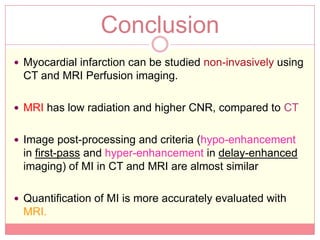
Conclusion
 Myocardial infarction can be studied non-invasively using
 CT and MRI Perfusion imaging.

 MRI has low radiation and higher CNR, compared to CT


 Image post-processing and criteria (hypo-enhancement
 in first-pass and hyper-enhancement in delay-enhanced
 imaging) of MI in CT and MRI are almost similar

 Quantification of MI is more accurately evaluated with
 MRI.
THANK YOU…
References
   http://www.medicinenet.com/heart_attack
   http://www.nhlbi.nih.gov/health/dci/Diseases/HeartAttack /HeartAttack_WhatIs.html

 A.C. Lardo, A.S. Cordeiro, et.al. Contrast-Enhanced Multidetector
    Computed Tomography Viability Imaging After Myocardial Infarction
    Characterization of Myocyte Death, Microvascular Obstruction, and
    Chronic Scar. 2006. AHA Journal Circulation, Dallas.113:394-404
   Richard T. George, et.al. Multidetector Computed Tomography Myocardial
    Perfusion Imaging During Adenosine Stress. 2006. Journal of the American
    College of Cardiology. Vol. 48, No. 1.
   C.Valdiviezo, M.Ambrose, et al. Review: Quantitative and qualitative
    analysis and interpretation of CT perfusion imaging. 2007. Journal of
    Nuclear Cardiology. Volume 17, Number 6;1091–100.
   K. Nieman, M.D. Shapiro, et al. Reperfused Myocardial Infarction:
    Contrast-enhanced 64-Section CT in Comparison to MR Imaging.2008.
    Radiology: Volume 247: Number 1—April.
   P.Hunold, T.Schlosser. Myocardial Late Enhancement in Contrast-
    Enhanced Cardiac MRI: Distinction Between Infarction Scar and Non–
    Infarction-Related Disease. AJR 2005;184:1420–1426
   B. L. Gerber, B.Belge, et al. Characterization of Acute and Chronic
    Myocardial Infarcts by Multidetector Computed Tomography Comparison
    With Contrast-Enhanced Magnetic Resonance. 2006. AHA Circulation
    113;823-833
References

•   W.Ksai, K.M. Holohan. Myocardial Perfusion Imaging from Echocardiography to
    SPECT, PET, CT, and MRI—Recent Advances and Applications. US
    Cardiology. Touch Briefings, 2010.
   A.T. Yan, A. J. Shayne, Characterization of the Peri-Infarct Zone by Contrast-
    Enhanced Cardiac Magnetic Resonance Imaging Is a Powerful Predictor of
    Post–Myocardial Infarction Mortality. 2006. AHA Circulation 114;32-39.
   A.Schmidt, M.F Azevedo, et al. Infarct Tissue Heterogeneity by Magnetic
    Resonance Imaging Identifies Enhanced Cardiac Arrhythmia Susceptibility in
    Patients With Left Ventricular Dysfunction. 2007. AHA Circulation.115;2006-
    2014.
   Glenn S. Slavin, et al. First-Pass Myocardial Perfusion MR Imagingwith
    Interleaved Notched Saturation: Feasibility Study. Radiology, April 2001.
    Vol.219: pp.259 – 263.
   Li-Yueh Hsu, et al. Quantitative Myocardial Infarction on Delayed Enhancement
    MRI. Part I: Animal Validation of an Automated Feature Analysis and Combined
    Thresholding Infarct Sizing Algorithm. 2006. JOURNAL OF MAGNETIC
    RESONANCE IMAGING 23:298–308.
   Li-Yueh Hsu, et al. Quantitative Myocardial Infarction on Delayed Enhancement

Myocardial Infraction diagnosis using CT-Scan & MRI

  • 1.
    Literature Review ofImage Processing Methods for Myocardial Infarction Studies in MRI and CT-Scan By: Vanya Vabrina V Rui Hua VIBOT 4 2 0 11
  • 2.
    What is MyocardialInfarction (MI)? Heart attack Need immediate treatment
  • 3.
    Type of Diagnosis SPECT limitation: Expensive Dose heavy + ionizing radiation Artifact prone Poor spatial resolution  Coronary Angiography limitation: Invasive method!
  • 4.
    Non-Invasive Solutions: CT-Scan andMRI Perfusion Imaging MI  limited flow
  • 5.
    Cardiac CT Multi-Detector ComputedTomography (MDCT) o High-resolution 3D of the moving heart and study the coronary vessels o Cover volumes of anatomy within a single breath-hold o Improved spatial resolution o Improved temporal resolution
  • 6.
    Cardiac MRI Fast MRISequence  Gradient Echo Many application in clinical Cardiac MRI:  Cardiac function: Cine – MRI  Perfusion SSFP  Bright blood Breath-hold Inversion recovery pre-pulse
  • 7.
    CT – PerfusionImaging Pharmacologic  Stress agent : Adenosine  Contrast agent : Iodine based (e.g, Visipaque) [concentration ~ x-ray absorbtion]  Signal-density-time curve ~ CT attenuation over time
  • 8.
    MR-Perfusion Imaging Pharmacologic  Stressagent : Adenosine  Contrast agent: Gadolinium (Gd)  Signal intensity-time curve ~ contrast agent
  • 9.
    Criteria of MI– CT  First-Pass  Hypo enhancement
  • 10.
    Criteria of MI– MRI  First Pass Imaging (FP) Examines myocardial tissue perfusion (wash in) MI criteria: slow wash in Hypo-enhancement
  • 11.
    Criteria of MI– MRI  Delay enhancement Imaging (DE) Examine the kinetics of contrast agent elimination (wash out) MI criteria: slow wash out Transmural MI Sub-endocardial MI Hyper-enhancement
  • 12.
  • 13.
    Image Post-Processing …of MI Diagnosis in CT Scan and MRI Perfusion Imaging
  • 14.
  • 15.
    CT – SemiQuantitative TAC (Time Attenuation Curve) Up slope analysis First pass imaging  upslope analysis can provide semi quantitative measure for myocardial perfusion
  • 16.
    CT – SemiQuantitative MI region myocardium with 1 SD below the mean of the remote region Clustering algorithm Result – MI : hypo-perfused  blue area 17-segment polar plot of MDCT-derived myocardial signal densities
  • 17.
    CT –Visual Analysis 17 segment model Scored - the absence/presence of a perfusion defect Graded - reversibility
  • 18.
  • 19.
    MRI MYOCARDIAL PERFUSIONANALYSIS  Qualitative Visual assessment
  • 20.
    MRI MYOCARDIAL PERFUSIONANALYSIS  Automatic endocardial and epicardial borders detection Snake Contour Thickness Epicardial contour Endocardial contour Endocardial delineation: Gradient Vector Flow (GVF) snake algorithm on an edge map Epicardial delineation:
  • 21.
    MRI MYOCARDIAL PERFUSIONANALYSIS  Automatic endocardial and epicardial borders detection Centerline Method Geometrical Template  dark circular kernel template Modeled as: Centerline and width Template deformation to find parameters minimizing a criterion
  • 22.
    MRI – FIRSTPASS IMAGING Wash-in within the different regions were assessed by signal-intensity (SI) time curve analysis
  • 23.
    MRI – DELAYENHANCED IMAGING  Quantitative FACT (Feature Analysis and Combined Threshold )method MR Image Contoured Image Histogram Image Pre- 2SD Processing Threshol d Output Region Feature Feature FWHM contouring analysis analysis
  • 24.
    MRI – DELAYENHANCED IMAGING FACT Result – Contoured MI
  • 25.
    MRI – DELAYENHANCED IMAGING Quantification  MI Volume combine all MI area in contiguous slices  Measurement of MI size  from the result of FACT algorithm.  Sector based  viability measurement
  • 26.
    MRI – DELAYENHANCED IMAGING Peri- Core-infarct infarct
  • 27.
    Comparison Object CT Scan MRI Contrast assesment Attenuation Signal intensity Criteria in FP Hypo-enhancement Hypo- enhancement Criteria in DE Hyper- Hyper- enhancement enhancement Functional recovery Early Prediction in DE hypoenhanced Infarct size Over-estimation Good prediction Late Well correlated Well correlated hypoenhancment
  • 28.
    Comparison Modalities Advantages Limitations High CNR Limited spatial resolution High accuracy of MRI in axial direction (slice thickness) Low ionizing radiation Higher cost. Longer MRI and less toxic contrast scanning time agent Highly attractive for Restriction to patients viability imaging with implanted electronic devices Improved spatial High radiation and resolution contrast dose Faster/high temporal Lower CNR CT SCAN resolution Greatly reduced slice Require hardware width development to reduce motion artifact
  • 29.
    Conclusion  Myocardial infarctioncan be studied non-invasively using CT and MRI Perfusion imaging.  MRI has low radiation and higher CNR, compared to CT  Image post-processing and criteria (hypo-enhancement in first-pass and hyper-enhancement in delay-enhanced imaging) of MI in CT and MRI are almost similar  Quantification of MI is more accurately evaluated with MRI.
  • 30.
  • 31.
    References  http://www.medicinenet.com/heart_attack  http://www.nhlbi.nih.gov/health/dci/Diseases/HeartAttack /HeartAttack_WhatIs.html  A.C. Lardo, A.S. Cordeiro, et.al. Contrast-Enhanced Multidetector Computed Tomography Viability Imaging After Myocardial Infarction Characterization of Myocyte Death, Microvascular Obstruction, and Chronic Scar. 2006. AHA Journal Circulation, Dallas.113:394-404  Richard T. George, et.al. Multidetector Computed Tomography Myocardial Perfusion Imaging During Adenosine Stress. 2006. Journal of the American College of Cardiology. Vol. 48, No. 1.  C.Valdiviezo, M.Ambrose, et al. Review: Quantitative and qualitative analysis and interpretation of CT perfusion imaging. 2007. Journal of Nuclear Cardiology. Volume 17, Number 6;1091–100.  K. Nieman, M.D. Shapiro, et al. Reperfused Myocardial Infarction: Contrast-enhanced 64-Section CT in Comparison to MR Imaging.2008. Radiology: Volume 247: Number 1—April.  P.Hunold, T.Schlosser. Myocardial Late Enhancement in Contrast- Enhanced Cardiac MRI: Distinction Between Infarction Scar and Non– Infarction-Related Disease. AJR 2005;184:1420–1426  B. L. Gerber, B.Belge, et al. Characterization of Acute and Chronic Myocardial Infarcts by Multidetector Computed Tomography Comparison With Contrast-Enhanced Magnetic Resonance. 2006. AHA Circulation 113;823-833
  • 32.
    References • W.Ksai, K.M. Holohan. Myocardial Perfusion Imaging from Echocardiography to SPECT, PET, CT, and MRI—Recent Advances and Applications. US Cardiology. Touch Briefings, 2010.  A.T. Yan, A. J. Shayne, Characterization of the Peri-Infarct Zone by Contrast- Enhanced Cardiac Magnetic Resonance Imaging Is a Powerful Predictor of Post–Myocardial Infarction Mortality. 2006. AHA Circulation 114;32-39.  A.Schmidt, M.F Azevedo, et al. Infarct Tissue Heterogeneity by Magnetic Resonance Imaging Identifies Enhanced Cardiac Arrhythmia Susceptibility in Patients With Left Ventricular Dysfunction. 2007. AHA Circulation.115;2006- 2014.  Glenn S. Slavin, et al. First-Pass Myocardial Perfusion MR Imagingwith Interleaved Notched Saturation: Feasibility Study. Radiology, April 2001. Vol.219: pp.259 – 263.  Li-Yueh Hsu, et al. Quantitative Myocardial Infarction on Delayed Enhancement MRI. Part I: Animal Validation of an Automated Feature Analysis and Combined Thresholding Infarct Sizing Algorithm. 2006. JOURNAL OF MAGNETIC RESONANCE IMAGING 23:298–308.  Li-Yueh Hsu, et al. Quantitative Myocardial Infarction on Delayed Enhancement

Editor's Notes

  • #3 Myocardial Infarction terms came from “myocardium” means the heart muscle which dead because of “infarction” – orthe blocking of the coronary arteries. Coronary arteries supply the heart muscle with blood and oxygen. But, if there is a blockage there is no supplies and leads to injury and chest pain, which is a common symptom of a heart attack. As we know, heart attack is a major cause of sudden death if there is no immediate treatment.
  • #4 The diagnosis of MI including laboratory studies, ECG analysis and imaging procedure. For imaging procedure,nuclear imaging is usually used as current reference standard, but they have limitations. They are expensive, more exposure to ionizing radiation, have more attenuation artifacts, and poor spatial resolution.The other common technique for MI detection is cardiac angiography, but it requires the catheterization.Unfortunately, it is an invasive method which may risk the patient more.
  • #5 Therefore, non-invasive imaging solution are MRI and CT scan, by perfusion imaging.It may be powerful method since myocardial infarctions (MIs) are associated with limited flow Next, we will talk about these modalities and the post-processing for this diagonis…
  • #6 Cardiac CT is mostly applied by multidetectorcomputedtomography (MDCT). With multi-slice scanning, it can achieve..Because it is fast, it can cover ….Spatial:thinner slice widthsTemporal: faster scanning is benefit for cardiac imaging.
  • #7 requires a fast MRI sequence such the GRE sequences. Cine MRI: which is useful to evaluate ourcardiac cycle and functionPerfusion is useful for myocardium study…Using bright blood” sequences with Steady-state free precession (SSFP) gradient echo sequences.and IR prepulseto optimize visualization
  • #8 Why we need stress agent for perfusion imaging?At stress there is an increase the blood flow… adenosine is the most common material used.Whereas iodine based contrast agent such as Visipaque is used as a tracer in CT perfusion imaging.concentration of Contrast agents is proportional to the absorption of x-raysThe signal-density-time curve cab be constructed by measuring the change in CT attenuation over time Vasodilator-induced tachycardia (adenosine) can increase heart rate and create motion artifact
  • #9 For Pharmacologic.. Stress agent is the same, but for contrast agent..Gd is an alternative for people who are allergic to the dyes used in CT scanningGdis a paramagneticcontrastthatcan more enhance the signal on T1-weighted images,leads to an increase of the blood pool and myocardial signal intensities the relation between contrast agent and signal intensity in the curve is propotional…
  • #10 This image shows the CT Perfusion on first pass imaging, which isperformed immediately after contrast agent injection.The criteria of myocardial infarct is hypo enhance, means there is perfusion defect and it has lower attenuation
  • #11 For FP, it examines the wash in from the intensity time curve.. The criteria of Mi has slow wash in caused by reduced perfusion, and it appears as hypoenhancement.
  • #12 Delayed images are acquired within 15-20 minutes after contrast injectionIt examines the wash out…Criteria of MI is it has slow wash out sothat thecontrast agent willaccumulate, cause a hyper-enhancement in the signal.Othercriteria of MI based on itsextent in DE are a transmuralinfarct.. Sub-endocardial..Or mid-myocardial.. Sub-epicardial
  • #13 A common technique during DE imagingisusing the Inversion recovery. For DE images, Phase Sensitive Inversion Recovery (PSIR) cangive a constant contrast compared to these standard and magnitude images, which are influenced by choice of optimal TI.
  • #16 myocardial perfusion can be evaluated from the signal enhancement Time Attenuation Curve (TAC).In first-pass imaging, upslope analyses is used for semi-quantitative method. The upslope can be calculated by applying a linear fit from this wash in from TACHere, if we observe the curve… myocardium infarction is indicated by the low value of upslope, compared to the remote area and left ventricular.
  • #17 After that, the MI region is defined as myocardium having an signal density one standard deviation below the mean signal density of the remote region.The MI region is determined by clustering algorithm. It generates clusters of voxels that meet the MI definition and yields the myocardial infarct size as the largest cluster detected. And the signal densities of myocardium is plotted in17-segment polar model. Lower signal or hypo-perfused corresponds to MI regions, which is indicated in blue.
  • #18 Thissemi-quantitative result can be used for visual evaluation of CT perfusion images In this visualization, myocardium can be examined and scored for perfusion deficits using a standard myocardial 17-segment model.Scored based on the absence or presence of a perfusion defect They graded reversibility from 0 to 3 as no reversibility, minimal, partial, or complete, respectively.
  • #20 MI in cardiac perfusion MRI can be analysed during first-pass (FP) and delay-contrast enhancement (DE), using qualitative, semi-quantitative and quantitative method.For qualitative method, perfusion abnormalities are visually assessed.
  • #21 For semi-quantitative and quantitative methods, first they require the segmentation of endocardial and epicardial contours on every slice in short axis. The borders can be manually segmented or automatic.. Snake contour is one of the automatic method. It search for the minimum energy as the optimal contour.To detect epicardial contour, a gradient profile is computed and the center of the cavity is detected. This center distances is used to draw a horizontal half line toward the right ventrical through ventricular septum to approximate the myocardial thickness
  • #22 Using geometrical template, the borders are modeled withC(s) = (x(s), y(s)) and variable width w(s), which are continous interpolations of a samples at each node. Ci is endocardial and Co is epicardial..After that, they apply template deformation to find parameters minimizing a criterion
  • #23 In this curve, we can see that healthy myocardium has fast wash-in or high slope. Whereas MI has a lack of perfusion which indicates by a slow uptake. Using this information, region of infarct can be classified as shown in this figure. Basically, image processing and analysis methods in FP MRI is almost similar with FP in MDCT.
  • #24 An important step in myocardial infarction of MRI diagnosis is to quantify the volume size of infarct. In order to do that, FACT method is introduced. Instead of using only a simple intensity thresholding, features analysis is applied:initial input for FACT algorithm is the set of myocardial regions or contoured imageThen, a bi-modal histogram is obtained  normal is in lower area, MI is in this region, so the initial threshold can be setIn pre-processingmedian filtering and histogram clustering were used And threshold again using 2SD above the meanFeature analysis is done to remove false positive areas. Set the middle intensity of FWHM to reduce the overestimation.Then, feature analysis was repeated again to effectively remove false positive.. and it also includes the dark pixels inside the infarct area or the microvascular obstructionThen, region contouring is performed And this is the output..
  • #26 into a single volumetric measurement. .. measurement of global size are determined directly by the result of FACT algorithm. While, the sector based regional assessment is used for viability measures.And it can provide the grade for transmural extent for each sector. The white area here show the MI detected by human and computer.Several factors can lead to errors in quantifying infarct size, such as partial volume errors, imperfect myocardial segmentation, intensity thresholds, andthe inclusion of the peri-infarction zone, which is the intermediate pixel intensities near the infarct borders
  • #27 So, they try to quantify the peri-infarct zone First the Total MI mass is defined as signal-intensity at threshold of >2 SD remote myocardial region Then this total MI mass is partitioned to be:Core infarct mass  signal-intensity thresholds of >3 SDs) Infarct Periphery mass  2 - 3 SDs above the remote segment
  • #28 From this graph we can see that CNR for first-pass MR (MRFP) is comparable with first-pass CT (CTFP). While for the delay-enhanced, CNR in MR (MRDE) is significantly better than CT (CTDE). This is shown cleary in the image, DE in CT cannot give a good quality…From this table, criteria of FP, DE and non reflow phenomena gives an agreement between MRI and CT.But, MRI is precise in infarct size quantification…This is due to the non-assessable and many streak artifact speculated to be caused by attenuation of the x-ray through the liver in CTDE
  • #29 MDCT only need single breath hold
  • #30 Such as the size quantification and reversibility