
object tracking:a surveyNhat ‘Rich’ NguyenVision SeminarFebruary 2010Based on a paper by Yilmaz et al
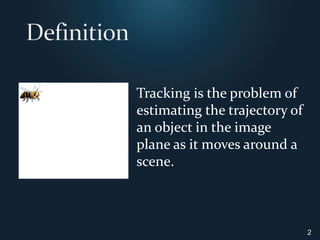
Definition2Tracking is the problem of estimatingthe trajectory of an object in the image plane as it moves around a scene.
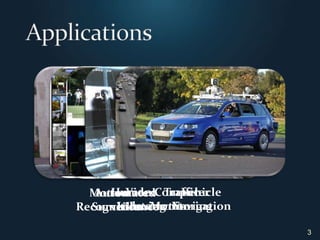
Applications3Motion RecognitionAutomated SurveillanceVideo IndexingHuman Computer InteractionTraffic MonitoringVehicleNavigation
ProblemsProjectionNoisesComplex shapeComplex motionNon-rigid OcclusionsLightingReal-time4
QuestionsWhich object representation is suitable?Which image features should be used?How should motion, appearance of the object be modeled?5Help you to design an object tracking system
OverviewObject RepresentationsFeatures SelectionObject DetectionObject TrackingFuture Direction6
1. Object Representation7[How to represent an object for tracking]
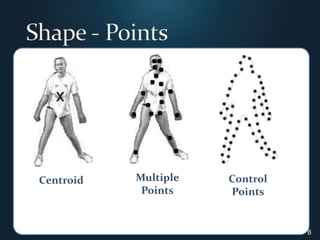
8Shape - PointsCentroidMultiple PointsControl Points
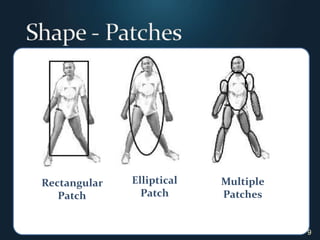
9Shape - PatchesRectangular PatchEllipticalPatchMultiple Patches
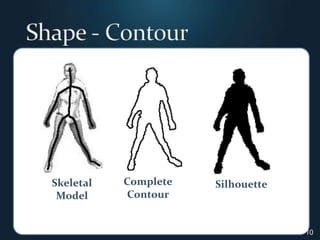
10Shape - ContourCompleteContourSkeletal ModelSilhouette
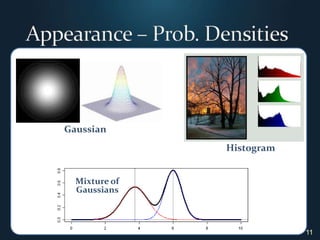
11Appearance – Prob. DensitiesGaussianHistogramMixture of Gaussians
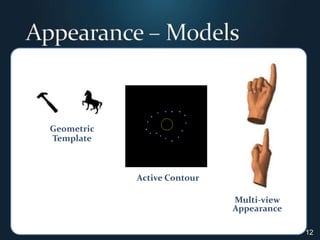
12Appearance – ModelsGeometric TemplateActive ContourMulti-view Appearance
2. Feature Selection13[Which feature can be easily distinguished?]
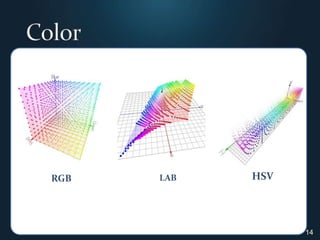
14ColorHSVRGBLAB
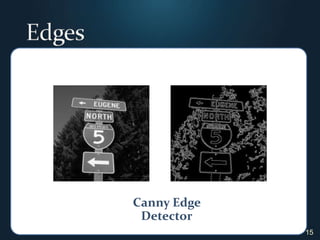
15EdgesCanny Edge Detector
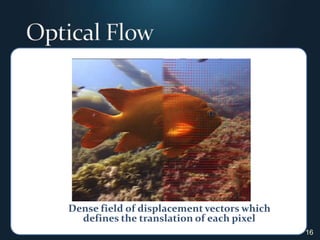
16Optical FlowDense field of displacement vectors which defines the translation of each pixel
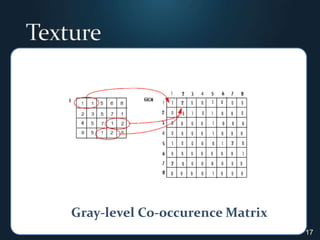
17TextureGray-level Co-occurence Matrix
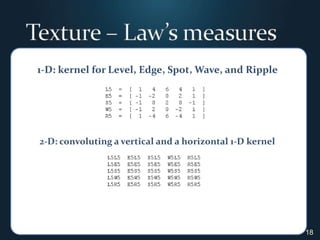
18Texture – Law’s measures1-D: kernel for Level, Edge, Spot, Wave, and Ripple2-D: convoluting a vertical and a horizontal 1-D kernel
3. Object Detection19[To track, we first detect.]
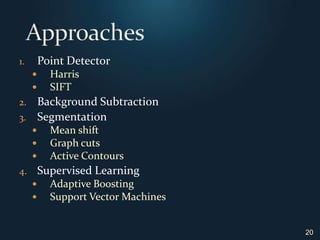
20ApproachesPoint DetectorHarris SIFTBackground SubtractionSegmentationMean shiftGraph cutsActive ContoursSupervised LearningAdaptive BoostingSupport Vector Machines
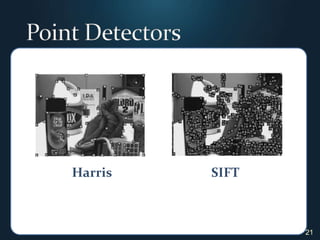
21Point DetectorsHarrisSIFT
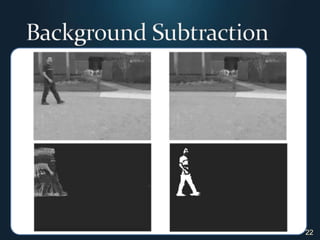
22Background Subtraction
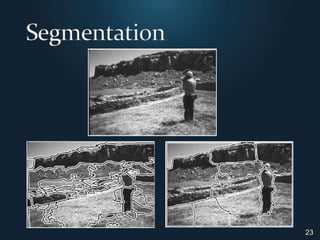
23Segmentation
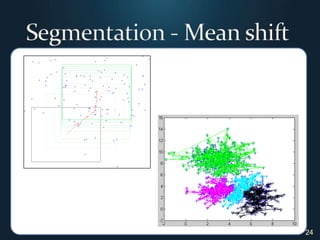
24Segmentation - Mean shift
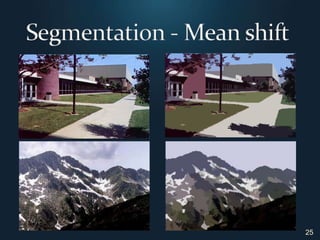
25Segmentation - Mean shift
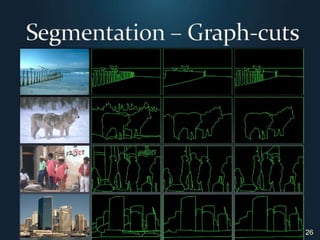
26Segmentation – Graph-cuts
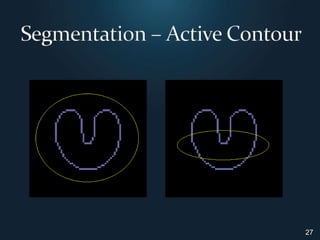
27Segmentation – Active Contour
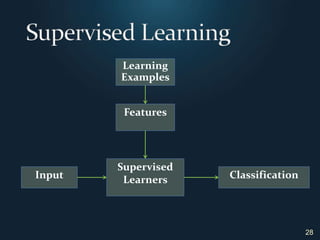
28Supervised LearningLearningExamplesFeaturesSupervised LearnersInputClassification
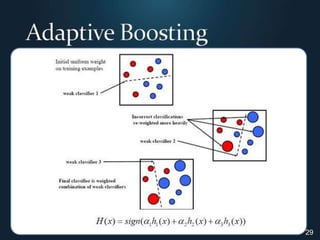
29Adaptive Boosting
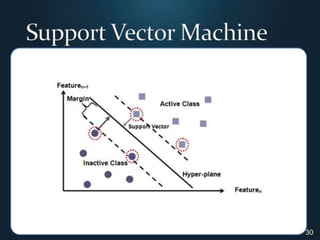
30Support Vector Machine
4. Object Tracking31[State-of-the-art methods.]
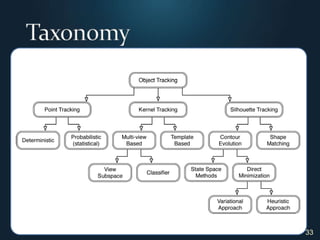
32ApproachesPoint Tracking[Multi-point Correspondence] Kernel Tracking[Parametric Transformation] Silhouette Tracking[Contour Evolution]
33Taxonomy
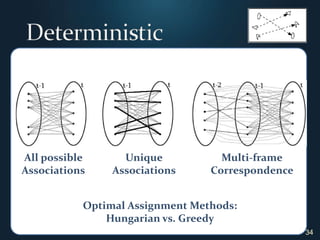
34DeterministicAll possible AssociationsUniqueAssociationsMulti-frameCorrespondenceOptimal Assignment Methods:Hungarian vs. Greedy
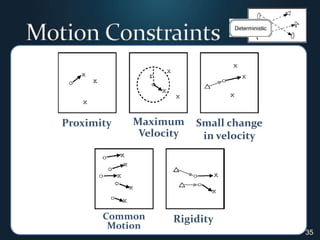
35Motion ConstraintsProximitySmall changein velocityMaximumVelocityCommonMotionRigidity
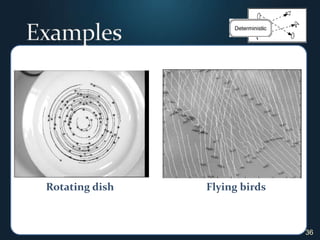
36ExamplesRotating dishFlying birds
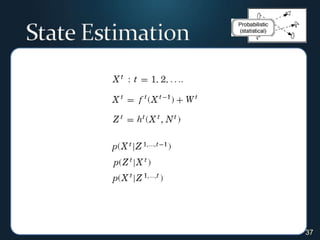
37State Estimation
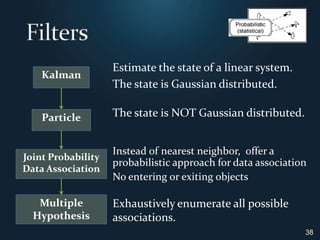
Estimate the state of a linear system.The state is Gaussian distributed.Filters38KalmanThe state is NOT Gaussian distributed.ParticleInstead of nearest neighbor, offer a probabilistic approach for data associationNo entering or exiting objectsJoint ProbabilityData AssociationMultiple HypothesisExhaustively enumerate all possible associations.
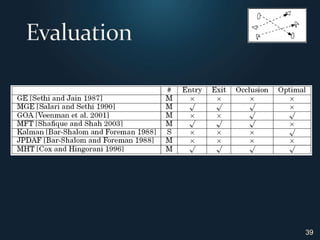
39Evaluation
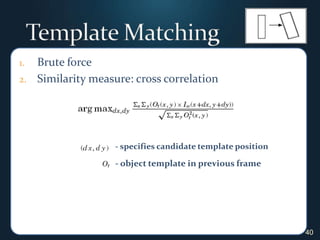
40Template MatchingBrute forceSimilarity measure: cross correlation- specifies candidate template position- object template in previous frame
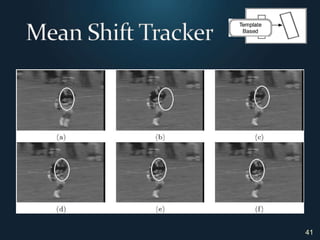
41Mean Shift Tracker
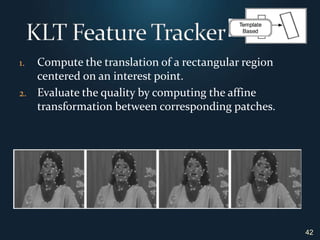
42KLT Feature TrackerCompute the translation of a rectangular region centered on an interest point.Evaluate the quality by computing the affine transformation between corresponding patches.
43Eigen TrackerSubspace-based approach for multi-view appearance.Uses eigenspace for similarity instead of SSD, or correlation.Allows distortion in the template.
44SVM TrackerPositive samples consist of images of the object to be tracked.Negative samples consist of images of background object.Maximizes the  SVM classification score over image region to estimate the object position.Knowledge about background object is explicitly incorporated in the tracker.
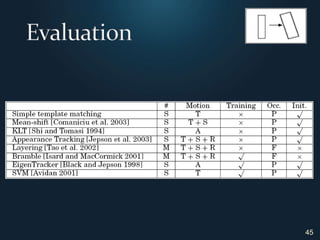
45Evaluation
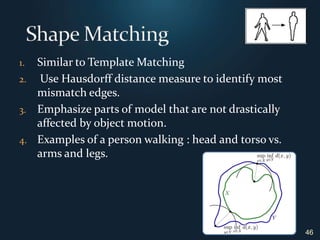
46Shape MatchingSimilar to Template MatchingUse Hausdorff distance measure to identify most mismatch edges.Emphasize parts of model that are not drastically affected by object motion.Examples of a person walking : head and torso vs. arms and legs.
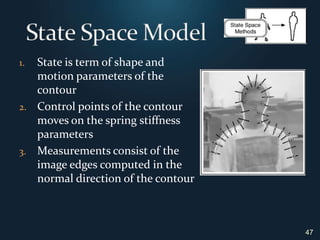
47State Space ModelState is term of shape and motion parameters of the  contourControl points of the contour moves on the spring stiffness parametersMeasurements consist of the image edges computed in the normal direction of the contour
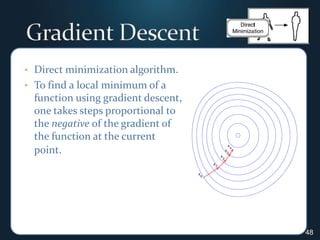
48Gradient DescentDirect minimization algorithm.
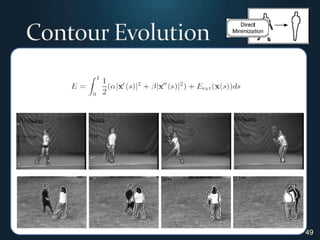
To find a local minimum of a function using gradient descent, one takes steps proportional to the negative of the gradient of the function at the current point.rms and legs.49Contour Evolution
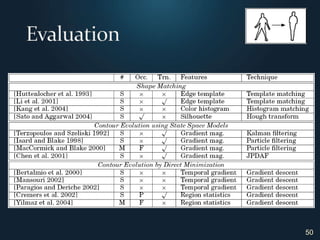
50Evaluation
5. Future Direction51[What’s left for us?]
Depth informationOcclusion ResolutionMoving camerasNon-overlapping viewMultiple Camera Tracking52
Broadcast news or home videos.Noisy, compressed, unstructured, multiple views.Severe occlusion, object partially visible.Employ audio in addition to video.Unconstrained Videos53
Ability to learn object model online.Unsupervised learning of object models for multiple non-rigid moving object from a single camera.Efficient Online Estimation54
Require detection at some point.State-of-the-art tracking methods.Point correspondenceGeometric modelsContour evolutionDependency on context of use.Give valuable insight and encourage new research.Concluding Remarks55

Object tracking survey