International Journal of Modern Engineering Research (IJMER)
                www.ijmer.com              Vol.2, Issue 4, July-Aug 2012 pp-1872-1874        ISSN: 2249-6645

    Shape Recognition Based On Features Matching Using Morphological
                               Operations
                                    Shikha Garg1, Gianetan Singh Sekhon2
            1
             (Student, M.Tech Department of Computer Engineering, YCOE, Punjabi University, Patiala, India)
      2
       (Assistant Professor, M.Tech Department of Computer Engineering, YCOE, Punjabi University, Patiala, India)


Abstract: This paper presents the implementation of               real time and practical applications. In this paper we
method of shape recognition among different regular               consider just the boundary based technique.
geometrical shapes using morphological operations. Many                     In the previous work of shape recognition, object
algorithms have been proposed for this problem but the            detection approaches based on color/texture segmentation or
major issue that has been enlightened in this paper is over       image binarization and foreground extraction is proposed,
segmentation dodging among different objects. After an            which can be used in this case. Other shape detection
introduction to shape recognition concept, we describe the        solutions are based on edge-detection, sliding-windows or
process of extracting the boundaries of objects in order to       generalized Hough transforms. The identified image objects
avoid over segmentation. Then, a shape recognition                are then recognized by their shapes. The focus of this paper
approach is proposed. It is based on some mathematical            is shape recognition by edge detection using morphological
formulae. Our new algorithm detects the shapes in the             operations. In this paper the problem of over segmentation
following cases when (i) There are distinct objects in the        among different objects has been taken into consideration
given image. (ii) The objects are touching in the given           for shape recognition. The different objects in the given
image. (iii) The objects are overlapping in the given image.      image are processed one by one and then they are clustered
(iv)One object is contained in the other in the given image.      together to form the output image. This process is executed
Then with the help of boundaries concentrate and shape            in two stages: firstly, the image is read in from the user and
properties, classification of the shapes is done.                 objects which are touching one another are segmented.
                                                                  Then we will match the features of the current object with
Keywords:    Edge    detection,        geometrical   shapes,      the preloaded features in the database or we can say training
morphological operations, over         segmentation, Shape        set for recognition.
recognition.
                                                                             II.     Materials and methods
                    I.    Introduction                                     The computation of proposed method can be
          In an image, shape plays a significant role. Shape      briefly summarised in 2 steps (1) Avoidance of over
of an image is one of the key information when an eye             segmentation among different objects like circle, rectangle,
recognizes an object. Shape of an image does not change           square etc with the use of morphological operations (2)
when colour of image is changed. Shape recognition finds          Labelling the objects after recognition of various objects
its applications in robotics, fingerprint analysis, handwriting   within the image.
mapping, face recognition, remote sensors etc [6]. In pattern
recognition shape is one of the significant research areas.       2.1 Over segmentation avoidance
Main focus of the pattern recognition is the classification                 The proposed method is trying to prevent the over
between objects.                                                  segmentation and segment some overlapping areas to
          In a computer system, shape of an object can be         extract the boundaries of various objects within the image.
interpreted as a region encircled by an outline of the object.    For this, read the RGB image in from the user and convert
The important job in shape recognition is to find and             the RGB (coloured) image to gray scale and then to binary
represent the exact shape information. Many algorithms for        image. Invert the binary image in order to speed up the time
shape representation have been proposed so far.                   of processing. Then morphological operation is
          Many methods for 2D shape representation and            implemented so that all the objects are eroded from all the
recognition have been reported. Curvature scale space             sides and then the boundaries of small radius are enhanced
(CSS), dynamic programming, shape context, Fourier                along the edges of the objects.
descriptor, and wavelet descriptor are as the example of              se = strel('disk', 1);
these approaches [8]. There are two methods for shape                dummy1=imerode(dummy,se);
recognition, area based and boundary based technique. In
area based technique, all pixels within the region of image                 SE = strel('disk', R,) creates a flat, disk-shaped
are taken into consideration to get shape representation.         structuring element, where R specifies the radius. R must be
Common area based technique uses moment descriptors to            a nonnegative integer. Here the value of R is 1. Imerode
depict the shape. Whereas boundary based technique                performs binary erosion; otherwise it performs gray scale
focuses mainly on object boundary. Boundary based                 erosion. If SE is an array of structuring element objects,
technique represents shape feature of object more clearly as      imerode performs multiple erosions of the input image,
compared to area based technique. It is fast in processing        using each structuring element in SE in succession.
and needs less computation than area based technique. Due
to fast processing and easy computation it is widely used in

                                                    www.ijmer.com                                                1872 | P a g e
International Journal of Modern Engineering Research (IJMER)
              www.ijmer.com               Vol.2, Issue 4, July-Aug 2012 pp-1872-1874        ISSN: 2249-6645
2.2 Recognition and labelling of objects
         In this algorithm when the objects are being
segmented from each other, the final stage is to identify the
shape of the objects. This is done by using filtering                                                                                                                   obj:4
                                                                                                                                                                                                       obj:9
                                                                                                                                                                                                                  obj:12


technique. Some properties like centroid and corners of the                                                                                                                                           obj:8
                                                                                                                                                                                   obj:3
objects are needed to predict the shapes of varying objects.                                                                                                                                                     obj:11


Then with these mathematical parameters, objects of input                                                                                                       obj:2
                                                                                                                                                                         obj:5

                                                                                                                                                                                              obj:7


image are matched with the preloaded features of the                                                                                                                                                           obj:10
                                                                                                                                                                                 obj:6
objects in the database or we can say training set and thus
we can recognize the shape of the objects.
    CIRCLE                                          TRIANGLE                                           SQUARE

            Number of corners = 0                           Number of corners = 3                            Number of corners = 4
            Absolute difference b/w                         Sensitivity Factor = 0.24                        Absolute difference b/w
             length and breadth < 25                                                                            length and breadth < 10
            Sensitivity Factor = 0.24                                                                      
                                                                                                            
                                                                                                                Sensitivity Factor = 0.24
                                                                                                                                                              Fig.2 segmented objects
                     RECTANGLE                                               POLYGON

                         
                         
                              Number of corners = 4
                              Absolute difference b/w
                                                                                  
                                                                                  
                                                                                          Number of corners > 4
                                                                                          Absolute difference b/w
                                                                                                                                                     The connected components of the enhanced binary
                         
                              length and breadth > 10
                              Sensitivity Factor = 0.24                           
                                                                                          length and breadth < 10
                                                                                          Sensitivity Factor = 0.2                          image are detected, thus the image foreground, containing
                                                 Table.1 filters used to distinguish objects                                                the main objects, being extracted. The feature extraction
                                                                                                                                            process is then applied on the detected shapes. The obtained
                                                                                                                                            shapes are then classified using the presented shape
                                                                                                                                            recognition algorithm. The shape names corresponding to
                   III.    Experiments
                                                                                                                                            the image from Fig. 1 are represented in Fig. 3. As one can
          We have performed numerous experiments using
                                                                                                                                            see in that figure, each object is labelled with the name
the described shape recognition approach. The proposed
                                                                                                                                            matched          with         its        features.      The
technique has been tested on various image datasets and
                                                                                                                                            finalrecognitionresultsare,circle{obj4,obj6},square{obj8},re
satisfactory results have been obtained. A high recognition
                                                                                                                                            ctangle{obj3},triangle{obj5,obj12},polygon{obj11}.
rate, of approximately 95 %, is achieved by our method. It
represents a better rate that those of many other object
recognition approaches.
          An indexed image consists of an array and a
colormap matrix. The pixel values in the array are direct
indices into a colormap. An indexed image uses direct
mapping of pixel values to colormap values. The color of
each image pixel is determined by using the corresponding
value of X as an index. As RGB image is having an index
value of 255 therefore we set this parameter to a scalar
between 250 and 0 and in loop this scalar value go on
decrementing with a value 5.As this scalar value matches
with the index value of object ,the particular object is
identified. The image is then converted in the binary form,
then the binary image is processed using some                                                                                                            Fig.3 The resulted labelled objects
morphological operations, to eliminate the over segmented
area and retain only the important image regions.
                                                                                                                                                                IV.                        Conclusion
                                                                                                                                                      In this study, a new method of shape recognition is
                                                                                                                                            proposed which takes into account the problem of over
                                                                                                                                            segmentation. By integrating the structural features like
                                                                                                                                            distance measure and centroid, the proposed method
                                                                                                                                            extracts the structural information of shapes. Based on those
                                                                                                                                            properties, various shapes can be recognized. The
                                                                                                                                            identification of the appropriate name of shape clusters
                                                                                                                                            automatizes the classification method, which represents a
                                                                                                                                            very important thing. That means our recognition technique
                                                                                                                                            can be used successfully for very large sets of images,
                                                                                                                                            containing a high number of shapes.
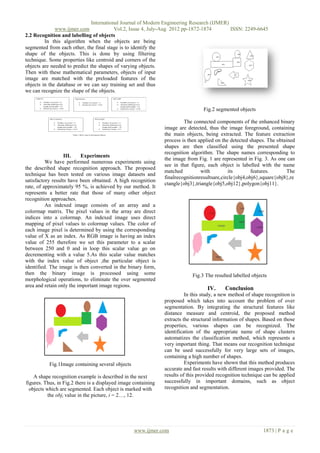
                    Fig.1Image containing several objects                                                                                             Experiments have shown that this method produces
                                                                                                                                            accurate and fast results with different images provided. The
    A shape recognition example is described in the next                                                                                    results of this provided recognition technique can be applied
figures. Thus, in Fig.2 there is a displayed image containing                                                                               successfully in important domains, such as object
  objects which are segmented. Each object is marked with                                                                                   recognition and segmentation.
           the obji value in the picture, i = 2…, 12.


                                                                                                                                 www.ijmer.com                                                                             1873 | P a g e
International Journal of Modern Engineering Research (IJMER)
             www.ijmer.com                Vol.2, Issue 4, July-Aug 2012 pp-1872-1874        ISSN: 2249-6645
                        References                                 [6]    Ehsan Moomivand, A Modified Structural Method for
[1]   S. W.Chen, S. T. Tung, and C. Y. Fang, Extended                     Shape Recognition, IEEE Symposium on Industrial
      Attributed String Matching for Shape Recognition,                   Electronics and Applications (ISIEA2011), September 25-
      COMPUTER VISION AND IMAGE UNDERSTANDING,                            28, Langkawi, Malaysia, 2011.
      Vol. 70, No. 1, April, pp. 36–50, 1998.                      [7]    Jon Almaz´an, Alicia Forn´ Third es, Ernest Valveny, A
[2]   Sajjad Baloch, Object Recognition Through Topo-                     Non-Rigid Feature Extraction Method for Shape
      Geometric Shape Models Using Error-Tolerant Subgraph                Recognition, International Conference on Document
      Isomorphism, IEEE TRANSACTIONS ON IMAGE                             Analysis and Recognition, Spain, 2011.
      PROCESSING, VOL. 19, NO. 5, 1191, 2010.                      [8]    Kosorl Thourn and Yuttana Kitjaidure, Multi-View Shape
[3]   Rong Wang, Fanliang Bu, Hua Jin, Lihua Li, TOE SHAPE                Recognition Based on Principal Component Analysis,
      RECOGNITION ALGORITHM BASED ON FUZZY                                International Conference on Advanced Computer Control
      NEURAL NETWORKS, Third International Conference                     Department of Electronics, Bangkok, 10520, 2008.
      on Natural Computation (ICNC 2007),0-7695-2875-9/07,         [9]    Sen Wang, Yang Wang, Miao Jin, Xian feng David Gu,
      © 2007.                                                             and Dimitris Samaras, Conformal Geometry and Its
[4]   Ruixia Song , Zhaoxia Zhao, Yanan Yanan Li, Qiaoxia                 Applications on 3D Shape Matching, Recognition, and
      Zhang, Xi Chen, The Method of Shape Recognition Based               Stitching, IEEE TRANSACTIONS ON PATTERN
      on V-system, Fifth International Conference on Frontier of          ANALYSIS AND MACHINE INTELLIGENCE, VOL. 29,
      Computer Science and Technology, China, 100144,2010.                NO. 7, JULY 2007.
[5]   S.Thilagamani, N.Shanthi, A Novel Recursive Clustering       [10]   REN Honge, ZHONG Qiubo, KANG Junfen, Object
      Algorithm for Image algorithm, European Journal of                  Recognition Algorithm Research Based on Variable
      Scientific Research, ISSN 1450-216X, Vol.52, No.3, 2011.            Illumination, Proceedings of the IEEE International
                                                                          Conference on Automation and Logistics Shenyang,
                                                                          150040, China, 2009.


                                                     www.ijmer.com                                                1874 | P a g e

Aj2418721874

  • 1.
    International Journal ofModern Engineering Research (IJMER) www.ijmer.com Vol.2, Issue 4, July-Aug 2012 pp-1872-1874 ISSN: 2249-6645 Shape Recognition Based On Features Matching Using Morphological Operations Shikha Garg1, Gianetan Singh Sekhon2 1 (Student, M.Tech Department of Computer Engineering, YCOE, Punjabi University, Patiala, India) 2 (Assistant Professor, M.Tech Department of Computer Engineering, YCOE, Punjabi University, Patiala, India) Abstract: This paper presents the implementation of real time and practical applications. In this paper we method of shape recognition among different regular consider just the boundary based technique. geometrical shapes using morphological operations. Many In the previous work of shape recognition, object algorithms have been proposed for this problem but the detection approaches based on color/texture segmentation or major issue that has been enlightened in this paper is over image binarization and foreground extraction is proposed, segmentation dodging among different objects. After an which can be used in this case. Other shape detection introduction to shape recognition concept, we describe the solutions are based on edge-detection, sliding-windows or process of extracting the boundaries of objects in order to generalized Hough transforms. The identified image objects avoid over segmentation. Then, a shape recognition are then recognized by their shapes. The focus of this paper approach is proposed. It is based on some mathematical is shape recognition by edge detection using morphological formulae. Our new algorithm detects the shapes in the operations. In this paper the problem of over segmentation following cases when (i) There are distinct objects in the among different objects has been taken into consideration given image. (ii) The objects are touching in the given for shape recognition. The different objects in the given image. (iii) The objects are overlapping in the given image. image are processed one by one and then they are clustered (iv)One object is contained in the other in the given image. together to form the output image. This process is executed Then with the help of boundaries concentrate and shape in two stages: firstly, the image is read in from the user and properties, classification of the shapes is done. objects which are touching one another are segmented. Then we will match the features of the current object with Keywords: Edge detection, geometrical shapes, the preloaded features in the database or we can say training morphological operations, over segmentation, Shape set for recognition. recognition. II. Materials and methods I. Introduction The computation of proposed method can be In an image, shape plays a significant role. Shape briefly summarised in 2 steps (1) Avoidance of over of an image is one of the key information when an eye segmentation among different objects like circle, rectangle, recognizes an object. Shape of an image does not change square etc with the use of morphological operations (2) when colour of image is changed. Shape recognition finds Labelling the objects after recognition of various objects its applications in robotics, fingerprint analysis, handwriting within the image. mapping, face recognition, remote sensors etc [6]. In pattern recognition shape is one of the significant research areas. 2.1 Over segmentation avoidance Main focus of the pattern recognition is the classification The proposed method is trying to prevent the over between objects. segmentation and segment some overlapping areas to In a computer system, shape of an object can be extract the boundaries of various objects within the image. interpreted as a region encircled by an outline of the object. For this, read the RGB image in from the user and convert The important job in shape recognition is to find and the RGB (coloured) image to gray scale and then to binary represent the exact shape information. Many algorithms for image. Invert the binary image in order to speed up the time shape representation have been proposed so far. of processing. Then morphological operation is Many methods for 2D shape representation and implemented so that all the objects are eroded from all the recognition have been reported. Curvature scale space sides and then the boundaries of small radius are enhanced (CSS), dynamic programming, shape context, Fourier along the edges of the objects. descriptor, and wavelet descriptor are as the example of se = strel('disk', 1); these approaches [8]. There are two methods for shape dummy1=imerode(dummy,se); recognition, area based and boundary based technique. In area based technique, all pixels within the region of image SE = strel('disk', R,) creates a flat, disk-shaped are taken into consideration to get shape representation. structuring element, where R specifies the radius. R must be Common area based technique uses moment descriptors to a nonnegative integer. Here the value of R is 1. Imerode depict the shape. Whereas boundary based technique performs binary erosion; otherwise it performs gray scale focuses mainly on object boundary. Boundary based erosion. If SE is an array of structuring element objects, technique represents shape feature of object more clearly as imerode performs multiple erosions of the input image, compared to area based technique. It is fast in processing using each structuring element in SE in succession. and needs less computation than area based technique. Due to fast processing and easy computation it is widely used in www.ijmer.com 1872 | P a g e
  • 2.
    International Journal ofModern Engineering Research (IJMER) www.ijmer.com Vol.2, Issue 4, July-Aug 2012 pp-1872-1874 ISSN: 2249-6645 2.2 Recognition and labelling of objects In this algorithm when the objects are being segmented from each other, the final stage is to identify the shape of the objects. This is done by using filtering obj:4 obj:9 obj:12 technique. Some properties like centroid and corners of the obj:8 obj:3 objects are needed to predict the shapes of varying objects. obj:11 Then with these mathematical parameters, objects of input obj:2 obj:5 obj:7 image are matched with the preloaded features of the obj:10 obj:6 objects in the database or we can say training set and thus we can recognize the shape of the objects. CIRCLE TRIANGLE SQUARE  Number of corners = 0  Number of corners = 3  Number of corners = 4  Absolute difference b/w  Sensitivity Factor = 0.24  Absolute difference b/w length and breadth < 25 length and breadth < 10  Sensitivity Factor = 0.24   Sensitivity Factor = 0.24 Fig.2 segmented objects RECTANGLE POLYGON   Number of corners = 4 Absolute difference b/w   Number of corners > 4 Absolute difference b/w The connected components of the enhanced binary  length and breadth > 10 Sensitivity Factor = 0.24  length and breadth < 10 Sensitivity Factor = 0.2 image are detected, thus the image foreground, containing Table.1 filters used to distinguish objects the main objects, being extracted. The feature extraction process is then applied on the detected shapes. The obtained shapes are then classified using the presented shape recognition algorithm. The shape names corresponding to III. Experiments the image from Fig. 1 are represented in Fig. 3. As one can We have performed numerous experiments using see in that figure, each object is labelled with the name the described shape recognition approach. The proposed matched with its features. The technique has been tested on various image datasets and finalrecognitionresultsare,circle{obj4,obj6},square{obj8},re satisfactory results have been obtained. A high recognition ctangle{obj3},triangle{obj5,obj12},polygon{obj11}. rate, of approximately 95 %, is achieved by our method. It represents a better rate that those of many other object recognition approaches. An indexed image consists of an array and a colormap matrix. The pixel values in the array are direct indices into a colormap. An indexed image uses direct mapping of pixel values to colormap values. The color of each image pixel is determined by using the corresponding value of X as an index. As RGB image is having an index value of 255 therefore we set this parameter to a scalar between 250 and 0 and in loop this scalar value go on decrementing with a value 5.As this scalar value matches with the index value of object ,the particular object is identified. The image is then converted in the binary form, then the binary image is processed using some Fig.3 The resulted labelled objects morphological operations, to eliminate the over segmented area and retain only the important image regions. IV. Conclusion In this study, a new method of shape recognition is proposed which takes into account the problem of over segmentation. By integrating the structural features like distance measure and centroid, the proposed method extracts the structural information of shapes. Based on those properties, various shapes can be recognized. The identification of the appropriate name of shape clusters automatizes the classification method, which represents a very important thing. That means our recognition technique can be used successfully for very large sets of images, containing a high number of shapes. Fig.1Image containing several objects Experiments have shown that this method produces accurate and fast results with different images provided. The A shape recognition example is described in the next results of this provided recognition technique can be applied figures. Thus, in Fig.2 there is a displayed image containing successfully in important domains, such as object objects which are segmented. Each object is marked with recognition and segmentation. the obji value in the picture, i = 2…, 12. www.ijmer.com 1873 | P a g e
  • 3.
    International Journal ofModern Engineering Research (IJMER) www.ijmer.com Vol.2, Issue 4, July-Aug 2012 pp-1872-1874 ISSN: 2249-6645 References [6] Ehsan Moomivand, A Modified Structural Method for [1] S. W.Chen, S. T. Tung, and C. Y. Fang, Extended Shape Recognition, IEEE Symposium on Industrial Attributed String Matching for Shape Recognition, Electronics and Applications (ISIEA2011), September 25- COMPUTER VISION AND IMAGE UNDERSTANDING, 28, Langkawi, Malaysia, 2011. Vol. 70, No. 1, April, pp. 36–50, 1998. [7] Jon Almaz´an, Alicia Forn´ Third es, Ernest Valveny, A [2] Sajjad Baloch, Object Recognition Through Topo- Non-Rigid Feature Extraction Method for Shape Geometric Shape Models Using Error-Tolerant Subgraph Recognition, International Conference on Document Isomorphism, IEEE TRANSACTIONS ON IMAGE Analysis and Recognition, Spain, 2011. PROCESSING, VOL. 19, NO. 5, 1191, 2010. [8] Kosorl Thourn and Yuttana Kitjaidure, Multi-View Shape [3] Rong Wang, Fanliang Bu, Hua Jin, Lihua Li, TOE SHAPE Recognition Based on Principal Component Analysis, RECOGNITION ALGORITHM BASED ON FUZZY International Conference on Advanced Computer Control NEURAL NETWORKS, Third International Conference Department of Electronics, Bangkok, 10520, 2008. on Natural Computation (ICNC 2007),0-7695-2875-9/07, [9] Sen Wang, Yang Wang, Miao Jin, Xian feng David Gu, © 2007. and Dimitris Samaras, Conformal Geometry and Its [4] Ruixia Song , Zhaoxia Zhao, Yanan Yanan Li, Qiaoxia Applications on 3D Shape Matching, Recognition, and Zhang, Xi Chen, The Method of Shape Recognition Based Stitching, IEEE TRANSACTIONS ON PATTERN on V-system, Fifth International Conference on Frontier of ANALYSIS AND MACHINE INTELLIGENCE, VOL. 29, Computer Science and Technology, China, 100144,2010. NO. 7, JULY 2007. [5] S.Thilagamani, N.Shanthi, A Novel Recursive Clustering [10] REN Honge, ZHONG Qiubo, KANG Junfen, Object Algorithm for Image algorithm, European Journal of Recognition Algorithm Research Based on Variable Scientific Research, ISSN 1450-216X, Vol.52, No.3, 2011. Illumination, Proceedings of the IEEE International Conference on Automation and Logistics Shenyang, 150040, China, 2009. www.ijmer.com 1874 | P a g e