Forcible EntryForcible Entry
Prepared by Lt. Eric Neubert
April, 2013
Sourced from Jones & Bartlett
Fundamentals of Firefighter Skills,
2nd
Edition
1
OpeningOpening
 Instructors/Students
 Exits
 Cell Phones/Radios
 Interactive
 Plan
 Companies
2
ObjectivesObjectives
 Understand the association between specific
tools and special forcible entry needs.
 Describe the basic construction of typical
doors, windows, and walls.
 Know the dangers associated with forcing entry
through doors, windows, and walls.
 Know how forcible entry relates to salvage.
3
11
IntroductionIntroduction (1 of 2)(1 of 2)
 Forcible entry
 Method to gain access when normal means of entry
cannot be used
 Requires strength, knowledge, proper techniques, and
skill
 Use amount of force appropriate to situation.
 Alarm/Nothing showing VS. working fire
4
11
IntroductionIntroduction (2 of 2)(2 of 2)
 Arrange to secure the opening before leaving scene.
 Keep up with how new styles of windows, doors, locks,
and security devices operate.
5
11
PreparationPreparation
 Your Gear
 Personal tools
 Your Truck (Engine)
 Available tools and location
 Your Tools
 In service and ready to use
 Your District
 Yourself
6
Preparation (cont)Preparation (cont)
 Your District
 Types of occupancies
 Special problems or hazards
7
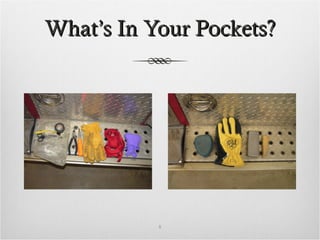
What’s In Your Pockets?What’s In Your Pockets?
8
Forcible Entry SituationsForcible Entry Situations
 Required at emergency incidents where time is a
critical factor
 Effect a rescue.
 Control a fire before it extends.
 Non Emergency situations
 Calls for a more thoughtful approach
9
11
Forcible Entry SituationsForcible Entry Situations
 Company Officer Selects
 Point of entry
 Method to use
 “Try before you pry”
10
The ProblemThe Problem
 Primarily Residential, Mercantile, Light Industrial
 Look for the easy way
 Try doors & windows
 Knox Box or hidden keys
 Neighbors
 Alternate Entry
 2nd
Floor
 Bulkhead
 Air conditioners
11
Forcible Entry ToolsForcible Entry Tools
 Fire fighters must know:
 What tools are available
 Uses and limitations of each tool
 How to select the right tool
 How to operate each tool
 How to carry each tool
 How to inspect and maintain each tool
12
11
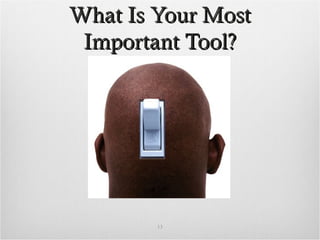
What Is Your MostWhat Is Your Most
Important Tool?Important Tool?
13
General Tool SafetyGeneral Tool Safety
 Incorrect use or improper maintenance can be
dangerous.
 Always wear proper PPE.
 Use the right tool for the job.
 Keep tools clean and serviced.
 Take broken tools out of service for repair.
 Keep tools in proper area or container.
14
11
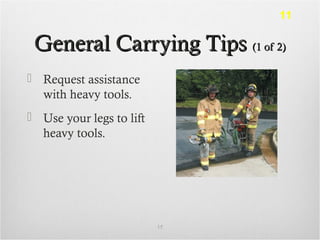
General Carrying TipsGeneral Carrying Tips (1 of 2)(1 of 2)
 Request assistance
with heavy tools.
 Use your legs to lift
heavy tools.
15
11
General Carrying TipsGeneral Carrying Tips (2 of 2)(2 of 2)
 Keep sharp edges and points away from your body.
 Cover them with a gloved hand.
 Carry long tools pointing down.
 Be aware of overhead wires.
16
11
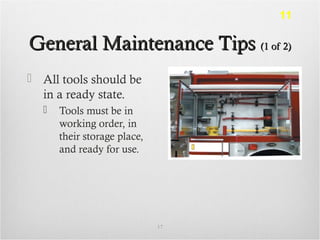
General Maintenance TipsGeneral Maintenance Tips (1 of 2)(1 of 2)
 All tools should be
in a ready state.
 Tools must be in
working order, in
their storage place,
and ready for use.
17
11
General Maintenance TipsGeneral Maintenance Tips
(2 of 2)(2 of 2)
 Tools require regular maintenance and cleaning to
ensure readiness.
 Perform required checks conscientiously.
 Follow manufacturer’s guidelines and instructions.
 Keep proper records of maintenance, repairs, and
warranty work performed.
18
11
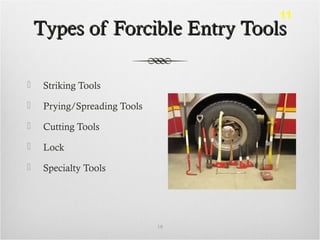
Types of Forcible Entry ToolsTypes of Forcible Entry Tools
 Striking Tools
 Prying/Spreading Tools
 Cutting Tools
 Lock
 Specialty Tools
19
11
Striking ToolsStriking Tools
 Used to generate an impact force directly on an object
or another tool
 Head usually made of hardened steel
 Flat-head axe
 TNT Tool
 Sledgehammer
20
11
Flat-Head AxeFlat-Head Axe
 One side of the axe head is a cutting blade.
 Other side is a flat striking surface.
 Fire fighters often use flat side to strike a Halligan tool
and drive a wedge into an opening.
21
11
SledgehammerSledgehammer
 Sometimes called mauls
 Come in various weights and sizes
 Head of hammer can weigh from 2 to 20 pounds.
 Handle may be short like a carpenter’s hammer or long
like an axe handle.
 Can be used alone to break down a door or with other
striking tools
22
11
Prying/Spreading ToolsPrying/Spreading Tools
 Halligan tool
 Pry bar/Crow bar/Variations
 Pry axe
 Hydraulic tools
23
11
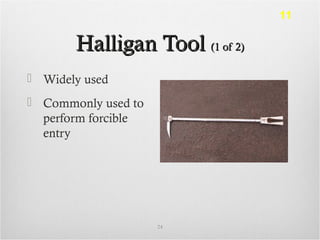
Halligan ToolHalligan Tool (1 of 2)(1 of 2)
 Widely used
 Commonly used to
perform forcible
entry
24
11
Halligan ToolHalligan Tool (2 of 2)(2 of 2)
 Incorporates adz, pick, and claw
 Adz end pries open doors and windows.
 Pick end makes holes or breaks glass.
 Claw pulls nails and pries apart wooden slats.
*Pairing with flat head axe creates The Irons
25
11
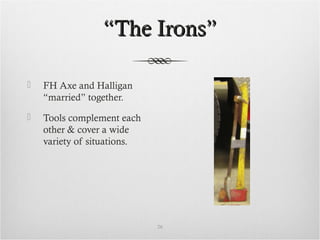
““The Irons”The Irons”
 FH Axe and Halligan
“married” together.
 Tools complement each
other & cover a wide
variety of situations.
26
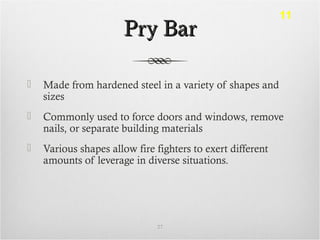
Pry BarPry Bar
 Made from hardened steel in a variety of shapes and
sizes
 Commonly used to force doors and windows, remove
nails, or separate building materials
 Various shapes allow fire fighters to exert different
amounts of leverage in diverse situations.
27
11
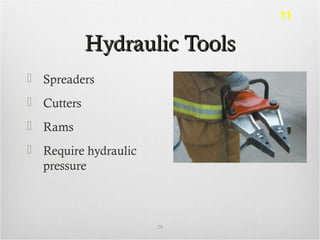
Hydraulic ToolsHydraulic Tools
 Spreaders
 Cutters
 Rams
 Require hydraulic
pressure
28
11
Cutting ToolsCutting Tools
 Primarily used for cutting doors, roofs, walls, and
floors
 Hand operated and power cutting tools
 Axe
 Bolt cutters
 Circular saw
 Bullet/Chain Saw
29
11
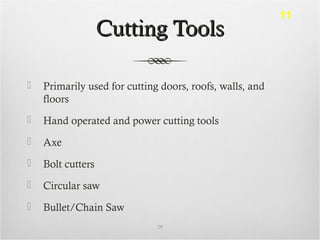
AxeAxe (1 of 2)(1 of 2)
 Many different types
of axes
 Flathead
 Pickhead
 Pry axe
 Special purpose
30
11
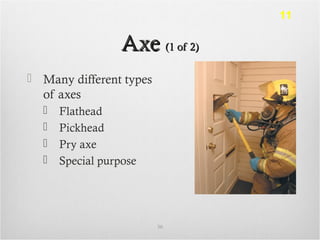
AxeAxe (2 of 2)(2 of 2)
 Cutting edge of axe used to break into plaster and
wood walls, roofs, and doors
 Pick used for opening walls, floors, etc.
 Flat portion for striking other tools
31
11
Bolt CuttersBolt Cutters
 Used to cut metal components as bolts, padlocks,
chains, and chain-link fences
 Available in several different sizes
 The longer the handle, the greater the cutting force.
 May not be able to cut into some heavy-duty padlocks
made of case-hardened metal
32
11
Circular SawCircular Saw
 Gasoline-powered
 Light, powerful, and easy-to-use
 Blades can be changed quickly.
 Carbide-tipped blades
 Metal-cutting blades
 Masonry-cutting blades
33
11
Bullet SawBullet Saw
 Gas Powered Chain Saw
 Depth Gauge
 Carbide tipped bullet chain
 Able to cut through multiple layers of roofing, boards,
nails, light gauge metal
 “Roll” over rafters/floor joists
34
Lock/Specialty ToolsLock/Specialty Tools (1 of 2)(1 of 2)
 Used to disassemble the locking mechanism on a door
 Cause minimal damage to the door and the door frame
 Experienced user can usually gain entry in less than a
minute.
35
11
Lock/Specialty ToolsLock/Specialty Tools (2 of 2)(2 of 2)
 K tool
 Lock wrenches
 Halligan (pick)
 Credit Card
 Pocket Knife
 Hood Latch Tool
36
11
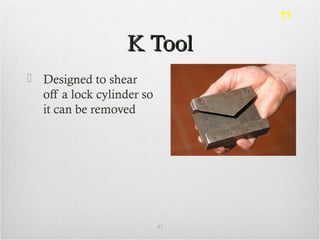
K ToolK Tool
 Designed to shear
off a lock cylinder so
it can be removed
37
11
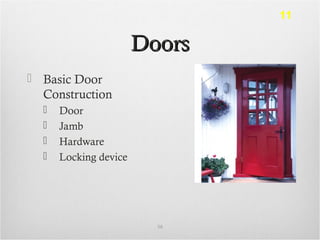
DoorsDoors
 Basic Door
Construction
 Door
 Jamb
 Hardware
 Locking device
38
11
Construction MaterialConstruction Material
 Wood
 Metal
 Fiberglass/Composite
 Glass
39
11
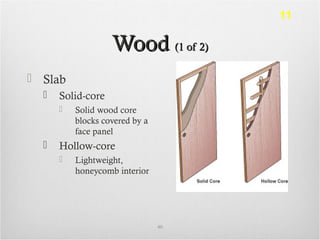
WoodWood (1 of 2)(1 of 2)
 Slab
 Solid-core
 Solid wood core
blocks covered by a
face panel
 Hollow-core
 Lightweight,
honeycomb interior
40
11
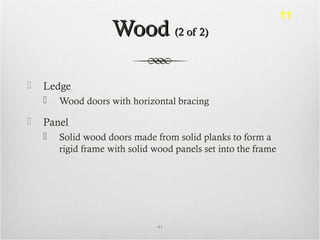
WoodWood (2 of 2)(2 of 2)
 Ledge
 Wood doors with horizontal bracing
 Panel
 Solid wood doors made from solid planks to form a
rigid frame with solid wood panels set into the frame
41
11
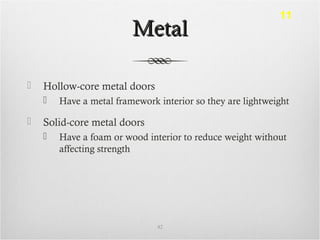
MetalMetal
 Hollow-core metal doors
 Have a metal framework interior so they are lightweight
 Solid-core metal doors
 Have a foam or wood interior to reduce weight without
affecting strength
42
11
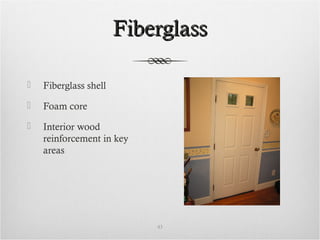
FiberglassFiberglass
 Fiberglass shell
 Foam core
 Interior wood
reinforcement in key
areas
43
GlassGlass
 Generally steel frame with tempered glass or tempered
glass only
 Easy to force
 Produce a large amount of broken glass
44
11
Types of DoorsTypes of Doors (1 of 2)(1 of 2)
 Inward-opening
 Outward-opening
 Sliding doors
 Revolving doors
 Overhead doors
45
11
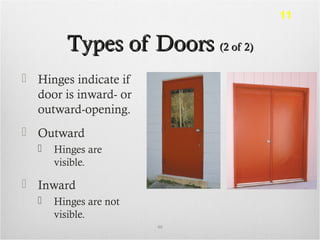
Types of DoorsTypes of Doors (2 of 2)(2 of 2)
 Hinges indicate if
door is inward- or
outward-opening.
 Outward
 Hinges are
visible.
 Inward
 Hinges are not
visible.
46
11
Door FramesDoor Frames (1 of 2)(1 of 2)
 Wood-framed doors
 Stopped door frames
 Have a piece of wood attached to the frame to stop the
door from swinging past the latch
 Rabbeted door frames
 Have a stop cut built into the frame so it cannot be
removed
47
11
Door FramesDoor Frames (2 of 2)(2 of 2)
 Metal-framed doors are more difficult to force open.
 Look like rabbeted door frames
48
11
Inward-Opening DoorsInward-Opening Doors (1 of 2)(1 of 2)
 Design
 Made of wood, steel, or glass
 Have an exterior frame with a stop or rabbet
 Locking mechanisms range from standard door knob
locks to deadbolt locks or sliding latches.
 Most residential open inward
49
11
Inward-Opening DoorsInward-Opening Doors (2 of 2)(2 of 2)
 Forcing Entry
 Determine what type of frame the door has.
 Use a prying tool near the locking mechanism to pry the
stop away from the frame.
 Use a striking tool to force the prying tool further into
the jamb.
50
11
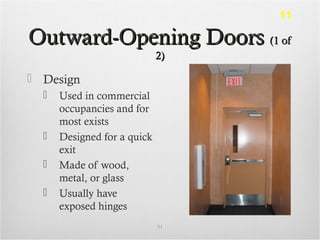
Outward-Opening DoorsOutward-Opening Doors (1 of(1 of
2)2)
 Design
 Used in commercial
occupancies and for
most exists
 Designed for a quick
exit
 Made of wood,
metal, or glass
 Usually have
exposed hinges
51
11
Outward-Opening DoorsOutward-Opening Doors (2 of(2 of
2)2)
 Forcing entry
 Check to see if hinges can be disassembled or hinge pins
removed.
 Place adz end of prying tool into the door frame.
 Use striking tool.
 Leverage the tool to force the door outward away from
the jamb.
52
11
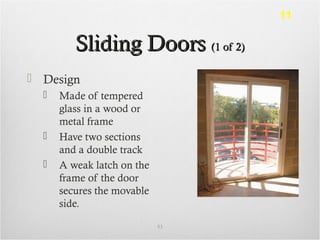
Sliding DoorsSliding Doors (1 of 2)(1 of 2)
 Design
 Made of tempered
glass in a wood or
metal frame
 Have two sections
and a double track
 A weak latch on the
frame of the door
secures the movable
side.
53
11
Sliding DoorsSliding Doors (2 of 2)(2 of 2)
 Forcing Entry
 Check whether a security rod is in the door track.
 If present, try another door.
 If not present, use a pry bar to lever door away from
locking mechanism.
 If necessary, break the glass.
-Some patio doors swing on hinges-
54
11
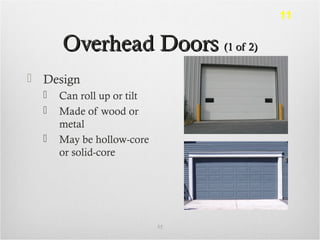
Overhead DoorsOverhead Doors (1 of 2)(1 of 2)
 Design
 Can roll up or tilt
 Made of wood or
metal
 May be hollow-core
or solid-core
55
11
Overhead DoorsOverhead Doors (2 of 2)(2 of 2)
 Forcing entry
 Break out a panel or window and manually operate lock
from within.
 Always securely prop door open to prevent door closing.
 Security roll-up door
 Cut triangle-shape entry.
56
11
WindowsWindows (1 of 2)(1 of 2)
 Usually easier to force than doors
 Frames made of wood, metal, vinyl
 Glass is the easiest way to force a window, but also the
most dangerous.
57
11
WindowsWindows (2 of 2)(2 of 2)
 Safety
 Wear PPE with face and eye protection.
 Clear area of personnel.
 Coordinate with fire attack to prevent flare-ups and
backdrafts.
 Completely clear frame of glass shards.
58
11
Glass ConstructionGlass Construction
 Regular or Annealed Glass
 Double-Pane Glass
 Plate Glass
 Laminated Glass
 Tempered Glass
 Wire Glass
59
11
Regular or Annealed GlassRegular or Annealed Glass
 Commonly used because it is inexpensive
 Larger pieces called plate glass
 Easily broken with a pike pole
 Watch out for shards.
 Can penetrate helmets, boots, and other protective gear
60
11
Double-Pane GlassDouble-Pane Glass
 Used in many homes because it improves home
insulation
 Uses two panes with an air pocket between them
 Two panes need to be broken separately.
 Watch out for shards.
61
11
Plate GlassPlate Glass
 Commercial plate glass is stronger, thicker glass used in
large window openings.
 Can easily be broken with a Halligan tool or pike pole
 Watch out for large shards.
62
11
Laminated GlassLaminated Glass
 Also known as safety glass
 Molded sheet of plastic between two sheets of glass
 Commonly used in vehicle windshields
63
11
Tempered GlassTempered Glass
 Specially heat-treated
 Four times stronger than regular glass
 Common in side and rear vehicle windows,
commercial or sliding doors
 Breaks into small pellets without sharp edges
64
11
Wired GlassWired Glass
 Tempered glass with wire reinforcement
 Often used in fire-rated doors
 Difficult to break
65
11
Frame DesignsFrame Designs
 Double-Hung Window
 Single-Hung Window
 Jalousie Window
 Awning Window
 Horizontal-Sliding Window
 Casement Window
 Projected Window
66
11
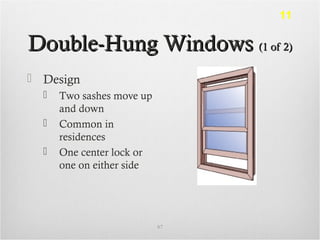
Double-Hung WindowsDouble-Hung Windows (1 of 2)(1 of 2)
 Design
 Two sashes move up
and down
 Common in
residences
 One center lock or
one on either side
67
11
Double-Hung WindowsDouble-Hung Windows (2 of 2)(2 of 2)
 Forcible entry
 Break locking mechanism to force entry.
 Place a prying tool under the lower sash and force it up.
 May be cheaper and easier to break glass.
68
11
Single-Hung WindowsSingle-Hung Windows (1 of 2)(1 of 2)
 Design
 Upper sash is fixed—only lower sash moves.
 Locking mechanism is the same.
 May be difficult to distinguish between single-hung and
double-hung from exterior.
69
11
Single-Hung WindowsSingle-Hung Windows (2 of 2)(2 of 2)
 Forcing entry
 Use same technique as forced entry through double-
hung window.
 Breaking glass and opening the window is generally
easier.
70
11
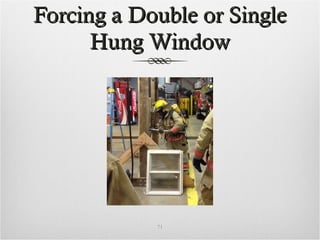
Forcing a Double or SingleForcing a Double or Single
Hung WindowHung Window
71
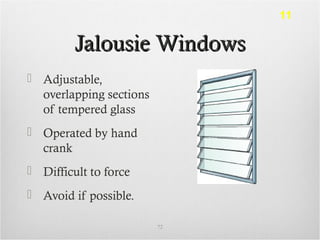
Jalousie WindowsJalousie Windows
 Adjustable,
overlapping sections
of tempered glass
 Operated by hand
crank
 Difficult to force
 Avoid if possible.
72
11
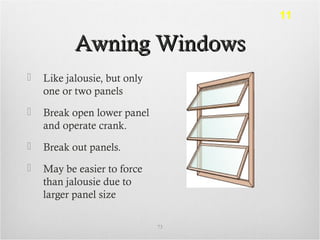
Awning WindowsAwning Windows
 Like jalousie, but only
one or two panels
 Break open lower panel
and operate crank.
 Break out panels.
 May be easier to force
than jalousie due to
larger panel size
73
11
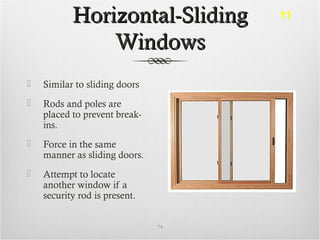
Horizontal-SlidingHorizontal-Sliding
WindowsWindows
 Similar to sliding doors
 Rods and poles are
placed to prevent break-
ins.
 Force in the same
manner as sliding doors.
 Attempt to locate
another window if a
security rod is present.
74
11
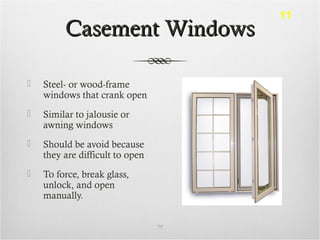
Casement WindowsCasement Windows
 Steel- or wood-frame
windows that crank open
 Similar to jalousie or
awning windows
 Should be avoid because
they are difficult to open
 To force, break glass,
unlock, and open
manually.
75
11
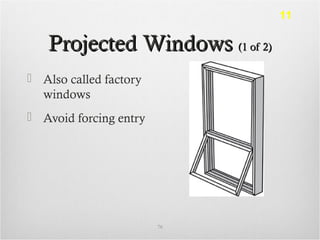
Projected WindowsProjected Windows (1 of 2)(1 of 2)
 Also called factory
windows
 Avoid forcing entry
76
11
Projected WindowsProjected Windows (2 of 2)(2 of 2)
 To force entry, break a pane, unlock, and open the
window manually.
 If opening is not large enough, break out entire
assembly.
77
11
Types of LocksTypes of Locks
 Cylindrical Locks
 Padlocks
 Mortise Locks
 Rim Locks
78
11
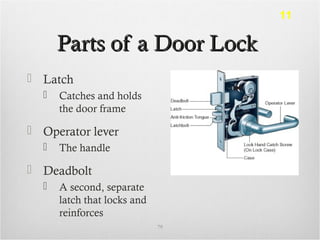
Parts of a Door LockParts of a Door Lock
 Latch
 Catches and holds
the door frame
 Operator lever
 The handle
 Deadbolt
 A second, separate
latch that locks and
reinforces
79
11
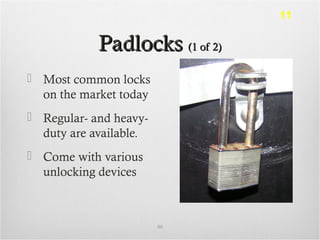
PadlocksPadlocks (1 of 2)(1 of 2)
 Most common locks
on the market today
 Regular- and heavy-
duty are available.
 Come with various
unlocking devices
80
11
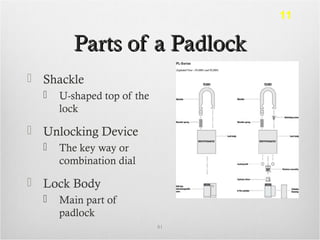
Parts of a PadlockParts of a Padlock
 Shackle
 U-shaped top of the
lock
 Unlocking Device
 The key way or
combination dial
 Lock Body
 Main part of
padlock
81
11
Forcing a PadlockForcing a Padlock
 Forcing entry
 Cut the shackle- bolt cutters
 Break the shackle- Irons
 If padlock is made of case-hardened steel, many
conventional methods will be ineffective.
82
11
Bolt CuttersBolt Cutters
 Can quickly and easily break regular-duty
padlocks
 Cannot be used on heavy-duty case-hardened
steel padlocks
 To use, open jaws as wide as possible.
 Close jaws around one side of the lock
shackles.
 Once the shackle is cut, the other side will spin
freely and allow access.83
11
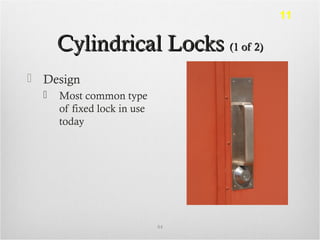
Cylindrical LocksCylindrical Locks (1 of 2)(1 of 2)
 Design
 Most common type
of fixed lock in use
today
84
11
Cylindrical LocksCylindrical Locks (2 of 2)(2 of 2)
 Forced entry
 K Tool
 To force, place a pry bar near the locking mechanism
and lever it.
85
11
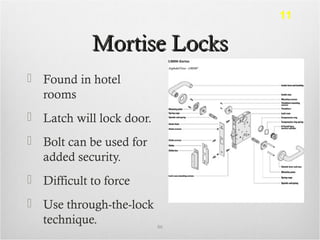
Mortise LocksMortise Locks
 Found in hotel
rooms
 Latch will lock door.
 Bolt can be used for
added security.
 Difficult to force
 Use through-the-lock
technique. 86
11
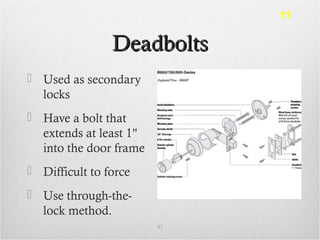
DeadboltsDeadbolts
 Used as secondary
locks
 Have a bolt that
extends at least 1"
into the door frame
 Difficult to force
 Use through-the-
lock method.
87
11
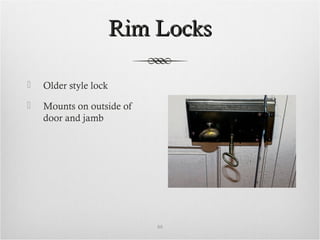
Rim LocksRim Locks
 Older style lock
 Mounts on outside of
door and jamb
88
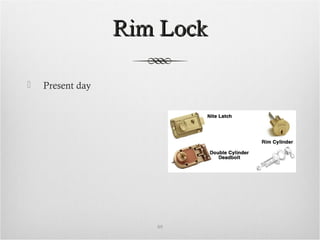
Rim LockRim Lock
 Present day
89
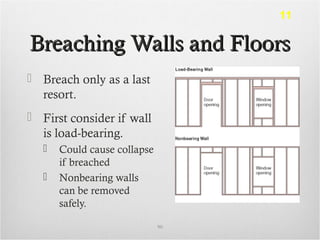
Breaching Walls and FloorsBreaching Walls and Floors
 Breach only as a last
resort.
 First consider if wall
is load-bearing.
 Could cause collapse
if breached
 Nonbearing walls
can be removed
safely.
90
11
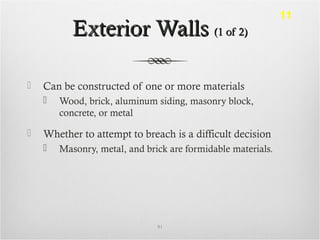
Exterior WallsExterior Walls (1 of 2)(1 of 2)
 Can be constructed of one or more materials
 Wood, brick, aluminum siding, masonry block,
concrete, or metal
 Whether to attempt to breach is a difficult decision
 Masonry, metal, and brick are formidable materials.
91
11
Exterior WallsExterior Walls (2 of 2)(2 of 2)
 Breaking through can be very difficult.
 Best tools to use are:
 Sledgehammer
 Rotary saw with a concrete blade
92
11
Interior WallsInterior Walls (1 of 2)(1 of 2)
 Constructed of wood or metal studs covered by plaster
or sheetrock in residences
 Commercial buildings may have concrete block interior
walls.
 Breaching an interior wall can be dangerous.
 Bearing or non-bearing.
93
11
Interior WallsInterior Walls (2 of 2)(2 of 2)
 Locate a stud away from electrical outlets and switches.
 Make a small hole to check for obstructions.
 If area is clear, expand to reveal studs.
94
11
FloorsFloors
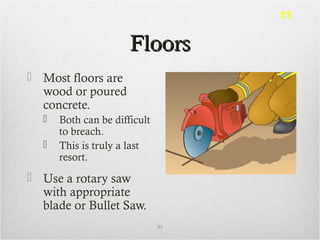
 Most floors are
wood or poured
concrete.
 Both can be difficult
to breach.
 This is truly a last
resort.
 Use a rotary saw
with appropriate
blade or Bullet Saw.
95
11
Forcible Entry and SalvageForcible Entry and Salvage
 Try to keep damage to a minimum.
 Secure structure before leaving.
 Replace locks or board up entry point- nails or screws
 Ensure owner is on-site or request additional police
patrols.
96
11
SummarySummary
 “Try before you pry.”
 Use the minimum amount of force necessary to gain
access.
 Knowledge of building construction is essential to
successful forcible entry.
 Use proper PPE.
 Use and carry tools safely.
97
11
Hands- on DrillsHands- on Drills
 Forcing double hung window
 Forcing inward swinging door
 Forcing outward swinging door
 K Tool (time permitting)
 Building doors (time permitting)
98
SafetySafety
 Keep cutting tools sharp.
 Use proper PPE.
 Gloves
 Eye protection
 Face protection
 Have others stand away.
99
11
Hands-on DrillsHands-on Drills
 Assign Companies into two groups
 1 group to Vent, 1 to Forcible Entry
 Vent will go over power tools, breach floor and breach
wall.
 Forcible entry will work door prop, window prop, and
interior doors.
 Groups will switch ½ way through.
100
ResourcesResources
 Jones & Bartlett- Fundamentals of Fire Fighter Skills,
2nd
ed.
 Truckie-Talk (Facebook)
 VentEnterSearch.com
 Firefighterclosecalls.com & The Secret List
101
Questions?Questions?
Comments or
Suggestions?
102

SFD forcible entry

  • 1.
    Forcible EntryForcible Entry Preparedby Lt. Eric Neubert April, 2013 Sourced from Jones & Bartlett Fundamentals of Firefighter Skills, 2nd Edition 1
  • 2.
    OpeningOpening  Instructors/Students  Exits Cell Phones/Radios  Interactive  Plan  Companies 2
  • 3.
    ObjectivesObjectives  Understand theassociation between specific tools and special forcible entry needs.  Describe the basic construction of typical doors, windows, and walls.  Know the dangers associated with forcing entry through doors, windows, and walls.  Know how forcible entry relates to salvage. 3 11
  • 4.
    IntroductionIntroduction (1 of2)(1 of 2)  Forcible entry  Method to gain access when normal means of entry cannot be used  Requires strength, knowledge, proper techniques, and skill  Use amount of force appropriate to situation.  Alarm/Nothing showing VS. working fire 4 11
  • 5.
    IntroductionIntroduction (2 of2)(2 of 2)  Arrange to secure the opening before leaving scene.  Keep up with how new styles of windows, doors, locks, and security devices operate. 5 11
  • 6.
    PreparationPreparation  Your Gear Personal tools  Your Truck (Engine)  Available tools and location  Your Tools  In service and ready to use  Your District  Yourself 6
  • 7.
    Preparation (cont)Preparation (cont) Your District  Types of occupancies  Special problems or hazards 7
  • 8.
    What’s In YourPockets?What’s In Your Pockets? 8
  • 9.
    Forcible Entry SituationsForcibleEntry Situations  Required at emergency incidents where time is a critical factor  Effect a rescue.  Control a fire before it extends.  Non Emergency situations  Calls for a more thoughtful approach 9 11
  • 10.
    Forcible Entry SituationsForcibleEntry Situations  Company Officer Selects  Point of entry  Method to use  “Try before you pry” 10
  • 11.
    The ProblemThe Problem Primarily Residential, Mercantile, Light Industrial  Look for the easy way  Try doors & windows  Knox Box or hidden keys  Neighbors  Alternate Entry  2nd Floor  Bulkhead  Air conditioners 11
  • 12.
    Forcible Entry ToolsForcibleEntry Tools  Fire fighters must know:  What tools are available  Uses and limitations of each tool  How to select the right tool  How to operate each tool  How to carry each tool  How to inspect and maintain each tool 12 11
  • 13.
    What Is YourMostWhat Is Your Most Important Tool?Important Tool? 13
  • 14.
    General Tool SafetyGeneralTool Safety  Incorrect use or improper maintenance can be dangerous.  Always wear proper PPE.  Use the right tool for the job.  Keep tools clean and serviced.  Take broken tools out of service for repair.  Keep tools in proper area or container. 14 11
  • 15.
    General Carrying TipsGeneralCarrying Tips (1 of 2)(1 of 2)  Request assistance with heavy tools.  Use your legs to lift heavy tools. 15 11
  • 16.
    General Carrying TipsGeneralCarrying Tips (2 of 2)(2 of 2)  Keep sharp edges and points away from your body.  Cover them with a gloved hand.  Carry long tools pointing down.  Be aware of overhead wires. 16 11
  • 17.
    General Maintenance TipsGeneralMaintenance Tips (1 of 2)(1 of 2)  All tools should be in a ready state.  Tools must be in working order, in their storage place, and ready for use. 17 11
  • 18.
    General Maintenance TipsGeneralMaintenance Tips (2 of 2)(2 of 2)  Tools require regular maintenance and cleaning to ensure readiness.  Perform required checks conscientiously.  Follow manufacturer’s guidelines and instructions.  Keep proper records of maintenance, repairs, and warranty work performed. 18 11
  • 19.
    Types of ForcibleEntry ToolsTypes of Forcible Entry Tools  Striking Tools  Prying/Spreading Tools  Cutting Tools  Lock  Specialty Tools 19 11
  • 20.
    Striking ToolsStriking Tools Used to generate an impact force directly on an object or another tool  Head usually made of hardened steel  Flat-head axe  TNT Tool  Sledgehammer 20 11
  • 21.
    Flat-Head AxeFlat-Head Axe One side of the axe head is a cutting blade.  Other side is a flat striking surface.  Fire fighters often use flat side to strike a Halligan tool and drive a wedge into an opening. 21 11
  • 22.
    SledgehammerSledgehammer  Sometimes calledmauls  Come in various weights and sizes  Head of hammer can weigh from 2 to 20 pounds.  Handle may be short like a carpenter’s hammer or long like an axe handle.  Can be used alone to break down a door or with other striking tools 22 11
  • 23.
    Prying/Spreading ToolsPrying/Spreading Tools Halligan tool  Pry bar/Crow bar/Variations  Pry axe  Hydraulic tools 23 11
  • 24.
    Halligan ToolHalligan Tool(1 of 2)(1 of 2)  Widely used  Commonly used to perform forcible entry 24 11
  • 25.
    Halligan ToolHalligan Tool(2 of 2)(2 of 2)  Incorporates adz, pick, and claw  Adz end pries open doors and windows.  Pick end makes holes or breaks glass.  Claw pulls nails and pries apart wooden slats. *Pairing with flat head axe creates The Irons 25 11
  • 26.
    ““The Irons”The Irons” FH Axe and Halligan “married” together.  Tools complement each other & cover a wide variety of situations. 26
  • 27.
    Pry BarPry Bar Made from hardened steel in a variety of shapes and sizes  Commonly used to force doors and windows, remove nails, or separate building materials  Various shapes allow fire fighters to exert different amounts of leverage in diverse situations. 27 11
  • 28.
    Hydraulic ToolsHydraulic Tools Spreaders  Cutters  Rams  Require hydraulic pressure 28 11
  • 29.
    Cutting ToolsCutting Tools Primarily used for cutting doors, roofs, walls, and floors  Hand operated and power cutting tools  Axe  Bolt cutters  Circular saw  Bullet/Chain Saw 29 11
  • 30.
    AxeAxe (1 of2)(1 of 2)  Many different types of axes  Flathead  Pickhead  Pry axe  Special purpose 30 11
  • 31.
    AxeAxe (2 of2)(2 of 2)  Cutting edge of axe used to break into plaster and wood walls, roofs, and doors  Pick used for opening walls, floors, etc.  Flat portion for striking other tools 31 11
  • 32.
    Bolt CuttersBolt Cutters Used to cut metal components as bolts, padlocks, chains, and chain-link fences  Available in several different sizes  The longer the handle, the greater the cutting force.  May not be able to cut into some heavy-duty padlocks made of case-hardened metal 32 11
  • 33.
    Circular SawCircular Saw Gasoline-powered  Light, powerful, and easy-to-use  Blades can be changed quickly.  Carbide-tipped blades  Metal-cutting blades  Masonry-cutting blades 33 11
  • 34.
    Bullet SawBullet Saw Gas Powered Chain Saw  Depth Gauge  Carbide tipped bullet chain  Able to cut through multiple layers of roofing, boards, nails, light gauge metal  “Roll” over rafters/floor joists 34
  • 35.
    Lock/Specialty ToolsLock/Specialty Tools(1 of 2)(1 of 2)  Used to disassemble the locking mechanism on a door  Cause minimal damage to the door and the door frame  Experienced user can usually gain entry in less than a minute. 35 11
  • 36.
    Lock/Specialty ToolsLock/Specialty Tools(2 of 2)(2 of 2)  K tool  Lock wrenches  Halligan (pick)  Credit Card  Pocket Knife  Hood Latch Tool 36 11
  • 37.
    K ToolK Tool Designed to shear off a lock cylinder so it can be removed 37 11
  • 38.
    DoorsDoors  Basic Door Construction Door  Jamb  Hardware  Locking device 38 11
  • 39.
    Construction MaterialConstruction Material Wood  Metal  Fiberglass/Composite  Glass 39 11
  • 40.
    WoodWood (1 of2)(1 of 2)  Slab  Solid-core  Solid wood core blocks covered by a face panel  Hollow-core  Lightweight, honeycomb interior 40 11
  • 41.
    WoodWood (2 of2)(2 of 2)  Ledge  Wood doors with horizontal bracing  Panel  Solid wood doors made from solid planks to form a rigid frame with solid wood panels set into the frame 41 11
  • 42.
    MetalMetal  Hollow-core metaldoors  Have a metal framework interior so they are lightweight  Solid-core metal doors  Have a foam or wood interior to reduce weight without affecting strength 42 11
  • 43.
    FiberglassFiberglass  Fiberglass shell Foam core  Interior wood reinforcement in key areas 43
  • 44.
    GlassGlass  Generally steelframe with tempered glass or tempered glass only  Easy to force  Produce a large amount of broken glass 44 11
  • 45.
    Types of DoorsTypesof Doors (1 of 2)(1 of 2)  Inward-opening  Outward-opening  Sliding doors  Revolving doors  Overhead doors 45 11
  • 46.
    Types of DoorsTypesof Doors (2 of 2)(2 of 2)  Hinges indicate if door is inward- or outward-opening.  Outward  Hinges are visible.  Inward  Hinges are not visible. 46 11
  • 47.
    Door FramesDoor Frames(1 of 2)(1 of 2)  Wood-framed doors  Stopped door frames  Have a piece of wood attached to the frame to stop the door from swinging past the latch  Rabbeted door frames  Have a stop cut built into the frame so it cannot be removed 47 11
  • 48.
    Door FramesDoor Frames(2 of 2)(2 of 2)  Metal-framed doors are more difficult to force open.  Look like rabbeted door frames 48 11
  • 49.
    Inward-Opening DoorsInward-Opening Doors(1 of 2)(1 of 2)  Design  Made of wood, steel, or glass  Have an exterior frame with a stop or rabbet  Locking mechanisms range from standard door knob locks to deadbolt locks or sliding latches.  Most residential open inward 49 11
  • 50.
    Inward-Opening DoorsInward-Opening Doors(2 of 2)(2 of 2)  Forcing Entry  Determine what type of frame the door has.  Use a prying tool near the locking mechanism to pry the stop away from the frame.  Use a striking tool to force the prying tool further into the jamb. 50 11
  • 51.
    Outward-Opening DoorsOutward-Opening Doors(1 of(1 of 2)2)  Design  Used in commercial occupancies and for most exists  Designed for a quick exit  Made of wood, metal, or glass  Usually have exposed hinges 51 11
  • 52.
    Outward-Opening DoorsOutward-Opening Doors(2 of(2 of 2)2)  Forcing entry  Check to see if hinges can be disassembled or hinge pins removed.  Place adz end of prying tool into the door frame.  Use striking tool.  Leverage the tool to force the door outward away from the jamb. 52 11
  • 53.
    Sliding DoorsSliding Doors(1 of 2)(1 of 2)  Design  Made of tempered glass in a wood or metal frame  Have two sections and a double track  A weak latch on the frame of the door secures the movable side. 53 11
  • 54.
    Sliding DoorsSliding Doors(2 of 2)(2 of 2)  Forcing Entry  Check whether a security rod is in the door track.  If present, try another door.  If not present, use a pry bar to lever door away from locking mechanism.  If necessary, break the glass. -Some patio doors swing on hinges- 54 11
  • 55.
    Overhead DoorsOverhead Doors(1 of 2)(1 of 2)  Design  Can roll up or tilt  Made of wood or metal  May be hollow-core or solid-core 55 11
  • 56.
    Overhead DoorsOverhead Doors(2 of 2)(2 of 2)  Forcing entry  Break out a panel or window and manually operate lock from within.  Always securely prop door open to prevent door closing.  Security roll-up door  Cut triangle-shape entry. 56 11
  • 57.
    WindowsWindows (1 of2)(1 of 2)  Usually easier to force than doors  Frames made of wood, metal, vinyl  Glass is the easiest way to force a window, but also the most dangerous. 57 11
  • 58.
    WindowsWindows (2 of2)(2 of 2)  Safety  Wear PPE with face and eye protection.  Clear area of personnel.  Coordinate with fire attack to prevent flare-ups and backdrafts.  Completely clear frame of glass shards. 58 11
  • 59.
    Glass ConstructionGlass Construction Regular or Annealed Glass  Double-Pane Glass  Plate Glass  Laminated Glass  Tempered Glass  Wire Glass 59 11
  • 60.
    Regular or AnnealedGlassRegular or Annealed Glass  Commonly used because it is inexpensive  Larger pieces called plate glass  Easily broken with a pike pole  Watch out for shards.  Can penetrate helmets, boots, and other protective gear 60 11
  • 61.
    Double-Pane GlassDouble-Pane Glass Used in many homes because it improves home insulation  Uses two panes with an air pocket between them  Two panes need to be broken separately.  Watch out for shards. 61 11
  • 62.
    Plate GlassPlate Glass Commercial plate glass is stronger, thicker glass used in large window openings.  Can easily be broken with a Halligan tool or pike pole  Watch out for large shards. 62 11
  • 63.
    Laminated GlassLaminated Glass Also known as safety glass  Molded sheet of plastic between two sheets of glass  Commonly used in vehicle windshields 63 11
  • 64.
    Tempered GlassTempered Glass Specially heat-treated  Four times stronger than regular glass  Common in side and rear vehicle windows, commercial or sliding doors  Breaks into small pellets without sharp edges 64 11
  • 65.
    Wired GlassWired Glass Tempered glass with wire reinforcement  Often used in fire-rated doors  Difficult to break 65 11
  • 66.
    Frame DesignsFrame Designs Double-Hung Window  Single-Hung Window  Jalousie Window  Awning Window  Horizontal-Sliding Window  Casement Window  Projected Window 66 11
  • 67.
    Double-Hung WindowsDouble-Hung Windows(1 of 2)(1 of 2)  Design  Two sashes move up and down  Common in residences  One center lock or one on either side 67 11
  • 68.
    Double-Hung WindowsDouble-Hung Windows(2 of 2)(2 of 2)  Forcible entry  Break locking mechanism to force entry.  Place a prying tool under the lower sash and force it up.  May be cheaper and easier to break glass. 68 11
  • 69.
    Single-Hung WindowsSingle-Hung Windows(1 of 2)(1 of 2)  Design  Upper sash is fixed—only lower sash moves.  Locking mechanism is the same.  May be difficult to distinguish between single-hung and double-hung from exterior. 69 11
  • 70.
    Single-Hung WindowsSingle-Hung Windows(2 of 2)(2 of 2)  Forcing entry  Use same technique as forced entry through double- hung window.  Breaking glass and opening the window is generally easier. 70 11
  • 71.
    Forcing a Doubleor SingleForcing a Double or Single Hung WindowHung Window 71
  • 72.
    Jalousie WindowsJalousie Windows Adjustable, overlapping sections of tempered glass  Operated by hand crank  Difficult to force  Avoid if possible. 72 11
  • 73.
    Awning WindowsAwning Windows Like jalousie, but only one or two panels  Break open lower panel and operate crank.  Break out panels.  May be easier to force than jalousie due to larger panel size 73 11
  • 74.
    Horizontal-SlidingHorizontal-Sliding WindowsWindows  Similar tosliding doors  Rods and poles are placed to prevent break- ins.  Force in the same manner as sliding doors.  Attempt to locate another window if a security rod is present. 74 11
  • 75.
    Casement WindowsCasement Windows Steel- or wood-frame windows that crank open  Similar to jalousie or awning windows  Should be avoid because they are difficult to open  To force, break glass, unlock, and open manually. 75 11
  • 76.
    Projected WindowsProjected Windows(1 of 2)(1 of 2)  Also called factory windows  Avoid forcing entry 76 11
  • 77.
    Projected WindowsProjected Windows(2 of 2)(2 of 2)  To force entry, break a pane, unlock, and open the window manually.  If opening is not large enough, break out entire assembly. 77 11
  • 78.
    Types of LocksTypesof Locks  Cylindrical Locks  Padlocks  Mortise Locks  Rim Locks 78 11
  • 79.
    Parts of aDoor LockParts of a Door Lock  Latch  Catches and holds the door frame  Operator lever  The handle  Deadbolt  A second, separate latch that locks and reinforces 79 11
  • 80.
    PadlocksPadlocks (1 of2)(1 of 2)  Most common locks on the market today  Regular- and heavy- duty are available.  Come with various unlocking devices 80 11
  • 81.
    Parts of aPadlockParts of a Padlock  Shackle  U-shaped top of the lock  Unlocking Device  The key way or combination dial  Lock Body  Main part of padlock 81 11
  • 82.
    Forcing a PadlockForcinga Padlock  Forcing entry  Cut the shackle- bolt cutters  Break the shackle- Irons  If padlock is made of case-hardened steel, many conventional methods will be ineffective. 82 11
  • 83.
    Bolt CuttersBolt Cutters Can quickly and easily break regular-duty padlocks  Cannot be used on heavy-duty case-hardened steel padlocks  To use, open jaws as wide as possible.  Close jaws around one side of the lock shackles.  Once the shackle is cut, the other side will spin freely and allow access.83 11
  • 84.
    Cylindrical LocksCylindrical Locks(1 of 2)(1 of 2)  Design  Most common type of fixed lock in use today 84 11
  • 85.
    Cylindrical LocksCylindrical Locks(2 of 2)(2 of 2)  Forced entry  K Tool  To force, place a pry bar near the locking mechanism and lever it. 85 11
  • 86.
    Mortise LocksMortise Locks Found in hotel rooms  Latch will lock door.  Bolt can be used for added security.  Difficult to force  Use through-the-lock technique. 86 11
  • 87.
    DeadboltsDeadbolts  Used assecondary locks  Have a bolt that extends at least 1" into the door frame  Difficult to force  Use through-the- lock method. 87 11
  • 88.
    Rim LocksRim Locks Older style lock  Mounts on outside of door and jamb 88
  • 89.
    Rim LockRim Lock Present day 89
  • 90.
    Breaching Walls andFloorsBreaching Walls and Floors  Breach only as a last resort.  First consider if wall is load-bearing.  Could cause collapse if breached  Nonbearing walls can be removed safely. 90 11
  • 91.
    Exterior WallsExterior Walls(1 of 2)(1 of 2)  Can be constructed of one or more materials  Wood, brick, aluminum siding, masonry block, concrete, or metal  Whether to attempt to breach is a difficult decision  Masonry, metal, and brick are formidable materials. 91 11
  • 92.
    Exterior WallsExterior Walls(2 of 2)(2 of 2)  Breaking through can be very difficult.  Best tools to use are:  Sledgehammer  Rotary saw with a concrete blade 92 11
  • 93.
    Interior WallsInterior Walls(1 of 2)(1 of 2)  Constructed of wood or metal studs covered by plaster or sheetrock in residences  Commercial buildings may have concrete block interior walls.  Breaching an interior wall can be dangerous.  Bearing or non-bearing. 93 11
  • 94.
    Interior WallsInterior Walls(2 of 2)(2 of 2)  Locate a stud away from electrical outlets and switches.  Make a small hole to check for obstructions.  If area is clear, expand to reveal studs. 94 11
  • 95.
    FloorsFloors  Most floorsare wood or poured concrete.  Both can be difficult to breach.  This is truly a last resort.  Use a rotary saw with appropriate blade or Bullet Saw. 95 11
  • 96.
    Forcible Entry andSalvageForcible Entry and Salvage  Try to keep damage to a minimum.  Secure structure before leaving.  Replace locks or board up entry point- nails or screws  Ensure owner is on-site or request additional police patrols. 96 11
  • 97.
    SummarySummary  “Try beforeyou pry.”  Use the minimum amount of force necessary to gain access.  Knowledge of building construction is essential to successful forcible entry.  Use proper PPE.  Use and carry tools safely. 97 11
  • 98.
    Hands- on DrillsHands-on Drills  Forcing double hung window  Forcing inward swinging door  Forcing outward swinging door  K Tool (time permitting)  Building doors (time permitting) 98
  • 99.
    SafetySafety  Keep cuttingtools sharp.  Use proper PPE.  Gloves  Eye protection  Face protection  Have others stand away. 99 11
  • 100.
    Hands-on DrillsHands-on Drills Assign Companies into two groups  1 group to Vent, 1 to Forcible Entry  Vent will go over power tools, breach floor and breach wall.  Forcible entry will work door prop, window prop, and interior doors.  Groups will switch ½ way through. 100
  • 101.
    ResourcesResources  Jones &Bartlett- Fundamentals of Fire Fighter Skills, 2nd ed.  Truckie-Talk (Facebook)  VentEnterSearch.com  Firefighterclosecalls.com & The Secret List 101
  • 102.