3
DOOR AND WINDOW
HINGES
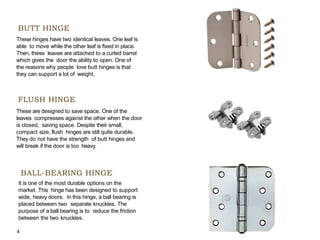
These hinges have two identical leaves. One leaf is
able to move while the other leaf is fixed in place.
Then, these leaves are attached to a curled barrel
which gives the door the ability to open. One of
the reasons why people love butt hinges is that
they can support a lot of weight.
BUTT HINGE
These are designed to save space. One of the
leaves compresses against the other when the door
is closed, saving space. Despite their small,
compact size, flush hinges are still quite durable.
They do not have the strength of butt hinges and
will break if the door is too heavy.
4
FLUSH HINGE
It is one of the most durable options on the
market. This hinge has been designed to support
wide, heavy doors. In this hinge, a ball bearing is
placed between two separate knuckles. The
purpose of a ball bearing is to reduce the friction
between the two knuckles.
BALL-BEARING HINGE
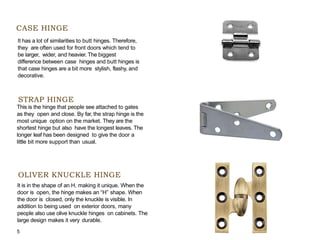
It has a lot of similarities to butt hinges. Therefore,
they are often used for front doors which tend to
be larger, wider, and heavier. The biggest
difference between case hinges and butt hinges is
that case hinges are a bit more stylish, flashy, and
decorative.
CASE HINGE
This is the hinge that people see attached to gates
as they open and close. By far, the strap hinge is the
most unique option on the market. They are the
shortest hinge but also have the longest leaves. The
longer leaf has been designed to give the door a
little bit more support than usual.
5
STRAP HINGE
It is in the shape of an H, making it unique. When the
door is open, the hinge makes an “H” shape. When
the door is closed, only the knuckle is visible. In
addition to being used on exterior doors, many
people also use olive knuckle hinges on cabinets. The
large design makes it very durable.
OLIVER KNUCKLE HINGE
It has been designed to work with larger doors.
When someone has a larger door, it might be a
challenge to keep it aligned with the wall and the
floor. The pivot hinge can fix this problem. This
hinge has been designed to pivot when the door
opens, helping to keep it in place.
PIVOT HINGE
These interior door hinges aren’t able to be used
outside because they cannot handle the weight of a
steel or fiberglass door. These hinges are most
commonly found in the kitchen and dining room.
Some of the other names people might use to refer
to this type of hinge include the café, sway, swing,
and saloon door hinge.
6
DOUBLE ACTION SPARING
HINGE
It is a little bit less common than other door hinges;
however, they do serve a unique purpose. In some
situations, people might need a hinge with multiple
leaves that are of varying lengths. This is the
design of a bi-fold hinge. There are multiple pivots
in this hinge that allow the door to move to a
greater extent.
BI FOLD HINGE
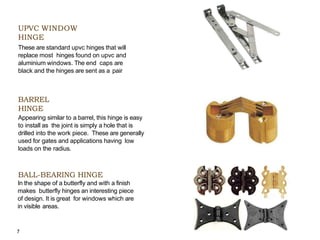
These are standard upvc hinges that will
replace most hinges found on upvc and
aluminium windows. The end caps are
black and the hinges are sent as a pair
UPVC WINDOW
HINGE
Appearing similar to a barrel, this hinge is easy
to install as the joint is simply a hole that is
drilled into the work piece. These are generally
used for gates and applications having low
loads on the radius.
7
BARREL
HINGE
In the shape of a butterfly and with a finish
makes butterfly hinges an interesting piece
of design. It is great for windows which are
in visible areas.
BALL-BEARING HINGE
8
DOOR AND
WINDOW BOLTS
This type of bolt is used to keep the
windows shutter in required position when
it is opened.
HOOK AND EYE BOLT
In case of this bolt, it is desired to keep with
the face of the door.
9
FLUSH BOLT
It is the most old and common type bolt.
Tolock this, padlocks are used.
ALDROP BOLT
Tofix the backfires of door. barrel bolts are used. It
contains socket and plate. Socket is fixed to the frame
and plate is fixed to back of the door.
Barrel Bolt
It is used for highly secured doors and casement windows
which cannot be reached easily.
10
Espagnalette Bolt
It is locked using padlock too. Hasp is fixed to the door
or window while staple is fixed to frame.
Hasp and Staple Bolt
11
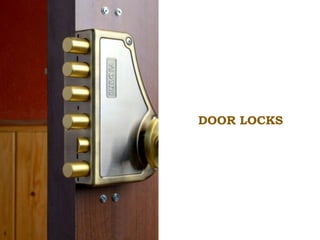
DOOR LOCKS
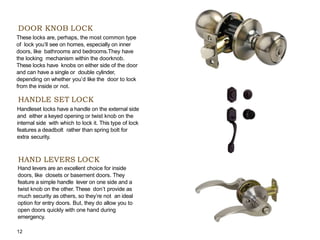
These locks are, perhaps, the most common type
of lock you’ll see on homes, especially on inner
doors, like bathrooms and bedrooms.They have
the locking mechanism within the doorknob.
These locks have knobs on either side of the door
and can have a single or double cylinder,
depending on whether you’d like the door to lock
from the inside or not.
DOOR KNOB LOCK
Handleset locks have a handle on the external side
and either a keyed opening or twist knob on the
internal side with which to lock it. This type of lock
features a deadbolt rather than spring bolt for
extra security.
12
HANDLE SET LOCK
Hand levers are an excellent choice for inside
doors, like closets or basement doors. They
feature a simple handle lever on one side and a
twist knob on the other. These don’t provide as
much security as others, so they’re not an ideal
option for entry doors. But, they do allow you to
open doors quickly with one hand during
emergency.
HAND LEVERS LOCK
Used in filing cabinets, mailboxes, lockers, and
low- security bank deposit boxes. The cam lock is
a simplified version of other locks, requiring a key
to turn a cam, which locks and unlocks it. Cam
locks can be either flat or tubular, with keys of the
same shape necessary to open them.
CAM LOCK
These are ones you usually see on the inside of hotel
doors. These locks have a catch on the door frame
and a main locking assembly on the door, much like
a barrel bolt, but use a chain to lock the door instead
of the cylinder piece.
The idea of the chain lock is to allow you to open the
door slightly to greet someone while still keeping the
door closed.
13
CHAIN LOCK
Electronic locks are ones that don’t require keys
to lock and unlock them. Instead, they have a
keypad or card system in which you can use a
special code or key to unlock the door. Most of
the time, these locks lock the door automatically.
Some comes with keys too.
ELECTRONIC LOCKS
14
DOOR AND WINDOW
HANDLES
The door handles are the ones which are placed
on the doors for opening and closing of the door.
There can be various deigns available. There are
handles which are made with back plate and then
there are those which are made on circular or
square rose.
COMMON DOOR HANDLES
Pull handles are used on doors where the doors are
opened inwards. These are horizontal and vertical.
Door handles are mostly vertical and drawer
handles are mostly horizontal. Pull Handles used
on doors are usually used in offices and workplace.
15
PULL HANDLES
These handles are used on windows. Depending
on the look and the ease of use there are various
types of window handles. The window handles
should be able to support the movement of
windows inwards and outwards. There are
handles that provide security to the windows with
locking options.
WINDOW HANDLES
Glass handles are handles that are fitted on glass
doors in offices and workplace. These handles
are to be made with care and precision as it has
to be fitted on glass objects.
GLASS HANDLES
Lever Handles is a type of door handle. This type of
handle consists of black plate and key cut hole. The
handles are opened by pushing the handle and they
can be locked by a key. The lever handles are used
mostly in bathrooms as they can be easily locked
and unlocked easily.
16
LEVER HANDLES
14
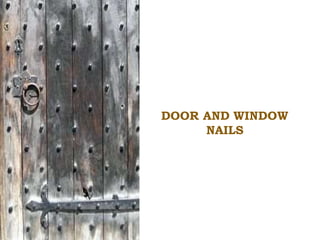
DOOR AND WINDOW
NAILS
18
COMMON NAILS
Also known as round head, these are the most
widely-used type of nail for joining timber and
other elements, particularly where a rougher finish is
acceptable. It is good practice to use nails that are at
least three times longer than the depth of the
thinner material that is being nailed.
A variation is the oval head nail which is oval in cross-
section and minimise the risk of splitting the timber.
FINISHING NAIL
These are similar to common nails but have much
smaller heads which sit flush with the timber surface
and provide a neater finish. A nail set can be used to
recess the head to conceal it completely.
This capability means that they are often used
in furniture and decorative or exposed timber. The
smaller head sizes also mean there is a
reduced risk of the timber splitting.
Finishing nails can be made of brass to provide a
decorative detail.
19
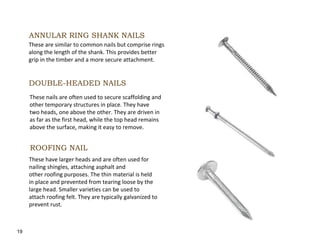
ANNULAR RING SHANK NAILS
These are similar to common nails but comprise rings
along the length of the shank. This provides better
grip in the timber and a more secure attachment.
DOUBLE-HEADED NAILS
These nails are often used to secure scaffolding and
other temporary structures in place. They have
two heads, one above the other. They are driven in
as far as the first head, while the top head remains
above the surface, making it easy to remove.
ROOFING NAIL
These have larger heads and are often used for
nailing shingles, attaching asphalt and
other roofing purposes. The thin material is held
in place and prevented from tearing loose by the
large head. Smaller varieties can be used to
attach roofing felt. They are typically galvanized to
prevent rust.
14
DOOR AND WINDOW
SCREWS
SCREWS
A Screw is a sharp-pointed short metal pin of certain pitch length with helical threads running round of it. It is used to
fasten two pieces together or join them for a desired working. It can fasten any type of piece made of either wood
or metal. There are number of types of screws used to fasten various types of parts performing different functions.
22
WOOD SCREW
Perhaps the single most common type of screw is a
wood screw. Wood screws aren’t made of actual
wood. Rather, they are used to connect two or more
solid wooden objects. Wood screws have a sharp
point that’s able to dig into wood, making them
highly useful for woodworking applications.
MACHINE SCREW
A machine screw, as the name suggests, is a type of
screw that’s used in machining applications. There
are many different types of machine screws, one
type is a stove bolt. Machine screws are used to hold
heavy-duty metal objects together. According to
Wikipedia, machine screws can have a diameter up
to 0.75 inches, making them bigger than most other
screws.
LAG SCREW
While not as common as wood or machine screws, lag
screws are another type of screw worth mentioning. Also
known as lag bolts or coach bolts, they are essentially
jumbo-sized wood screws coated with zinc. A zinc layer is
applied to lag screws to protect them against rust and
corrosion. To apply the zinc, companies typically perform
electroplating or hot-dip galvanization.
23
SHEET METAL SCREW
Sheet metal screws, of course, are designed to be
driven into sheet metal. They can still be used on
other materials, such as wood, but they are primarily
used for sheet metal. Sheet metal screws have
threading all the way up to the shank at the top,
allowing them to easily dig into sheet metal.
TWINFAST SCREW
Twinfast screws feature a unique design consisting of two
threads rather than just one. With twice the threading, they
can be driven into objects twice as quickly when compared
to traditional screws. Most drywall screws are twinfast
screws. With that said, twinfast screws can be used for other
applications besides the installation and hanging of drywall.
Security Screw
Finally, security screws are designed to protect against
removal or tampering. Unlike other screws, security screws
don’t have an operable head that can be reversed to remove
the screw. Rather, they generally require a specialized tool
like a spanner or square driver to remove. This design makes
them an excellent choice for security applications.
14
HARDWARE USED IN
CABINETS AND
FURNITURE
KNOBS AND PULLS
Knobs and pulls are the most visible
hardware components on cabinets and
furniture, making them an important
consideration for both functionality
and aesthetics. There are many
different types of knobs and pulls
available, including traditional,
modern, and ornate designs.
When selecting knobs and pulls, it's
important to consider the size, shape,
and finish of the hardware. A well-
chosen knob or pull can add a touch of
elegance or personality to any cabinet
or piece of furniture.
HINGES
Hinges are an essential component of
cabinet and furniture hardware,
providing support and allowing doors
and drawers to open and close
smoothly. There are many different
types of hinges available, including
concealed, decorative, and self-
closing hinges.
When selecting hinges, it's important to
consider the weight and size of the
door or drawer, as well as the desired
level of functionality. A well-chosen
hinge can ensure that your cabinet or
furniture piece operates smoothly and
reliably.
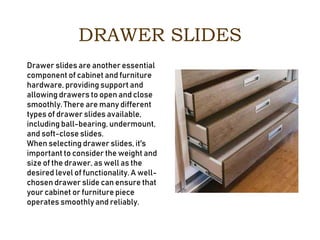
DRAWER SLIDES
Drawer slides are another essential
component of cabinet and furniture
hardware, providing support and
allowing drawers to open and close
smoothly. There are many different
types of drawer slides available,
including ball-bearing, undermount,
and soft-close slides.
When selecting drawer slides, it's
important to consider the weight and
size of the drawer, as well as the
desired level of functionality. A well-
chosen drawer slide can ensure that
your cabinet or furniture piece
operates smoothly and reliably.
THANK
YOU

HARDWARE AND ITS APPLICATIONS.pptx

  • 3.
  • 4.
    These hinges havetwo identical leaves. One leaf is able to move while the other leaf is fixed in place. Then, these leaves are attached to a curled barrel which gives the door the ability to open. One of the reasons why people love butt hinges is that they can support a lot of weight. BUTT HINGE These are designed to save space. One of the leaves compresses against the other when the door is closed, saving space. Despite their small, compact size, flush hinges are still quite durable. They do not have the strength of butt hinges and will break if the door is too heavy. 4 FLUSH HINGE It is one of the most durable options on the market. This hinge has been designed to support wide, heavy doors. In this hinge, a ball bearing is placed between two separate knuckles. The purpose of a ball bearing is to reduce the friction between the two knuckles. BALL-BEARING HINGE
  • 5.
    It has alot of similarities to butt hinges. Therefore, they are often used for front doors which tend to be larger, wider, and heavier. The biggest difference between case hinges and butt hinges is that case hinges are a bit more stylish, flashy, and decorative. CASE HINGE This is the hinge that people see attached to gates as they open and close. By far, the strap hinge is the most unique option on the market. They are the shortest hinge but also have the longest leaves. The longer leaf has been designed to give the door a little bit more support than usual. 5 STRAP HINGE It is in the shape of an H, making it unique. When the door is open, the hinge makes an “H” shape. When the door is closed, only the knuckle is visible. In addition to being used on exterior doors, many people also use olive knuckle hinges on cabinets. The large design makes it very durable. OLIVER KNUCKLE HINGE
  • 6.
    It has beendesigned to work with larger doors. When someone has a larger door, it might be a challenge to keep it aligned with the wall and the floor. The pivot hinge can fix this problem. This hinge has been designed to pivot when the door opens, helping to keep it in place. PIVOT HINGE These interior door hinges aren’t able to be used outside because they cannot handle the weight of a steel or fiberglass door. These hinges are most commonly found in the kitchen and dining room. Some of the other names people might use to refer to this type of hinge include the café, sway, swing, and saloon door hinge. 6 DOUBLE ACTION SPARING HINGE It is a little bit less common than other door hinges; however, they do serve a unique purpose. In some situations, people might need a hinge with multiple leaves that are of varying lengths. This is the design of a bi-fold hinge. There are multiple pivots in this hinge that allow the door to move to a greater extent. BI FOLD HINGE
  • 7.
    These are standardupvc hinges that will replace most hinges found on upvc and aluminium windows. The end caps are black and the hinges are sent as a pair UPVC WINDOW HINGE Appearing similar to a barrel, this hinge is easy to install as the joint is simply a hole that is drilled into the work piece. These are generally used for gates and applications having low loads on the radius. 7 BARREL HINGE In the shape of a butterfly and with a finish makes butterfly hinges an interesting piece of design. It is great for windows which are in visible areas. BALL-BEARING HINGE
  • 8.
  • 9.
    This type ofbolt is used to keep the windows shutter in required position when it is opened. HOOK AND EYE BOLT In case of this bolt, it is desired to keep with the face of the door. 9 FLUSH BOLT It is the most old and common type bolt. Tolock this, padlocks are used. ALDROP BOLT
  • 10.
    Tofix the backfiresof door. barrel bolts are used. It contains socket and plate. Socket is fixed to the frame and plate is fixed to back of the door. Barrel Bolt It is used for highly secured doors and casement windows which cannot be reached easily. 10 Espagnalette Bolt It is locked using padlock too. Hasp is fixed to the door or window while staple is fixed to frame. Hasp and Staple Bolt
  • 11.
  • 12.
    These locks are,perhaps, the most common type of lock you’ll see on homes, especially on inner doors, like bathrooms and bedrooms.They have the locking mechanism within the doorknob. These locks have knobs on either side of the door and can have a single or double cylinder, depending on whether you’d like the door to lock from the inside or not. DOOR KNOB LOCK Handleset locks have a handle on the external side and either a keyed opening or twist knob on the internal side with which to lock it. This type of lock features a deadbolt rather than spring bolt for extra security. 12 HANDLE SET LOCK Hand levers are an excellent choice for inside doors, like closets or basement doors. They feature a simple handle lever on one side and a twist knob on the other. These don’t provide as much security as others, so they’re not an ideal option for entry doors. But, they do allow you to open doors quickly with one hand during emergency. HAND LEVERS LOCK
  • 13.
    Used in filingcabinets, mailboxes, lockers, and low- security bank deposit boxes. The cam lock is a simplified version of other locks, requiring a key to turn a cam, which locks and unlocks it. Cam locks can be either flat or tubular, with keys of the same shape necessary to open them. CAM LOCK These are ones you usually see on the inside of hotel doors. These locks have a catch on the door frame and a main locking assembly on the door, much like a barrel bolt, but use a chain to lock the door instead of the cylinder piece. The idea of the chain lock is to allow you to open the door slightly to greet someone while still keeping the door closed. 13 CHAIN LOCK Electronic locks are ones that don’t require keys to lock and unlock them. Instead, they have a keypad or card system in which you can use a special code or key to unlock the door. Most of the time, these locks lock the door automatically. Some comes with keys too. ELECTRONIC LOCKS
  • 14.
  • 15.
    The door handlesare the ones which are placed on the doors for opening and closing of the door. There can be various deigns available. There are handles which are made with back plate and then there are those which are made on circular or square rose. COMMON DOOR HANDLES Pull handles are used on doors where the doors are opened inwards. These are horizontal and vertical. Door handles are mostly vertical and drawer handles are mostly horizontal. Pull Handles used on doors are usually used in offices and workplace. 15 PULL HANDLES These handles are used on windows. Depending on the look and the ease of use there are various types of window handles. The window handles should be able to support the movement of windows inwards and outwards. There are handles that provide security to the windows with locking options. WINDOW HANDLES
  • 16.
    Glass handles arehandles that are fitted on glass doors in offices and workplace. These handles are to be made with care and precision as it has to be fitted on glass objects. GLASS HANDLES Lever Handles is a type of door handle. This type of handle consists of black plate and key cut hole. The handles are opened by pushing the handle and they can be locked by a key. The lever handles are used mostly in bathrooms as they can be easily locked and unlocked easily. 16 LEVER HANDLES
  • 17.
  • 18.
    18 COMMON NAILS Also knownas round head, these are the most widely-used type of nail for joining timber and other elements, particularly where a rougher finish is acceptable. It is good practice to use nails that are at least three times longer than the depth of the thinner material that is being nailed. A variation is the oval head nail which is oval in cross- section and minimise the risk of splitting the timber. FINISHING NAIL These are similar to common nails but have much smaller heads which sit flush with the timber surface and provide a neater finish. A nail set can be used to recess the head to conceal it completely. This capability means that they are often used in furniture and decorative or exposed timber. The smaller head sizes also mean there is a reduced risk of the timber splitting. Finishing nails can be made of brass to provide a decorative detail.
  • 19.
    19 ANNULAR RING SHANKNAILS These are similar to common nails but comprise rings along the length of the shank. This provides better grip in the timber and a more secure attachment. DOUBLE-HEADED NAILS These nails are often used to secure scaffolding and other temporary structures in place. They have two heads, one above the other. They are driven in as far as the first head, while the top head remains above the surface, making it easy to remove. ROOFING NAIL These have larger heads and are often used for nailing shingles, attaching asphalt and other roofing purposes. The thin material is held in place and prevented from tearing loose by the large head. Smaller varieties can be used to attach roofing felt. They are typically galvanized to prevent rust.
  • 20.
  • 21.
    SCREWS A Screw isa sharp-pointed short metal pin of certain pitch length with helical threads running round of it. It is used to fasten two pieces together or join them for a desired working. It can fasten any type of piece made of either wood or metal. There are number of types of screws used to fasten various types of parts performing different functions.
  • 22.
    22 WOOD SCREW Perhaps thesingle most common type of screw is a wood screw. Wood screws aren’t made of actual wood. Rather, they are used to connect two or more solid wooden objects. Wood screws have a sharp point that’s able to dig into wood, making them highly useful for woodworking applications. MACHINE SCREW A machine screw, as the name suggests, is a type of screw that’s used in machining applications. There are many different types of machine screws, one type is a stove bolt. Machine screws are used to hold heavy-duty metal objects together. According to Wikipedia, machine screws can have a diameter up to 0.75 inches, making them bigger than most other screws. LAG SCREW While not as common as wood or machine screws, lag screws are another type of screw worth mentioning. Also known as lag bolts or coach bolts, they are essentially jumbo-sized wood screws coated with zinc. A zinc layer is applied to lag screws to protect them against rust and corrosion. To apply the zinc, companies typically perform electroplating or hot-dip galvanization.
  • 23.
    23 SHEET METAL SCREW Sheetmetal screws, of course, are designed to be driven into sheet metal. They can still be used on other materials, such as wood, but they are primarily used for sheet metal. Sheet metal screws have threading all the way up to the shank at the top, allowing them to easily dig into sheet metal. TWINFAST SCREW Twinfast screws feature a unique design consisting of two threads rather than just one. With twice the threading, they can be driven into objects twice as quickly when compared to traditional screws. Most drywall screws are twinfast screws. With that said, twinfast screws can be used for other applications besides the installation and hanging of drywall. Security Screw Finally, security screws are designed to protect against removal or tampering. Unlike other screws, security screws don’t have an operable head that can be reversed to remove the screw. Rather, they generally require a specialized tool like a spanner or square driver to remove. This design makes them an excellent choice for security applications.
  • 24.
  • 25.
    KNOBS AND PULLS Knobsand pulls are the most visible hardware components on cabinets and furniture, making them an important consideration for both functionality and aesthetics. There are many different types of knobs and pulls available, including traditional, modern, and ornate designs. When selecting knobs and pulls, it's important to consider the size, shape, and finish of the hardware. A well- chosen knob or pull can add a touch of elegance or personality to any cabinet or piece of furniture.
  • 26.
    HINGES Hinges are anessential component of cabinet and furniture hardware, providing support and allowing doors and drawers to open and close smoothly. There are many different types of hinges available, including concealed, decorative, and self- closing hinges. When selecting hinges, it's important to consider the weight and size of the door or drawer, as well as the desired level of functionality. A well-chosen hinge can ensure that your cabinet or furniture piece operates smoothly and reliably.
  • 27.
    DRAWER SLIDES Drawer slidesare another essential component of cabinet and furniture hardware, providing support and allowing drawers to open and close smoothly. There are many different types of drawer slides available, including ball-bearing, undermount, and soft-close slides. When selecting drawer slides, it's important to consider the weight and size of the drawer, as well as the desired level of functionality. A well- chosen drawer slide can ensure that your cabinet or furniture piece operates smoothly and reliably.
  • 28.