Essentials of Fire Fighting,
           5th Edition

Chapter 2 — Firefighter Safety and
              Health
           Firefighter I
Chapter 2 Lesson Goal

• After completing this lesson, the
 student shall be able to apply firefighter
 safety and health practices following
 the policies and procedures set forth by
 the authority having jurisdiction (AHJ).


                  Firefighter I
                      2–2
Specific Objectives

   1.     List ways to prevent firefighter
   injuries.
   2.     Discuss National Fire Protection
   Association standards related to
   firefighter health and safety.
   3.     Discuss Occupational Safety
   and Health Administration regulations.
                                     (Continued)


                 Firefighter I
                     2–3
Specific Objectives

   4.     Summarize the IFSTA Principles
   of Risk Management.
   5. List the main goals of a safety
   program.
   6.     Discuss firefighter health
   considerations and employee
   assistance and wellness programs.
                                    (Continued)


                Firefighter I
                    2–4
Specific Objectives

   7.     List guidelines for riding safely
   on the apparatus.
   8.     Discuss safety in the fire
   station.
   9.     Describe ways to maintain
   safety in training.
   10. Explain how to maintain and
                                        (Continued)
   service equipment used in training.
                   Firefighter I
                       2–5
Specific Objectives

   11. Discuss emergency scene
   preparedness.
   12. Discuss emergency scene
   safety.
   13. Summarize general guidelines
   for scene management including
   highway incidents, crowd control, and
   cordoning off emergency scenes. (Continued)
                 Firefighter I
                     2–6
Specific Objectives

   14. Explain the importance of
   personnel accountability.
   15. Summarize basic interior
   operations techniques.
   16. Describe emergency escape
   and rapid intervention.

                                   (Continued)


              Firefighter I
                  2–7
Specific Objectives

   17. Respond to an incident,
   correctly mounting and dismounting
   an apparatus. (Skill Sheet 2-I-1)
   18. Set up and operate in work
   areas at an incident using traffic and
   scene control devices. (Skill Sheet 2-
   I-2)

                 Firefighter I
                     2–8
Ways to Prevent Injuries

• Conducting effective training
• Maintaining company discipline and
  accountability
• Following established SOPs


                                       (Continued)


                 Firefighter I
                     2–9
Ways to Prevent Injuries

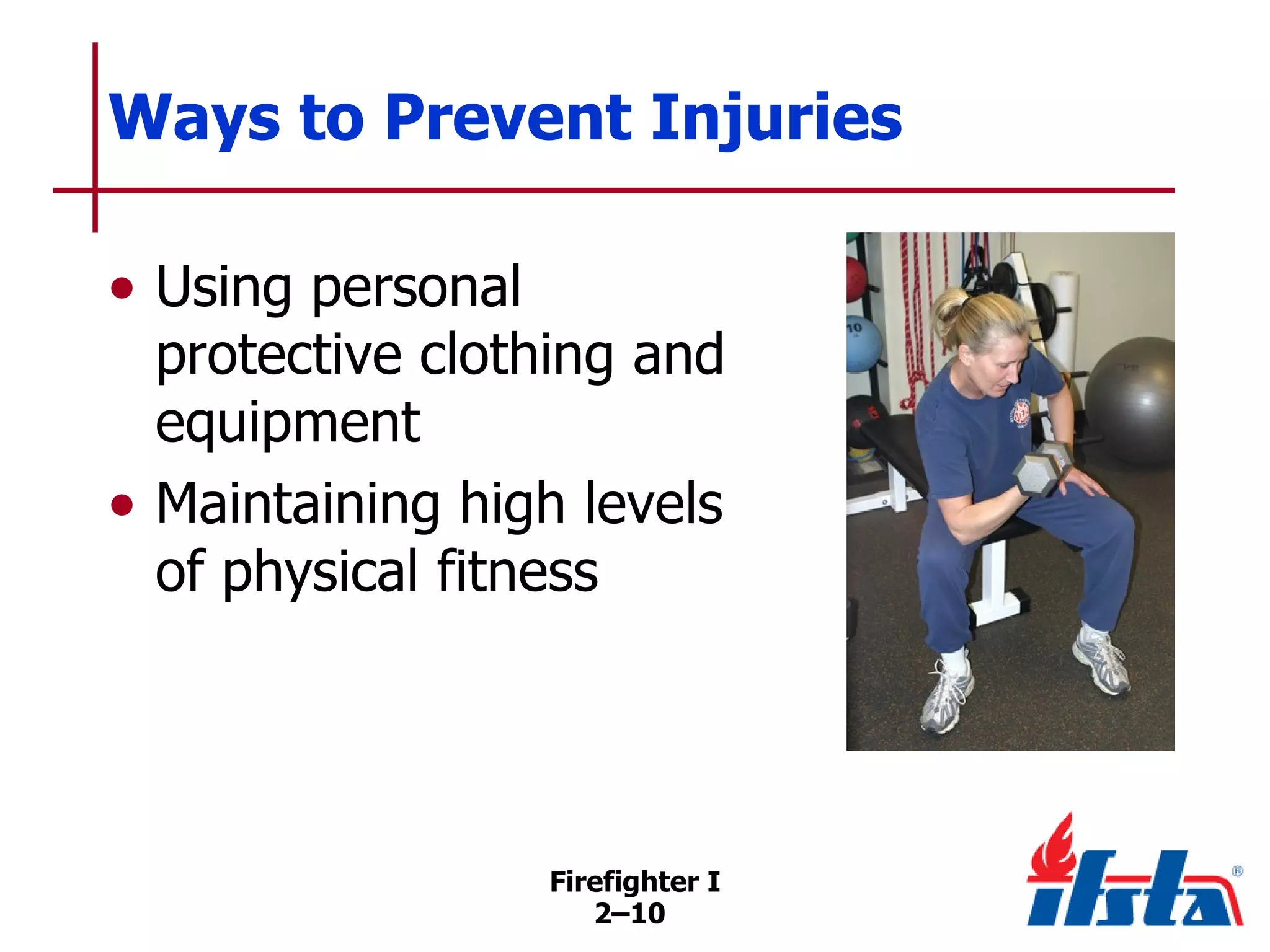
• Using personal
  protective clothing and
  equipment
• Maintaining high levels
  of physical fitness


                   Firefighter I
                      2–10
DISCUSSION QUESTION


 What do you think causes the greatest
 number of firefighter injuries?


                Firefighter I
                   2–11
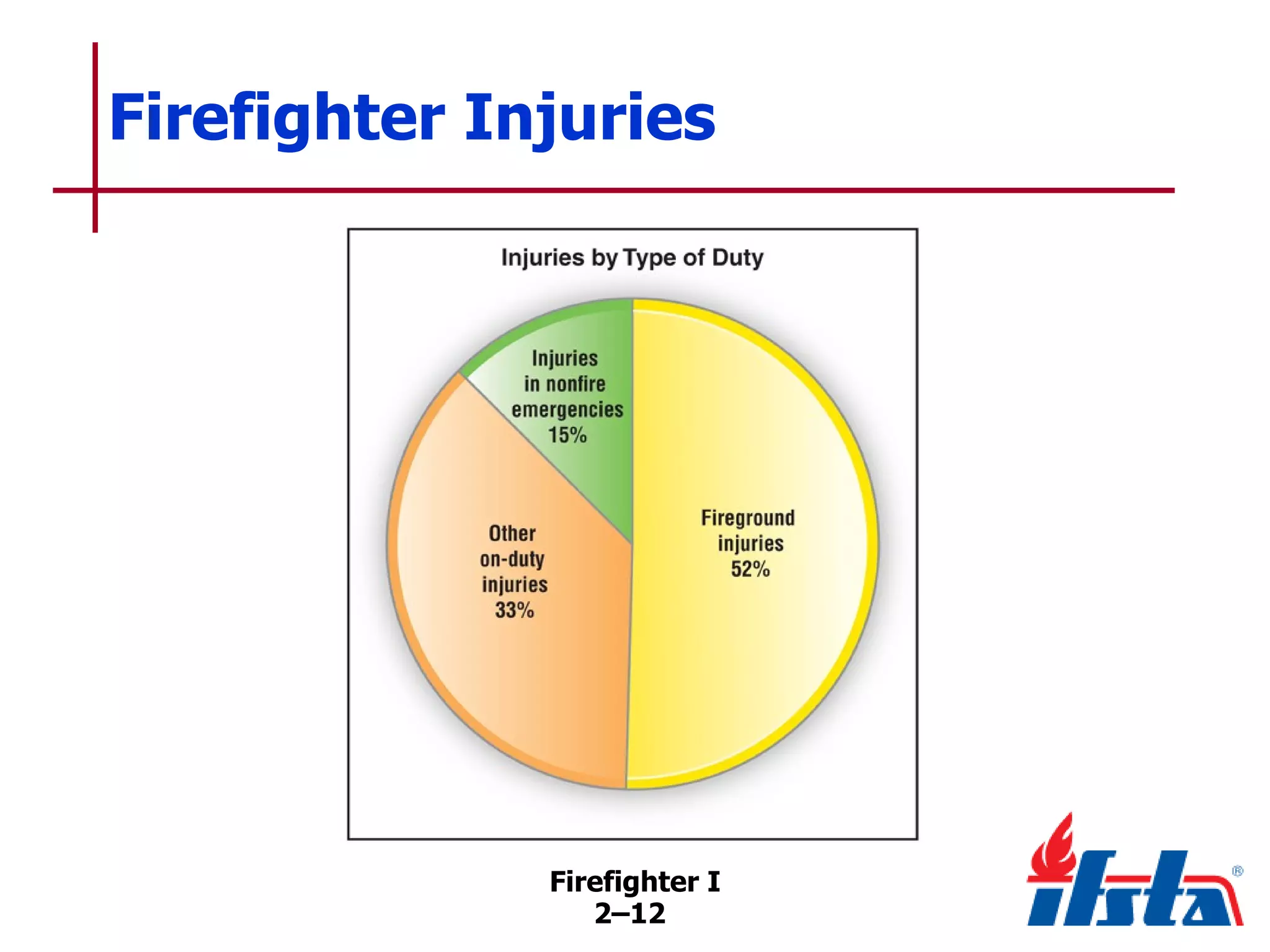
Firefighter Injuries


              Firefighter I
                 2–12
NFPA® Standards

• Relate to firefighter safety and health
• Consensus documents; not law unless
  adopted by governing body
• Many U.S. and Canadian governing
  bodies have adopted some NFPA®
  standards; others have not


                  Firefighter I
                     2–13
NFPA® 1500

• Most comprehensive firefighter safety
  and health standard
• Specifies fire department safety and
  health program minimum requirements
• Applied to any fire department or
  similar organization

                                     (Continued)


                 Firefighter I
                    2–14
NFPA® 1500

• Fire departments should:
  – Recognize safety and health as official
    objectives
  – Provide as healthy and safe work
    environment as possible


                                              (Continued)


                   Firefighter I
                      2–15
NFPA® 1500

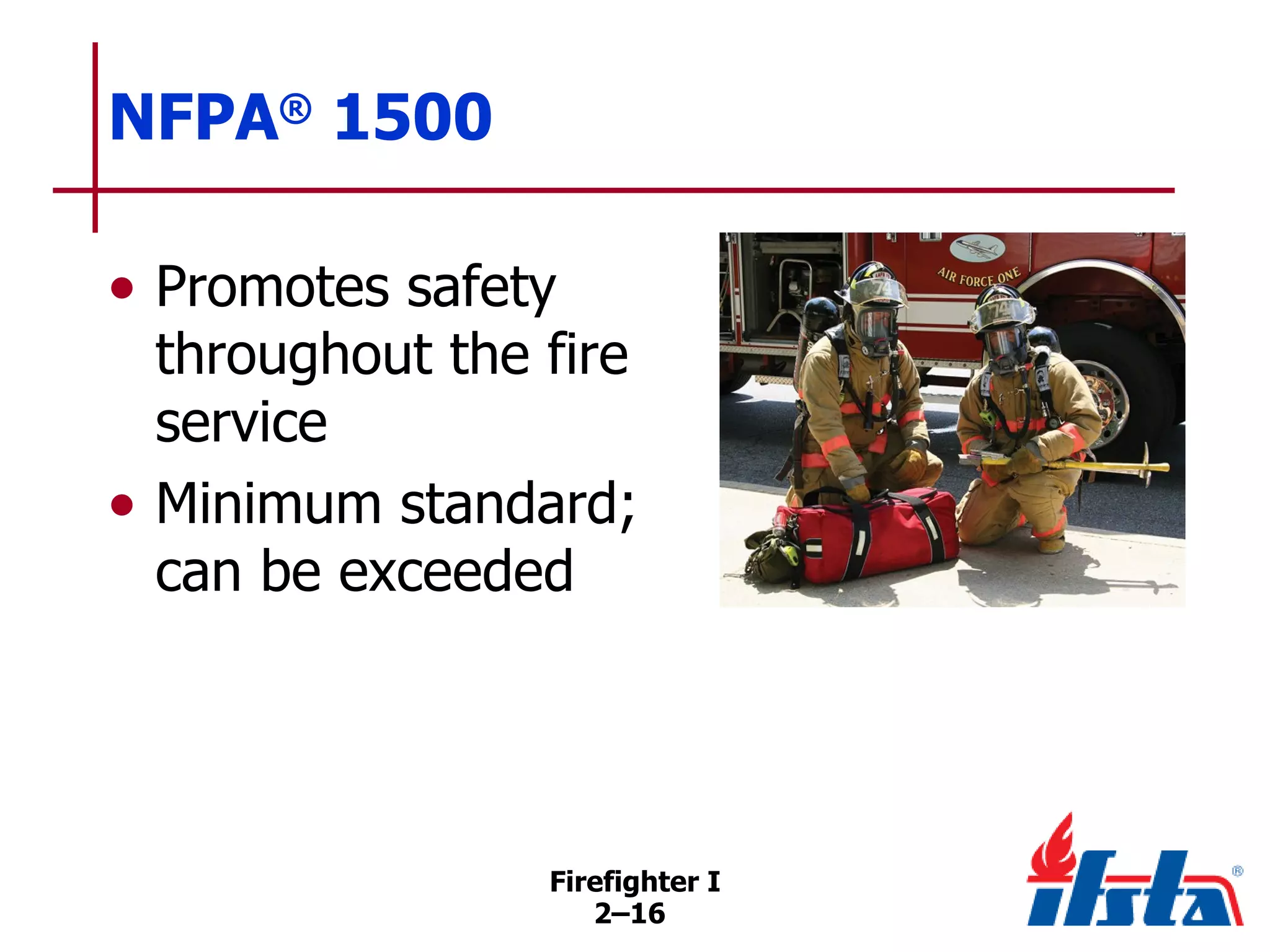
• Promotes safety
  throughout the fire
  service
• Minimum standard;
  can be exceeded


                 Firefighter I
                    2–16
NFPA® 1500 Topics

• Safety and health-related policies and
  procedures
• Training and education
• Fire apparatus, equipment, and
  driver/operators
• Protective clothing and protective
  equipment
                                       (Continued)


                  Firefighter I
                     2–17
NFPA® 1500 Topics

• Emergency operations
• Facility safety
• Medical and physical requirements
• Member assistance and wellness
  programs
• Critical incident stress management
  program

                 Firefighter I
                    2–18
NFPA® 1500 — Safety and Health-
Related Policies and Procedures

• Fire departments must:
  – Develop an organizational plan, risk
    management plan, safety and health policy
  – Define roles and responsibilities
  – Establish safety and health committee
  – Keep records
  – Appoint a health and safety officer
                                         (Continued)


                  Firefighter I
                     2–19
NFPA® 1500 — Safety and Health-
Related Policies and Procedures

• Safety and health program must:
  – Address anticipated hazards
  – Include provisions for dealing with
    nonemergency issues
  – Include SOPs


                   Firefighter I
                      2–20
NFPA® 1500 — Training and
Education

• Goal must be to prevent occupational
  deaths, injuries and illnesses
• Training — Developing and
  maintaining job skills
• Education — Learning new
  information, concepts, and procedures

                                    (Continued)


                 Firefighter I
                    2–21
NFPA® 1500 — Training and
Education

• Train and educate personnel to consider
  safety in all activities
• Safety must be reinforced


                 Firefighter I
                    2–22
NFPA® 1500 — Fire Apparatus,
Equipment, and Driver/Operators

• Safety and health must be primary
 considerations for apparatus
  – Providing restraint devices
  – Meeting requirements for vehicle’s
    intended role
• All apparatus driver/operators must be
 trained
                                         (Continued)


                   Firefighter I
                      2–23
NFPA® 1500 — Fire Apparatus,
Equipment, and Driver/Operators

• Personnel riding in apparatus must be
 seated and securely belted inside the
 cab when in motion; three exceptions:
  – Hose loading
  – Tiller training
  – Some EMS operations

                                     (Continued)


                 Firefighter I
                    2–24
NFPA® 1500 — Fire Apparatus,
Equipment, and Driver/Operators

• If noise levels exceed 90 decibels (85
 dB in Canada), hearing protection must
 be worn.


                  Firefighter I
                     2–25
NFPA® 1500 — Protective Clothing
and Protective Equipment

• Departments must provide at least one
  set of protective clothing and protective
  equipment
• Protective clothing
  – Helmet
  – Hood and/or shroud
  – Coat
  – Pants                              (Continued)


                  Firefighter I
                     2–26
NFPA® 1500 — Protective Clothing
and Protective Equipment

• Protective clothing
  – Safety shoes or boots
  – Gloves
  – Goggles or safety glasses
  – Personal alert safety system (PASS) device


                                          (Continued)


                   Firefighter I
                      2–27
NFPA® 1500 — Protective Clothing
and Protective Equipment

• Protective equipment
  – SCBA
  – SAR
  – Other respiratory protection
  – May refer to body armor


                   Firefighter I
                      2–28
NFPA® 1500 — Emergency
Operations

• Requires an incident management
 system
  – Most use NIMS-ICS
  – Risk management
  – Personnel accountability


                                    (Continued)


                   Firefighter I
                      2–29
NFPA® 1500 — Emergency
Operations

• Limits emergency
 operations to those
 that can be safely
 conducted


                                (Continued)


                Firefighter I
                   2–30
NFPA® 1500 — Emergency
Operations

• NFPA® 1500 requires
  – Rapid intervention
  – Rehabilitation
  – Limiting exposure to violence
  – Postincident analysis


                                    (Continued)


                   Firefighter I
                      2–31
NFPA® 1500 — Emergency
Operations

• Both NFPA® 1500 and NFPA® 1561
 contain specific requirements regarding
 accountability


                Firefighter I
                   2–32
NFPA® 1500 — Facility Safety

• Sets minimum design requirements that
  meet NFPA® 101®, Life Safety Code®
• Provides a means for cleaning,
  disinfecting, and storing infection
  control devices


                                    (Continued)


                Firefighter I
                   2–33
NFPA® 1500 — Facility Safety

• Fire stations must be smoke-free
  environments
• Requires inspection, maintenance, and
  prompt repair of facilities


                 Firefighter I
                    2–34
NFPA® 1500 — Medical and
Physical Requirements

• Candidates must be medically evaluated
• Prohibits firefighters under the influence
  from participating
• Physical performance standards


                                       (Continued)


                  Firefighter I
                     2–35
NFPA® 1500 — Medical and
Physical Requirements

• Annual medical verification for fitness
  for duty
• Establishment of job-related fitness
  standards and fitness program
• Confidential health database

                                         (Continued)


                  Firefighter I
                     2–36
NFPA® 1500 — Medical and
Physical Requirements

• Infection control program
• Designated fire department physician
• Reporting and documenting injuries and
 exposures


                Firefighter I
                   2–37
NFPA® 1500 — Member Assistance
and Wellness Programs

• Member assistance program
  – Substance abuse
  – Stress
  – Personal problems
• Wellness program


                  Firefighter I
                     2–38
DISCUSSION QUESTION


 What other NFPA® standards relate to
 firefighter safety and health?


               Firefighter I
                  2–39
OSHA Regulations

• Came from the Williams-Steiger
  Occupational Safety and Health Act in
  1970
• OSHA operates under the U.S.
  Department of Labor


                                     (Continued)


                 Firefighter I
                    2–40
OSHA Regulations

• Sets two duties for employers
  – Furnish a place of employment free from
    recognized hazards likely to cause death or
    serious injury
  – Comply with OSHA standards
• Federal OSHA regulations
  – Apply to federal employees and private-
    sector employees                      (Continued)


                    Firefighter I
                       2–41
OSHA Regulations

• Federal OSHA has no jurisdiction over
 local and state public-sector firefighters
  – OSHA-approved state plans cover them
  – State plans may differ; must provide
    equivalent protection
  – Agencies may choose to follow OSHA
    standards


                 Firefighter I
                    2–42
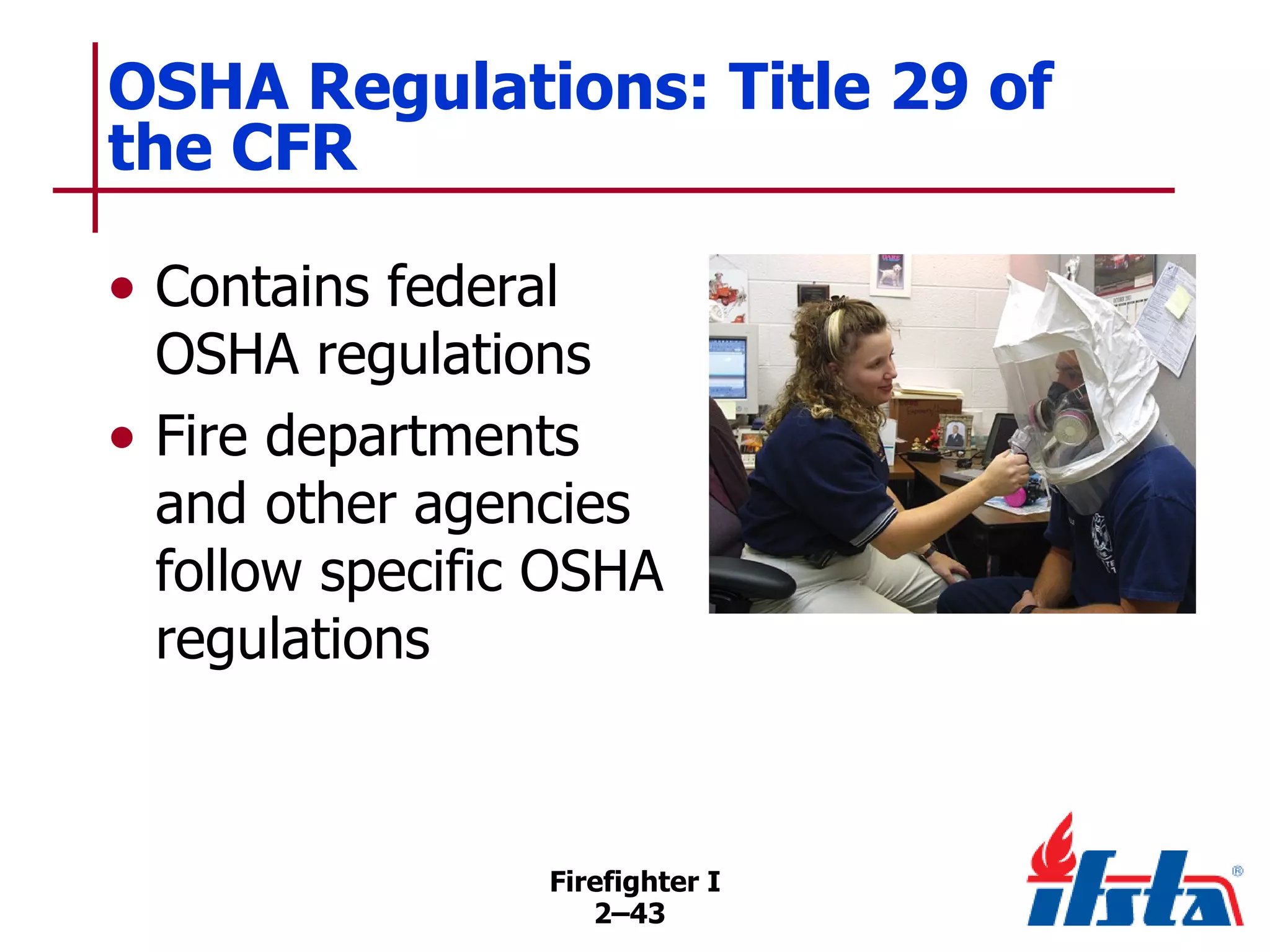
OSHA Regulations: Title 29 of
the CFR

• Contains federal
  OSHA regulations
• Fire departments
  and other agencies
  follow specific OSHA
  regulations


                 Firefighter I
                    2–43
IFSTA Principles of Risk
Management — Development

• NFPA® 1500 requires incident
  management systems to include a risk
  management plan
• Risk management plan
  – Established set of criteria
  – Tactical decisions can be made

                                     (Continued)


                  Firefighter I
                     2–44
IFSTA Principles of Risk
Management — Development

• Considered three prominent plans
  – Phoenix, AZ
  – NFPA® 1500
  – “Ten Rules of Engagement for Structural
    Fire Fighting” (IAFC)


                  Firefighter I
                     2–45
IFSTA Principles of Risk
Management


             Firefighter I
                2–46
IFSTA Principles of Risk
Management — Key Points

• Team integrity is vital to safety
• No property is worth the life of a
  firefighter
• Firefighters should not be committed to
  interior operations in abandoned or
  derelict buildings known or believed to
  be unoccupied

                  Firefighter I
                     2–47
DISCUSSION QUESTION


 Why do you feel these principles are
 important to the fire service?


                Firefighter I
                   2–48
Fireground Priority

• Highest priority is for firefighters to
  protect their lives and those of their
  fellow firefighters
  – If a firefighter is injured, unable to help
    others, other firefighters must respond to
    the injured firefighter


                    Firefighter I
                       2–49
Safety Program Goals

• Prevent human suffering, deaths,
 injuries, illnesses, and exposures to
 hazardous atmospheres and contagious
 diseases


                                     (Continued)


                 Firefighter I
                    2–50
Safety Program Goals

              • Prevent damage to
                or loss of equipment
              • Reduce incidence
                and severity of
                accidents and
                hazardous exposures


            Firefighter I
               2–51
DISCUSSION QUESTION


 What do you do to help maintain your
 personal health?


               Firefighter I
                  2–52
Firefighter Health
Considerations

• Stay informed about job-related health
  issues.
• Wear PPE and respiratory protection.
• Clean PPE.
• Follow hepatitis B vaccination
  recommendations.
                                     (Continued)


                 Firefighter I
                    2–53
Firefighter Health
Considerations

               • Use precautions to
                 avoid exposure to
                 bloodborne
                 pathogens.
               • Use proper lifting
                 techniques.

                                  (Continued)


              Firefighter I
                 2–54
Firefighter Health
Considerations

• Use lifting tools or get assistance with
  heavy objects.
• Clean, disinfect, and store tools and
  equipment used in patient care.
• Maintain a regular exercise program.

                                        (Continued)


                  Firefighter I
                     2–55
Firefighter Health
Considerations

• Maintain a diet low in cholesterol, fat,
  and sodium.
• Maintain blood pressure and cholesterol
  levels.
• Eliminate tobacco products.
• Have regular physicals and checkups.


                  Firefighter I
                     2–56
Employee Assistance Program
(EAP)

• Offers confidential assistance
  – Alcohol and drug abuse
  – Personal and interpersonal problems
  – Stress
  – Depression
  – Anxiety
  – Divorce
  – Financial problems
                  Firefighter I
                     2–57
Wellness Program

• Health-related problems
  – Nutrition
  – Hypertension
  – Cessation of tobacco use
  – Weight control
  – Physical conditioning


                  Firefighter I
                     2–58
Availability of EAP and Wellness
Programs

              • Available to all
                members and their
                families
              • Include appropriate
                referrals


                                   (Continued)


             Firefighter I
                2–59
Availability of EAP and Wellness
Programs

• Provide counseling and education on
  health concerns
• Allow easy, confidential access to help
• Distribute pamphlets and flyers
• Make services available to family


                  Firefighter I
                     2–60
Critical Incident Stress
Management (CISM)

• A critical incident
  stress debriefing
  should be part of
  the CISM program


                                   (Continued)


                   Firefighter I
                      2–61
Critical Incident Stress
Management (CISM)

• Process of managing stress starts
  before through prebriefing
• If working more than one shift in
  stressful conditions, go through a minor
  debriefing


                 Firefighter I
                    2–62
Riding on the Apparatus

• One of the most common dangers for
  firefighters
• Most departments require all protective
  clothing on when entering cab
• Some departments allow
  driver/operators to wait to don coats
  and helmets
                                     (Continued)


                 Firefighter I
                    2–63
Riding on the Apparatus

             • NFPA® 1500 requires
                  – Firefighters to ride in a
                    seat within the cab
                  – Have seatbelts
                    fastened


                                        (Continued)


             Firefighter I
                2–64
Riding on the Apparatus

             • Hearing protection is
                needed if sirens and
                engine noise levels
                exceed 90 decibels
                (85 dB in Canada)


                                  (Continued)


             Firefighter I
                2–65
Riding on the Apparatus

• Volunteers responding in own vehicles
  should use defensive driving
• If riding in an unenclosed jump seat,
  use safety bars and wear appropriate
  PPE


                                     (Continued)


                 Firefighter I
                    2–66
Riding on the Apparatus

• In most cases, use steps
 and handrails when
 mounting and
 dismounting


                 Firefighter I
                    2–67
Safety in the Fire Station —
Personnel Safety

• Improper lifting techniques cause
  – Back strains
  – Bruises, sprains, and fractures
  – Damaged equipment


                                      (Continued)


                   Firefighter I
                      2–68
Safety in the Fire Station —
Personnel Safety

• Correct lifting
  techniques
  – Keep the back
    straight; lift with the
    legs
  – Do not lift or carry
    heavy or bulky
    objects without help
                                     (Continued)


                     Firefighter I
                        2–69
Safety in the Fire Station —
Personnel Safety

• Slip, trip, or fall
   – Poor footing
   – Minor or serious
     injuries; damaged
     equipment
   – Good housekeeping
     can prevent


                        Firefighter I
                           2–70
Safety in the Fire Station — Tool
and Equipment Safety

• Accidents can happen if firefighters are
  not properly trained.
• Poorly maintained tools and equipment
  can be dangerous.
• NFPA® 1500 stresses tool safety.
• Always use appropriate PPE.


                  Firefighter I
                     2–71
Hand and Small Power Tool
Safety

• Wear appropriate PPE.
• Remove loose clothing and keep long
  hair clear of operating tool heads.
• Remove jewelry.
• Select the appropriate tool.
• Follow manufacturer’s instructions.
                                        (Continued)


                 Firefighter I
                    2–72
Hand and Small Power Tool
Safety

• Inspect tools before use.
• Do not use badly worn or broken tools.
• Provide adequate storage space and
  return tools after use.
• Inspect, clean, and put all tools in a
  ready state before storing.
                                           (Continued)


                  Firefighter I
                     2–73
Hand and Small Power Tool
Safety

• Consult with manufacturer before
  modifying any tool.
• Use intrinsically safe tools in flammable
  atmospheres.
• Do not remove safety shields or
  compromise built-in safety devices.


                  Firefighter I
                     2–74
Power Tool Safety

• Grinders, drills,
  saws, and welding
  equipment are
  common
• If improperly used
  can cause serious or
  life-threatening
  injury                              (Continued)


                      Firefighter I
                         2–75
Power Tool Safety

• Only firefighters who have read and
  understand manufacturer’s instructions
  should use power tools.
• Tool repairs must be made by a trained
  and authorized person.


                                        (Continued)


                 Firefighter I
                    2–76
Power Tool Safety

• Keep accurate
  records of repairs.
• Any electrical tool
  not marked “double
  insulated” should
  have a three-prong
  plug

                  Firefighter I
                     2–77
Power Saw Safety

• Match the saw to the task and material
  to be cut.
• Never force a saw beyond its design
  limitations.
• Wear proper PPE.
• Remove loose clothing and contain long
  hair.
                                     (Continued)

                 Firefighter I
                    2–78
Power Saw Safety

• Have hoselines when cutting materials
  that generate sparks.
• Avoid using in potentially flammable
  atmospheres.
• Keep bystanders out of work area.
• Follow manufacturer’s procedures.
                                         (Continued)

                 Firefighter I
                    2–79
Power Saw Safety

• Allow gasoline-powered saws to cool
  before refueling.
• Keep blades and cutting chains well
  sharpened.
• Use extreme caution when operating
  any saw above eye level.


                Firefighter I
                   2–80
Safety in Training

• Always wear appropriate protective
  gear.
• Refer trainees with symptoms to a
  physician prior to participation.
• Take into account environmental
  conditions.

                                       (Continued)

                 Firefighter I
                    2–81
Safety in Training

• Do NOT allow
 horseplay or
 unprofessional
 conduct.


                  Firefighter I
                     2–82
Safety in Training — Live Fire
Exercises

• Must be conducted according to NFPA®
  1403
• Key requirements of NFPA         ®
                                       1403
  – Site preparation
     –Clear site of potential hazards


                                              (Continued)

                   Firefighter I
                      2–83
Safety in Training — Live Fire
Exercises

• Key safety requirements of NFPA ®
 1403
  – Student-to-instructor ratio of 5:1 may not
    be exceeded
  – Must be a designated safety officer and an
    instructor-in-charge
  – Cannot use human beings as victims
                                          (Continued)

                   Firefighter I
                      2–84
Safety in Training — Live Fire
Exercises

• Key safety requirements of NFPA® 1403
  – Fires may not be set in egress routes
  – Uniforms and PPE must conform to NFPA®
    standards


                                      (Continued)

                 Firefighter I
                    2–85
Safety in Training — Live Fire
Exercises

• Key requirements of NFPA® 1403
  – Prerequisite training — All participants
    must have had basic fire training
  – Water supply — Adequate supply must be
    provided; separate for attack and backup
    lines


                                         (Continued)

                  Firefighter I
                     2–86
Safety in Training — Live Fire
Exercises

• Key requirements
 of NFPA® 1403
  – Training plan —
    Must be prepared
    and a briefing held


                                   (Continued)

                   Firefighter I
                      2–87
Safety in Training — Live Fire
Exercises

• Key requirements of NFPA® 1403
  – Fuel — Must have known burning
    characteristics
  – Ventilation — Means must be provided to
    prevent uncontrolled flashover and
    backdraft


                  Firefighter I
                     2–88
Maintain and Service Equipment

• Equipment for fire training
  – Must be in good condition
  – Frequently wears out sooner
  – Should be inspected before each drill


                                            (Continued)

                   Firefighter I
                      2–89
Maintain and Service Equipment

• Records and testing
  – Records must be maintained on all
    equipment for training
  – Training equipment should be tested
    according to:
     –Manufacturer’s instructions
     –Applicable standards


                  Firefighter I
                     2–90
Emergency Scene Preparedness

• Accidents or injuries at emergencies
  – Often caused by a series of events
  – Can be prevented by being in a ready state


                  Firefighter I
                     2–91
Actions for Preparedness:
Beginning Work Shift

• Be in the proper uniform, physically
  rested, and mentally alert
• Ensure all tools and equipment are in
  place and working
• Ensure PPE is in proper location.


                                         (Continued)

                 Firefighter I
                    2–92
Actions for Preparedness:
Beginning Work Shift

• Ensure SCBA is fully functional.
• Ensure EMS equipment is checked and
 restocked.


                Firefighter I
                   2–93
Actions for Preparedness: In the
Fire Station

• Firefighters must never put themselves
  in a position to delay response.
• When alarm sounds, stay calm and
  listen to dispatch
• Quickly and calmly mount apparatus


                 Firefighter I
                    2–94
Actions for Preparedness: Any
Stage of an Emergency

• If a firefighter is out of balance, he or
  she must correct the situation before
  going on to the next stage
• Firefighters must never operate in a
  manner that makes them a part of the
  emergency or creates a new one.


                   Firefighter I
                      2–95
Emergency Scene Safety

• Incident Commander (IC)
  – Officer of the first-arriving unit begins to
    control incident by assuming Command
    and using an incident management system


                                           (Continued)

                   Firefighter I
                      2–96
Emergency Scene Safety

• Initial IC must size up critical factors
  – Life safety hazards
  – Nature and extent of emergency
  – Building type, arrangement, and access
  – Resources
  – Special hazards

                                         (Continued)

                   Firefighter I
                      2–97
Emergency Scene Safety

• IC must determine
 overall incident
 strategy
  – Offensive operations
  – Defensive operations


                                    (Continued)

                    Firefighter I
                       2–98
Incident Action Plan

• IC develops IAP and bases operations
  around completion of tactical priorities
• Tactical priorities in a structure fire
  – Firefighter safety
  – Rescue
  – Fire control
  – Loss control
                                       (Continued)

                    Firefighter I
                       2–99
Incident Action Plan

• Priority objectives are reflected in
  benchmarks of completion
  – Personnel Accountability Report (PAR)
  – All Clear
  – Under Control
  – Loss Stopped


                   Firefighter I
                      2–100
Offensive Fire Operations

• Based around a controlled, aggressive
  interior search and fire attack
• Companies must be assigned according
  to fireground organizational structure
• Must work with the IAP

                                     (Continued)


                 Firefighter I
                    2–101
Offensive Fire Operations

• Company members inside hazard zone
 must be within contact with each other
 at all times.
  – Voice
  – Vision
  – Physical

                                    (Continued)


                Firefighter I
                   2–102
Offensive Fire Operations

• Companies must have at least one
  portable radio on correct tactical
  channel.
• After primary All Clear and Under
  Control are complete, efforts must be
  focused on controlling loss.


                 Firefighter I
                    2–103
Defensive Operations

• Based on:
  – Determining boundaries of hazard zone
  – Potential collapse zone
  – Keeping companies out of these boundaries
• Highest priority on all defensive fires is
  firefighter safety.


                   Firefighter I
                      2–104
Minimizing Risks

• Work within the IAP.
• Adequately assess the situation and
  maintain situational awareness.
• Wear appropriate PPE.
• Work together as a team.
• Follow all departmental SOPs.
                                        (Continued)


                 Firefighter I
                    2–105
Minimizing Risks

• Maintain communications with team
  members and Command.
• Do a risk/benefit analysis for every
  action.
• Employ safe and effective tactics.
• Use a personnel accountability system.
                                      (Continued)


                 Firefighter I
                    2–106
Minimizing Risks

• Have one or more RICs standing by.
• Set up Rehab.
• Use appropriate emergency escape
  techniques.
• Maintain company discipline and team
  integrity.


                Firefighter I
                   2–107
Highway Incident Guidelines

• Position fire
  apparatus to block
  oncoming traffic.
• Turn front wheels of
  blocking apparatus
  away from
  emergency.
                                  (Continued)


                  Firefighter I
                     2–108
Highway Incident Guidelines

• Set out traffic cones, signs, or other
  devices to detour traffic.
• Turn off lights that face opposing traffic.
• Emergency responders must never walk
  with their backs to the traffic.


                                           (Continued)


                  Firefighter I
                     2–109
Highway Incident Guidelines

• Wear reflective vests when PPE is not
  required.
• Close at least one traffic lane next to
  incident.
• Move apparatus not directly involved to
  the shoulder or off roadway.


                 Firefighter I
                    2–110
DISCUSSION QUESTION


 What precautions have you noticed
 emergency responders taking at vehicle
 accidents?


                Firefighter I
                   2–111
Crowd Control

• Usually responsibility of law
  enforcement
• Sometimes performed by firefighters or
  emergency responders
• IC is responsible for ensuring scene is
  secured and managed.

                                     (Continued)


                  Firefighter I
                     2–112
Crowd Control

• Bystanders should be restrained from
 getting too close
  – People can be emotional
  – Restrain relatives and friends


                   Firefighter I
                      2–113
Cordoning Off

• Maintain scene security by cordoning off

• Keep bystanders at a safe distance


                                       (Continued)


                 Firefighter I
                    2–114
Cordoning Off


            Firefighter I
               2–115
Cordoning Off

            • Can be done with rope
              or fireline or caution
              tape
            • Boundary should be
              monitored


            Firefighter I
               2–116
Personnel Accountability

• Every department must
 use some system of
 accountability that
 tracks personnel in the
 hazard zone


                                (Continued)


                Firefighter I
                   2–117
Personnel Accountability

• Accountability is vital
  – Sudden and unexpected change in fire
    behavior
  – Structural collapse
• Personnel accountability systems
  – Passport system
  – SCBA tag system


                   Firefighter I
                      2–118
Interior Operations Techniques

• Scan the outside of the building before
  entry.
• Wear full PPE including SCBA.
• Take appropriate tools and equipment.
• Maintain team integrity.

                                      (Continued)


                 Firefighter I
                    2–119
Interior Operations Techniques

• Remain in radio contact.
• Take a hoseline or tag line.
• Pay attention to surroundings.


                                   (Continued)


                 Firefighter I
                    2–120
Interior Operations Techniques

• Increase chances for survival
  – Maintain situational awareness.
  – Know protocol for Mayday.


                   Firefighter I
                      2–121
Emergency Escape

• Involves breaking
 through doors,
 windows, or walls to
 escape life-
 threatening
 situations


                                 (Continued)

                 Firefighter I
                    2–122
Emergency Escape

• Situations can occur when:
  – Sudden and unexpected change in fire
    behavior
  – Structural collapse
• May also be necessary if a firefighter
 becomes lost or disoriented and is in
 danger of running out of air

                  Firefighter I
                     2–123
Rapid Intervention

• NFPA® and OSHA regulations state that
 whenever firefighters are in an IDLH
 atmosphere:
  – Must work in teams of two or more
  – At least two fully trained and equipped
    firefighters must be outside

                                              (Continued)


                   Firefighter I
                      2–124
Rapid Intervention

• Outside team must
  be ready at a
  moment’s notice
• Known as the “two-
  in/two-out” rule


                                (Continued)


                Firefighter I
                   2–125
Rapid Intervention

• RIC members may be assigned other
 duties but must be able to fulfill primary
 function.


                 Firefighter I
                    2–126
Summary

• Firefighters are sometimes put at some
 risk during training and emergency
 operations. It is the firefighters’
 responsibility to maintain their physical
 and mental readiness to handle these
 situations.

                                       (Continued)


                 Firefighter I
                    2–127
Summary

• During fires and other emergencies,
 firefighters may be ordered into
 inherently dangerous situations, and to
 protect themselves they must be aware
 of the hazards and risks involved.


                                        (Continued)


                 Firefighter I
                    2–128
Summary

• Firefighters must always remember that
 along with their department they are
 responsible for their own safety. And
 firefighters must remember the most
 fundamental of all firefighter safety
 rules: Everyone looks out for everyone
 else.


                Firefighter I
                   2–129
Review Questions

  1.     What are three ways to prevent
  firefighter injuries?
  2.     What NFPA® standard specifies
  the minimum requirements for a fire
  department safety and health
  program?
  3.     What are the three IFSTA
  Principles of Risk Management? (Continued)
                Firefighter I
                   2–130
Review Questions

  4.      What are three guidelines that
  can help firefighters maintain their
  personal health?
  5.      What can firefighters do to help
  prevent slips, trips, and falls in the
  fire station?
                                      (Continued)


                Firefighter I
                   2–131
Review Questions

  6.      What are two safety rules for
  hand tools and small power tools?
  7.      What are two safety rules for
  power saws?
  8.      What NFPA® standard must live
  fire training exercises meet?

                                   (Continued)


               Firefighter I
                  2–132
Review Questions

  9.    What is one type of personnel
  accountability system?
  10. What are two basic interior
  operations techniques?


               Firefighter I
                  2–133

Chapter 02: Firefighter Safety and Health

  • 1.
    Essentials of FireFighting, 5th Edition Chapter 2 — Firefighter Safety and Health Firefighter I
  • 2.
    Chapter 2 LessonGoal • After completing this lesson, the student shall be able to apply firefighter safety and health practices following the policies and procedures set forth by the authority having jurisdiction (AHJ). Firefighter I 2–2
  • 3.
    Specific Objectives 1. List ways to prevent firefighter injuries. 2. Discuss National Fire Protection Association standards related to firefighter health and safety. 3. Discuss Occupational Safety and Health Administration regulations. (Continued) Firefighter I 2–3
  • 4.
    Specific Objectives 4. Summarize the IFSTA Principles of Risk Management. 5. List the main goals of a safety program. 6. Discuss firefighter health considerations and employee assistance and wellness programs. (Continued) Firefighter I 2–4
  • 5.
    Specific Objectives 7. List guidelines for riding safely on the apparatus. 8. Discuss safety in the fire station. 9. Describe ways to maintain safety in training. 10. Explain how to maintain and (Continued) service equipment used in training. Firefighter I 2–5
  • 6.
    Specific Objectives 11. Discuss emergency scene preparedness. 12. Discuss emergency scene safety. 13. Summarize general guidelines for scene management including highway incidents, crowd control, and cordoning off emergency scenes. (Continued) Firefighter I 2–6
  • 7.
    Specific Objectives 14. Explain the importance of personnel accountability. 15. Summarize basic interior operations techniques. 16. Describe emergency escape and rapid intervention. (Continued) Firefighter I 2–7
  • 8.
    Specific Objectives 17. Respond to an incident, correctly mounting and dismounting an apparatus. (Skill Sheet 2-I-1) 18. Set up and operate in work areas at an incident using traffic and scene control devices. (Skill Sheet 2- I-2) Firefighter I 2–8
  • 9.
    Ways to PreventInjuries • Conducting effective training • Maintaining company discipline and accountability • Following established SOPs (Continued) Firefighter I 2–9
  • 10.
    Ways to PreventInjuries • Using personal protective clothing and equipment • Maintaining high levels of physical fitness Firefighter I 2–10
  • 11.
    DISCUSSION QUESTION Whatdo you think causes the greatest number of firefighter injuries? Firefighter I 2–11
  • 12.
    Firefighter Injuries Firefighter I 2–12
  • 13.
    NFPA® Standards • Relateto firefighter safety and health • Consensus documents; not law unless adopted by governing body • Many U.S. and Canadian governing bodies have adopted some NFPA® standards; others have not Firefighter I 2–13
  • 14.
    NFPA® 1500 • Mostcomprehensive firefighter safety and health standard • Specifies fire department safety and health program minimum requirements • Applied to any fire department or similar organization (Continued) Firefighter I 2–14
  • 15.
    NFPA® 1500 • Firedepartments should: – Recognize safety and health as official objectives – Provide as healthy and safe work environment as possible (Continued) Firefighter I 2–15
  • 16.
    NFPA® 1500 • Promotessafety throughout the fire service • Minimum standard; can be exceeded Firefighter I 2–16
  • 17.
    NFPA® 1500 Topics •Safety and health-related policies and procedures • Training and education • Fire apparatus, equipment, and driver/operators • Protective clothing and protective equipment (Continued) Firefighter I 2–17
  • 18.
    NFPA® 1500 Topics •Emergency operations • Facility safety • Medical and physical requirements • Member assistance and wellness programs • Critical incident stress management program Firefighter I 2–18
  • 19.
    NFPA® 1500 —Safety and Health- Related Policies and Procedures • Fire departments must: – Develop an organizational plan, risk management plan, safety and health policy – Define roles and responsibilities – Establish safety and health committee – Keep records – Appoint a health and safety officer (Continued) Firefighter I 2–19
  • 20.
    NFPA® 1500 —Safety and Health- Related Policies and Procedures • Safety and health program must: – Address anticipated hazards – Include provisions for dealing with nonemergency issues – Include SOPs Firefighter I 2–20
  • 21.
    NFPA® 1500 —Training and Education • Goal must be to prevent occupational deaths, injuries and illnesses • Training — Developing and maintaining job skills • Education — Learning new information, concepts, and procedures (Continued) Firefighter I 2–21
  • 22.
    NFPA® 1500 —Training and Education • Train and educate personnel to consider safety in all activities • Safety must be reinforced Firefighter I 2–22
  • 23.
    NFPA® 1500 —Fire Apparatus, Equipment, and Driver/Operators • Safety and health must be primary considerations for apparatus – Providing restraint devices – Meeting requirements for vehicle’s intended role • All apparatus driver/operators must be trained (Continued) Firefighter I 2–23
  • 24.
    NFPA® 1500 —Fire Apparatus, Equipment, and Driver/Operators • Personnel riding in apparatus must be seated and securely belted inside the cab when in motion; three exceptions: – Hose loading – Tiller training – Some EMS operations (Continued) Firefighter I 2–24
  • 25.
    NFPA® 1500 —Fire Apparatus, Equipment, and Driver/Operators • If noise levels exceed 90 decibels (85 dB in Canada), hearing protection must be worn. Firefighter I 2–25
  • 26.
    NFPA® 1500 —Protective Clothing and Protective Equipment • Departments must provide at least one set of protective clothing and protective equipment • Protective clothing – Helmet – Hood and/or shroud – Coat – Pants (Continued) Firefighter I 2–26
  • 27.
    NFPA® 1500 —Protective Clothing and Protective Equipment • Protective clothing – Safety shoes or boots – Gloves – Goggles or safety glasses – Personal alert safety system (PASS) device (Continued) Firefighter I 2–27
  • 28.
    NFPA® 1500 —Protective Clothing and Protective Equipment • Protective equipment – SCBA – SAR – Other respiratory protection – May refer to body armor Firefighter I 2–28
  • 29.
    NFPA® 1500 —Emergency Operations • Requires an incident management system – Most use NIMS-ICS – Risk management – Personnel accountability (Continued) Firefighter I 2–29
  • 30.
    NFPA® 1500 —Emergency Operations • Limits emergency operations to those that can be safely conducted (Continued) Firefighter I 2–30
  • 31.
    NFPA® 1500 —Emergency Operations • NFPA® 1500 requires – Rapid intervention – Rehabilitation – Limiting exposure to violence – Postincident analysis (Continued) Firefighter I 2–31
  • 32.
    NFPA® 1500 —Emergency Operations • Both NFPA® 1500 and NFPA® 1561 contain specific requirements regarding accountability Firefighter I 2–32
  • 33.
    NFPA® 1500 —Facility Safety • Sets minimum design requirements that meet NFPA® 101®, Life Safety Code® • Provides a means for cleaning, disinfecting, and storing infection control devices (Continued) Firefighter I 2–33
  • 34.
    NFPA® 1500 —Facility Safety • Fire stations must be smoke-free environments • Requires inspection, maintenance, and prompt repair of facilities Firefighter I 2–34
  • 35.
    NFPA® 1500 —Medical and Physical Requirements • Candidates must be medically evaluated • Prohibits firefighters under the influence from participating • Physical performance standards (Continued) Firefighter I 2–35
  • 36.
    NFPA® 1500 —Medical and Physical Requirements • Annual medical verification for fitness for duty • Establishment of job-related fitness standards and fitness program • Confidential health database (Continued) Firefighter I 2–36
  • 37.
    NFPA® 1500 —Medical and Physical Requirements • Infection control program • Designated fire department physician • Reporting and documenting injuries and exposures Firefighter I 2–37
  • 38.
    NFPA® 1500 —Member Assistance and Wellness Programs • Member assistance program – Substance abuse – Stress – Personal problems • Wellness program Firefighter I 2–38
  • 39.
    DISCUSSION QUESTION Whatother NFPA® standards relate to firefighter safety and health? Firefighter I 2–39
  • 40.
    OSHA Regulations • Camefrom the Williams-Steiger Occupational Safety and Health Act in 1970 • OSHA operates under the U.S. Department of Labor (Continued) Firefighter I 2–40
  • 41.
    OSHA Regulations • Setstwo duties for employers – Furnish a place of employment free from recognized hazards likely to cause death or serious injury – Comply with OSHA standards • Federal OSHA regulations – Apply to federal employees and private- sector employees (Continued) Firefighter I 2–41
  • 42.
    OSHA Regulations • FederalOSHA has no jurisdiction over local and state public-sector firefighters – OSHA-approved state plans cover them – State plans may differ; must provide equivalent protection – Agencies may choose to follow OSHA standards Firefighter I 2–42
  • 43.
    OSHA Regulations: Title29 of the CFR • Contains federal OSHA regulations • Fire departments and other agencies follow specific OSHA regulations Firefighter I 2–43
  • 44.
    IFSTA Principles ofRisk Management — Development • NFPA® 1500 requires incident management systems to include a risk management plan • Risk management plan – Established set of criteria – Tactical decisions can be made (Continued) Firefighter I 2–44
  • 45.
    IFSTA Principles ofRisk Management — Development • Considered three prominent plans – Phoenix, AZ – NFPA® 1500 – “Ten Rules of Engagement for Structural Fire Fighting” (IAFC) Firefighter I 2–45
  • 46.
    IFSTA Principles ofRisk Management Firefighter I 2–46
  • 47.
    IFSTA Principles ofRisk Management — Key Points • Team integrity is vital to safety • No property is worth the life of a firefighter • Firefighters should not be committed to interior operations in abandoned or derelict buildings known or believed to be unoccupied Firefighter I 2–47
  • 48.
    DISCUSSION QUESTION Whydo you feel these principles are important to the fire service? Firefighter I 2–48
  • 49.
    Fireground Priority • Highestpriority is for firefighters to protect their lives and those of their fellow firefighters – If a firefighter is injured, unable to help others, other firefighters must respond to the injured firefighter Firefighter I 2–49
  • 50.
    Safety Program Goals •Prevent human suffering, deaths, injuries, illnesses, and exposures to hazardous atmospheres and contagious diseases (Continued) Firefighter I 2–50
  • 51.
    Safety Program Goals • Prevent damage to or loss of equipment • Reduce incidence and severity of accidents and hazardous exposures Firefighter I 2–51
  • 52.
    DISCUSSION QUESTION Whatdo you do to help maintain your personal health? Firefighter I 2–52
  • 53.
    Firefighter Health Considerations • Stayinformed about job-related health issues. • Wear PPE and respiratory protection. • Clean PPE. • Follow hepatitis B vaccination recommendations. (Continued) Firefighter I 2–53
  • 54.
    Firefighter Health Considerations • Use precautions to avoid exposure to bloodborne pathogens. • Use proper lifting techniques. (Continued) Firefighter I 2–54
  • 55.
    Firefighter Health Considerations • Uselifting tools or get assistance with heavy objects. • Clean, disinfect, and store tools and equipment used in patient care. • Maintain a regular exercise program. (Continued) Firefighter I 2–55
  • 56.
    Firefighter Health Considerations • Maintaina diet low in cholesterol, fat, and sodium. • Maintain blood pressure and cholesterol levels. • Eliminate tobacco products. • Have regular physicals and checkups. Firefighter I 2–56
  • 57.
    Employee Assistance Program (EAP) •Offers confidential assistance – Alcohol and drug abuse – Personal and interpersonal problems – Stress – Depression – Anxiety – Divorce – Financial problems Firefighter I 2–57
  • 58.
    Wellness Program • Health-relatedproblems – Nutrition – Hypertension – Cessation of tobacco use – Weight control – Physical conditioning Firefighter I 2–58
  • 59.
    Availability of EAPand Wellness Programs • Available to all members and their families • Include appropriate referrals (Continued) Firefighter I 2–59
  • 60.
    Availability of EAPand Wellness Programs • Provide counseling and education on health concerns • Allow easy, confidential access to help • Distribute pamphlets and flyers • Make services available to family Firefighter I 2–60
  • 61.
    Critical Incident Stress Management(CISM) • A critical incident stress debriefing should be part of the CISM program (Continued) Firefighter I 2–61
  • 62.
    Critical Incident Stress Management(CISM) • Process of managing stress starts before through prebriefing • If working more than one shift in stressful conditions, go through a minor debriefing Firefighter I 2–62
  • 63.
    Riding on theApparatus • One of the most common dangers for firefighters • Most departments require all protective clothing on when entering cab • Some departments allow driver/operators to wait to don coats and helmets (Continued) Firefighter I 2–63
  • 64.
    Riding on theApparatus • NFPA® 1500 requires – Firefighters to ride in a seat within the cab – Have seatbelts fastened (Continued) Firefighter I 2–64
  • 65.
    Riding on theApparatus • Hearing protection is needed if sirens and engine noise levels exceed 90 decibels (85 dB in Canada) (Continued) Firefighter I 2–65
  • 66.
    Riding on theApparatus • Volunteers responding in own vehicles should use defensive driving • If riding in an unenclosed jump seat, use safety bars and wear appropriate PPE (Continued) Firefighter I 2–66
  • 67.
    Riding on theApparatus • In most cases, use steps and handrails when mounting and dismounting Firefighter I 2–67
  • 68.
    Safety in theFire Station — Personnel Safety • Improper lifting techniques cause – Back strains – Bruises, sprains, and fractures – Damaged equipment (Continued) Firefighter I 2–68
  • 69.
    Safety in theFire Station — Personnel Safety • Correct lifting techniques – Keep the back straight; lift with the legs – Do not lift or carry heavy or bulky objects without help (Continued) Firefighter I 2–69
  • 70.
    Safety in theFire Station — Personnel Safety • Slip, trip, or fall – Poor footing – Minor or serious injuries; damaged equipment – Good housekeeping can prevent Firefighter I 2–70
  • 71.
    Safety in theFire Station — Tool and Equipment Safety • Accidents can happen if firefighters are not properly trained. • Poorly maintained tools and equipment can be dangerous. • NFPA® 1500 stresses tool safety. • Always use appropriate PPE. Firefighter I 2–71
  • 72.
    Hand and SmallPower Tool Safety • Wear appropriate PPE. • Remove loose clothing and keep long hair clear of operating tool heads. • Remove jewelry. • Select the appropriate tool. • Follow manufacturer’s instructions. (Continued) Firefighter I 2–72
  • 73.
    Hand and SmallPower Tool Safety • Inspect tools before use. • Do not use badly worn or broken tools. • Provide adequate storage space and return tools after use. • Inspect, clean, and put all tools in a ready state before storing. (Continued) Firefighter I 2–73
  • 74.
    Hand and SmallPower Tool Safety • Consult with manufacturer before modifying any tool. • Use intrinsically safe tools in flammable atmospheres. • Do not remove safety shields or compromise built-in safety devices. Firefighter I 2–74
  • 75.
    Power Tool Safety •Grinders, drills, saws, and welding equipment are common • If improperly used can cause serious or life-threatening injury (Continued) Firefighter I 2–75
  • 76.
    Power Tool Safety •Only firefighters who have read and understand manufacturer’s instructions should use power tools. • Tool repairs must be made by a trained and authorized person. (Continued) Firefighter I 2–76
  • 77.
    Power Tool Safety •Keep accurate records of repairs. • Any electrical tool not marked “double insulated” should have a three-prong plug Firefighter I 2–77
  • 78.
    Power Saw Safety •Match the saw to the task and material to be cut. • Never force a saw beyond its design limitations. • Wear proper PPE. • Remove loose clothing and contain long hair. (Continued) Firefighter I 2–78
  • 79.
    Power Saw Safety •Have hoselines when cutting materials that generate sparks. • Avoid using in potentially flammable atmospheres. • Keep bystanders out of work area. • Follow manufacturer’s procedures. (Continued) Firefighter I 2–79
  • 80.
    Power Saw Safety •Allow gasoline-powered saws to cool before refueling. • Keep blades and cutting chains well sharpened. • Use extreme caution when operating any saw above eye level. Firefighter I 2–80
  • 81.
    Safety in Training •Always wear appropriate protective gear. • Refer trainees with symptoms to a physician prior to participation. • Take into account environmental conditions. (Continued) Firefighter I 2–81
  • 82.
    Safety in Training •Do NOT allow horseplay or unprofessional conduct. Firefighter I 2–82
  • 83.
    Safety in Training— Live Fire Exercises • Must be conducted according to NFPA® 1403 • Key requirements of NFPA ® 1403 – Site preparation –Clear site of potential hazards (Continued) Firefighter I 2–83
  • 84.
    Safety in Training— Live Fire Exercises • Key safety requirements of NFPA ® 1403 – Student-to-instructor ratio of 5:1 may not be exceeded – Must be a designated safety officer and an instructor-in-charge – Cannot use human beings as victims (Continued) Firefighter I 2–84
  • 85.
    Safety in Training— Live Fire Exercises • Key safety requirements of NFPA® 1403 – Fires may not be set in egress routes – Uniforms and PPE must conform to NFPA® standards (Continued) Firefighter I 2–85
  • 86.
    Safety in Training— Live Fire Exercises • Key requirements of NFPA® 1403 – Prerequisite training — All participants must have had basic fire training – Water supply — Adequate supply must be provided; separate for attack and backup lines (Continued) Firefighter I 2–86
  • 87.
    Safety in Training— Live Fire Exercises • Key requirements of NFPA® 1403 – Training plan — Must be prepared and a briefing held (Continued) Firefighter I 2–87
  • 88.
    Safety in Training— Live Fire Exercises • Key requirements of NFPA® 1403 – Fuel — Must have known burning characteristics – Ventilation — Means must be provided to prevent uncontrolled flashover and backdraft Firefighter I 2–88
  • 89.
    Maintain and ServiceEquipment • Equipment for fire training – Must be in good condition – Frequently wears out sooner – Should be inspected before each drill (Continued) Firefighter I 2–89
  • 90.
    Maintain and ServiceEquipment • Records and testing – Records must be maintained on all equipment for training – Training equipment should be tested according to: –Manufacturer’s instructions –Applicable standards Firefighter I 2–90
  • 91.
    Emergency Scene Preparedness •Accidents or injuries at emergencies – Often caused by a series of events – Can be prevented by being in a ready state Firefighter I 2–91
  • 92.
    Actions for Preparedness: BeginningWork Shift • Be in the proper uniform, physically rested, and mentally alert • Ensure all tools and equipment are in place and working • Ensure PPE is in proper location. (Continued) Firefighter I 2–92
  • 93.
    Actions for Preparedness: BeginningWork Shift • Ensure SCBA is fully functional. • Ensure EMS equipment is checked and restocked. Firefighter I 2–93
  • 94.
    Actions for Preparedness:In the Fire Station • Firefighters must never put themselves in a position to delay response. • When alarm sounds, stay calm and listen to dispatch • Quickly and calmly mount apparatus Firefighter I 2–94
  • 95.
    Actions for Preparedness:Any Stage of an Emergency • If a firefighter is out of balance, he or she must correct the situation before going on to the next stage • Firefighters must never operate in a manner that makes them a part of the emergency or creates a new one. Firefighter I 2–95
  • 96.
    Emergency Scene Safety •Incident Commander (IC) – Officer of the first-arriving unit begins to control incident by assuming Command and using an incident management system (Continued) Firefighter I 2–96
  • 97.
    Emergency Scene Safety •Initial IC must size up critical factors – Life safety hazards – Nature and extent of emergency – Building type, arrangement, and access – Resources – Special hazards (Continued) Firefighter I 2–97
  • 98.
    Emergency Scene Safety •IC must determine overall incident strategy – Offensive operations – Defensive operations (Continued) Firefighter I 2–98
  • 99.
    Incident Action Plan •IC develops IAP and bases operations around completion of tactical priorities • Tactical priorities in a structure fire – Firefighter safety – Rescue – Fire control – Loss control (Continued) Firefighter I 2–99
  • 100.
    Incident Action Plan •Priority objectives are reflected in benchmarks of completion – Personnel Accountability Report (PAR) – All Clear – Under Control – Loss Stopped Firefighter I 2–100
  • 101.
    Offensive Fire Operations •Based around a controlled, aggressive interior search and fire attack • Companies must be assigned according to fireground organizational structure • Must work with the IAP (Continued) Firefighter I 2–101
  • 102.
    Offensive Fire Operations •Company members inside hazard zone must be within contact with each other at all times. – Voice – Vision – Physical (Continued) Firefighter I 2–102
  • 103.
    Offensive Fire Operations •Companies must have at least one portable radio on correct tactical channel. • After primary All Clear and Under Control are complete, efforts must be focused on controlling loss. Firefighter I 2–103
  • 104.
    Defensive Operations • Basedon: – Determining boundaries of hazard zone – Potential collapse zone – Keeping companies out of these boundaries • Highest priority on all defensive fires is firefighter safety. Firefighter I 2–104
  • 105.
    Minimizing Risks • Workwithin the IAP. • Adequately assess the situation and maintain situational awareness. • Wear appropriate PPE. • Work together as a team. • Follow all departmental SOPs. (Continued) Firefighter I 2–105
  • 106.
    Minimizing Risks • Maintaincommunications with team members and Command. • Do a risk/benefit analysis for every action. • Employ safe and effective tactics. • Use a personnel accountability system. (Continued) Firefighter I 2–106
  • 107.
    Minimizing Risks • Haveone or more RICs standing by. • Set up Rehab. • Use appropriate emergency escape techniques. • Maintain company discipline and team integrity. Firefighter I 2–107
  • 108.
    Highway Incident Guidelines •Position fire apparatus to block oncoming traffic. • Turn front wheels of blocking apparatus away from emergency. (Continued) Firefighter I 2–108
  • 109.
    Highway Incident Guidelines •Set out traffic cones, signs, or other devices to detour traffic. • Turn off lights that face opposing traffic. • Emergency responders must never walk with their backs to the traffic. (Continued) Firefighter I 2–109
  • 110.
    Highway Incident Guidelines •Wear reflective vests when PPE is not required. • Close at least one traffic lane next to incident. • Move apparatus not directly involved to the shoulder or off roadway. Firefighter I 2–110
  • 111.
    DISCUSSION QUESTION Whatprecautions have you noticed emergency responders taking at vehicle accidents? Firefighter I 2–111
  • 112.
    Crowd Control • Usuallyresponsibility of law enforcement • Sometimes performed by firefighters or emergency responders • IC is responsible for ensuring scene is secured and managed. (Continued) Firefighter I 2–112
  • 113.
    Crowd Control • Bystandersshould be restrained from getting too close – People can be emotional – Restrain relatives and friends Firefighter I 2–113
  • 114.
    Cordoning Off • Maintainscene security by cordoning off • Keep bystanders at a safe distance (Continued) Firefighter I 2–114
  • 115.
    Cordoning Off Firefighter I 2–115
  • 116.
    Cordoning Off • Can be done with rope or fireline or caution tape • Boundary should be monitored Firefighter I 2–116
  • 117.
    Personnel Accountability • Everydepartment must use some system of accountability that tracks personnel in the hazard zone (Continued) Firefighter I 2–117
  • 118.
    Personnel Accountability • Accountabilityis vital – Sudden and unexpected change in fire behavior – Structural collapse • Personnel accountability systems – Passport system – SCBA tag system Firefighter I 2–118
  • 119.
    Interior Operations Techniques •Scan the outside of the building before entry. • Wear full PPE including SCBA. • Take appropriate tools and equipment. • Maintain team integrity. (Continued) Firefighter I 2–119
  • 120.
    Interior Operations Techniques •Remain in radio contact. • Take a hoseline or tag line. • Pay attention to surroundings. (Continued) Firefighter I 2–120
  • 121.
    Interior Operations Techniques •Increase chances for survival – Maintain situational awareness. – Know protocol for Mayday. Firefighter I 2–121
  • 122.
    Emergency Escape • Involvesbreaking through doors, windows, or walls to escape life- threatening situations (Continued) Firefighter I 2–122
  • 123.
    Emergency Escape • Situationscan occur when: – Sudden and unexpected change in fire behavior – Structural collapse • May also be necessary if a firefighter becomes lost or disoriented and is in danger of running out of air Firefighter I 2–123
  • 124.
    Rapid Intervention • NFPA®and OSHA regulations state that whenever firefighters are in an IDLH atmosphere: – Must work in teams of two or more – At least two fully trained and equipped firefighters must be outside (Continued) Firefighter I 2–124
  • 125.
    Rapid Intervention • Outsideteam must be ready at a moment’s notice • Known as the “two- in/two-out” rule (Continued) Firefighter I 2–125
  • 126.
    Rapid Intervention • RICmembers may be assigned other duties but must be able to fulfill primary function. Firefighter I 2–126
  • 127.
    Summary • Firefighters aresometimes put at some risk during training and emergency operations. It is the firefighters’ responsibility to maintain their physical and mental readiness to handle these situations. (Continued) Firefighter I 2–127
  • 128.
    Summary • During firesand other emergencies, firefighters may be ordered into inherently dangerous situations, and to protect themselves they must be aware of the hazards and risks involved. (Continued) Firefighter I 2–128
  • 129.
    Summary • Firefighters mustalways remember that along with their department they are responsible for their own safety. And firefighters must remember the most fundamental of all firefighter safety rules: Everyone looks out for everyone else. Firefighter I 2–129
  • 130.
    Review Questions 1. What are three ways to prevent firefighter injuries? 2. What NFPA® standard specifies the minimum requirements for a fire department safety and health program? 3. What are the three IFSTA Principles of Risk Management? (Continued) Firefighter I 2–130
  • 131.
    Review Questions 4. What are three guidelines that can help firefighters maintain their personal health? 5. What can firefighters do to help prevent slips, trips, and falls in the fire station? (Continued) Firefighter I 2–131
  • 132.
    Review Questions 6. What are two safety rules for hand tools and small power tools? 7. What are two safety rules for power saws? 8. What NFPA® standard must live fire training exercises meet? (Continued) Firefighter I 2–132
  • 133.
    Review Questions 9. What is one type of personnel accountability system? 10. What are two basic interior operations techniques? Firefighter I 2–133