Fire Behavior
Fire Behavior
• Introduction
• Physical Science
– Definition
– Basic Components
– Fire Tetrahedron
– Fire Extinguishment Theory
– Classification of Fires
• Other References
Introduction
• Fire has been both a help and hindrance to
mankind
– heated homes, cooked our food, helped us to
become technologically advanced
• Firefighters should have a basic
understanding of the science of fire and the
factors that affect its ignition, growth, and
spread to perform safely and effectively in
any firefighting function
Physical Science
• Definition
– Fire is a rapid oxidation of combustible materials
accompanied by the released of heat and light at
various intensities.
– Pyrolysis is the chemical change brought about by heat.
• Basic Components:
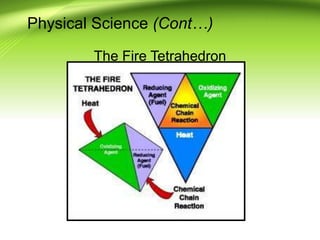
– Oxidizing Agent (Oxygen)
• those materials that yield oxygen or other oxidizing gases
during the course of a chemical reaction
• bromates, bromine, chlorates, chlorine, fluorine, iodine, nitrates,
nitric acid, nitrites, perchlorates, permanganates, peroxides
Physical Science (Cont…)
– Heat
• a form of energy; energy in transit
• sources
– chemical – chemical reactions generate heat
– electrical – current flow generates heat; ex. overloading, static,
lightning
– mechanical – friction and compression
– nuclear – fission or fusion of atoms
• ways on how heat supports the combustion reaction
– causes the pyrolysis or vaporization of solid and liquid fuels and
the production of ignitable vapors or gases
– provides the energy necessary for ignition
– causes the continuous production and ignition of fuel vapors or
gases so that the combustion reaction can continue
Physical Science (Cont…)
– Fuel
• the material or substance being oxidized or burned in the
combustion process
• also known as the reducing agent
• forms
– Solid – coal, wood, plastic, paper, cloth, wax, grease, leather, cork,
etc
– Liquid – gasoline, kerosene, turpentine, alcohol, paint, varnish, oil,
etc
– Gas – natural gas, propane, butane, hydrogen, acetylene, carbon
monoxide, etc
– Chemical Chain Reaction
• a series of reactions that occur in sequence with the results of
each individual reaction being added to the rest
Physical Science (Cont…)
The Fire Tetrahedron
Physical Science (Cont…)
• Fire Extinguishment Theory
– Temperature Reduction
– Fuel Removal
– Exclusion of Oxygen
– Chemical Flame Inhibition
Physical Science (Cont…)
• Classification of Fire
– Class A – Ordinary combustible materials
• wood, paper, cloth, paper, rubber, and many plastics
• can be extinguished by temperature reduction
– Class B – Flammable/combustible liquids
• gasoline, kerosene, alcohol, paint, varnish, etc
• oxygen exclusion is the most effective extinguishing method
• removal of fuel and temperature reduction can also be applied,
as well as interruption of the chain reaction by dry chemical
agents
Physical Science (Cont…)
• Classification of Fire (Cont…)
– Class C – Energized electrical fires
• household appliances, computers, transformers, and
overhead transmission lines
• can sometimes be controlled by a non-conducting
extinguishing agent such as halon, dry chemical, or
CO2
• safest procedure is to de-energize high voltage
circuits and fight the fire appropriately depending
upon the fuel involved
Physical Science (Cont…)
• Classification of Fire (Cont…)
– Class D – Combustible metal fires
• aluminum, magnesium, titanium, zirconium, sodium.,
potassium, etc
• hazardous in powdered form
• water and other common extinguishing agents are
ineffective due to extremely high temperature
• special extinguishing agents are available for control
of fire in each of the metals
Physical Science (Cont…)
• Mechanism of Heat
Transfer
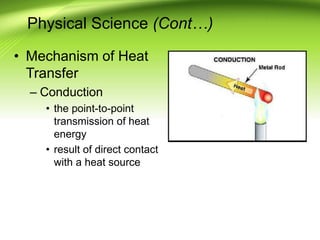
– Conduction
• the point-to-point
transmission of heat
energy
• result of direct contact
with a heat source
Physical Science (Cont…)
• Mechanism of Heat
Transfer (Cont…)
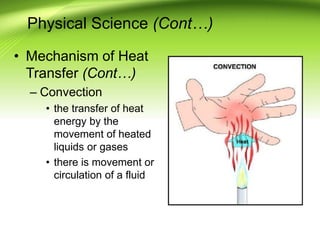
– Convection
• the transfer of heat
energy by the
movement of heated
liquids or gases
• there is movement or
circulation of a fluid
Physical Science (Cont…)
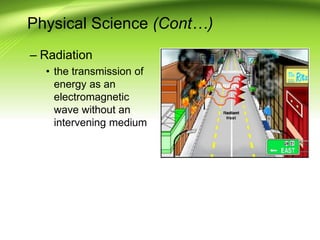
– Radiation
• the transmission of
energy as an
electromagnetic
wave without an
intervening medium
Physical Science (Cont…)
• Phases of Fire
– Incipient
• the oxygen content in the air has not been significantly reduced
• fire maybe producing a flame temperature well above 1000OF
(537OC), but the room temperature may be only slightly
increased
– Free-Burning
• oxygen-rich air is drawn into the flame as convection carries the
heat to the uppermost regions of the confined area
• temperature in the upper regions can exceed 1300OF (700OC)
• it continues to consume the free oxygen until it reaches the
point where there is insufficient oxygen to react with the fuel
Physical Science (Cont…)
• Phases of Fire (Cont…)
– Smoldering
• flame may cease to exist if the area of confinement is
sufficiently airtight
• burning is reduced to glowing embers
• fire will continue to smolder, and the room will
completely fill with dense smoke and gases of
combustion at a temperature of well over 1000OF
(537OC)
• creates the possibility of a backdraft (an explosive
ignition resulting from the combination of air with hot
gases)

Fire-Behavior-Lecture.ppt

  • 1.
  • 2.
    Fire Behavior • Introduction •Physical Science – Definition – Basic Components – Fire Tetrahedron – Fire Extinguishment Theory – Classification of Fires • Other References
  • 3.
    Introduction • Fire hasbeen both a help and hindrance to mankind – heated homes, cooked our food, helped us to become technologically advanced • Firefighters should have a basic understanding of the science of fire and the factors that affect its ignition, growth, and spread to perform safely and effectively in any firefighting function
  • 4.
    Physical Science • Definition –Fire is a rapid oxidation of combustible materials accompanied by the released of heat and light at various intensities. – Pyrolysis is the chemical change brought about by heat. • Basic Components: – Oxidizing Agent (Oxygen) • those materials that yield oxygen or other oxidizing gases during the course of a chemical reaction • bromates, bromine, chlorates, chlorine, fluorine, iodine, nitrates, nitric acid, nitrites, perchlorates, permanganates, peroxides
  • 5.
    Physical Science (Cont…) –Heat • a form of energy; energy in transit • sources – chemical – chemical reactions generate heat – electrical – current flow generates heat; ex. overloading, static, lightning – mechanical – friction and compression – nuclear – fission or fusion of atoms • ways on how heat supports the combustion reaction – causes the pyrolysis or vaporization of solid and liquid fuels and the production of ignitable vapors or gases – provides the energy necessary for ignition – causes the continuous production and ignition of fuel vapors or gases so that the combustion reaction can continue
  • 6.
    Physical Science (Cont…) –Fuel • the material or substance being oxidized or burned in the combustion process • also known as the reducing agent • forms – Solid – coal, wood, plastic, paper, cloth, wax, grease, leather, cork, etc – Liquid – gasoline, kerosene, turpentine, alcohol, paint, varnish, oil, etc – Gas – natural gas, propane, butane, hydrogen, acetylene, carbon monoxide, etc – Chemical Chain Reaction • a series of reactions that occur in sequence with the results of each individual reaction being added to the rest
  • 7.
  • 8.
    Physical Science (Cont…) •Fire Extinguishment Theory – Temperature Reduction – Fuel Removal – Exclusion of Oxygen – Chemical Flame Inhibition
  • 9.
    Physical Science (Cont…) •Classification of Fire – Class A – Ordinary combustible materials • wood, paper, cloth, paper, rubber, and many plastics • can be extinguished by temperature reduction – Class B – Flammable/combustible liquids • gasoline, kerosene, alcohol, paint, varnish, etc • oxygen exclusion is the most effective extinguishing method • removal of fuel and temperature reduction can also be applied, as well as interruption of the chain reaction by dry chemical agents
  • 10.
    Physical Science (Cont…) •Classification of Fire (Cont…) – Class C – Energized electrical fires • household appliances, computers, transformers, and overhead transmission lines • can sometimes be controlled by a non-conducting extinguishing agent such as halon, dry chemical, or CO2 • safest procedure is to de-energize high voltage circuits and fight the fire appropriately depending upon the fuel involved
  • 11.
    Physical Science (Cont…) •Classification of Fire (Cont…) – Class D – Combustible metal fires • aluminum, magnesium, titanium, zirconium, sodium., potassium, etc • hazardous in powdered form • water and other common extinguishing agents are ineffective due to extremely high temperature • special extinguishing agents are available for control of fire in each of the metals
  • 12.
    Physical Science (Cont…) •Mechanism of Heat Transfer – Conduction • the point-to-point transmission of heat energy • result of direct contact with a heat source
  • 13.
    Physical Science (Cont…) •Mechanism of Heat Transfer (Cont…) – Convection • the transfer of heat energy by the movement of heated liquids or gases • there is movement or circulation of a fluid
  • 14.
    Physical Science (Cont…) –Radiation • the transmission of energy as an electromagnetic wave without an intervening medium
  • 15.
    Physical Science (Cont…) •Phases of Fire – Incipient • the oxygen content in the air has not been significantly reduced • fire maybe producing a flame temperature well above 1000OF (537OC), but the room temperature may be only slightly increased – Free-Burning • oxygen-rich air is drawn into the flame as convection carries the heat to the uppermost regions of the confined area • temperature in the upper regions can exceed 1300OF (700OC) • it continues to consume the free oxygen until it reaches the point where there is insufficient oxygen to react with the fuel
  • 16.
    Physical Science (Cont…) •Phases of Fire (Cont…) – Smoldering • flame may cease to exist if the area of confinement is sufficiently airtight • burning is reduced to glowing embers • fire will continue to smolder, and the room will completely fill with dense smoke and gases of combustion at a temperature of well over 1000OF (537OC) • creates the possibility of a backdraft (an explosive ignition resulting from the combination of air with hot gases)