RECEO
 Priority sequence of operations
 Helps IC determine what needs to be
accomplished or assigned first
 Based on incident priorities
 Based on operating guidelines
 IC needs to communicate plan based on
observations
 IC may have plan that differs from the
automatic actions that would be taken.
RECEO
 R-escue
 E-xposures
 C-onfinement
 E-xtinguishment
 O-verhaul
• V-entilation
• S-alvage
 Locate the fire
 Confine
 Extinguish
 Secure and deliver
water
Engine responsibilities
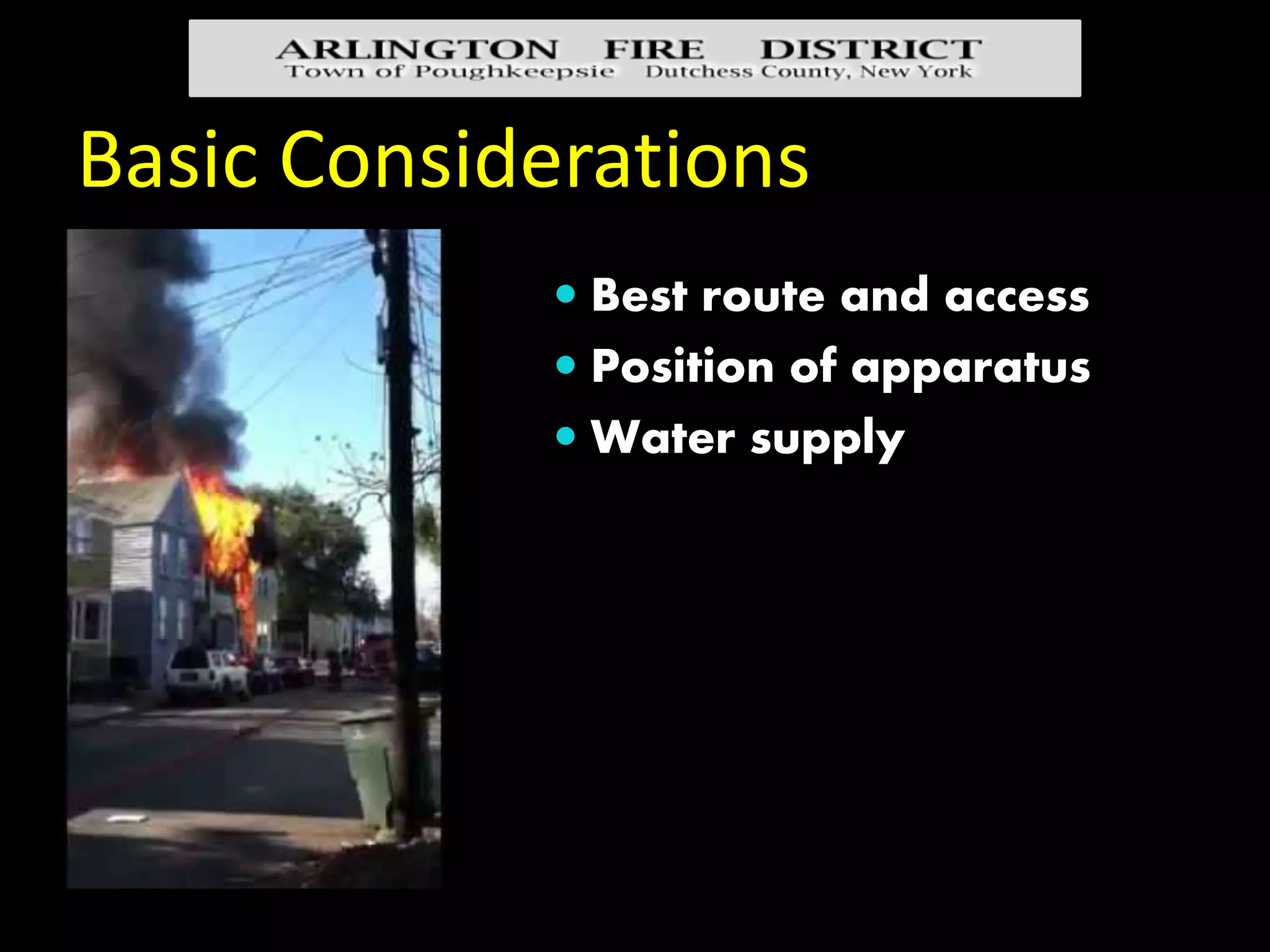
Basic Considerations
 Best route and access
 Position of apparatus
 Water supply
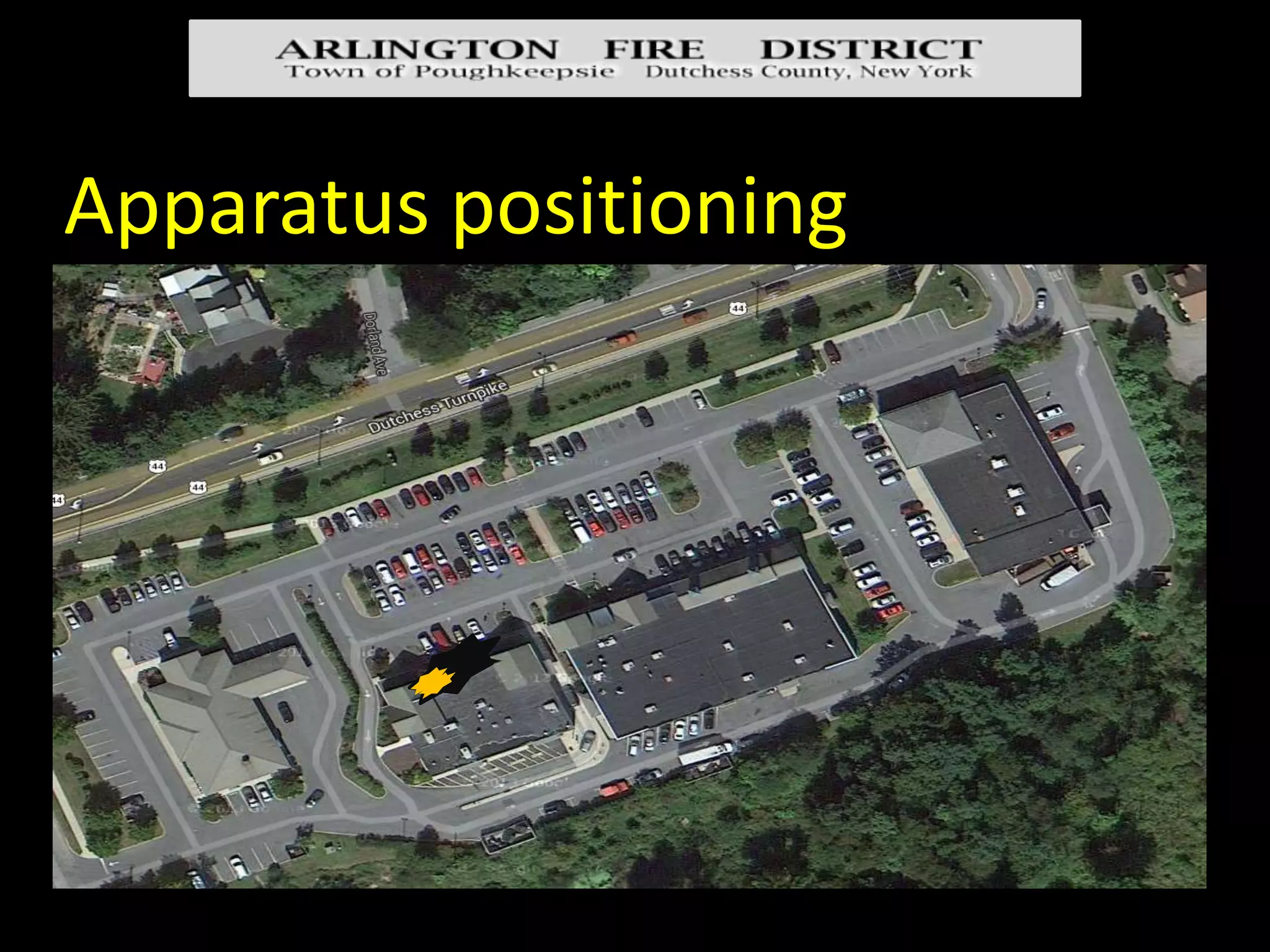
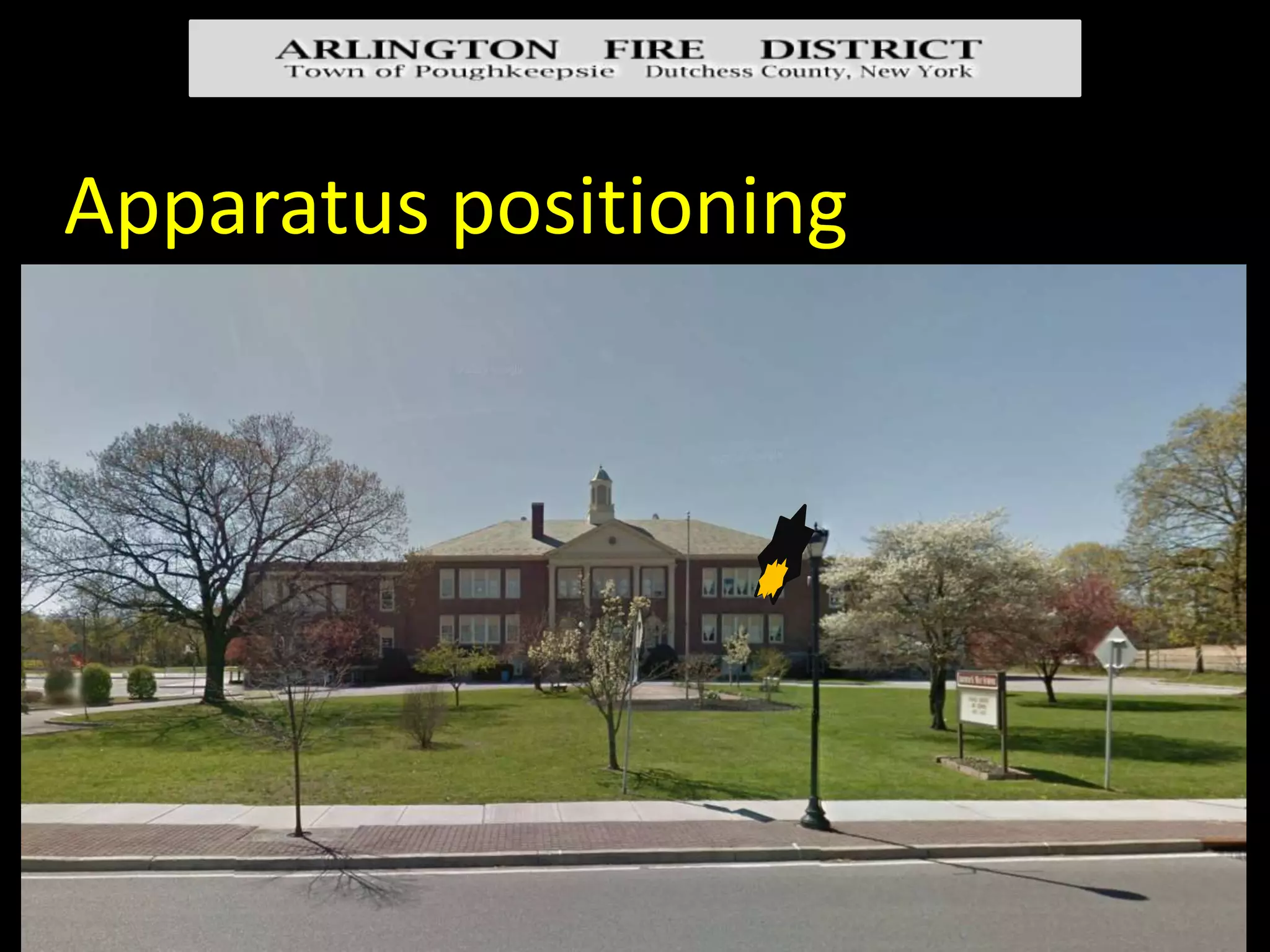
Apparatus positioning
More Considerations
• Pre-assigned duties
• Crew Accountability
• Communications
• Coordination
• Fire protection systems
• Location of fire
• What’s on fire
More Considerations
 Desired fire flow
 Hose selection
 Hose stretch and
deployment
 Line placement
Line placement
 Protection of occupants
 Protection of firefighters
 Protection of stairs and vertical
extension
 Protection of exposures
 Placement for fire confinement
Fire Flow basics
 Length x width / 3
 GPM needed to extinguish fire
 185 gpm good for how many square
feet?
 555 sq feet
 225 gpm (2”)?
 675 sq feet
Fire Flow basics
 Length x width / 3
 330 gpm (2 ½”)?
 990 sq feet
 500 gpm (Blitzfire)?
 1500 sq feet
 600 gpm (deckgun)?
 1800 sq feet
Fire Flow basics
 Water weighs roughly 8 lbs per gallon
 Requires 150 btu to raise 1 lb of room
temp water to 212o
 Requires 970 btu to convert 1 lb of 212o
water to steam
 We are applying 1480 lbs of water per
minute at 185 gpm
 This allows us to absorb 1.6 million btu
per minute.
Average BTU Production
• Wood
• Polyurethane
• Polyvinyl Chloride
• Polystyrene
• Polypropylene
• Polyethylene
• 7,000 Btu / lb.
• 14,000
• 17,900
• 18,750
• 20,000
• 20,100
15
Fire Flow basics
 An average sofa weighs
approximately 350 lbs
 It gives off between 10,000 and 20,000 btu
per pound
 That’s between 3.5 and 7 million btu for
just the sofa.
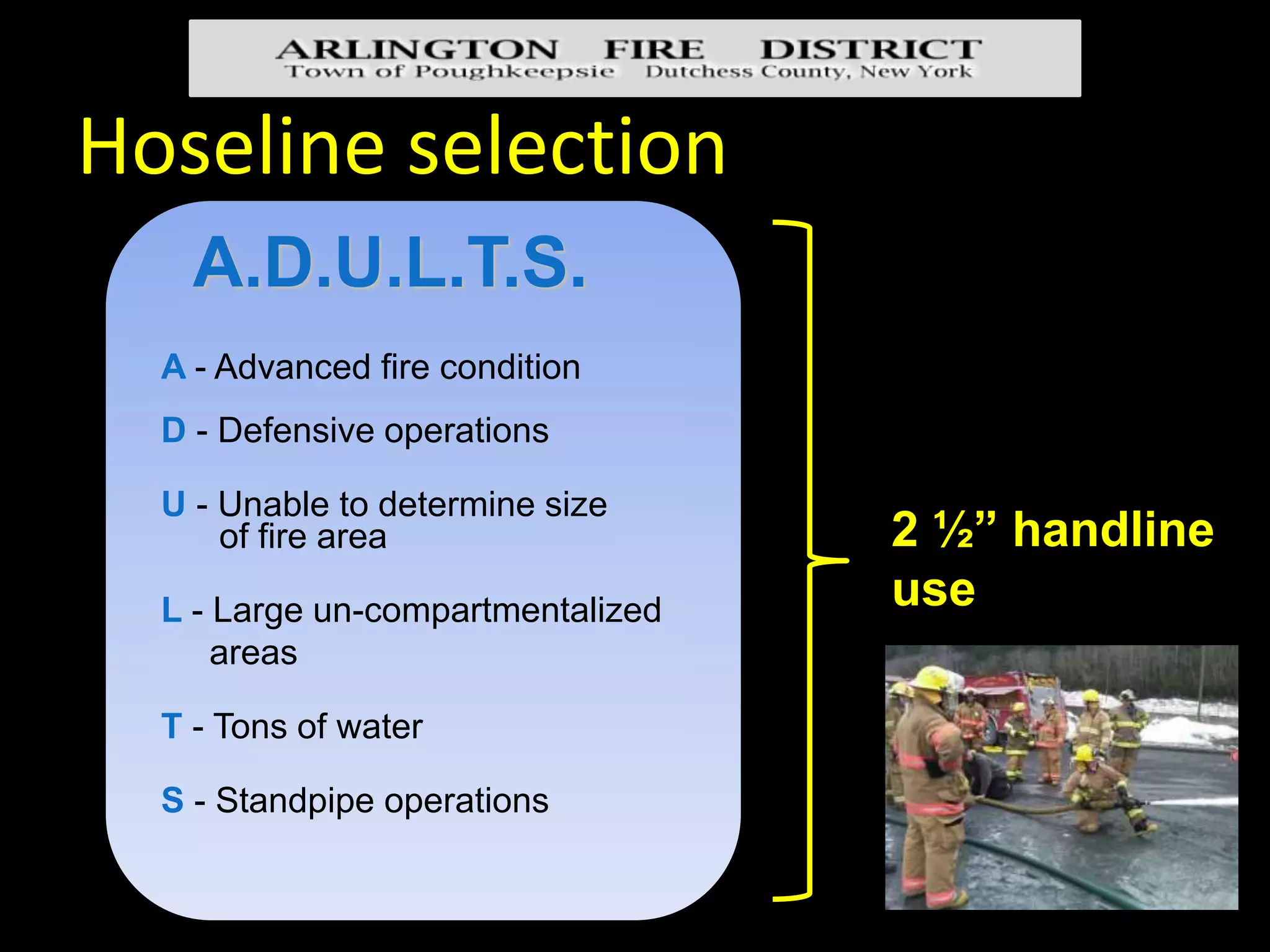
Hoseline selection
A - Advanced fire condition
D - Defensive operations
U - Unable to determine size
of fire area
L - Large un-compartmentalized
areas
T - Tons of water
S - Standpipe operations
A.D.U.L.T.S.
2 ½” handline
use
Hose stretch considerations
 Length of stretch
 S-load (flat load)
 Apartment line
 Shouldering hose
 Responsibilities of crew
 Driver
 Officer
 Nozzle Operator
Positions and Responsibilities
 Positions and Responsibilities
 Officer
 Driver
 Nozzle Operator
 *Back Up
 *Door
 *Control
* May not have personnel but tasks need to be
accomplished.
Positions and Responsibilities
 Must coordinate who is responsible for what
tasks through OGs and training
 May be decided en route
 Must have a plan.
Engine Company Officer
 Need to make the right decisions to effect
outcome of incident.
 Line size
 Offensive or Defensive attack?
 Need to understand tactics and operation
 Need to know and protect your crew.
Nozzle Operator
 Responsible for 1st length and nozzle
 Bring length and nozzle to a “safe” location for
stretching and flaking
 Stairwell, hallway, front door.
Nozzle Operator
 When water is called for, must bleed air from
nozzle
 Never enter fire area without water
 Never pass fire
 Door control for protection
Nozzle Operator
 Solid or straight stream
 All members on same side of line
 Force or open door and let fire “breathe”
 Fire may be “ventilation-limited”
 Look in room (LOW) for layout, fire or victims.
Nozzle Operator
 Deflected water (off ceiling) will:
 Cover a greater area
 Break up and cool superheated combustible
gases at ceiling
 Greater heat absorption by breaking up on
impact and providing larger surface area for
heat absorption
 Prevent rollover
 Prevent flashover by cooling overhead
Nozzle Firefighter
 Rapid side to side or circular rotation pushes
heat, fire and steam ahead of the team (walls,
ceiling, floors)
 As progress is made, direct stream toward base
of fire.
Back-up Firefighter
 2nd on hose line
 Chock doors
 Flake out hose line and facilitate advancement
 Nozzle is only as good as the back-up
Back-up Firefighter
 Flaking hose
 Up a stairwell
 In the hallway
 Adjacent/opposite room
 Wherever it is needed and space is available.
Back-up Firefighter
 Absorb as much nozzle reaction as possible
 Position as close to the nozzle operator as
possible
 Maintain a firm grasp on hose.
Additional tasks to be
performed
 Eliminate kinks and folds outside the fire building
 Feed hose to the nozzle team
 Don’t push
 Maintain slack – bend or circle of hose
 Operates valve for standpipe operations
 Keep an eye on the fire conditions in the area the
crew is operating
 When withdrawing, don’t turn back on fire
Fire attack
 Direct Attack
 Indirect Attack
 Modified Direct Attack
 Transitional
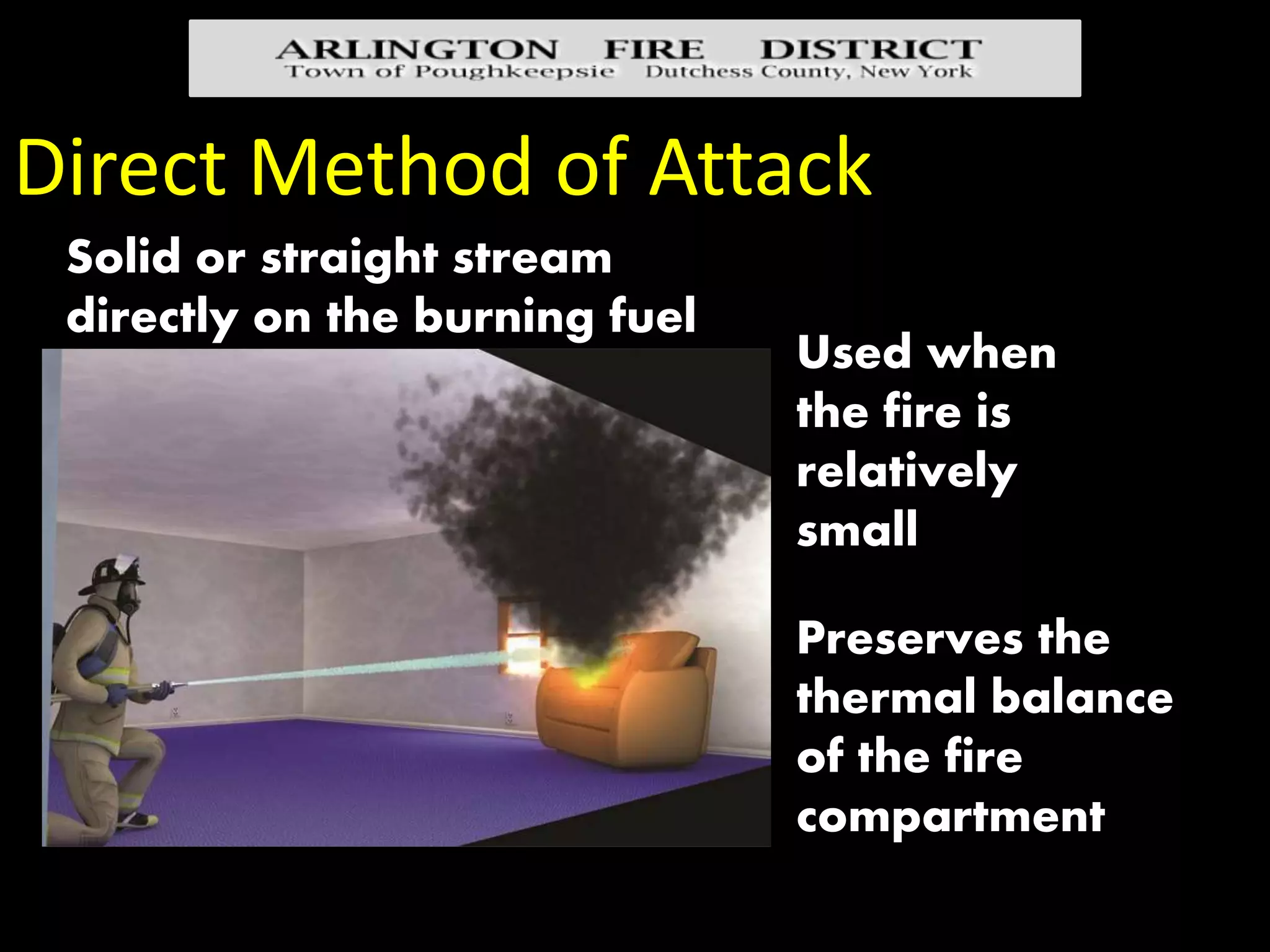
Direct Method of Attack
Solid or straight stream
directly on the burning fuel
Used when
the fire is
relatively
small
Preserves the
thermal balance
of the fire
compartment
Thermal Balance
Indirect Method of Attack
Fog stream is
remotely injected
into an unoccupied,
unvented
compartment
Indirect Attack Cautions
These Conditions Must be Met
There must be no life hazard in the
compartment, including firefighters
Ceiling temp. must be at least 1000°F
Water fog must be remotely injected from
outside the room with no ventilation
If these conditions are not met, a direct attack is needed
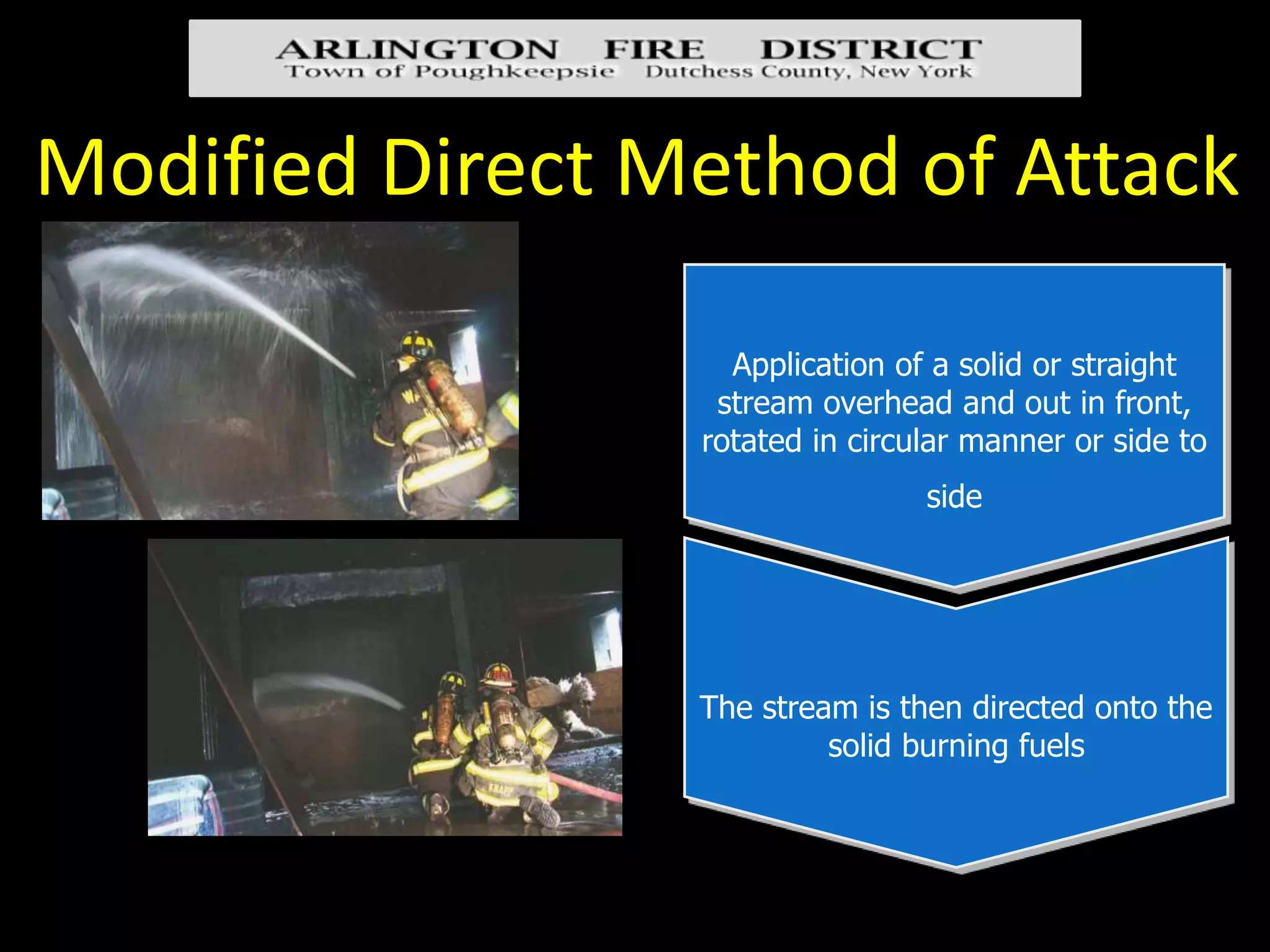
Modified Direct Method of Attack
Application of a solid or straight
stream overhead and out in front,
rotated in circular manner or side to
side
The stream is then directed onto the
solid burning fuels
Benefits of a Modified Direct
Attack
Transitional Attack
 May apply water through
window to darken fire
before entering structure
 Crews then enter structure
after fire has been
knocked down.
Choosing a Method of Attack
Only the direct and
modified direct
attack should be
used if anyone is
near the fire
compartment
Some general rules
Some general rules
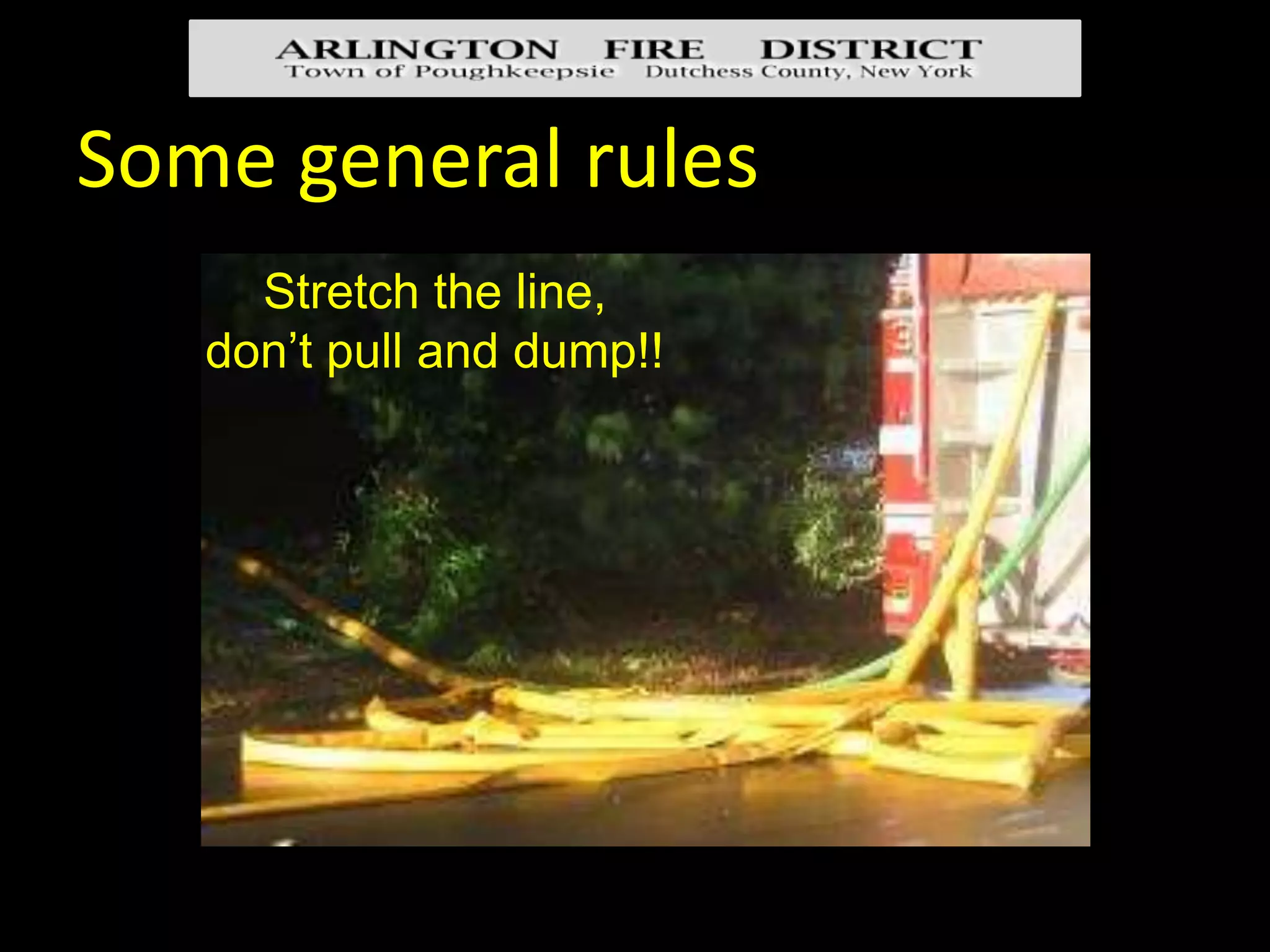
Stretch the line,
don’t pull and dump!!
Some general rules
 Front door is generally best option
for hose advancement
 Dry line advancement is quicker
than charged line
 Dry line puts out NO fire – have
charged line when entering fire
area
 No more than 2 lines should go
through same door way.
Some general rules
 Usually consider one length per floor and two
for fire floor
 Stretched up well-hole in stairway, one length
per three floors
 Stretched up the outside of the building, one
length per three floors
 Open the nozzle to hit the fire, do not spray the
smoke.
Some general rules
 When the fire is darkened down, close the
nozzle
 Use the nozzle to clear the room of smoke
 Listen for cues – engine rpm for example
 Support the placement of the primary line
before worrying about a back-up line.
 Difficult to overcome problems associated
with a hoseline stretched to the wrong
location.
Engine company operations

Engine company operations

  • 2.
    RECEO  Priority sequenceof operations  Helps IC determine what needs to be accomplished or assigned first  Based on incident priorities  Based on operating guidelines  IC needs to communicate plan based on observations  IC may have plan that differs from the automatic actions that would be taken.
  • 3.
    RECEO  R-escue  E-xposures C-onfinement  E-xtinguishment  O-verhaul • V-entilation • S-alvage
  • 4.
     Locate thefire  Confine  Extinguish  Secure and deliver water Engine responsibilities
  • 5.
    Basic Considerations  Bestroute and access  Position of apparatus  Water supply
  • 6.
  • 7.
  • 8.
  • 9.
    More Considerations • Pre-assignedduties • Crew Accountability • Communications • Coordination • Fire protection systems • Location of fire • What’s on fire
  • 10.
    More Considerations  Desiredfire flow  Hose selection  Hose stretch and deployment  Line placement
  • 11.
    Line placement  Protectionof occupants  Protection of firefighters  Protection of stairs and vertical extension  Protection of exposures  Placement for fire confinement
  • 12.
    Fire Flow basics Length x width / 3  GPM needed to extinguish fire  185 gpm good for how many square feet?  555 sq feet  225 gpm (2”)?  675 sq feet
  • 13.
    Fire Flow basics Length x width / 3  330 gpm (2 ½”)?  990 sq feet  500 gpm (Blitzfire)?  1500 sq feet  600 gpm (deckgun)?  1800 sq feet
  • 14.
    Fire Flow basics Water weighs roughly 8 lbs per gallon  Requires 150 btu to raise 1 lb of room temp water to 212o  Requires 970 btu to convert 1 lb of 212o water to steam  We are applying 1480 lbs of water per minute at 185 gpm  This allows us to absorb 1.6 million btu per minute.
  • 15.
    Average BTU Production •Wood • Polyurethane • Polyvinyl Chloride • Polystyrene • Polypropylene • Polyethylene • 7,000 Btu / lb. • 14,000 • 17,900 • 18,750 • 20,000 • 20,100 15
  • 16.
    Fire Flow basics An average sofa weighs approximately 350 lbs  It gives off between 10,000 and 20,000 btu per pound  That’s between 3.5 and 7 million btu for just the sofa.
  • 17.
    Hoseline selection A -Advanced fire condition D - Defensive operations U - Unable to determine size of fire area L - Large un-compartmentalized areas T - Tons of water S - Standpipe operations A.D.U.L.T.S. 2 ½” handline use
  • 18.
    Hose stretch considerations Length of stretch  S-load (flat load)  Apartment line  Shouldering hose  Responsibilities of crew  Driver  Officer  Nozzle Operator
  • 19.
    Positions and Responsibilities Positions and Responsibilities  Officer  Driver  Nozzle Operator  *Back Up  *Door  *Control * May not have personnel but tasks need to be accomplished.
  • 20.
    Positions and Responsibilities Must coordinate who is responsible for what tasks through OGs and training  May be decided en route  Must have a plan.
  • 21.
    Engine Company Officer Need to make the right decisions to effect outcome of incident.  Line size  Offensive or Defensive attack?  Need to understand tactics and operation  Need to know and protect your crew.
  • 22.
    Nozzle Operator  Responsiblefor 1st length and nozzle  Bring length and nozzle to a “safe” location for stretching and flaking  Stairwell, hallway, front door.
  • 23.
    Nozzle Operator  Whenwater is called for, must bleed air from nozzle  Never enter fire area without water  Never pass fire  Door control for protection
  • 24.
    Nozzle Operator  Solidor straight stream  All members on same side of line  Force or open door and let fire “breathe”  Fire may be “ventilation-limited”  Look in room (LOW) for layout, fire or victims.
  • 25.
    Nozzle Operator  Deflectedwater (off ceiling) will:  Cover a greater area  Break up and cool superheated combustible gases at ceiling  Greater heat absorption by breaking up on impact and providing larger surface area for heat absorption  Prevent rollover  Prevent flashover by cooling overhead
  • 26.
    Nozzle Firefighter  Rapidside to side or circular rotation pushes heat, fire and steam ahead of the team (walls, ceiling, floors)  As progress is made, direct stream toward base of fire.
  • 27.
    Back-up Firefighter  2ndon hose line  Chock doors  Flake out hose line and facilitate advancement  Nozzle is only as good as the back-up
  • 28.
    Back-up Firefighter  Flakinghose  Up a stairwell  In the hallway  Adjacent/opposite room  Wherever it is needed and space is available.
  • 29.
    Back-up Firefighter  Absorbas much nozzle reaction as possible  Position as close to the nozzle operator as possible  Maintain a firm grasp on hose.
  • 30.
    Additional tasks tobe performed  Eliminate kinks and folds outside the fire building  Feed hose to the nozzle team  Don’t push  Maintain slack – bend or circle of hose  Operates valve for standpipe operations  Keep an eye on the fire conditions in the area the crew is operating  When withdrawing, don’t turn back on fire
  • 31.
    Fire attack  DirectAttack  Indirect Attack  Modified Direct Attack  Transitional
  • 32.
    Direct Method ofAttack Solid or straight stream directly on the burning fuel Used when the fire is relatively small Preserves the thermal balance of the fire compartment
  • 33.
  • 34.
    Indirect Method ofAttack Fog stream is remotely injected into an unoccupied, unvented compartment
  • 35.
    Indirect Attack Cautions TheseConditions Must be Met There must be no life hazard in the compartment, including firefighters Ceiling temp. must be at least 1000°F Water fog must be remotely injected from outside the room with no ventilation If these conditions are not met, a direct attack is needed
  • 36.
    Modified Direct Methodof Attack Application of a solid or straight stream overhead and out in front, rotated in circular manner or side to side The stream is then directed onto the solid burning fuels
  • 37.
    Benefits of aModified Direct Attack
  • 38.
    Transitional Attack  Mayapply water through window to darken fire before entering structure  Crews then enter structure after fire has been knocked down.
  • 39.
    Choosing a Methodof Attack Only the direct and modified direct attack should be used if anyone is near the fire compartment
  • 40.
  • 41.
    Some general rules Stretchthe line, don’t pull and dump!!
  • 42.
    Some general rules Front door is generally best option for hose advancement  Dry line advancement is quicker than charged line  Dry line puts out NO fire – have charged line when entering fire area  No more than 2 lines should go through same door way.
  • 43.
    Some general rules Usually consider one length per floor and two for fire floor  Stretched up well-hole in stairway, one length per three floors  Stretched up the outside of the building, one length per three floors  Open the nozzle to hit the fire, do not spray the smoke.
  • 44.
    Some general rules When the fire is darkened down, close the nozzle  Use the nozzle to clear the room of smoke  Listen for cues – engine rpm for example  Support the placement of the primary line before worrying about a back-up line.  Difficult to overcome problems associated with a hoseline stretched to the wrong location.