Essentials of Fire Fighting
6th Edition
Firefighter I
Chapter 12 — Ground Ladders
Describe different construction types
of ground ladders.
Learning Objective 1
12–2
Identify the parts of a ladder
including markings and labels.
Learning Objective 2
12–3
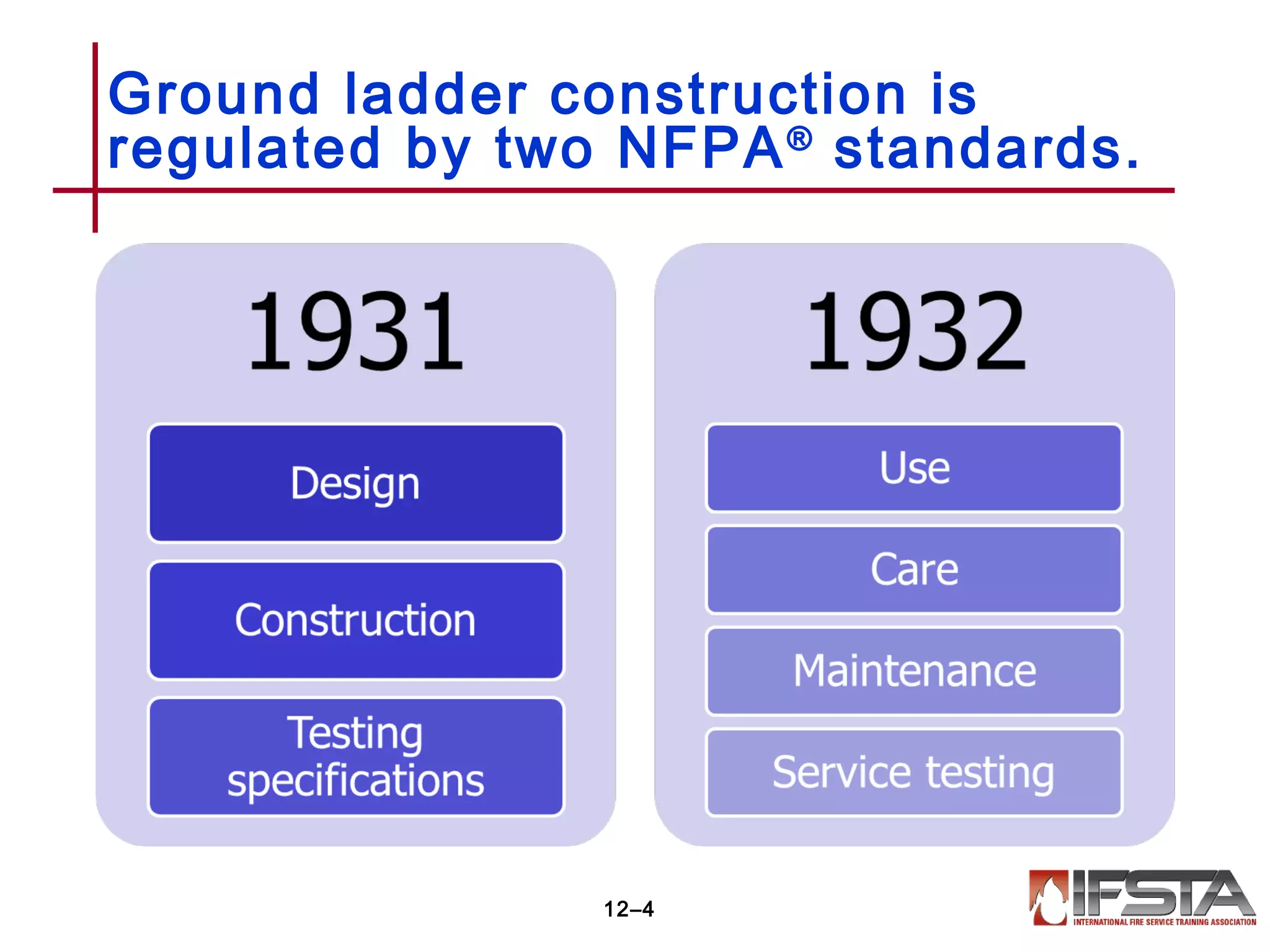
Ground ladder construction is
regulated by two NFPA®
standards.
12–4
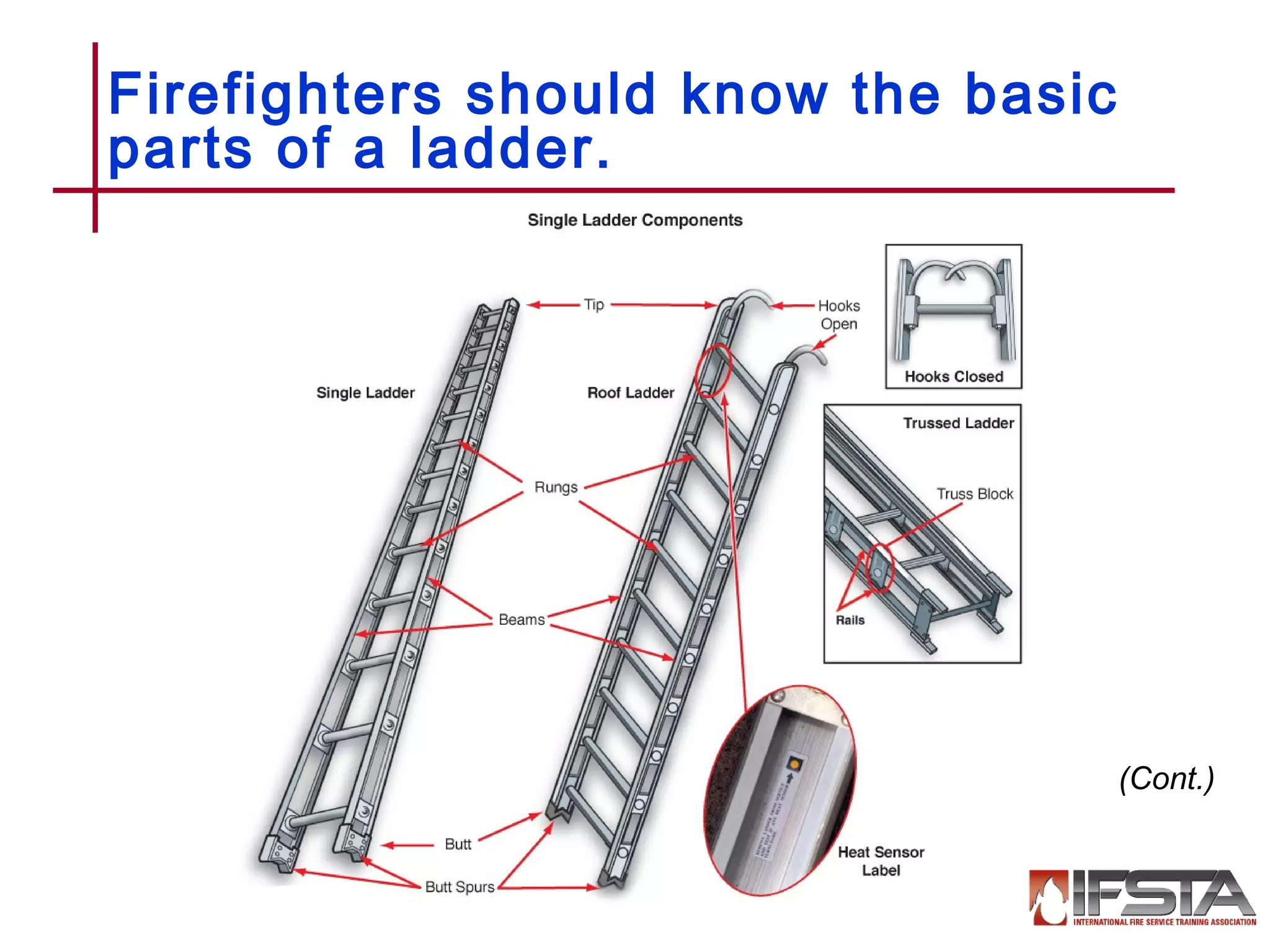
Firefighters should know the basic
parts of a ladder.
12–5
(Cont.)
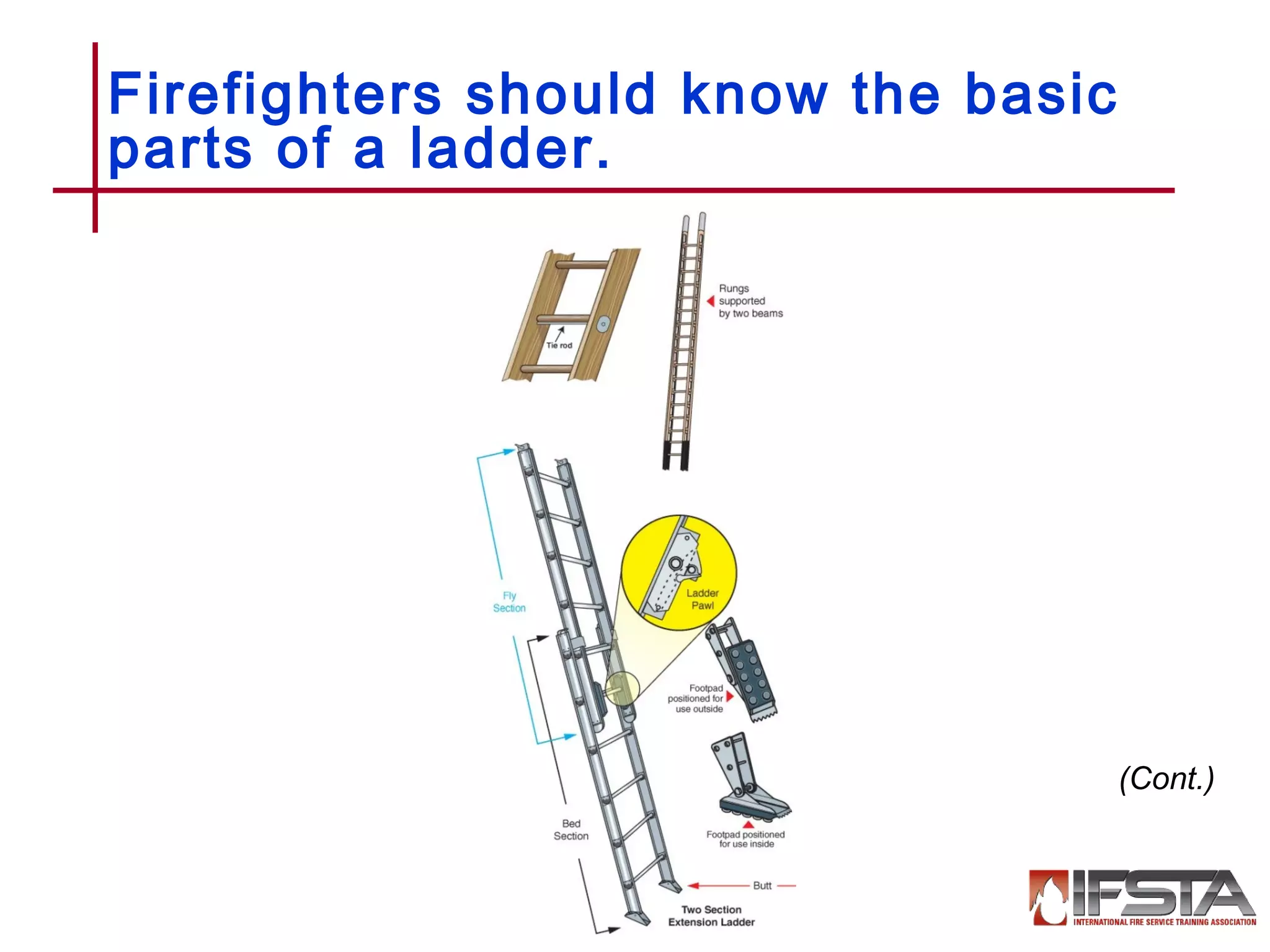
Firefighters should know the basic
parts of a ladder.
12–6
(Cont.)
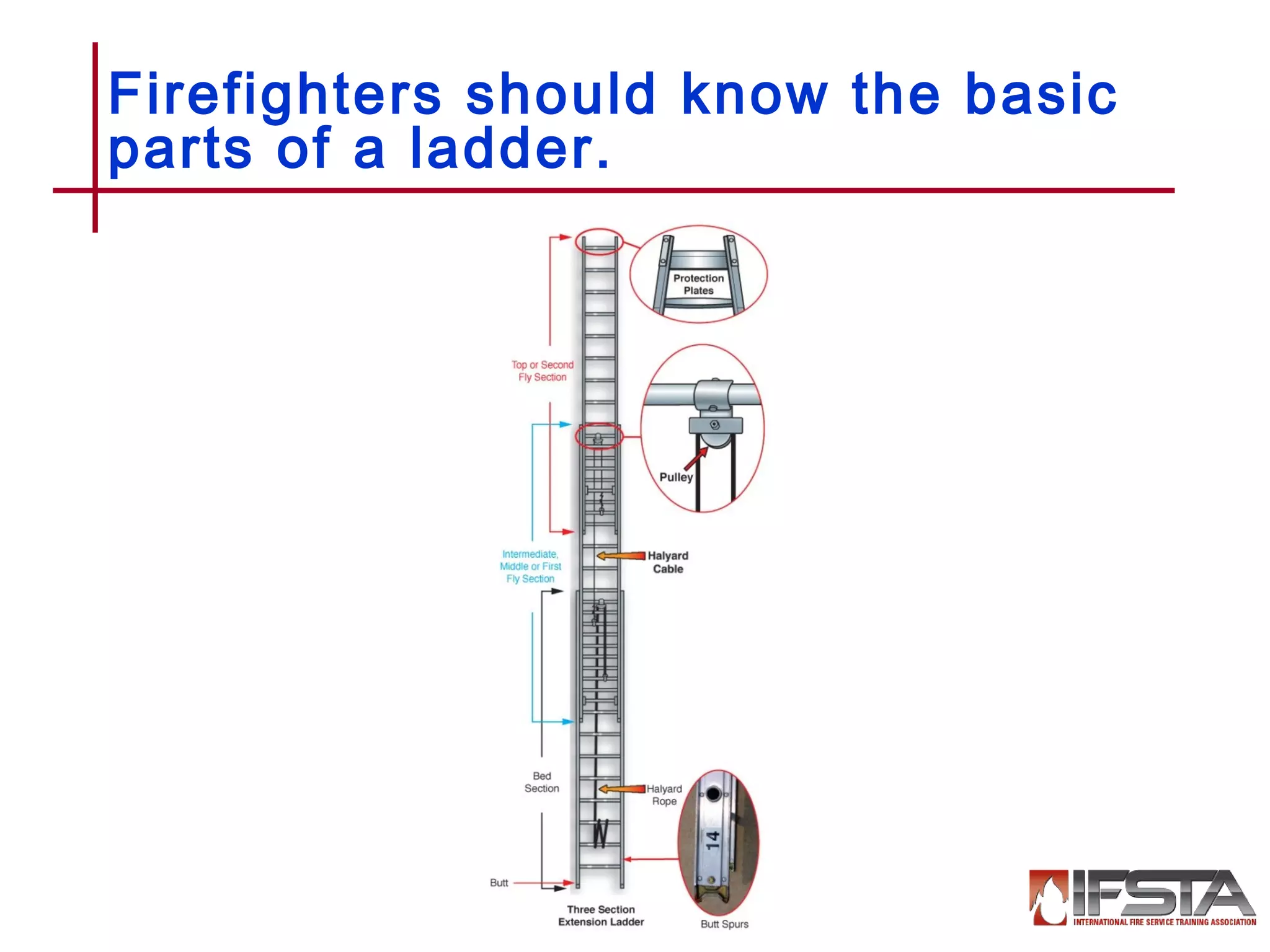
Firefighters should know the basic
parts of a ladder.
12–7
REVIEW QUESTION
What are the basic parts of fire
service ladders?
12–8
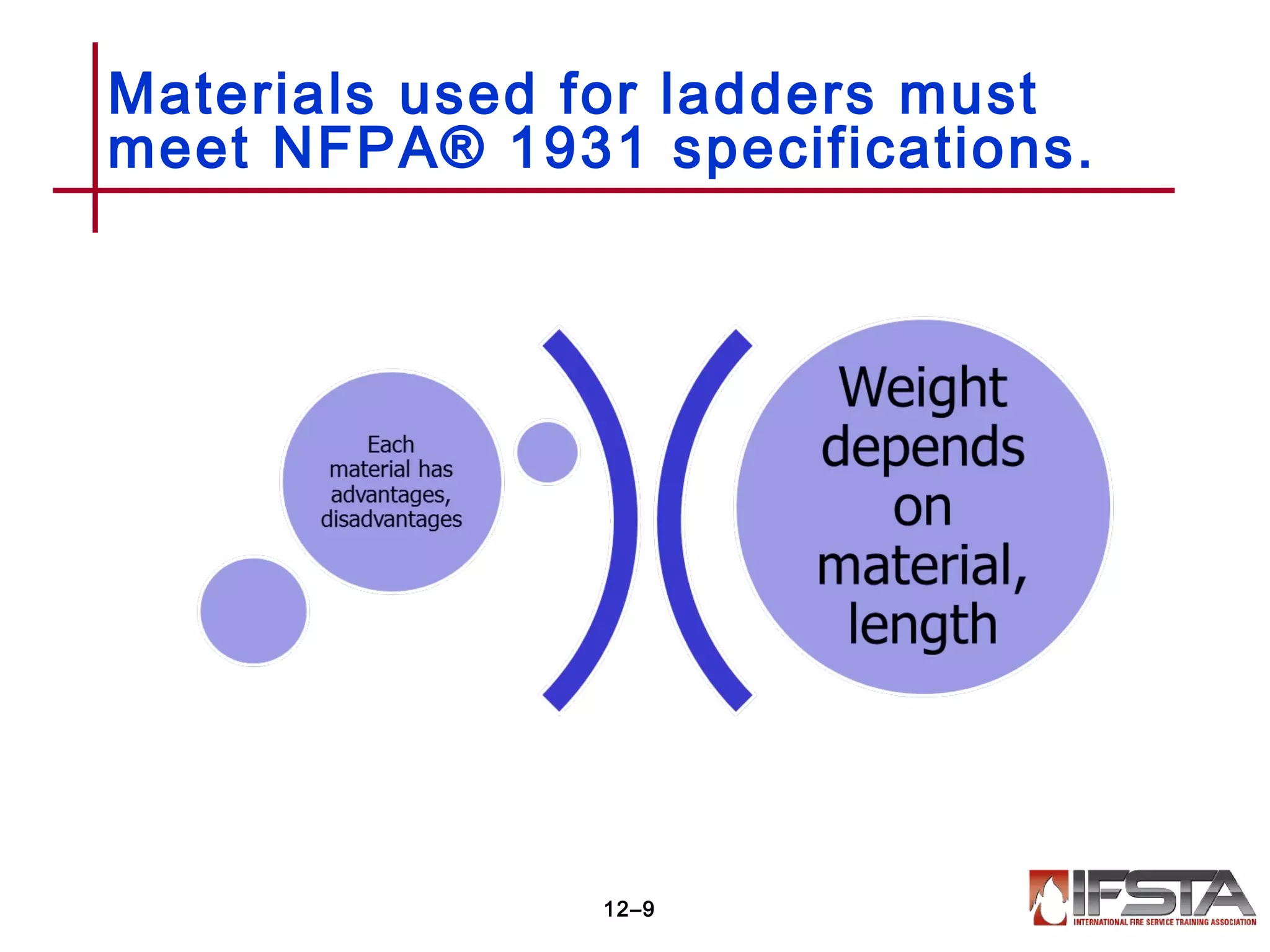
Materials used for ladders must
meet NFPA® 1931 specifications.
12–9
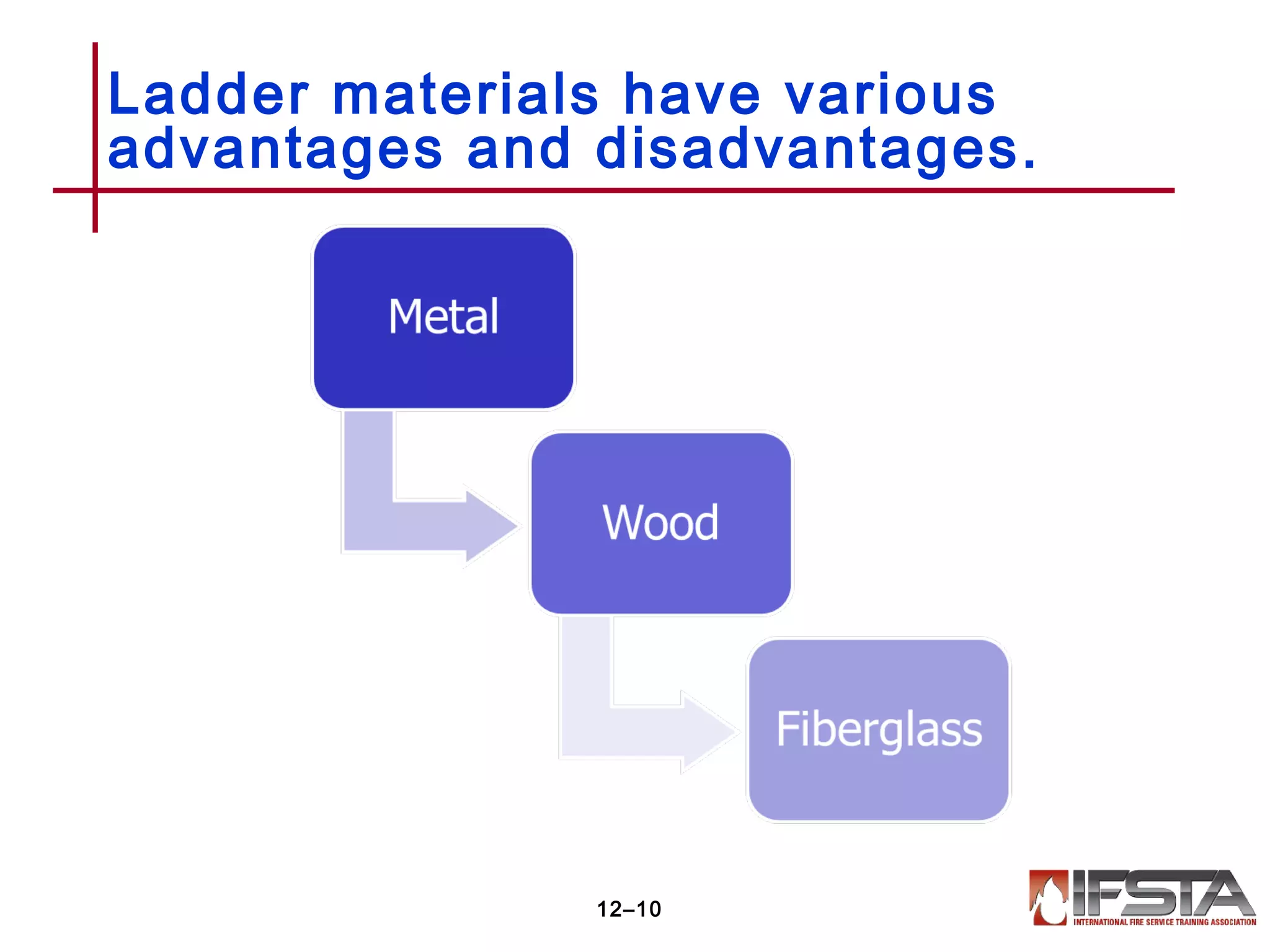
Ladder materials have various
advantages and disadvantages.
12–10
REVIEW QUESTION
How does a fire service ladder
constructed of metal differ from one
constructed of fiberglass?
12–11
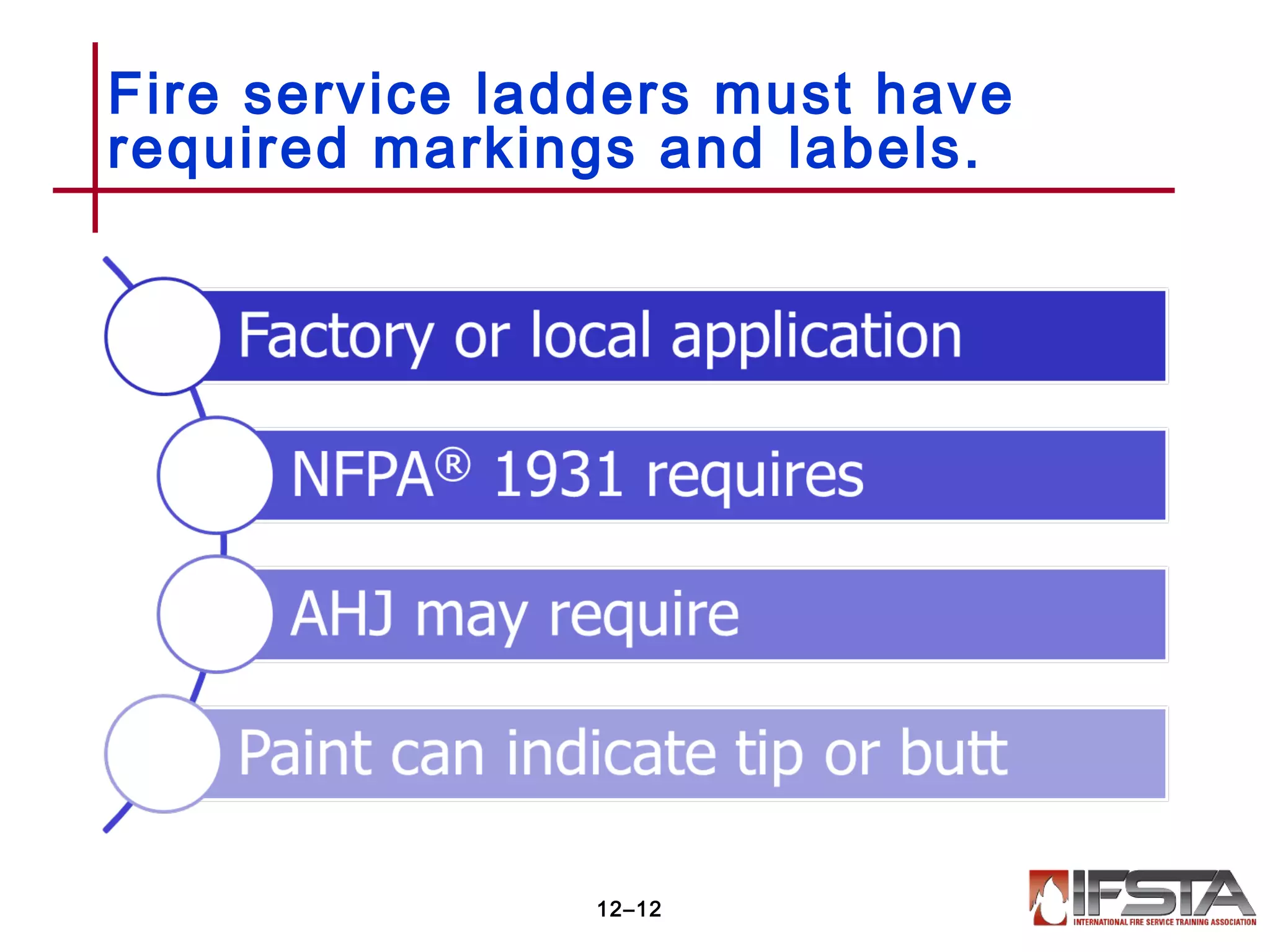
Fire service ladders must have
required markings and labels.
12–12
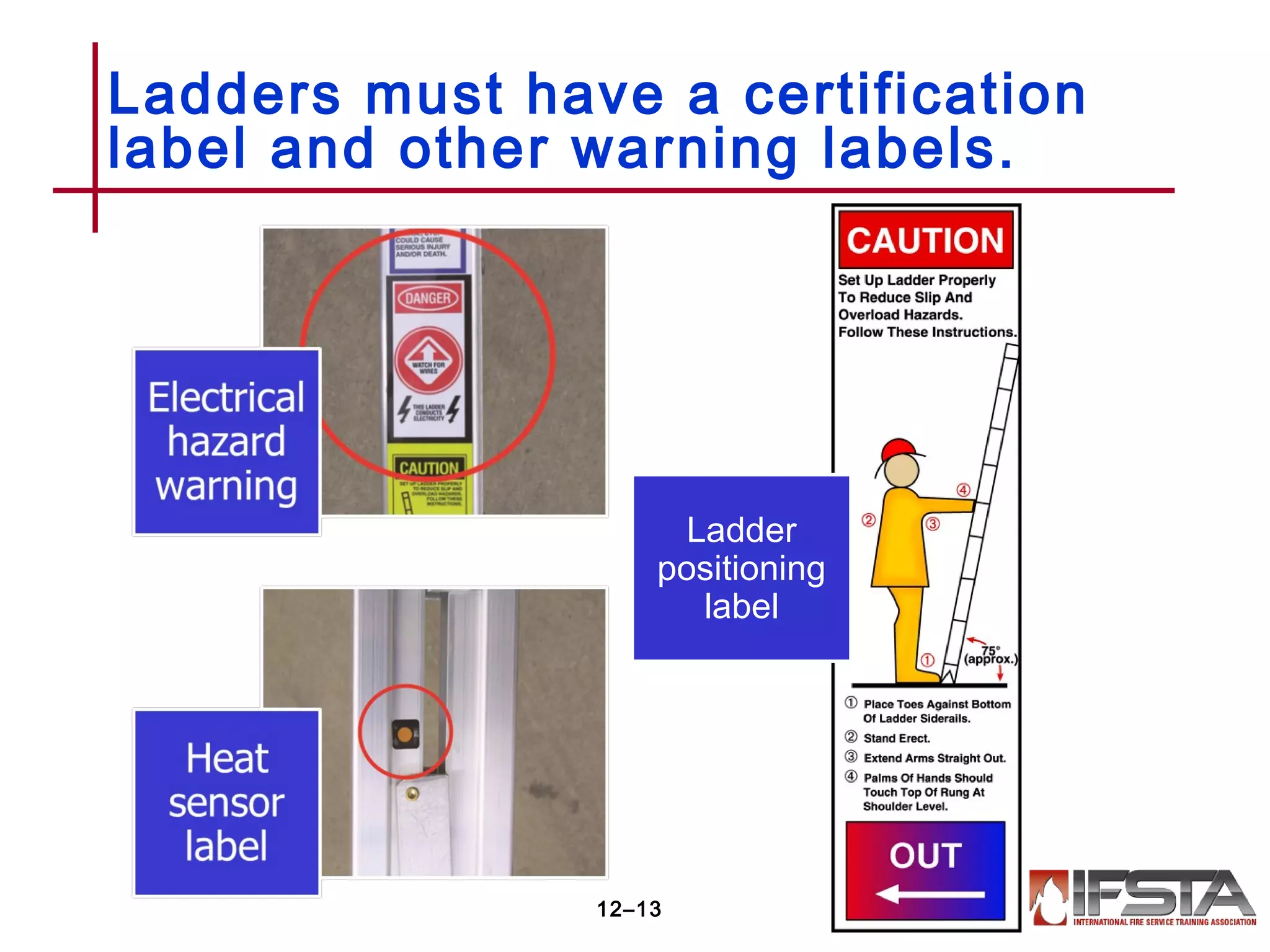
Ladders must have a certification
label and other warning labels.
12–13
Ladder
positioning
label
REVIEW QUESTION
What types of markings and labels
do fire service ladders have?
12–14
Recognize the types of ladders used
in the fire service.
Learning Objective 3
12–15
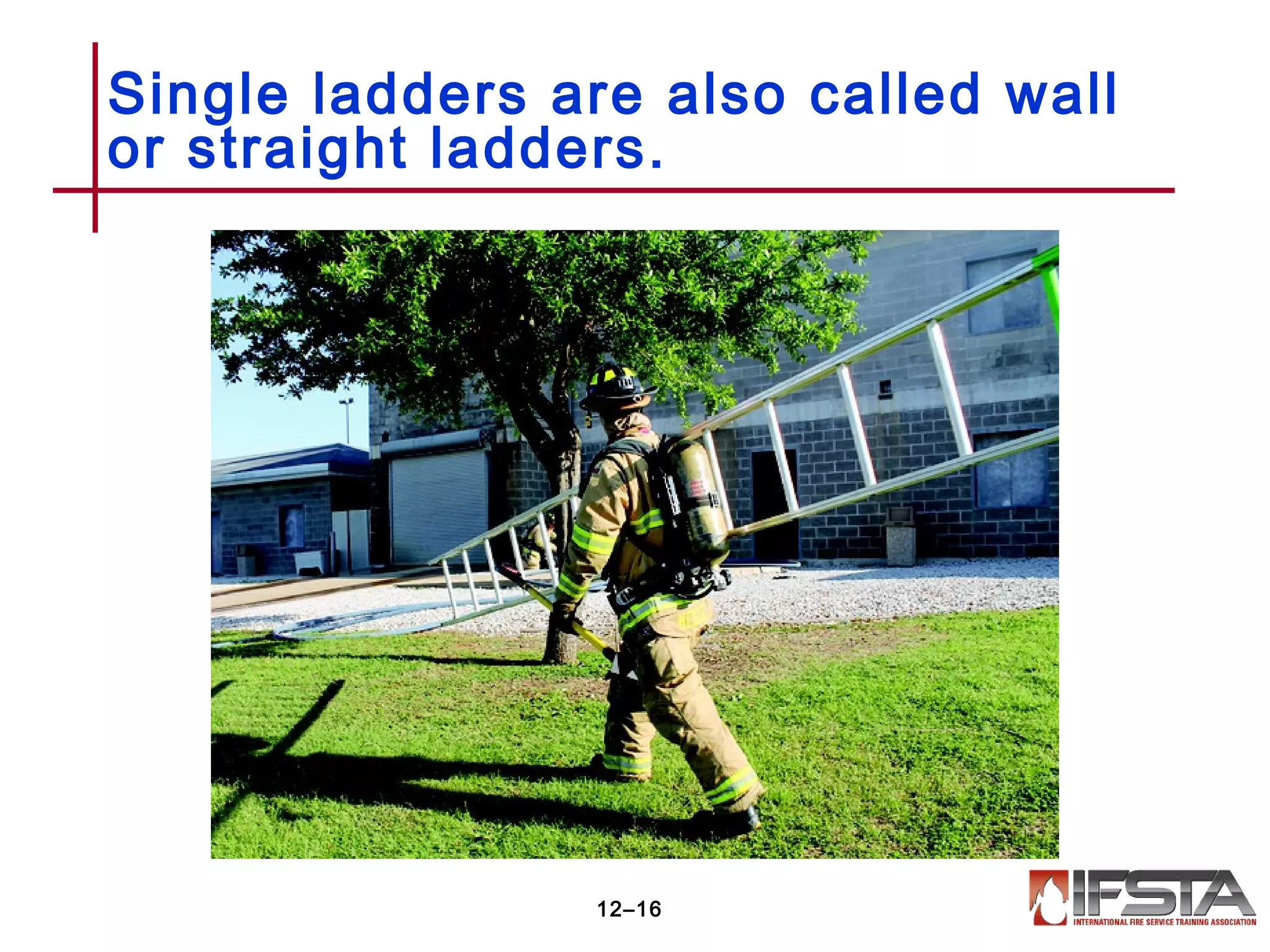
Single ladders are also called wall
or straight ladders.
12–16
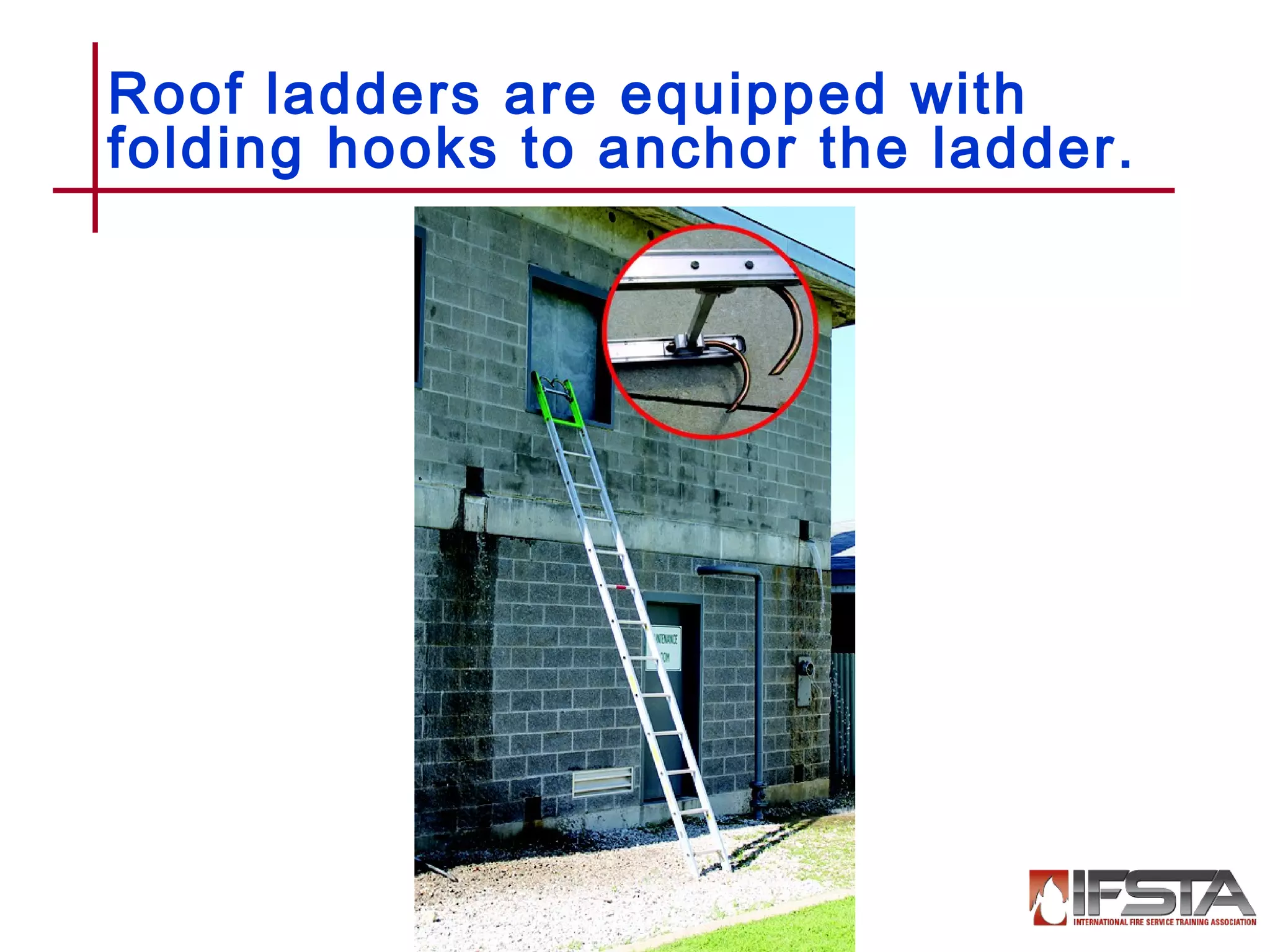
Roof ladders are equipped with
folding hooks to anchor the ladder.
12–17
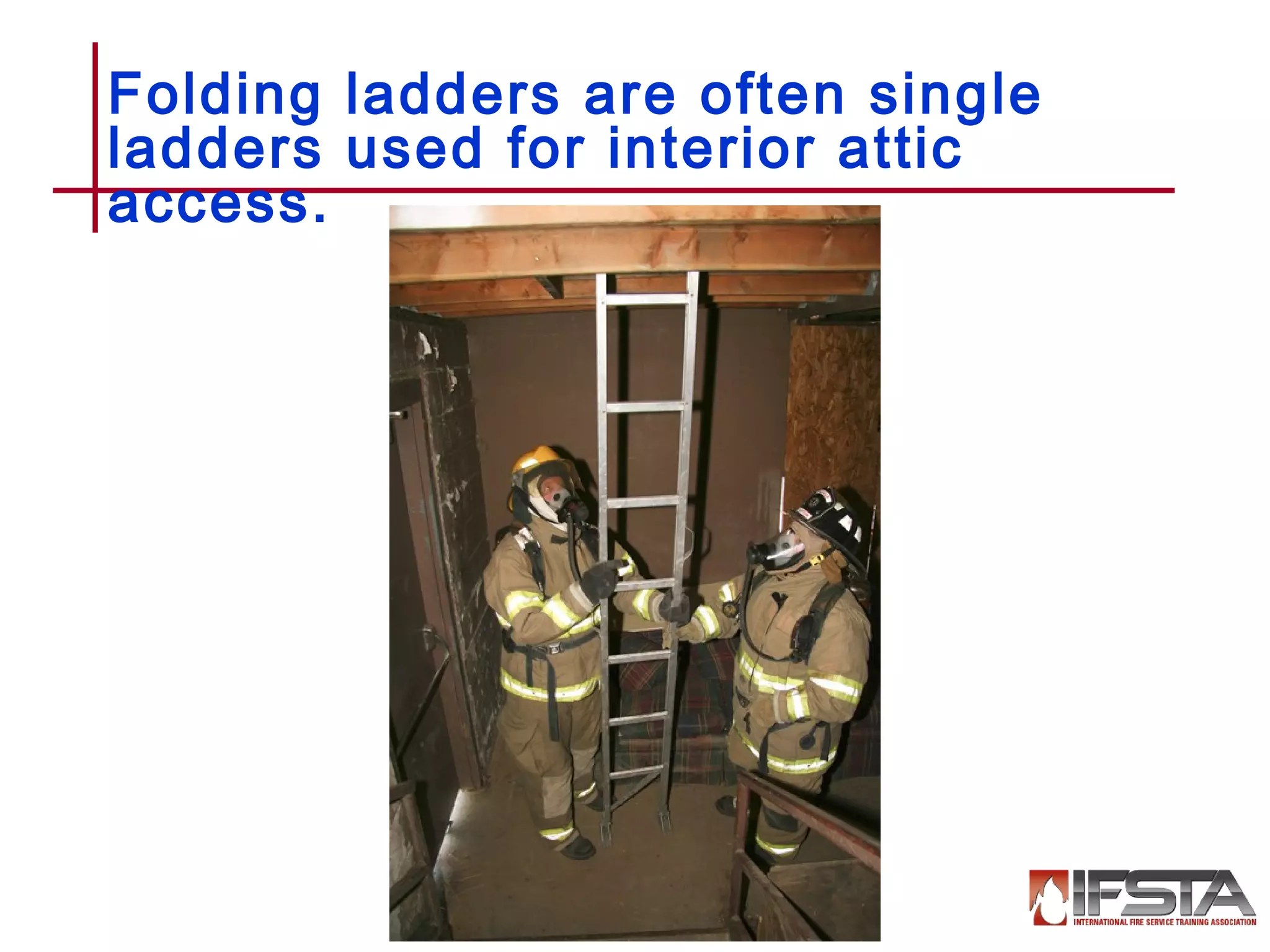
Folding ladders are often single
ladders used for interior attic
access.
12–18
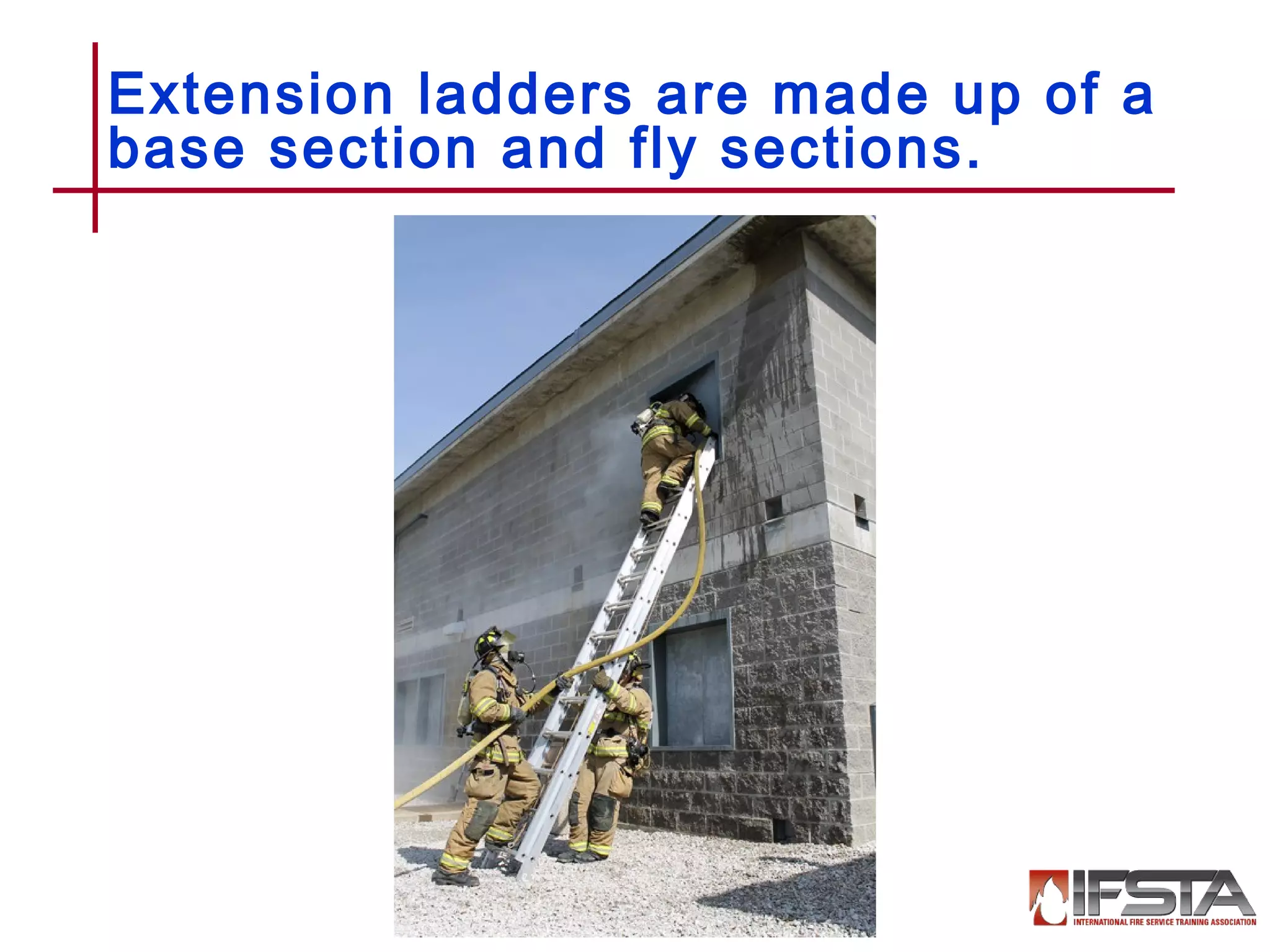
Extension ladders are made up of a
base section and fly sections.
12–19
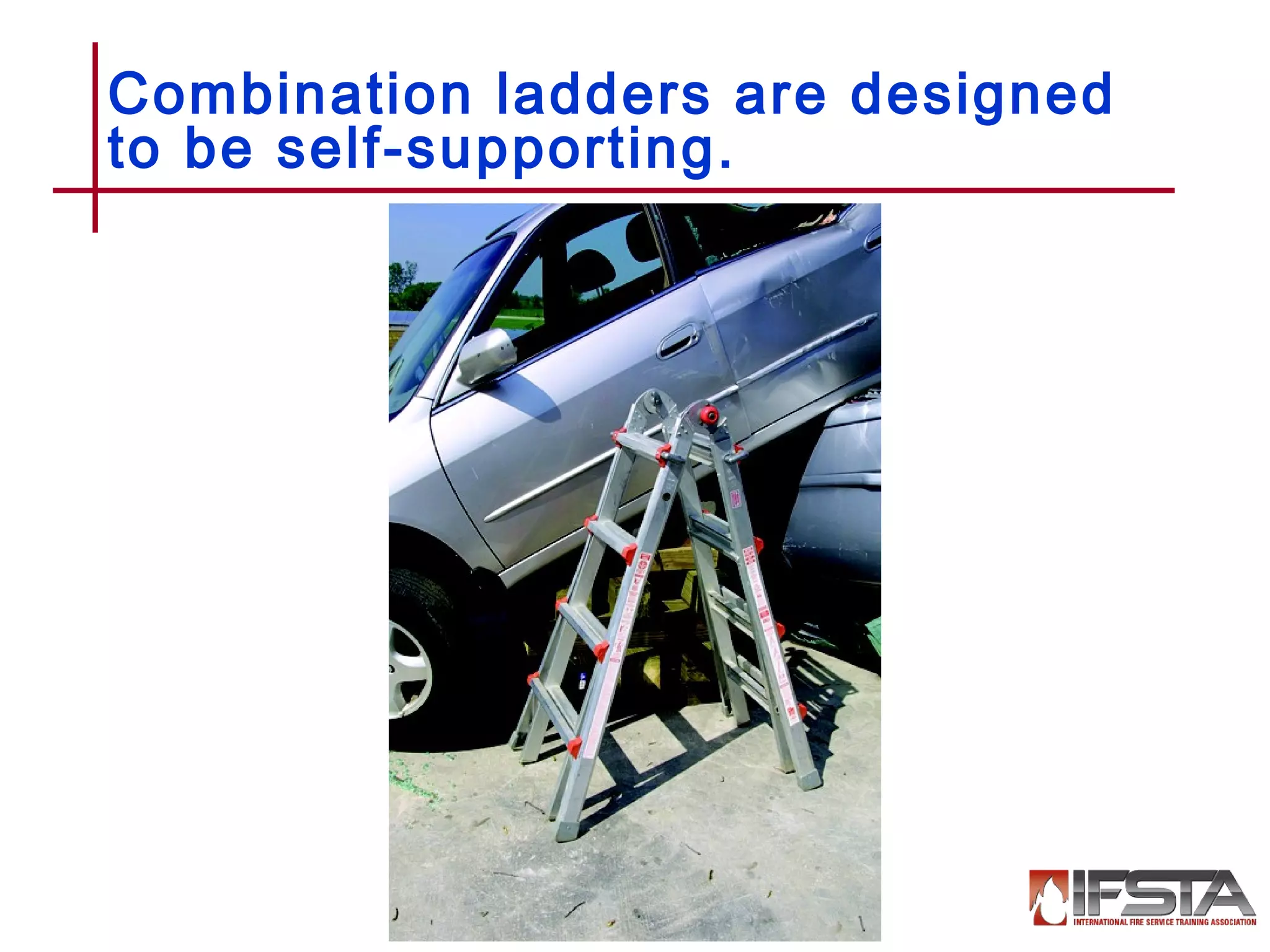
Combination ladders are designed
to be self-supporting.
12–20
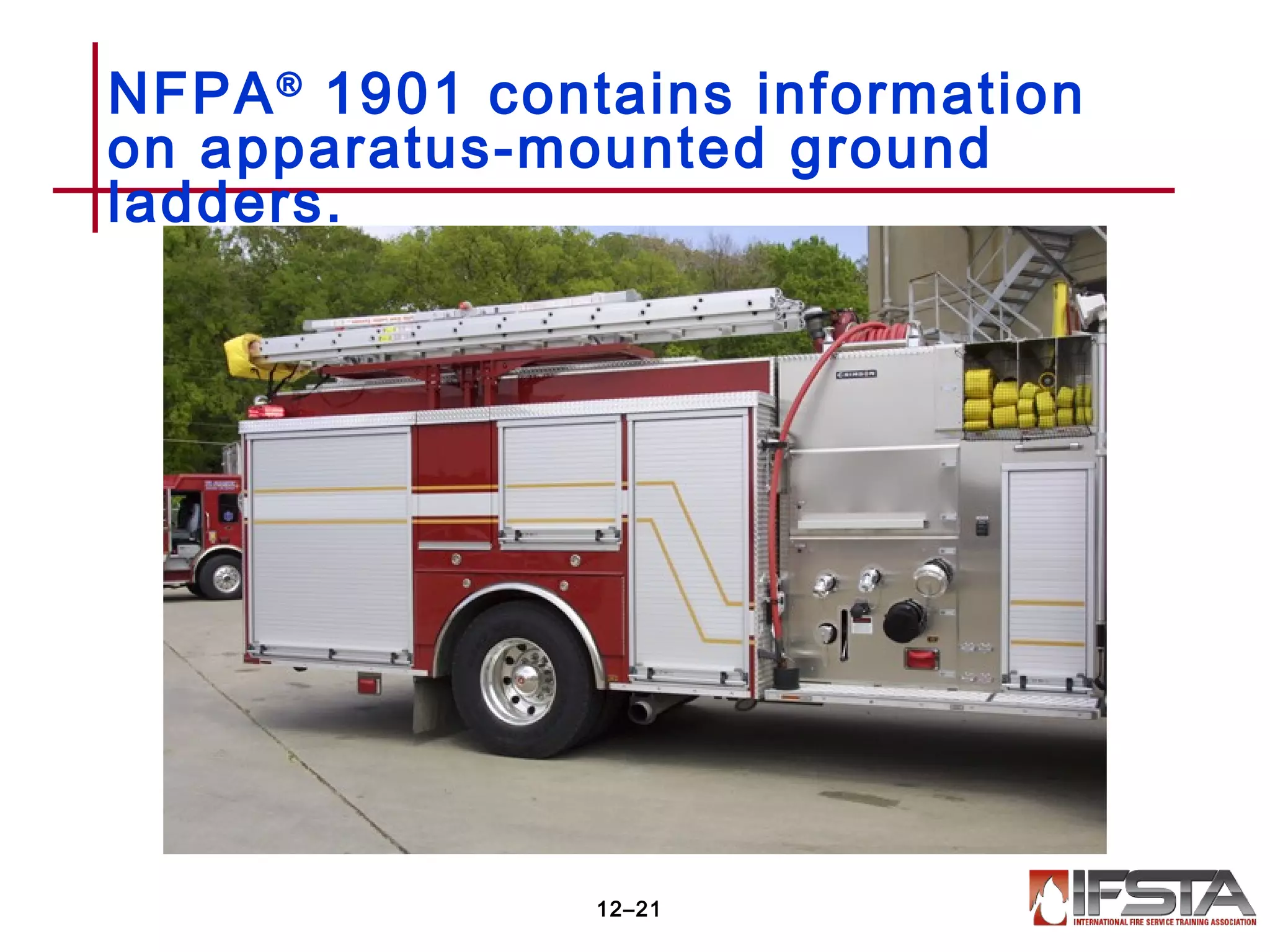
NFPA®
1901 contains information
on apparatus-mounted ground
ladders.
12–21
REVIEW QUESTION
How do the five types of ladders
used in the fire service compare with
one another?
12–22
Explain the considerations
addressed by ladder inspection,
cleaning, and maintenance.
Learning Objective 4
12–23
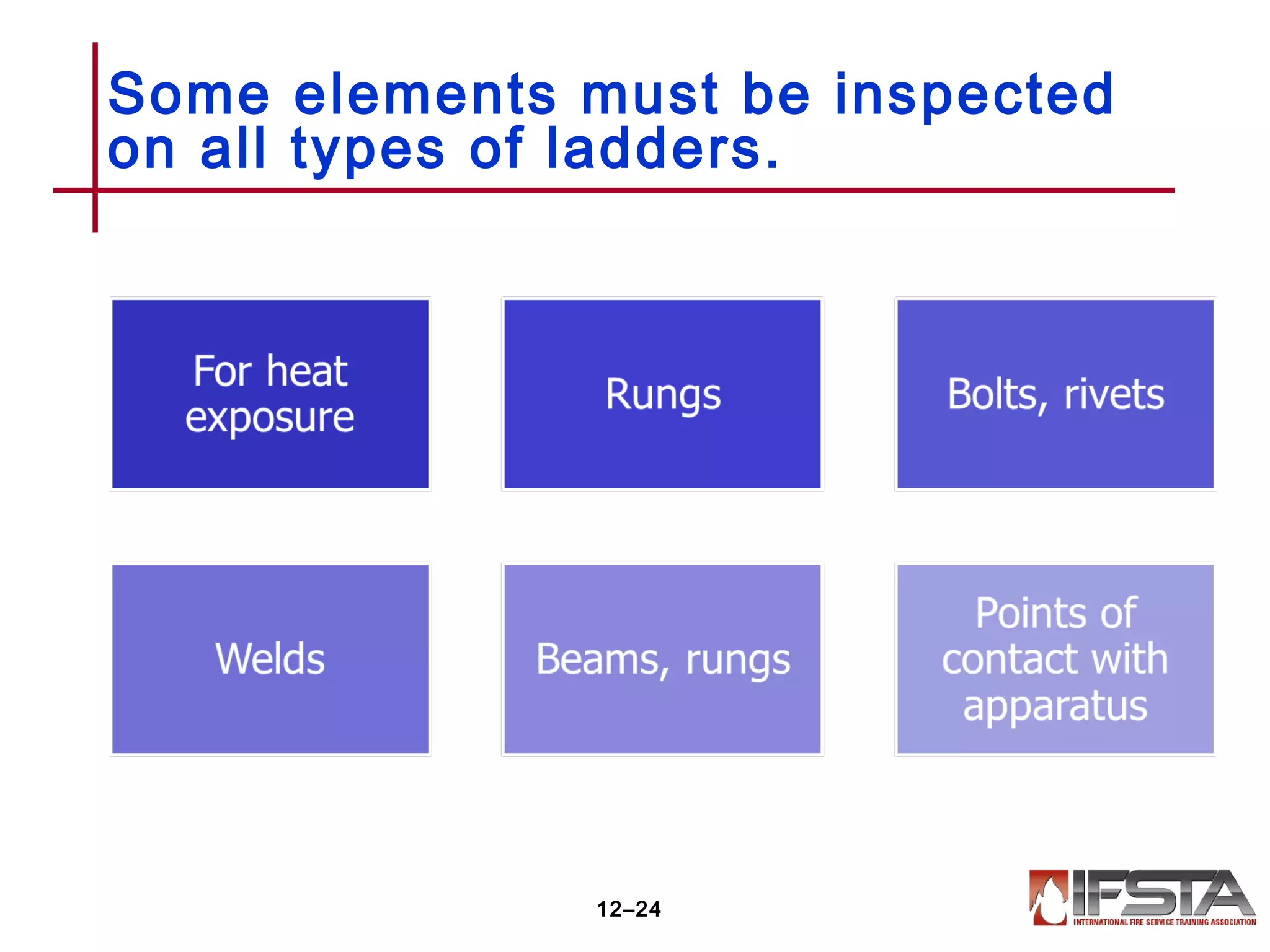
Some elements must be inspected
on all types of ladders.
12–24
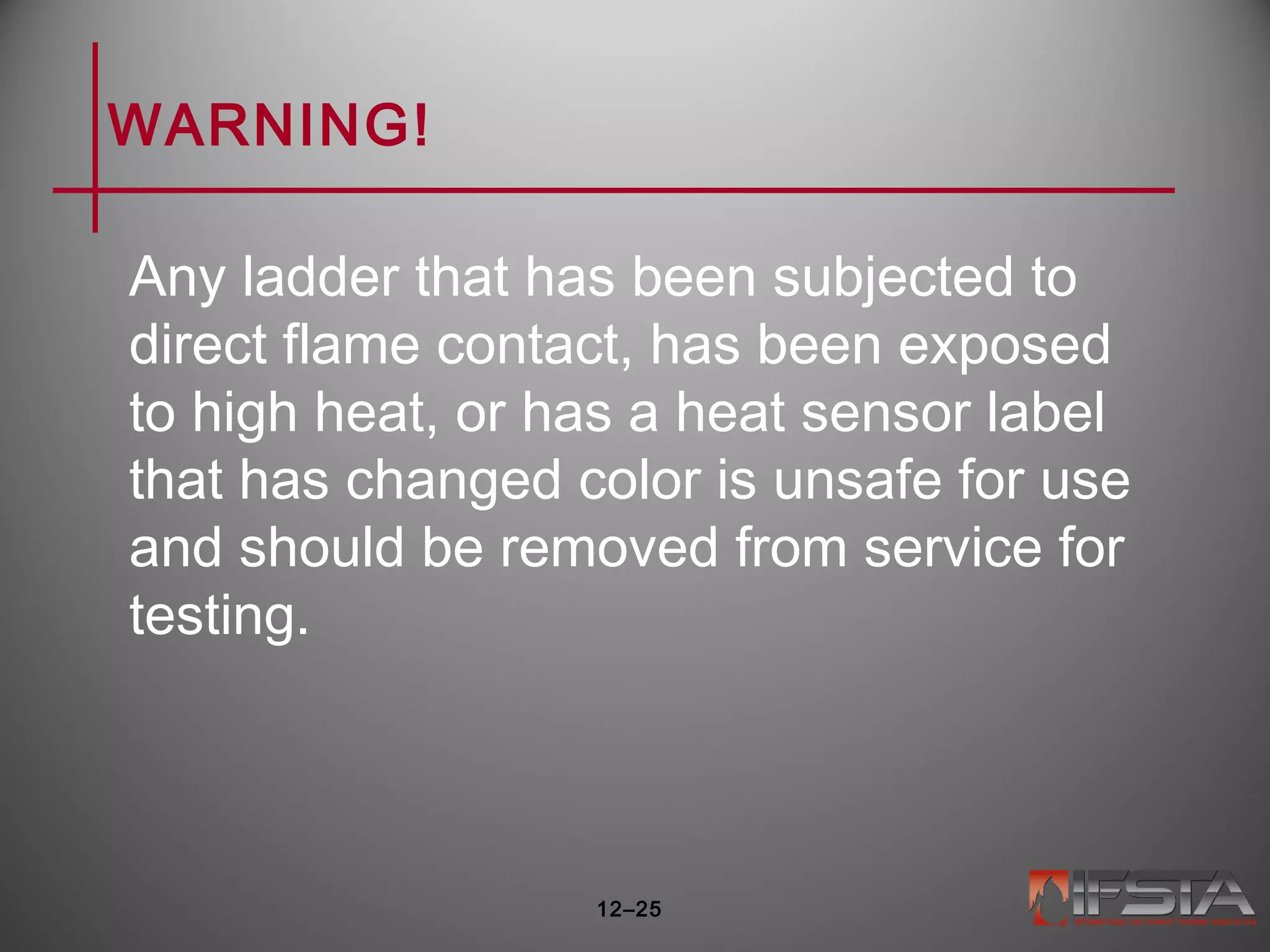
WARNING!
Any ladder that has been subjected to
direct flame contact, has been exposed
to high heat, or has a heat sensor label
that has changed color is unsafe for use
and should be removed from service for
testing.
12–25
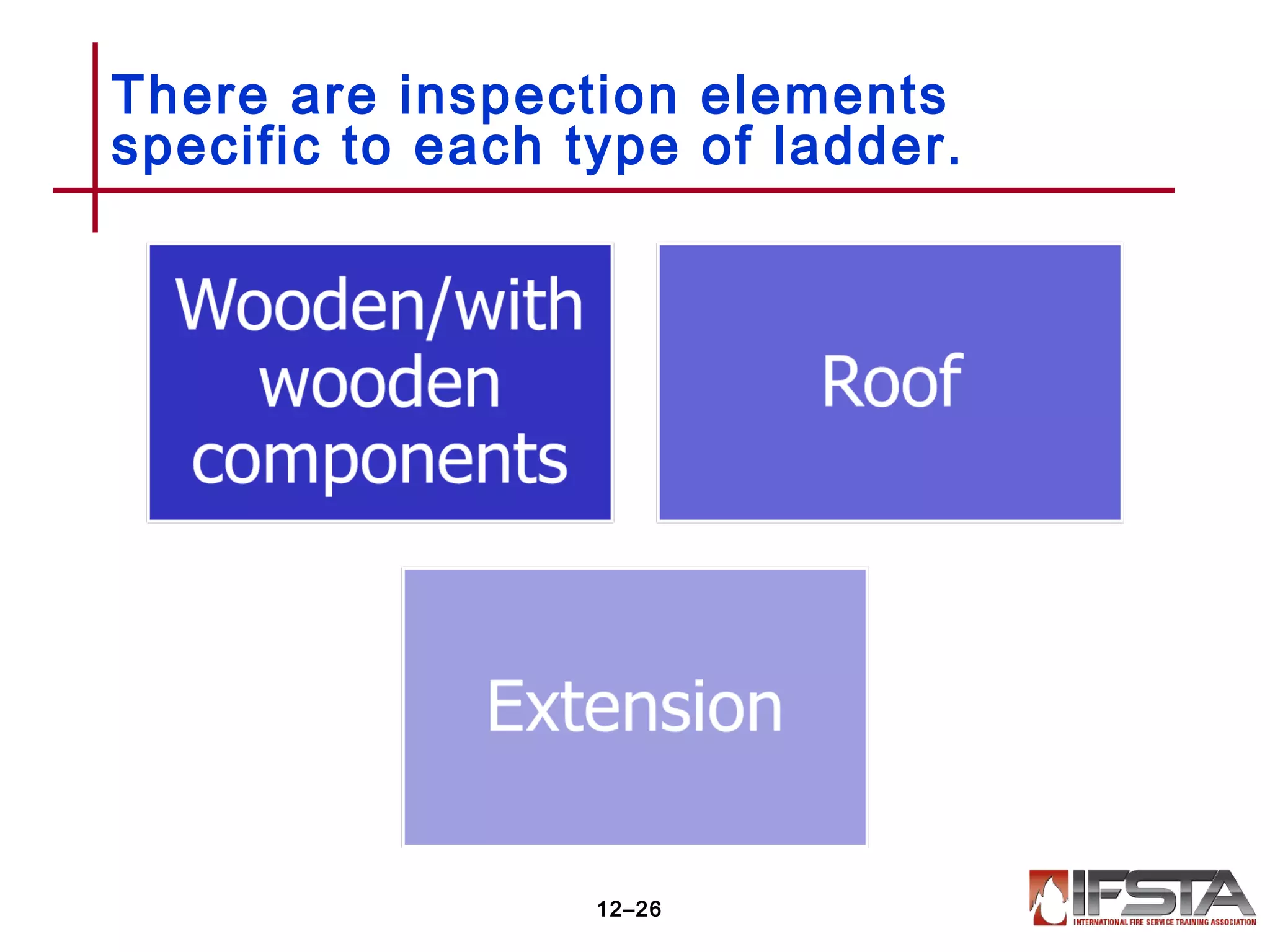
There are inspection elements
specific to each type of ladder.
12–26
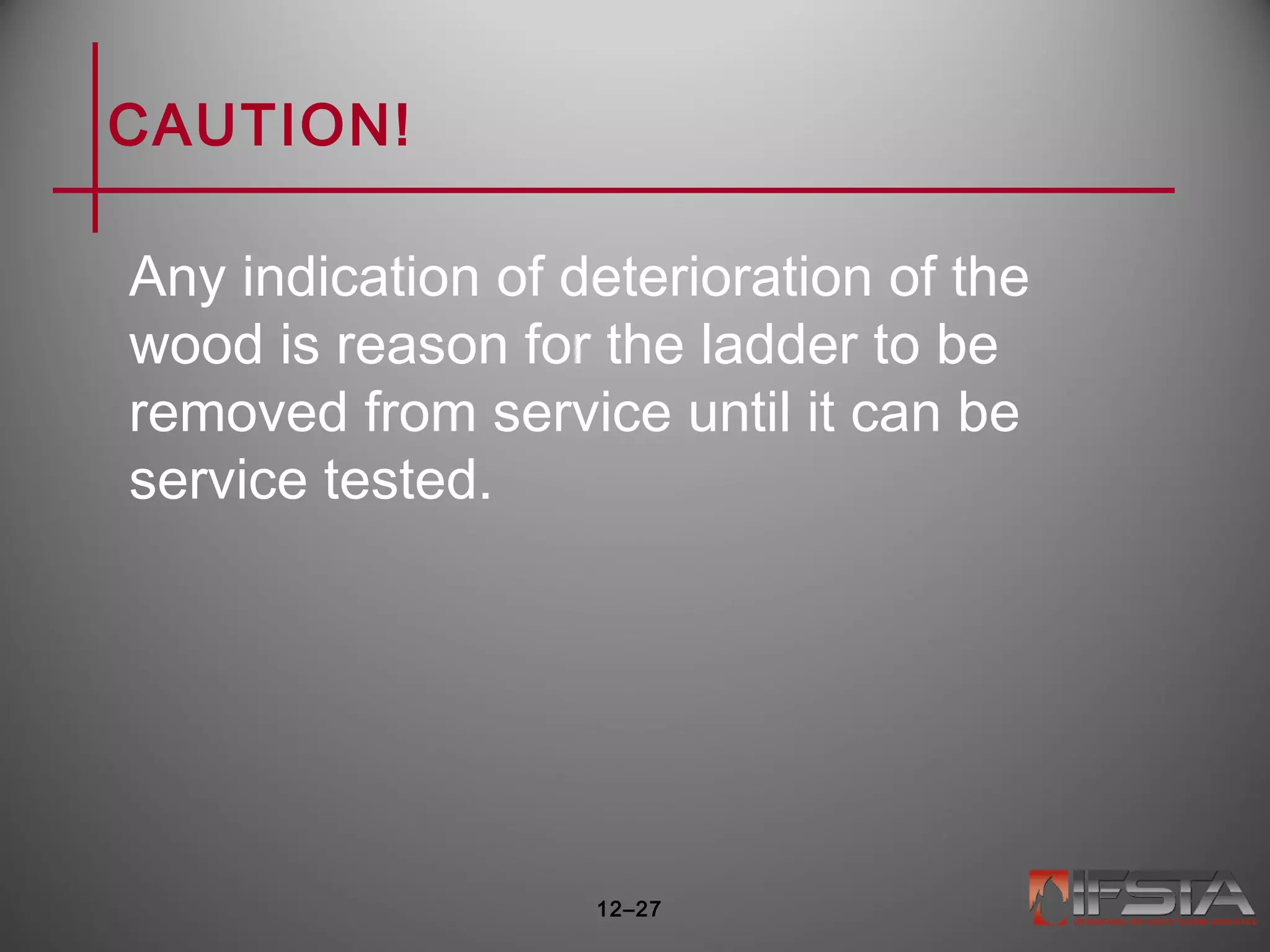
CAUTION!
Any indication of deterioration of the
wood is reason for the ladder to be
removed from service until it can be
service tested.
12–27
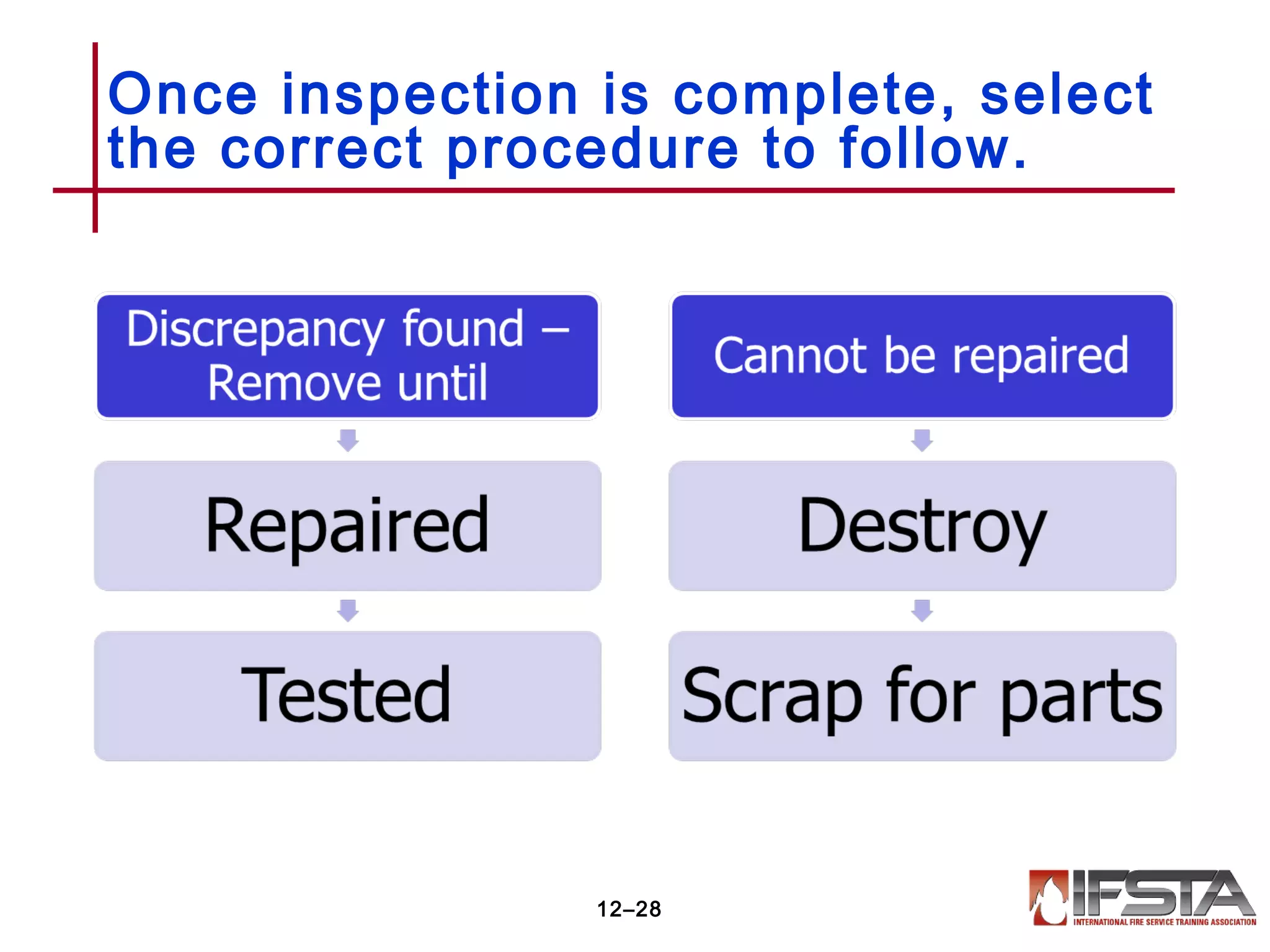
Once inspection is complete, select
the correct procedure to follow.
12–28
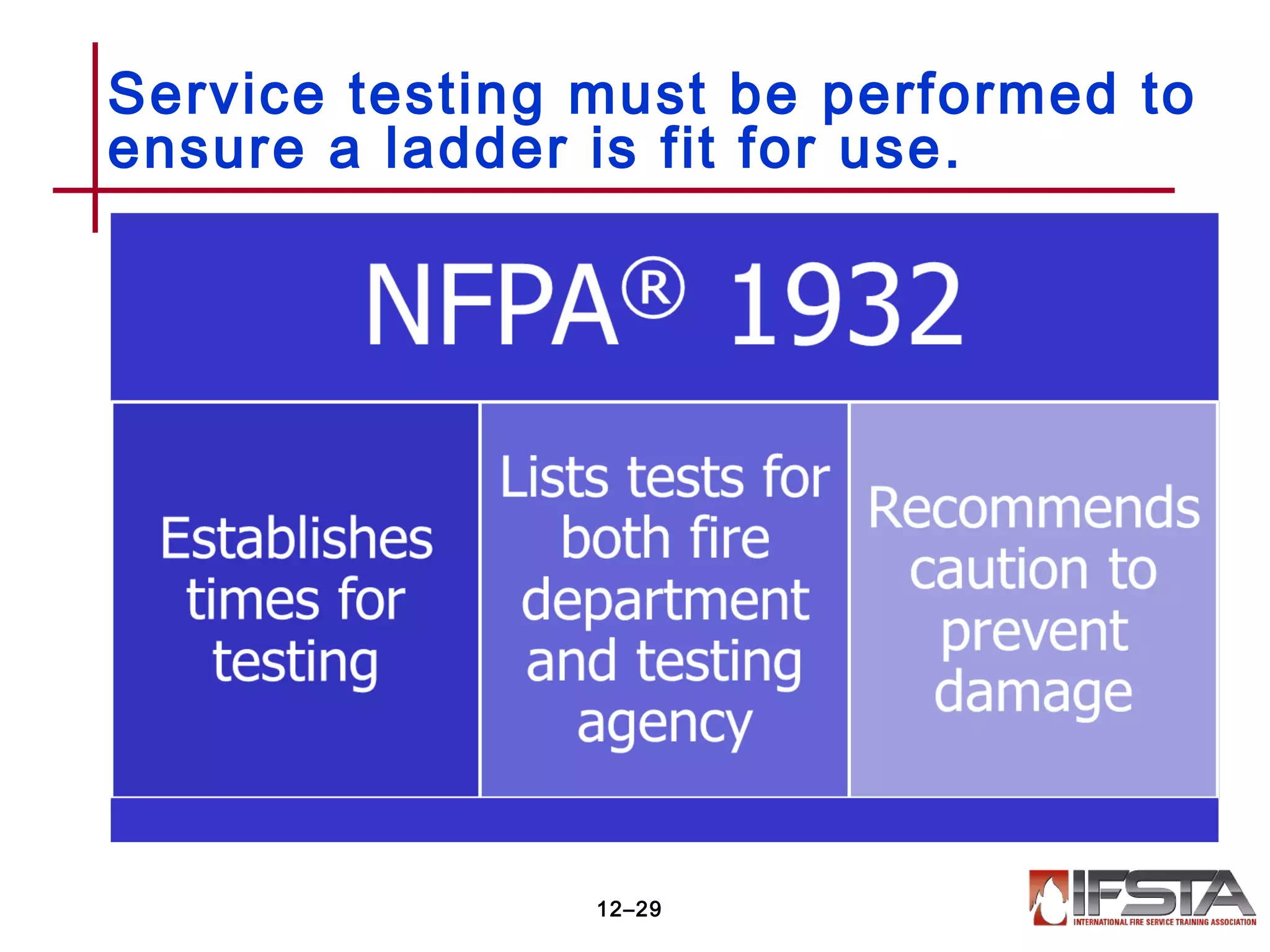
Service testing must be performed to
ensure a ladder is fit for use.
12–29
REVIEW QUESTION
What types of information do
general ladder inspections look for?
12–30
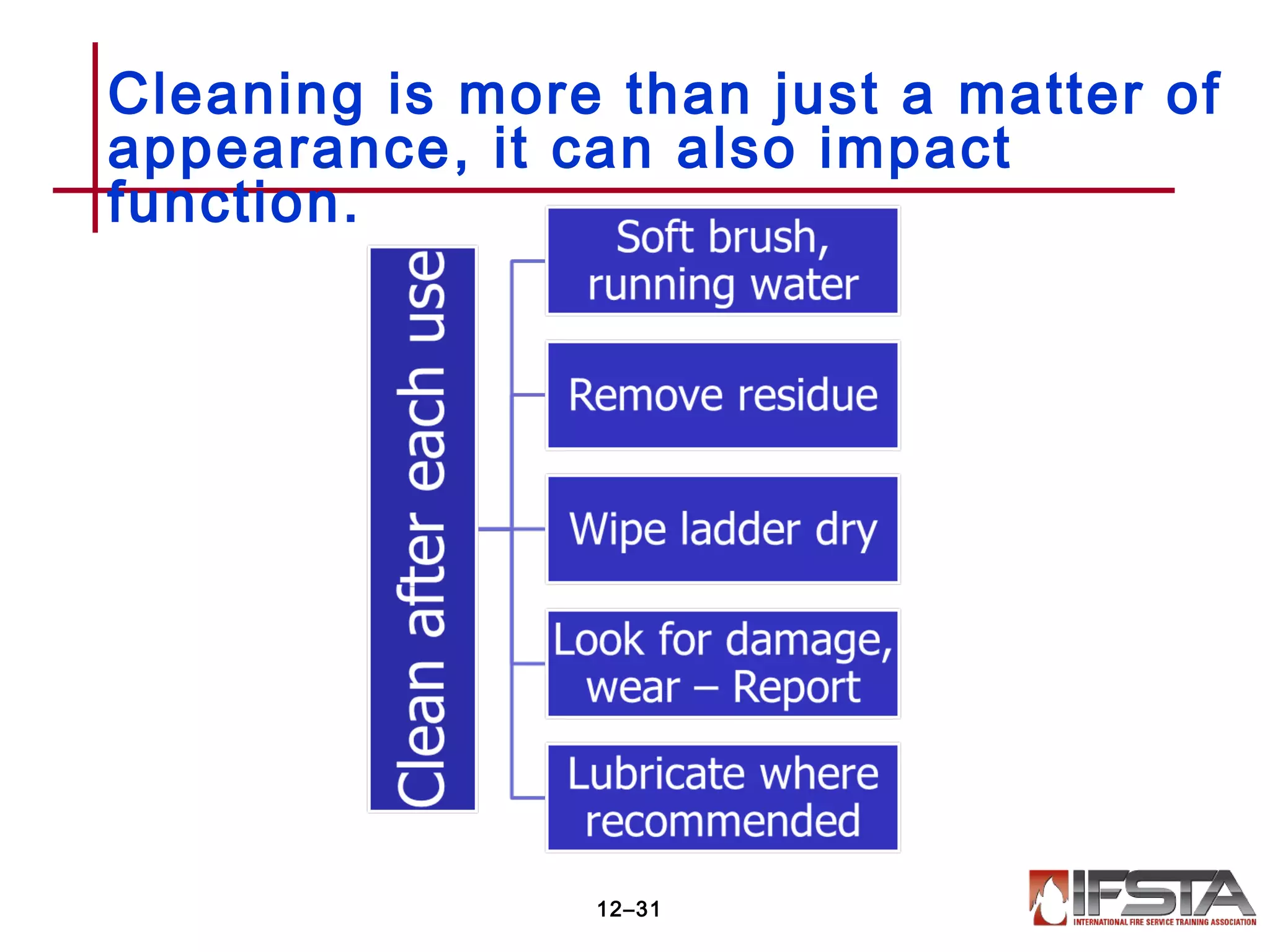
Cleaning is more than just a matter of
appearance, it can also impact
function.
12–31
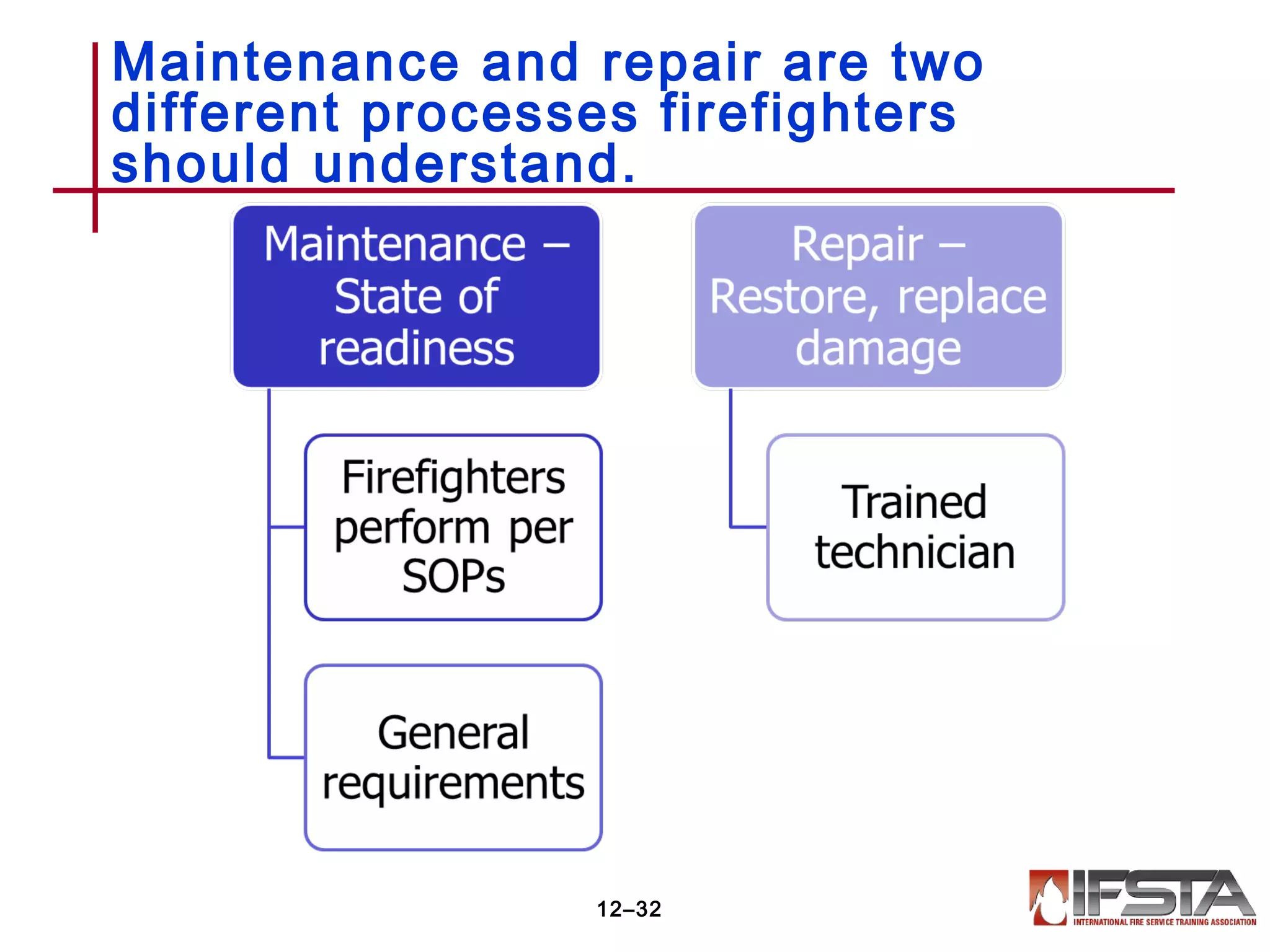
Maintenance and repair are two
different processes firefighters
should understand.
12–32
REVIEW QUESTION
What are the general maintenance
requirements for ground ladders?
12–33
Describe safety guidelines used
when handling ladders.
Learning Objective 5
12–34
Explain considerations taken when
selecting, lifting, and lowering a
ladder.
Learning Objective 6
12–35
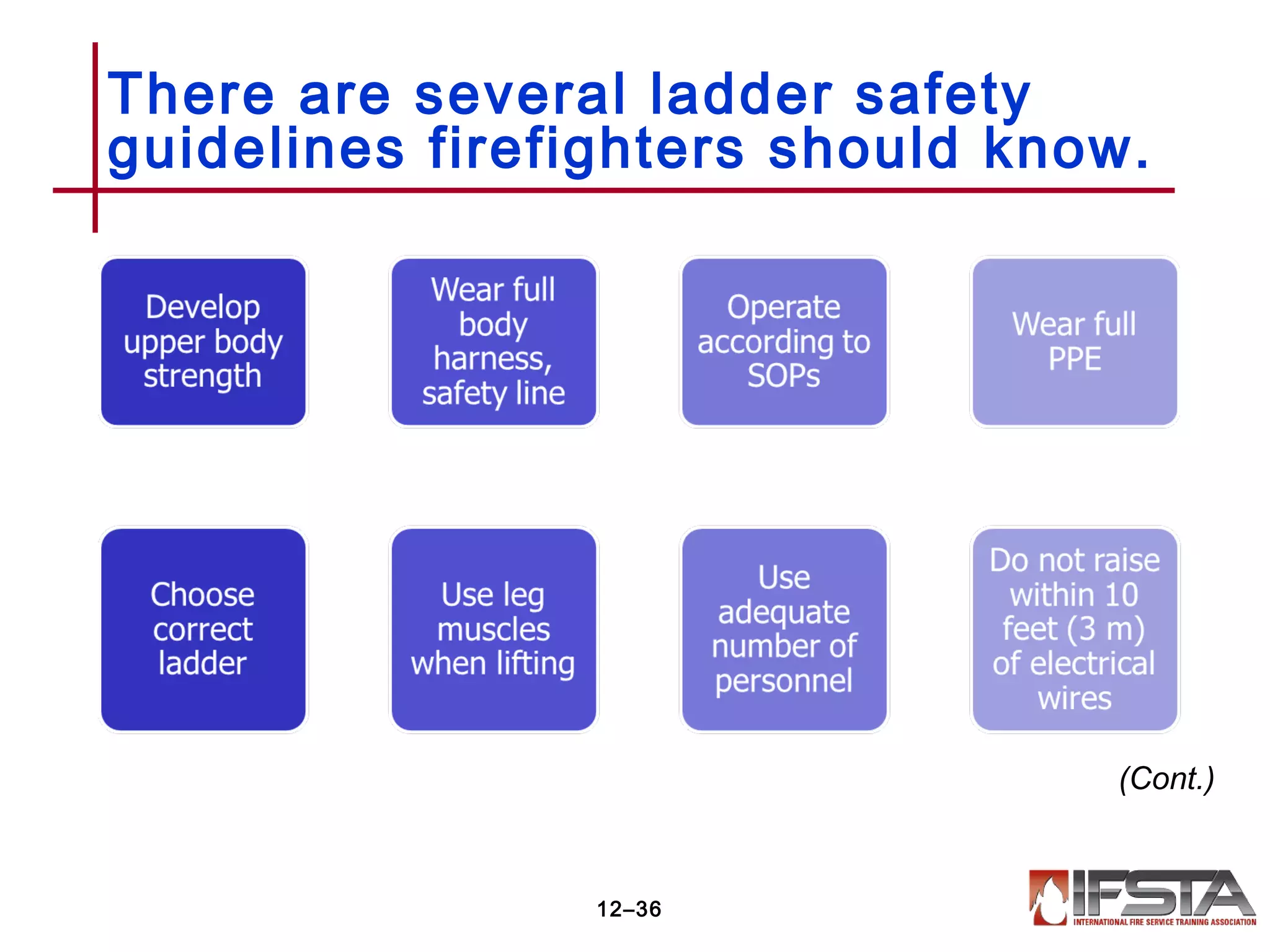
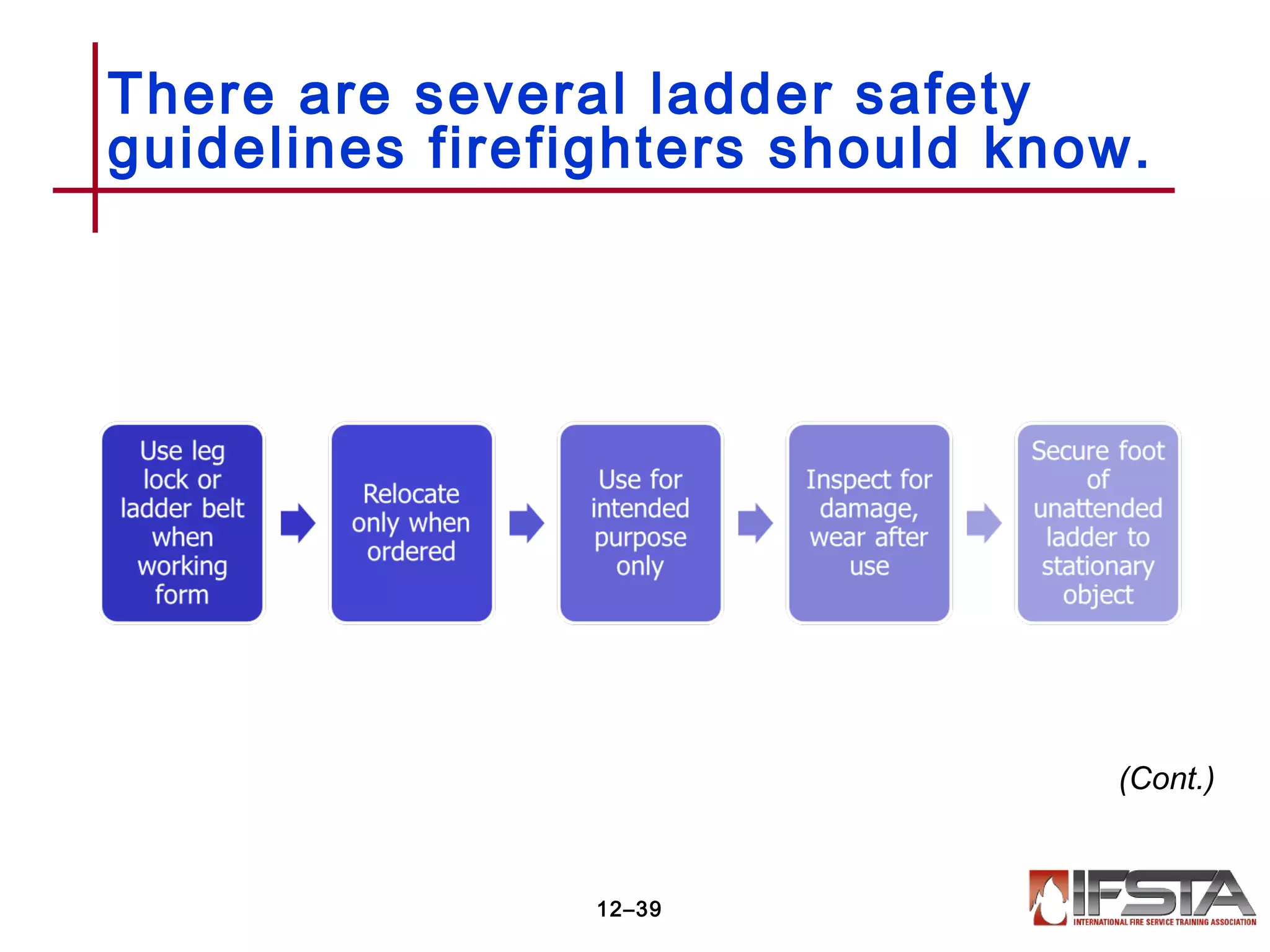
There are several ladder safety
guidelines firefighters should know.
12–36
(Cont.)
WARNING!
Ladders coming in contact with power
sources may result in electrocution of
anyone in contact with the ladder.
12–37
There are several ladder safety
guidelines firefighters should know.
12–38
(Cont.)
There are several ladder safety
guidelines firefighters should know.
12–39
(Cont.)
WARNING!
Sliding down a ladder either feet first or
head first – even in an emergency – is
unsafe and may result in serious injury
or death.
12–40
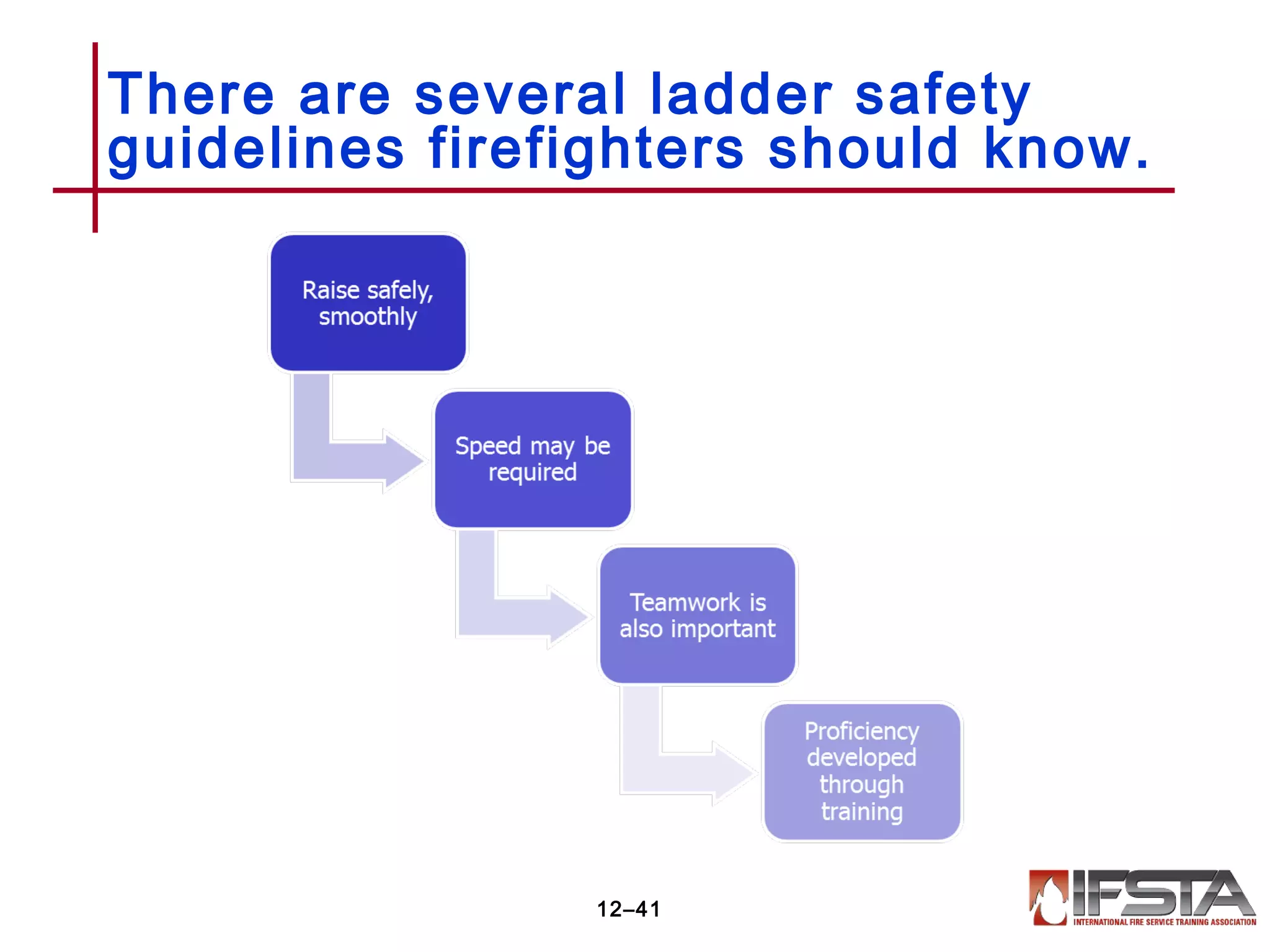
There are several ladder safety
guidelines firefighters should know.
12–41
REVIEW QUESTION
What are the guidelines for safely
carrying, raising, lowering, and
working on ladders?
12–42
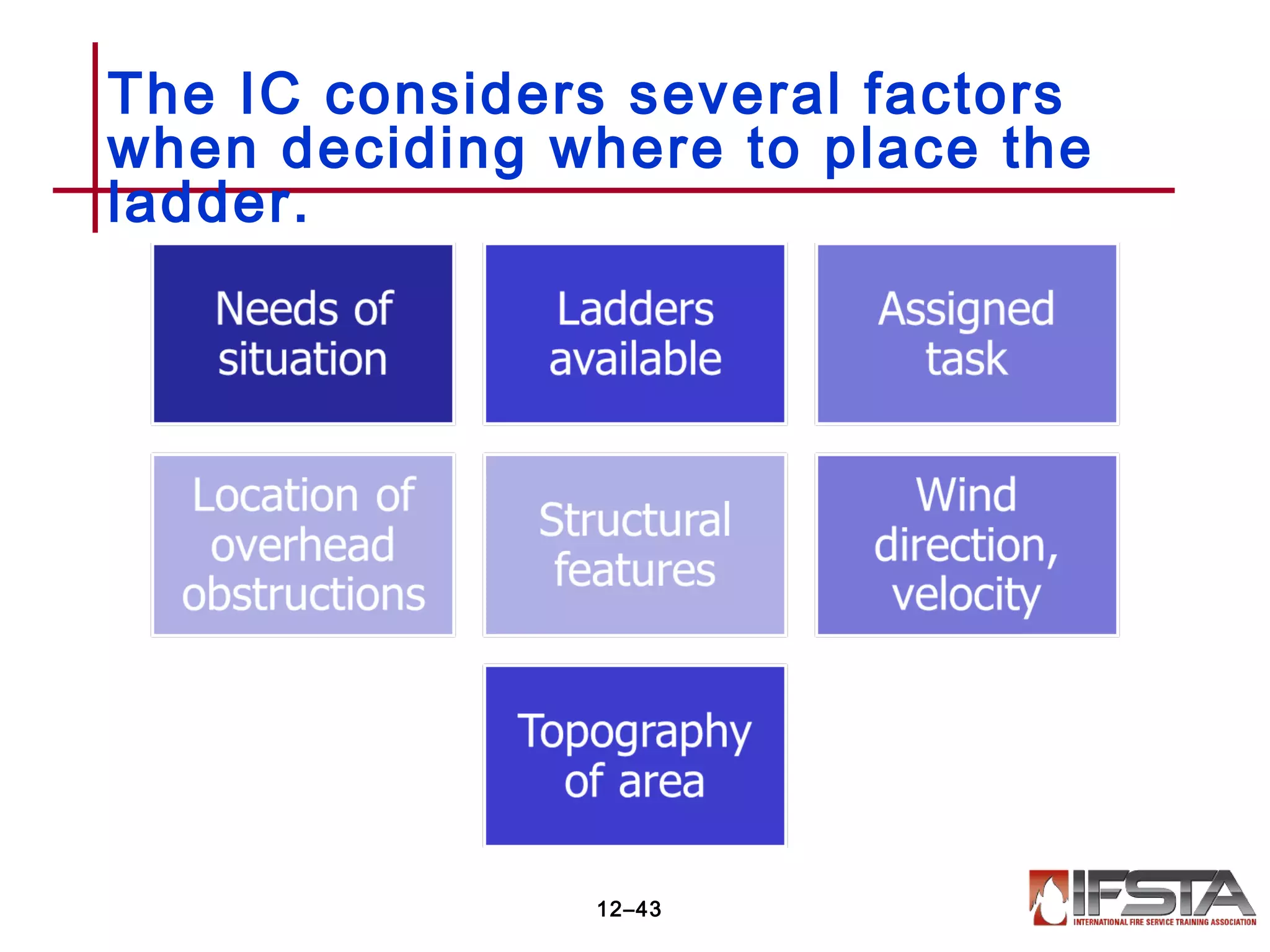
The IC considers several factors
when deciding where to place the
ladder.
12–43
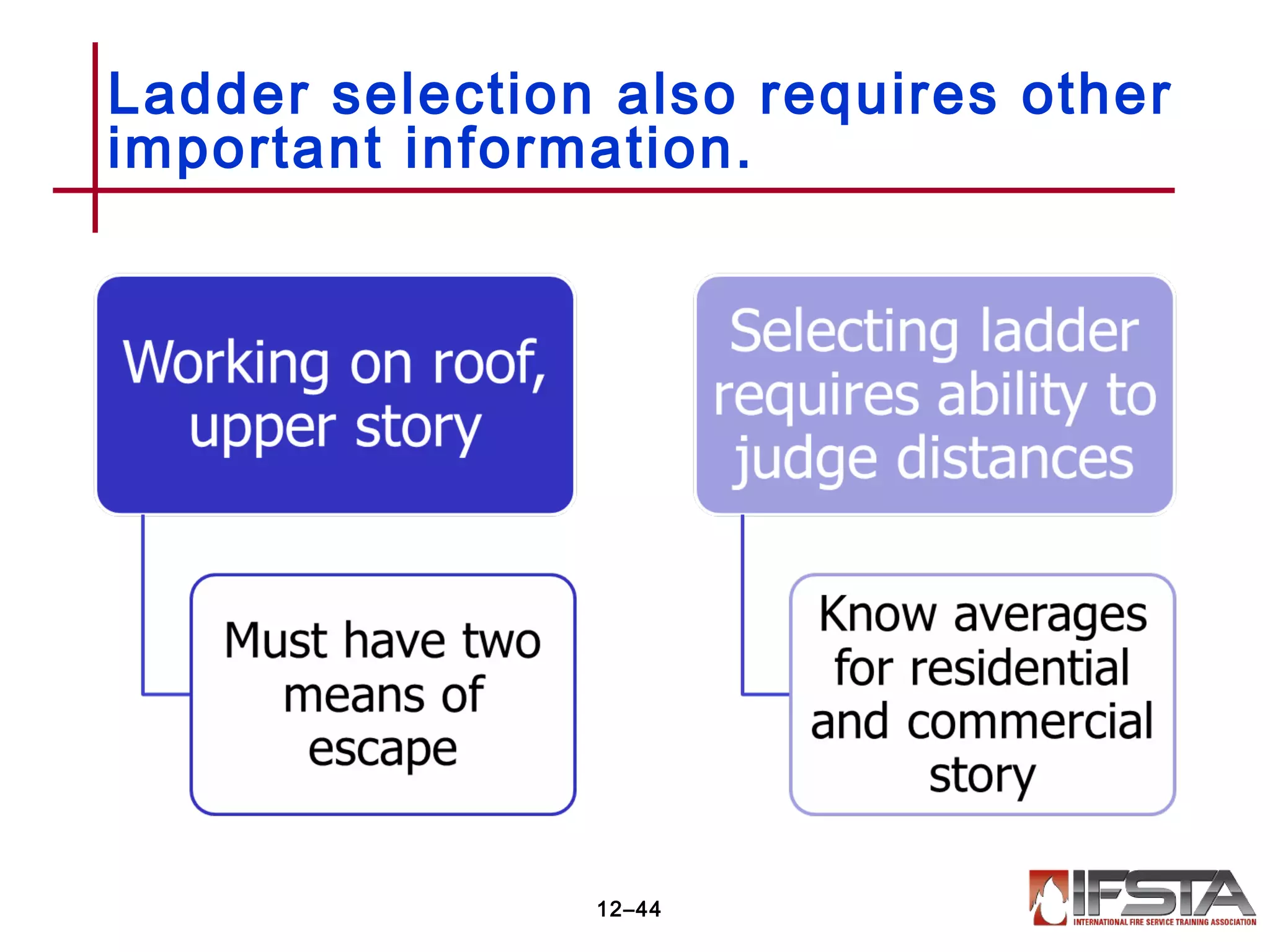
Ladder selection also requires other
important information.
12–44
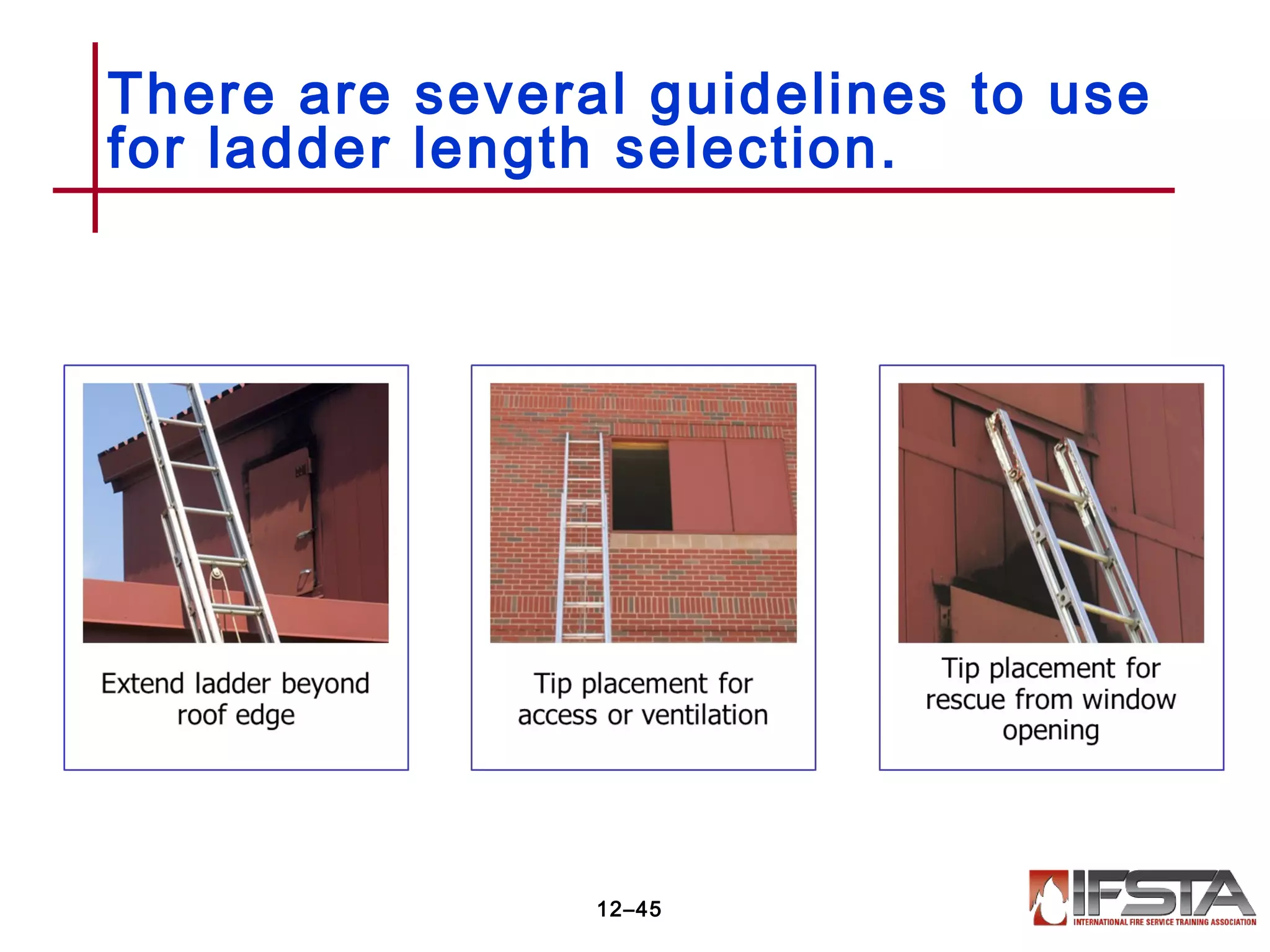
There are several guidelines to use
for ladder length selection.
12–45
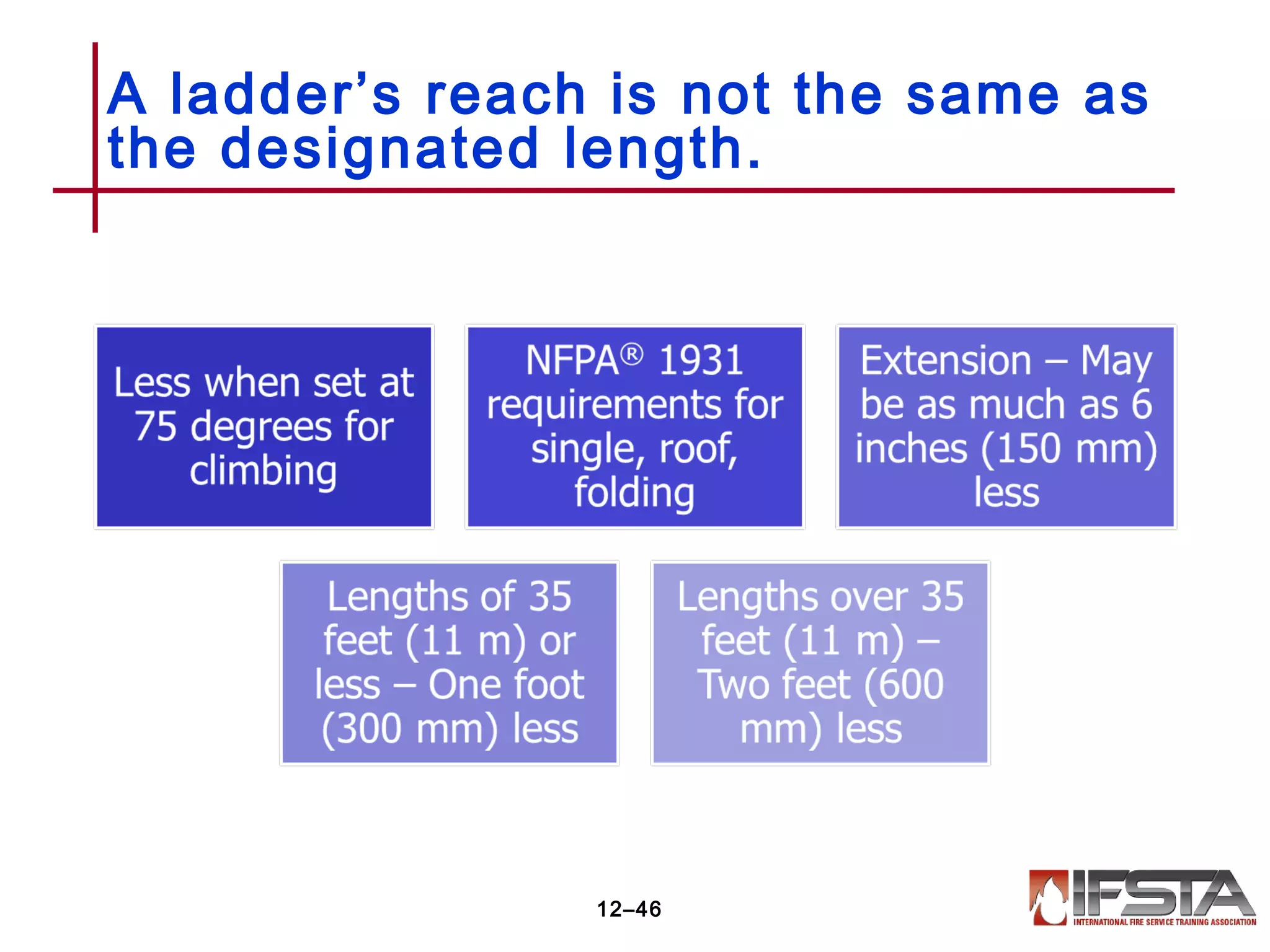
A ladder’s reach is not the same as
the designated length.
12–46
REVIEW QUESTION
What factors must be considered
when selecting a ladder placement
location?
12–47
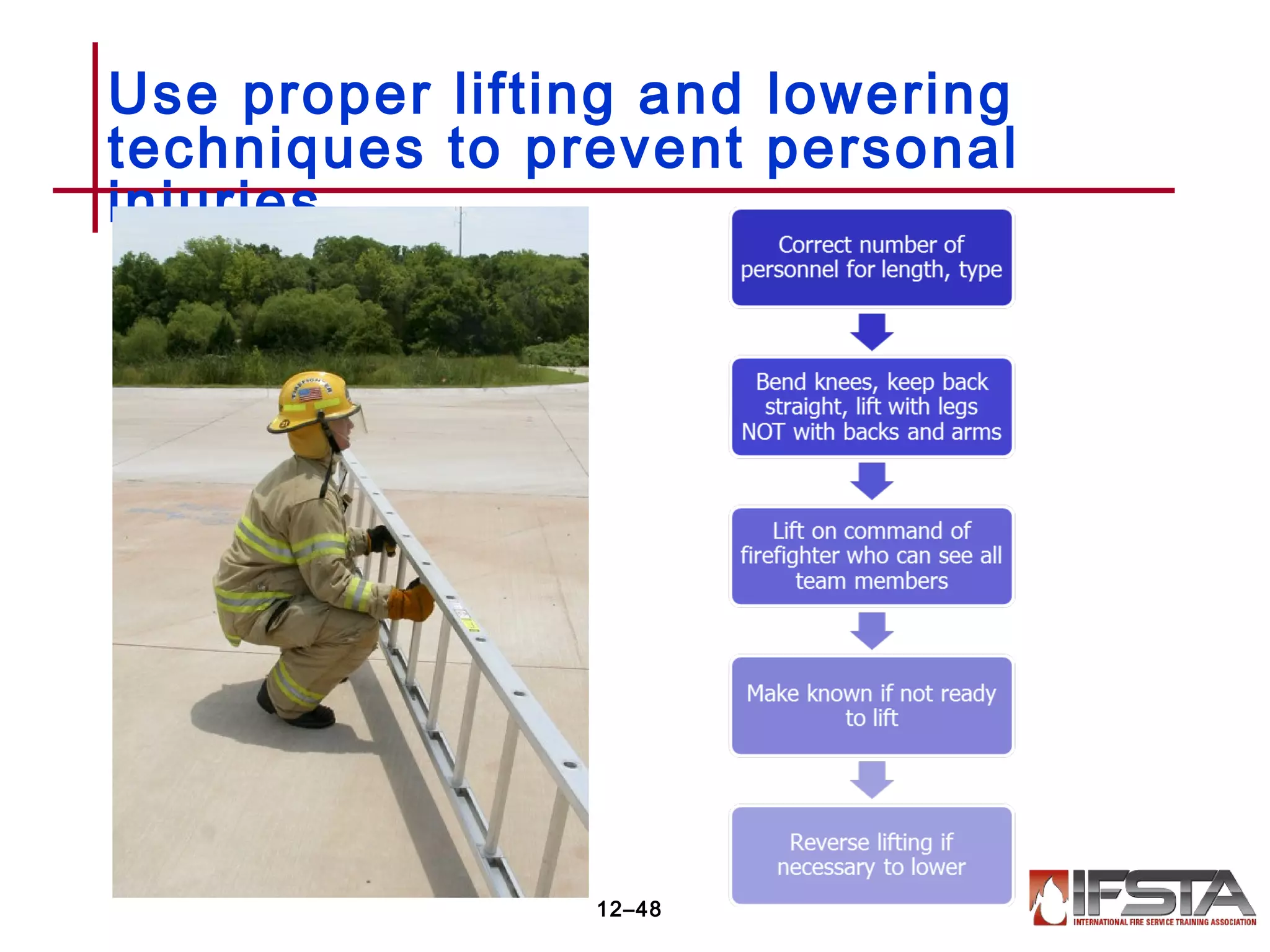
Use proper lifting and lowering
techniques to prevent personal
injuries.
12–48
REVIEW QUESTION
What techniques should be used to
prevent personal injuries when lifting
and lowering ladders?
12–49
Describe various methods for ladder
carries.
Learning Objective 7
12–50
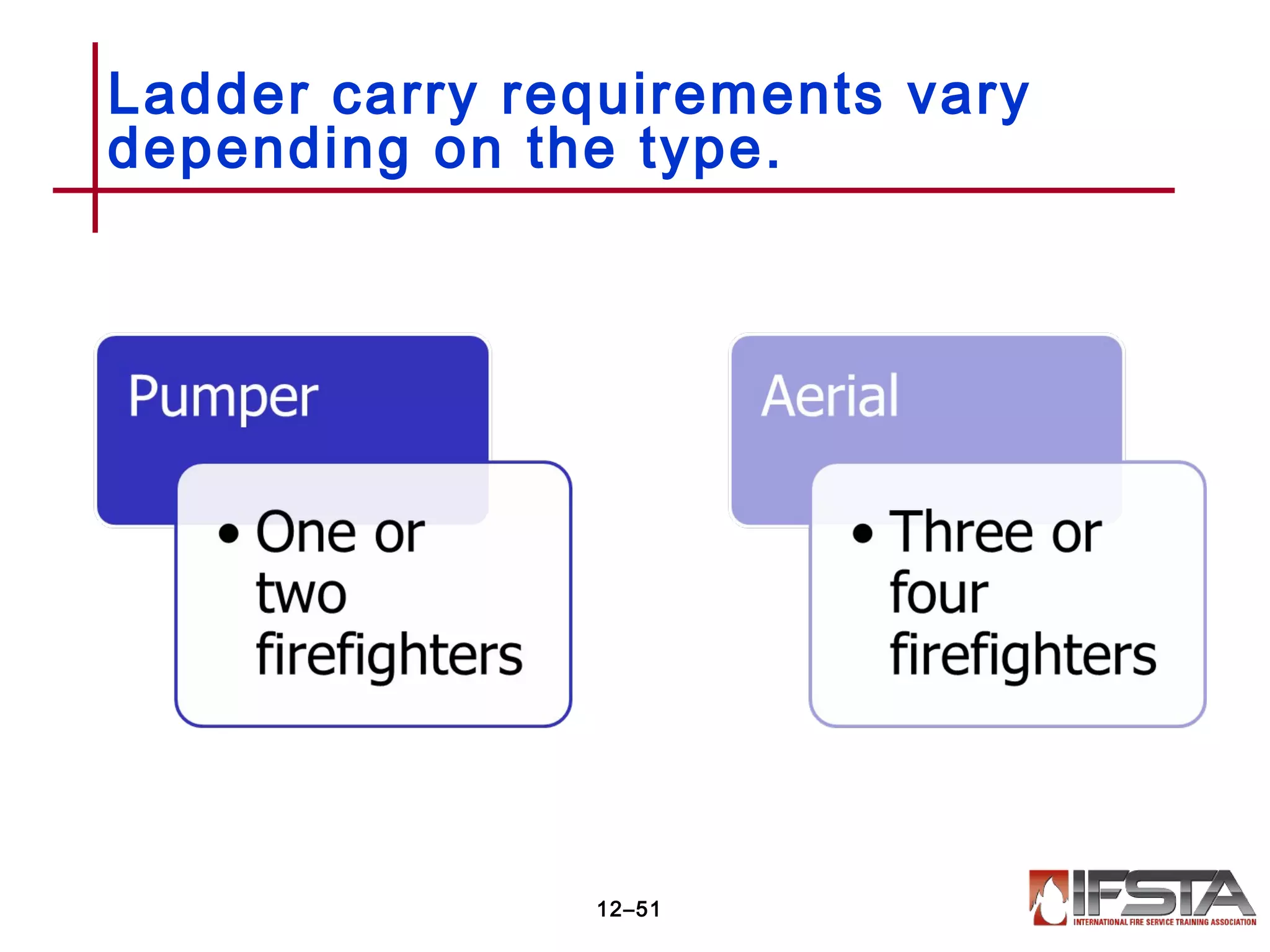
Ladder carry requirements vary
depending on the type.
12–51
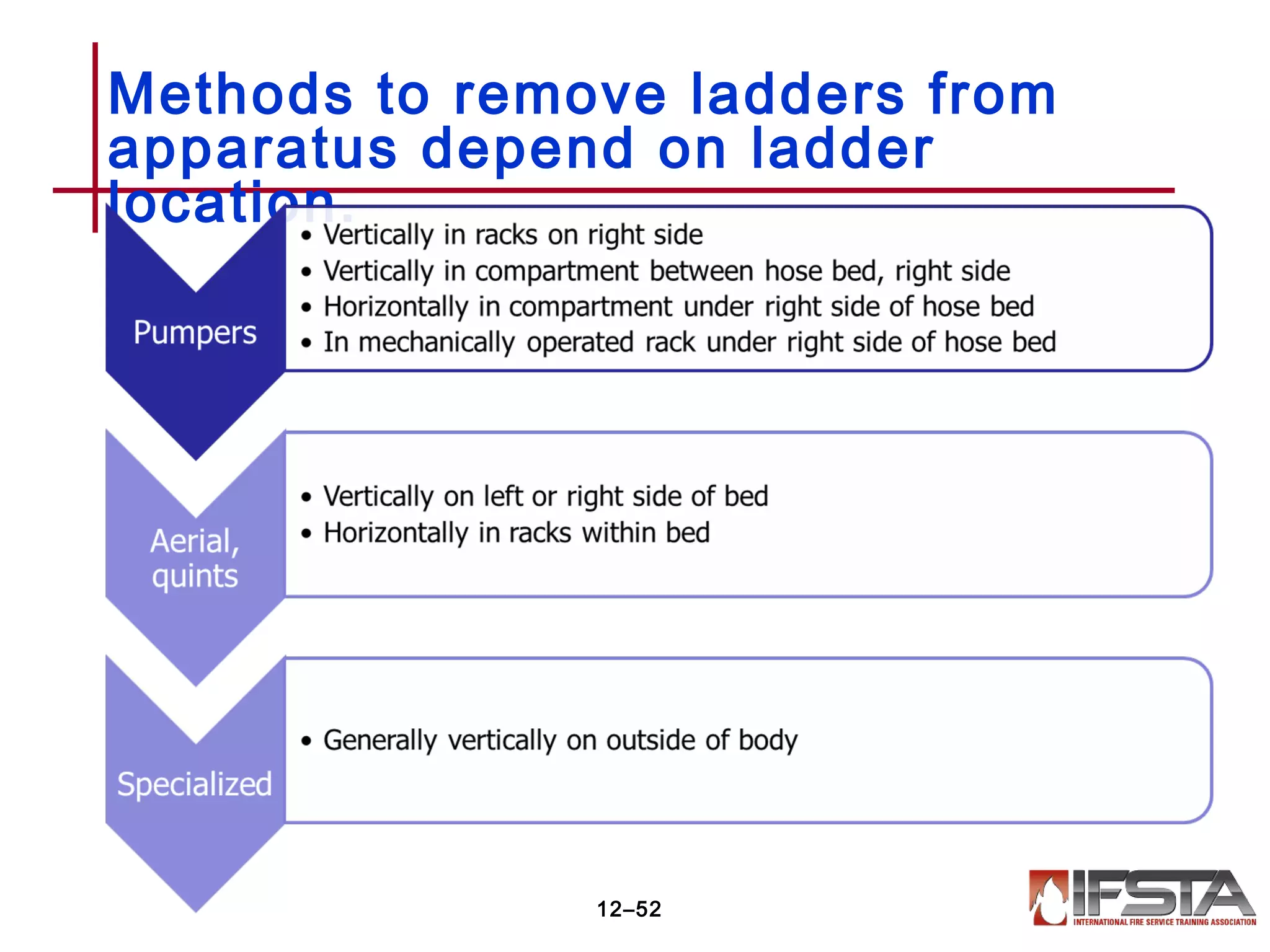
Methods to remove ladders from
apparatus depend on ladder
location.
12–52
DISCUSSION QUESTIONS
How are the ground ladders
mounted on the different apparatus in
your jurisdiction?
Have you observed ladders being
removed from racks, compartments, or a
mechanically operated rack?
12–53
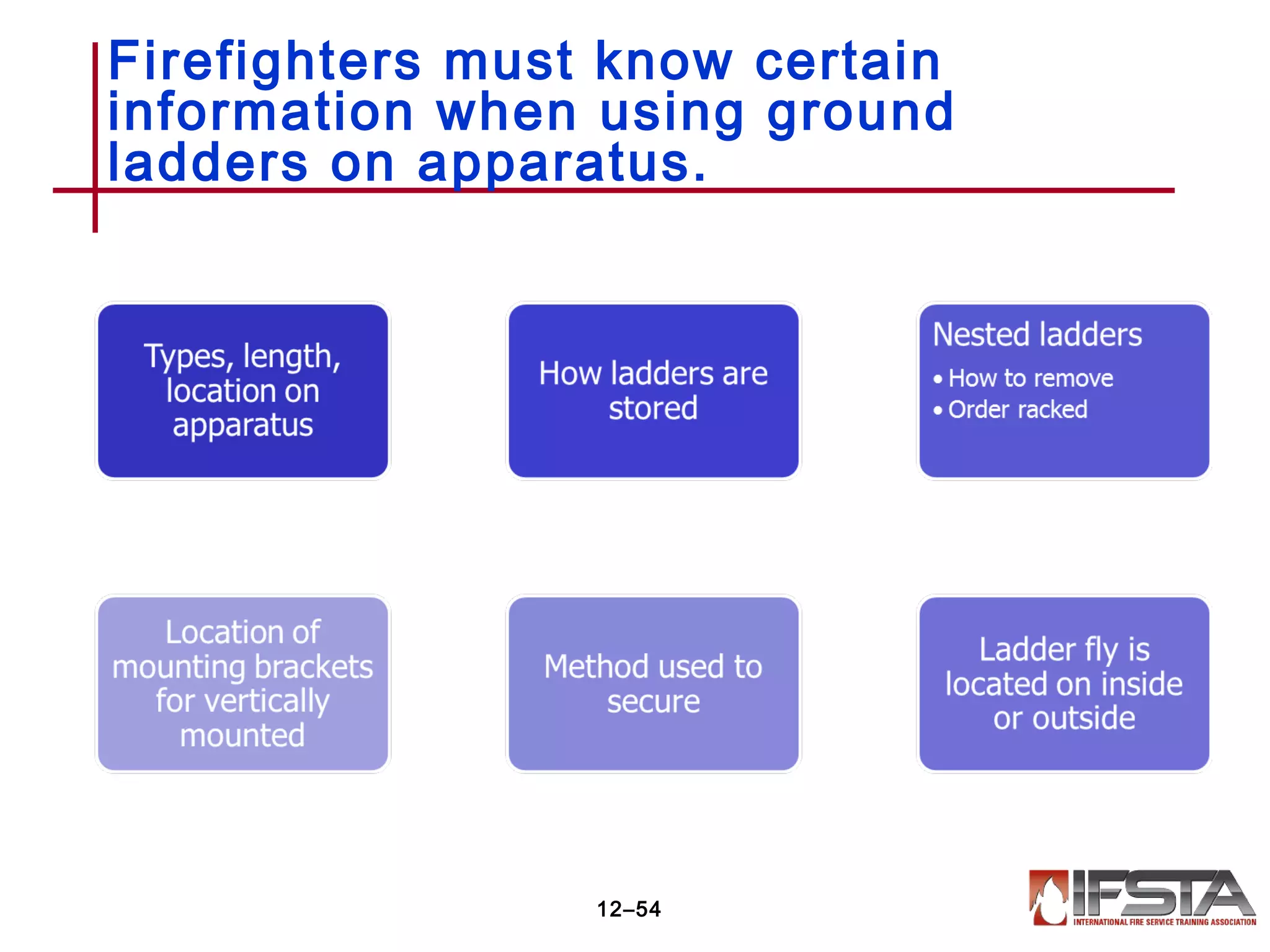
Firefighters must know certain
information when using ground
ladders on apparatus.
12–54
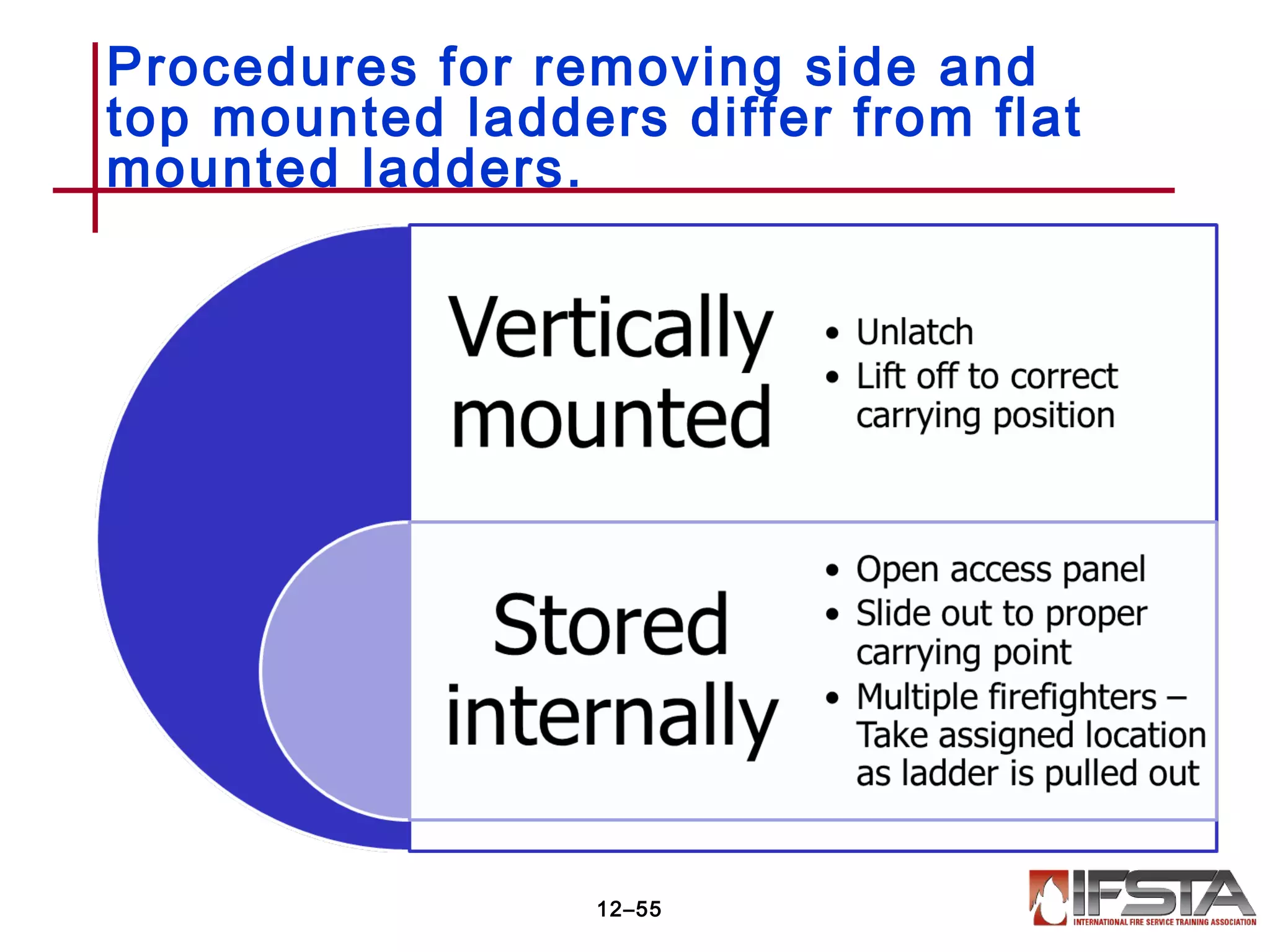
Procedures for removing side and
top mounted ladders differ from flat
mounted ladders.
12–55
REVIEW QUESTION
What information must a firefighter
know in order to use ground ladders?
12–56
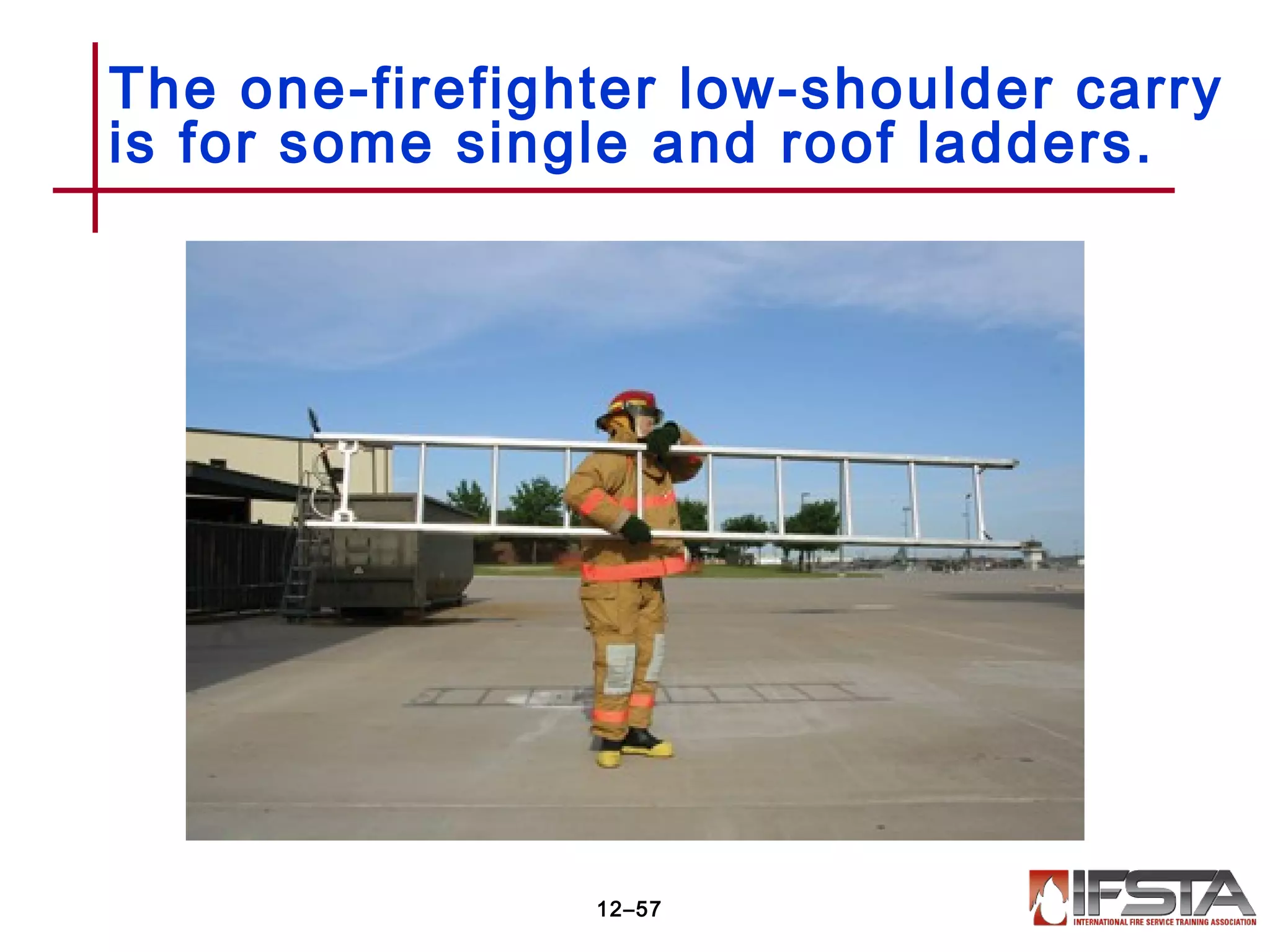
The one-firefighter low-shoulder carry
is for some single and roof ladders.
12–57
CAUTION!
Carrying the forward end of a ladder at
eye level impedes the carrier’s balance
and visibility and increases the risk of
the butt spurs striking someone else in
the head.
12–58
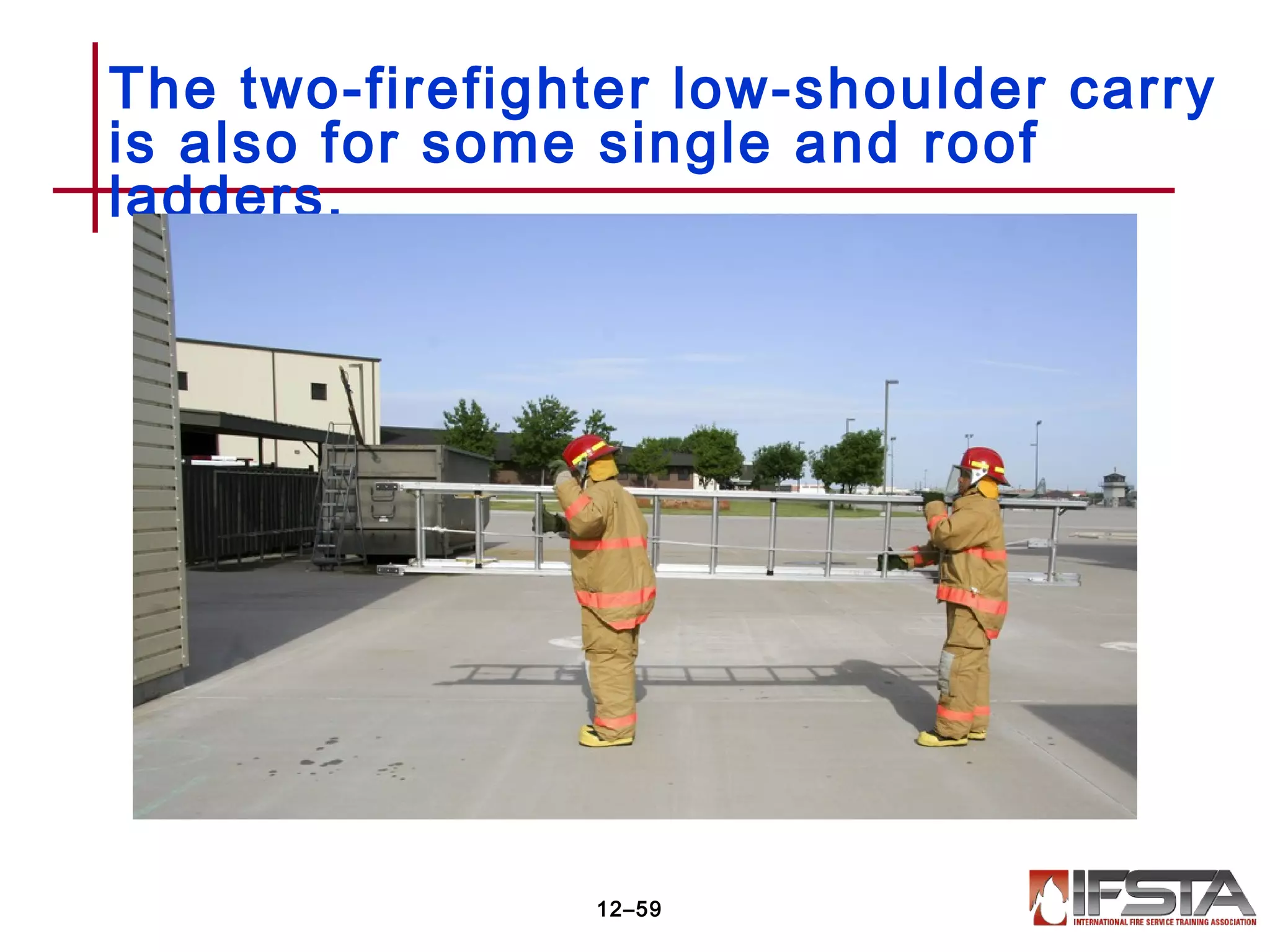
The two-firefighter low-shoulder carry
is also for some single and roof
ladders.
12–59
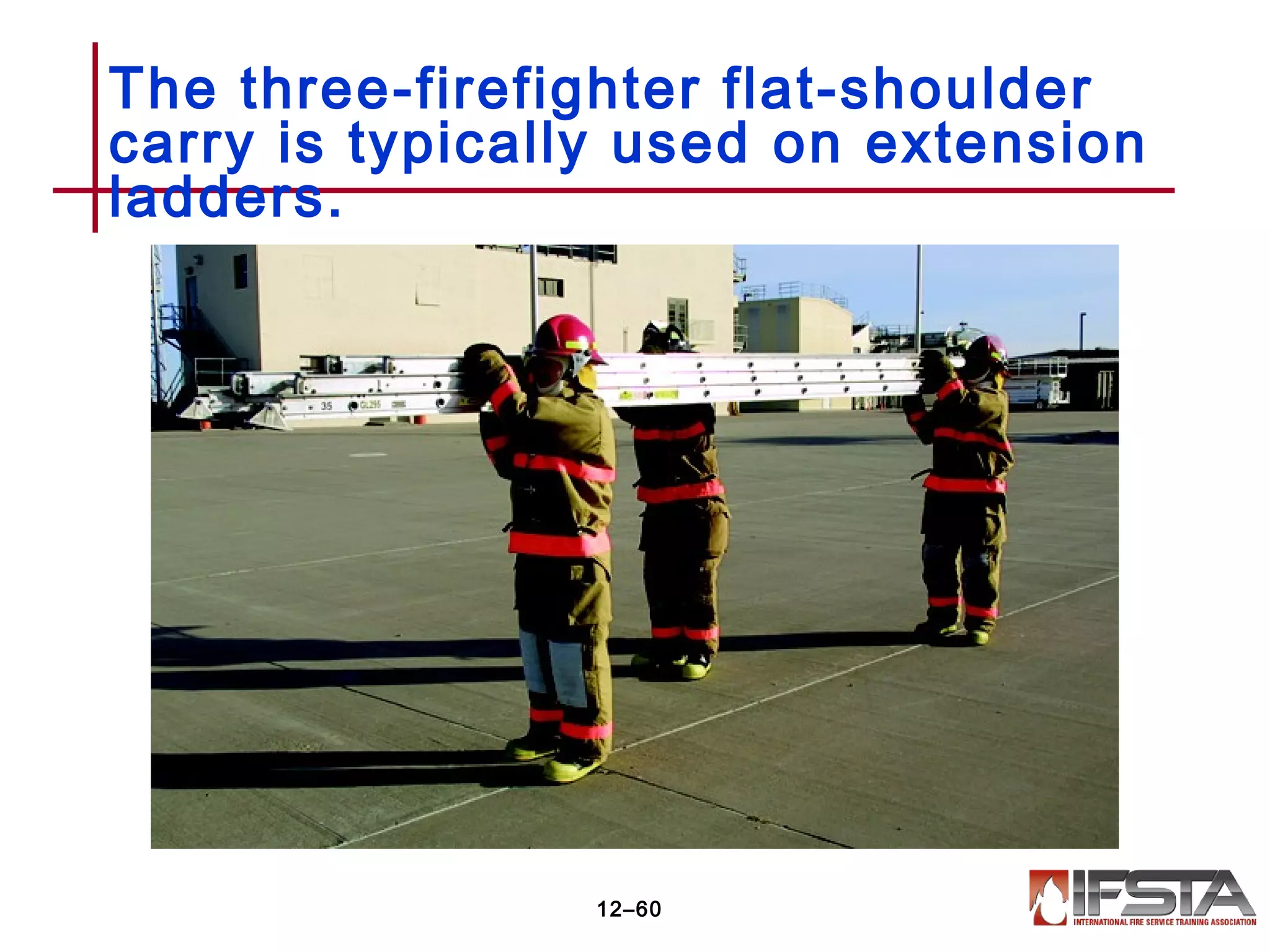
The three-firefighter flat-shoulder
carry is typically used on extension
ladders.
12–60
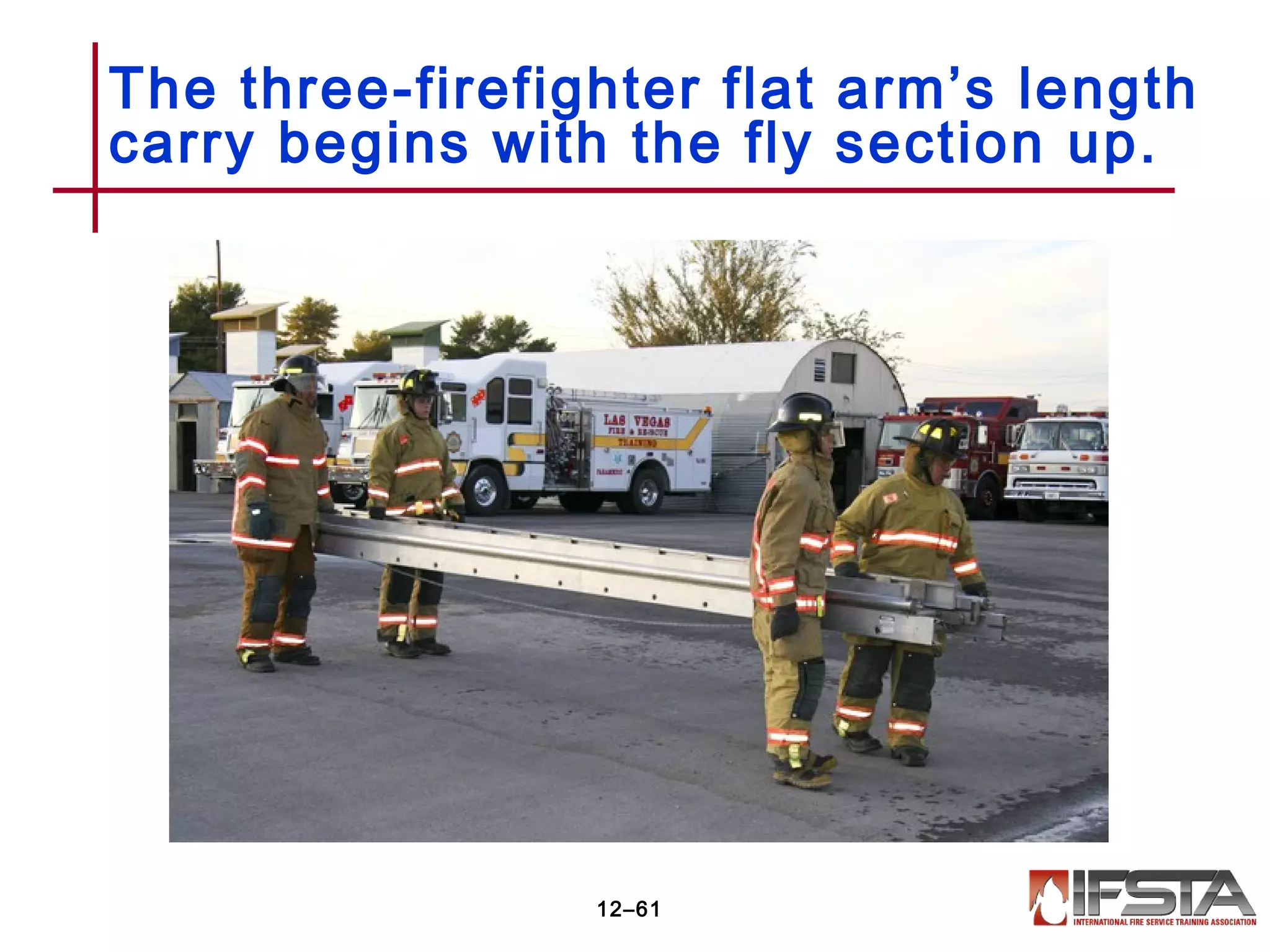
The three-firefighter flat arm’s length
carry begins with the fly section up.
12–61
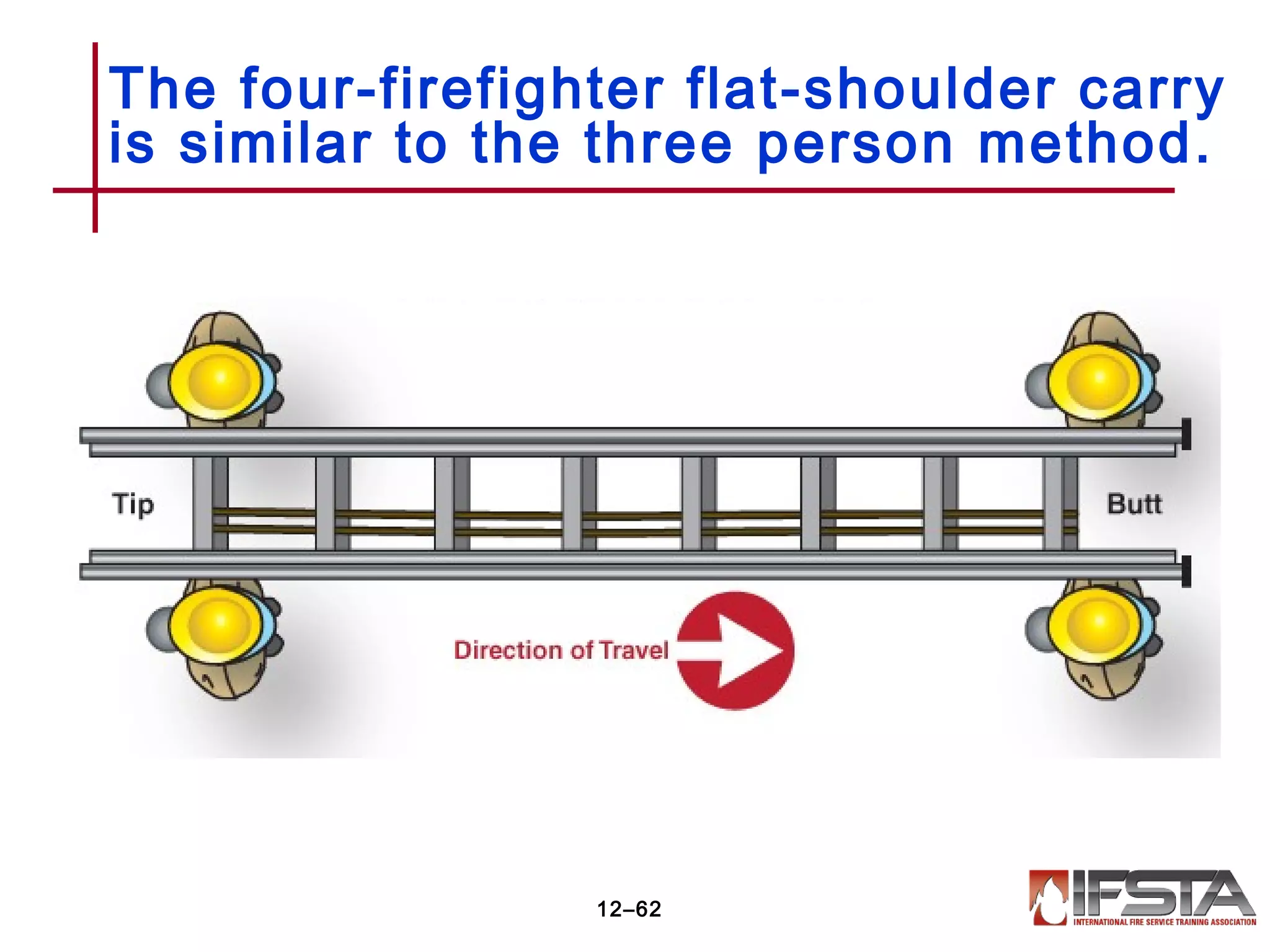
The four-firefighter flat-shoulder carry
is similar to the three person method.
12–62
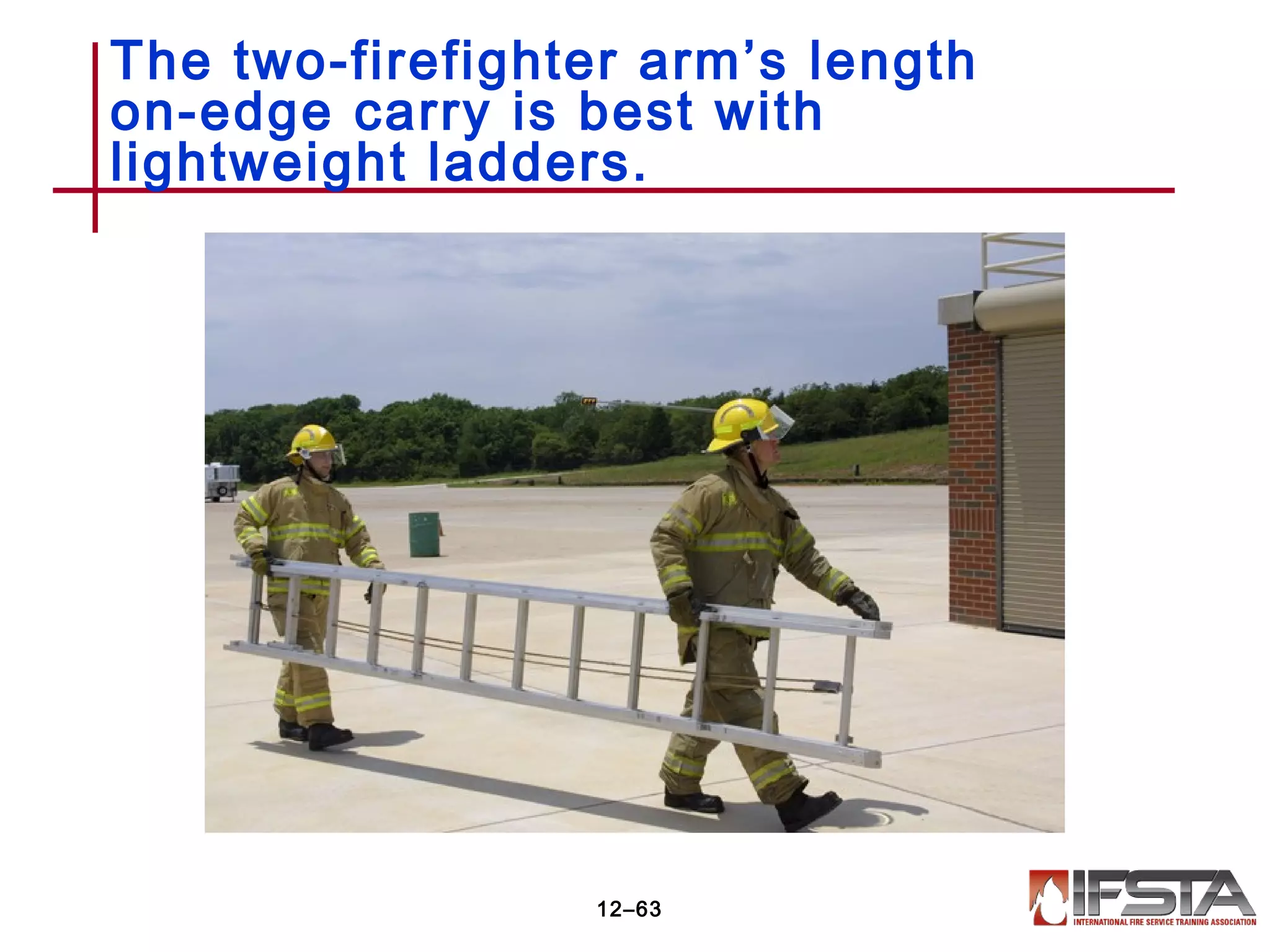
The two-firefighter arm’s length
on-edge carry is best with
lightweight ladders.
12–63
There are some general procedures
to use for carrying roof ladders.
12–64
Identify basic considerations and
requirements for ground ladder
placement.
Learning Objective 8
12–65
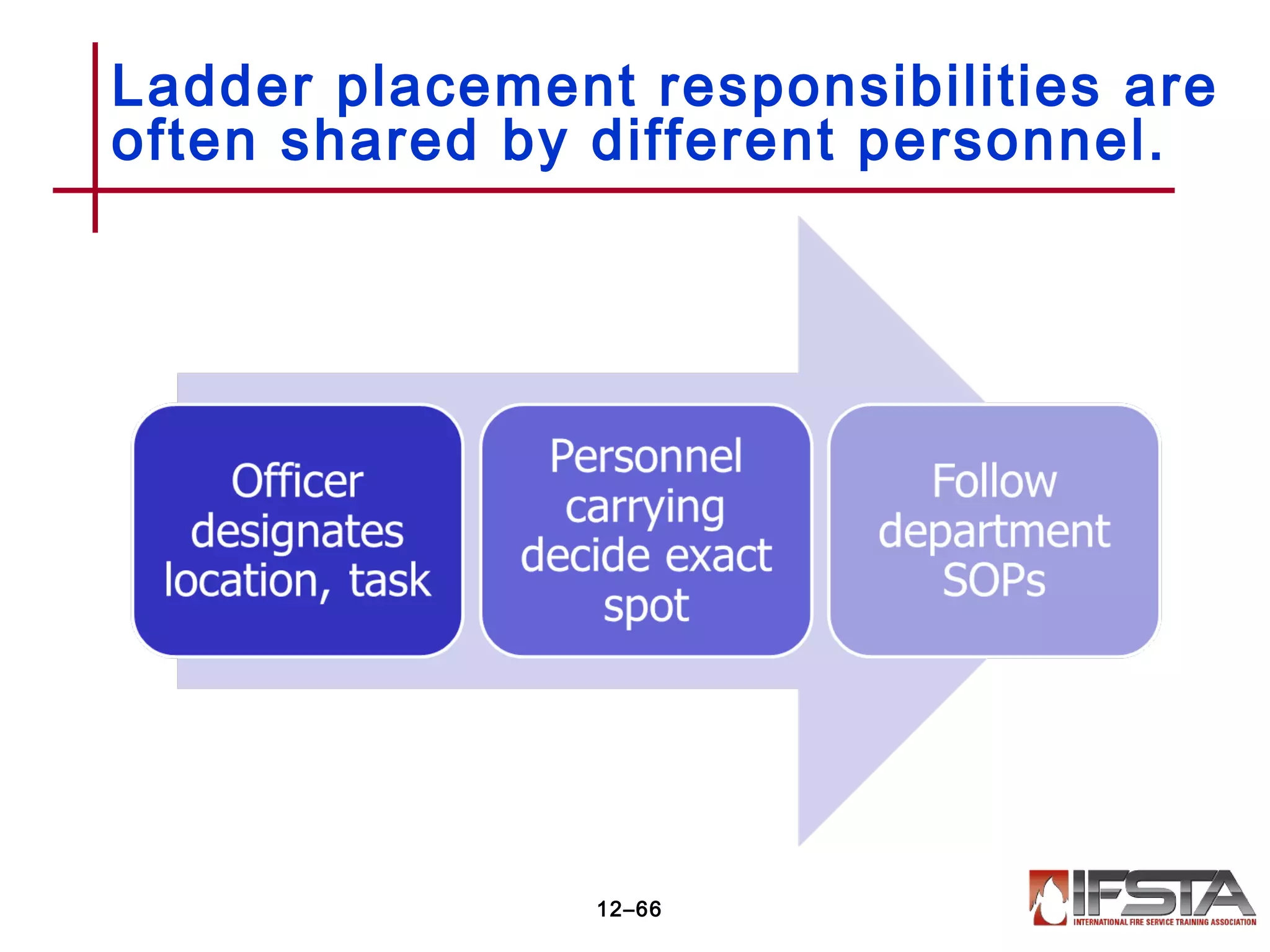
Ladder placement responsibilities are
often shared by different personnel.
12–66
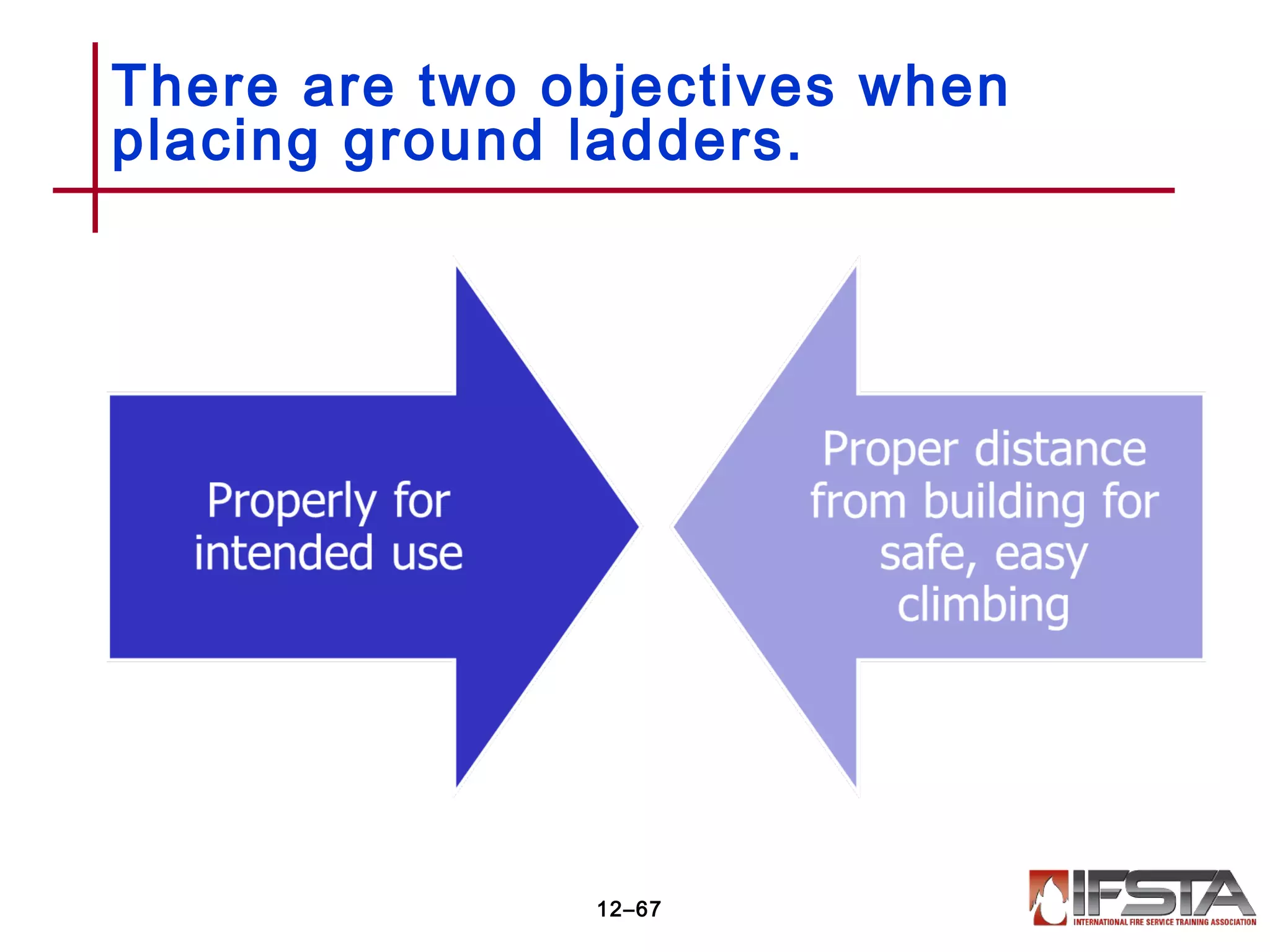
There are two objectives when
placing ground ladders.
12–67
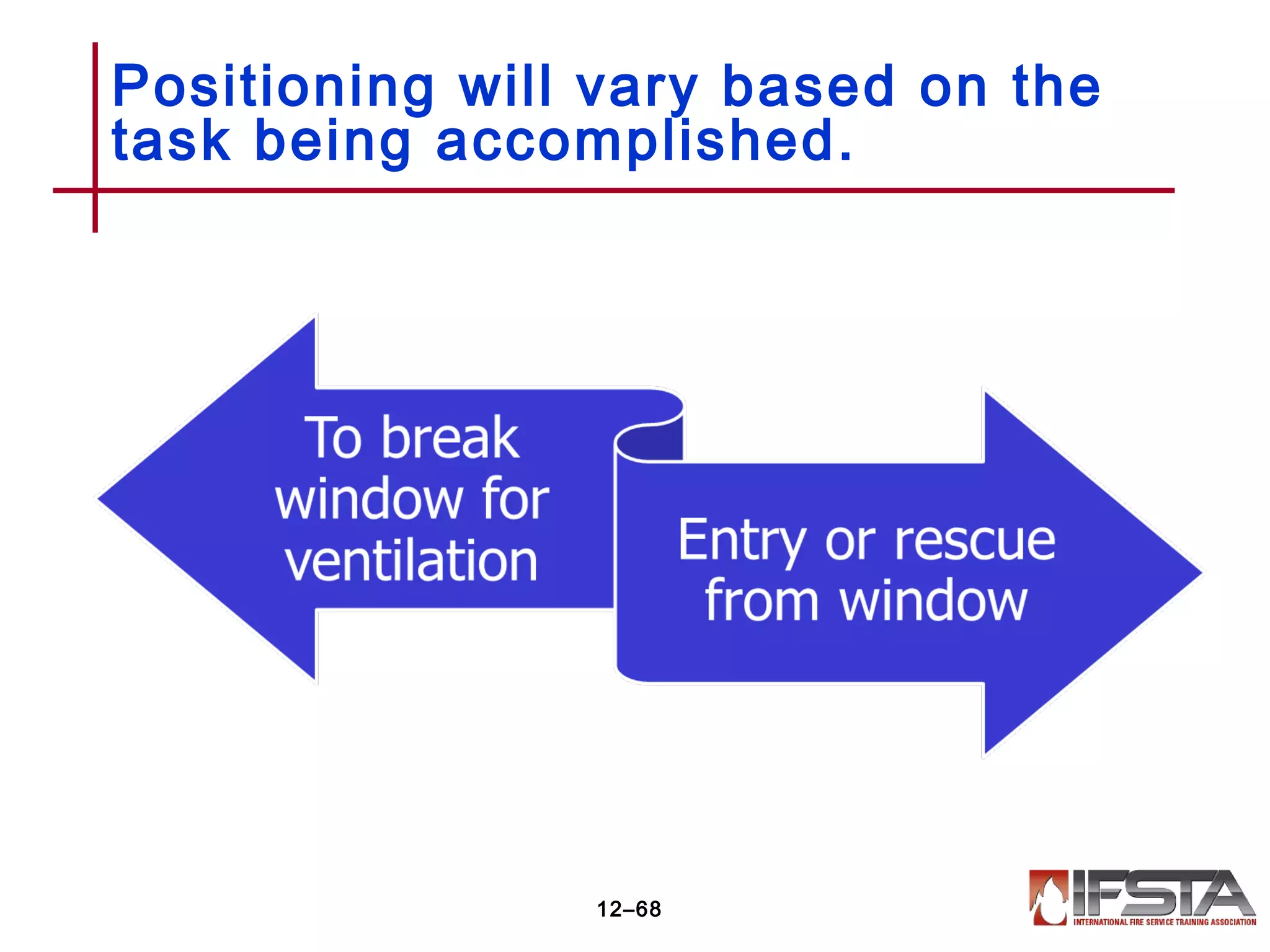
Positioning will vary based on the
task being accomplished.
12–68
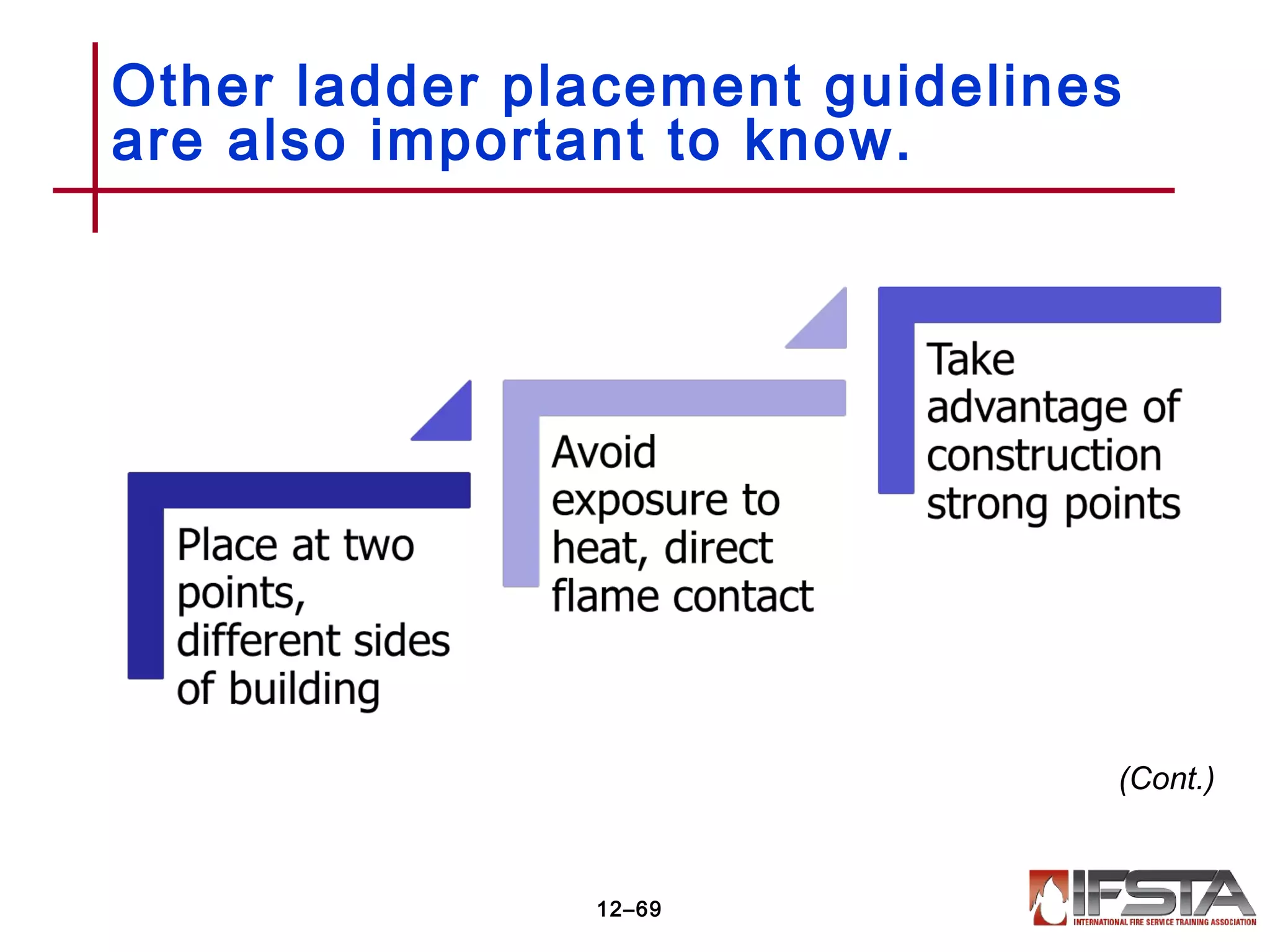
Other ladder placement guidelines
are also important to know.
12–69
(Cont.)
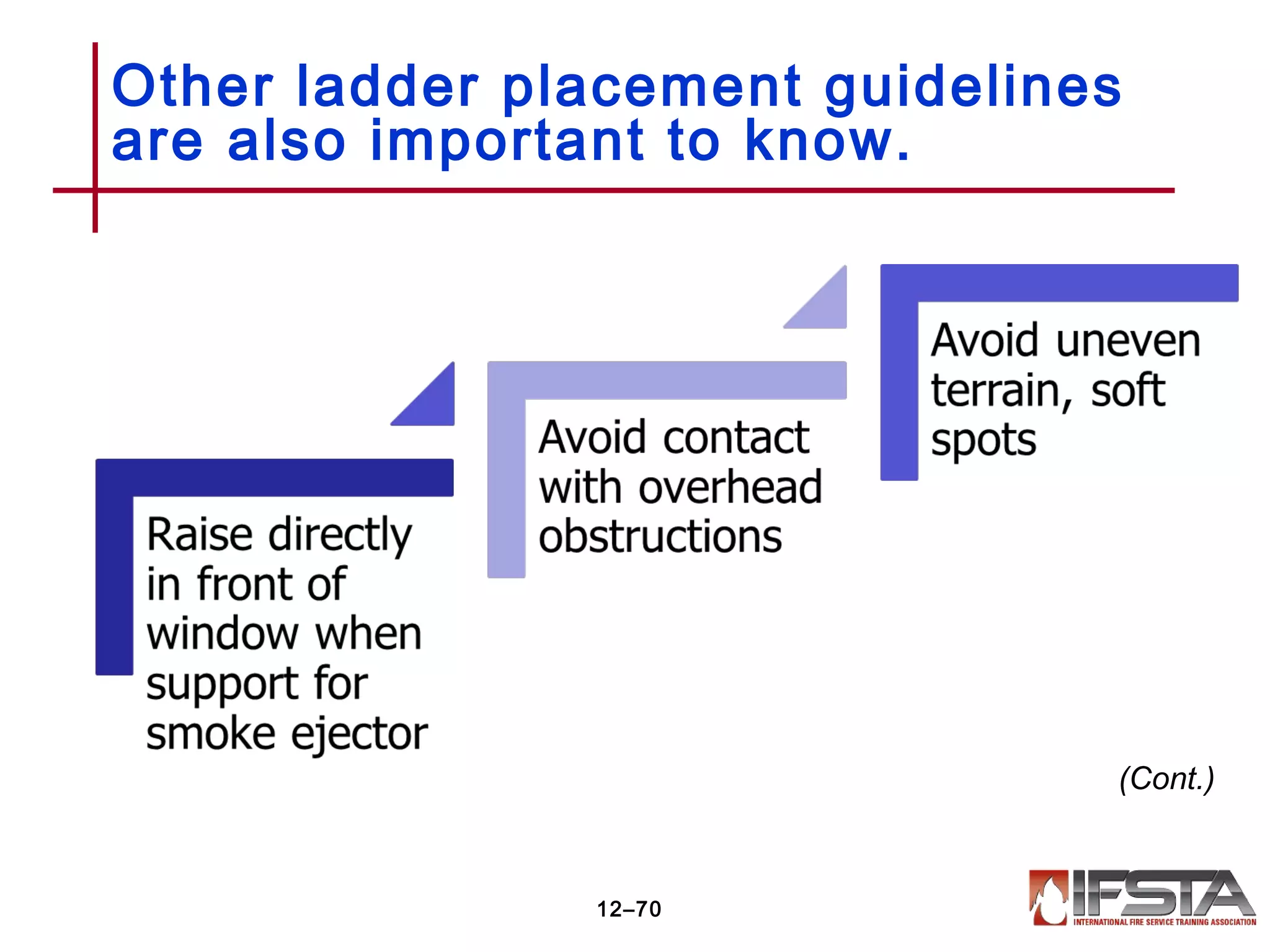
Other ladder placement guidelines
are also important to know.
12–70
(Cont.)
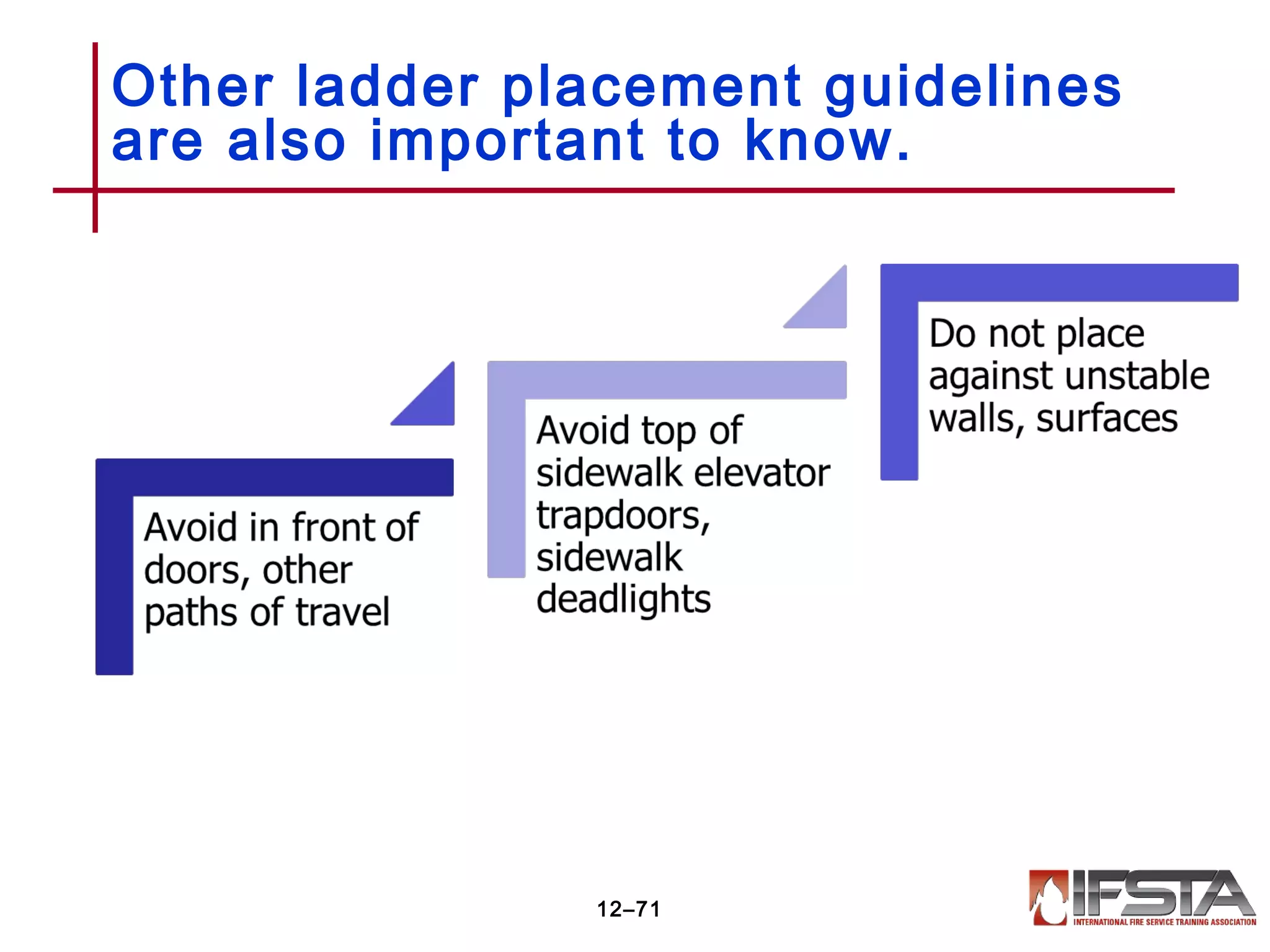
Other ladder placement guidelines
are also important to know.
12–71
REVIEW QUESTION
What are the two objectives that
must be met when placing ground
ladders?
12–72
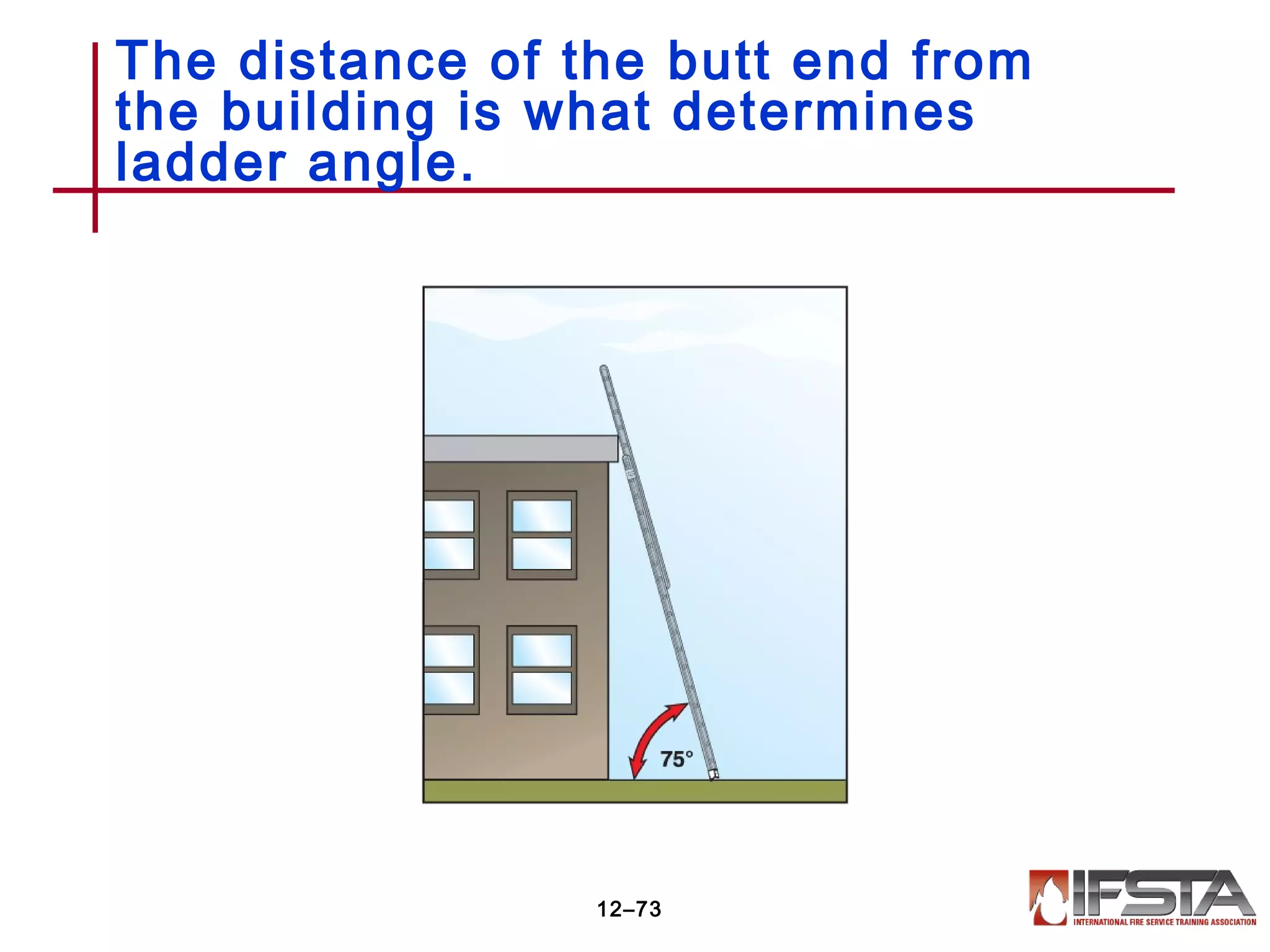
The distance of the butt end from
the building is what determines
ladder angle.
12–73
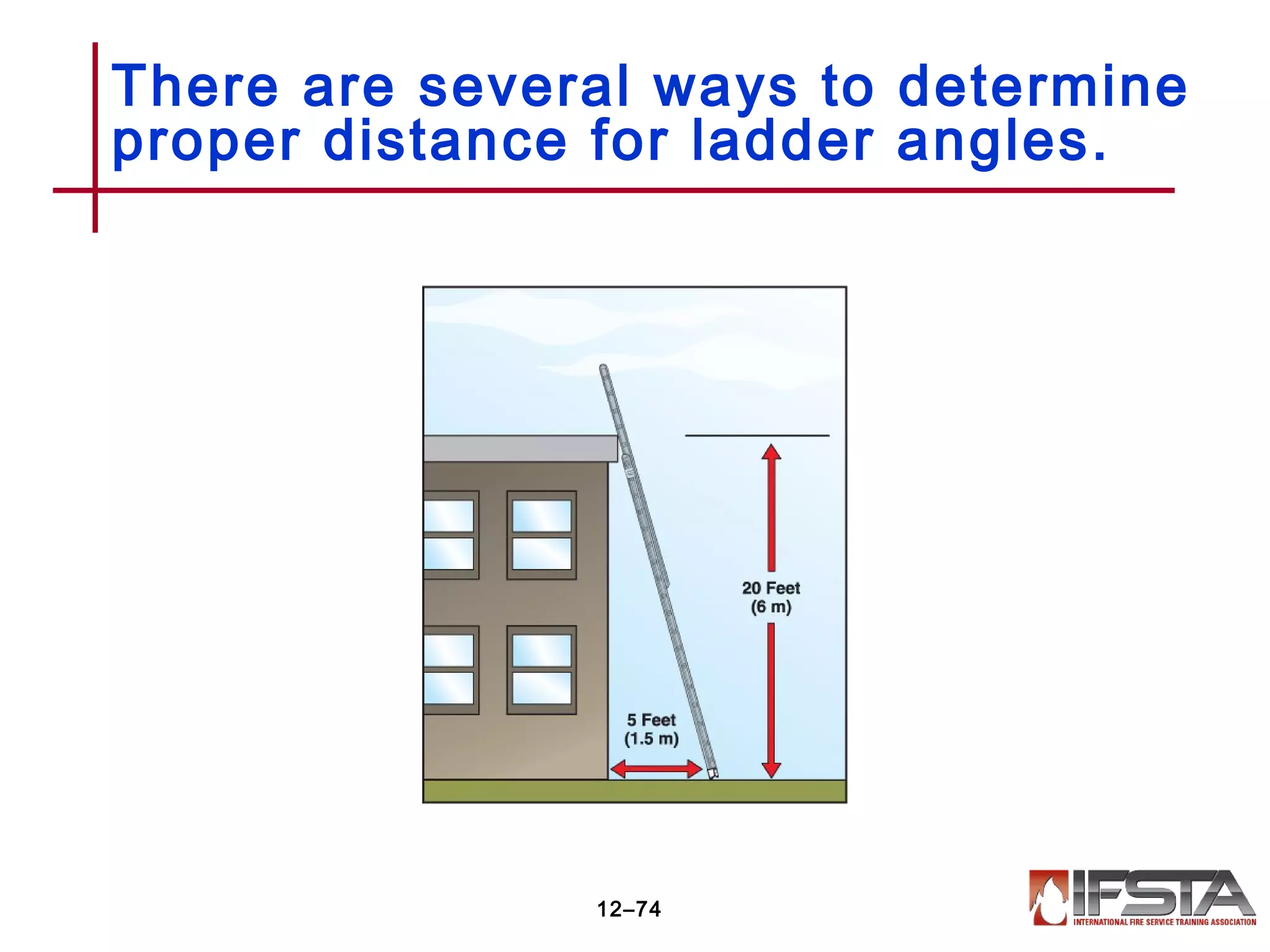
There are several ways to determine
proper distance for ladder angles.
12–74
REVIEW QUESTION
How can a firefighter determine the
proper distance between the heel of
the ladder and the building?
12–75
Describe various methods for ladder
raises.
Learning Objective 9
12–76
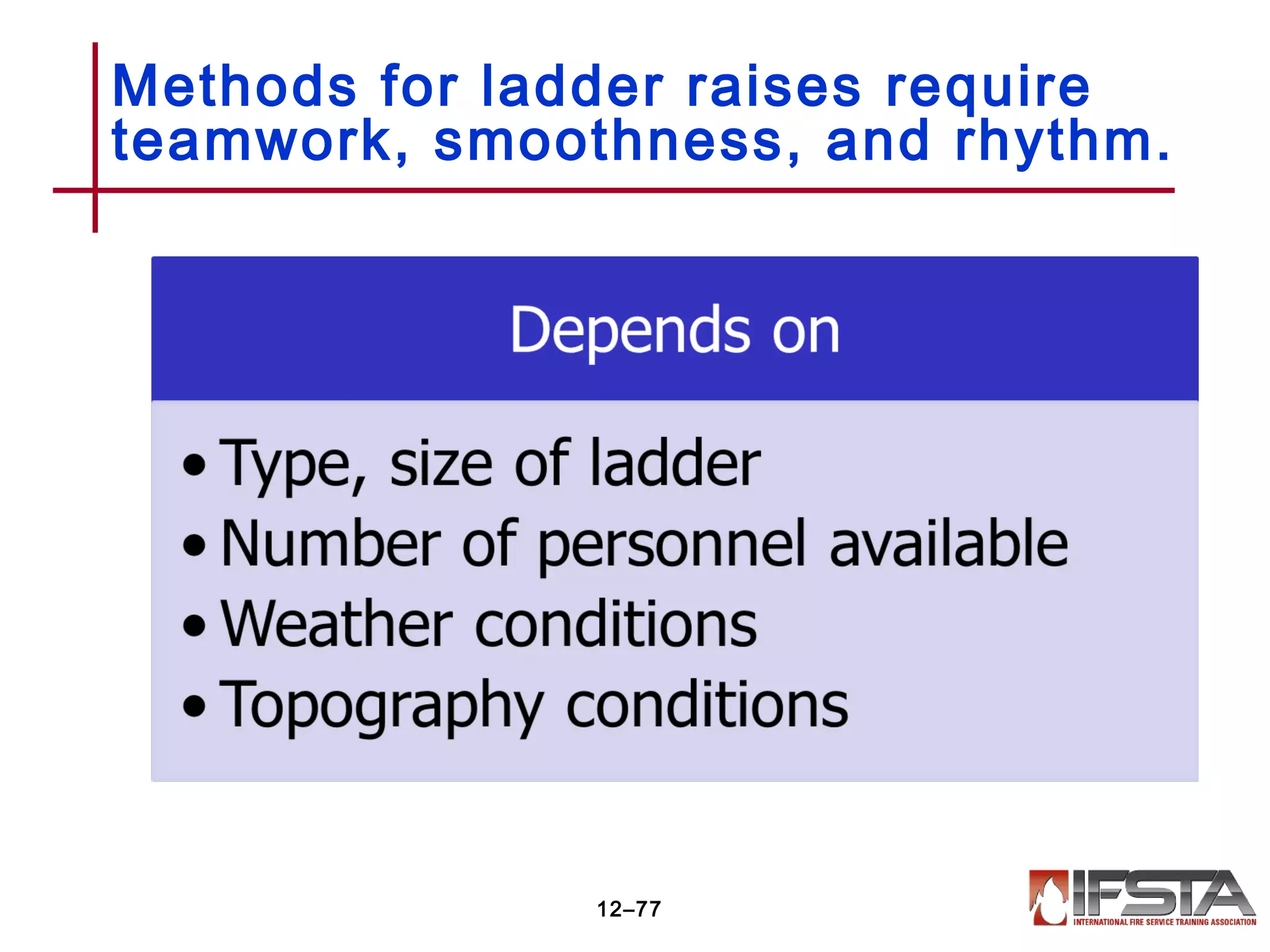
Methods for ladder raises require
teamwork, smoothness, and rhythm.
12–77
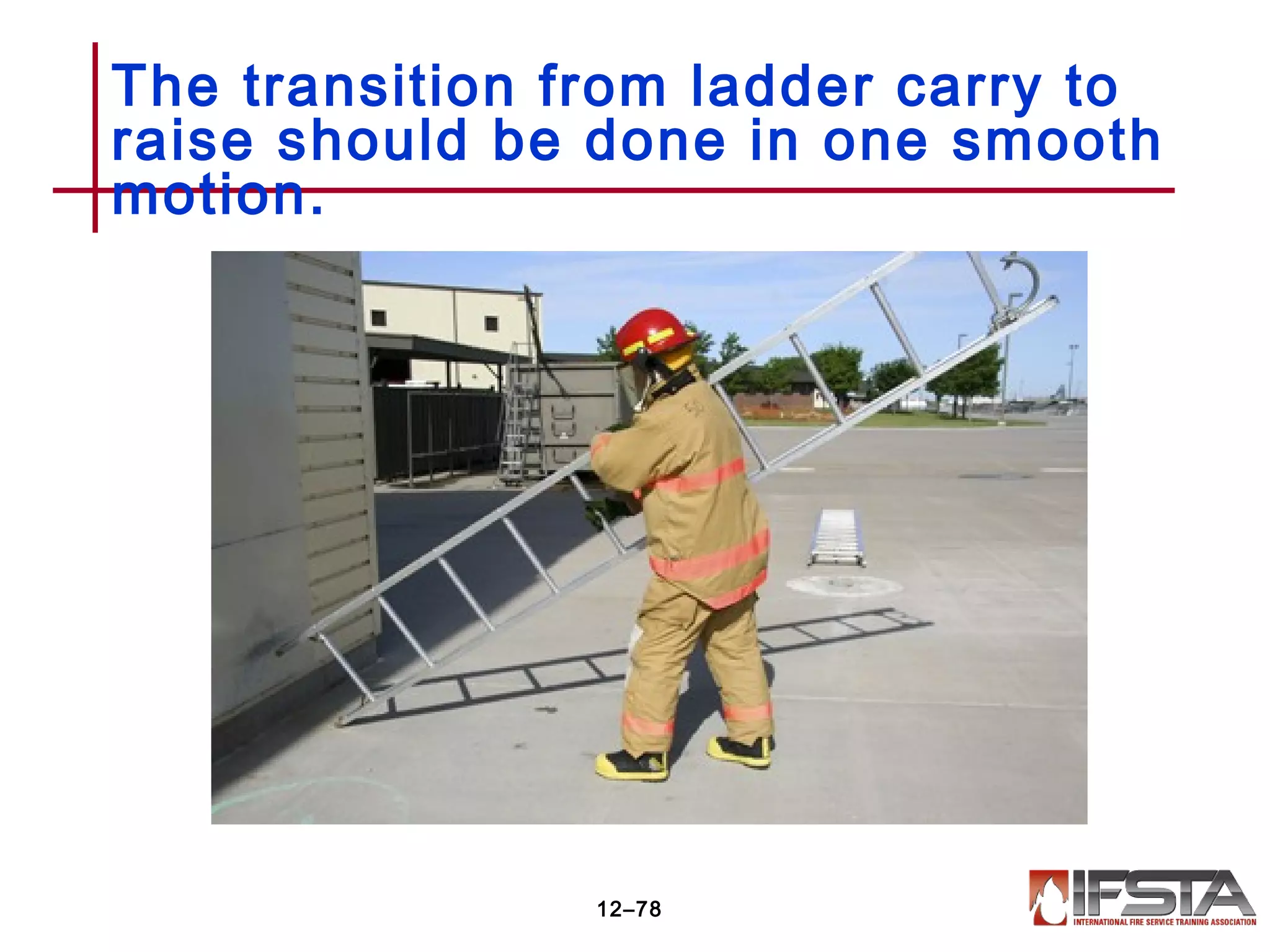
The transition from ladder carry to
raise should be done in one smooth
motion.
12–78
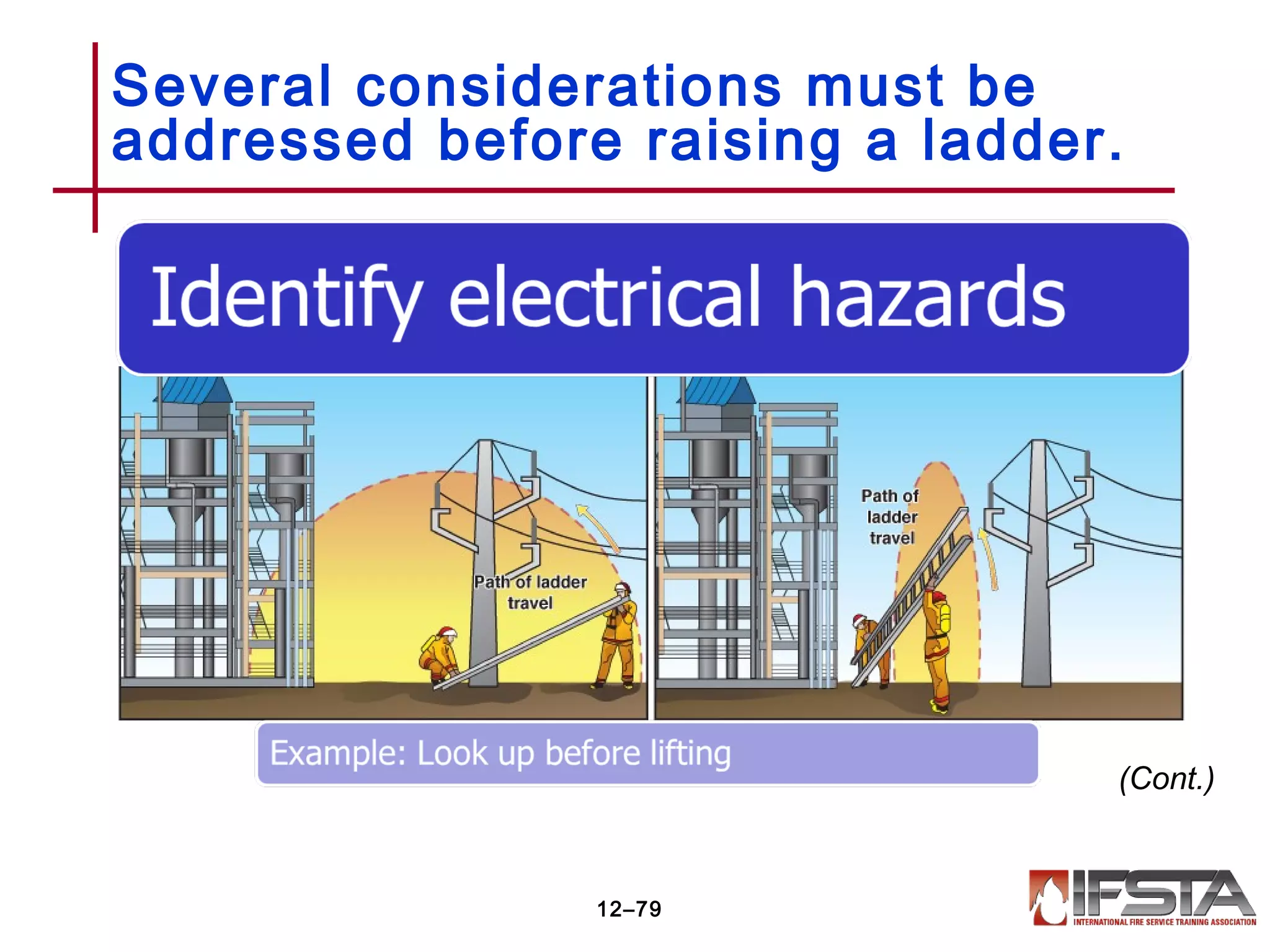
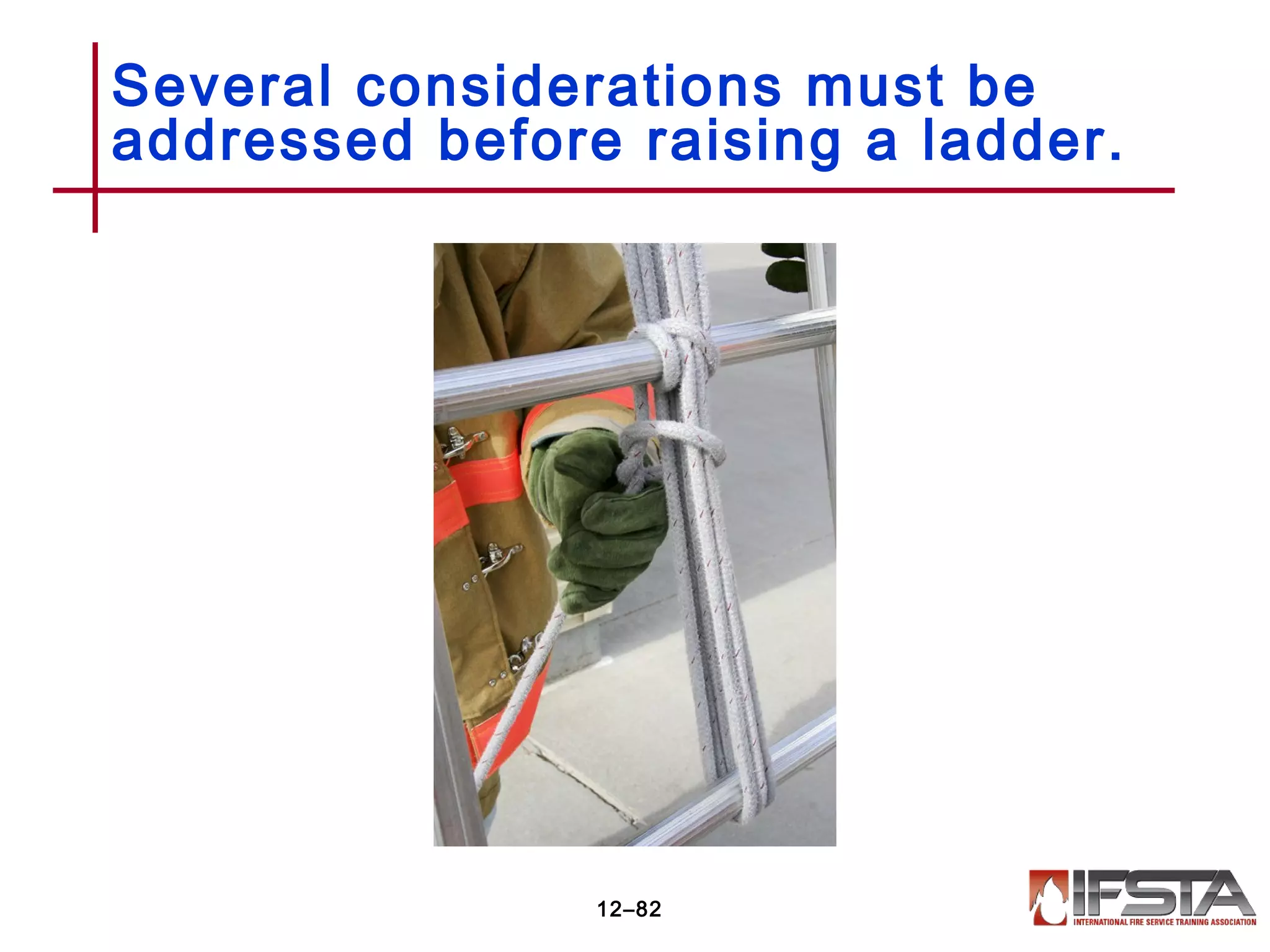
Several considerations must be
addressed before raising a ladder.
12–79
(Cont.)
WARNING!
All ladders will conduct electricity,
especially when wet, regardless of their
construction material.
12–80
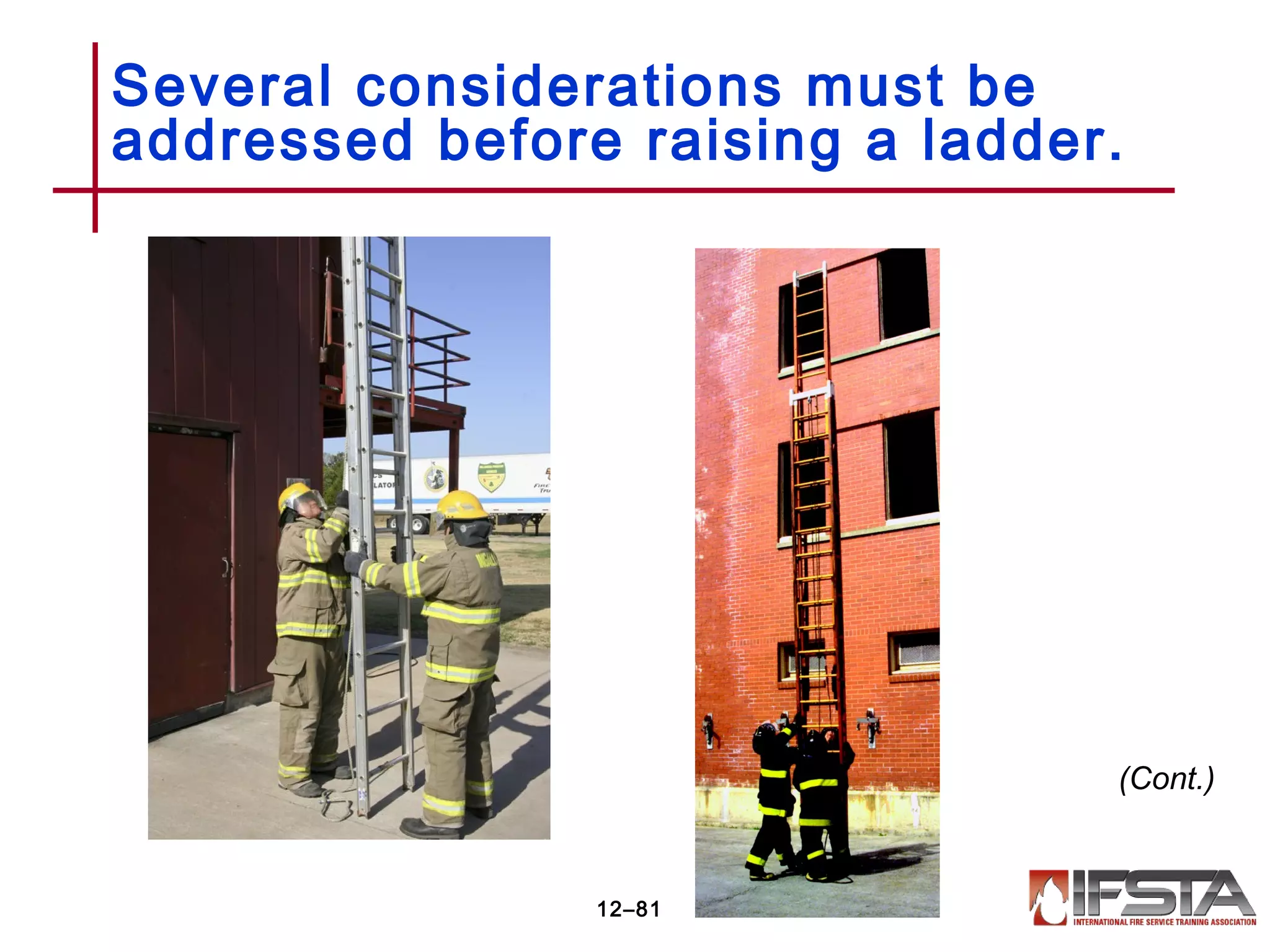
Several considerations must be
addressed before raising a ladder.
12–81
(Cont.)
Several considerations must be
addressed before raising a ladder.
12–82
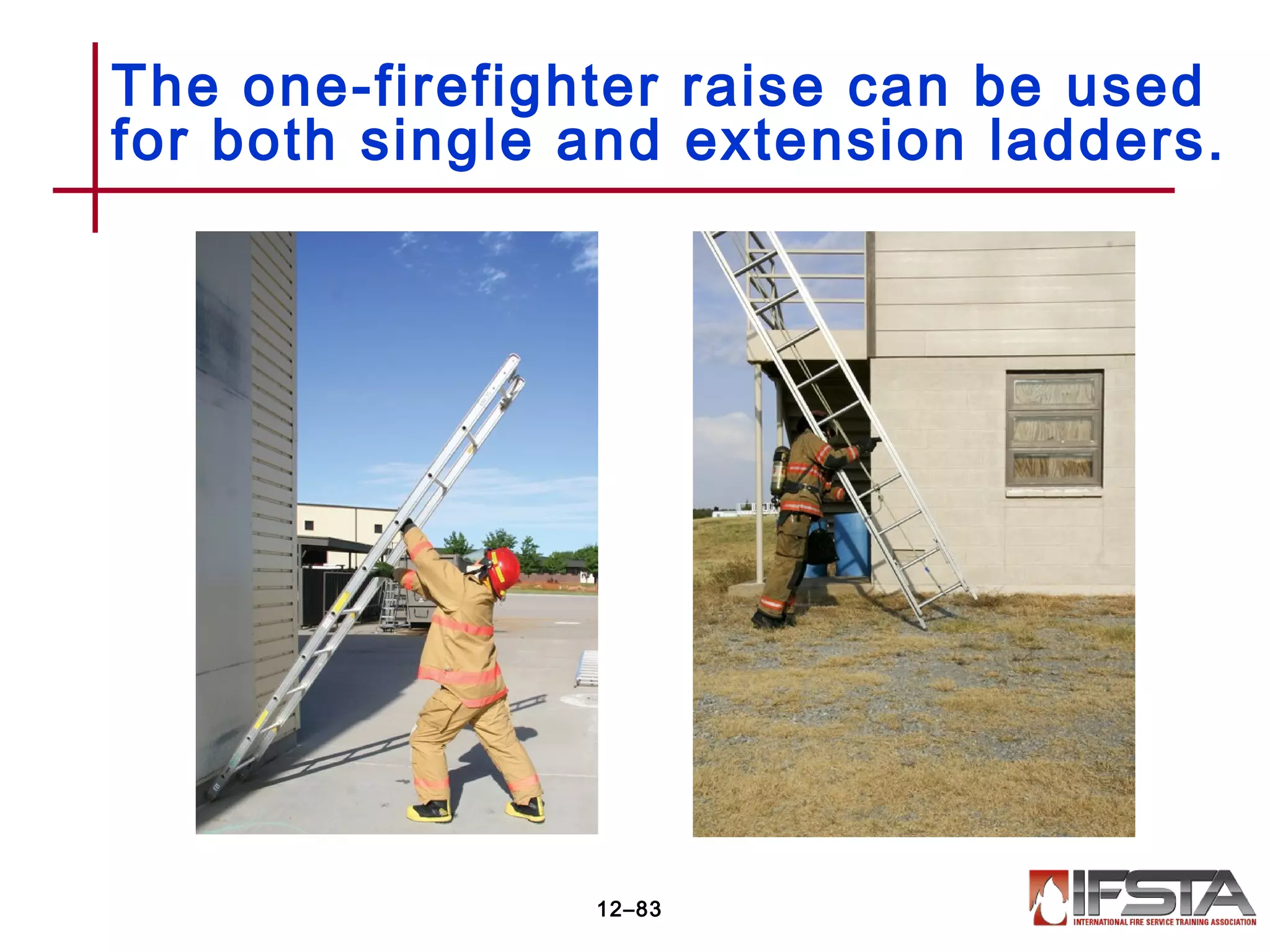
The one-firefighter raise can be used
for both single and extension ladders.
12–83
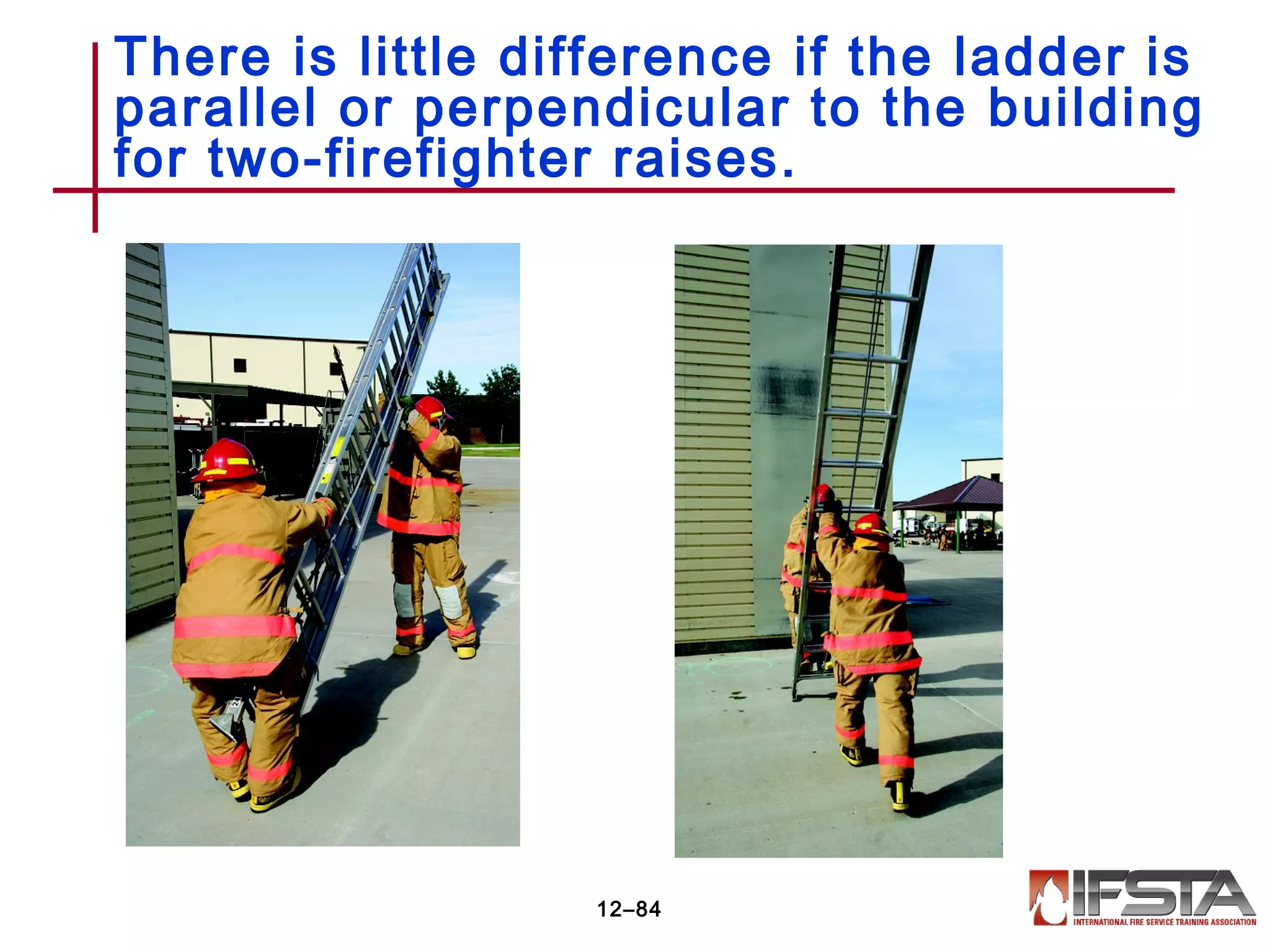
There is little difference if the ladder is
parallel or perpendicular to the building
for two-firefighter raises.
12–84
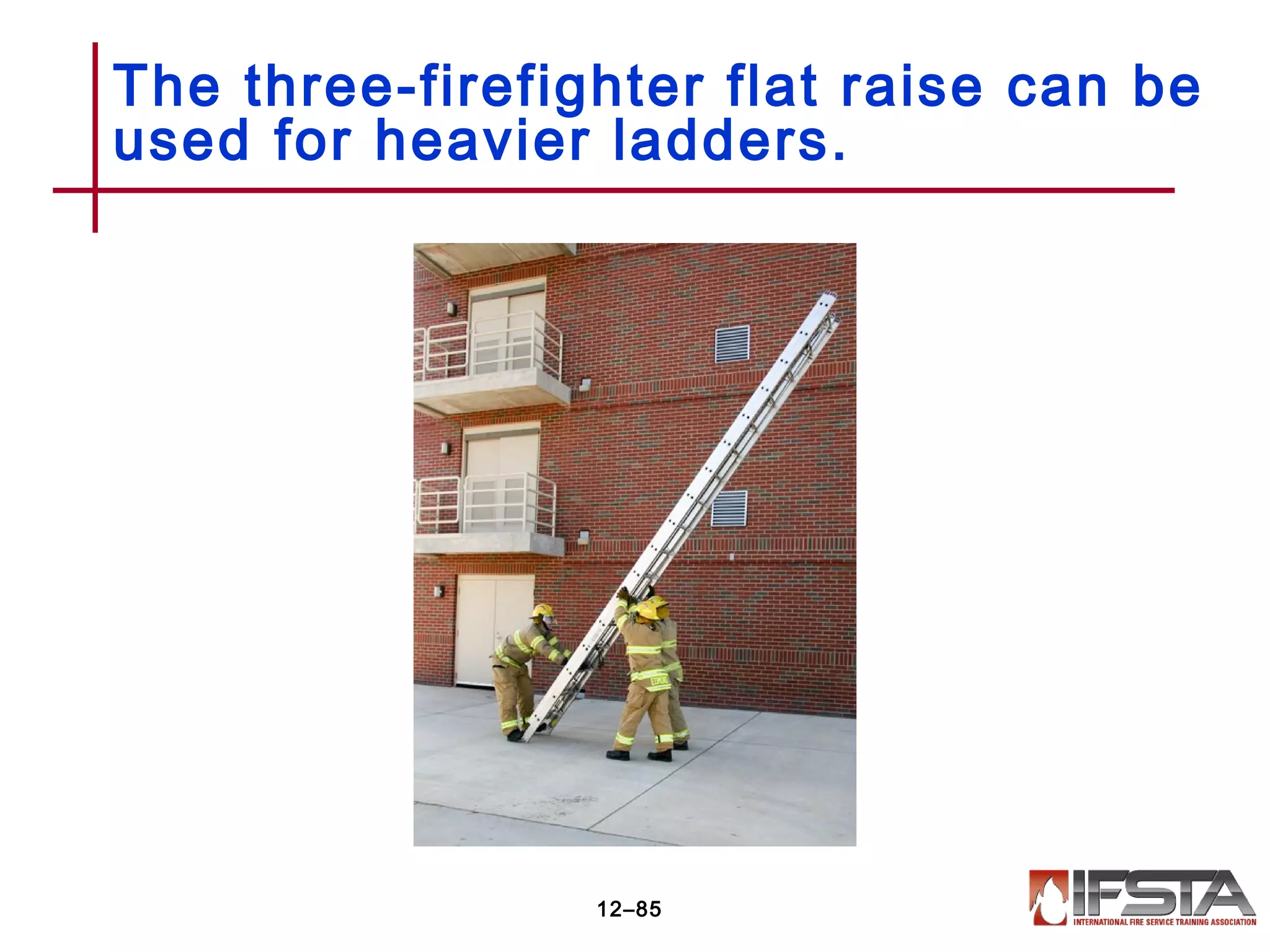
The three-firefighter flat raise can be
used for heavier ladders.
12–85
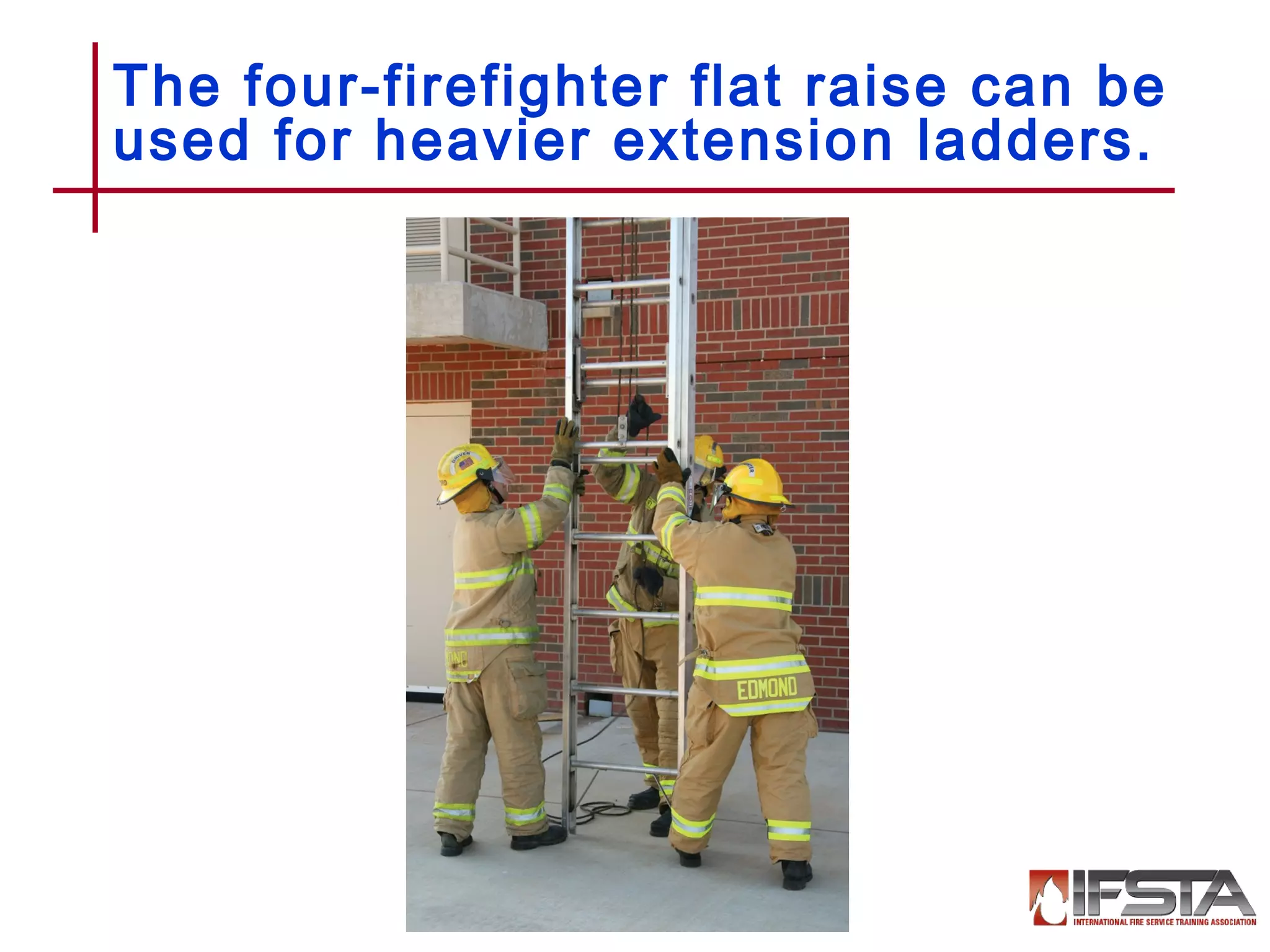
The four-firefighter flat raise can be
used for heavier extension ladders.
12–86
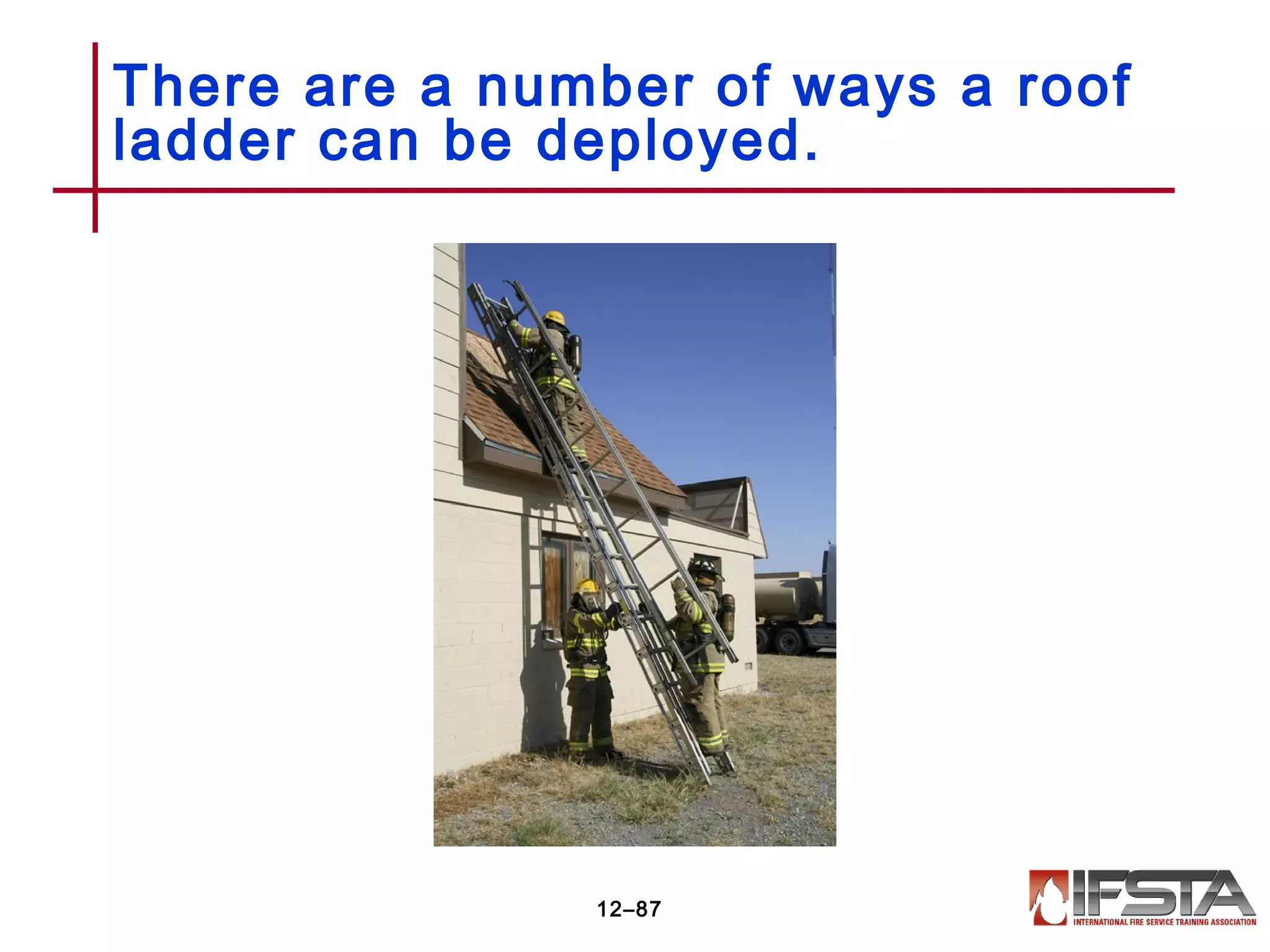
There are a number of ways a roof
ladder can be deployed.
12–87
REVIEW QUESTION
What considerations must be
addressed before raising a ladder?
12–88
Compare procedures for moving
ground ladders.
Learning Objective 10
12–89
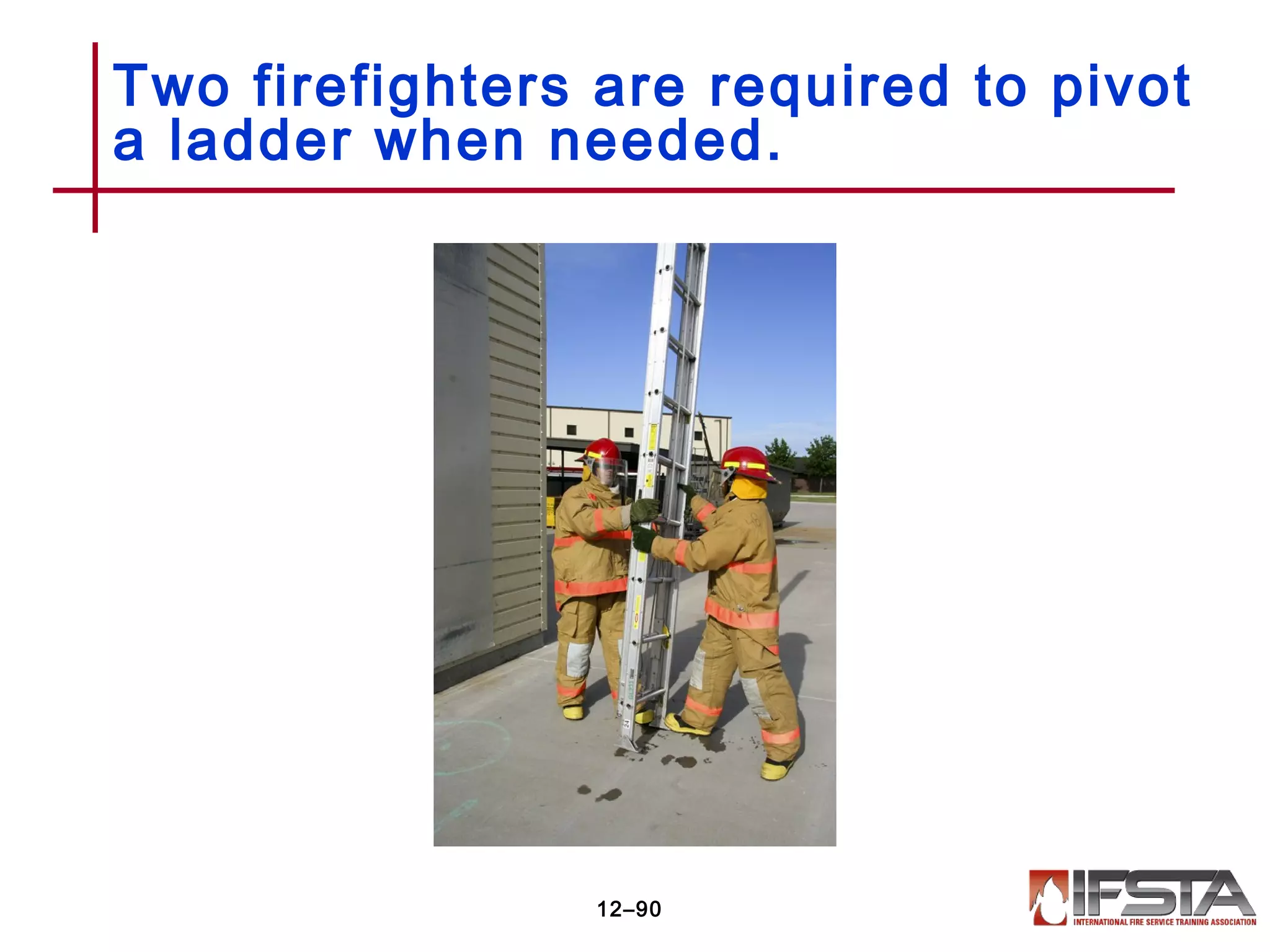
Two firefighters are required to pivot
a ladder when needed.
12–90
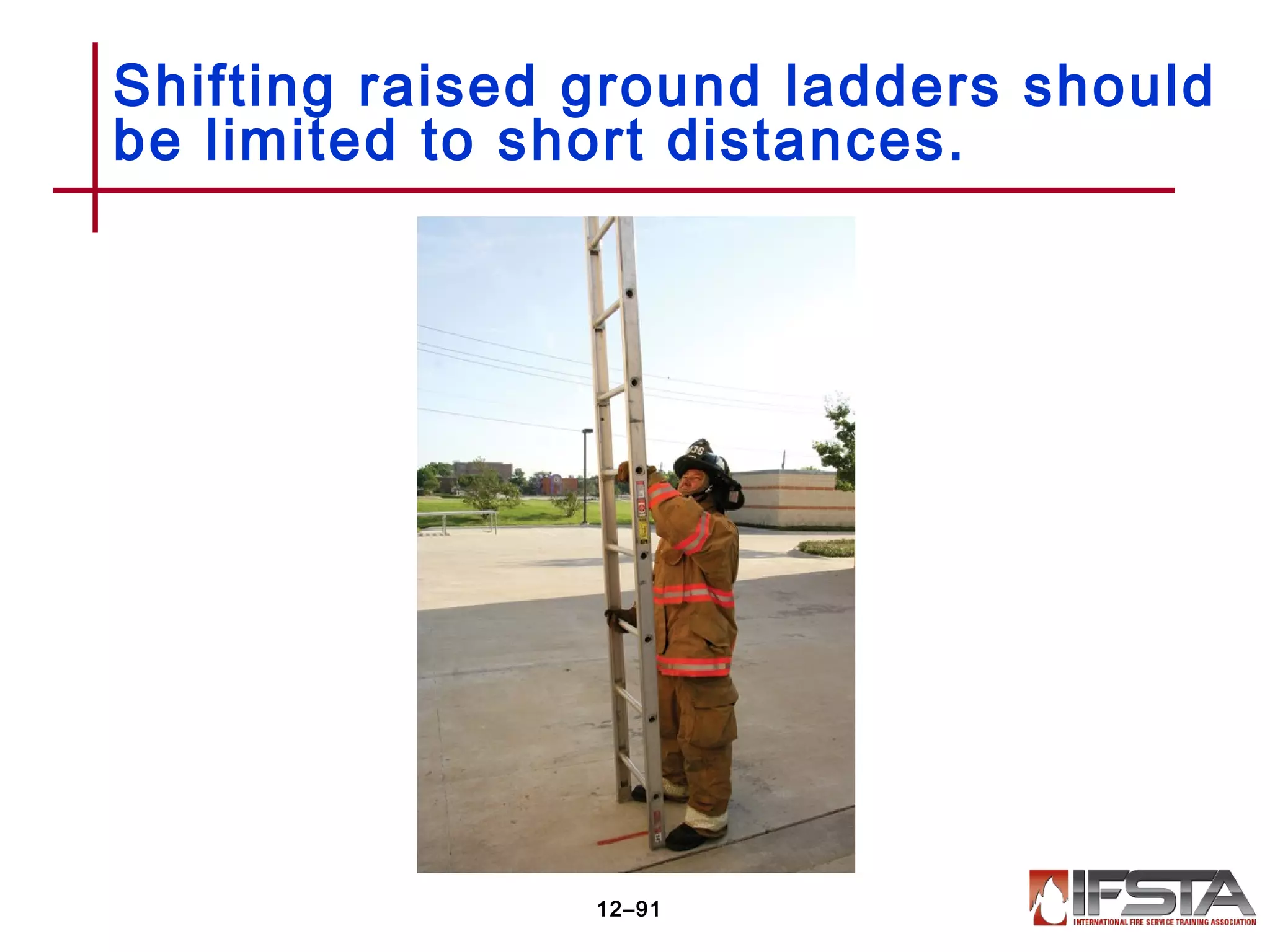
Shifting raised ground ladders should
be limited to short distances.
12–91
REVIEW QUESTION
What are two methods of safely
moving a ground ladder after it has
been raised?
12–92
Explain the methods used to secure
ladders.
Learning Objective 11
12–93
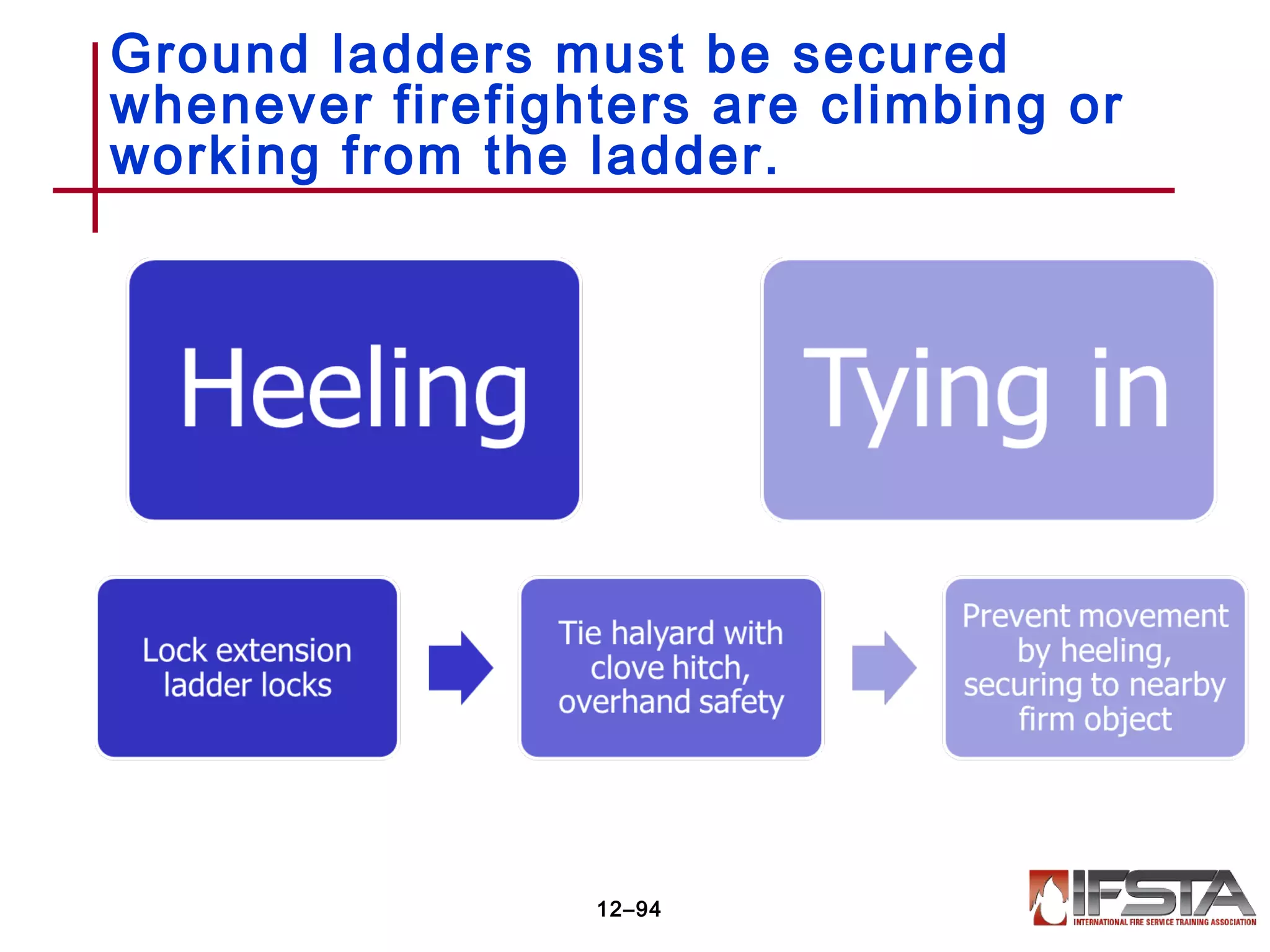
Ground ladders must be secured
whenever firefighters are climbing or
working from the ladder.
12–94
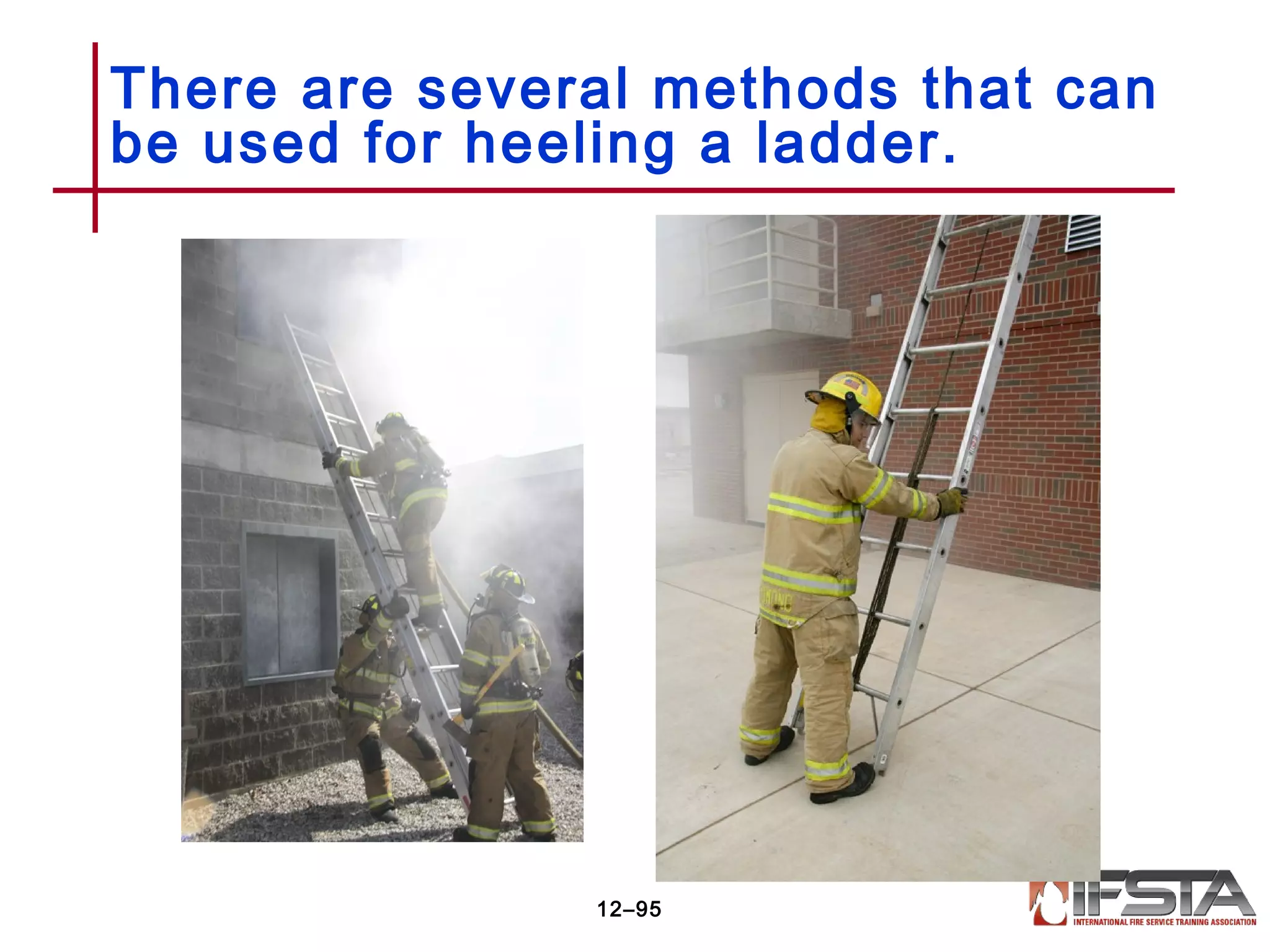
There are several methods that can
be used for heeling a ladder.
12–95
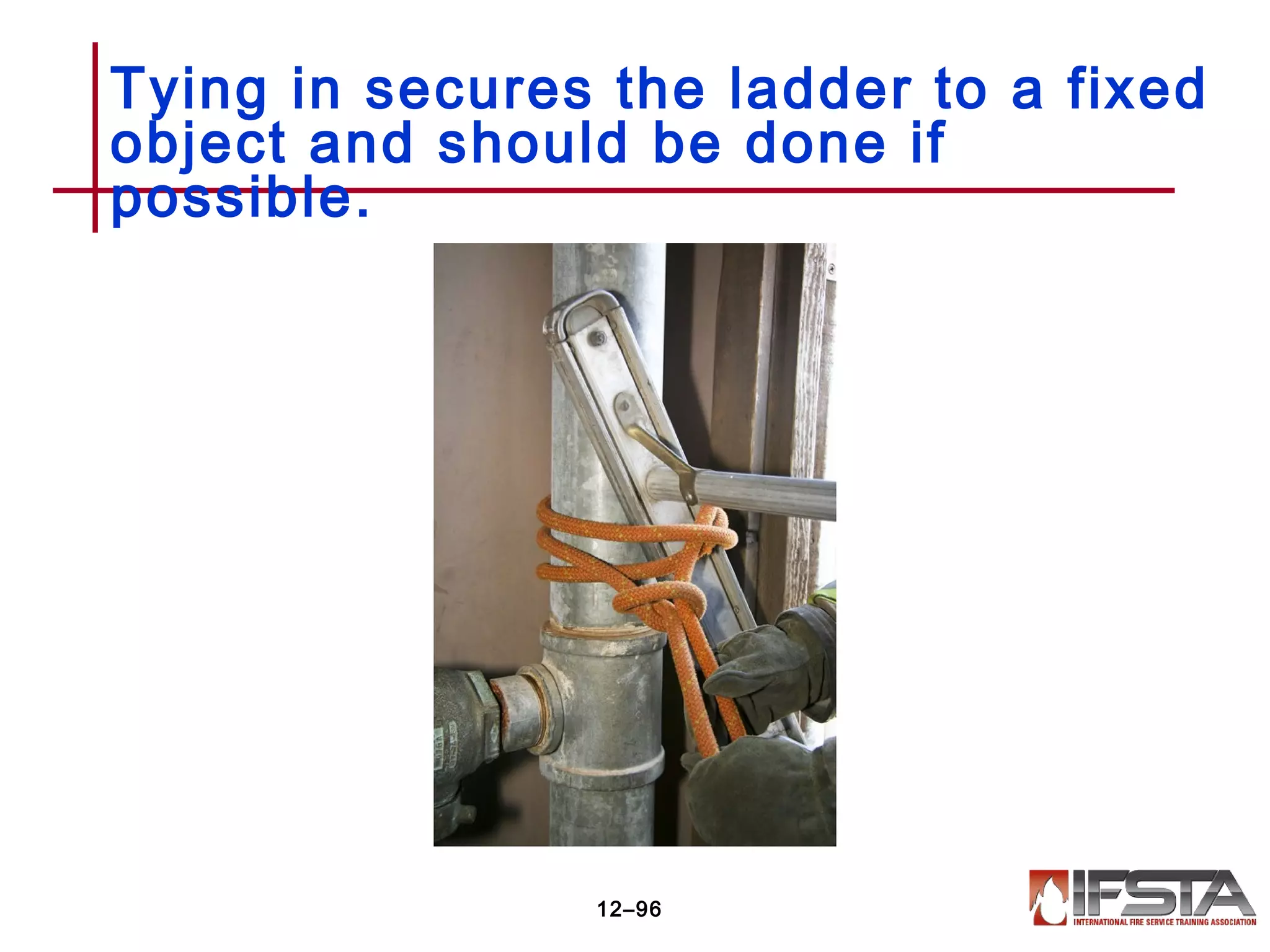
Tying in secures the ladder to a fixed
object and should be done if
possible.
12–96
REVIEW QUESTION
How do the two methods used for
securing ladders compare with one
another?
12–97
Describe ladder climbing
considerations.
Learning Objective 12
12–98
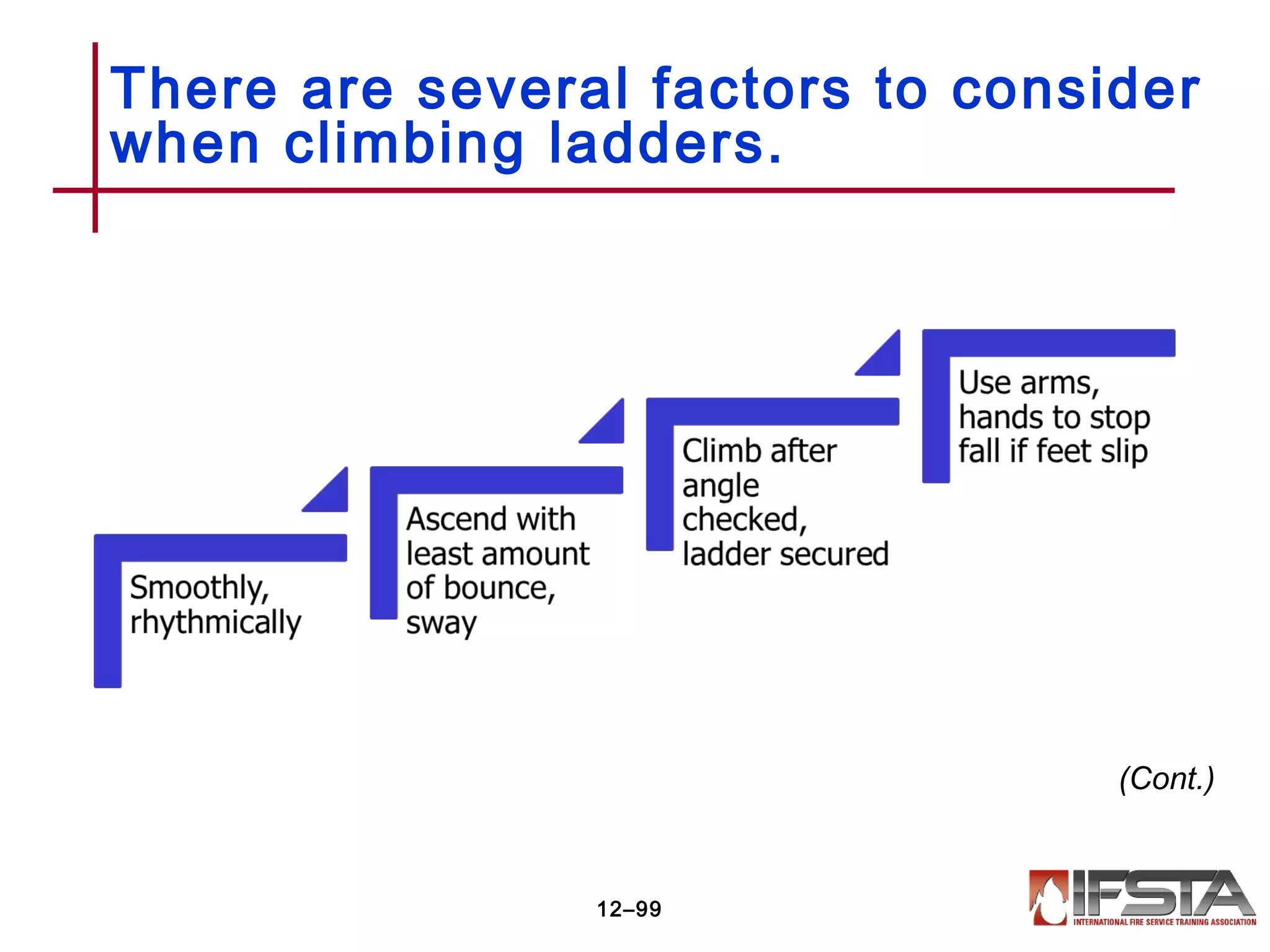
There are several factors to consider
when climbing ladders.
12–99
(Cont.)
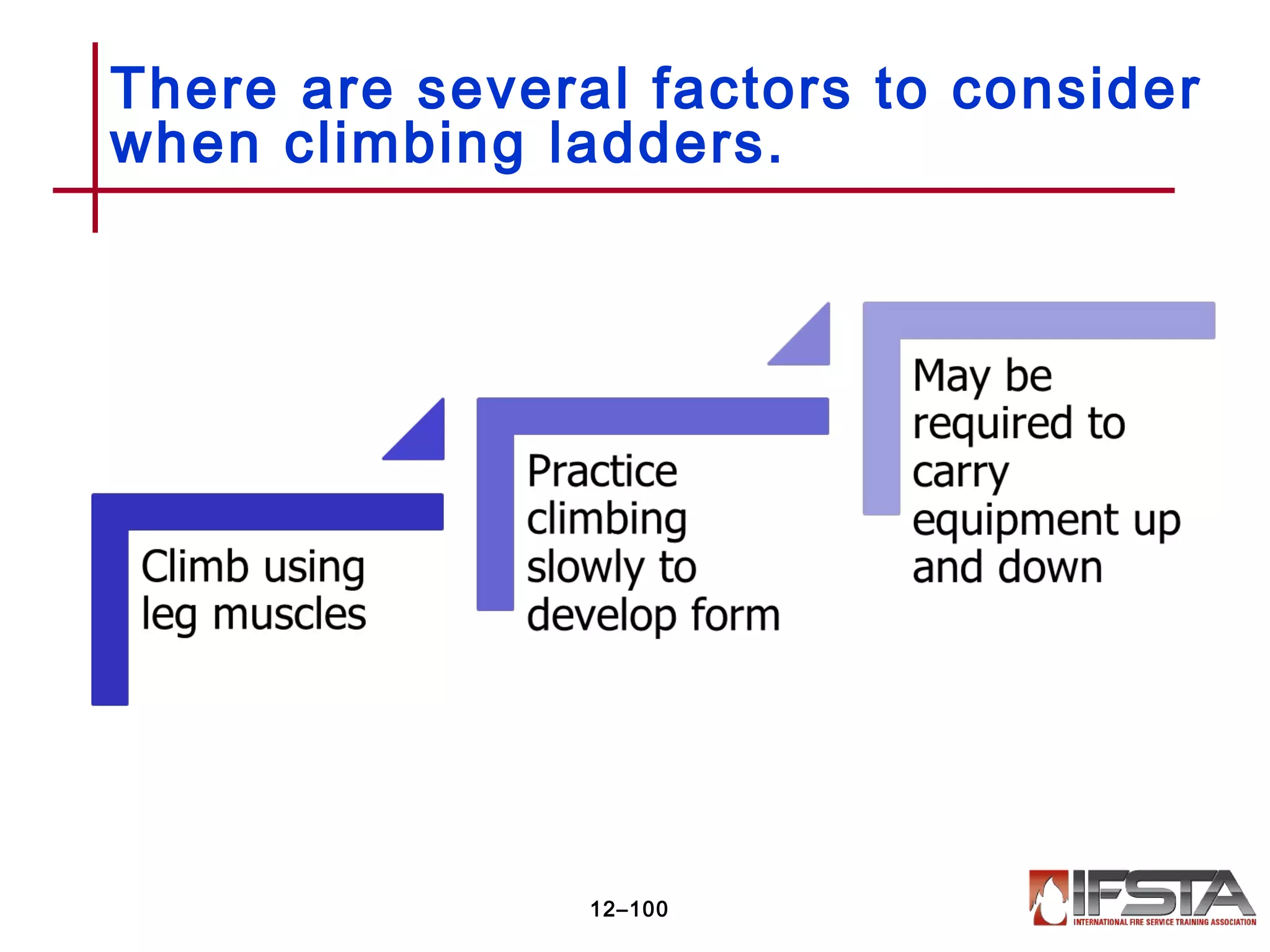
There are several factors to consider
when climbing ladders.
12–100
REVIEW QUESTION
How can a firefighter climb a ladder
so that there is the least possible
amount of bounce and sway?
12–101
Indicate what methods can be used
to work from a ladder.
Learning Objective 13
12–102
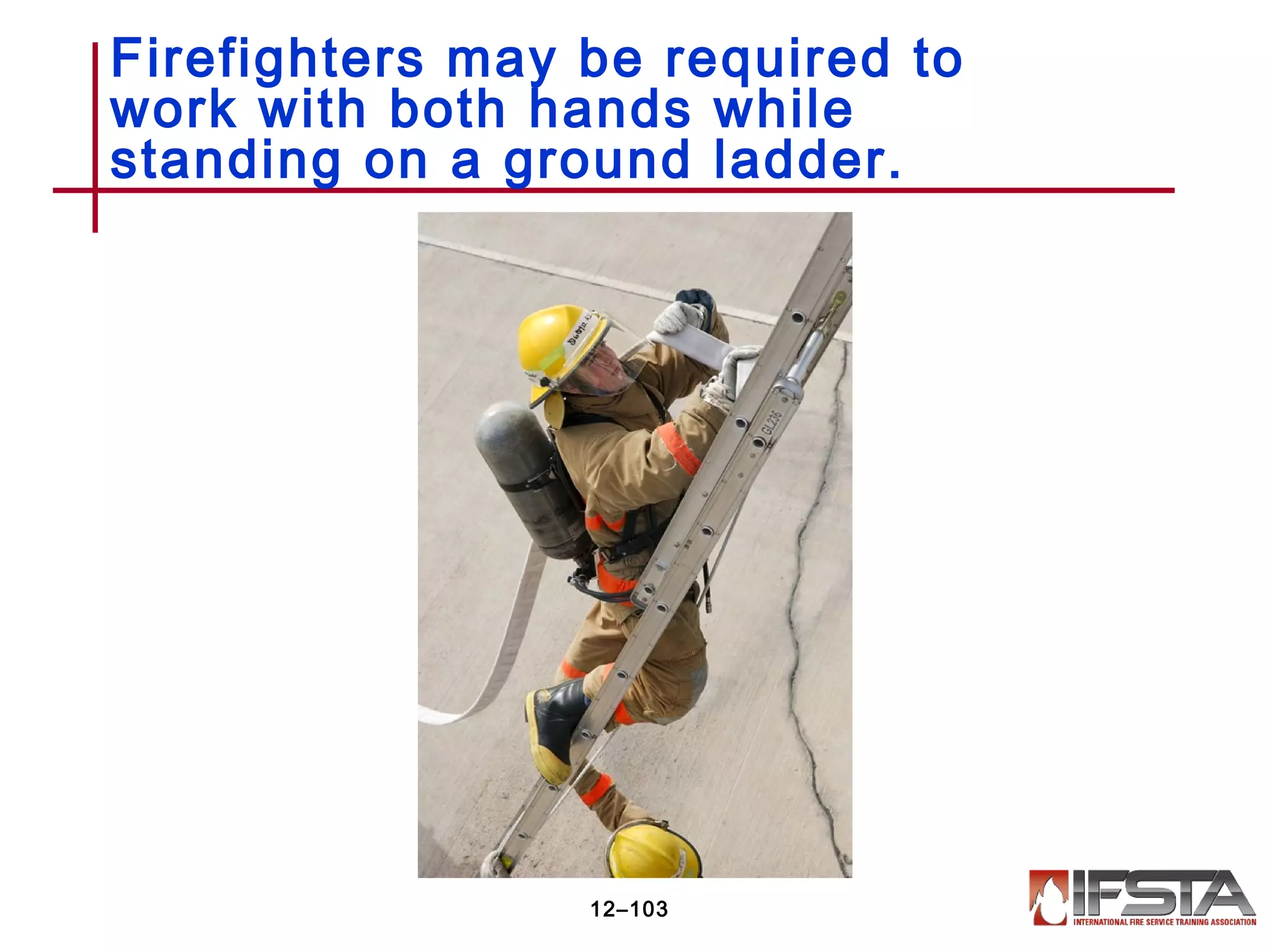
Firefighters may be required to
work with both hands while
standing on a ground ladder.
12–103
WARNING!
Do not exceed the rated load capacity
of the ladder. To avoid overloading the
ladder, allow only one firefighter on
each section of a ladder at the same
time. Be careful about stressing ladders
laterally.
12–104
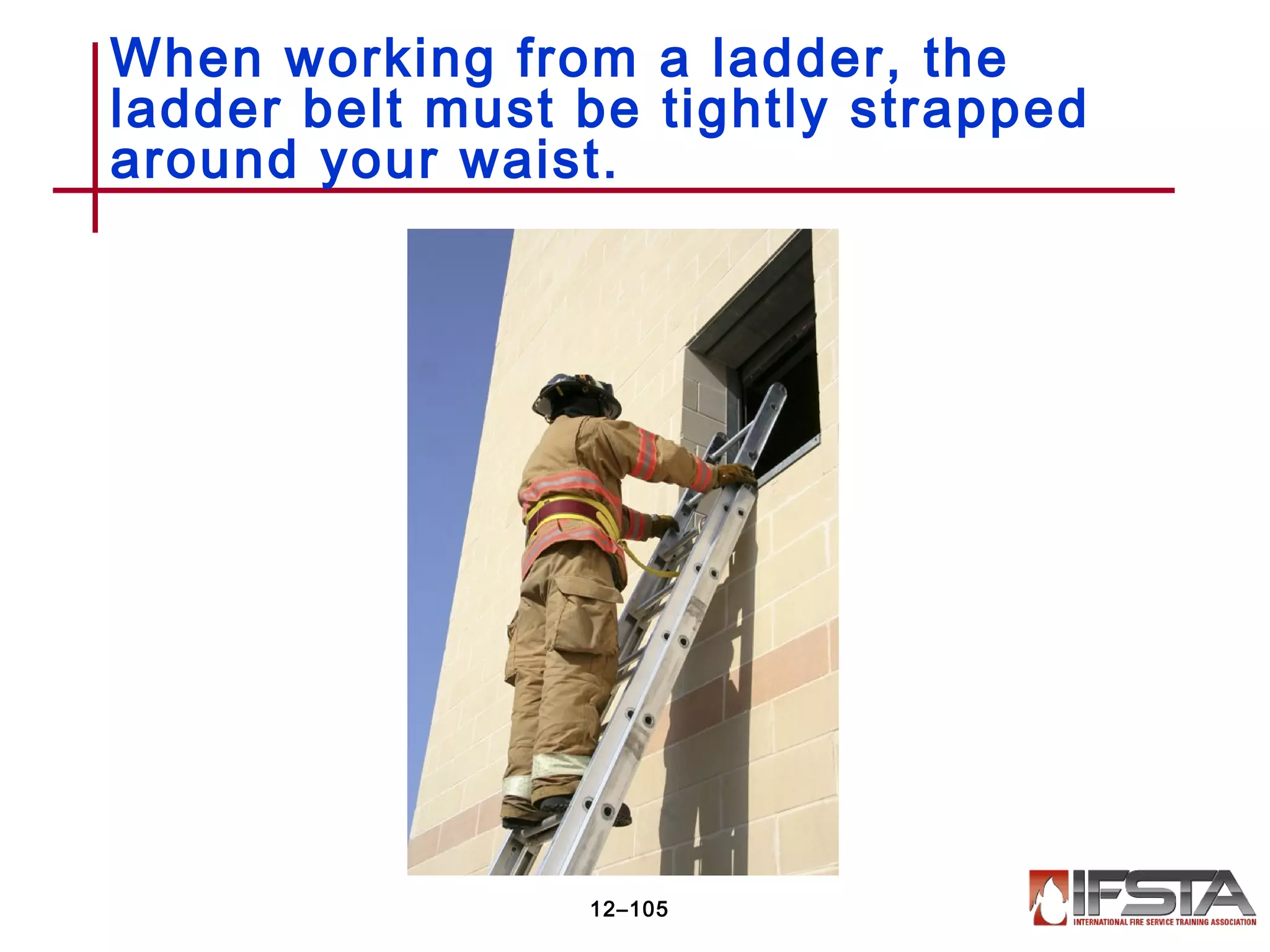
When working from a ladder, the
ladder belt must be tightly strapped
around your waist.
12–105
WARNING!
Use a leg lock only when working from
a ground ladder. Never use a leg lock
on an aerial ladder. Extending or
retracting the ladder could result in
serious injury.
12–106
REVIEW QUESTION
What methods can be used to
secure a firefighter to a ladder when
performing work?
12–107
Explain methods used for assisting a
victim down a ladder.
Learning Objective 14
12–108
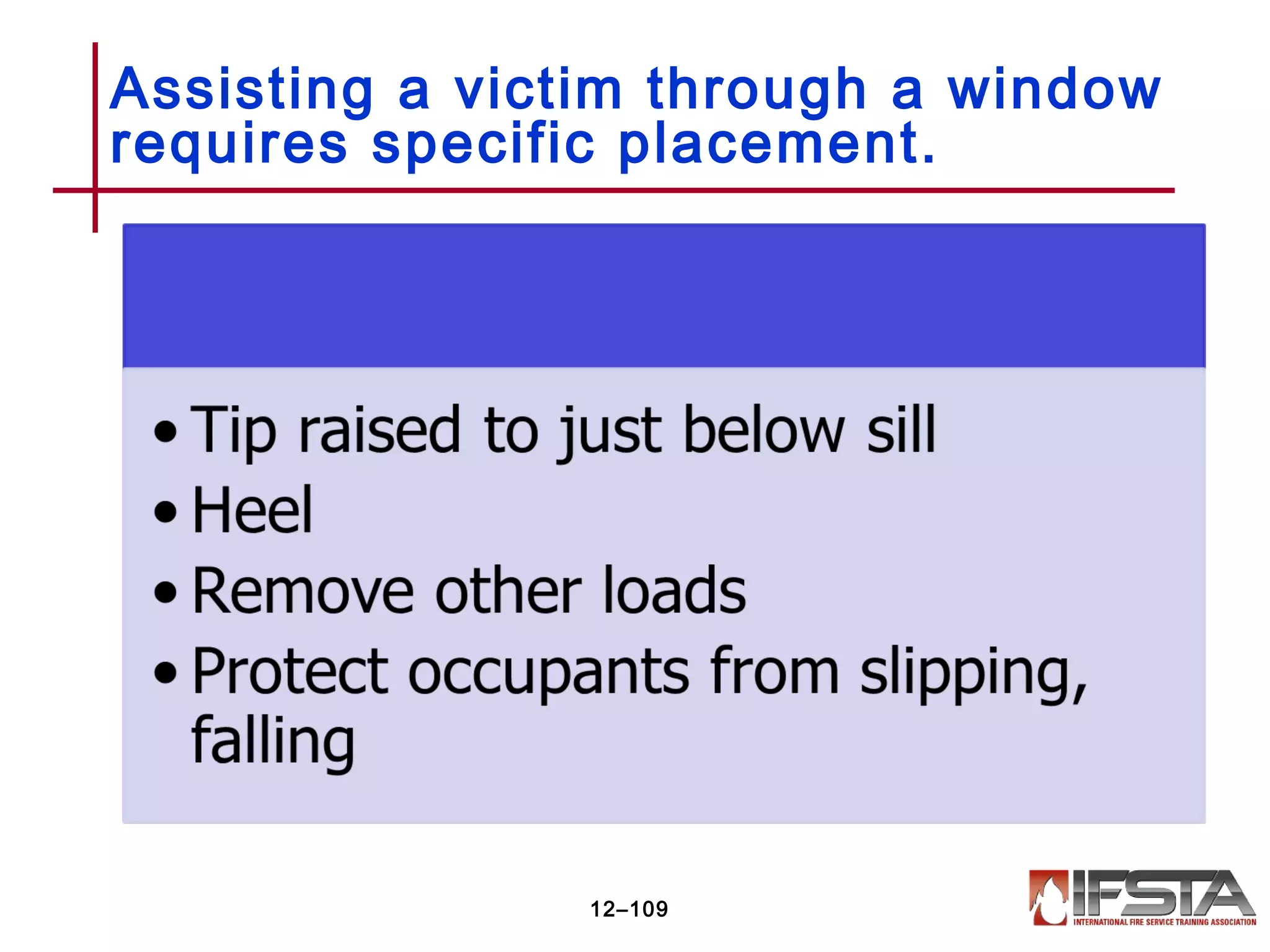
Assisting a victim through a window
requires specific placement.
12–109
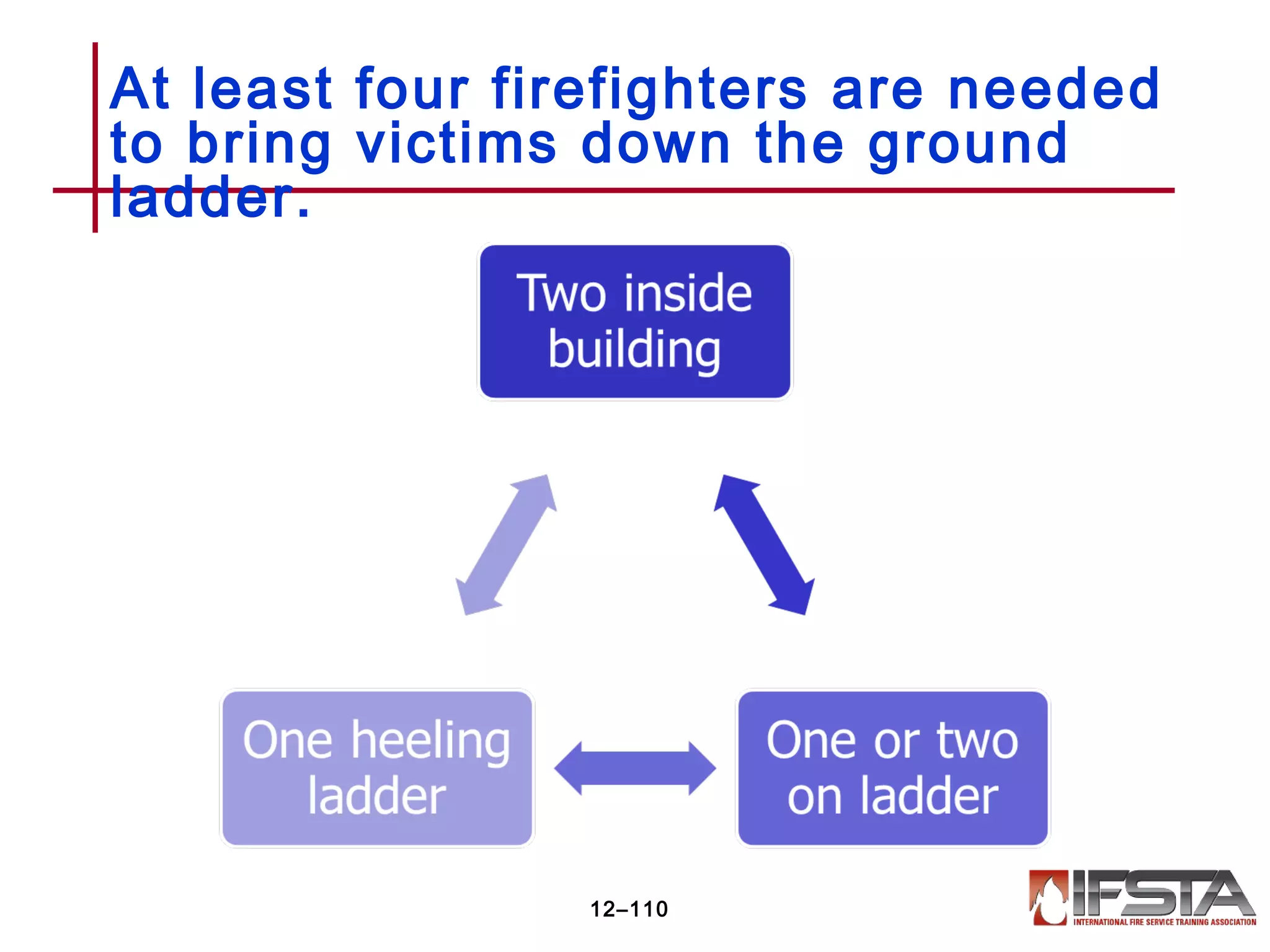
At least four firefighters are needed
to bring victims down the ground
ladder.
12–110
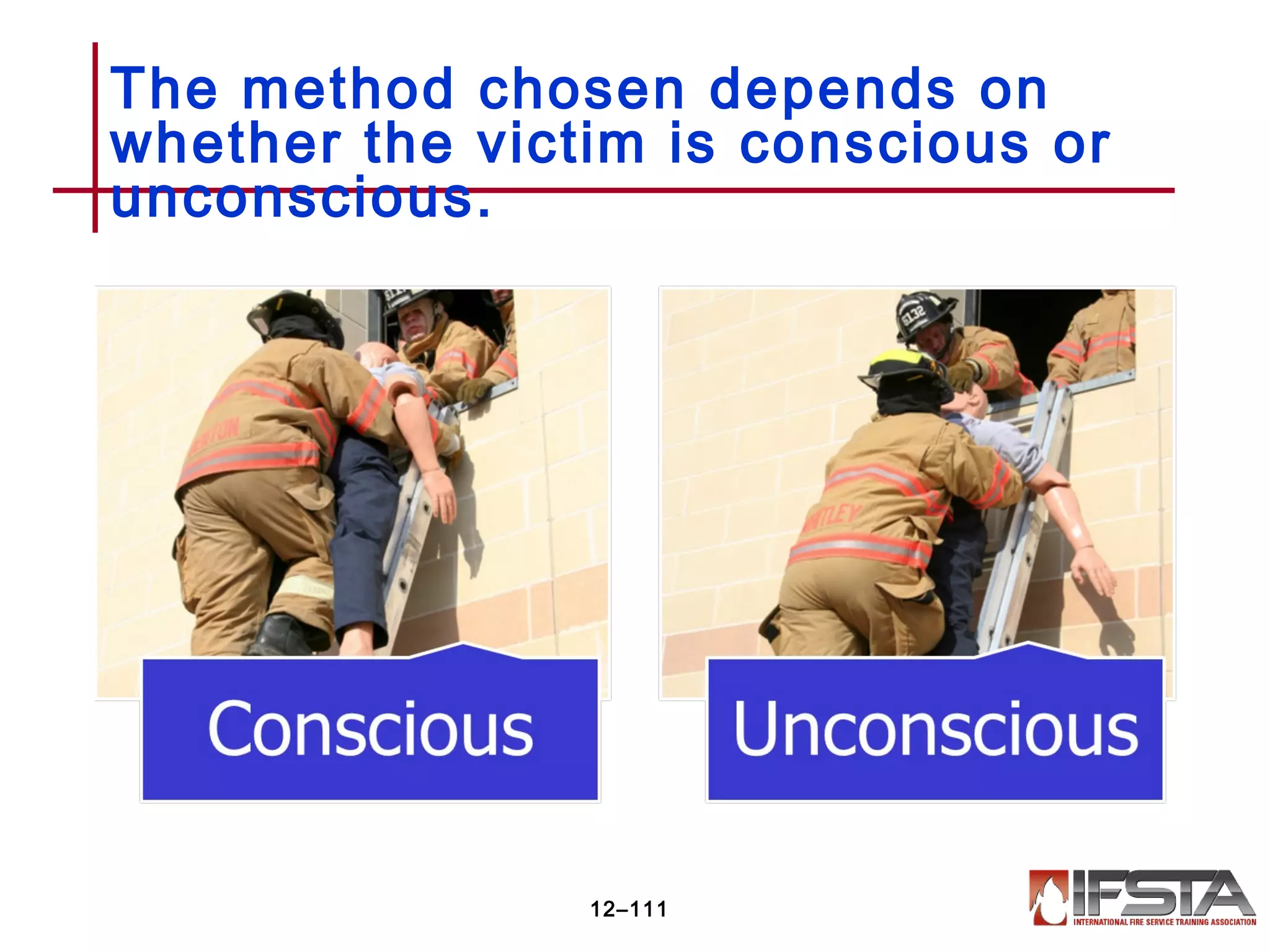
The method chosen depends on
whether the victim is conscious or
unconscious.
12–111
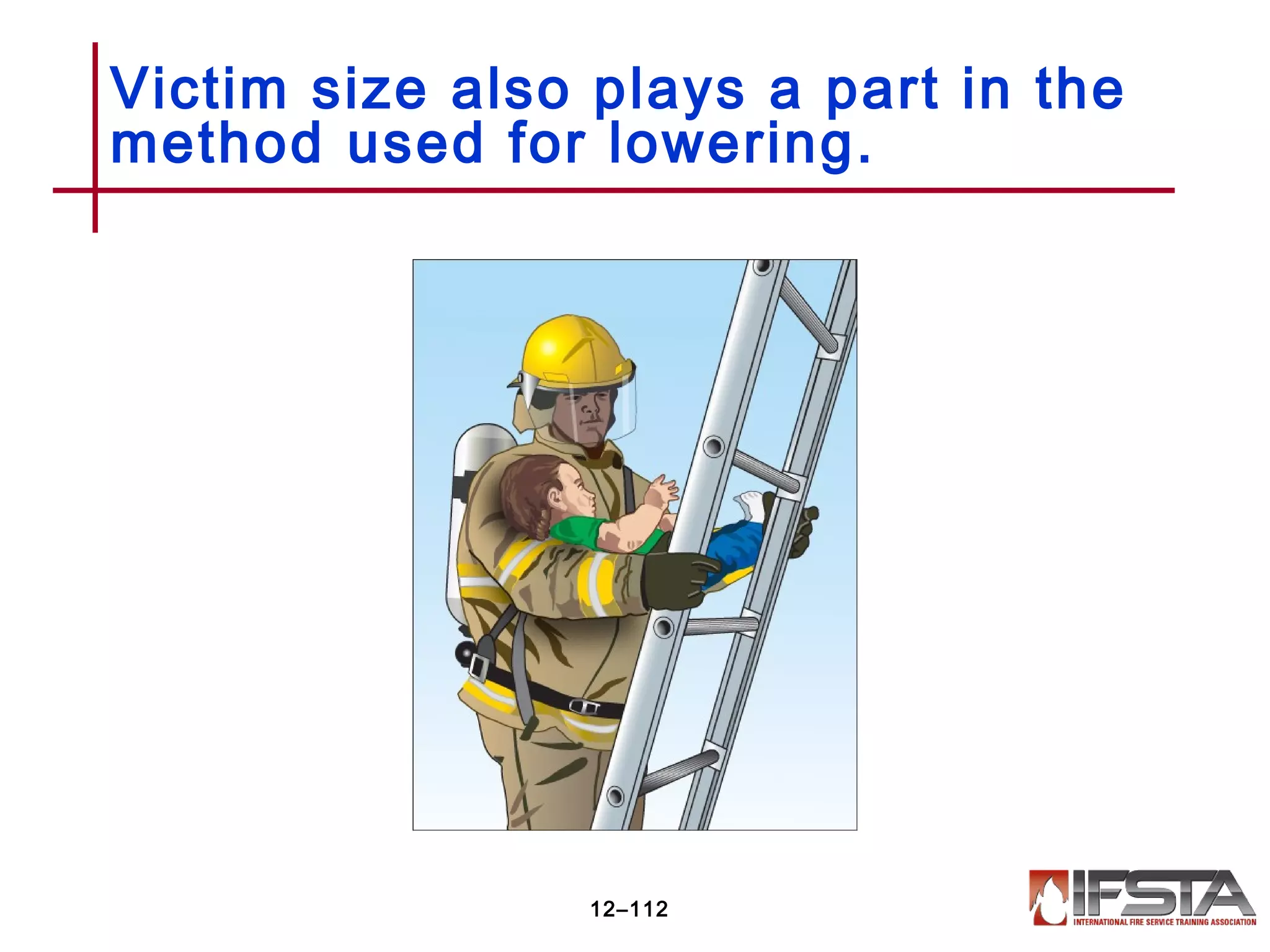
Victim size also plays a part in the
method used for lowering.
12–112
REVIEW QUESTION
How many firefighters are needed to
bring a victim down a ladder?
12–113
• Ground ladders are an essential tool
used to access levels above and below
ground level.
• You must know the types of ground
ladders your department uses, the
parts and construction materials, and
how to care for and maintain them.
Summary
12–114
(Cont.)
• You must be able to select, carry, and
place them to effectively gain access
and perform your assigned tasks.
• You must know the correct methods for
safely climbing, working from, and
assisting victims down ground ladders.
Summary
12–115
Clean, inspect, and maintain a ladder.
This objective is measured in Skill
Sheet 12-I-1.
Learning Objective 15
12–116
Carry a ladder – One-firefighter low-
shoulder method.
This objective is measured in Skill
Sheet 12-I-2.
Learning Objective 16
12–117
Carry a ladder – Two-firefighter low-
shoulder method.
This objective is measured in Skill
Sheet 12-I-3.
Learning Objective 17
12–118
Carry a ladder – Three-firefighter flat-
shoulder method.
This objective is measured in Skill
Sheet 12-I-4.
Learning Objective 18
12–119
Carry a ladder – Three-firefighter flat-
arm's length method.
This objective is measured in Skill
Sheet 12-I-5.
Learning Objective 19
12–120
Carry a ladder – Two-firefighter arm’s
length on-edge method.
This objective is measured in Skill
Sheet 12-I-6.
Learning Objective 20
12–121
Tie the halyard.
This objective is measured in Skill
Sheet 12-I-7.
Learning Objective 21
12–122
Raise a ladder – One-firefighter
method.
This objective is measured in Skill
Sheet 12-I-8.
Learning Objective 22
12–123
Raise a ladder – Two-firefighter flat
raise.
This objective is measured in Skill
Sheet 12-I-9.
Learning Objective 23
12–124
Raise a ladder – Two-firefighter beam
raise.
This objective is measured in Skill
Sheet 12-I-10.
Learning Objective 24
12–125
Raise a ladder – Three- or four-
firefighter flat raise.
This objective is measured in Skill
Sheet 12-I-11.
Learning Objective 25
12–126
Deploy a roof ladder – One-firefighter
method.
This objective is measured in Skill
Sheet 12-I-12.
Learning Objective 26
12–127
Pivot a ladder – Two-firefighter
method.
This objective is measured in Skill
Sheet 12-I-13.
Learning Objective 27
12–128
Shift a ladder – One-firefighter
method.
This objective is measured in Skill
Sheet 12-I-14.
Learning Objective 28
12–129
Shift a ladder – Two-firefighter
method.
This objective is measured in Skill
Sheet 12-I-15.
Learning Objective 29
12–130
Heel a ground ladder.
This objective is measured in Skill
Sheet 12-I-16.
Learning Objective 30
12–131
Leg lock on a ground ladder.
This objective is measured in Skill
Sheet 12-I-17.
Learning Objective 31
12–132
Assist a conscious victim down a
ground ladder.
This objective is measured in Skill
Sheet 12-I-18.
Learning Objective 32
12–133
Assist an unconscious victim down a
ground ladder.
This objective is measured in Skill
Sheet 12-I-19.
Learning Objective 33
12–134

Chapter 12 powerpoint