WEL COME
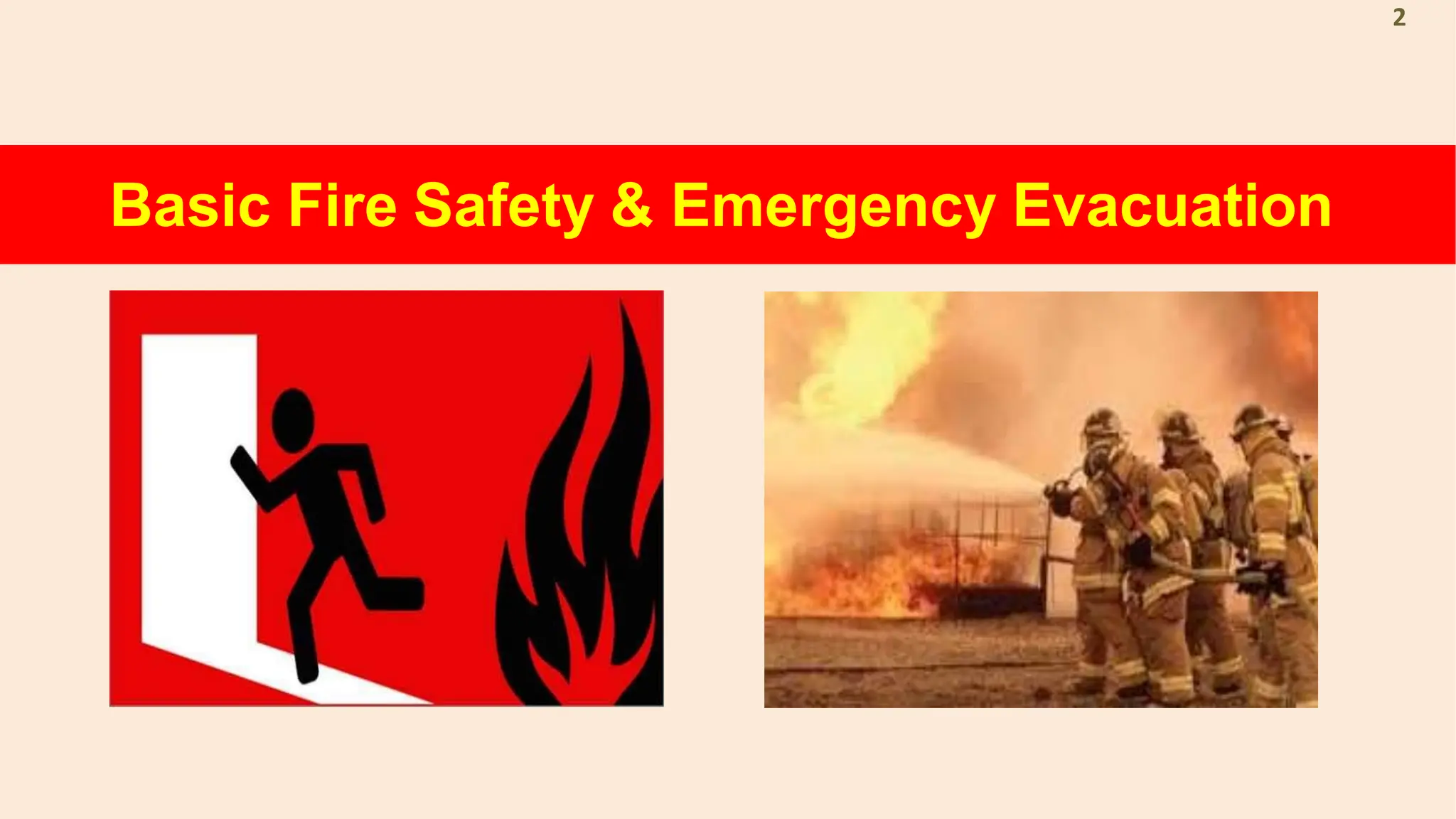
Basic Fire Safety & Emergency Evacuation
2
1
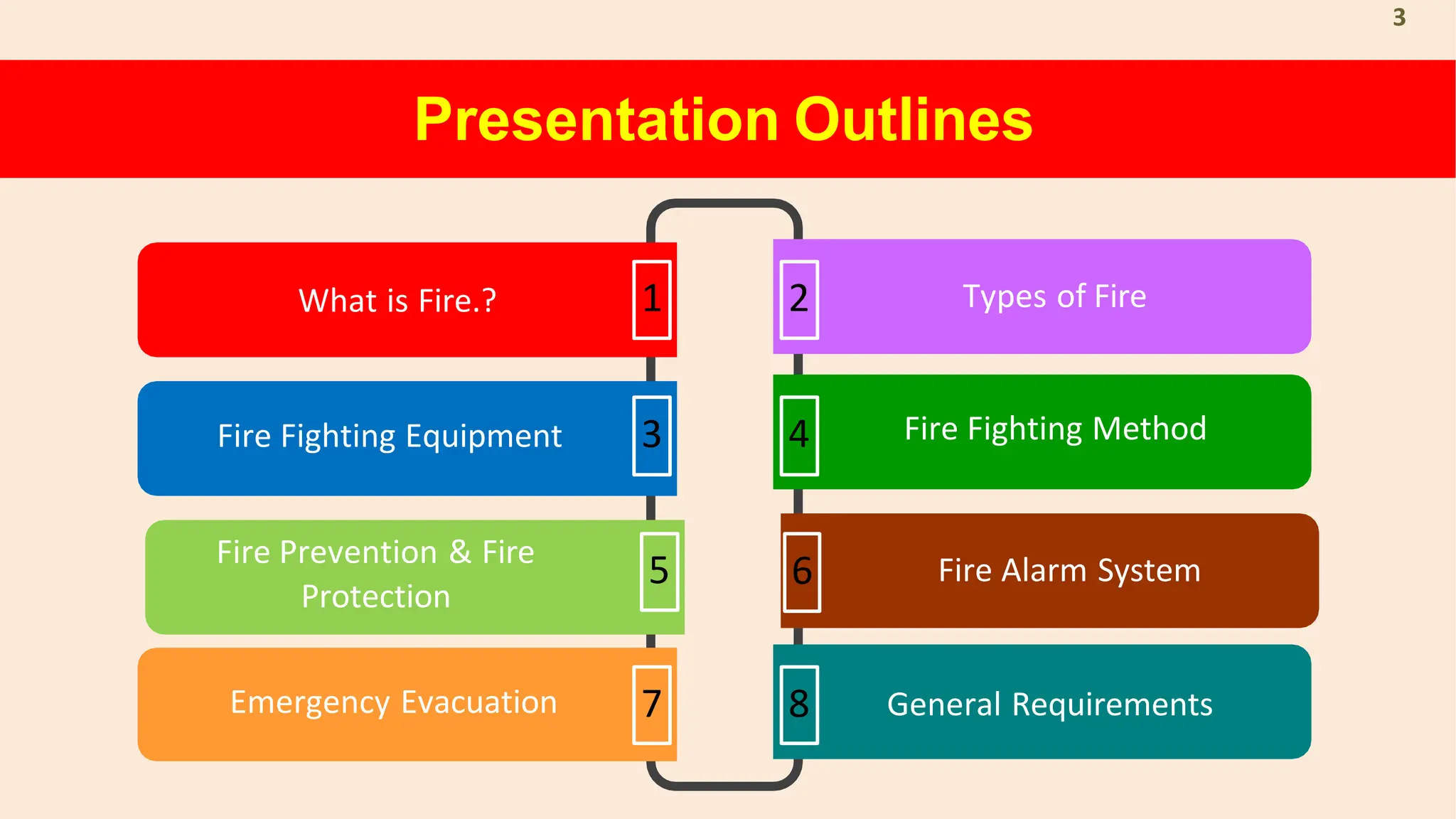
What is Fire.? 2 Types of Fire
7
Emergency Evacuation
3
Fire Fighting Equipment
5
Fire Prevention & Fire
Protection
4 Fire Fighting Method
6 Fire Alarm System
8 General Requirements
Presentation Outlines
3
01. What is Fire.?
Fire is a chemical reaction of three
components:
 Oxygen
 Fuel
 Heat
4
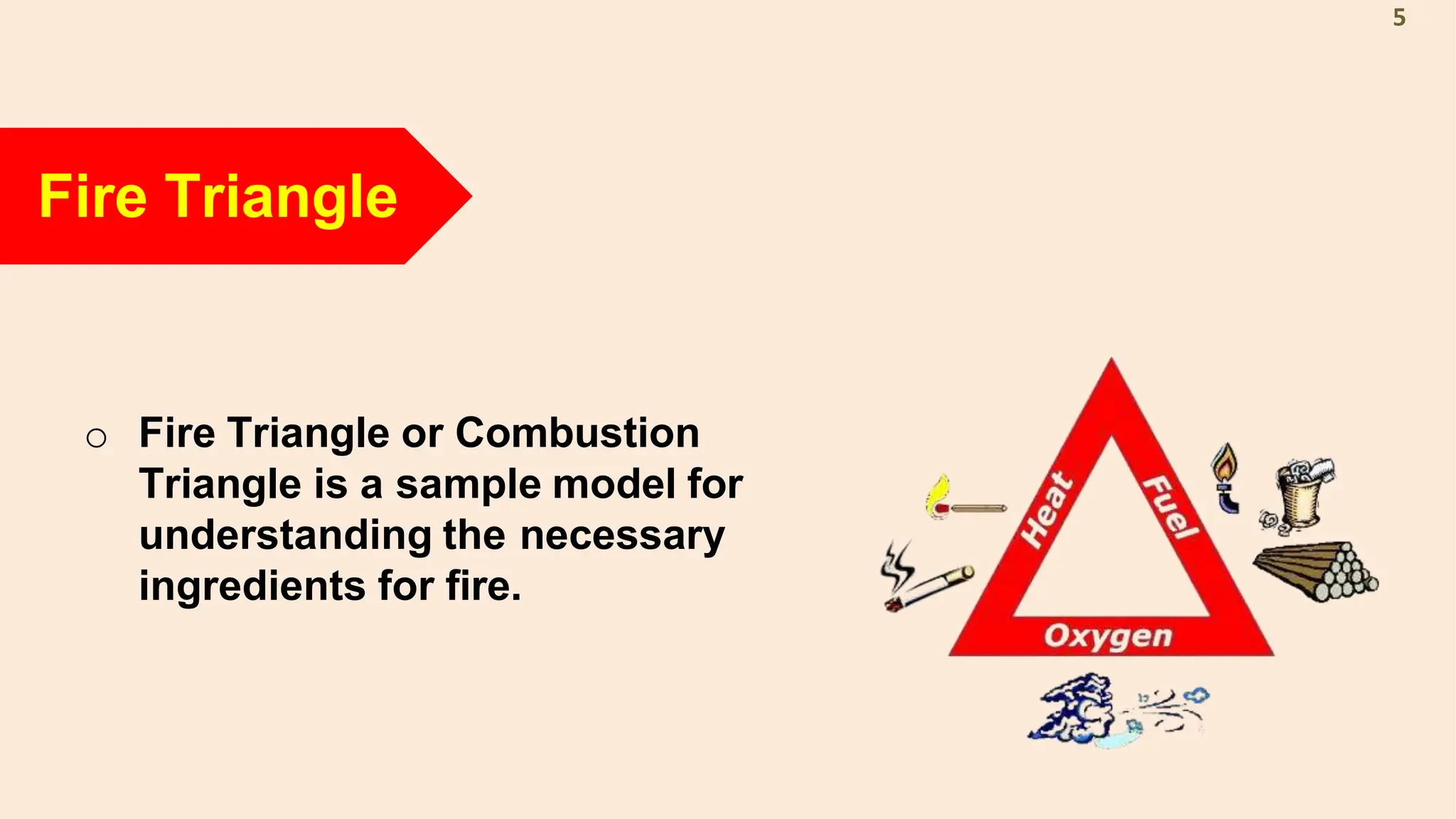
o Fire Triangle or Combustion
Triangle is a sample model for
understanding the necessary
ingredients for fire.
Fire Triangle
5
Fire Tetrahedron
Fire tetrahedron can be describe as
pyramid which is solid having four
faces:
 Oxygen
 Fuel
 Heat
 Chemical Reaction
6
The Spread of Fire
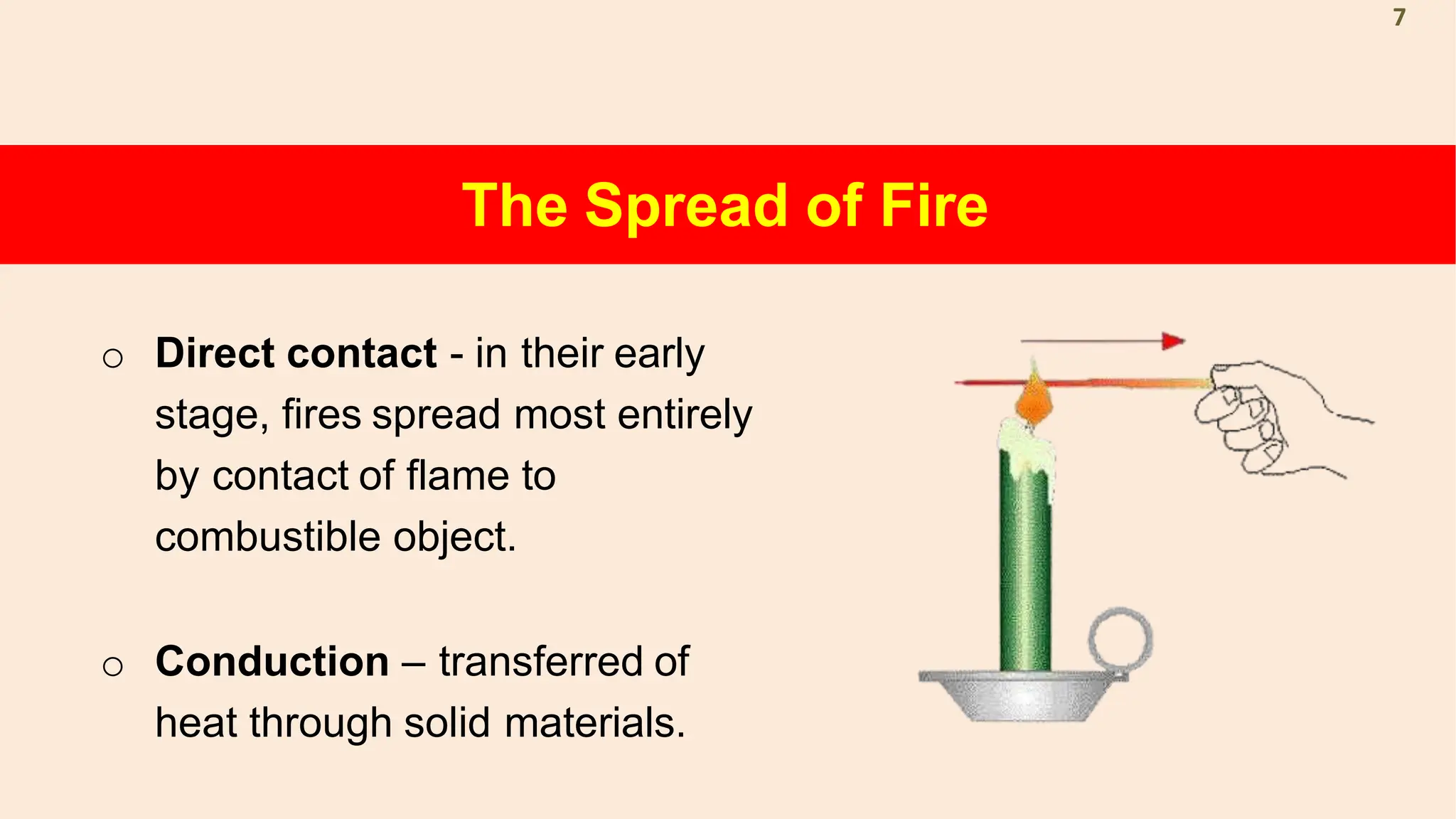
o Direct contact - in their early
stage, fires spread most entirely
by contact of flame to
combustible object.
o Conduction – transferred of
heat through solid materials.
7
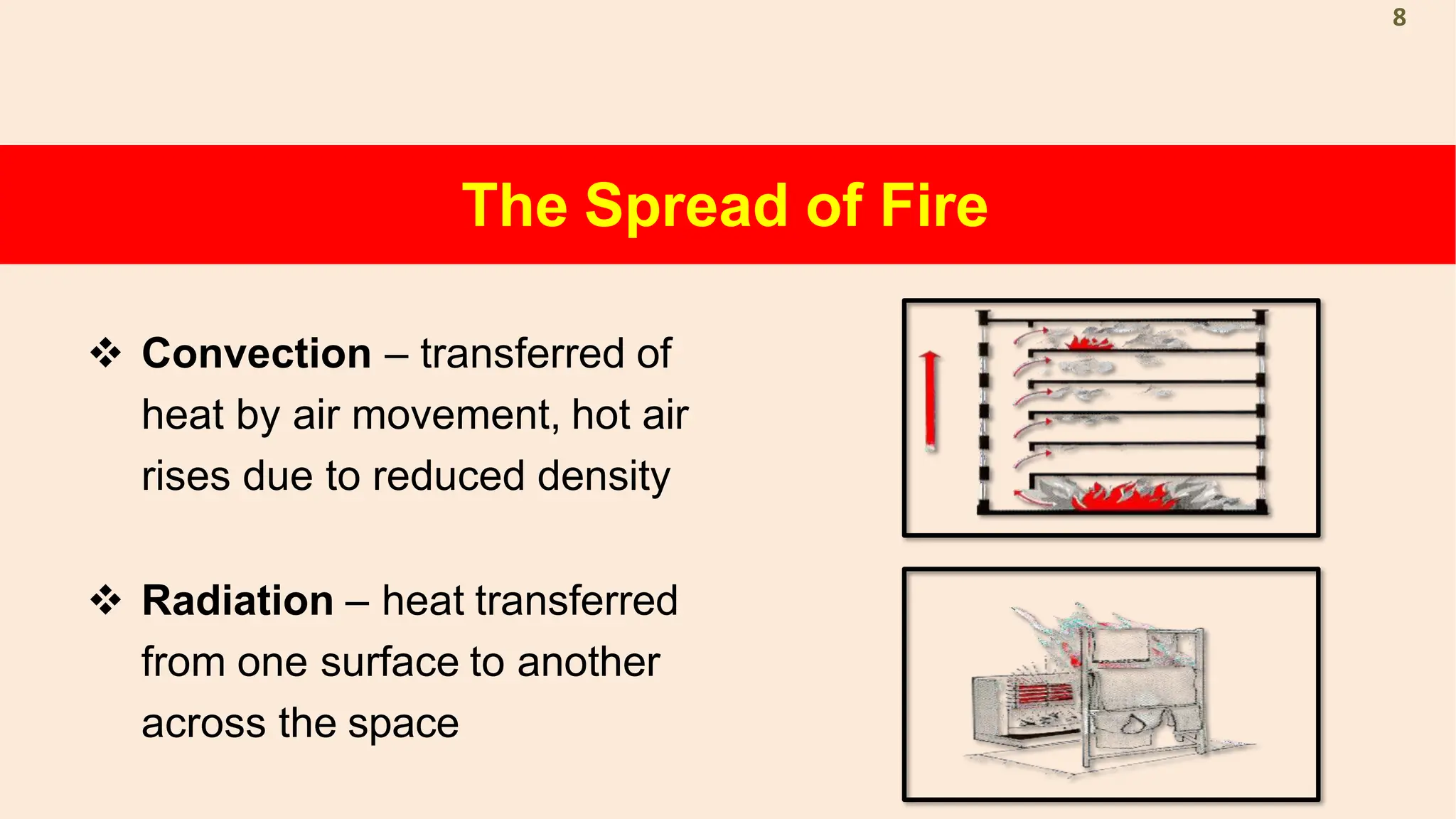
The Spread of Fire
 Convection – transferred of
heat by air movement, hot air
rises due to reduced density
 Radiation – heat transferred
from one surface to another
across the space
8
4
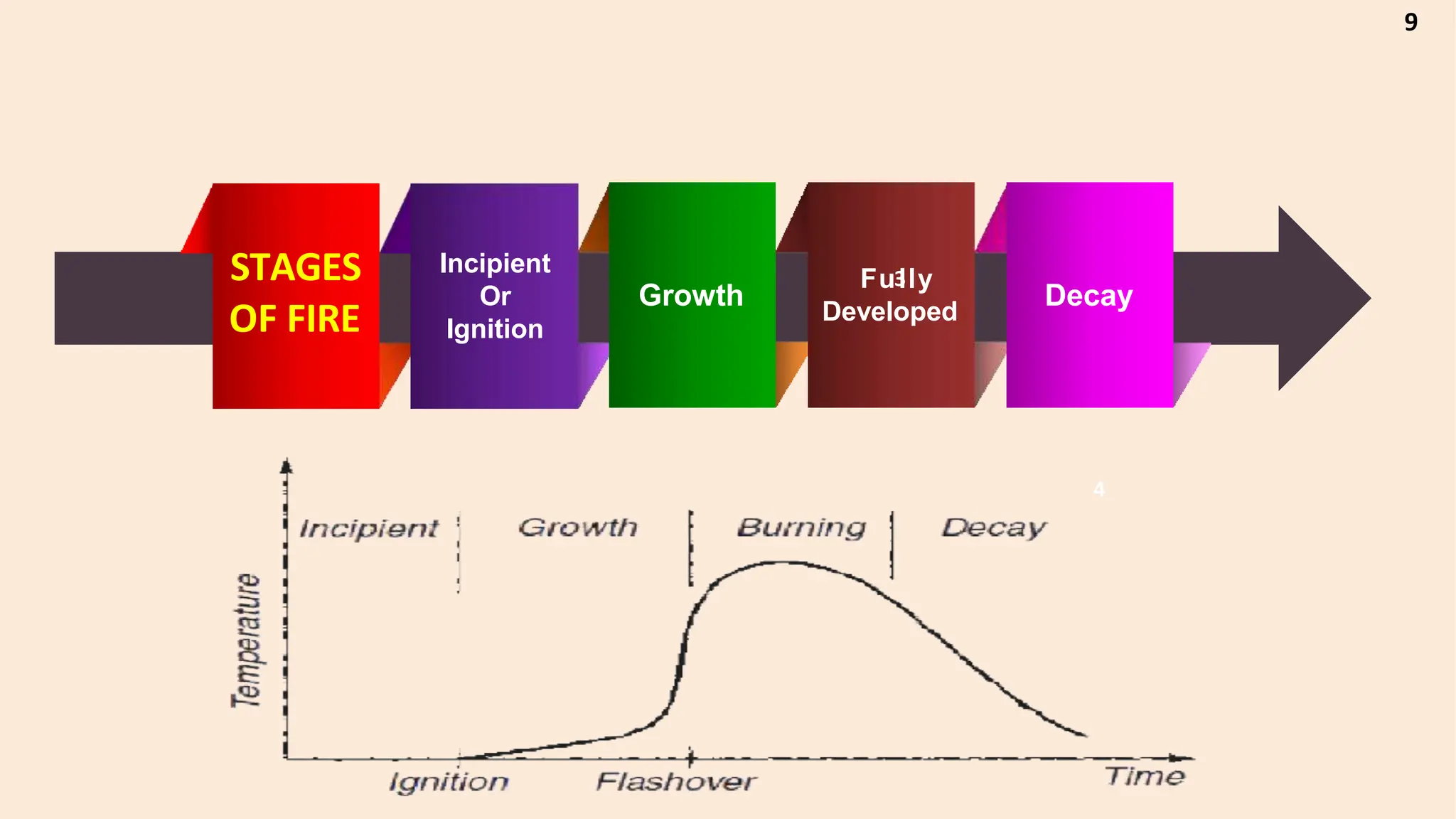
STAGES
OF FIRE
Incipient
Or
Ignition
Growth
Fu3
lly
Developed
Decay
9
Cooking
Equipment's Smoking
Electrical Distribution
Equipment's
Electrical
Appliances
Oil, Kerosene.
Petrol & Lubricants
Gas
Leakages
Heating
Equipment's
Pow er
Storages
Explosives
Common Causes of Fire
10
END CHAPTTER 01
11
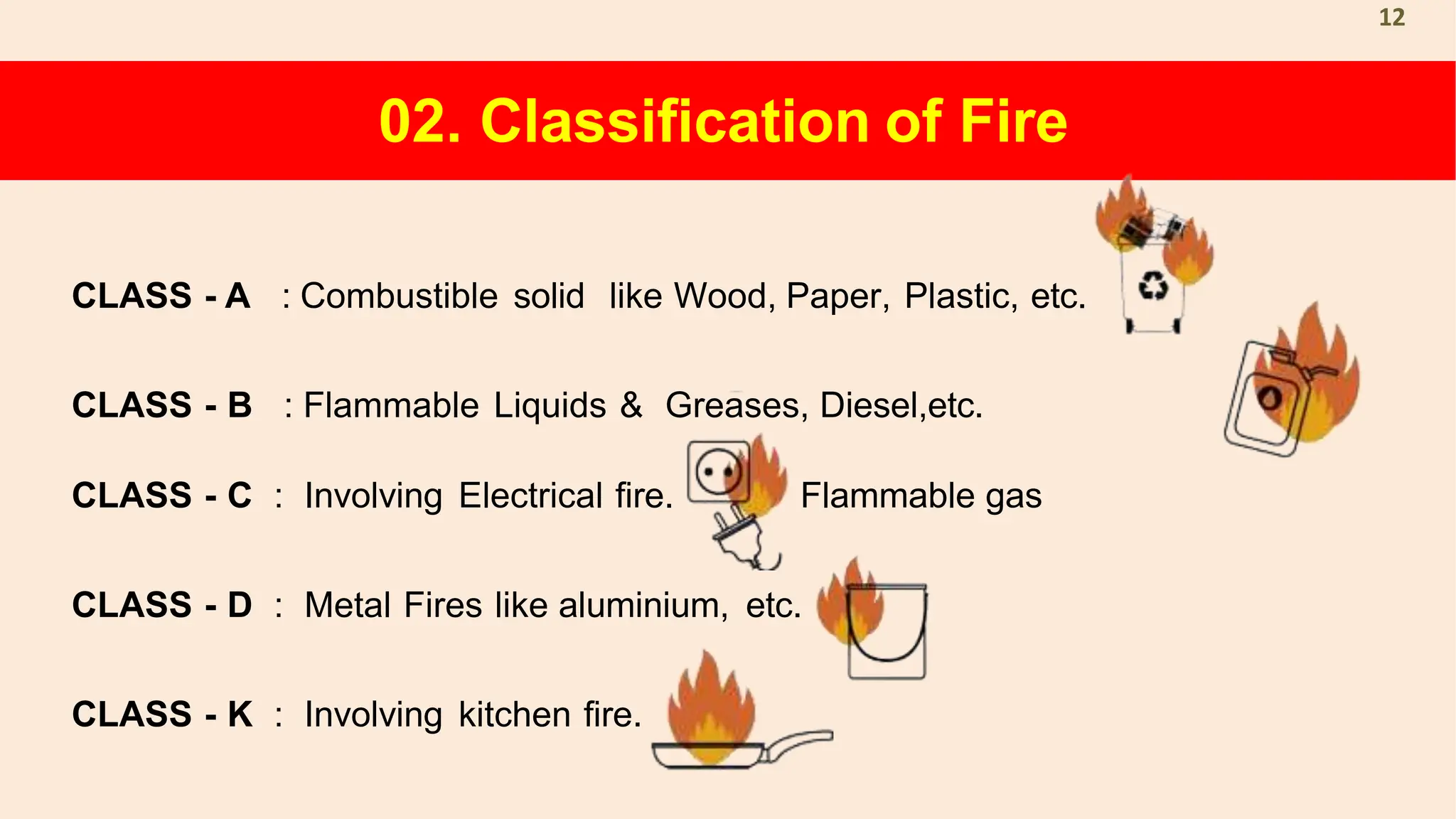
02. Classification of Fire
CLASS - A : Combustible solid like Wood, Paper, Plastic, etc.
CLASS - B : Flammable Liquids & Greases, Diesel,etc.
CLASS - C : Involving Electrical fire. Flammable gas
CLASS - D : Metal Fires like aluminium, etc.
CLASS - K : Involving kitchen fire.
12
END CHAPTTER 02
13
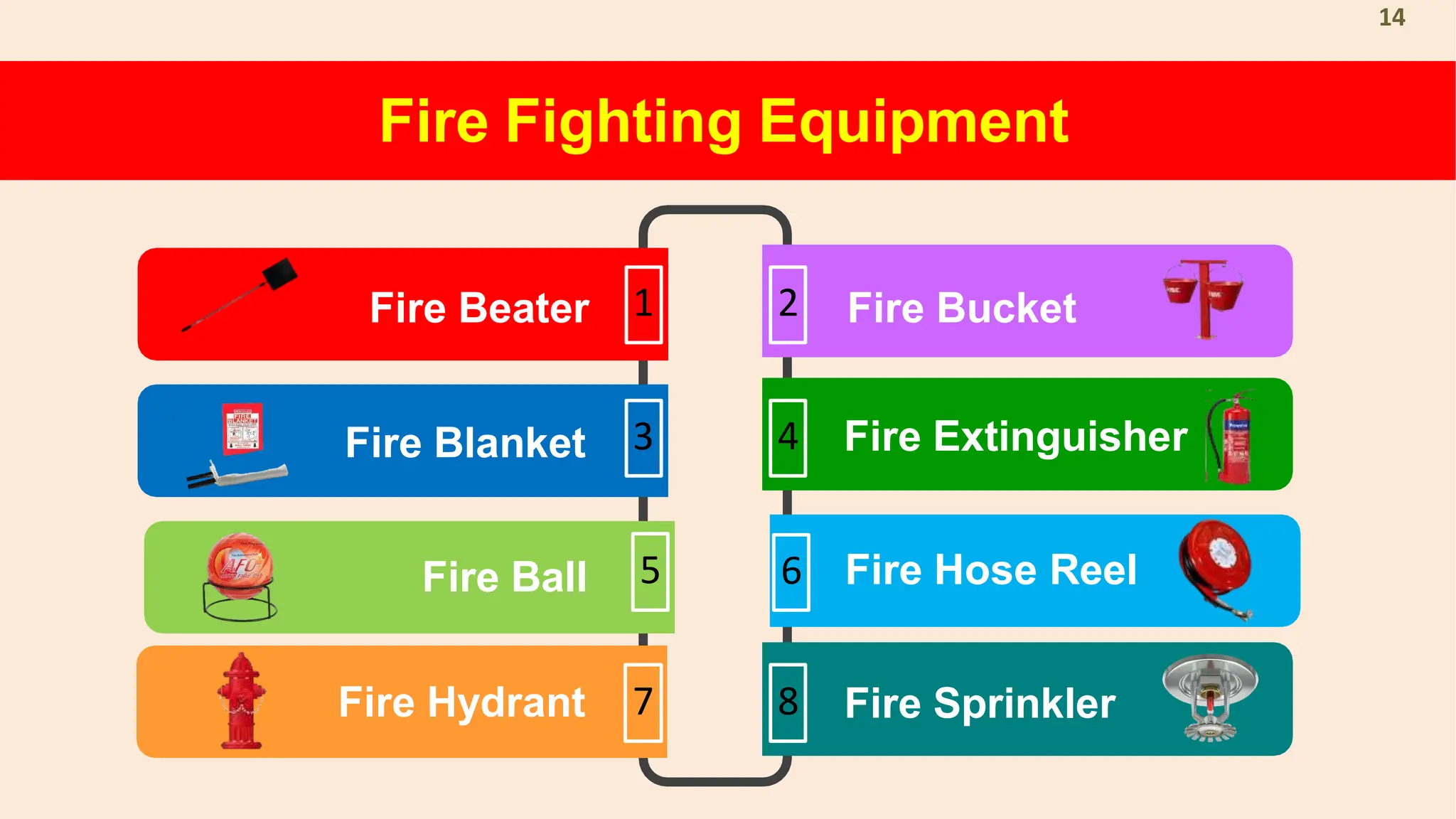
Fire Fighting Equipment
1
Fire Beater 2 Fire Bucket
7
Fire Hydrant
3
Fire Blanket
5
Fire Ball
4 Fire Extinguisher
6 Fire Hose Reel
8 Fire Sprinkler
14
Fire Fighting Equipment
01. Fire Beater 02. Fire Bucket
A simple tool for fighting
wildfires, consisting of a
piece of rubber at the
end of a pole.
A Fire Bucket is filled with
sand or water and is used
to extinguish fires.
15
Fire Fighting Equipment
03. Fire Blanket 04. Fire Ball
A sheet of flexible material,
typically woven fiberglass,
used to smother a fire in an
emergency.
A round-shaped fire extinguisher
that self-activates after about
three to five seconds of fire
exposure.
16
Fire Fighting Equipment
05. Fire Hose 06. Fire Hydrant
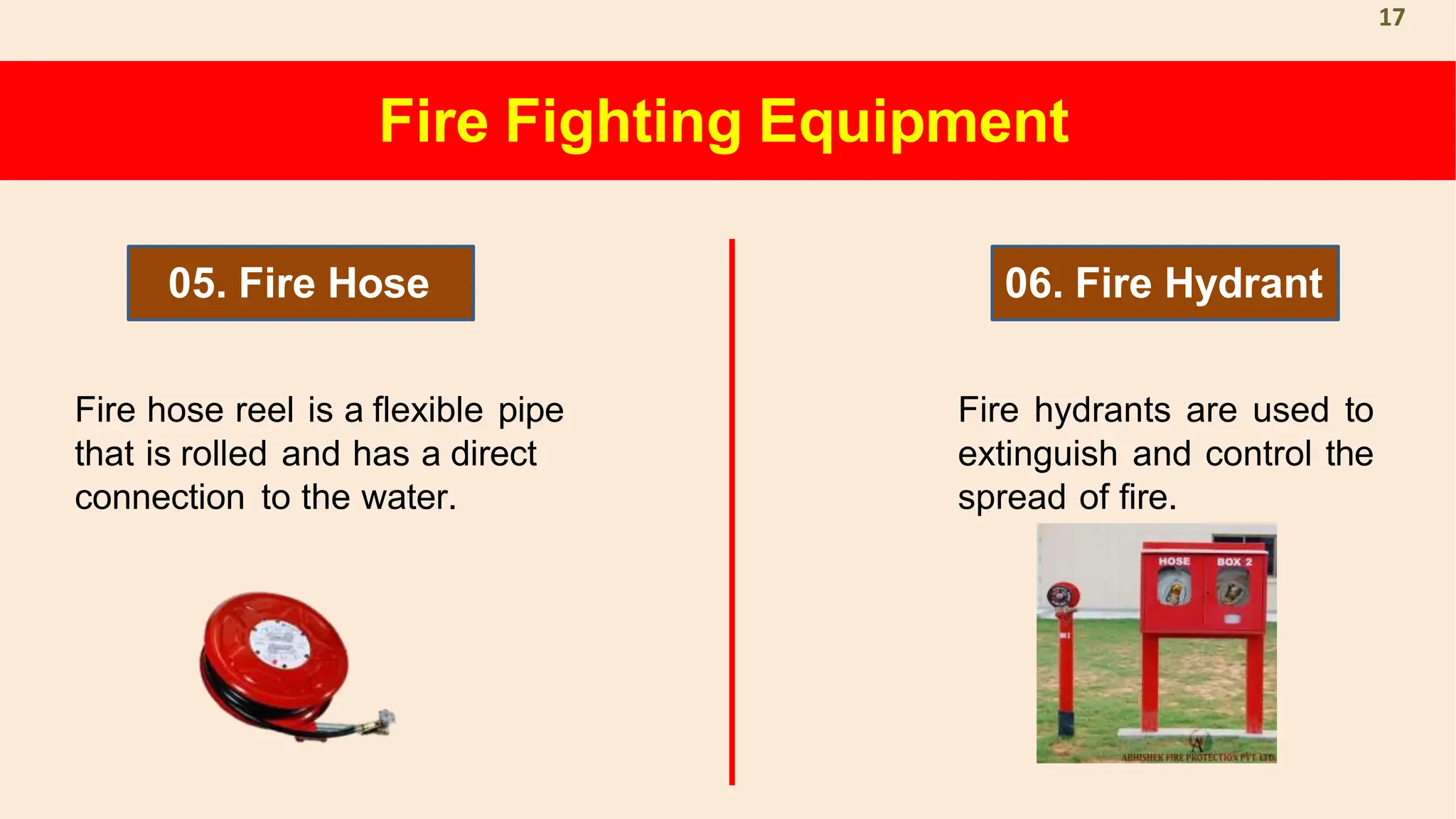
Fire hose reel is a flexible pipe
that is rolled and has a direct
connection to the water.
Fire hydrants are used to
extinguish and control the
spread of fire.
17
Fire Fighting Equipment
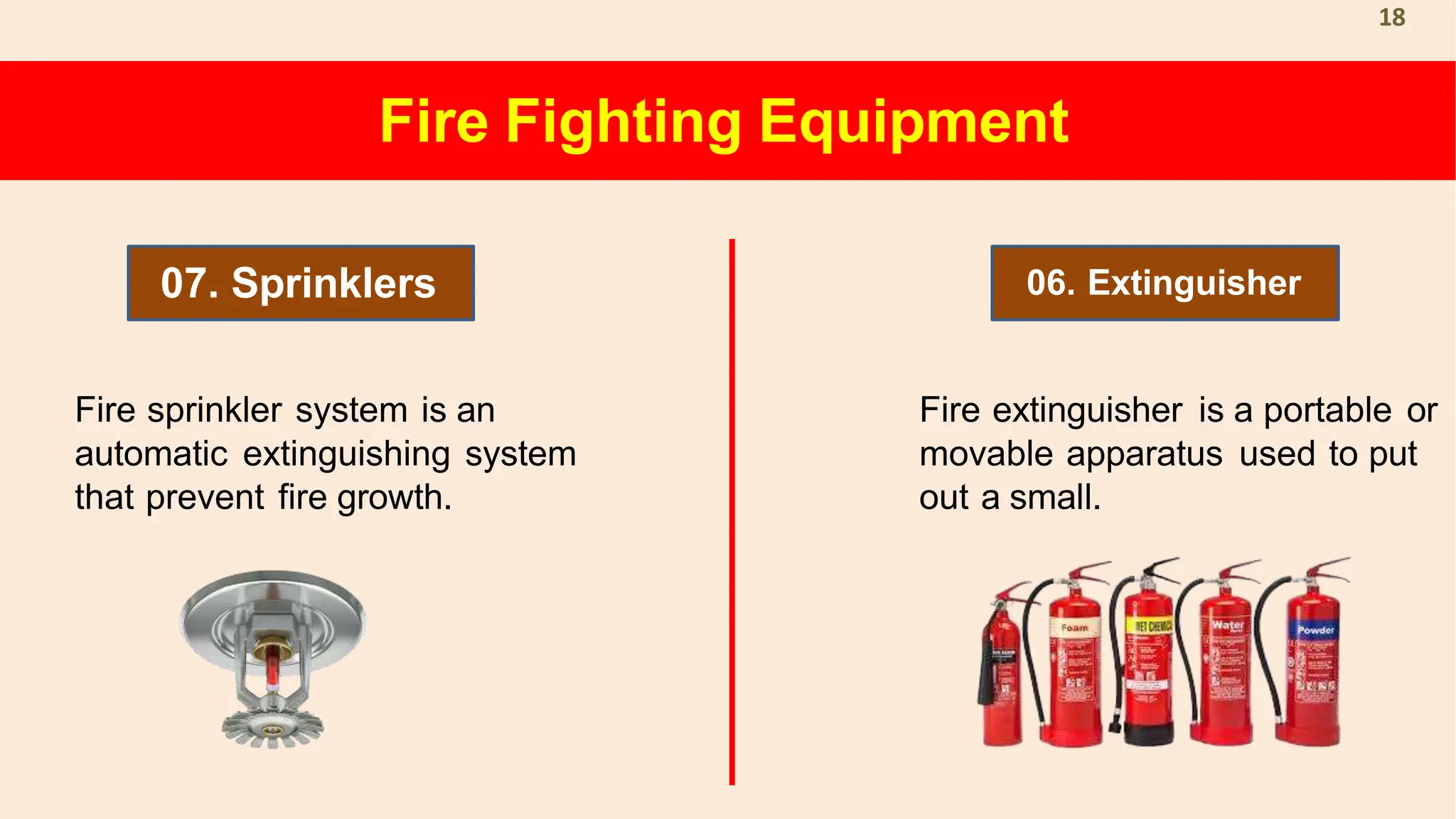
07. Sprinklers 06. Extinguisher
Fire sprinkler system is an
automatic extinguishing system
that prevent fire growth.
Fire extinguisher is a portable or
movable apparatus used to put
out a small.
18
Fire Fighting Equipment
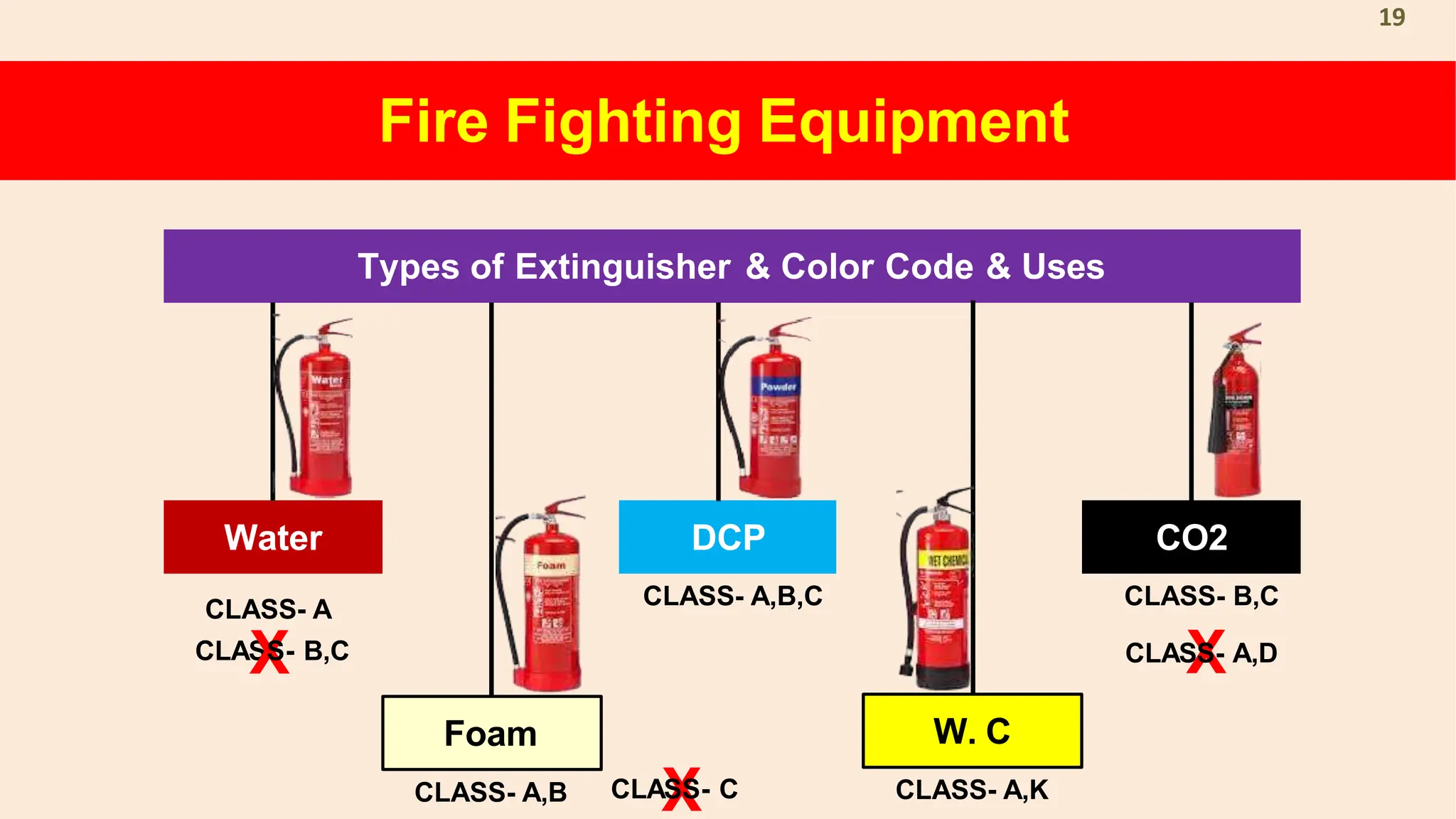
Types of Extinguisher & Color Code & Uses
Water
W. C
Foam
CO2
DCP
CLASS- A,B
CLASS- A,B,C
CLASS- A,K
CLASS- A
CLAS
X
S- B,C
CLAX
SS- C
CLASS- B,C
CLAS
X
S- A,D
19
Fire Fighting Equipment
P
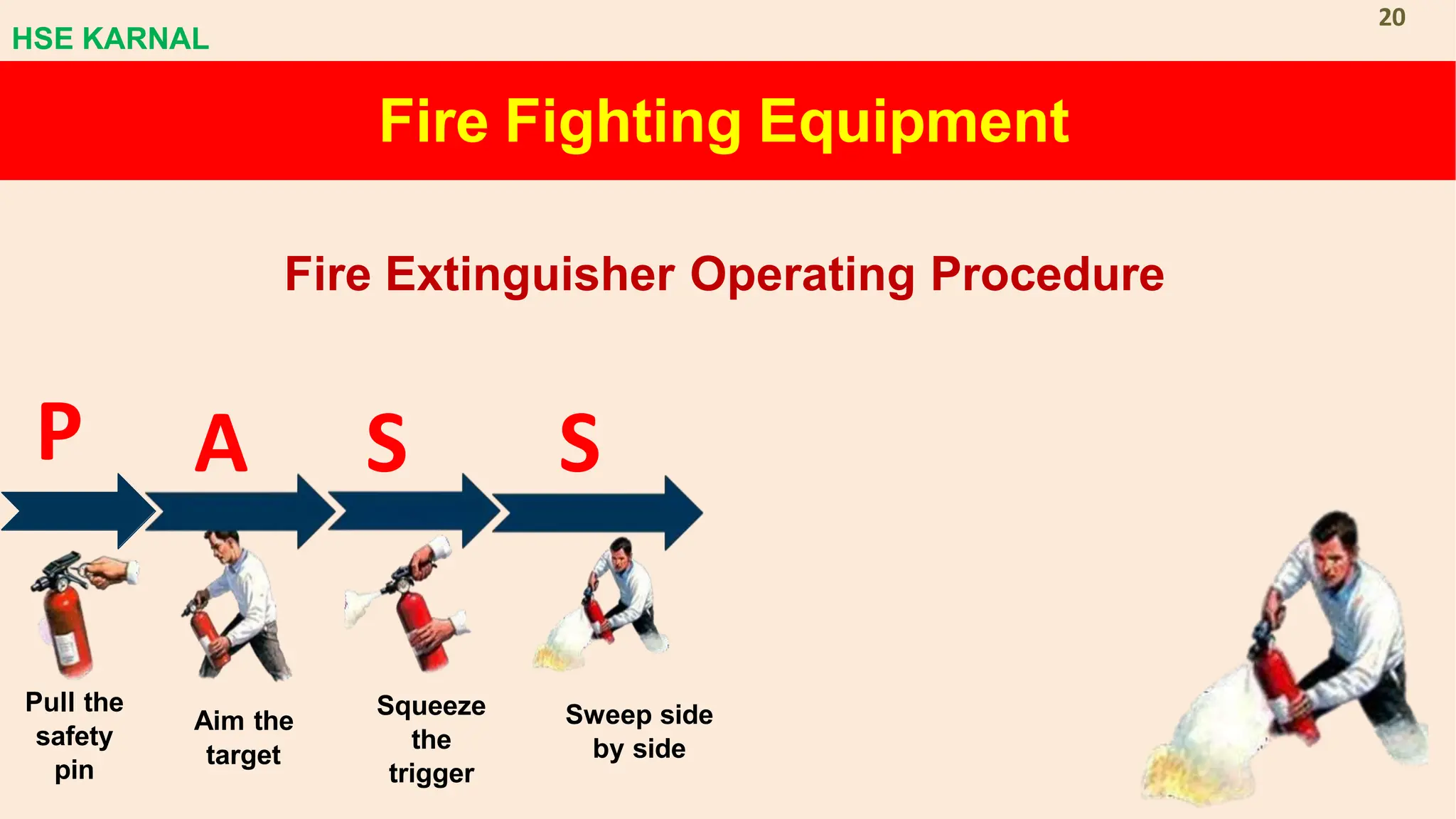
Fire Extinguisher Operating Procedure
A S S
Pull the
safety
pin
Aim the
target
Squeeze
the
trigger
Sweep side
by side
HSE KARNAL
20
Fire Fighting Equipment
Fire Extinguisher Using TIPs
Check for your own safety before starting to extinguish a fire.
Assess the fire only a small fire should be fought using a fire extinguisher
Select the right type of fire extinguisher.
Remember the simple acronym P.A.S.S. : Pull, Aim, Squeeze, Sweep,
Always try to work in pair for safety.
Target the base of the fire not the flame.
If fire extinguished at first sight, stay ready for re-ignition.
Keep minimum 8-10 feet distance from fire during use fire extinguisher.
21
Fire Fighting Equipment
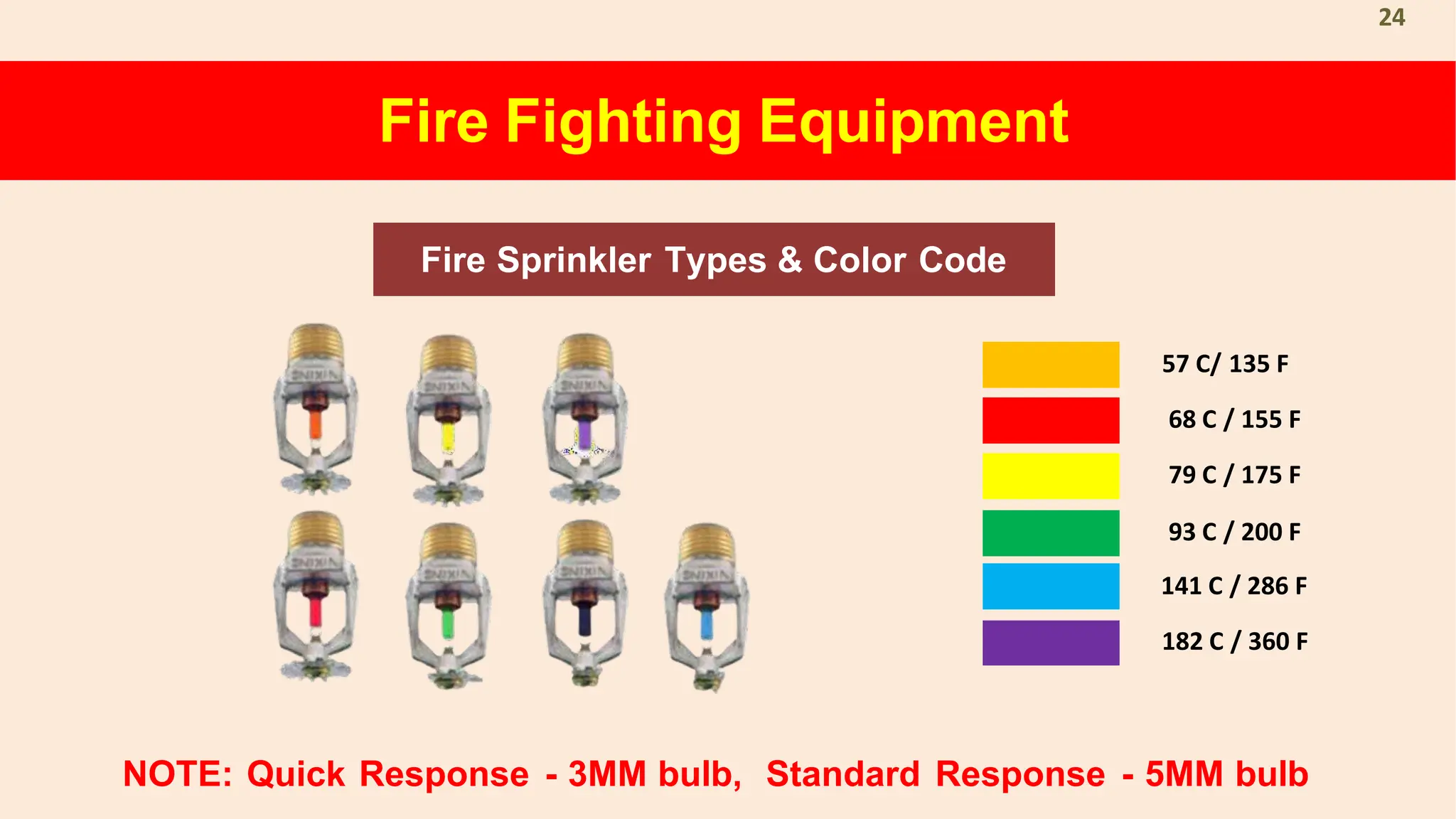
Fire Sprinkler Types & Color Code
Open Fire Sprinkler:
Sprinkler that is not equipped with actuator
or heat response element.
Closed Fire Sprinkler:
Sprinkler that is equipped with actuator or
heat response element.
23
Fire Fighting Equipment
Fire Sprinkler Types & Color Code
57 C/ 135 F
68 C / 155 F
79 C / 175 F
93 C / 200 F
141 C / 286 F
182 C / 360 F
NOTE: Quick Response - 3MM bulb, Standard Response - 5MM bulb
24
Fire Fighting Equipment
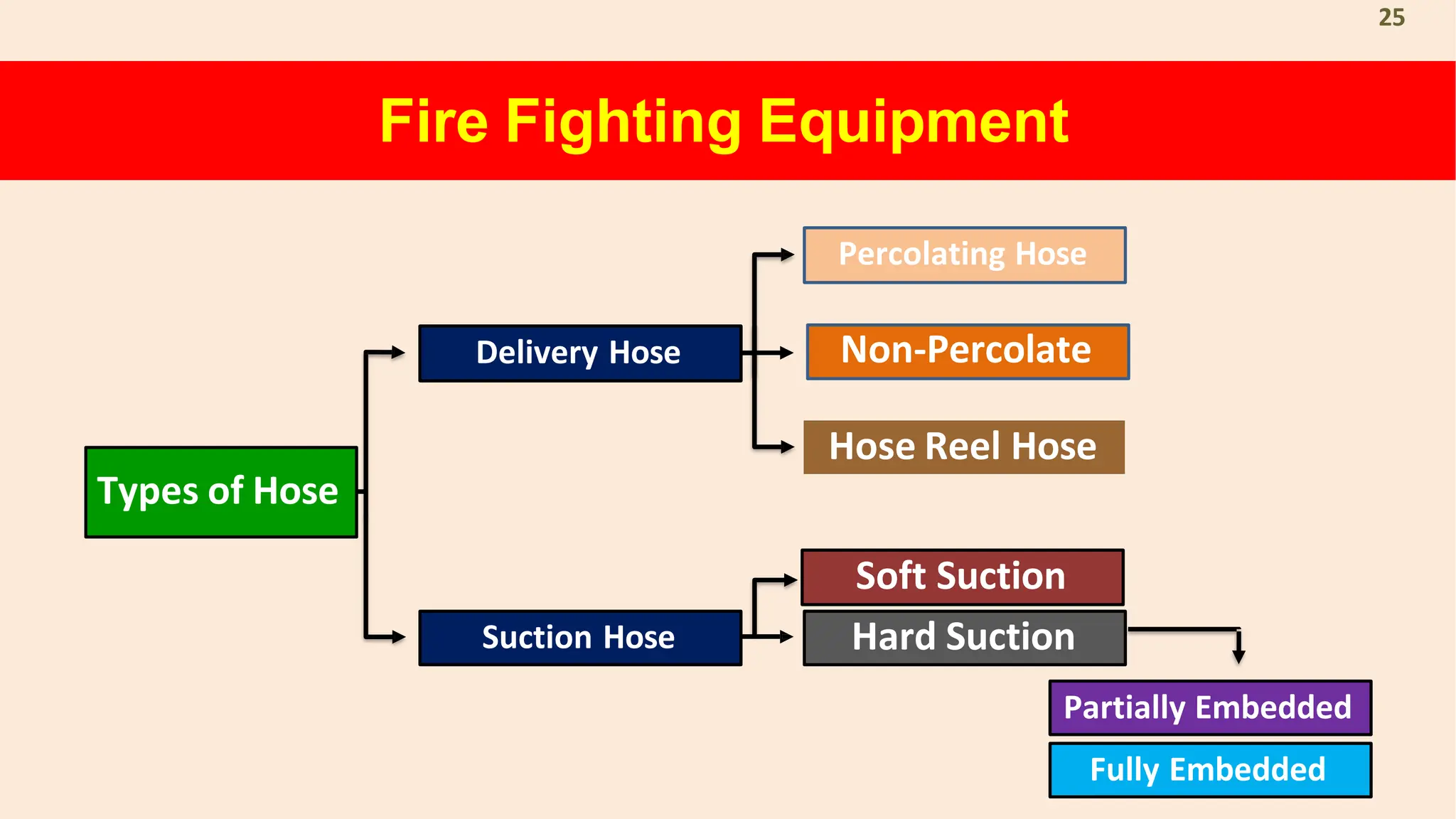
Types of Hose
Delivery Hose
Suction Hose
Hose Reel Hose
Percolating Hose
Hard Suction
Non-Percolate
Partially Embedded
Soft Suction
Fully Embedded
25
Fire Fighting Equipment
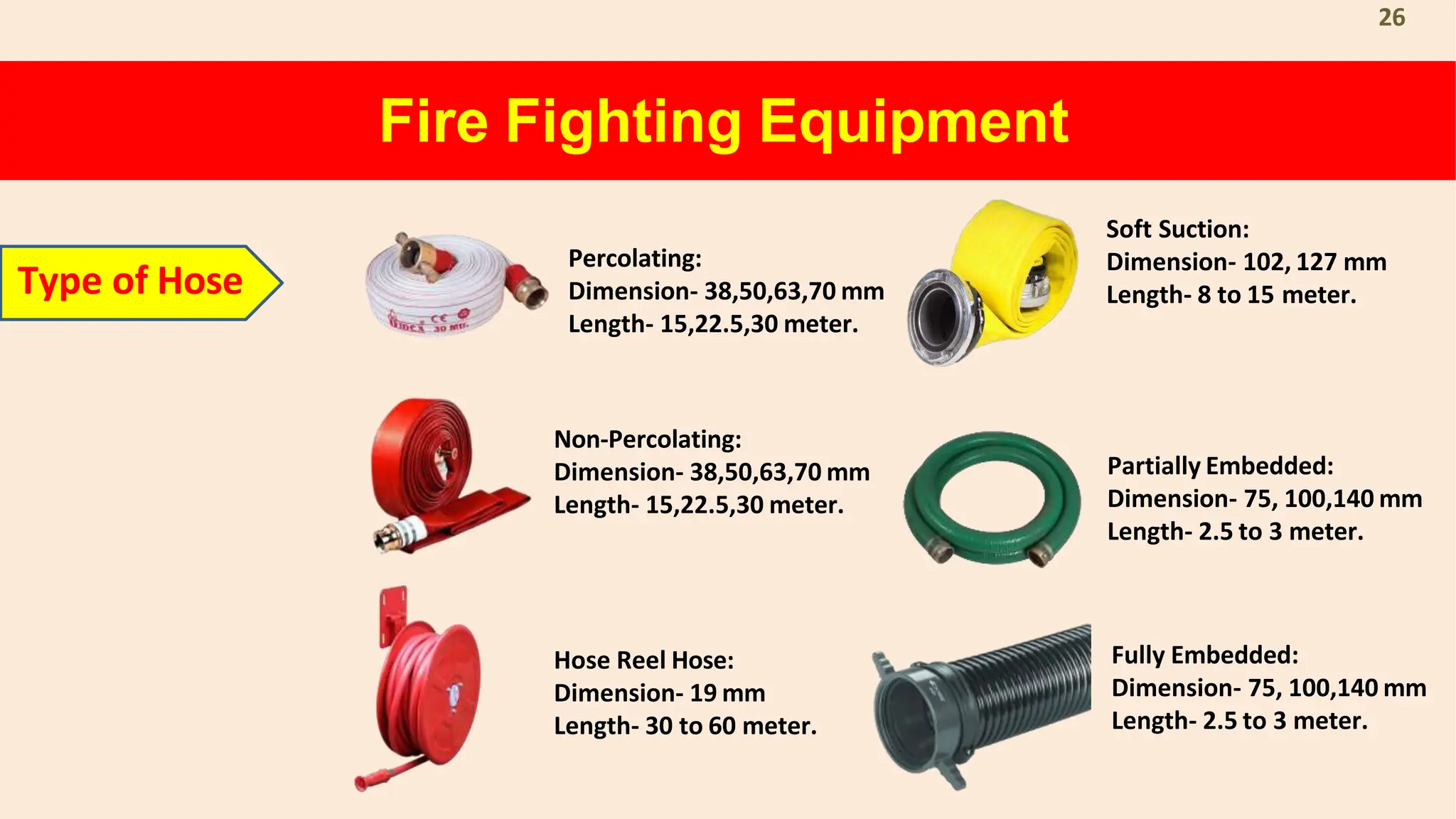
Type of Hose
Percolating:
Dimension- 38,50,63,70 mm
Length- 15,22.5,30 meter.
Non-Percolating:
Dimension- 38,50,63,70 mm
Length- 15,22.5,30 meter.
Hose Reel Hose:
Dimension- 19 mm
Length- 30 to 60 meter.
Soft Suction:
Dimension- 102, 127 mm
Length- 8 to 15 meter.
Partially Embedded:
Dimension- 75, 100,140 mm
Length- 2.5 to 3 meter.
Fully Embedded:
Dimension- 75, 100,140 mm
Length- 2.5 to 3 meter.
26
END CHAPTTER 03
27
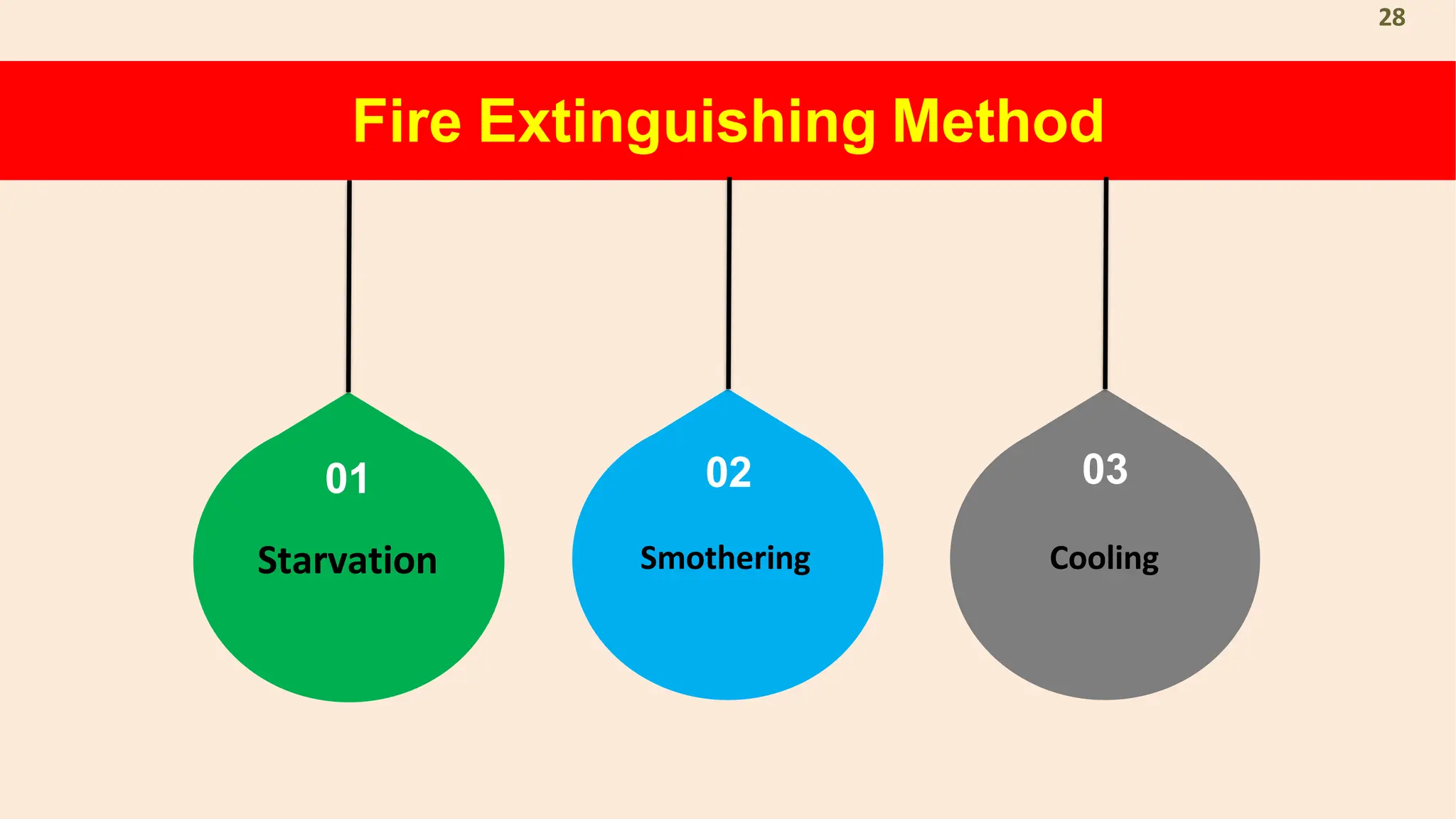
Fire Extinguishing Method
Starvation
01
Smothering
02
Cooling
03
28
Fire Extinguishing Method
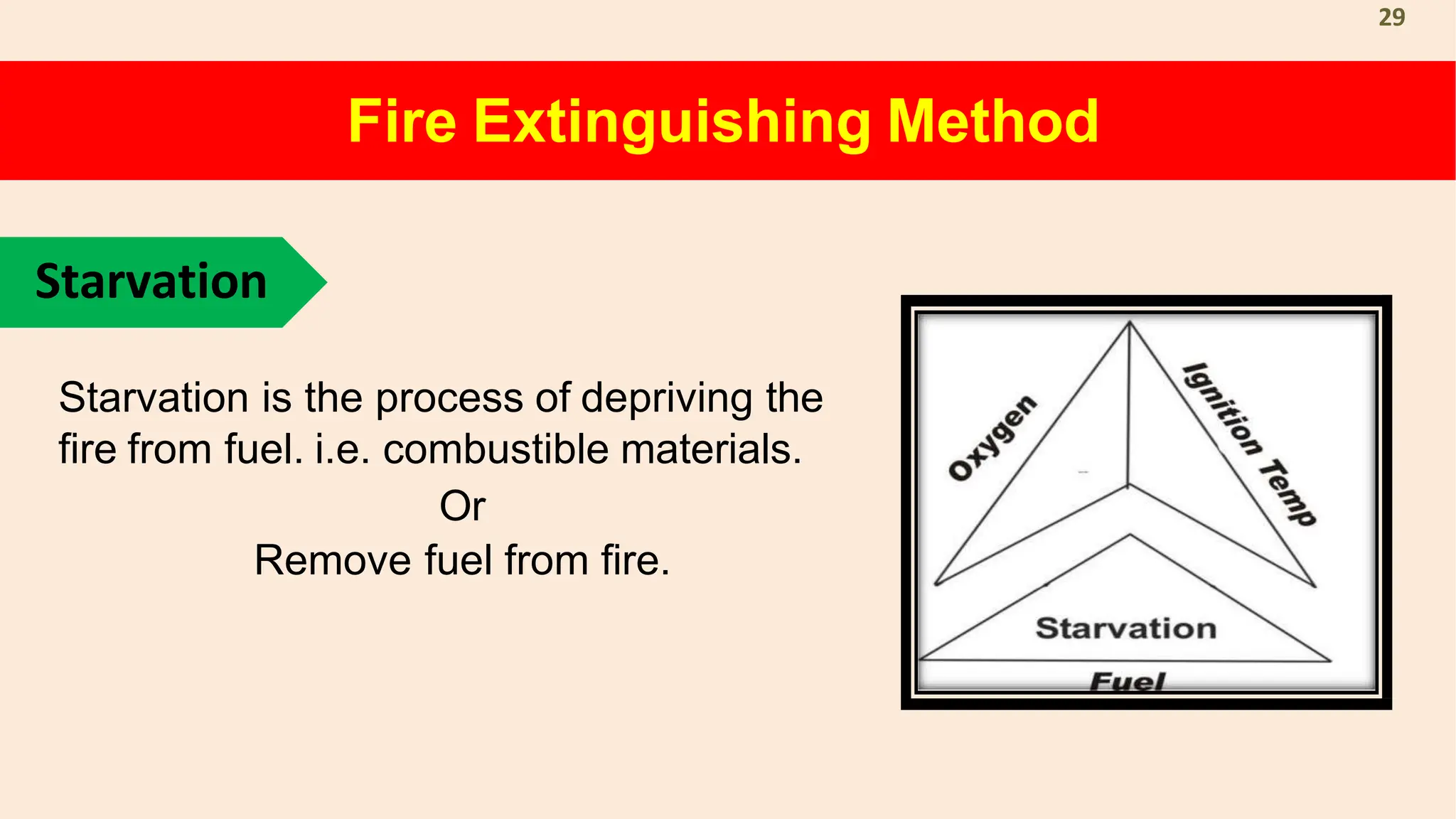
Starvation
Starvation is the process of depriving the
fire from fuel. i.e. combustible materials.
Or
Remove fuel from fire.
29
Fire Extinguishing Method
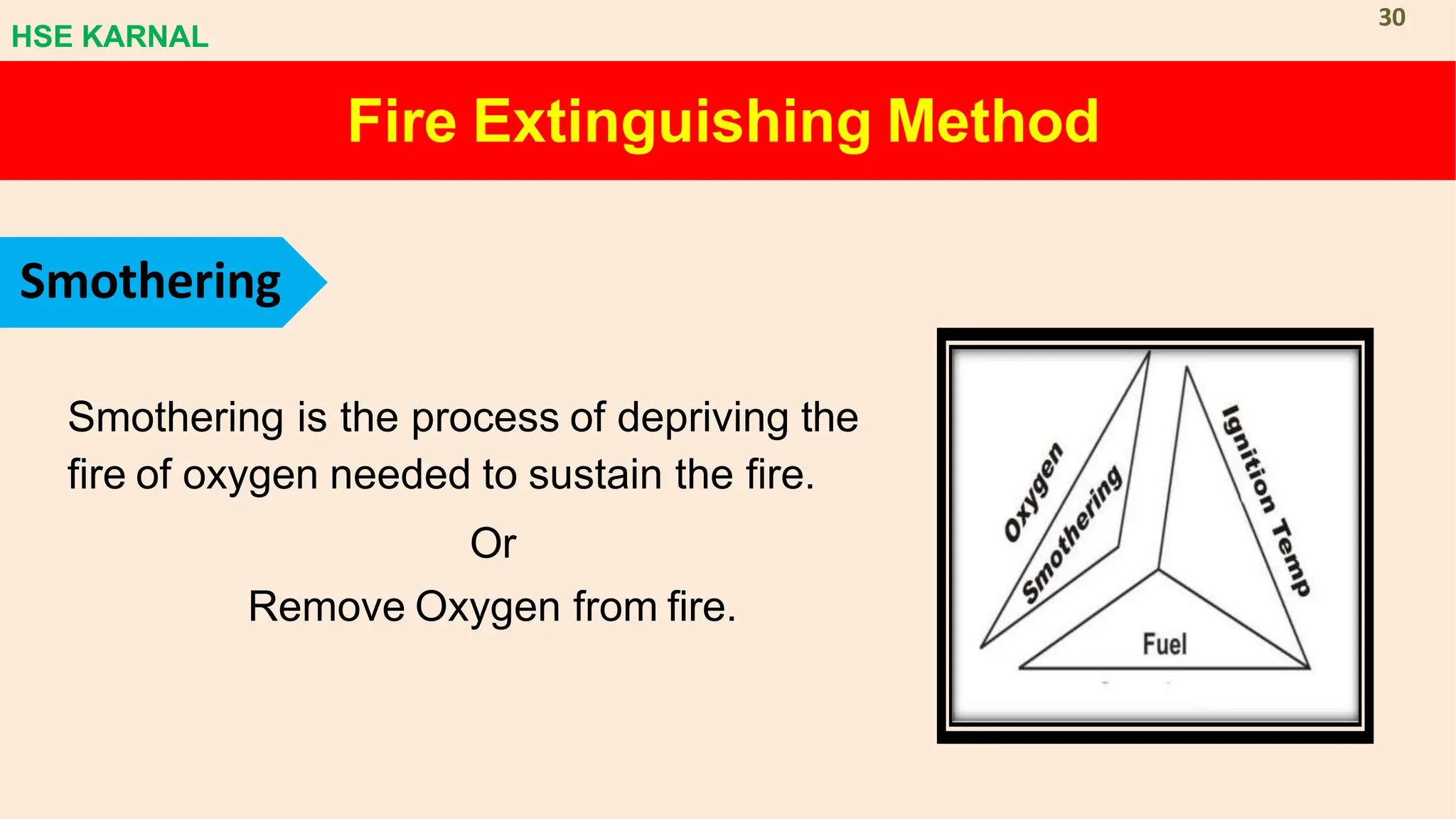
Smothering
Smothering is the process of depriving the
fire of oxygen needed to sustain the fire.
Or
Remove Oxygen from fire.
HSE KARNAL
30
Fire Extinguishing Method
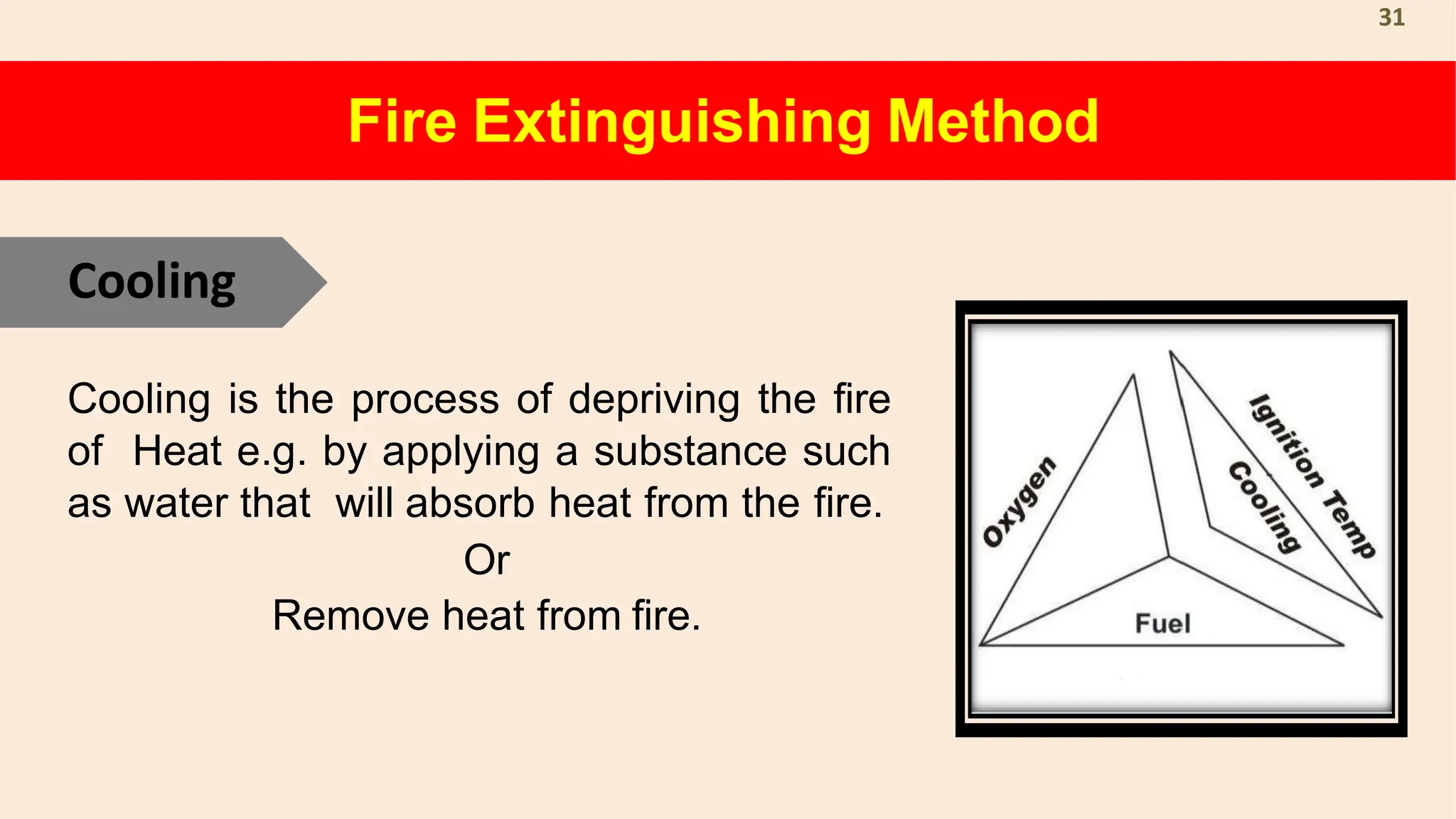
Cooling
Cooling is the process of depriving the fire
of Heat e.g. by applying a substance such
as water that will absorb heat from the fire.
Or
Remove heat from fire.
31
END CHAPTTER 04
32
Fire Prevention & Fire Protection
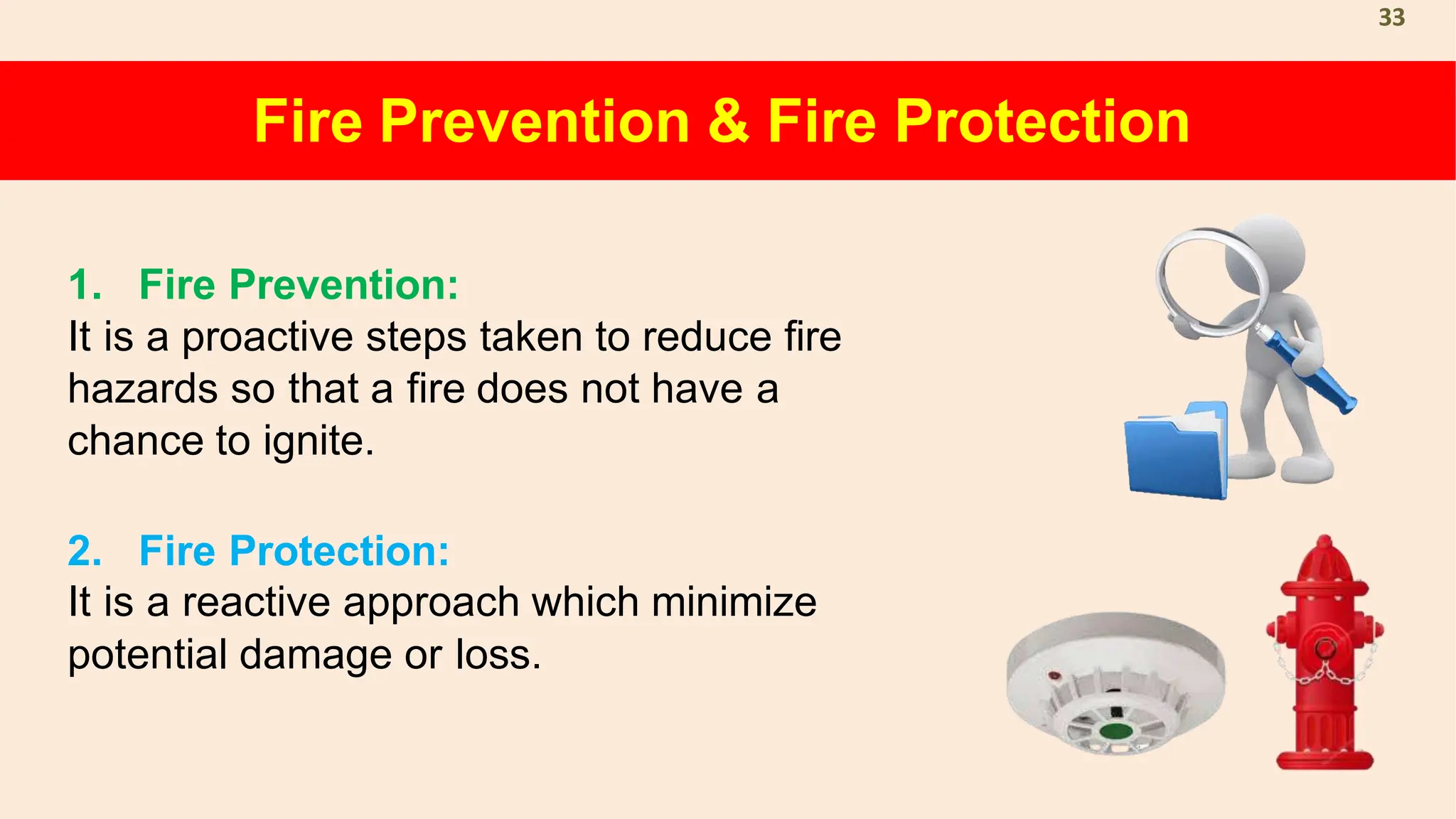
1. Fire Prevention:
It is a proactive steps taken to reduce fire
hazards so that a fire does not have a
chance to ignite.
2. Fire Protection:
It is a reactive approach which minimize
potential damage or loss.
33
Fire Prevention & Fire Protection
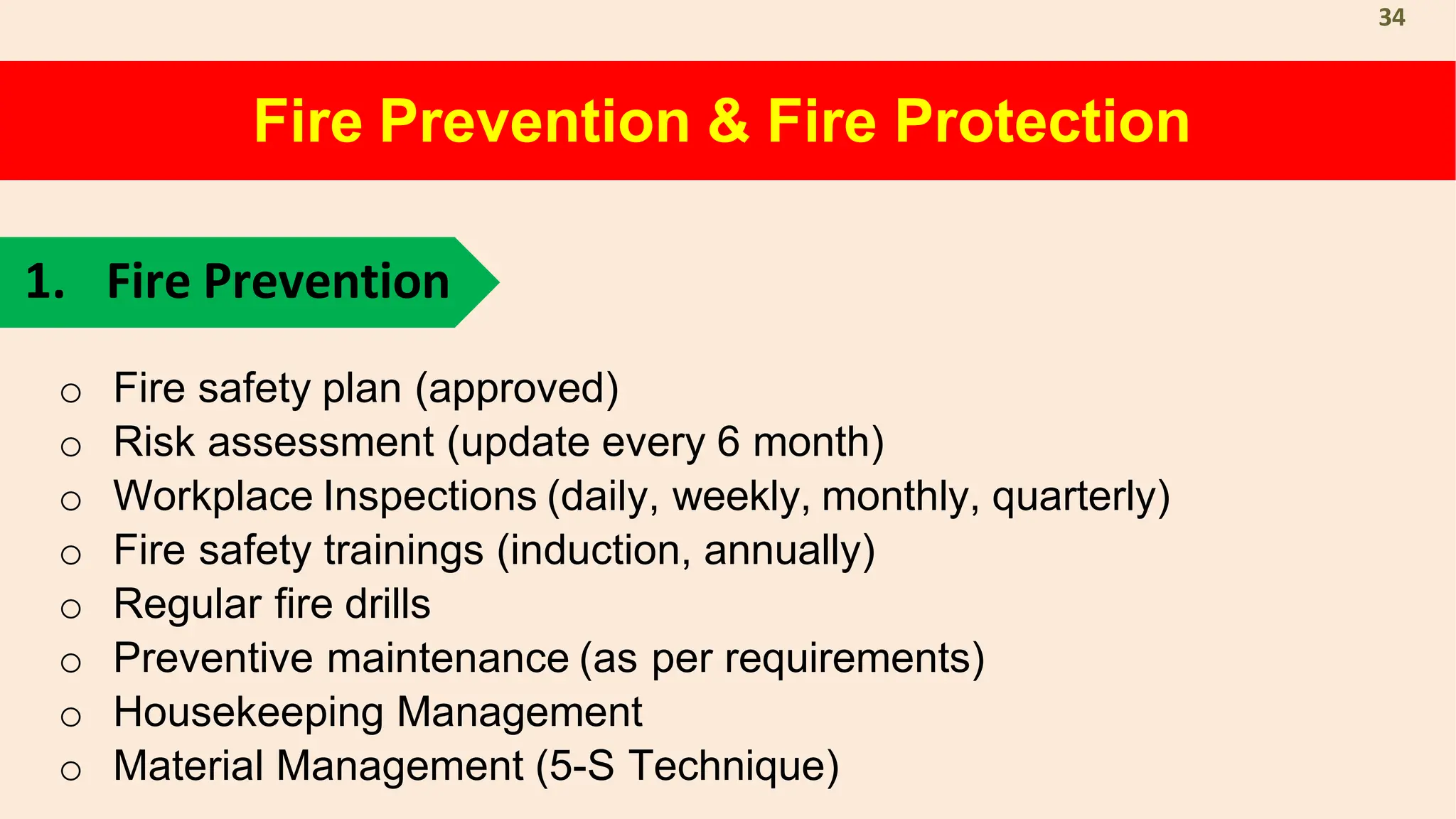
1. Fire Prevention
o Fire safety plan (approved)
o Risk assessment (update every 6 month)
o Workplace Inspections (daily, weekly, monthly, quarterly)
o Fire safety trainings (induction, annually)
o Regular fire drills
o Preventive maintenance (as per requirements)
o Housekeeping Management
o Material Management (5-S Technique)
34
Fire Prevention & Fire Protection
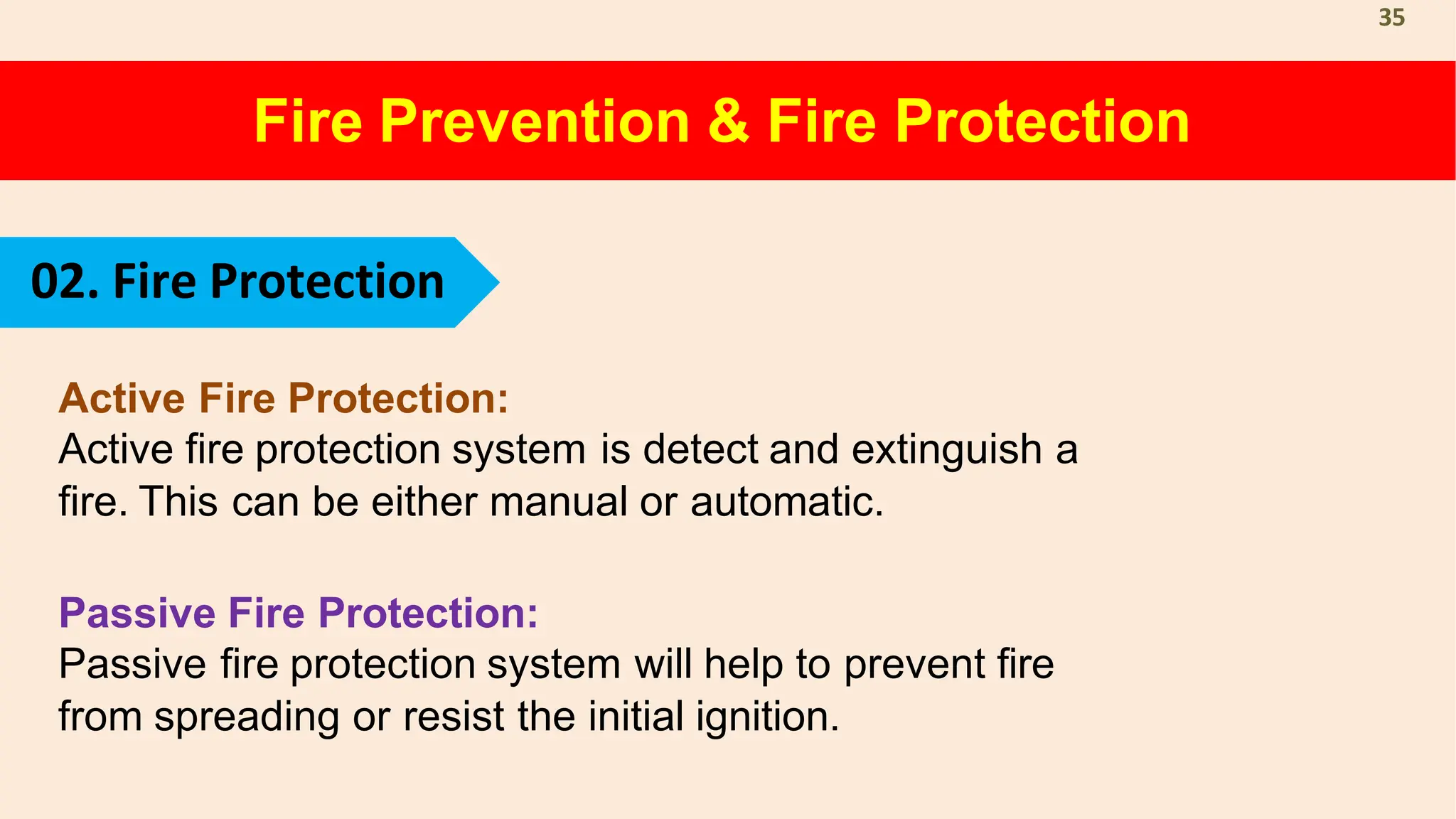
02. Fire Protection
Active Fire Protection:
Active fire protection system is detect and extinguish a
fire. This can be either manual or automatic.
Passive Fire Protection:
Passive fire protection system will help to prevent fire
from spreading or resist the initial ignition.
35
Fire Prevention & Fire Protection
Active Fire Protection Passive Fire Protection
o Smoke and heat alarm
o Manual Call Point
o Fire Sprinklers
o Fire extinguishers
o Fire hydrants
o Video monitoring
o Etc.
o Compartment
o Fire proofing
o Fire door
o Fire wall
o Fire Stopper
o Fire Curtain / Baffle
o Etc.
36
END CHAPTTER 05
37
Fire Alarm System
Fire Alarm Control Panel:
A fire panel is a safety appliance that
receives information from devices
designed to detect and report fires,
monitor their operational integrity.
38
Fire Alarm System
Types of Fire Alarm System
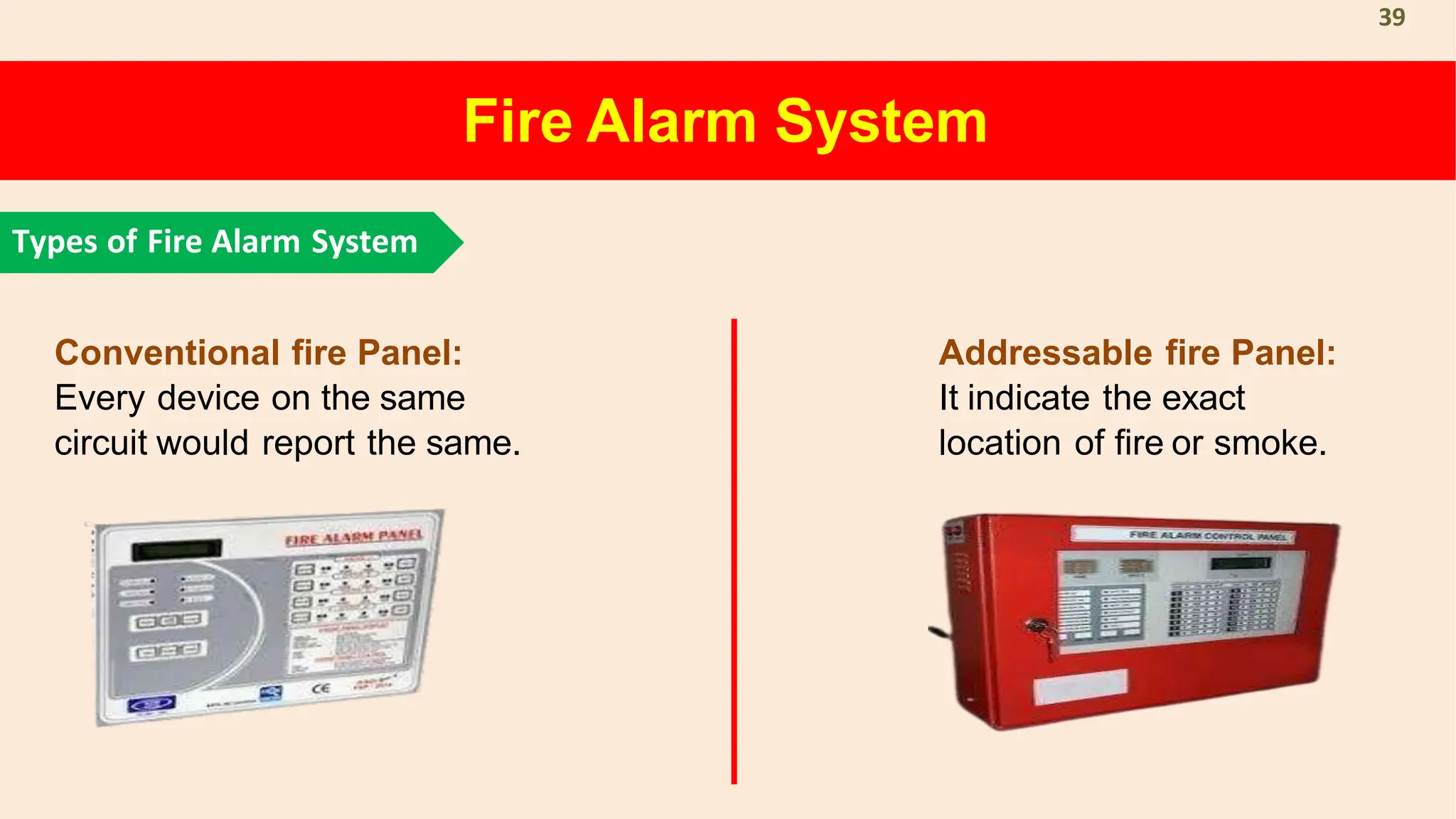
Conventional fire Panel:
Every device on the same
circuit would report the same.
Addressable fire Panel:
It indicate the exact
location of fire or smoke.
39
Fire Alarm System
Fire Detectors
Fire Detectors:
A device which can detect a fire, and provide a signal to an alarm circuit.
Fire detectors are different types;
1. Smoke Detectors
2. Heat Detectors
3. Flame Detectors
40
Fire Alarm System
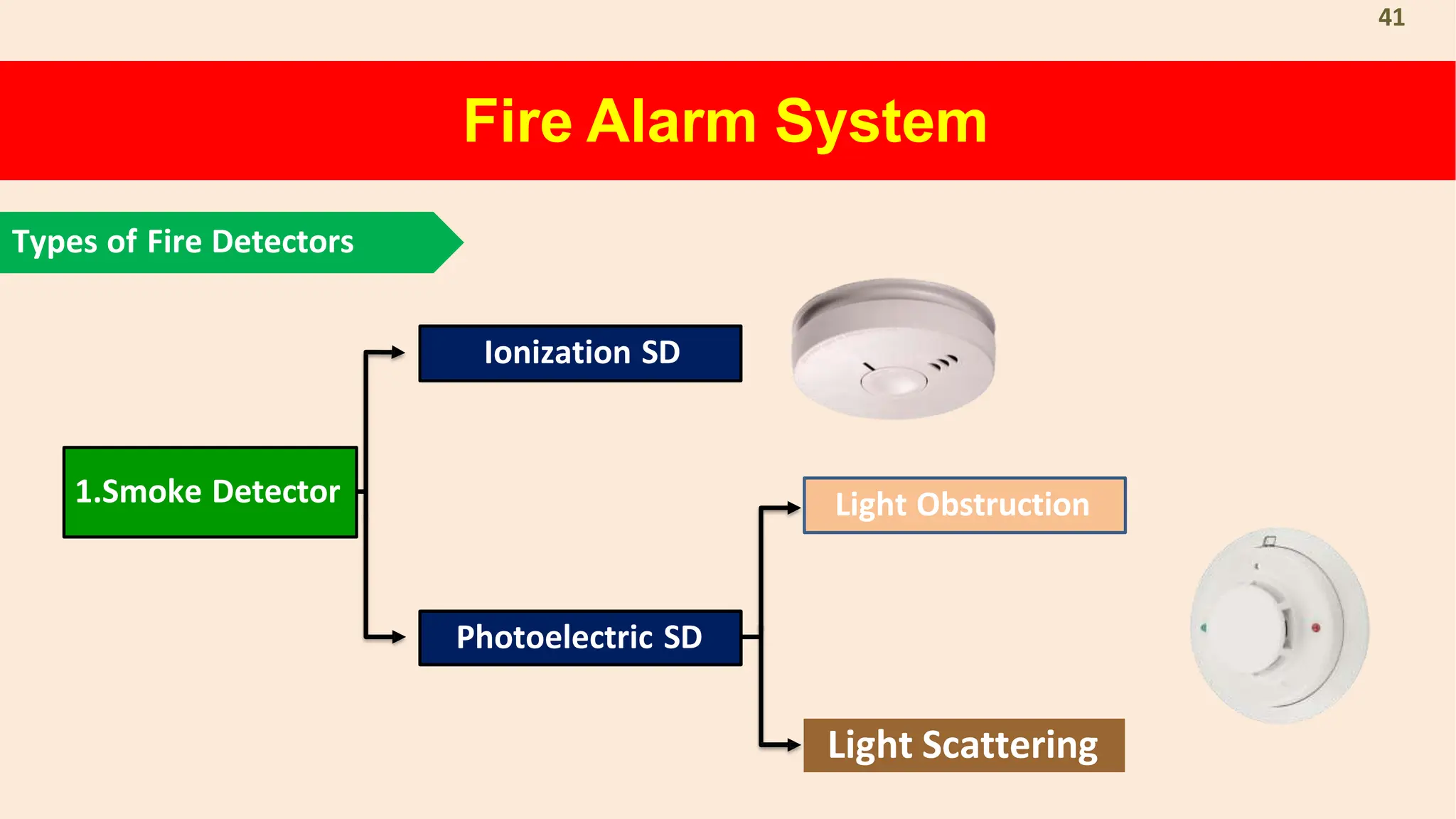
1.Smoke Detector
Types of Fire Detectors
Ionization SD
Photoelectric SD
Light Scattering
Light Obstruction
41
2. Heat Detector
Fixed Temp HD
Rate Of Rise HD
Fire Alarm System
Types of Fire Detectors
42
3. Flame Detector
IR Detector
UV Detector
Fire Alarm System
Types of Fire Detectors
43
Fire Alarm System
Manual Call Point
o It is a device used to initiate an alarm signal.
o They operate by means of a simple button press or when glass is broken
revealing a button.
o They can form part of a manual alarm system or an automatic alarm system.
o MCP activation is typically achieved through the use of a pull station or call
point which then sounds the evacuation alarm for the relevant building or zone.
44
Fire Alarm System
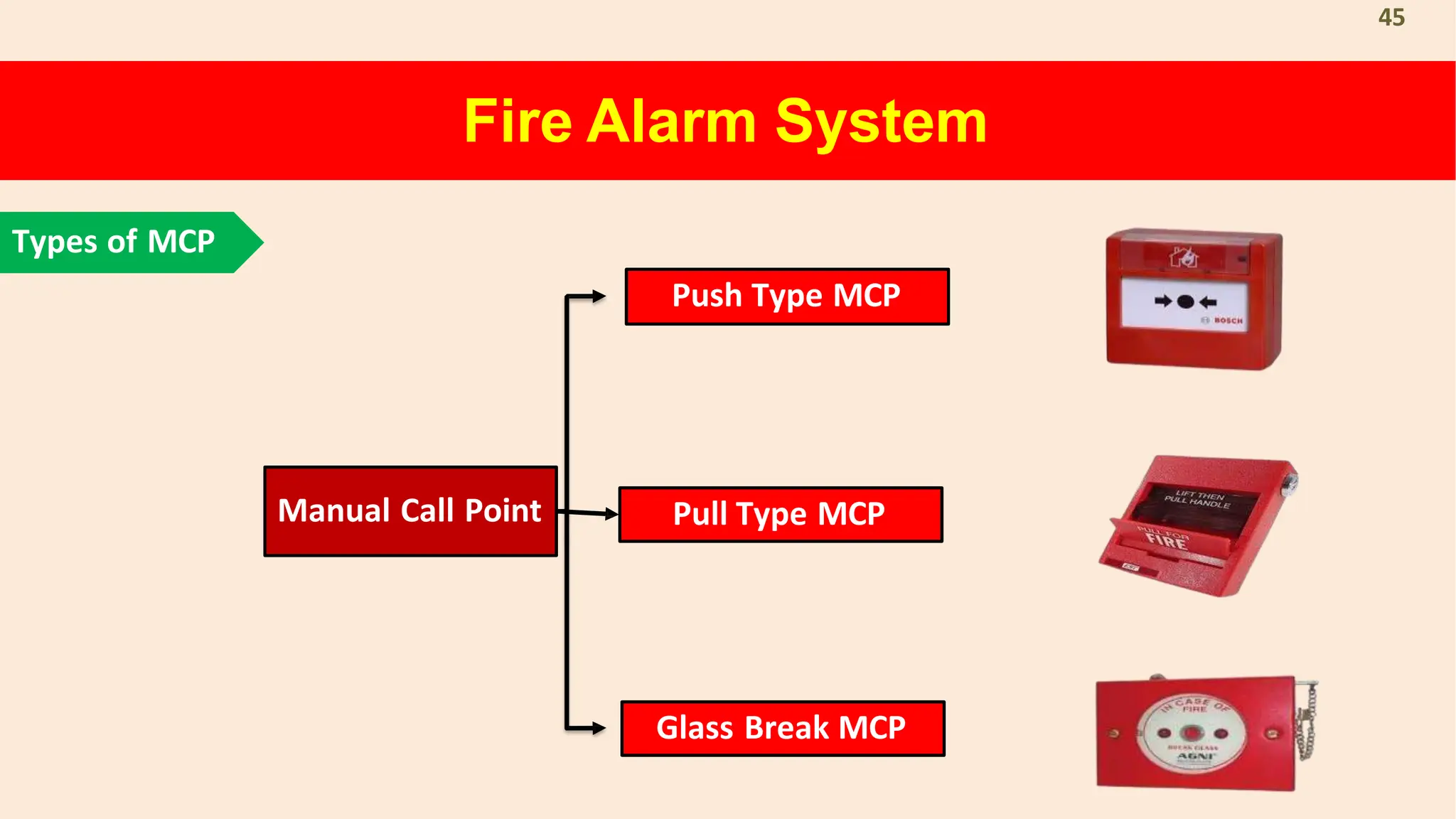
Types of MCP
Manual Call Point
Push Type MCP
Glass Break MCP
Pull Type MCP
45
END CHAPTTER 06
46
Fire Evacuation Procedure
Action on Hearing Alarm
• Don’t panic and be calm.
• Stop any activity immediately and prepare to leave the
room.
• Turn off all ignition sources such as AC, Equipment.
• Evacuate the room to nearest safe assembly area.
• Remain in the assembly area (in group) until instructed to
leave.
• After the all clear alarm you may continue your work.
47
Fire Evacuation Procedure
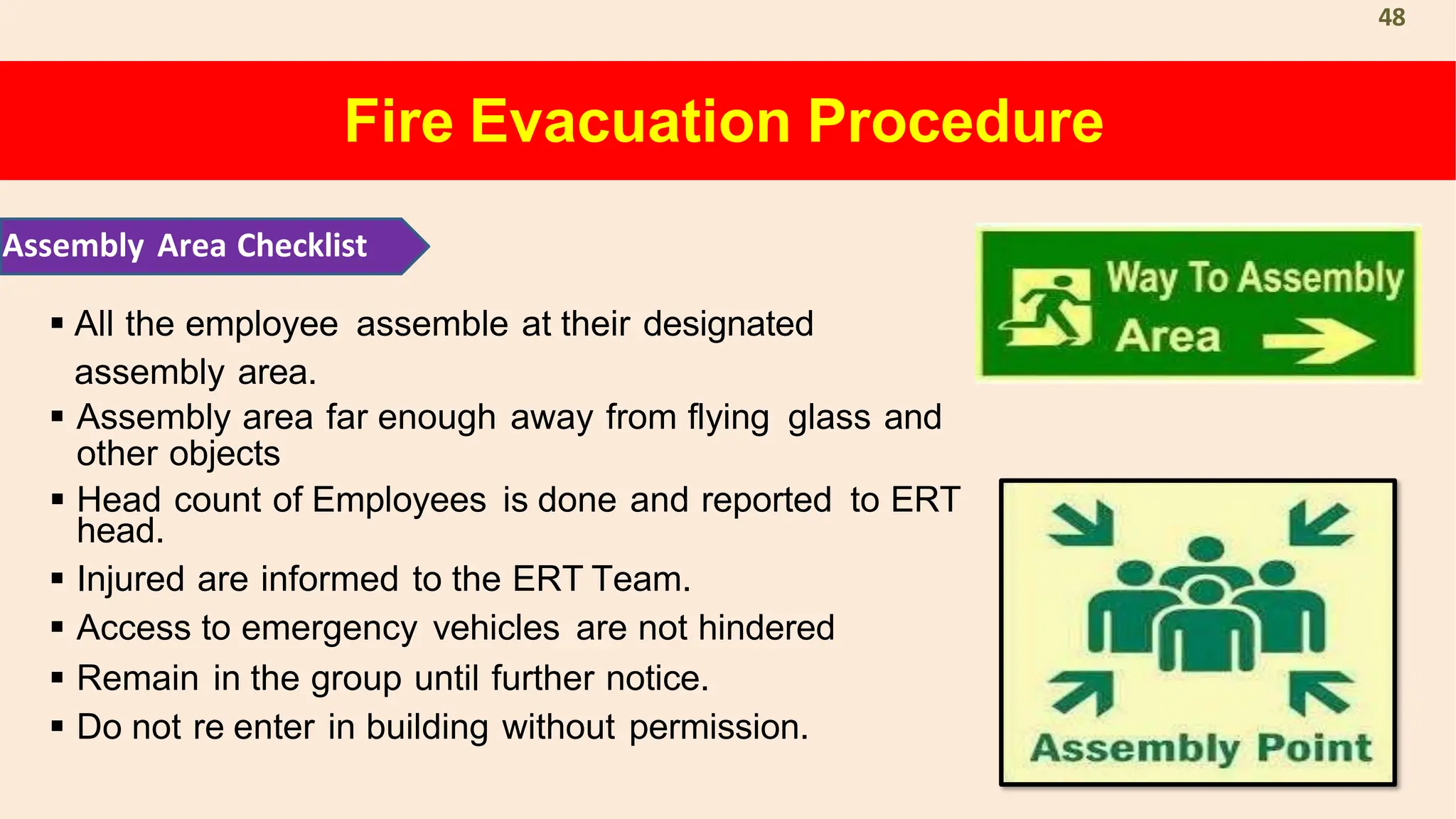
Assembly Area Checklist
 All the employee assemble at their designated
assembly area.
 Assembly area far enough away from flying glass and
other objects
 Head count of Employees is done and reported to ERT
head.
 Injured are informed to the ERT Team.
 Access to emergency vehicles are not hindered
 Remain in the group until further notice.
 Do not re enter in building without permission.
48
Fire Evacuation Procedure
Emergency Reporting
1. Call 108/101 and say this is an emergency.
2. Describe the incident location.
3. Describe the nature of incident.
4. Report injuries if any.
5. Give you name, badge number and contact.
6. Repeat the above information.
7. Stay on the line until further instructed.
49
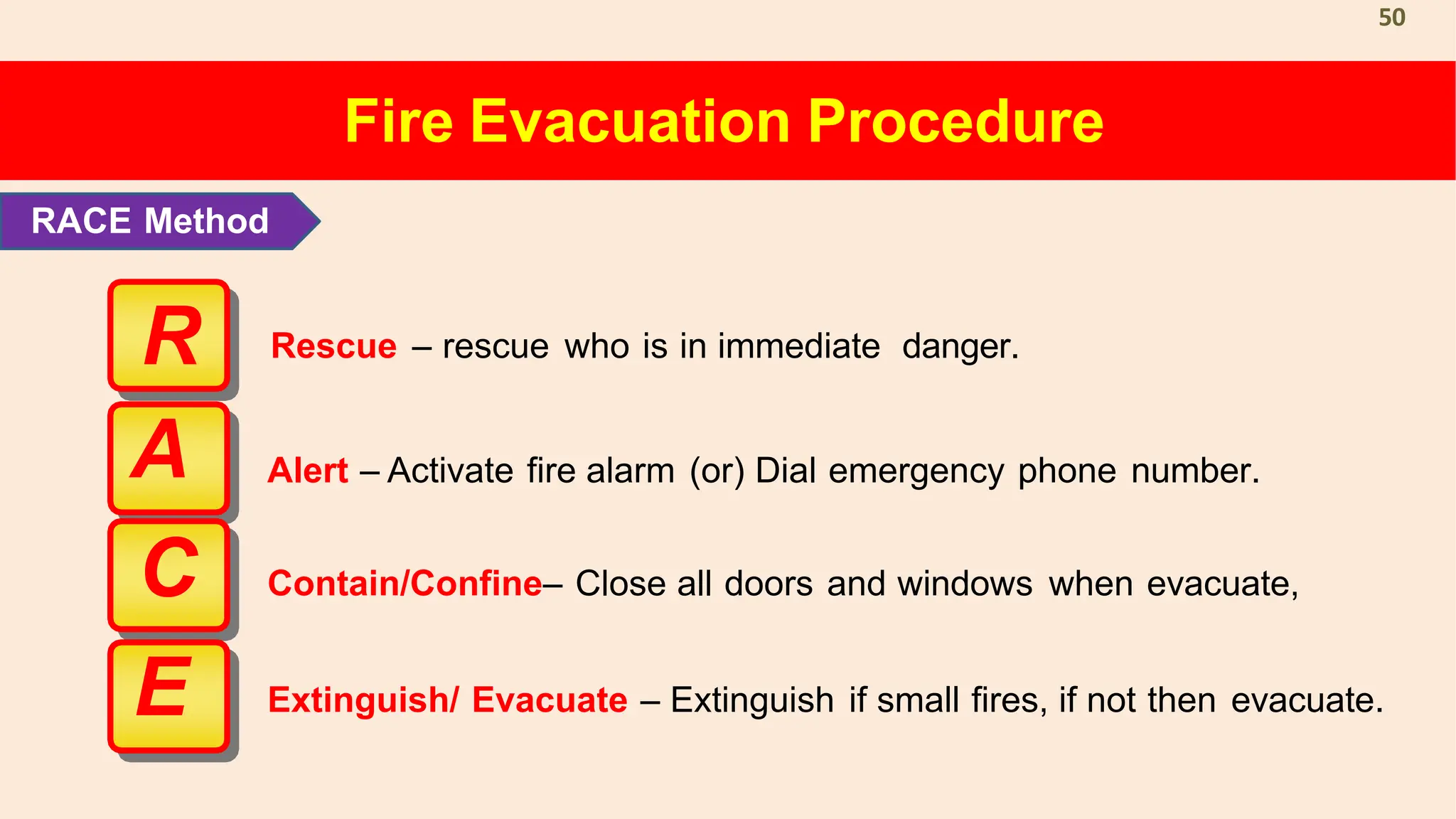
Rescue – rescue who is in immediate danger.
Alert – Activate fire alarm (or) Dial emergency phone number.
Contain/Confine– Close all doors and windows when evacuate,
Extinguish/ Evacuate – Extinguish if small fires, if not then evacuate.
R
A
C
E
RACE Method
Fire Evacuation Procedure
50
Fire Evacuation Procedure
Duties of ERT
o All Fire Equipment's are always in working condition. Any deviation needs to
be reported to Facilities/Security Team.
o ERT should know the locations of Fire Extinguishers and their handling
techniques
o ERT is to help Security/Fire Team in case of any Fire incident.
o ERT needs to ensure that emergency situations are handled peacefully and
authoritatively without any stampede.
o ERT should know the details of Handicap person(s) and their workstation and
contact details.
o While evacuation of employees, priority to be given to disabled employees,
pregnant ladies and visitors.
51
Fire Evacuation Procedure
Duties of ERT
o ERT assess the situation at the scene itself.
o If situation is not risky and can be controlled without any human safety risk then
control same.
o In case situation warrants to evacuate the building, start evacuation with
assistance of team members and simultaneously inform ERT Leader/Office
Head for assistance or guidance.
o Follow the instructions of ERT Leader/Office Head and handle it appropriately.
52
Don’trun – it will
make the fire
Get down ontothe
floor
Rollover -
this willput the flames
worse! out
1 2 3
If your clothes are on fire:
Fire Evacuation Procedure
53
END CHAPTTER 07
54
Fire Safety General Requirements
 Storage of flammable and combustible materials shall be minimum
 Incompatible materials (flammable and oxidizer) shall not be stored together
 Vegetation (weeds &grass)shall kept down
 Minimum clearance of 0.6m or 2ft shall be maintained between the ceiling and
the top level of any stocked material below
 Minimum 0.5m or 1.5ft clearance between top level of stocked material and
sprinkler head
 Temporary wiring shall be installed according to the provision of NFPA 70.
 Electrical equipment should be regularly checked
55
 GFCI (Ground Fault Circuit Interrupters) shall be provided where required.
 Smoking is permitted only in designated “Smoking Area”
 Open fires or open burning of materials are strictly prohibited.
 Proper bonding & grounding techniques shall be used for any operation.
 Trained and certified Fire Watch should be present all the at hot work area.
 Monthly inspection of all FACP and Fire Fighting equipment.
 CO2 fire extinguisher is prohibited to use in Confined Space.
Fire Safety General Requirements
56
END CHAPTTER 08
57
QUIZ..?
58
THANK YOU
59

FIRE PREVENTION AND FIRE PROTECTION SAFETY TRAINING PPT

  • 1.
  • 2.
    Basic Fire Safety& Emergency Evacuation 2
  • 3.
    1 What is Fire.?2 Types of Fire 7 Emergency Evacuation 3 Fire Fighting Equipment 5 Fire Prevention & Fire Protection 4 Fire Fighting Method 6 Fire Alarm System 8 General Requirements Presentation Outlines 3
  • 4.
    01. What isFire.? Fire is a chemical reaction of three components:  Oxygen  Fuel  Heat 4
  • 5.
    o Fire Triangleor Combustion Triangle is a sample model for understanding the necessary ingredients for fire. Fire Triangle 5
  • 6.
    Fire Tetrahedron Fire tetrahedroncan be describe as pyramid which is solid having four faces:  Oxygen  Fuel  Heat  Chemical Reaction 6
  • 7.
    The Spread ofFire o Direct contact - in their early stage, fires spread most entirely by contact of flame to combustible object. o Conduction – transferred of heat through solid materials. 7
  • 8.
    The Spread ofFire  Convection – transferred of heat by air movement, hot air rises due to reduced density  Radiation – heat transferred from one surface to another across the space 8
  • 9.
  • 10.
    Cooking Equipment's Smoking Electrical Distribution Equipment's Electrical Appliances Oil,Kerosene. Petrol & Lubricants Gas Leakages Heating Equipment's Pow er Storages Explosives Common Causes of Fire 10
  • 11.
  • 12.
    02. Classification ofFire CLASS - A : Combustible solid like Wood, Paper, Plastic, etc. CLASS - B : Flammable Liquids & Greases, Diesel,etc. CLASS - C : Involving Electrical fire. Flammable gas CLASS - D : Metal Fires like aluminium, etc. CLASS - K : Involving kitchen fire. 12
  • 13.
  • 14.
    Fire Fighting Equipment 1 FireBeater 2 Fire Bucket 7 Fire Hydrant 3 Fire Blanket 5 Fire Ball 4 Fire Extinguisher 6 Fire Hose Reel 8 Fire Sprinkler 14
  • 15.
    Fire Fighting Equipment 01.Fire Beater 02. Fire Bucket A simple tool for fighting wildfires, consisting of a piece of rubber at the end of a pole. A Fire Bucket is filled with sand or water and is used to extinguish fires. 15
  • 16.
    Fire Fighting Equipment 03.Fire Blanket 04. Fire Ball A sheet of flexible material, typically woven fiberglass, used to smother a fire in an emergency. A round-shaped fire extinguisher that self-activates after about three to five seconds of fire exposure. 16
  • 17.
    Fire Fighting Equipment 05.Fire Hose 06. Fire Hydrant Fire hose reel is a flexible pipe that is rolled and has a direct connection to the water. Fire hydrants are used to extinguish and control the spread of fire. 17
  • 18.
    Fire Fighting Equipment 07.Sprinklers 06. Extinguisher Fire sprinkler system is an automatic extinguishing system that prevent fire growth. Fire extinguisher is a portable or movable apparatus used to put out a small. 18
  • 19.
    Fire Fighting Equipment Typesof Extinguisher & Color Code & Uses Water W. C Foam CO2 DCP CLASS- A,B CLASS- A,B,C CLASS- A,K CLASS- A CLAS X S- B,C CLAX SS- C CLASS- B,C CLAS X S- A,D 19
  • 20.
    Fire Fighting Equipment P FireExtinguisher Operating Procedure A S S Pull the safety pin Aim the target Squeeze the trigger Sweep side by side HSE KARNAL 20
  • 21.
    Fire Fighting Equipment FireExtinguisher Using TIPs Check for your own safety before starting to extinguish a fire. Assess the fire only a small fire should be fought using a fire extinguisher Select the right type of fire extinguisher. Remember the simple acronym P.A.S.S. : Pull, Aim, Squeeze, Sweep, Always try to work in pair for safety. Target the base of the fire not the flame. If fire extinguished at first sight, stay ready for re-ignition. Keep minimum 8-10 feet distance from fire during use fire extinguisher. 21
  • 22.
    Fire Fighting Equipment FireSprinkler Types & Color Code Open Fire Sprinkler: Sprinkler that is not equipped with actuator or heat response element. Closed Fire Sprinkler: Sprinkler that is equipped with actuator or heat response element. 23
  • 23.
    Fire Fighting Equipment FireSprinkler Types & Color Code 57 C/ 135 F 68 C / 155 F 79 C / 175 F 93 C / 200 F 141 C / 286 F 182 C / 360 F NOTE: Quick Response - 3MM bulb, Standard Response - 5MM bulb 24
  • 24.
    Fire Fighting Equipment Typesof Hose Delivery Hose Suction Hose Hose Reel Hose Percolating Hose Hard Suction Non-Percolate Partially Embedded Soft Suction Fully Embedded 25
  • 25.
    Fire Fighting Equipment Typeof Hose Percolating: Dimension- 38,50,63,70 mm Length- 15,22.5,30 meter. Non-Percolating: Dimension- 38,50,63,70 mm Length- 15,22.5,30 meter. Hose Reel Hose: Dimension- 19 mm Length- 30 to 60 meter. Soft Suction: Dimension- 102, 127 mm Length- 8 to 15 meter. Partially Embedded: Dimension- 75, 100,140 mm Length- 2.5 to 3 meter. Fully Embedded: Dimension- 75, 100,140 mm Length- 2.5 to 3 meter. 26
  • 26.
  • 27.
  • 28.
    Fire Extinguishing Method Starvation Starvationis the process of depriving the fire from fuel. i.e. combustible materials. Or Remove fuel from fire. 29
  • 29.
    Fire Extinguishing Method Smothering Smotheringis the process of depriving the fire of oxygen needed to sustain the fire. Or Remove Oxygen from fire. HSE KARNAL 30
  • 30.
    Fire Extinguishing Method Cooling Coolingis the process of depriving the fire of Heat e.g. by applying a substance such as water that will absorb heat from the fire. Or Remove heat from fire. 31
  • 31.
  • 32.
    Fire Prevention &Fire Protection 1. Fire Prevention: It is a proactive steps taken to reduce fire hazards so that a fire does not have a chance to ignite. 2. Fire Protection: It is a reactive approach which minimize potential damage or loss. 33
  • 33.
    Fire Prevention &Fire Protection 1. Fire Prevention o Fire safety plan (approved) o Risk assessment (update every 6 month) o Workplace Inspections (daily, weekly, monthly, quarterly) o Fire safety trainings (induction, annually) o Regular fire drills o Preventive maintenance (as per requirements) o Housekeeping Management o Material Management (5-S Technique) 34
  • 34.
    Fire Prevention &Fire Protection 02. Fire Protection Active Fire Protection: Active fire protection system is detect and extinguish a fire. This can be either manual or automatic. Passive Fire Protection: Passive fire protection system will help to prevent fire from spreading or resist the initial ignition. 35
  • 35.
    Fire Prevention &Fire Protection Active Fire Protection Passive Fire Protection o Smoke and heat alarm o Manual Call Point o Fire Sprinklers o Fire extinguishers o Fire hydrants o Video monitoring o Etc. o Compartment o Fire proofing o Fire door o Fire wall o Fire Stopper o Fire Curtain / Baffle o Etc. 36
  • 36.
  • 37.
    Fire Alarm System FireAlarm Control Panel: A fire panel is a safety appliance that receives information from devices designed to detect and report fires, monitor their operational integrity. 38
  • 38.
    Fire Alarm System Typesof Fire Alarm System Conventional fire Panel: Every device on the same circuit would report the same. Addressable fire Panel: It indicate the exact location of fire or smoke. 39
  • 39.
    Fire Alarm System FireDetectors Fire Detectors: A device which can detect a fire, and provide a signal to an alarm circuit. Fire detectors are different types; 1. Smoke Detectors 2. Heat Detectors 3. Flame Detectors 40
  • 40.
    Fire Alarm System 1.SmokeDetector Types of Fire Detectors Ionization SD Photoelectric SD Light Scattering Light Obstruction 41
  • 41.
    2. Heat Detector FixedTemp HD Rate Of Rise HD Fire Alarm System Types of Fire Detectors 42
  • 42.
    3. Flame Detector IRDetector UV Detector Fire Alarm System Types of Fire Detectors 43
  • 43.
    Fire Alarm System ManualCall Point o It is a device used to initiate an alarm signal. o They operate by means of a simple button press or when glass is broken revealing a button. o They can form part of a manual alarm system or an automatic alarm system. o MCP activation is typically achieved through the use of a pull station or call point which then sounds the evacuation alarm for the relevant building or zone. 44
  • 44.
    Fire Alarm System Typesof MCP Manual Call Point Push Type MCP Glass Break MCP Pull Type MCP 45
  • 45.
  • 46.
    Fire Evacuation Procedure Actionon Hearing Alarm • Don’t panic and be calm. • Stop any activity immediately and prepare to leave the room. • Turn off all ignition sources such as AC, Equipment. • Evacuate the room to nearest safe assembly area. • Remain in the assembly area (in group) until instructed to leave. • After the all clear alarm you may continue your work. 47
  • 47.
    Fire Evacuation Procedure AssemblyArea Checklist  All the employee assemble at their designated assembly area.  Assembly area far enough away from flying glass and other objects  Head count of Employees is done and reported to ERT head.  Injured are informed to the ERT Team.  Access to emergency vehicles are not hindered  Remain in the group until further notice.  Do not re enter in building without permission. 48
  • 48.
    Fire Evacuation Procedure EmergencyReporting 1. Call 108/101 and say this is an emergency. 2. Describe the incident location. 3. Describe the nature of incident. 4. Report injuries if any. 5. Give you name, badge number and contact. 6. Repeat the above information. 7. Stay on the line until further instructed. 49
  • 49.
    Rescue – rescuewho is in immediate danger. Alert – Activate fire alarm (or) Dial emergency phone number. Contain/Confine– Close all doors and windows when evacuate, Extinguish/ Evacuate – Extinguish if small fires, if not then evacuate. R A C E RACE Method Fire Evacuation Procedure 50
  • 50.
    Fire Evacuation Procedure Dutiesof ERT o All Fire Equipment's are always in working condition. Any deviation needs to be reported to Facilities/Security Team. o ERT should know the locations of Fire Extinguishers and their handling techniques o ERT is to help Security/Fire Team in case of any Fire incident. o ERT needs to ensure that emergency situations are handled peacefully and authoritatively without any stampede. o ERT should know the details of Handicap person(s) and their workstation and contact details. o While evacuation of employees, priority to be given to disabled employees, pregnant ladies and visitors. 51
  • 51.
    Fire Evacuation Procedure Dutiesof ERT o ERT assess the situation at the scene itself. o If situation is not risky and can be controlled without any human safety risk then control same. o In case situation warrants to evacuate the building, start evacuation with assistance of team members and simultaneously inform ERT Leader/Office Head for assistance or guidance. o Follow the instructions of ERT Leader/Office Head and handle it appropriately. 52
  • 52.
    Don’trun – itwill make the fire Get down ontothe floor Rollover - this willput the flames worse! out 1 2 3 If your clothes are on fire: Fire Evacuation Procedure 53
  • 53.
  • 54.
    Fire Safety GeneralRequirements  Storage of flammable and combustible materials shall be minimum  Incompatible materials (flammable and oxidizer) shall not be stored together  Vegetation (weeds &grass)shall kept down  Minimum clearance of 0.6m or 2ft shall be maintained between the ceiling and the top level of any stocked material below  Minimum 0.5m or 1.5ft clearance between top level of stocked material and sprinkler head  Temporary wiring shall be installed according to the provision of NFPA 70.  Electrical equipment should be regularly checked 55
  • 55.
     GFCI (GroundFault Circuit Interrupters) shall be provided where required.  Smoking is permitted only in designated “Smoking Area”  Open fires or open burning of materials are strictly prohibited.  Proper bonding & grounding techniques shall be used for any operation.  Trained and certified Fire Watch should be present all the at hot work area.  Monthly inspection of all FACP and Fire Fighting equipment.  CO2 fire extinguisher is prohibited to use in Confined Space. Fire Safety General Requirements 56
  • 56.
  • 57.
  • 58.