





TEFL Course


              1
Course Tutors


 • Mary Kay Maas
  • Gill Brownlow
 • Chris Evenden
• Stephanie Bianco
   • Adriana Real


                     2
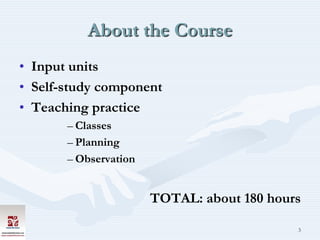
About the Course
• Input units
• Self-study component
• Teaching practice
       – Classes
       – Planning
       – Observation


                       TOTAL: about 180 hours

                                            3
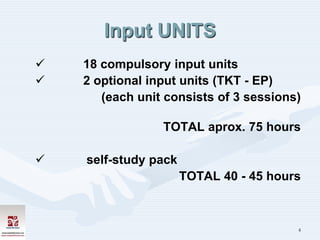
Input UNITS
   18 compulsory input units
   2 optional input units (TKT - EP)
       (each unit consists of 3 sessions)

                 TOTAL aprox. 75 hours

   self-study pack
                      TOTAL 40 - 45 hours


                                        4
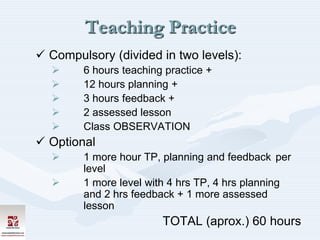
Teaching Practice
 Compulsory (divided in two levels):
       6 hours teaching practice +
       12 hours planning +
       3 hours feedback +
       2 assessed lesson
       Class OBSERVATION
 Optional
       1 more hour TP, planning and feedback per
        level
       1 more level with 4 hrs TP, 4 hrs planning
        and 2 hrs feedback + 1 more assessed
        lesson
                        TOTAL (aprox.) 60 hours
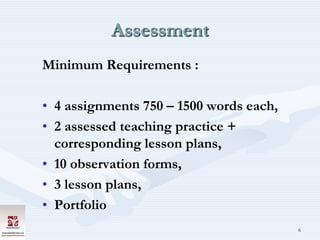
Assessment
Minimum Requirements :

• 4 assignments 750 – 1500 words each,
• 2 assessed teaching practice +
  corresponding lesson plans,
• 10 observation forms,
• 3 lesson plans,
• Portfolio
                                         6
AWARENESS


THEORY SNAPSHOT


                  7
GLOSSARY


• http://www.cambridgeesol.org/assets/pdf/tkt_
  glossary_august_2009_final.pdf


                                                 8
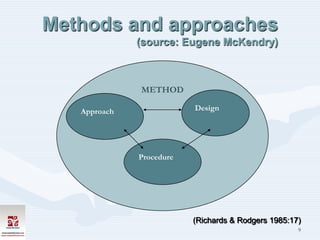
Methods and approaches
              (source: Eugene McKendry)


              METHOD

   Approach               Design


              Procedure


                          (Richards & Rodgers 1985:17)
                                                     9
Traditional
Methods and approaches


 Grammar Translation Method
      Direct Method
      Audiolingualism


                               10
Methods and approaches
       “Designer” Methods
• The Silent Way
   – Caleb Gattegno, Egyptian - ~1972
       • When Gattegno studied himself as a learner, he realised that only
         awareness can be educated in humans. His approach is therefore based on
         producing awareness rather than providing knowledge.

• Suggestopedia
   – Georgi Lozanov, Bulgarian - ~1971
       • The intended purpose of Suggestopedia was to enhance learning by
         lowering the affective filter of learners

• TPR - Total Physical Response
   – James Asher, American - ~1966
       • It looks to the way that children learn their native language.

                                                                          From Wikipedia


                                                                                      11
Methods and approaches
• The wholistic Approach (CLL)
  (Community Language Learning)
  – The person as a whole

• The Communicative Approach (CLT)
  – Notional – Functional Syllabi

• The Natural Approach
  – Krashen, acquisition vs learning, ~1980

                                              12
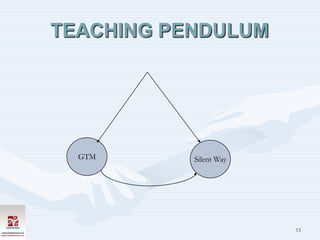
TEACHING PENDULUM


  GTM      Silent Way


                        13
ECLECTICISM

Making decisions on the basis of what
seems best instead of following some
single doctrine or style


                                        14
A Vision of K-12 Students Today


                                  15
LEARNER CHARACTERISTICS


                          16
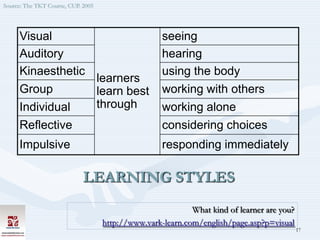
Source: The TKT Course, CUP. 2005


     Visual                                         seeing
     Auditory                                       hearing
     Kinaesthetic                                   using the body
                  learners
     Group        learn best                        working with others
     Individual   through                           working alone
     Reflective                                     considering choices
     Impulsive                                      responding immediately

                             LEARNING STYLES
                                                            What kind of learner are you?
                                    http://www.vark-learn.com/english/page.asp?p=visual
                                                                                            17
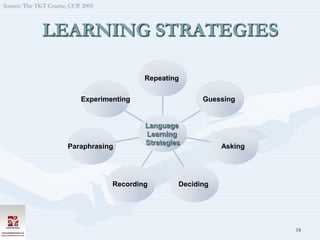
Source: The TKT Course, CUP. 2005


              LEARNING STRATEGIES

                                            Repeating

                            Experimenting                  Guessing


                                            Language
                                            Learning
                                            Strategies
                       Paraphrasing                             Asking


                                    Recording        Deciding


                                                                         18
LEARNER NEEDS


                19
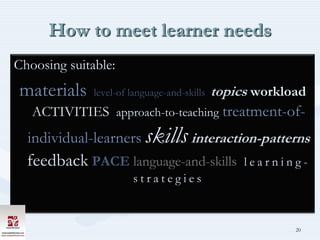
How to meet learner needs
Choosing suitable:
materials     level-of language-and-skills   topics workload
   ACTIVITIES approach-to-teaching treatment-of-
  individual-learners skills interaction-patterns
  feedback PACE language-and-skills               learning-
                       strategies


                                                          20
TEACHER’S ROLES


                  21
A “JUG
AND MUG”
TEACHER


           22
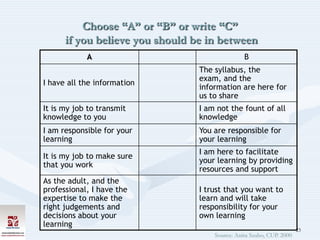
Choose “A” or “B” or write “C”
      if you believe you should be in between
            A                                   B
                                 The syllabus, the
                                 exam, and the
I have all the information
                                 information are here for
                                 us to share
It is my job to transmit         I am not the fount of all
knowledge to you                 knowledge
I am responsible for your        You are responsible for
learning                         your learning
                                 I am here to facilitate
It is my job to make sure
                                 your learning by providing
that you work
                                 resources and support
As the adult, and the
professional, I have the         I trust that you want to
expertise to make the            learn and will take
right judgements and             responsibility for your
decisions about your             own learning
learning
                                                                      23
                                     Source: Anita Szabo, CUP. 2000
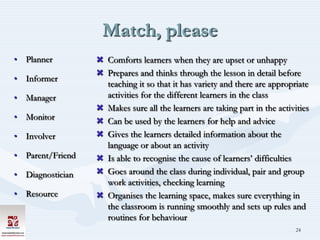
Match, please
• Planner          Comforts learners when they are upset or unhappy
                   Prepares and thinks through the lesson in detail before
• Informer
                    teaching it so that it has variety and there are appropriate
• Manager           activities for the different learners in the class
                   Makes sure all the learners are taking part in the activities
• Monitor          Can be used by the learners for help and advice
• Involver         Gives the learners detailed information about the
                    language or about an activity
• Parent/Friend    Is able to recognise the cause of learners’ difficulties
• Diagnostician    Goes around the class during individual, pair and group
                    work activities, checking learning
• Resource         Organises the learning space, makes sure everything in
                    the classroom is running smoothly and sets up rules and
                    routines for behaviour
                                                                             24
CELTA BOOK
THE LEARNERS AND THEIR CONTEXTS


                                  25
CU NXT CLASS


               26

Week 1

  • 1.
  • 2.
    Course Tutors •Mary Kay Maas • Gill Brownlow • Chris Evenden • Stephanie Bianco • Adriana Real 2
  • 3.
    About the Course •Input units • Self-study component • Teaching practice – Classes – Planning – Observation TOTAL: about 180 hours 3
  • 4.
    Input UNITS  18 compulsory input units  2 optional input units (TKT - EP) (each unit consists of 3 sessions) TOTAL aprox. 75 hours  self-study pack TOTAL 40 - 45 hours 4
  • 5.
    Teaching Practice  Compulsory(divided in two levels):  6 hours teaching practice +  12 hours planning +  3 hours feedback +  2 assessed lesson  Class OBSERVATION  Optional  1 more hour TP, planning and feedback per level  1 more level with 4 hrs TP, 4 hrs planning and 2 hrs feedback + 1 more assessed lesson TOTAL (aprox.) 60 hours
  • 6.
    Assessment Minimum Requirements : •4 assignments 750 – 1500 words each, • 2 assessed teaching practice + corresponding lesson plans, • 10 observation forms, • 3 lesson plans, • Portfolio 6
  • 7.
  • 8.
  • 9.
    Methods and approaches (source: Eugene McKendry) METHOD Approach Design Procedure (Richards & Rodgers 1985:17) 9
  • 10.
    Traditional Methods and approaches Grammar Translation Method Direct Method Audiolingualism 10
  • 11.
    Methods and approaches “Designer” Methods • The Silent Way – Caleb Gattegno, Egyptian - ~1972 • When Gattegno studied himself as a learner, he realised that only awareness can be educated in humans. His approach is therefore based on producing awareness rather than providing knowledge. • Suggestopedia – Georgi Lozanov, Bulgarian - ~1971 • The intended purpose of Suggestopedia was to enhance learning by lowering the affective filter of learners • TPR - Total Physical Response – James Asher, American - ~1966 • It looks to the way that children learn their native language. From Wikipedia 11
  • 12.
    Methods and approaches •The wholistic Approach (CLL) (Community Language Learning) – The person as a whole • The Communicative Approach (CLT) – Notional – Functional Syllabi • The Natural Approach – Krashen, acquisition vs learning, ~1980 12
  • 13.
    TEACHING PENDULUM GTM Silent Way 13
  • 14.
    ECLECTICISM Making decisions onthe basis of what seems best instead of following some single doctrine or style 14
  • 15.
    A Vision ofK-12 Students Today 15
  • 16.
  • 17.
    Source: The TKTCourse, CUP. 2005 Visual seeing Auditory hearing Kinaesthetic using the body learners Group learn best working with others Individual through working alone Reflective considering choices Impulsive responding immediately LEARNING STYLES What kind of learner are you? http://www.vark-learn.com/english/page.asp?p=visual 17
  • 18.
    Source: The TKTCourse, CUP. 2005 LEARNING STRATEGIES Repeating Experimenting Guessing Language Learning Strategies Paraphrasing Asking Recording Deciding 18
  • 19.
  • 20.
    How to meetlearner needs Choosing suitable: materials level-of language-and-skills topics workload ACTIVITIES approach-to-teaching treatment-of- individual-learners skills interaction-patterns feedback PACE language-and-skills learning- strategies 20
  • 21.
  • 22.
  • 23.
    Choose “A” or“B” or write “C” if you believe you should be in between A B The syllabus, the exam, and the I have all the information information are here for us to share It is my job to transmit I am not the fount of all knowledge to you knowledge I am responsible for your You are responsible for learning your learning I am here to facilitate It is my job to make sure your learning by providing that you work resources and support As the adult, and the professional, I have the I trust that you want to expertise to make the learn and will take right judgements and responsibility for your decisions about your own learning learning 23 Source: Anita Szabo, CUP. 2000
  • 24.
    Match, please • Planner  Comforts learners when they are upset or unhappy  Prepares and thinks through the lesson in detail before • Informer teaching it so that it has variety and there are appropriate • Manager activities for the different learners in the class  Makes sure all the learners are taking part in the activities • Monitor  Can be used by the learners for help and advice • Involver  Gives the learners detailed information about the language or about an activity • Parent/Friend  Is able to recognise the cause of learners’ difficulties • Diagnostician  Goes around the class during individual, pair and group work activities, checking learning • Resource  Organises the learning space, makes sure everything in the classroom is running smoothly and sets up rules and routines for behaviour 24
  • 25.
    CELTA BOOK THE LEARNERSAND THEIR CONTEXTS 25
  • 26.