Designing Leaner Centered Instruction
            Pinnacle 2012
High School Students Surveyed

    49%


                     18%


Found classes   Schoolwork too
   boring        hard or boring

                                    (Kortering and Braziel, 2002)
What do students say?
• Make things more exciting
• Make boring classes more fun
• Provide more hands-on activities
• Provide more individualized help for specific
  learning needs
• Use experiments rather than so much bookwork
• Explain things better, break it down, teach
  students rather than books
Small-group
Practice and review
                            instruction


   Dialogue with
  students about        Adjust difficulty of
    process and               tasks
      content


                   (Swanson, 1999)
What are learning centers?
• Any area that defines a specific focus or
  affords an unique learning opportunity
  (Cosgrove, 1992)
• Divide a room in a way that allows
  students to make choices, move
  freely, grow in areas of need, and work
  together
• NOT busy work, tests, or mindless play
Learners who “got” the content
                     and are ready to move on to
                     much higher levels of content

                     Learners for whom the
                     presentation, pace, and practice
                     the teacher is using is “just right”

                     Learners who need a little bit
                     more practice with new content


                     Learners who need a lot more
                     practice with new content
(King-Sears, 2007)
• Students can be more actively engaged in learning


        • Students have the opportunity to practice new skills


        • Students can increase proficiency in acquired skills


        • Students can apply knowledge and skills to new situations


(King-Sears, 2007)
HOW DO LEARNING CENTERS “FIT”
INTO INSTRUCTION?
Learning Center Quick Tips
How many centers?                   Start small! You can add more once students are
                                    comfortable and you are proficient at managing them.


What content should be the focus?   Content you’ve already taught or are currently teaching.
                                    Students should be able to practice, explore, build on, and
                                    review content.


How do I avoid setting up new       Establish generic centers where the content and level is
centers every week?                 the change.


How do I ensure students know       Procedures! Practice them until you and students are sure
what to do?                         and clear!


How do I monitor student            You can use self-check or self-graphing items.
progress?
Differentiated Learning Center Activities
Outcome: Students read or listen to information and
then write or type responses to questions about the
information.
Materials: Books, Laptops, Discovery Streaming videos,
Viewing guide or form with varied levels of questions
about the information


Differentiation:
•Students complete fill-in-the-blank responses
•Students respond to a prompt and write an essay
response
•Students complete an outline as they are listening
Differentiated Learning Center Activities
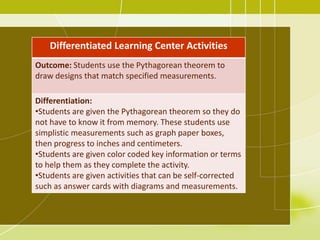
Outcome: Students use the Pythagorean theorem to
draw designs that match specified measurements.

Differentiation:
•Students are given the Pythagorean theorem so they do
not have to know it from memory. These students use
simplistic measurements such as graph paper boxes,
then progress to inches and centimeters.
•Students are given color coded key information or terms
to help them as they complete the activity.
•Students are given activities that can be self-corrected
such as answer cards with diagrams and measurements.
WHERE DO TEACHERS START WHEN
DESIGNING LEARNING CENTERS?
Certain students need      Students will utilize Quizlet
more practice with new     to practice vocabulary.
vocabulary.

                           Students will work at the
                           writing center using story
One group knows the        starters and open ended
content, but needs time    questions to complete a
for application.           blog post.

                           Students will practice
I need a review activity   placing the vocabulary by
for vocabulary.            the corresponding picture
                           or definition on the graphic
                           organizer.
WHAT KIND OF ACTIVITIES CAN
OCCUR AT LEARNING CENTERS?
Varied and Diverse Activities

                  • Illustrations
                  • Color-coded tasks


              Visual

                                     Auditory
             • Verbal directions
             • Step-by-step directions
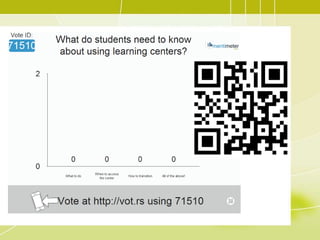
WHAT DO STUDENTS NEED TO
KNOW ABOUT LEARNING CENTERS?
What to do        How to do it     When to do it


                 How & where      What to do with
Where they
                    to find       the completed
should do it
                   materials          activity

           How to          What they
        evaluate their   should do when
           success       they’ve finished
Other considerations
   How will students be assessed?


   Ensure that students have been introduced to material .


   Leave directions at the center, even if they’ve previously been
   given verbally.


   Activities should be meaningful, not busy work.
Example Activities
Language Arts               Social Studies              Mathematics
• Language/lit study        • Small group instruction   • Small group instruction
• Read Aloud                • Read, listen, watch       • Draw pictures to
• Silent Reading            • Practice vocabulary         represent math problems
• Journal Writing           • Timeline creation         • Math fact practice
• Composing                 • Compare and contrast      • Describe problem solving
• Small group instruction                                 steps in writing
                                                        • Use newspaper ad to
                                                          determine…
                                                        • Arrange objects to show
                                                          the fractional parts…
WHAT DO TEACHERS DO WHEN
STUDENTS ARE AT LEARNING
CENTERS?
Example 90 minute math course with learning centers

Plan for amount of time per       Learning                     Learning Center              Learning Center              Learning
designated instructional task
                                  Center A                     B                            C                            Center D

1:10 to 1:15 (5 minutes)          Whole Class: listens to the advance organizer for the day, completes warm-up independently, check warm-
Opener, warm-up                   up

1:15 to 1:35 (20 minutes)         Assign Learning Centers: Demonstration has occurred the previous day; today’s demonstration is the 3 rd
Direct Instruction, Whole group   Pythagorean theorem for the class. Vocabulary has been introduced and used. Assign groupings per
                                  learning center: ___ goes to LC-A first; ___goes to LC-B first; ___ goes to LC-C first; ___ goes to LC-D first


1:35 to 1:37 (2 minutes)          Students Move to the Appropriate Learning Center for Them. Two minutes maximum for transition; this
Transition to learning center     includes gathering materials, moving, and beginning work.

1:37 to 2:00 (23 minutes)         Small Group Instruction      Complete the                 Match the                    Draw your own
Learning center activities        with Teacher                 Problems…                    measurements….               triangle…


2:00 to 2:02 (2 minutes)          Students Move to Their Next Learning Center.
Transition to learning center

2:02 to 2:25 (23 minutes)         Small Group Instruction      Complete the                 Match the                    Draw your own
Learning center activities        with Teacher                 Problems…                    measurements….               triangle…


2:25 to 2:27 (2 minutes)          Students Return to Their Desks
Transition to desks

2:27 to 2:40 (13 minutes)         •Students respond in writing to three brief problems to provide teacher with formative feedback.
Closure and mini-assessment       •Assign homework.
                                  •Provide review.
HOW DO I SET THIS UP?
• Tables and storage
                             Traffic Flow        • How many people?
                                                                           Availability
                       • Doors, windows, desks                        • Equipment
                                                                      • Materials


           Space                                          People


     Classroom Floor Plan Sites:
     http://classroom.4teachers.org/
     http://teacher.scholastic.com/tools/class_setup/
LEARNING CENTER EVALUATION
Did I clearly state the objective of the center?

Are the materials properly prepared?

Are the activities interesting and do they stimulate curiosity and problem solving?

Are the directions easy to follow?

Are the activities adaptable to different needs?

Are the activities self-checking?

Do students know what to do before, during, and after their time at the center?

Are self-control, resourcefulness, independence, & good work habits nurtured?
References
Sloane, M. W. (2000). Make the most of learning centers. Dimensions of
   Early Childhood, Winter, 16-20.
King-Sears, M. E. (2007). Designing and delivering learning center
   instruction. Intervention in School and Clinic,42(3), 137-147.
Cosgrove, M. S. (1992). Inside learning centers.

Designing Learning Centers

  • 1.
    Designing Leaner CenteredInstruction Pinnacle 2012
  • 3.
    High School StudentsSurveyed 49% 18% Found classes Schoolwork too boring hard or boring (Kortering and Braziel, 2002)
  • 4.
    What do studentssay? • Make things more exciting • Make boring classes more fun • Provide more hands-on activities • Provide more individualized help for specific learning needs • Use experiments rather than so much bookwork • Explain things better, break it down, teach students rather than books
  • 5.
    Small-group Practice and review instruction Dialogue with students about Adjust difficulty of process and tasks content (Swanson, 1999)
  • 6.
    What are learningcenters? • Any area that defines a specific focus or affords an unique learning opportunity (Cosgrove, 1992) • Divide a room in a way that allows students to make choices, move freely, grow in areas of need, and work together • NOT busy work, tests, or mindless play
  • 7.
    Learners who “got”the content and are ready to move on to much higher levels of content Learners for whom the presentation, pace, and practice the teacher is using is “just right” Learners who need a little bit more practice with new content Learners who need a lot more practice with new content (King-Sears, 2007)
  • 8.
    • Students canbe more actively engaged in learning • Students have the opportunity to practice new skills • Students can increase proficiency in acquired skills • Students can apply knowledge and skills to new situations (King-Sears, 2007)
  • 10.
    HOW DO LEARNINGCENTERS “FIT” INTO INSTRUCTION?
  • 12.
    Learning Center QuickTips How many centers? Start small! You can add more once students are comfortable and you are proficient at managing them. What content should be the focus? Content you’ve already taught or are currently teaching. Students should be able to practice, explore, build on, and review content. How do I avoid setting up new Establish generic centers where the content and level is centers every week? the change. How do I ensure students know Procedures! Practice them until you and students are sure what to do? and clear! How do I monitor student You can use self-check or self-graphing items. progress?
  • 13.
    Differentiated Learning CenterActivities Outcome: Students read or listen to information and then write or type responses to questions about the information. Materials: Books, Laptops, Discovery Streaming videos, Viewing guide or form with varied levels of questions about the information Differentiation: •Students complete fill-in-the-blank responses •Students respond to a prompt and write an essay response •Students complete an outline as they are listening
  • 14.
    Differentiated Learning CenterActivities Outcome: Students use the Pythagorean theorem to draw designs that match specified measurements. Differentiation: •Students are given the Pythagorean theorem so they do not have to know it from memory. These students use simplistic measurements such as graph paper boxes, then progress to inches and centimeters. •Students are given color coded key information or terms to help them as they complete the activity. •Students are given activities that can be self-corrected such as answer cards with diagrams and measurements.
  • 15.
    WHERE DO TEACHERSSTART WHEN DESIGNING LEARNING CENTERS?
  • 19.
    Certain students need Students will utilize Quizlet more practice with new to practice vocabulary. vocabulary. Students will work at the writing center using story One group knows the starters and open ended content, but needs time questions to complete a for application. blog post. Students will practice I need a review activity placing the vocabulary by for vocabulary. the corresponding picture or definition on the graphic organizer.
  • 20.
    WHAT KIND OFACTIVITIES CAN OCCUR AT LEARNING CENTERS?
  • 22.
    Varied and DiverseActivities • Illustrations • Color-coded tasks Visual Auditory • Verbal directions • Step-by-step directions
  • 23.
    WHAT DO STUDENTSNEED TO KNOW ABOUT LEARNING CENTERS?
  • 25.
    What to do How to do it When to do it How & where What to do with Where they to find the completed should do it materials activity How to What they evaluate their should do when success they’ve finished
  • 26.
    Other considerations How will students be assessed? Ensure that students have been introduced to material . Leave directions at the center, even if they’ve previously been given verbally. Activities should be meaningful, not busy work.
  • 27.
    Example Activities Language Arts Social Studies Mathematics • Language/lit study • Small group instruction • Small group instruction • Read Aloud • Read, listen, watch • Draw pictures to • Silent Reading • Practice vocabulary represent math problems • Journal Writing • Timeline creation • Math fact practice • Composing • Compare and contrast • Describe problem solving • Small group instruction steps in writing • Use newspaper ad to determine… • Arrange objects to show the fractional parts…
  • 28.
    WHAT DO TEACHERSDO WHEN STUDENTS ARE AT LEARNING CENTERS?
  • 31.
    Example 90 minutemath course with learning centers Plan for amount of time per Learning Learning Center Learning Center Learning designated instructional task Center A B C Center D 1:10 to 1:15 (5 minutes) Whole Class: listens to the advance organizer for the day, completes warm-up independently, check warm- Opener, warm-up up 1:15 to 1:35 (20 minutes) Assign Learning Centers: Demonstration has occurred the previous day; today’s demonstration is the 3 rd Direct Instruction, Whole group Pythagorean theorem for the class. Vocabulary has been introduced and used. Assign groupings per learning center: ___ goes to LC-A first; ___goes to LC-B first; ___ goes to LC-C first; ___ goes to LC-D first 1:35 to 1:37 (2 minutes) Students Move to the Appropriate Learning Center for Them. Two minutes maximum for transition; this Transition to learning center includes gathering materials, moving, and beginning work. 1:37 to 2:00 (23 minutes) Small Group Instruction Complete the Match the Draw your own Learning center activities with Teacher Problems… measurements…. triangle… 2:00 to 2:02 (2 minutes) Students Move to Their Next Learning Center. Transition to learning center 2:02 to 2:25 (23 minutes) Small Group Instruction Complete the Match the Draw your own Learning center activities with Teacher Problems… measurements…. triangle… 2:25 to 2:27 (2 minutes) Students Return to Their Desks Transition to desks 2:27 to 2:40 (13 minutes) •Students respond in writing to three brief problems to provide teacher with formative feedback. Closure and mini-assessment •Assign homework. •Provide review.
  • 32.
    HOW DO ISET THIS UP?
  • 33.
    • Tables andstorage Traffic Flow • How many people? Availability • Doors, windows, desks • Equipment • Materials Space People Classroom Floor Plan Sites: http://classroom.4teachers.org/ http://teacher.scholastic.com/tools/class_setup/
  • 34.
  • 35.
    Did I clearlystate the objective of the center? Are the materials properly prepared? Are the activities interesting and do they stimulate curiosity and problem solving? Are the directions easy to follow? Are the activities adaptable to different needs? Are the activities self-checking? Do students know what to do before, during, and after their time at the center? Are self-control, resourcefulness, independence, & good work habits nurtured?
  • 36.
    References Sloane, M. W.(2000). Make the most of learning centers. Dimensions of Early Childhood, Winter, 16-20. King-Sears, M. E. (2007). Designing and delivering learning center instruction. Intervention in School and Clinic,42(3), 137-147. Cosgrove, M. S. (1992). Inside learning centers.

Editor's Notes

  • #3 What’s the one thing you always need more of as a teacher? There’s not enough to cover all the content and curriculum we need to cover, but according to students there are classroom tasks where students feel they already know the content OR where they don’t understand but instruction moves on anyway.
  • #4 In a survey of high school students with learning disabilities, 49% found a particular class/classes boring and 18% found schoolwork too hard or boring.
  • #5 Students were asked about changes that would help them stay in school or how teachers could help them learn
  • #6 We know some students need more time to learn and practice, and others are ready for more. Regardless of instructional model, these are the components that can be powerful. So as teachers, how do fit in all the instructional components?
  • #8 One way to make everything fit is to design and implement learning centers. When designing these, we should think about these four groups of students that are seen in diverse classrooms.
  • #9 Well designed learning centers provide students with these opportunities to do these things. To achieve all of this…educators have to be highly organized!
  • #10 To achieve all of this…educators have to be highly organized! Educators have to know: what they want students to learn (learning outcomes), how students can practice what is taught, what student’s learning levels are
  • #12 Vote: http://vot.rs/76b5d2Admin: http://mentimeter.com/e/88859e534f47Results: http://mentimeter.com/public/000bab413124
  • #13 Learning centers should be made up of activities and tasks that students can do without teachers needed to be there to provide instruction.
  • #14 Listening Learning Center Example
  • #15 Math Learning Center Example
  • #17 Vote: http://vot.rs/06cb32Admin: http://mentimeter.com/e/39df458d932eResults: http://mentimeter.com/public/c9602f075e5e
  • #18 Starting point is what students need practice on.
  • #19 Can start by making a list. What outcomes are you not meeting that you feel students need more practice on?
  • #20 Turn the statements from the list into actual learning center activities into actual activities. Consider learning centers as mini-lessons with the goal of students being able to independently practice and apply information. They should be an extension of your instruction.
  • #22 Vote: http://vot.rs/edf8a9Admin: http://mentimeter.com/e/9e46e3a4f163Results: http://mentimeter.com/public/6283ce174187
  • #23 Activities should be expansive enough to provide for auditory, visual, and kinesthetic practice. Materials can be set up anywhere, as long as students know where they are and how to access them.
  • #25 Vote: http://vot.rs/0c8612Admin: http://mentimeter.com/e/fddd375d3638Results: http://mentimeter.com/public/578e928edb62
  • #26 The basic things students need to know about using learning centers.
  • #27 1.Assessment: built in grading process or formative (take notes, no grades)2. In instruction, be explicit in letting students know “you’ll practice this later”3. Checklists, picture, or audio directions help increase student independence4. Meaningful activities can be developed from lessons teachers have already taught but students need more practice with.
  • #30 Vote: http://vot.rs/4d553bAdmin: http://mentimeter.com/e/4488d912eb3eResults: http://mentimeter.com/public/816e5c142536
  • #31 Teachers should be circulating, assisting, and reinforcing students. As long as students know procedures, teachers also make themselves a learning center.
  • #34 Your classroom is already overcrowded! So where do you put centers?
  • #36 When evaluating the effectiveness of the center, consider these questions