








The Making of
a Professional Teacher
       2007 師德全台巡迴講座

          Michael Tsai

            師德種子講師
       知名連鎖品牌美語師資培訓講師
        英國劍橋 TKT 國際認證講師
         快速記憶及心智繪圖講師
                          1
Agenda


1. Approach, Method and Technique

2. Teaching Methodologies

3. How to choose the “best” method?

4. Teaching very young learners

4. Practical games and activities


                                    2
What is it to be
a professional teacher?


                          3
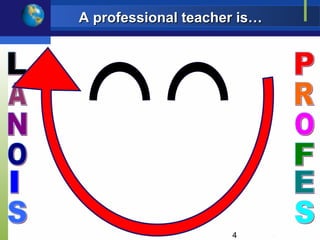
A professional teacher is…


                     4
Approach, method or
    technique?


                      5
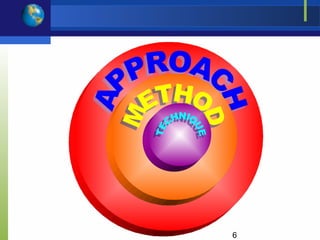
6
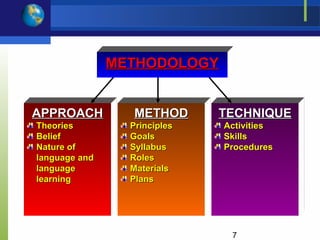
METHODOLOGY


APPROACH          METHOD      TECHNIQUE
Theories         Principles   Activities
Belief           Goals        Skills
Nature of        Syllabus     Procedures
language and     Roles
language         Materials
learning         Plans


                               7
Teaching Methodologies


                         8
Before we start…

Don’t look at your handouts!
How did you learn your first foreign
 language?
How did you learn your mother
 tongue?
Which teaching method or methods do
 you usually use to teach English?
Talk with your partner.
Share with us.
                               9
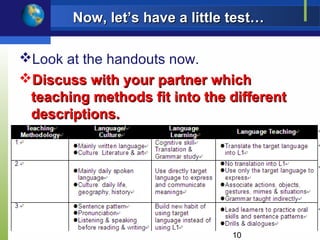
Now, let’s have a little test…

Look at the handouts now.
Discuss with your partner which
 teaching methods fit into the different
 descriptions.


                                10
Teaching Methodologies


                         11
1. The Grammar-Translation
          Method


                             12
13
General description

Focus
     Translation
     Grammar
Traditional way to teach
     Latin
     Greek
19th century
     European languages
Develop
     Reading skill
     cognitive ability            14
Activities

Presentation of grammar rules
Study of lists of vocabulary
Synonyms, antonyms, roots, prefixes,
 suffixes
Translation exercise
Reading comprehension


                               15
2. Natural Approach


                      16
17
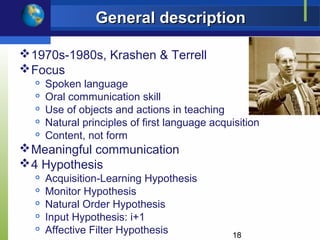
General description

 1970s-1980s, Krashen & Terrell
 Focus
     Spoken language
     Oral communication skill
     Use of objects and actions in teaching
     Natural principles of first language acquisition
     Content, not form
 Meaningful communication
 4 Hypothesis
     Acquisition-Learning Hypothesis
     Monitor Hypothesis
     Natural Order Hypothesis
     Input Hypothesis: i+1
     Affective Filter Hypothesis              18
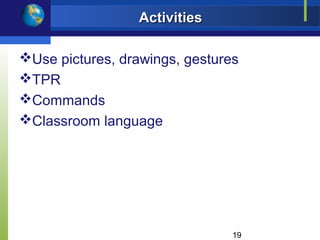
Activities

Use pictures, drawings, gestures
TPR
Commands
Classroom language


                                19
3. The Direct Method


                       20
21
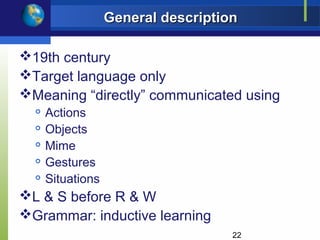
General description

19th century
Target language only
Meaning “directly” communicated using
     Actions
     Objects
     Mime
     Gestures
     Situations
L & S before R & W
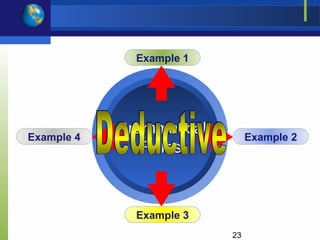
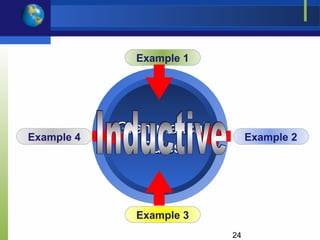
Grammar: inductive learning
                                     22
Example 1


Example 4
            Grammatical        Example 2
               Rules


              Example 3
                          23
Example 1


Example 4
            Grammatical        Example 2
               Rules


              Example 3
                          24
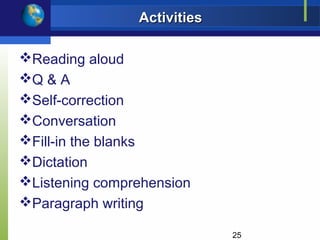
Activities

Reading aloud
Q & A
Self-correction
Conversation
Fill-in the blanks
Dictation
Listening comprehension
Paragraph writing

                             25
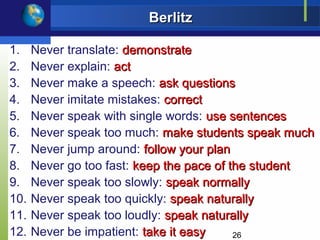
Berlitz

1.    Never translate: demonstrate
2.    Never explain: act
3.    Never make a speech: ask questions
4.    Never imitate mistakes: correct
5.    Never speak with single words: use sentences
6.    Never speak too much: make students speak much
7.    Never jump around: follow your plan
8.    Never go too fast: keep the pace of the student
9.    Never speak too slowly: speak normally
10.   Never speak too quickly: speak naturally
11.   Never speak too loudly: speak naturally
12.   Never be impatient: take it easy     26
4. The Audio-Lingual Method


                              27
28
General description

1950s-1960s, US
Army Method
Behaviorism
L & S before R & W
Use
     Dialogues
     Drills
Discourage the use of mother tongue

                               29
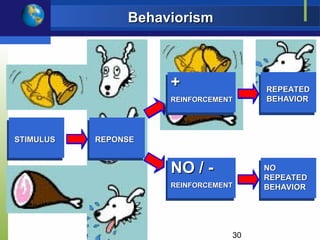
Behaviorism


                     +                REPEATED
                     REINFORCEMENT    BEHAVIOR


STIMULUS   REPONSE


                     NO / -           NO
                                      REPEATED
                     REINFORCEMENT    BEHAVIOR


                                 30
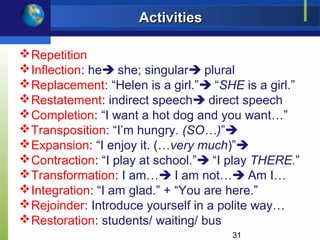
Activities

 Repetition
 Inflection: he she; singular plural
 Replacement: “Helen is a girl.” “SHE is a girl.”
 Restatement: indirect speech direct speech
 Completion: “I want a hot dog and you want…”
 Transposition: “I’m hungry. (SO…)”
 Expansion: “I enjoy it. (…very much)”
 Contraction: “I play at school.” “I play THERE.”
 Transformation: I am… I am not… Am I…
 Integration: “I am glad.” + “You are here.”
 Rejoinder: Introduce yourself in a polite way…
 Restoration: students/ waiting/ bus
                                      31
5. The Silent Way


                    32
33
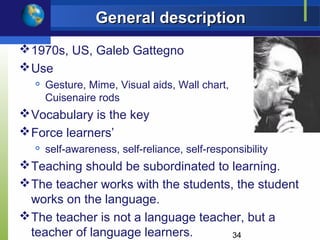
General description
 1970s, US, Galeb Gattegno
 Use
     Gesture, Mime, Visual aids, Wall chart,
      Cuisenaire rods
 Vocabulary is the key
 Force learners’
     self-awareness, self-reliance, self-responsibility
 Teaching should be subordinated to learning.
 The teacher works with the students, the student
  works on the language.
 The teacher is not a language teacher, but a
  teacher of language learners.       34
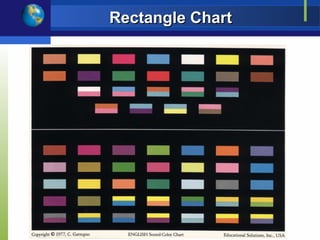
Rectangle Chart


              35
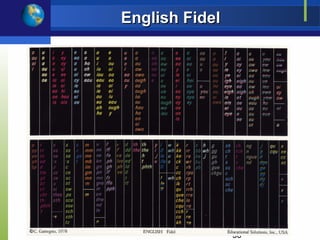
English Fidel


                36
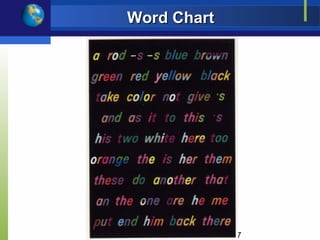
Word Chart


             37
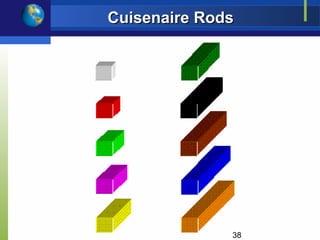
Cuisenaire Rods


              38
Activities

1. Pronunciation (stress, intonation)
     Word
     Phrase
     Sentence
2. Structure
     Vocabulary
     Sentence pattern


                                  39
6. Desuggestopedia


                     40
41
General description

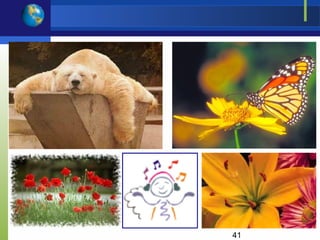
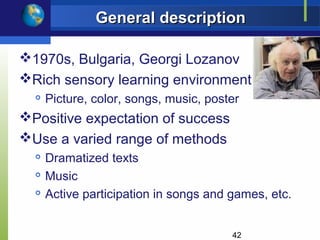
1970s, Bulgaria, Georgi Lozanov
Rich sensory learning environment
     Picture, color, songs, music, poster
Positive expectation of success
Use a varied range of methods
     Dramatized texts
  
      Music
     Active participation in songs and games, etc.


                                        42
Activities

1. Presentation
  
      Relax
  
      Positive frame of mind
     Learning is going to be easy and fun.
2. First Concert - "Active Concert“
     Active presentation
     Accompanied by classical music.
3. Second Concert - "Passive Review“
     Relax and listen to some Baroque music
  
      Text read very quietly in the background
4. Practice
  
      Games, puzzles, etc.
  
      Review and consolidate                  43
7. Community Language
      Learning


                        44
45
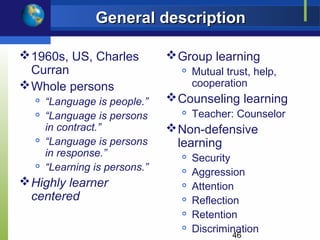
General description

 1960s, US, Charles            Group learning
  Curran                         
                                     Mutual trust, help,
 Whole persons                      cooperation
  
      “Language is people.”     Counseling learning
  
      “Language is persons       
                                     Teacher: Counselor
      in contract.”             Non-defensive
  
      “Language is persons       learning
      in response.”              
                                     Security
  
      “Learning is persons.”        Aggression
 Highly learner                    Attention
  centered                          Reflection
                                    Retention
                                    Discrimination
                                              46
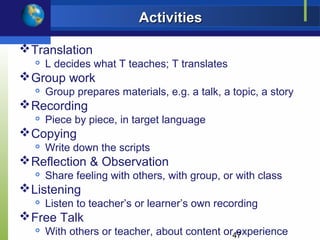
Activities

 Translation
     L decides what T teaches; T translates
 Group work
     Group prepares materials, e.g. a talk, a topic, a story
 Recording
  
      Piece by piece, in target language
 Copying
     Write down the scripts
 Reflection & Observation
  
      Share feeling with others, with group, or with class
 Listening
     Listen to teacher’s or learner’s own recording
 Free Talk
  
      With others or teacher, about content or47
                                               experience
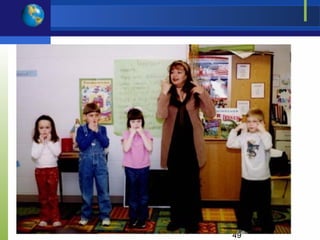
8. Total Physical Response


                             48
49
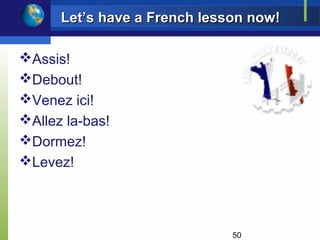
Let’s have a French lesson now!

Assis!
Debout!
Venez ici!
Allez la-bas!
Dormez!
Levez!


                              50
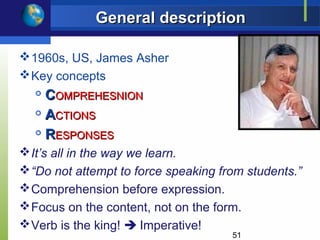
General description

 1960s, US, James Asher
 Key concepts
   COMPREHESNION
  
    ACTIONS
   RESPONSES

 It’s all in the way we learn.
 “Do not attempt to force speaking from students.”
 Comprehension before expression.
 Focus on the content, not on the form.
 Verb is the king!  Imperative!
                                      51
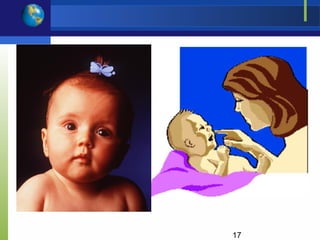
How does a baby learn to utter the
          first word and then speak?

Language-body conversation
Babies don’t learn by memorization.
Words without actions in the primary stage
  
      Meaningless!
     No matter how many times they are repeated!
     Try with your dog!


                                     52
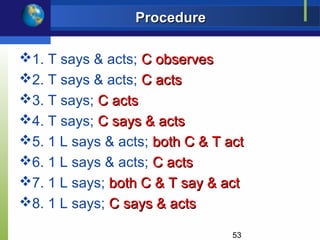
Procedure

1. T says & acts; C observes
2. T says & acts; C acts
3. T says; C acts
4. T says; C says & acts
5. 1 L says & acts; both C & T act
6. 1 L says & acts; C acts
7. 1 L says; both C & T say & act
8. 1 L says; C says & acts

                                 53
9. Communicative Approach


                            54
55
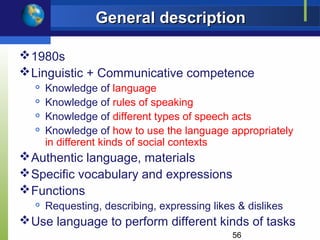
General description

 1980s
 Linguistic + Communicative competence
  
      Knowledge of language
  
      Knowledge of rules of speaking
     Knowledge of different types of speech acts
     Knowledge of how to use the language appropriately
      in different kinds of social contexts
 Authentic language, materials
 Specific vocabulary and expressions
 Functions
     Requesting, describing, expressing likes & dislikes
 Use language to perform different kinds of tasks
                                              56
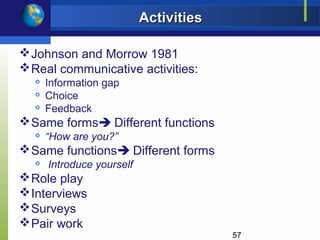
Activities

 Johnson and Morrow 1981
 Real communicative activities:
     Information gap
     Choice
     Feedback
 Same forms Different functions
  
      “How are you?”
 Same functions Different forms
     Introduce yourself
 Role play
 Interviews
 Surveys
 Pair work
                                        57
10. Content-based Approach


                             58
59
General description

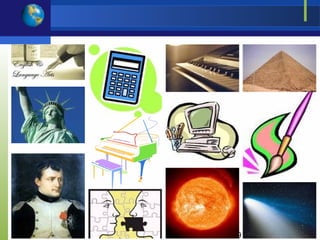
 Language across the curriculum
 Language immersion
 Target language is a medium to learn other
  content areas
 Language immersion
     Immerge language teaching with authentic contents,
      communication and other school subjects
 Develop communicative skill
 Satisfy learners’ needs
  
      Choose their own materials, topics, activities
 Encourage independent learning!
                                               60
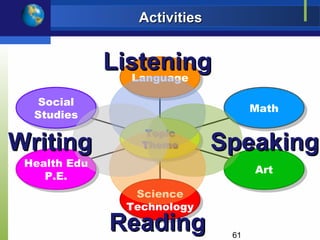
Activities


              Listening
                 Language
                 Language

  Social
   Social                           Math
                                    Math
  Studies
  Studies
                  Topic
Writing            Topic
                  Theme
                  Theme       Speaking
 Health Edu
 Health Edu                         Art
                                    Art
    P.E.
    P.E.
                 Science
                  Science
                Technology
                Technology
              Reading          61
11. Task-based Approach


                          62
63
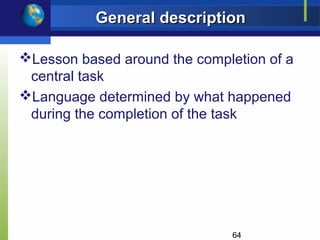
General description

Lesson based around the completion of a
 central task
Language determined by what happened
 during the completion of the task


                               64
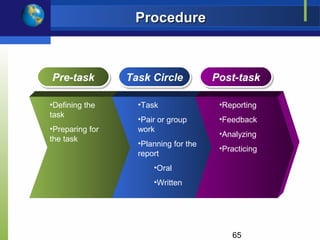
Procedure


Pre-task
Pre-task         Task Circle
                 Task Circle           Post-task
                                       Post-task

•Defining the      •Task                •Reporting
task
                   •Pair or group       •Feedback
•Preparing for     work
                                        •Analyzing
the task
                   •Planning for the
                                        •Practicing
                   report
                       •Oral
                       •Written


                                           65
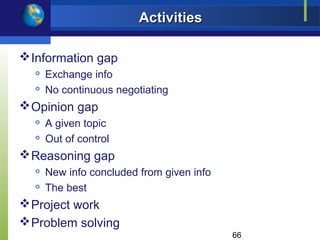
Activities

 Information gap
  
      Exchange info
     No continuous negotiating
 Opinion gap
     A given topic
  
      Out of control
 Reasoning gap
     New info concluded from given info
     The best
 Project work
 Problem solving
                                           66
12. Cooperative Learning


                           67
68
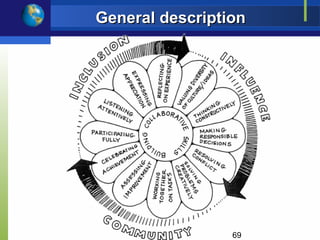
General description


                 69
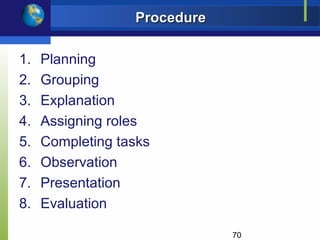
Procedure

1.   Planning
2.   Grouping
3.   Explanation
4.   Assigning roles
5.   Completing tasks
6.   Observation
7.   Presentation
8.   Evaluation

                              70
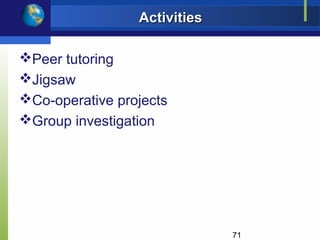
Activities

Peer tutoring
Jigsaw
Co-operative projects
Group investigation


                              71
13. Multiple Intelligences


                             72
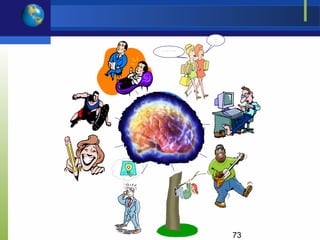
Yea
                       me
                      too.

I just love to talk


8
8


                             73
General description

1983, US, Howard Gardner
There is more than one psychological site
 of intelligence in the human brain.
     7 basic intelligences
     8th: Naturalist intelligence
     9th: Existentialist/ Spiritualist intelligence
The weak intelligences can be improved
 by working on strong ones!!
Use the children’s natural learning
 strengths to enhance their weak ones.
                                            74
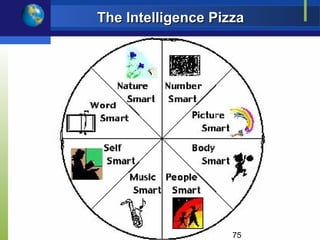
The Intelligence Pizza


                    75
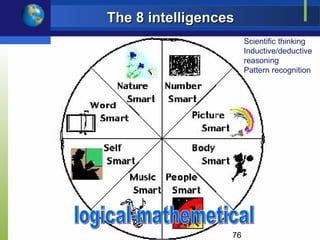
The 8 intelligences
                       Scientific thinking
                       Inductive/deductive
                       reasoning
                       Pattern recognition


                  76
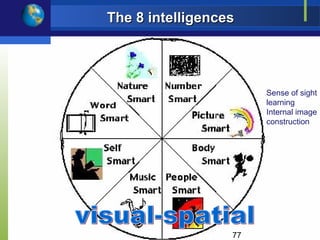
The 8 intelligences


                       Sense of sight
                       learning
                       Internal image
                       construction


                  77
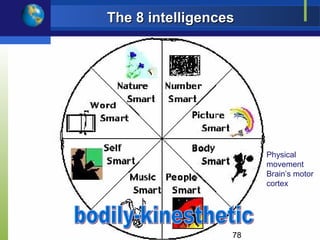
The 8 intelligences


                       Physical
                       movement
                       Brain’s motor
                       cortex


                  78
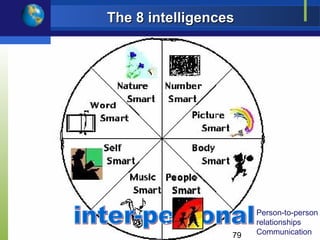
The 8 intelligences


                       Person-to-person
                       relationships
                  79   Communication
The 8 intelligences


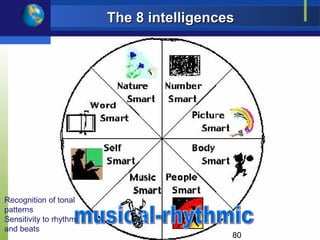
Recognition of tonal
patterns
Sensitivity to rhythm
and beats
                                          80
The 8 intelligences


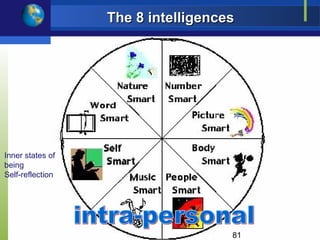
Inner states of
being
Self-reflection


                                    81
The 8 intelligences


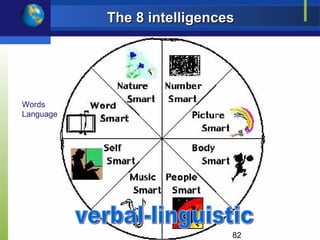
Words
Language


                             82
The 8 intelligences
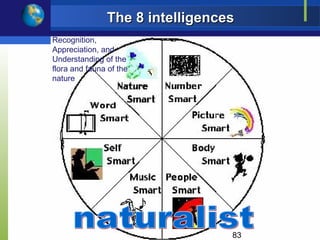
Recognition,
Appreciation, and
Understanding of the
flora and fauna of the
nature


                                 83
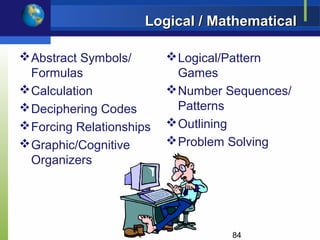
Logical / Mathematical

 Abstract Symbols/        Logical/Pattern
  Formulas                  Games
 Calculation              Number Sequences/
 Deciphering Codes         Patterns
 Forcing Relationships    Outlining
 Graphic/Cognitive        Problem Solving
  Organizers


                                    84
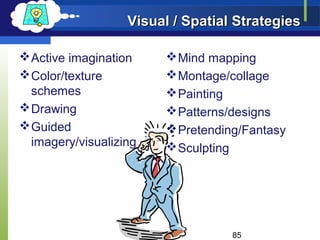
Visual / Spatial Strategies

 Active imagination     Mind mapping
 Color/texture          Montage/collage
  schemes                Painting
 Drawing                Patterns/designs
 Guided                 Pretending/Fantasy
  imagery/visualizing    Sculpting


                                   85
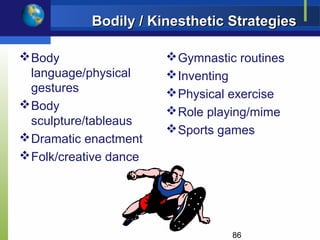
Bodily / Kinesthetic Strategies

 Body                   Gymnastic routines
  language/physical      Inventing
  gestures               Physical exercise
 Body                   Role playing/mime
  sculpture/tableaus
                         Sports games
 Dramatic enactment
 Folk/creative dance


                                   86
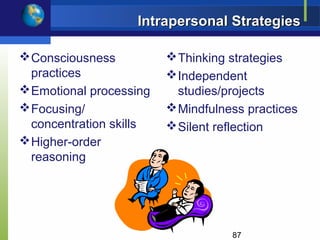
Intrapersonal Strategies

 Consciousness           Thinking strategies
  practices               Independent
 Emotional processing     studies/projects
 Focusing/               Mindfulness practices
  concentration skills    Silent reflection
 Higher-order
  reasoning


                                    87
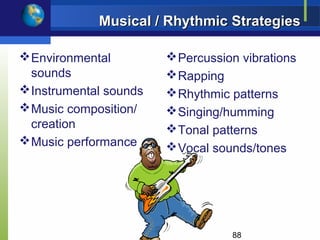
Musical / Rhythmic Strategies

 Environmental          Percussion vibrations
  sounds                 Rapping
 Instrumental sounds    Rhythmic patterns
 Music composition/     Singing/humming
  creation               Tonal patterns
 Music performance      Vocal sounds/tones


                                   88
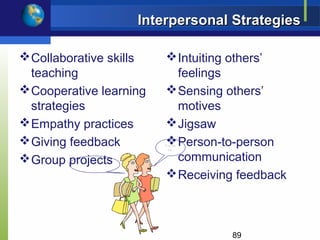
Interpersonal Strategies

 Collaborative skills               Intuiting others’
  teaching                            feelings
 Cooperative learning               Sensing others’
  strategies                          motives
 Empathy practices                  Jigsaw
 Giving feedback                    Person-to-person
                                    Yea me
                                     too.


 Group projects
          I just love to talk
                                      communication
                                     Receiving feedback


                                               89
Verbal / Linguistics Strategies

 Creative writing      Poetry
 Formal speaking       Reading
 Humor/jokes           Storytelling
 Impromptu speaking    Story creation
 Journal/diary         Verbal debate
  keeping               Vocabulary


                                  90
Naturalist Strategies

 Caring for        Nature encounters/
  plants/animals     field trips
 Conservation      Natural observation
  practices         Natural world
                     simulations
 Environmental
                    Species classification
  feedback           
                         (Organic/inorganic)
 Hands-on labs


                                 91
How to choose the “best”
        method?


                           92
What affects your choices?

Personal belief
Experience
Teaching styles
Classes
Students
Situations


                             93
Different choices

Absolutism
Relativism
Pluralism
Eclecticism
Principled Eclecticism


                                  94
To sum up…

There is no perfect method!
A method is suitable only for a certain
 environment.
A good method depends on the efforts
 furnished by the teacher him-/herself.
All methods are results of wisdom and
 experiences of many people.
Consider about your students’ needs!
“Adapt; don’t adopt!”~ Clifford Drator
                                 95
Teaching very young learners


                           96
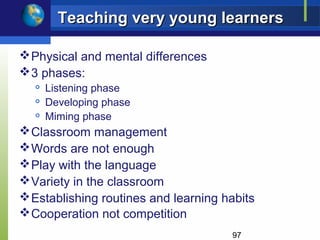
Teaching very young learners

 Physical and mental differences
 3 phases:
  
      Listening phase
  
      Developing phase
     Miming phase
 Classroom management
 Words are not enough
 Play with the language
 Variety in the classroom
 Establishing routines and learning habits
 Cooperation not competition
                                      97
Practical games, activities
  and scoring systems


                              98
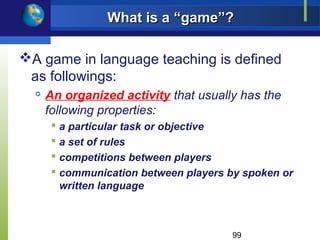
What is a “game”?

A game in language teaching is defined
 as followings:
     An organized activity that usually has the
      following properties:
        a particular task or objective
        a set of rules
        competitions between players
        communication between players by spoken or
         written language


                                       99
Warm-ups or lead-ins?

Warm-ups (warmers):
     To raise students’ energy level
     Make them feel comfortable
     Not always connected to the topic
Lead-ins:
     Focus on the topic or the new language
     Motivate students
     Make a link between the topic and students’
      own lives

                                          100
Scoring beyond scores

Think beyond points
Use toys, toy money
Combine games, gambling with scoring
Focus on fun, not on competition
Be fair!


                              101
Conclusion


             102
What you can do…

Improve your overall English ability!
Learn everything around English teaching!
Reflect upon your own teaching often!
Think about the ultimate destination you
 want to take your students to in the end!
Be open-minded!
Be a life-long learner yourself!


                                103
Thank you for your attention!
      Any comments or shares of
        thoughts are welcome!

         huttm@hotmail.com


                                  104

The Making-of-a-Professional-Teacher

  • 1.
    The Making of aProfessional Teacher 2007 師德全台巡迴講座 Michael Tsai 師德種子講師 知名連鎖品牌美語師資培訓講師 英國劍橋 TKT 國際認證講師 快速記憶及心智繪圖講師 1
  • 2.
    Agenda 1. Approach, Methodand Technique 1. Approach, Method and Technique 2. Teaching Methodologies 2. Teaching Methodologies 3. How to choose the “best” method? 3. How to choose the “best” method? 4. Teaching very young learners 4. Teaching very young learners 4. Practical games and activities 4. Practical games and activities 2
  • 3.
    What is itto be a professional teacher? 3
  • 4.
  • 5.
  • 6.
  • 7.
    METHODOLOGY APPROACH METHOD TECHNIQUE Theories Principles Activities Belief Goals Skills Nature of Syllabus Procedures language and Roles language Materials learning Plans 7
  • 8.
  • 9.
    Before we start… Don’tlook at your handouts! How did you learn your first foreign language? How did you learn your mother tongue? Which teaching method or methods do you usually use to teach English? Talk with your partner. Share with us. 9
  • 10.
    Now, let’s havea little test… Look at the handouts now. Discuss with your partner which teaching methods fit into the different descriptions. 10
  • 11.
  • 12.
  • 13.
  • 14.
    General description Focus  Translation  Grammar Traditional way to teach  Latin  Greek 19th century  European languages Develop  Reading skill  cognitive ability 14
  • 15.
    Activities Presentation of grammarrules Study of lists of vocabulary Synonyms, antonyms, roots, prefixes, suffixes Translation exercise Reading comprehension 15
  • 16.
  • 17.
  • 18.
    General description  1970s-1980s,Krashen & Terrell  Focus  Spoken language  Oral communication skill  Use of objects and actions in teaching  Natural principles of first language acquisition  Content, not form  Meaningful communication  4 Hypothesis  Acquisition-Learning Hypothesis  Monitor Hypothesis  Natural Order Hypothesis  Input Hypothesis: i+1  Affective Filter Hypothesis 18
  • 19.
    Activities Use pictures, drawings,gestures TPR Commands Classroom language 19
  • 20.
    3. The DirectMethod 20
  • 21.
  • 22.
    General description 19th century Targetlanguage only Meaning “directly” communicated using  Actions  Objects  Mime  Gestures  Situations L & S before R & W Grammar: inductive learning 22
  • 23.
    Example 1 Example 4 Grammatical Example 2 Rules Example 3 23
  • 24.
    Example 1 Example 4 Grammatical Example 2 Rules Example 3 24
  • 25.
    Activities Reading aloud Q &A Self-correction Conversation Fill-in the blanks Dictation Listening comprehension Paragraph writing 25
  • 26.
    Berlitz 1. Never translate: demonstrate 2. Never explain: act 3. Never make a speech: ask questions 4. Never imitate mistakes: correct 5. Never speak with single words: use sentences 6. Never speak too much: make students speak much 7. Never jump around: follow your plan 8. Never go too fast: keep the pace of the student 9. Never speak too slowly: speak normally 10. Never speak too quickly: speak naturally 11. Never speak too loudly: speak naturally 12. Never be impatient: take it easy 26
  • 27.
  • 28.
  • 29.
    General description 1950s-1960s, US ArmyMethod Behaviorism L & S before R & W Use  Dialogues  Drills Discourage the use of mother tongue 29
  • 30.
    Behaviorism + REPEATED REINFORCEMENT BEHAVIOR STIMULUS REPONSE NO / - NO REPEATED REINFORCEMENT BEHAVIOR 30
  • 31.
    Activities  Repetition  Inflection:he she; singular plural  Replacement: “Helen is a girl.” “SHE is a girl.”  Restatement: indirect speech direct speech  Completion: “I want a hot dog and you want…”  Transposition: “I’m hungry. (SO…)”  Expansion: “I enjoy it. (…very much)”  Contraction: “I play at school.” “I play THERE.”  Transformation: I am… I am not… Am I…  Integration: “I am glad.” + “You are here.”  Rejoinder: Introduce yourself in a polite way…  Restoration: students/ waiting/ bus 31
  • 32.
  • 33.
  • 34.
    General description  1970s,US, Galeb Gattegno  Use  Gesture, Mime, Visual aids, Wall chart, Cuisenaire rods  Vocabulary is the key  Force learners’  self-awareness, self-reliance, self-responsibility  Teaching should be subordinated to learning.  The teacher works with the students, the student works on the language.  The teacher is not a language teacher, but a teacher of language learners. 34
  • 35.
  • 36.
  • 37.
  • 38.
  • 39.
    Activities 1. Pronunciation (stress,intonation)  Word  Phrase  Sentence 2. Structure  Vocabulary  Sentence pattern 39
  • 40.
  • 41.
  • 42.
    General description 1970s, Bulgaria,Georgi Lozanov Rich sensory learning environment  Picture, color, songs, music, poster Positive expectation of success Use a varied range of methods  Dramatized texts  Music  Active participation in songs and games, etc. 42
  • 43.
    Activities 1. Presentation  Relax  Positive frame of mind  Learning is going to be easy and fun. 2. First Concert - "Active Concert“  Active presentation  Accompanied by classical music. 3. Second Concert - "Passive Review“  Relax and listen to some Baroque music  Text read very quietly in the background 4. Practice  Games, puzzles, etc.  Review and consolidate 43
  • 44.
  • 45.
  • 46.
    General description  1960s,US, Charles  Group learning Curran  Mutual trust, help,  Whole persons cooperation  “Language is people.”  Counseling learning  “Language is persons  Teacher: Counselor in contract.”  Non-defensive  “Language is persons learning in response.”  Security  “Learning is persons.”  Aggression  Highly learner  Attention centered  Reflection  Retention  Discrimination 46
  • 47.
    Activities  Translation  L decides what T teaches; T translates  Group work  Group prepares materials, e.g. a talk, a topic, a story  Recording  Piece by piece, in target language  Copying  Write down the scripts  Reflection & Observation  Share feeling with others, with group, or with class  Listening  Listen to teacher’s or learner’s own recording  Free Talk  With others or teacher, about content or47 experience
  • 48.
    8. Total PhysicalResponse 48
  • 49.
  • 50.
    Let’s have aFrench lesson now! Assis! Debout! Venez ici! Allez la-bas! Dormez! Levez! 50
  • 51.
    General description  1960s,US, James Asher  Key concepts  COMPREHESNION  ACTIONS  RESPONSES  It’s all in the way we learn.  “Do not attempt to force speaking from students.”  Comprehension before expression.  Focus on the content, not on the form.  Verb is the king!  Imperative! 51
  • 52.
    How does ababy learn to utter the first word and then speak? Language-body conversation Babies don’t learn by memorization. Words without actions in the primary stage  Meaningless!  No matter how many times they are repeated!  Try with your dog! 52
  • 53.
    Procedure 1. T says& acts; C observes 2. T says & acts; C acts 3. T says; C acts 4. T says; C says & acts 5. 1 L says & acts; both C & T act 6. 1 L says & acts; C acts 7. 1 L says; both C & T say & act 8. 1 L says; C says & acts 53
  • 54.
  • 55.
  • 56.
    General description  1980s Linguistic + Communicative competence  Knowledge of language  Knowledge of rules of speaking  Knowledge of different types of speech acts  Knowledge of how to use the language appropriately in different kinds of social contexts  Authentic language, materials  Specific vocabulary and expressions  Functions  Requesting, describing, expressing likes & dislikes  Use language to perform different kinds of tasks 56
  • 57.
    Activities  Johnson andMorrow 1981  Real communicative activities:  Information gap  Choice  Feedback  Same forms Different functions  “How are you?”  Same functions Different forms  Introduce yourself  Role play  Interviews  Surveys  Pair work 57
  • 58.
  • 59.
  • 60.
    General description  Languageacross the curriculum  Language immersion  Target language is a medium to learn other content areas  Language immersion  Immerge language teaching with authentic contents, communication and other school subjects  Develop communicative skill  Satisfy learners’ needs  Choose their own materials, topics, activities  Encourage independent learning! 60
  • 61.
    Activities Listening Language Language Social Social Math Math Studies Studies Topic Writing Topic Theme Theme Speaking Health Edu Health Edu Art Art P.E. P.E. Science Science Technology Technology Reading 61
  • 62.
  • 63.
  • 64.
    General description Lesson basedaround the completion of a central task Language determined by what happened during the completion of the task 64
  • 65.
    Procedure Pre-task Pre-task Task Circle Task Circle Post-task Post-task •Defining the •Task •Reporting task •Pair or group •Feedback •Preparing for work •Analyzing the task •Planning for the •Practicing report •Oral •Written 65
  • 66.
    Activities  Information gap  Exchange info  No continuous negotiating  Opinion gap  A given topic  Out of control  Reasoning gap  New info concluded from given info  The best  Project work  Problem solving 66
  • 67.
  • 68.
  • 69.
  • 70.
    Procedure 1. Planning 2. Grouping 3. Explanation 4. Assigning roles 5. Completing tasks 6. Observation 7. Presentation 8. Evaluation 70
  • 71.
  • 72.
  • 73.
    Yea me too. I just love to talk 8 8 73
  • 74.
    General description 1983, US,Howard Gardner There is more than one psychological site of intelligence in the human brain.  7 basic intelligences  8th: Naturalist intelligence  9th: Existentialist/ Spiritualist intelligence The weak intelligences can be improved by working on strong ones!! Use the children’s natural learning strengths to enhance their weak ones. 74
  • 75.
  • 76.
    The 8 intelligences Scientific thinking Inductive/deductive reasoning Pattern recognition 76
  • 77.
    The 8 intelligences Sense of sight learning Internal image construction 77
  • 78.
    The 8 intelligences Physical movement Brain’s motor cortex 78
  • 79.
    The 8 intelligences Person-to-person relationships 79 Communication
  • 80.
    The 8 intelligences Recognitionof tonal patterns Sensitivity to rhythm and beats 80
  • 81.
    The 8 intelligences Innerstates of being Self-reflection 81
  • 82.
  • 83.
    The 8 intelligences Recognition, Appreciation,and Understanding of the flora and fauna of the nature 83
  • 84.
    Logical / Mathematical Abstract Symbols/  Logical/Pattern Formulas Games  Calculation  Number Sequences/  Deciphering Codes Patterns  Forcing Relationships  Outlining  Graphic/Cognitive  Problem Solving Organizers 84
  • 85.
    Visual / SpatialStrategies  Active imagination  Mind mapping  Color/texture  Montage/collage schemes  Painting  Drawing  Patterns/designs  Guided  Pretending/Fantasy imagery/visualizing  Sculpting 85
  • 86.
    Bodily / KinestheticStrategies  Body  Gymnastic routines language/physical  Inventing gestures  Physical exercise  Body  Role playing/mime sculpture/tableaus  Sports games  Dramatic enactment  Folk/creative dance 86
  • 87.
    Intrapersonal Strategies  Consciousness  Thinking strategies practices  Independent  Emotional processing studies/projects  Focusing/  Mindfulness practices concentration skills  Silent reflection  Higher-order reasoning 87
  • 88.
    Musical / RhythmicStrategies  Environmental  Percussion vibrations sounds  Rapping  Instrumental sounds  Rhythmic patterns  Music composition/  Singing/humming creation  Tonal patterns  Music performance  Vocal sounds/tones 88
  • 89.
    Interpersonal Strategies  Collaborativeskills  Intuiting others’ teaching feelings  Cooperative learning  Sensing others’ strategies motives  Empathy practices  Jigsaw  Giving feedback  Person-to-person Yea me too.  Group projects I just love to talk communication  Receiving feedback 89
  • 90.
    Verbal / LinguisticsStrategies  Creative writing  Poetry  Formal speaking  Reading  Humor/jokes  Storytelling  Impromptu speaking  Story creation  Journal/diary  Verbal debate keeping  Vocabulary 90
  • 91.
    Naturalist Strategies  Caringfor  Nature encounters/ plants/animals field trips  Conservation  Natural observation practices  Natural world simulations  Environmental  Species classification feedback  (Organic/inorganic)  Hands-on labs 91
  • 92.
    How to choosethe “best” method? 92
  • 93.
    What affects yourchoices? Personal belief Experience Teaching styles Classes Students Situations 93
  • 94.
  • 95.
    To sum up… Thereis no perfect method! A method is suitable only for a certain environment. A good method depends on the efforts furnished by the teacher him-/herself. All methods are results of wisdom and experiences of many people. Consider about your students’ needs! “Adapt; don’t adopt!”~ Clifford Drator 95
  • 96.
  • 97.
    Teaching very younglearners  Physical and mental differences  3 phases:  Listening phase  Developing phase  Miming phase  Classroom management  Words are not enough  Play with the language  Variety in the classroom  Establishing routines and learning habits  Cooperation not competition 97
  • 98.
    Practical games, activities and scoring systems 98
  • 99.
    What is a“game”? A game in language teaching is defined as followings:  An organized activity that usually has the following properties:  a particular task or objective  a set of rules  competitions between players  communication between players by spoken or written language 99
  • 100.
    Warm-ups or lead-ins? Warm-ups(warmers):  To raise students’ energy level  Make them feel comfortable  Not always connected to the topic Lead-ins:  Focus on the topic or the new language  Motivate students  Make a link between the topic and students’ own lives 100
  • 101.
    Scoring beyond scores Thinkbeyond points Use toys, toy money Combine games, gambling with scoring Focus on fun, not on competition Be fair! 101
  • 102.
  • 103.
    What you cando… Improve your overall English ability! Learn everything around English teaching! Reflect upon your own teaching often! Think about the ultimate destination you want to take your students to in the end! Be open-minded! Be a life-long learner yourself! 103
  • 104.
    Thank you foryour attention! Any comments or shares of thoughts are welcome! huttm@hotmail.com 104