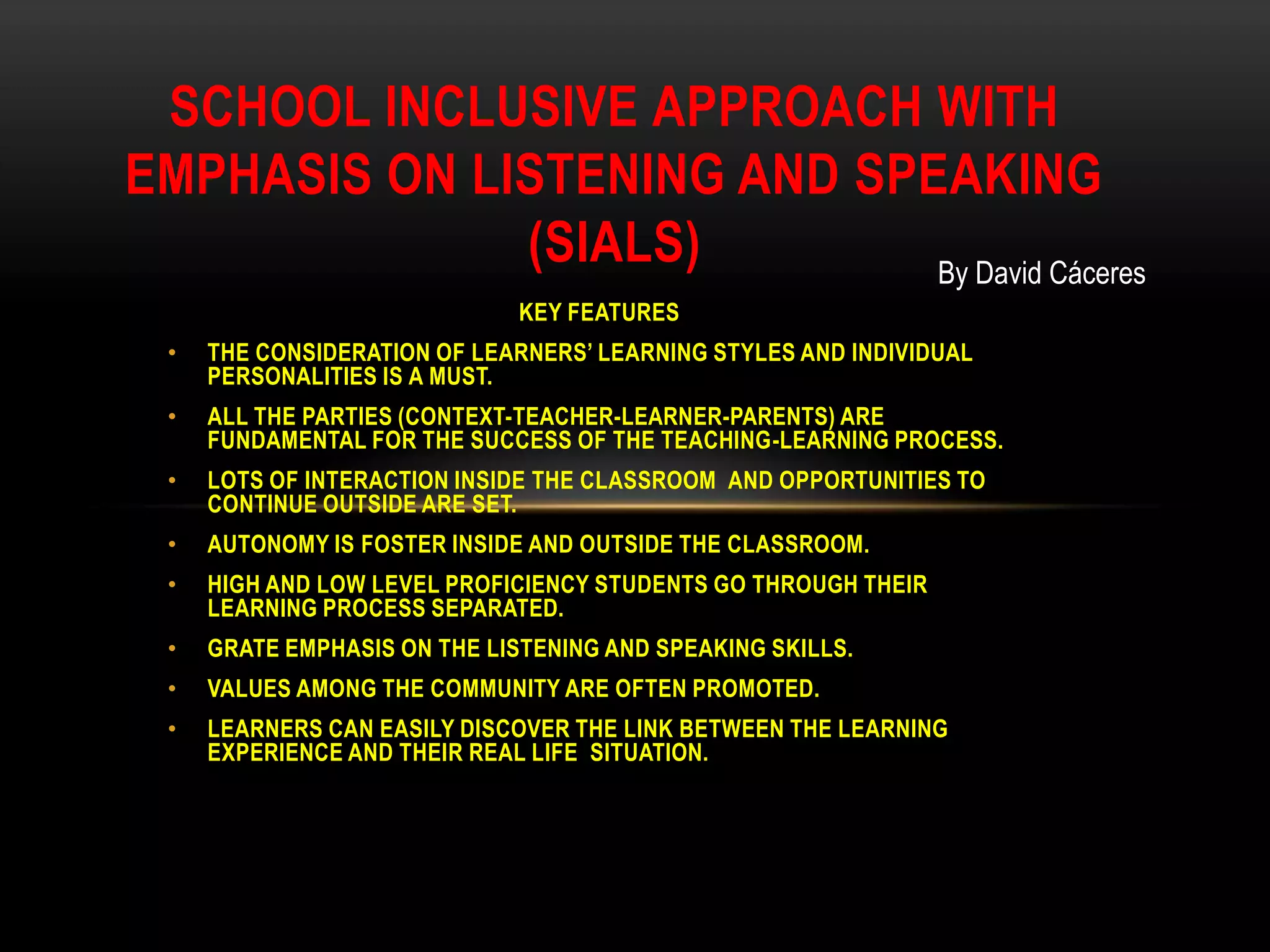
SCHOOL INCLUSIVE APPROACH WITH
EMPHASIS ON LISTENING AND SPEAKING
              (SIALS)        By David Cáceres
                              KEY FEATURES
 •   THE CONSIDERATION OF LEARNERS’ LEARNING STYLES AND INDIVIDUAL
     PERSONALITIES IS A MUST.
 •   ALL THE PARTIES (CONTEXT-TEACHER-LEARNER-PARENTS) ARE
     FUNDAMENTAL FOR THE SUCCESS OF THE TEACHING-LEARNING PROCESS.
 •   LOTS OF INTERACTION INSIDE THE CLASSROOM AND OPPORTUNITIES TO
     CONTINUE OUTSIDE ARE SET.
 •   AUTONOMY IS FOSTER INSIDE AND OUTSIDE THE CLASSROOM.
 •   HIGH AND LOW LEVEL PROFICIENCY STUDENTS GO THROUGH THEIR
     LEARNING PROCESS SEPARATED.
 •   GRATE EMPHASIS ON THE LISTENING AND SPEAKING SKILLS.
 •   VALUES AMONG THE COMMUNITY ARE OFTEN PROMOTED.
 •   LEARNERS CAN EASILY DISCOVER THE LINK BETWEEN THE LEARNING
     EXPERIENCE AND THEIR REAL LIFE SITUATION.
THEORY OF LANGUAGE
By the end of the 19th century, linguists emphasized that speech was the primary form
of language for which they became interested in the controversies that emerged about
the best way to teach foreign languages. Therefore, the functional and communicative
potential of language was emphasized and then language teaching focused on
communicative proficiency (Richards & Rodgers). In this approach to foreign
language teaching, moreover, learners’ sociolinguistic (Hymes), strategic, and
discourse (Calane & Swain) competence is of great importance (CEFR), which is based
on the interactionist method . The main theorist associated with interactionist theory is
Lev Vygotsky. Interactionists acknowledge the importance of two-way communication
in the target language.
THEORIES OF LEARNING
•   FOR CONTEXT: According to Ellis’s (1994), “Gardner’s Socio educational model explains
    how setting [formal and informal] is related to L2 proficiency […] by identifying variables
    of psychological nature such as attitudes, motivation, self confidence and by trying to
    show how these are interrelated and how they affect learning”.
•   FOR INDIVIDUAL PERSONALITIES: Gardner asserts that learning behaviour seen in
    different learners in educational settings and in non-educational settings, determine
    learning outcomes both linguistic, like L2 proficiency and non-linguistic such as
    attitudes, motivations, self-concept, cultural values, and beliefs (Ellis, 1994: 237).
•   FOR INTERACTION:
    Longs’ (1981) study on modifications in NS input to NNSs made a distinction between
    linguistic modifications and interactive modifications, claiming that interactive
    modifications were facilitative and necessary for second language acquisition.
    Verplaetse (1993) found NS modifications to have negative effects on NNS participation
    in conversations thus questioning Longs’ general idea that NS are primarily beneficial to
    NNSs. (Hall & Verplaetse, 2000).
THEORIES OF LEARNING
•   Gass and Varonis (1985a) and Varonis and Gass (1985b) argued that NNS-NNS
    interactions provide greater opportunities than NS-NNS interactions for the negotiation
    of meaning and therefore for obtaining comprehensible input. [that in turn, according to
    Krashen’s input hypothesis, facilitates L2 acquisition]. (Shehadeh, 1999).
•   Swain (1985) argued that comprehensible input *[listening/reading] is not sufficient for
    successful second language acquisition (SLA), but that opportunities for non-native
    speakers (NNSs) to produce comprehensible output *[speaking/writing] are also
    necessary. Swain claimed that understanding new forms is not enough and that learners
    must also be given the opportunity to produce them.
•   FOR LEARNING STYLES: Fleming's VARK model (1987), one of the most common and
    highly used learning styles models claimed that visual learners have a preference for
    learning through visual aids, through listening, and trough experience.
•   FOR AUTONOMY: Holec and Henri (1982) stated that the autonomous language learner
    takes responsibility for the totality of his learning situation. He does this by determining
    his own objectives, defining the contents to be learned and the progression of the
    course, selecting methods and techniques to be used, monitoring this procedure, and
    evaluating what he has acquired. Objectives are specific to the learner, and the learner's
    communicative needs determine the verbal elements chosen
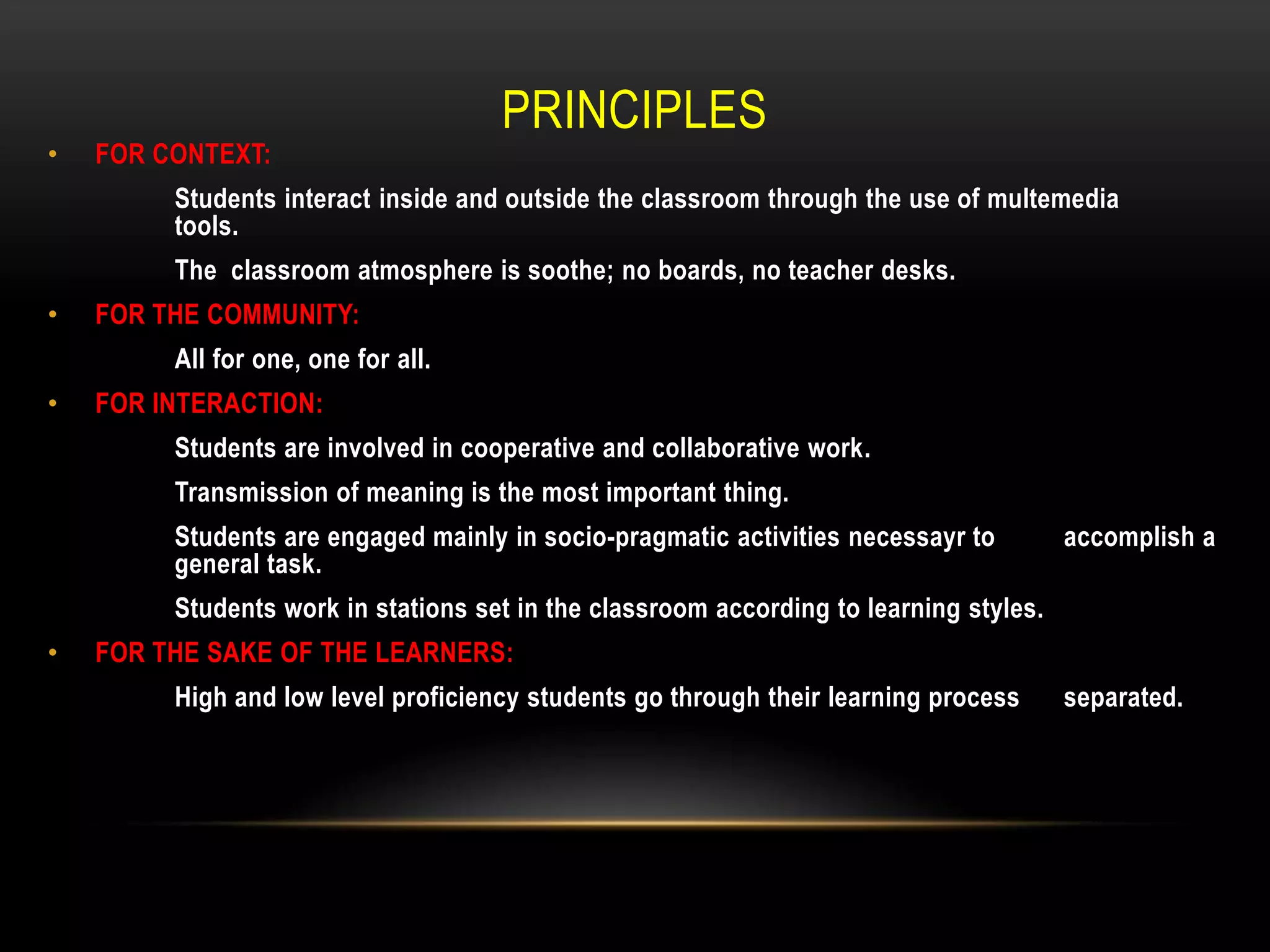
PRINCIPLES
•   FOR CONTEXT:
         Students interact inside and outside the classroom through the use of multemedia
         tools.
         The classroom atmosphere is soothe; no boards, no teacher desks.
•   FOR THE COMMUNITY:
         All for one, one for all.
•   FOR INTERACTION:
         Students are involved in cooperative and collaborative work.
         Transmission of meaning is the most important thing.
         Students are engaged mainly in socio-pragmatic activities necessayr to         accomplish a
         general task.
         Students work in stations set in the classroom according to learning styles.
•   FOR THE SAKE OF THE LEARNERS:
         High and low level proficiency students go through their learning process      separated.
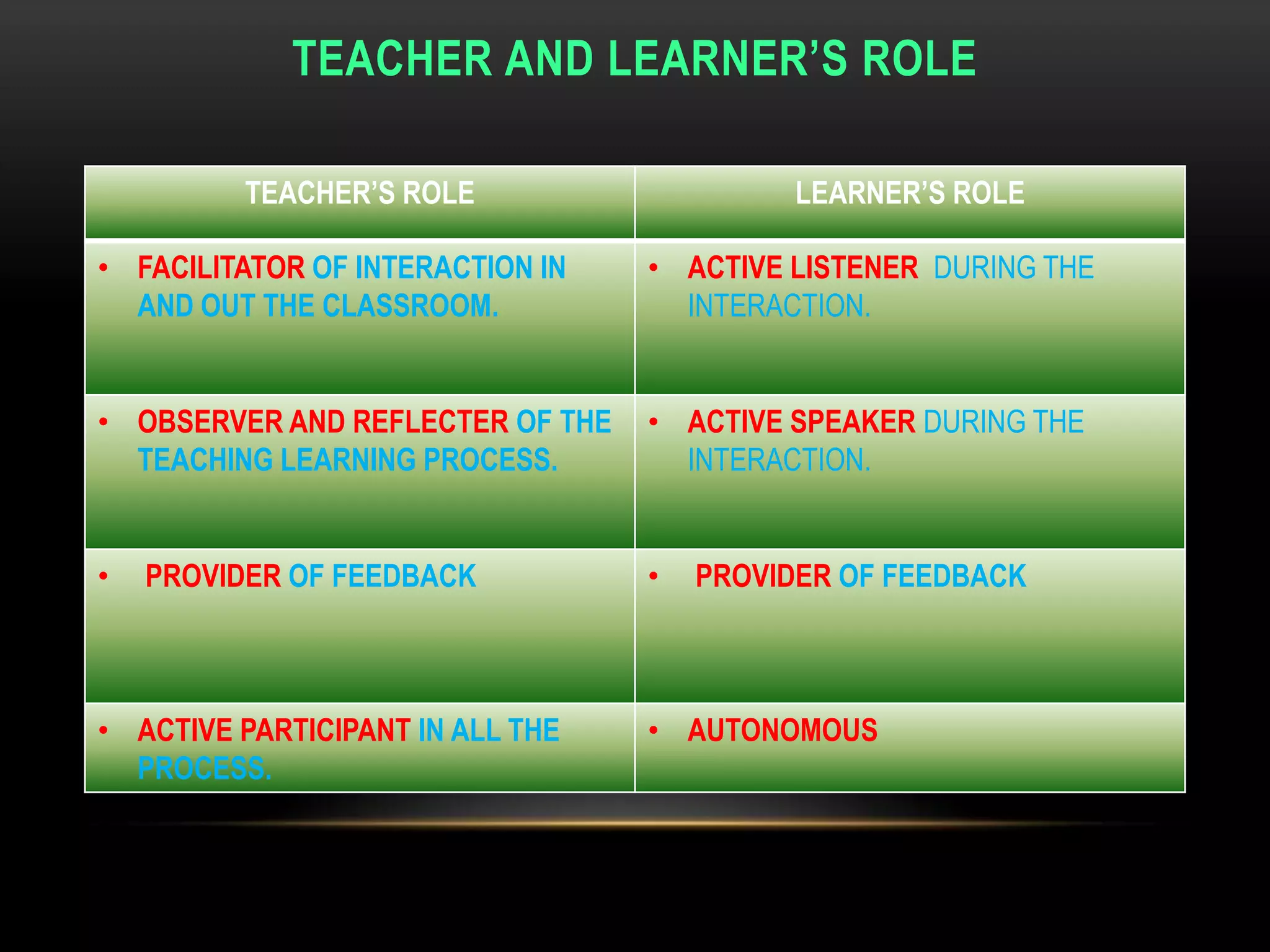
TEACHER AND LEARNER’S ROLE

          TEACHER’S ROLE                    LEARNER’S ROLE

• FACILITATOR OF INTERACTION IN   • ACTIVE LISTENER DURING THE
  AND OUT THE CLASSROOM.            INTERACTION.


• OBSERVER AND REFLECTER OF THE   • ACTIVE SPEAKER DURING THE
  TEACHING LEARNING PROCESS.        INTERACTION.


•   PROVIDER OF FEEDBACK          •   PROVIDER OF FEEDBACK


• ACTIVE PARTICIPANT IN ALL THE   • AUTONOMOUS
  PROCESS.
METHOD
• LEARNER-CENTERED METHOD: the learning
  matches the student rather than the student
  needing to accommodate the learning
  preferences of the instructor. Students use
  the learning style that is most effective for
  them.

All inclusive approach with emphasis on listening and

  • 1.
    SCHOOL INCLUSIVE APPROACHWITH EMPHASIS ON LISTENING AND SPEAKING (SIALS) By David Cáceres KEY FEATURES • THE CONSIDERATION OF LEARNERS’ LEARNING STYLES AND INDIVIDUAL PERSONALITIES IS A MUST. • ALL THE PARTIES (CONTEXT-TEACHER-LEARNER-PARENTS) ARE FUNDAMENTAL FOR THE SUCCESS OF THE TEACHING-LEARNING PROCESS. • LOTS OF INTERACTION INSIDE THE CLASSROOM AND OPPORTUNITIES TO CONTINUE OUTSIDE ARE SET. • AUTONOMY IS FOSTER INSIDE AND OUTSIDE THE CLASSROOM. • HIGH AND LOW LEVEL PROFICIENCY STUDENTS GO THROUGH THEIR LEARNING PROCESS SEPARATED. • GRATE EMPHASIS ON THE LISTENING AND SPEAKING SKILLS. • VALUES AMONG THE COMMUNITY ARE OFTEN PROMOTED. • LEARNERS CAN EASILY DISCOVER THE LINK BETWEEN THE LEARNING EXPERIENCE AND THEIR REAL LIFE SITUATION.
  • 2.
    THEORY OF LANGUAGE Bythe end of the 19th century, linguists emphasized that speech was the primary form of language for which they became interested in the controversies that emerged about the best way to teach foreign languages. Therefore, the functional and communicative potential of language was emphasized and then language teaching focused on communicative proficiency (Richards & Rodgers). In this approach to foreign language teaching, moreover, learners’ sociolinguistic (Hymes), strategic, and discourse (Calane & Swain) competence is of great importance (CEFR), which is based on the interactionist method . The main theorist associated with interactionist theory is Lev Vygotsky. Interactionists acknowledge the importance of two-way communication in the target language.
  • 3.
    THEORIES OF LEARNING • FOR CONTEXT: According to Ellis’s (1994), “Gardner’s Socio educational model explains how setting [formal and informal] is related to L2 proficiency […] by identifying variables of psychological nature such as attitudes, motivation, self confidence and by trying to show how these are interrelated and how they affect learning”. • FOR INDIVIDUAL PERSONALITIES: Gardner asserts that learning behaviour seen in different learners in educational settings and in non-educational settings, determine learning outcomes both linguistic, like L2 proficiency and non-linguistic such as attitudes, motivations, self-concept, cultural values, and beliefs (Ellis, 1994: 237). • FOR INTERACTION: Longs’ (1981) study on modifications in NS input to NNSs made a distinction between linguistic modifications and interactive modifications, claiming that interactive modifications were facilitative and necessary for second language acquisition. Verplaetse (1993) found NS modifications to have negative effects on NNS participation in conversations thus questioning Longs’ general idea that NS are primarily beneficial to NNSs. (Hall & Verplaetse, 2000).
  • 4.
    THEORIES OF LEARNING • Gass and Varonis (1985a) and Varonis and Gass (1985b) argued that NNS-NNS interactions provide greater opportunities than NS-NNS interactions for the negotiation of meaning and therefore for obtaining comprehensible input. [that in turn, according to Krashen’s input hypothesis, facilitates L2 acquisition]. (Shehadeh, 1999). • Swain (1985) argued that comprehensible input *[listening/reading] is not sufficient for successful second language acquisition (SLA), but that opportunities for non-native speakers (NNSs) to produce comprehensible output *[speaking/writing] are also necessary. Swain claimed that understanding new forms is not enough and that learners must also be given the opportunity to produce them. • FOR LEARNING STYLES: Fleming's VARK model (1987), one of the most common and highly used learning styles models claimed that visual learners have a preference for learning through visual aids, through listening, and trough experience. • FOR AUTONOMY: Holec and Henri (1982) stated that the autonomous language learner takes responsibility for the totality of his learning situation. He does this by determining his own objectives, defining the contents to be learned and the progression of the course, selecting methods and techniques to be used, monitoring this procedure, and evaluating what he has acquired. Objectives are specific to the learner, and the learner's communicative needs determine the verbal elements chosen
  • 5.
    PRINCIPLES • FOR CONTEXT: Students interact inside and outside the classroom through the use of multemedia tools. The classroom atmosphere is soothe; no boards, no teacher desks. • FOR THE COMMUNITY: All for one, one for all. • FOR INTERACTION: Students are involved in cooperative and collaborative work. Transmission of meaning is the most important thing. Students are engaged mainly in socio-pragmatic activities necessayr to accomplish a general task. Students work in stations set in the classroom according to learning styles. • FOR THE SAKE OF THE LEARNERS: High and low level proficiency students go through their learning process separated.
  • 6.
    TEACHER AND LEARNER’SROLE TEACHER’S ROLE LEARNER’S ROLE • FACILITATOR OF INTERACTION IN • ACTIVE LISTENER DURING THE AND OUT THE CLASSROOM. INTERACTION. • OBSERVER AND REFLECTER OF THE • ACTIVE SPEAKER DURING THE TEACHING LEARNING PROCESS. INTERACTION. • PROVIDER OF FEEDBACK • PROVIDER OF FEEDBACK • ACTIVE PARTICIPANT IN ALL THE • AUTONOMOUS PROCESS.
  • 7.
    METHOD • LEARNER-CENTERED METHOD:the learning matches the student rather than the student needing to accommodate the learning preferences of the instructor. Students use the learning style that is most effective for them.