Noticing AGAIN! Can you think of
activities to focus on ACQUISITION
(use the tape scripts to so do).

Read the text on pages 166 & 167
for next class, and bring materials/
ideas about the topic of respect
and discrimination.
Before we
analyse it,
let’s do it
A. Conversational
   Routines
B. Styles of Speaking
C. Functions of speaking
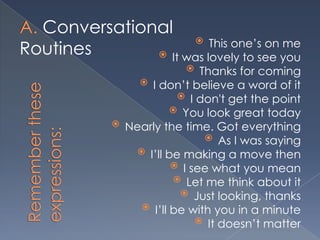
Conversational
                     This one’s on me
Routines       It was lovely to see you
                               Thanks for coming
                    I don’t believe a word of it
                            I don't get the point
                           You look great today
                Nearly the time. Got everything
                                  As I was saying
                   I’ll be making a move then
                           I see what you mean
                           Let me think about it
                             Just looking, thanks
                    I’ll be with you in a minute
                                It doesn’t matter
DO YOU KNOW WHAT I MEAN…
   AT THE END OF THE DAY…
    AND ALL THE REST OF IT
 AND ALL THAT SORT OF THING
   I DON’T KNOW WHAT IT IS
AND THIS, THAT AND THE OTHER
FROM THE POINT OF VIEW OF…
    A HELL OF A LOT OF…
 IN THE MIDDLE OF THE NIGHT
  DO YOU WANT ME TO DO…
 ON THE OTHER SIDE OF THE…
 I DON’T KNOW WHAT TO DO…
IF YOU SEE/ KNOW WHAT I MEAN
 DO YOU WANT TO HAVE A…
Styles of Speaking


 Got the time?
 I guess it must be quite late now?
 What’s the time?
 Do you have the time?
 Can I bother you for the time?
 You wouldn’t have the time would you?
Styles of Speaking
   Have you seen the boss?
    › Have you seen the manager? LEXICAL


   Whachadoin?
    › What are you doing? PHONOLOGICAL

   Seen Joe lately?
     › Have you seen Joe lately?
       GRAMMATICAL
Functions of Speaking


 1. Talk as interaction
 2. Talk as transaction
 3. Talk as performance
Talk as Interaction = Conversation
                                  (see sample dialogue)
Examples:
   Chatting to an adjacent passenger during a plane flight (polite
    conversation that does not seek to develop the basis for future
    social contact)
   Chatting to a school friend over coffee (casual conversation that
    serves to mark an ongoing friendship)
   A student chatting to his or her professor while waiting for an
    elevator (polite conversation that reflects unequal power between
    the two participants)
   Telling a friend about an amusing weekend experience, and
    hearing him or her recount a similar experience he or she once had
    (sharing personal recounts)
   Has a primarily social function
   Reflects role relationships
   Reflects speaker’s identity
   May be formal or casual
   Uses conversational conventions
   Reflects degrees of politeness
   Employs many generic words
   Uses conversational register
   Is jointly constructed
   Opening and closing conversations
   Choosing topics
   Making small-talk
   Joking
   Recounting personal incidents and
    experiences
   Turn-taking
   Using adjacency pairs
   Interrupting
   Reacting to others
   Using an appropriate style of speaking
Talk as Transaction
                              (see sample dialogue)

Examples:
   Classroom group discussions and problem-solving activities
   A class activity during which students design a poster
   Discussing needed computer repairs with a technician
   Discussing sightseeing plans with a hotel clerk or tour guide
   Making a telephone call to obtain flight information
   Asking someone for directions on the street
   Buying something in a shop
   Ordering food from a menu in a restaurant
   It has a primarily information focus.
   The main focus is on the message and not the
    participants.
   Participants employ communication
    strategies to make themselves understood.
   There may be frequent questions, repetitions,
    and comprehension checks, as in the
    example from the preceding classroom
    lesson.
   There may be negotiation and digression.
   Linguistic accuracy is not always important.
   Explaining a need or intention
   Describing something
   Asking questions
   Asking for clarification
   Confirming information
   Justifying an opinion
   Making suggestions
   Clarifying understanding
   Making comparisons
   Agreeing and disagreeing
Talk as Performance


  Examples:
   Giving a class report about a
    school trip
   Conducting a class debate
   Giving a speech of welcome
   Making a sales presentation
   Giving a lecture
 A focus on both message and
  audience
 Predictable organization and
  sequencing
 Importance of both form and
  accuracy
 Language is more like written
  language
 Often monologic
   Using an appropriate format
   Presenting information in an
    appropriate sequence
   Maintaining audience engagement
   Using correct pronunciation and
    grammar
   Creating an effect on the audience
   Using appropriate vocabulary
   Using an appropriate opening and
    closing
Now identify the
different activities
 and categorise
       them.
          (see activities Upstream)
   Discuss
       (P. 165)
   Useful language + discuss
       (P. 171 Ex 18 & 19)
   Useful language + discuss
       (P. 172 Ex 20a & b)
   Discuss
       (P. 172 Ex 21a)
   Exam Practice: Individual long turn
       (P. 173 Ex 26)
And what
about these?
    (see activities CELTA p. 56-59)
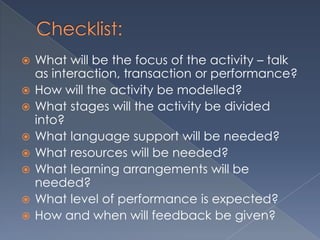
   What will be the focus of the activity – talk
    as interaction, transaction or performance?
   How will the activity be modelled?
   What stages will the activity be divided
    into?
   What language support will be needed?
   What resources will be needed?
   What learning arrangements will be
    needed?
   What level of performance is expected?
   How and when will feedback be given?
Listening & speaking part 2

Listening & speaking part 2

  • 1.
    Noticing AGAIN! Canyou think of activities to focus on ACQUISITION (use the tape scripts to so do). Read the text on pages 166 & 167 for next class, and bring materials/ ideas about the topic of respect and discrimination.
  • 3.
  • 4.
    A. Conversational Routines B. Styles of Speaking C. Functions of speaking
  • 5.
    Conversational  This one’s on me Routines  It was lovely to see you  Thanks for coming  I don’t believe a word of it  I don't get the point  You look great today  Nearly the time. Got everything  As I was saying  I’ll be making a move then  I see what you mean  Let me think about it  Just looking, thanks  I’ll be with you in a minute  It doesn’t matter
  • 6.
    DO YOU KNOWWHAT I MEAN… AT THE END OF THE DAY… AND ALL THE REST OF IT AND ALL THAT SORT OF THING I DON’T KNOW WHAT IT IS AND THIS, THAT AND THE OTHER FROM THE POINT OF VIEW OF… A HELL OF A LOT OF… IN THE MIDDLE OF THE NIGHT DO YOU WANT ME TO DO… ON THE OTHER SIDE OF THE… I DON’T KNOW WHAT TO DO… IF YOU SEE/ KNOW WHAT I MEAN DO YOU WANT TO HAVE A…
  • 7.
    Styles of Speaking Got the time?  I guess it must be quite late now?  What’s the time?  Do you have the time?  Can I bother you for the time?  You wouldn’t have the time would you?
  • 8.
    Styles of Speaking  Have you seen the boss? › Have you seen the manager? LEXICAL  Whachadoin? › What are you doing? PHONOLOGICAL  Seen Joe lately? › Have you seen Joe lately? GRAMMATICAL
  • 9.
    Functions of Speaking 1. Talk as interaction 2. Talk as transaction 3. Talk as performance
  • 10.
    Talk as Interaction= Conversation (see sample dialogue) Examples:  Chatting to an adjacent passenger during a plane flight (polite conversation that does not seek to develop the basis for future social contact)  Chatting to a school friend over coffee (casual conversation that serves to mark an ongoing friendship)  A student chatting to his or her professor while waiting for an elevator (polite conversation that reflects unequal power between the two participants)  Telling a friend about an amusing weekend experience, and hearing him or her recount a similar experience he or she once had (sharing personal recounts)
  • 11.
    Has a primarily social function  Reflects role relationships  Reflects speaker’s identity  May be formal or casual  Uses conversational conventions  Reflects degrees of politeness  Employs many generic words  Uses conversational register  Is jointly constructed
  • 12.
    Opening and closing conversations  Choosing topics  Making small-talk  Joking  Recounting personal incidents and experiences  Turn-taking  Using adjacency pairs  Interrupting  Reacting to others  Using an appropriate style of speaking
  • 13.
    Talk as Transaction (see sample dialogue) Examples:  Classroom group discussions and problem-solving activities  A class activity during which students design a poster  Discussing needed computer repairs with a technician  Discussing sightseeing plans with a hotel clerk or tour guide  Making a telephone call to obtain flight information  Asking someone for directions on the street  Buying something in a shop  Ordering food from a menu in a restaurant
  • 14.
    It has a primarily information focus.  The main focus is on the message and not the participants.  Participants employ communication strategies to make themselves understood.  There may be frequent questions, repetitions, and comprehension checks, as in the example from the preceding classroom lesson.  There may be negotiation and digression.  Linguistic accuracy is not always important.
  • 15.
    Explaining a need or intention  Describing something  Asking questions  Asking for clarification  Confirming information  Justifying an opinion  Making suggestions  Clarifying understanding  Making comparisons  Agreeing and disagreeing
  • 16.
    Talk as Performance Examples:  Giving a class report about a school trip  Conducting a class debate  Giving a speech of welcome  Making a sales presentation  Giving a lecture
  • 17.
     A focuson both message and audience  Predictable organization and sequencing  Importance of both form and accuracy  Language is more like written language  Often monologic
  • 18.
    Using an appropriate format  Presenting information in an appropriate sequence  Maintaining audience engagement  Using correct pronunciation and grammar  Creating an effect on the audience  Using appropriate vocabulary  Using an appropriate opening and closing
  • 19.
    Now identify the differentactivities and categorise them. (see activities Upstream)
  • 20.
    Discuss  (P. 165)  Useful language + discuss  (P. 171 Ex 18 & 19)  Useful language + discuss  (P. 172 Ex 20a & b)  Discuss  (P. 172 Ex 21a)  Exam Practice: Individual long turn  (P. 173 Ex 26)
  • 21.
    And what about these? (see activities CELTA p. 56-59)
  • 22.
    What will be the focus of the activity – talk as interaction, transaction or performance?  How will the activity be modelled?  What stages will the activity be divided into?  What language support will be needed?  What resources will be needed?  What learning arrangements will be needed?  What level of performance is expected?  How and when will feedback be given?