SEROTONIN
SYNTHESIS AND ITS MECHANISM
History
• In 1935, Vittorio Erspamer showed that an
extract from enterochromaffin cells made
intestines contract.
• Two years later, Erspamer was able to show that
it was a previously unknown amine, which he
named enteramine.
• In 1948, Maurice M. Rapport, Arda Green, and
Irvine Page of the Cleveland Clinic discovered a
vasoconstrictor substance in blood serum and
named it SEROTONIN.
• 5-HT was synthesised in 1951.
• In 1957,Gaddum & Picarelli proposed 2
distinct 5-HT receptor subtypes-M & D
receptors.
• In 1979, Peroutka & Snyder provided evidence
for 2 distinct recognition sites for 5-HT.
Anatomy
• The neurons of the raphe nuclei are the
principle source of 5-HT release in the brain.
• The raphe nuclei are neurons grouped into 9
pairs and distributed along the entire length of
the brainstem, centered around the reticular
formation.
• Axons from the neurons of the raphe nuclei
form a neurotransmitter system, reaching
almost every part of the CNS.
• Axons of neurons in the lower raphe nuclei
terminate in the cerebellum and spinal cord,
while the axons of the higher nuclei spread
out in the entire brain.
Factor Enhances
serotonin levels
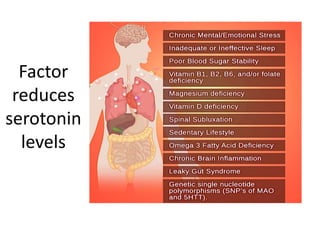
Factor
reduces
serotonin
levels
Biosynthesis
• Hydroxylation at C5 is rate limiting step, can be
blocked by p-chlorophenylalanine & p-
chloroamphetamine.
• 5-HT is concentrated in synaptic vesicles by a vesicle
associated transporter (VAT) that is blocked by
reserpine.
• Serotonin or 5-Hydroxytryptamine (5-HT) is a
monoamine neurotransmitter.
• Biochemically derived from tryptophan, serotonin is
primarily found in the
– Enterochromaffin cells in Gastrointestinal tract (˃ 90 %)
– Platelets
– Central nervous system (CNS)
TERMINATION
• Serotonergic action is terminated primarily via
uptake of 5-HT from the synapse.
• This is accomplished through the specific
monoamine transporter for 5-HT, SERT, on the
presynaptic neuron.
• Another monoamine transporter known as Plasma
membrane monoamine transporter [PMAT] has been
regarded to be important in the clearance of
Serotonin.
5-HT RECEPTORS
• The 5-HT receptors are the receptors for serotonin.
• They are located on the cell membrane of nerve cells
and mediate the effects of serotonin as the
endogenous ligand.
• All 5-HT receptors (except 5-HT3) are G protein-
coupled, seven transmembrane (or heptahelical)
receptors that activate an intracellular second
messenger cascade.
SEROTONIN RECEPTORS
Family Type Mechanism Potential
5-HT1 G-protein coupled.
Decreasing cellular
levels of cAMP.
Inhibitory
5-HT2 G-protein coupled.
Increasing cellular levels
of IP3 and DAG.
Excitatory
5-HT3
Ligandg
gated Na+ and K+ cation
channel.
Depolarizing plasma
membrane.
Excitatory
5-HT4 G-protein coupled.
Increasing cellular levels
of cAMP.
Excitatory
5-HT5 G-protein coupled.
Decreasing cellular
levels of cAMP.
Inhibitory
5-HT6 G-protein coupled.
Increasing cellular levels
of cAMP.
Excitatory
5-HT7 G-protein coupled.
Increasing cellular levels
of cAMP.
Excitatory
5-HT 1B/1D
• cause constriction of cranial blood vessels.
• Selective agonist- Sumatriptan
• It also cause inhibition of NA release from
sympathetic nerve endings & inflammatory
neuropeptides from nerve endings in cranial
blood vessels
5- HT 2 RECEPTOR
• It is a G protein coupled receptor acts by ↑IP3/DAG
• Earlier designated as D type.
• It is of 3 types.
– 5-HT 2A -Most widely expressed, localized in
platelets, vascular & visceral smooth muscle,
cerebral cortex.
Mediates most of the direct actions of 5-HT like
vasoconstriction, intestinal, uterine & bronchial
contraction, platelet aggregation & activation of
cerebral neurons.
Selective agonist – α-methyl-5-HT
Selective antagonist – Ketanserin
• 5-HT2B – Localized in stomach fundus
– Selective agonist- α-methyl-5-HT
– Selective antagonist – SB204741
• 5- HT2C – Localized in choroid plexus, hippocampus,
substantia niagra.
– It elicits vasodilatation through EDRF release.
• Selective agonist- α-methyl-5-HT
• Selective antagonist – Mesulergine
5- HT 3 receptor
• It is a Na+ - K+ ion channel
Localized in area postrema, sensory & enteric
nerves
 Mediates indirect & reflex effects of 5-HT at :
a) Somatic & autonomic nerve endings- pain, itch ,
coronary chemoreflex (bradycardia, ↓BP due to
withdrawal of sympathetic tone, respiratory
stimulation or apnea elicited by stimulation of
receptors in coronary bed).
B. Nerve endings in myenteric plexus- ↑ peristalsis,
emetic reflex
C. Area postrema & NTS in brain stem- nausea, vomiting
 Selective agonist – 2-methyl-5-HT,
 Selective antagonist – Granisetron, Ondansetron
,Tropisetron
5- HT4 receptor
It is a G protein coupled receptor acts by ↑
cAMP
Localized in hippocampus & colliculi (↓ K
conductance), smooth muscle of gut (↑
intestinal secretion & peristalsis)
Selective agonist- 5-methoxytryptamine,
Renzapride
5-HT5 receptor
It is a G protein coupled receptor acts by ↓
cAMP
Localized in hippocampus
It is of 2 types-5-HT5A & 5-HT5B
ACTIONS
Platelets
• 5-HT is not synthesized in platelets, but is
taken up from the circulation and stored in
secretory granules by active transport.
• Na dependent transport across the surface
membrane of platelets like VMAT2.
• Measuring the rate of Na+-dependent 5-HT
uptake by platelets provides a sensitive assay
for 5-HT uptake inhibitors.
• Whenever platelets contact with injured
endothelium, they release substances that
promote platelet aggregation, and secondarily,
they release 5-HT.
• 5-HT binds to platelet 5-HT2A receptors and elicits
a weak aggregation response that is markedly
augmented by the presence of collagen.
• If the damaged blood vessel is injured to a depth
where vascular smooth muscle is exposed, 5-HT
exerts a direct vasoconstrictor effect, thereby
contributing to hemostasis, which is enhanced by
locally released autocoids (thromboxaneA2, kinins,
and vasoactive peptides).
Cardiovascular System
• 5-HT is vasoconstrictor, particularly in the
splanchnic, renal, pulmonary, and cerebral
vasculatures.
• 5-HT has positive inotropic and chronotropic
actions on the heart.
• Activation of 5-HT3 receptors on vagus nerve
endings elicits the Bezold-Jarisch reflex,
causing extreme bradycardia and hypotension.
On BP
• Triphasic response is classically seen on IV
injection
– Early sharp fall in BP- due to coronary chemo
reflex
– Brief rise in BP- due to vasoconstriction & ↑ CO
– Prolonged fall in BP- due to arteriolar
vasodilatation & extravasation of fluid.
GI Tract
• Enterochromaffin cells in the gastric mucosa
are the site of the synthesis and most of the
storage of 5-HT in the body and are the source
of circulating 5-HT.
• These cells synthesize 5-HT from tryptophan,
and store 5-HT and other autacoids, such as
the vasodilator peptide substance P and other
kinins.
• Enteric 5-HT is augmented by mechanical
stretching, such as that caused by food, and
by efferent vagal stimulation and enters the
portal vein then metabolized by MAO-A in the
liver.
• 5-HT that survives hepatic oxidation may be
captured by platelets or rapidly removed by
the endothelium of lung capillaries and
inactivated.
• It inhibits gastric secretion (acid & pepsin) but
↑ mucus production ulcer protective
property
• Nerve endings & Adrenal medulla
– Activation of afferent nerve endings- tingling &
pricking sensation, pain
• Respiration
– Brief stimulation of respiration & hyperventilation.
– Large doses can cause transient apnea (coronary
chemoreflex).
• CNS
– Direct injection in brain causes sleepiness, change
in body temperature, hunger & behavioural
effects.
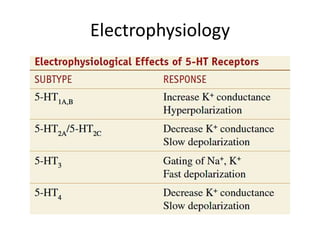
Electrophysiology
PATHOPHYSIOLOGICAL ROLES
1. Neurotransmitter
– It is a neurotransmitter in brain & is involved in sleep,
temperature regulation, thought, cognitive function, behaviour
& mood (imbalance causes affective disorders & schizophrenia),
vomiting & pain perception.
2. Precursor of melatonin in pineal gland
– regulates biological clock & maintain circadian rhythm.
3. Neuro-endocrine function
– Hypothalamic neurons that control release of anterior pituitary
hormones are probably regulated by serotonergic mechanism.
4.Nausea & vomiting
– especially evoked by cytotoxic drugs or radiotherapy is
mediated by release of 5-HT (5-HT 3 receptors in gut ,area
postrema & NTS)
5.Migraine
– It initiates vasoconstrictor phase of migraine & participates in
neurogenic inflammation of cranial blood vessels.
6.Haemostasis
– It causes platelet aggregation & clot formation at site of
injury to blood vessel & also promotes retraction of injured
vessel.
7.Raynaud’s phenomenon
– 5-HT release from platelets may trigger acute vasospastic
episodes of larger arteries.
– Ketanserin (5-HT2 antagonist) is used as a prophylactic.
8. Hypertension
– ↑ responsiveness to 5-HT & ↓ uptake & clearance by
platelets seen in hypertensives.
– Ketanserin has anti-hypertensive property
9.Intestinal motility
– Enterochromaffin cells & 5-HT containing neurons regulate
peristalsis & local reflexes in gut(activated by intestinal
distension).
10.Carcinoid tumours
– They produce massive amounts of 5-HT. Bowel
hypermotility & bronchoconstriction in carcinoid is due to
5-HT.
Pellagra may occur due to diversion of tryptophan
for synthesizing 5-HT.
DRUGS AFFECTING 5-HT SYSTEM
1. 5-HT Precursor
– Tryptophan increases brain 5-HT & produces behavioural
effects.
2. Synthesis lnhibitor:
– p-Chlorophenylalanine (PCPA) selectively inhibits tryptophan
hydroxylase (rate limiting step) & ↓5-HT level in tissues.
– It is not used clinically due to high toxicity.
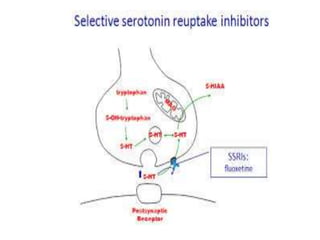
3. Uptake Inhibitor –
– TCAs inhibit 5-HT & NA uptake. Fluoxetine & Sertraline are
selective serotonin reuptake inhibitors(SSRI).
4.Storage Inhibitor:
– Reserpine blocks 5-HT (as well as NA) uptake in
storage granules & cause depletion.
– Fenfluramine selectively releases 5-HT & has
anorectic property.
5. Degradation Inhibitor:
– Nonselective MAO inhibitor (Tranylcypromine) &
Selective MAO inhibitor (Clorgyline) ↑ 5-HT
content by inhibiting degradation.
6. Neuronal Degeneration-
– 5,6 dihydroxytryptamine selectively destroys 5-HT
neurons.
5-HT AGONISTS
1. D-Lysergic acid diethyl amide (LSD)
– It is a potent hallucinogen.
– It activates 5-HT 1A on raphe cell bodies, 5-HT 2A/2C
(responsible for hallucinogenic effect) & 5-HT 5-7 in brain.
2. Azapirones
– They include Buspirone, Gepirone & Ipsapirone.
– It is a new class of anti-anxiety drugs which do not cause
sedation.
– They act as partial agonist of 5-HT 1A receptors in brain.
3. 8-Hydroxydipropylamino tetraline (8-OH DPAT)
– It is a highly selective 5- HT 1A agonist used as an experimental
tool.
4. Triptans like Sumatriptan, Zolmitriptan, Naratriptan,
Rizatriptan-
– selective 5-HT 1B/1D agonist, constrict cerebral blood vessels &
is the most effective treatment of migraine attacks.
5.Cisapride, Mosapride
– 5-HT 4 agonist.
– It increases GI motility & is used in GERD, irritable bowel
syndrome.
– Renzapride & Prucalopride is also 5- HT 4 agonist.
5-HT ANTAGONISTS
Cyproheptadine
• It blocks 5-HT 2A receptors & also has H1 anti-histaminic,
anticholinergic & sedative properties.
• It is used to ↑ appetite in children & poor eaters to
promote weight gain.
• Used to control intestinal manifestations of carcinoid &
post-gastrectomy dumping syndromes.
• Also in antagonizing priapism/orgasmic delay caused by
5-HT uptake inhibitors (Fluoxetine & Trazadone).
• Used in allergic conditions.
• Side effects- drowsiness, dry mouth, confusion, ataxia,
weight gain.
Methysergide
• It antagonizes actions of 5-HT on smooth
muscles including that of blood vessels.
• Potent 5-HT 2A/2C antagonist
• Used in migraine prophylaxis, carcinoid &
post-gastrectomy dumping syndromes.
• Side effects-
– abdominal, pulmonary & endocardial fibrosis on
prolonged use.
Ketanserin
• It is selective 5-HT 2 antagonist (5-HT 2A> 5-
HT2C).
• It blocks 5-HT induced vasoconstriction, platelet
aggregation & contraction of airway smooth
muscle.
• It also has α1, H1 & dopaminergic blocking
activity.
• It is used as an effective anti-hypertensive (α1
blockade).
• Ritanserin is a more selective 5-HT 2A congener
of Ketanserin.
Clozapine
• It is an atypical antipsychotic which blocks
dopamine & 5-HT 2A/2C receptors.
• It is also an inverse agonist at cerebral 5-HT
2A/2C receptors so used in resistant
schizophrenia.
Risperidone
• This atypical antipsychotic is 5-HT 2A
& D2 antagonist like Clozapine.
• It is used in schizophrenia.
Ondansetron
• It is selective 5-HT 3 antagonist.
• It is used in controlling nausea &
vomiting due to anticancer drugs &
radiotherapy.
• Granisetron & Tropisetron are other
selective 5-HT 3 antagonists.
CLINICAL PHARMACOLOGY OF 5-HT
• Serotonin has no clinical application as a drug.
• However, its receptor agonism & antagonism
has many clinical implications.
• Serotonin is closely related with behaviour,
mood & is therefore important in many
neuropsychiatric diseases and their
symptomatology.
• It also has a role in many other clinical
conditions.
USES
1. Major Depression– SSRIs like Fluoxetine, Sertraline
2. Obsessive compulsive disorder – SSRIs
3. Phobic disorders - SSRIs
4. Premenstrual symptoms - SSRIs
5. Somatoform disorders (Hypochondriasis) - SSRIs
6. Post traumatic stress disorder - SSRIs
7. Neuropathic pain & Fibromyalgia pain
8. Anxiety neurosis – Azapirones like Buspirone,
Gepirone Ipsapirone (5- HT 1A partial agonist)
OTHER CLINICAL USES
1. Migraine – Triptans like Sumatriptan, Zolmitriptan,
Naratriptan, Rizatriptan – 5-HT 1B/1D agonist
2. Appetite stimulant – Cyproheptadine (5-HT 2A antagonist)
3. Schizophrenia – Clozapine (5-HT 2A/2C antagonist)
4. Chemotherapy induced nausea & vomiting (CINV) –
Ondansetron (Emeset 4,8 mg tabs ,2mg/ml inj in 2ml & 4ml
amps), Granisetron (Granicip 1,2mg tabs ,1mg/ml inj in 1ml
& 3ml amps) & Tropisetron (5-HT 3 antagonist).
5. GERD – Mosapride available as Moza 2.5mg ,5mg tabs (5-HT
4 agonist )
6. Irritable Bowel Syndrome – Mosapride, Prucalopride (5-HT 4
agonist)
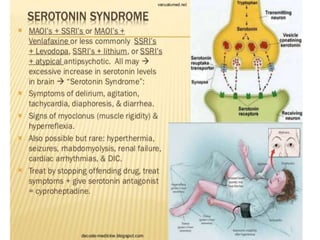
SEROTONIN SYNDROME
• Precipitating drugs – SSRIs, second generation
antidepressants, MAOIs, Linezolid, Tramadol,
Meperidine, Fentanyl, Ondansetron, Sumatriptan, LSD,
St.John’s wort.
• Onset within hours.
• S/S – Hypertension, hyper-reflexia, tremor, clonus,
hyperthermia, hyperactive bowel sounds, diarrhea,
mydriasis, agitation, coma.
• T/T – Sedation by Benzodiazepines, Intubation &
ventilation 5-HT 2 block by Cyproheptadine or
Chlorpromazine.
What is Migraine?
• A debilitating neurobiological headache disorder
• Affects 18% of women & 6% of men
• Decreases with age
• Two categories
– 80% = common migraine
– 20% = classic migraine (w/ aura)
MIGRAINE
• It is a disorder characterized by pulsating headache,
usually restricted to one side, which comes in attacks
lasting 4-48 hrs & is often associated with nausea,
vomiting, sensitivity to light & sound, flashes of light,
vertigo, loose motions & other symptoms.
• It is of 2 types
a) Migraine with aura (classical migraine) – headache is
preceded by visual or neurological symptoms.
b) Migraine without aura (common migraine)
• 5-HT appears to play a pivotal role in this disorder.
Causes of Migraine
• Increased excitability of CNS
• Meningeal blood vessel dilation
• Activation of perivascular sensory trigeminal nerves
• Pain impulses
• Vasoactive neuropeptides contain:
– substance P
– calcitonin gene-related peptide (CGRP)
– neurokinin A
• combination of increased pain sensitivity, tissue and vessel
swelling, and inflammation
MIGRAINE - PATHOPHYSIOLOGY
VASCULAR THEORY
• Intracerebral blood vessel vasoconstriction – aura
• Intracranial/Extra cranial blood vessel vasodilatation – headache
SEROTONIN THEORY
• Decreased serotonin levels linked to migraine
• Specific serotonin receptors found in blood vessels of brain
• Neurovascular process, in which neural events result in activation of
blood vessels, which in turn results in pain and further nerve
activation
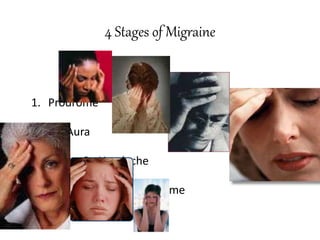
4 Stages of Migraine
1. Prodrome
2. Aura
3. Headache
4. Postdrome
History of Treatment
• Herbal brews and folk practices
• 1200 BC: Egyptians – clay crocodile & magic herbs
• 10th century AD: Arabian physicians – garlic or hot
iron to incision at temple
• Mid-1600’s AD: Dr. Thomas Willis – enemas, blood
letting, leeches, and natural products
• 1870’s: cold bandage on head, quiet room, and sleep
DRUG THERAPY OF MIGRAINE
1. Mild Migraine – Cases having <1 attack/month of throbbing
but tolerable headache lasting upto 8 hrs which does not
incapacitate the individual. Drugs used include-
a. Analgesics - Paracetamol (0.5-1 gm) or aspirin (300-600mg)
4-6 hourly.
b. NSAIDs – Drugs like Ibuprofen (400-800 mg 8 hourly) ,
Naproxen (500mg followed by 250mg 8 hourly) , Diclofenac
(50mg 8 hourly), Mephenamic acid (500mg 8 hourly) either
alone or combined with Paracetamol/ Codeine/ Diazepam/
Diphenhydramine / Caffeine.
c. Antiemetics – Metoclopramide (10mg oral/im) is commonly
used. Domperidone (10-20mg oral) & Prochlorperazine (10-
25 mg oral/im) are also effective.
2. Moderate Migraine – It is when throbbing headache is more
intense, lasts for 6-24 hours, nausea/vomiting & other features are
prominent & patient is functionally impaired. 1 or more attacks
/month occur. Treatment includes-
a) NSAIDs or their combinations
b) Ergot alkaloids – Ergotamine (1mg oral at half hr interval till relief
is obtained or a total of 6mg is given). Caffeine 100mg is taken
with ergotamine.
c) Sumatriptan – 50-100mg oral at onset of migraine, repeated once
within 24 hrs if required. It is the only triptan available for
parenteral use. Dose – 6mg sc
Rizatriptan is more potent, has higher bioavailability with fast
onset of action. Dose – 10mg, repeat once after 2 hr if required.
d) Antiemetics
3. Severe Migraine – Patients suffer 2-3 or more
attacks/month of severe throbbing headache lasts 12-48
hours, accompanied by vertigo, vomiting & other
symptoms, the patient is grossly incapacitated during
attack. Treatment includes-
a) Ergot alkaloids
b) Sumatriptan
c) Antiemetics
Prophylactic regime lasting 6 months is recommended.
PROPHYLAXIS OF MIGRAINE
1. β adrenergic blockers – Propranolol 40mg BD, may be
increased upto 160mg BD
2. TCAs – Amitriptylline 25-50mg HS. It is better suited for
patients who also suffer from depression.
3. Calcium channel blockers – Verapamil is useful.
Flunarizine 10-20 mg OD is more effective.
4. Anticonvulsants – Valproic acid 400-1200mg/day &
Gabapentin 300-1200 mg/day. Topiramate 25 mg OD is
also useful.
5. 5-HT antagonists – Methysergide & Cyproheptadine
may be helpful but seldom used now.
RECENT ADVANCES
• Tandospirone – Also known as Metanopirone. It is a 5-HT
1A partial agonist. It is used in China & Japan as an
anxiolytic & antidepressant. Dose – 30mg/day.
• Agomelatine – 5-HT 2C antagonist & agonist at melatonin
receptor. Used in depression.
• Nelotanserin (APD-125) – selective 5-HT 2A inverse
agonist developed by Arena pharmaceuticals for
treatment of insomnia.
• Palonosetron (Aloxi) – approved by FDA in 2003 for iv
use in preventing delayed chemotherapy induced nausea
& vomiting. Oral formulation approved in 2008 for acute
chemotherapy induced nausea & vomiting.
CONTD…
• Ramosetron – 5-HT 3 antagonist available in Japan &
South east Asian countries used in chemotherapy
induced nausea & vomiting.
• Cilansetron – 5-HT 3 antagonist used in Irritable
Bowel Syndrome (IBS) where diarrhoea is the
dominant symptom.

Serotonin

  • 1.
  • 3.
    History • In 1935,Vittorio Erspamer showed that an extract from enterochromaffin cells made intestines contract. • Two years later, Erspamer was able to show that it was a previously unknown amine, which he named enteramine. • In 1948, Maurice M. Rapport, Arda Green, and Irvine Page of the Cleveland Clinic discovered a vasoconstrictor substance in blood serum and named it SEROTONIN.
  • 4.
    • 5-HT wassynthesised in 1951. • In 1957,Gaddum & Picarelli proposed 2 distinct 5-HT receptor subtypes-M & D receptors. • In 1979, Peroutka & Snyder provided evidence for 2 distinct recognition sites for 5-HT.
  • 5.
    Anatomy • The neuronsof the raphe nuclei are the principle source of 5-HT release in the brain. • The raphe nuclei are neurons grouped into 9 pairs and distributed along the entire length of the brainstem, centered around the reticular formation.
  • 6.
    • Axons fromthe neurons of the raphe nuclei form a neurotransmitter system, reaching almost every part of the CNS. • Axons of neurons in the lower raphe nuclei terminate in the cerebellum and spinal cord, while the axons of the higher nuclei spread out in the entire brain.
  • 10.
  • 11.
  • 12.
  • 16.
    • Hydroxylation atC5 is rate limiting step, can be blocked by p-chlorophenylalanine & p- chloroamphetamine. • 5-HT is concentrated in synaptic vesicles by a vesicle associated transporter (VAT) that is blocked by reserpine. • Serotonin or 5-Hydroxytryptamine (5-HT) is a monoamine neurotransmitter. • Biochemically derived from tryptophan, serotonin is primarily found in the – Enterochromaffin cells in Gastrointestinal tract (˃ 90 %) – Platelets – Central nervous system (CNS)
  • 17.
    TERMINATION • Serotonergic actionis terminated primarily via uptake of 5-HT from the synapse. • This is accomplished through the specific monoamine transporter for 5-HT, SERT, on the presynaptic neuron. • Another monoamine transporter known as Plasma membrane monoamine transporter [PMAT] has been regarded to be important in the clearance of Serotonin.
  • 18.
    5-HT RECEPTORS • The5-HT receptors are the receptors for serotonin. • They are located on the cell membrane of nerve cells and mediate the effects of serotonin as the endogenous ligand. • All 5-HT receptors (except 5-HT3) are G protein- coupled, seven transmembrane (or heptahelical) receptors that activate an intracellular second messenger cascade.
  • 21.
    SEROTONIN RECEPTORS Family TypeMechanism Potential 5-HT1 G-protein coupled. Decreasing cellular levels of cAMP. Inhibitory 5-HT2 G-protein coupled. Increasing cellular levels of IP3 and DAG. Excitatory 5-HT3 Ligandg gated Na+ and K+ cation channel. Depolarizing plasma membrane. Excitatory 5-HT4 G-protein coupled. Increasing cellular levels of cAMP. Excitatory 5-HT5 G-protein coupled. Decreasing cellular levels of cAMP. Inhibitory 5-HT6 G-protein coupled. Increasing cellular levels of cAMP. Excitatory 5-HT7 G-protein coupled. Increasing cellular levels of cAMP. Excitatory
  • 24.
    5-HT 1B/1D • causeconstriction of cranial blood vessels. • Selective agonist- Sumatriptan • It also cause inhibition of NA release from sympathetic nerve endings & inflammatory neuropeptides from nerve endings in cranial blood vessels
  • 25.
    5- HT 2RECEPTOR • It is a G protein coupled receptor acts by ↑IP3/DAG • Earlier designated as D type. • It is of 3 types. – 5-HT 2A -Most widely expressed, localized in platelets, vascular & visceral smooth muscle, cerebral cortex. Mediates most of the direct actions of 5-HT like vasoconstriction, intestinal, uterine & bronchial contraction, platelet aggregation & activation of cerebral neurons. Selective agonist – α-methyl-5-HT Selective antagonist – Ketanserin
  • 26.
    • 5-HT2B –Localized in stomach fundus – Selective agonist- α-methyl-5-HT – Selective antagonist – SB204741 • 5- HT2C – Localized in choroid plexus, hippocampus, substantia niagra. – It elicits vasodilatation through EDRF release. • Selective agonist- α-methyl-5-HT • Selective antagonist – Mesulergine
  • 27.
    5- HT 3receptor • It is a Na+ - K+ ion channel Localized in area postrema, sensory & enteric nerves  Mediates indirect & reflex effects of 5-HT at : a) Somatic & autonomic nerve endings- pain, itch , coronary chemoreflex (bradycardia, ↓BP due to withdrawal of sympathetic tone, respiratory stimulation or apnea elicited by stimulation of receptors in coronary bed).
  • 28.
    B. Nerve endingsin myenteric plexus- ↑ peristalsis, emetic reflex C. Area postrema & NTS in brain stem- nausea, vomiting  Selective agonist – 2-methyl-5-HT,  Selective antagonist – Granisetron, Ondansetron ,Tropisetron
  • 29.
    5- HT4 receptor Itis a G protein coupled receptor acts by ↑ cAMP Localized in hippocampus & colliculi (↓ K conductance), smooth muscle of gut (↑ intestinal secretion & peristalsis) Selective agonist- 5-methoxytryptamine, Renzapride
  • 30.
    5-HT5 receptor It isa G protein coupled receptor acts by ↓ cAMP Localized in hippocampus It is of 2 types-5-HT5A & 5-HT5B
  • 31.
  • 32.
    Platelets • 5-HT isnot synthesized in platelets, but is taken up from the circulation and stored in secretory granules by active transport. • Na dependent transport across the surface membrane of platelets like VMAT2. • Measuring the rate of Na+-dependent 5-HT uptake by platelets provides a sensitive assay for 5-HT uptake inhibitors.
  • 33.
    • Whenever plateletscontact with injured endothelium, they release substances that promote platelet aggregation, and secondarily, they release 5-HT. • 5-HT binds to platelet 5-HT2A receptors and elicits a weak aggregation response that is markedly augmented by the presence of collagen. • If the damaged blood vessel is injured to a depth where vascular smooth muscle is exposed, 5-HT exerts a direct vasoconstrictor effect, thereby contributing to hemostasis, which is enhanced by locally released autocoids (thromboxaneA2, kinins, and vasoactive peptides).
  • 35.
    Cardiovascular System • 5-HTis vasoconstrictor, particularly in the splanchnic, renal, pulmonary, and cerebral vasculatures. • 5-HT has positive inotropic and chronotropic actions on the heart. • Activation of 5-HT3 receptors on vagus nerve endings elicits the Bezold-Jarisch reflex, causing extreme bradycardia and hypotension.
  • 36.
    On BP • Triphasicresponse is classically seen on IV injection – Early sharp fall in BP- due to coronary chemo reflex – Brief rise in BP- due to vasoconstriction & ↑ CO – Prolonged fall in BP- due to arteriolar vasodilatation & extravasation of fluid.
  • 37.
    GI Tract • Enterochromaffincells in the gastric mucosa are the site of the synthesis and most of the storage of 5-HT in the body and are the source of circulating 5-HT. • These cells synthesize 5-HT from tryptophan, and store 5-HT and other autacoids, such as the vasodilator peptide substance P and other kinins.
  • 38.
    • Enteric 5-HTis augmented by mechanical stretching, such as that caused by food, and by efferent vagal stimulation and enters the portal vein then metabolized by MAO-A in the liver. • 5-HT that survives hepatic oxidation may be captured by platelets or rapidly removed by the endothelium of lung capillaries and inactivated.
  • 39.
    • It inhibitsgastric secretion (acid & pepsin) but ↑ mucus production ulcer protective property
  • 40.
    • Nerve endings& Adrenal medulla – Activation of afferent nerve endings- tingling & pricking sensation, pain • Respiration – Brief stimulation of respiration & hyperventilation. – Large doses can cause transient apnea (coronary chemoreflex). • CNS – Direct injection in brain causes sleepiness, change in body temperature, hunger & behavioural effects.
  • 41.
  • 42.
    PATHOPHYSIOLOGICAL ROLES 1. Neurotransmitter –It is a neurotransmitter in brain & is involved in sleep, temperature regulation, thought, cognitive function, behaviour & mood (imbalance causes affective disorders & schizophrenia), vomiting & pain perception. 2. Precursor of melatonin in pineal gland – regulates biological clock & maintain circadian rhythm. 3. Neuro-endocrine function – Hypothalamic neurons that control release of anterior pituitary hormones are probably regulated by serotonergic mechanism.
  • 43.
    4.Nausea & vomiting –especially evoked by cytotoxic drugs or radiotherapy is mediated by release of 5-HT (5-HT 3 receptors in gut ,area postrema & NTS) 5.Migraine – It initiates vasoconstrictor phase of migraine & participates in neurogenic inflammation of cranial blood vessels. 6.Haemostasis – It causes platelet aggregation & clot formation at site of injury to blood vessel & also promotes retraction of injured vessel. 7.Raynaud’s phenomenon – 5-HT release from platelets may trigger acute vasospastic episodes of larger arteries. – Ketanserin (5-HT2 antagonist) is used as a prophylactic.
  • 44.
    8. Hypertension – ↑responsiveness to 5-HT & ↓ uptake & clearance by platelets seen in hypertensives. – Ketanserin has anti-hypertensive property 9.Intestinal motility – Enterochromaffin cells & 5-HT containing neurons regulate peristalsis & local reflexes in gut(activated by intestinal distension). 10.Carcinoid tumours – They produce massive amounts of 5-HT. Bowel hypermotility & bronchoconstriction in carcinoid is due to 5-HT. Pellagra may occur due to diversion of tryptophan for synthesizing 5-HT.
  • 45.
    DRUGS AFFECTING 5-HTSYSTEM 1. 5-HT Precursor – Tryptophan increases brain 5-HT & produces behavioural effects. 2. Synthesis lnhibitor: – p-Chlorophenylalanine (PCPA) selectively inhibits tryptophan hydroxylase (rate limiting step) & ↓5-HT level in tissues. – It is not used clinically due to high toxicity. 3. Uptake Inhibitor – – TCAs inhibit 5-HT & NA uptake. Fluoxetine & Sertraline are selective serotonin reuptake inhibitors(SSRI).
  • 47.
    4.Storage Inhibitor: – Reserpineblocks 5-HT (as well as NA) uptake in storage granules & cause depletion. – Fenfluramine selectively releases 5-HT & has anorectic property. 5. Degradation Inhibitor: – Nonselective MAO inhibitor (Tranylcypromine) & Selective MAO inhibitor (Clorgyline) ↑ 5-HT content by inhibiting degradation. 6. Neuronal Degeneration- – 5,6 dihydroxytryptamine selectively destroys 5-HT neurons.
  • 50.
    5-HT AGONISTS 1. D-Lysergicacid diethyl amide (LSD) – It is a potent hallucinogen. – It activates 5-HT 1A on raphe cell bodies, 5-HT 2A/2C (responsible for hallucinogenic effect) & 5-HT 5-7 in brain. 2. Azapirones – They include Buspirone, Gepirone & Ipsapirone. – It is a new class of anti-anxiety drugs which do not cause sedation. – They act as partial agonist of 5-HT 1A receptors in brain. 3. 8-Hydroxydipropylamino tetraline (8-OH DPAT) – It is a highly selective 5- HT 1A agonist used as an experimental tool.
  • 51.
    4. Triptans likeSumatriptan, Zolmitriptan, Naratriptan, Rizatriptan- – selective 5-HT 1B/1D agonist, constrict cerebral blood vessels & is the most effective treatment of migraine attacks. 5.Cisapride, Mosapride – 5-HT 4 agonist. – It increases GI motility & is used in GERD, irritable bowel syndrome. – Renzapride & Prucalopride is also 5- HT 4 agonist.
  • 52.
  • 53.
    Cyproheptadine • It blocks5-HT 2A receptors & also has H1 anti-histaminic, anticholinergic & sedative properties. • It is used to ↑ appetite in children & poor eaters to promote weight gain. • Used to control intestinal manifestations of carcinoid & post-gastrectomy dumping syndromes. • Also in antagonizing priapism/orgasmic delay caused by 5-HT uptake inhibitors (Fluoxetine & Trazadone). • Used in allergic conditions. • Side effects- drowsiness, dry mouth, confusion, ataxia, weight gain.
  • 54.
    Methysergide • It antagonizesactions of 5-HT on smooth muscles including that of blood vessels. • Potent 5-HT 2A/2C antagonist • Used in migraine prophylaxis, carcinoid & post-gastrectomy dumping syndromes. • Side effects- – abdominal, pulmonary & endocardial fibrosis on prolonged use.
  • 55.
    Ketanserin • It isselective 5-HT 2 antagonist (5-HT 2A> 5- HT2C). • It blocks 5-HT induced vasoconstriction, platelet aggregation & contraction of airway smooth muscle. • It also has α1, H1 & dopaminergic blocking activity. • It is used as an effective anti-hypertensive (α1 blockade). • Ritanserin is a more selective 5-HT 2A congener of Ketanserin.
  • 56.
    Clozapine • It isan atypical antipsychotic which blocks dopamine & 5-HT 2A/2C receptors. • It is also an inverse agonist at cerebral 5-HT 2A/2C receptors so used in resistant schizophrenia.
  • 57.
    Risperidone • This atypicalantipsychotic is 5-HT 2A & D2 antagonist like Clozapine. • It is used in schizophrenia.
  • 58.
    Ondansetron • It isselective 5-HT 3 antagonist. • It is used in controlling nausea & vomiting due to anticancer drugs & radiotherapy. • Granisetron & Tropisetron are other selective 5-HT 3 antagonists.
  • 59.
    CLINICAL PHARMACOLOGY OF5-HT • Serotonin has no clinical application as a drug. • However, its receptor agonism & antagonism has many clinical implications. • Serotonin is closely related with behaviour, mood & is therefore important in many neuropsychiatric diseases and their symptomatology. • It also has a role in many other clinical conditions.
  • 60.
    USES 1. Major Depression–SSRIs like Fluoxetine, Sertraline 2. Obsessive compulsive disorder – SSRIs 3. Phobic disorders - SSRIs 4. Premenstrual symptoms - SSRIs 5. Somatoform disorders (Hypochondriasis) - SSRIs 6. Post traumatic stress disorder - SSRIs 7. Neuropathic pain & Fibromyalgia pain 8. Anxiety neurosis – Azapirones like Buspirone, Gepirone Ipsapirone (5- HT 1A partial agonist)
  • 61.
    OTHER CLINICAL USES 1.Migraine – Triptans like Sumatriptan, Zolmitriptan, Naratriptan, Rizatriptan – 5-HT 1B/1D agonist 2. Appetite stimulant – Cyproheptadine (5-HT 2A antagonist) 3. Schizophrenia – Clozapine (5-HT 2A/2C antagonist) 4. Chemotherapy induced nausea & vomiting (CINV) – Ondansetron (Emeset 4,8 mg tabs ,2mg/ml inj in 2ml & 4ml amps), Granisetron (Granicip 1,2mg tabs ,1mg/ml inj in 1ml & 3ml amps) & Tropisetron (5-HT 3 antagonist). 5. GERD – Mosapride available as Moza 2.5mg ,5mg tabs (5-HT 4 agonist ) 6. Irritable Bowel Syndrome – Mosapride, Prucalopride (5-HT 4 agonist)
  • 62.
    SEROTONIN SYNDROME • Precipitatingdrugs – SSRIs, second generation antidepressants, MAOIs, Linezolid, Tramadol, Meperidine, Fentanyl, Ondansetron, Sumatriptan, LSD, St.John’s wort. • Onset within hours. • S/S – Hypertension, hyper-reflexia, tremor, clonus, hyperthermia, hyperactive bowel sounds, diarrhea, mydriasis, agitation, coma. • T/T – Sedation by Benzodiazepines, Intubation & ventilation 5-HT 2 block by Cyproheptadine or Chlorpromazine.
  • 65.
    What is Migraine? •A debilitating neurobiological headache disorder • Affects 18% of women & 6% of men • Decreases with age • Two categories – 80% = common migraine – 20% = classic migraine (w/ aura)
  • 66.
    MIGRAINE • It isa disorder characterized by pulsating headache, usually restricted to one side, which comes in attacks lasting 4-48 hrs & is often associated with nausea, vomiting, sensitivity to light & sound, flashes of light, vertigo, loose motions & other symptoms. • It is of 2 types a) Migraine with aura (classical migraine) – headache is preceded by visual or neurological symptoms. b) Migraine without aura (common migraine) • 5-HT appears to play a pivotal role in this disorder.
  • 67.
    Causes of Migraine •Increased excitability of CNS • Meningeal blood vessel dilation • Activation of perivascular sensory trigeminal nerves • Pain impulses • Vasoactive neuropeptides contain: – substance P – calcitonin gene-related peptide (CGRP) – neurokinin A • combination of increased pain sensitivity, tissue and vessel swelling, and inflammation
  • 68.
    MIGRAINE - PATHOPHYSIOLOGY VASCULARTHEORY • Intracerebral blood vessel vasoconstriction – aura • Intracranial/Extra cranial blood vessel vasodilatation – headache SEROTONIN THEORY • Decreased serotonin levels linked to migraine • Specific serotonin receptors found in blood vessels of brain • Neurovascular process, in which neural events result in activation of blood vessels, which in turn results in pain and further nerve activation
  • 70.
    4 Stages ofMigraine 1. Prodrome 2. Aura 3. Headache 4. Postdrome
  • 71.
    History of Treatment •Herbal brews and folk practices • 1200 BC: Egyptians – clay crocodile & magic herbs • 10th century AD: Arabian physicians – garlic or hot iron to incision at temple • Mid-1600’s AD: Dr. Thomas Willis – enemas, blood letting, leeches, and natural products • 1870’s: cold bandage on head, quiet room, and sleep
  • 72.
    DRUG THERAPY OFMIGRAINE 1. Mild Migraine – Cases having <1 attack/month of throbbing but tolerable headache lasting upto 8 hrs which does not incapacitate the individual. Drugs used include- a. Analgesics - Paracetamol (0.5-1 gm) or aspirin (300-600mg) 4-6 hourly. b. NSAIDs – Drugs like Ibuprofen (400-800 mg 8 hourly) , Naproxen (500mg followed by 250mg 8 hourly) , Diclofenac (50mg 8 hourly), Mephenamic acid (500mg 8 hourly) either alone or combined with Paracetamol/ Codeine/ Diazepam/ Diphenhydramine / Caffeine. c. Antiemetics – Metoclopramide (10mg oral/im) is commonly used. Domperidone (10-20mg oral) & Prochlorperazine (10- 25 mg oral/im) are also effective.
  • 73.
    2. Moderate Migraine– It is when throbbing headache is more intense, lasts for 6-24 hours, nausea/vomiting & other features are prominent & patient is functionally impaired. 1 or more attacks /month occur. Treatment includes- a) NSAIDs or their combinations b) Ergot alkaloids – Ergotamine (1mg oral at half hr interval till relief is obtained or a total of 6mg is given). Caffeine 100mg is taken with ergotamine. c) Sumatriptan – 50-100mg oral at onset of migraine, repeated once within 24 hrs if required. It is the only triptan available for parenteral use. Dose – 6mg sc Rizatriptan is more potent, has higher bioavailability with fast onset of action. Dose – 10mg, repeat once after 2 hr if required. d) Antiemetics
  • 74.
    3. Severe Migraine– Patients suffer 2-3 or more attacks/month of severe throbbing headache lasts 12-48 hours, accompanied by vertigo, vomiting & other symptoms, the patient is grossly incapacitated during attack. Treatment includes- a) Ergot alkaloids b) Sumatriptan c) Antiemetics Prophylactic regime lasting 6 months is recommended.
  • 75.
    PROPHYLAXIS OF MIGRAINE 1.β adrenergic blockers – Propranolol 40mg BD, may be increased upto 160mg BD 2. TCAs – Amitriptylline 25-50mg HS. It is better suited for patients who also suffer from depression. 3. Calcium channel blockers – Verapamil is useful. Flunarizine 10-20 mg OD is more effective. 4. Anticonvulsants – Valproic acid 400-1200mg/day & Gabapentin 300-1200 mg/day. Topiramate 25 mg OD is also useful. 5. 5-HT antagonists – Methysergide & Cyproheptadine may be helpful but seldom used now.
  • 76.
    RECENT ADVANCES • Tandospirone– Also known as Metanopirone. It is a 5-HT 1A partial agonist. It is used in China & Japan as an anxiolytic & antidepressant. Dose – 30mg/day. • Agomelatine – 5-HT 2C antagonist & agonist at melatonin receptor. Used in depression. • Nelotanserin (APD-125) – selective 5-HT 2A inverse agonist developed by Arena pharmaceuticals for treatment of insomnia. • Palonosetron (Aloxi) – approved by FDA in 2003 for iv use in preventing delayed chemotherapy induced nausea & vomiting. Oral formulation approved in 2008 for acute chemotherapy induced nausea & vomiting.
  • 77.
    CONTD… • Ramosetron –5-HT 3 antagonist available in Japan & South east Asian countries used in chemotherapy induced nausea & vomiting. • Cilansetron – 5-HT 3 antagonist used in Irritable Bowel Syndrome (IBS) where diarrhoea is the dominant symptom.

Editor's Notes

  • #8 VTA ventral tegmental area