
SEROTONIN : DISEASES AND
THERAPEUTICS
By: Dr. Gaurav Yadav
Source & Chemistry
 3-(β-aminoethyl)-5-hydroxyindole
 Widely distributed in animals and plants.
 Present in sea food, meat, nuts, seeds, various grains.
 It is also present in venoms; common stinging nettles
and of wasps and scorpions.
 In humans it is found in high concentrations in
enterochromaffin cells throughout the gastrointestinal
tract, in storage granules in platelets and broadly
throughout the CNS.
HISTORY
 1930s Erspamer studied distribution of enterochromaffin cells.
 1948 Page and colleagues isolated and chemically characterized
vasoconstrictor substance from platelets as 5-HT.
 1957 Gaddum and Piccarelli classified 5-HT receptors into M
and D type.
 1959 Udenfriend discovered biosynthetic and degradative
pathways.
 1976 Page coined term SEROTONIN.
 1979 Peroutka &Snyder identified 5HT1 and 5HT2 receptors
by radioligand binding studies.
Synthesis and Metabolism
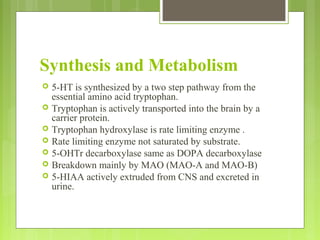
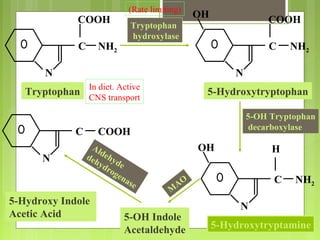
 5-HT is synthesized by a two step pathway from the
essential amino acid tryptophan.
 Tryptophan is actively transported into the brain by a
carrier protein.
 Tryptophan hydroxylase is rate limiting enzyme .
 Rate limiting enzyme not saturated by substrate.
 5-OHTr decarboxylase same as DOPA decarboxylase
 Breakdown mainly by MAO (MAO-A and MAO-B)
 5-HIAA actively extruded from CNS and excreted in
urine.
N
C
N
C NH2
COOH COOH
NH2
OH
N
C NH2
OH H
Tryptophan 5-Hydroxytryptophan
5-Hydroxytryptamine
N
C COOH
5-OH Indole
Acetaldehyde
5-Hydroxy Indole
Acetic Acid
Tryptophan
hydroxylase
5-OH Tryptophan
decarboxylase
M
AO
Aldehyde
dehydrogenase
(Rate limiting)
In diet. Active
CNS transport
Serotonin Receptors
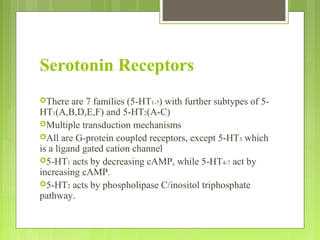
There are 7 families (5-HT1-7) with further subtypes of 5-
HT1(A,B,D,E,F) and 5-HT2(A-C)
Multiple transduction mechanisms
All are G-protein coupled receptors, except 5-HT3 which
is a ligand gated cation channel
5-HT1 acts by decreasing cAMP, while 5-HT4-7 act by
increasing cAMP.
5-HT2 acts by phospholipase C/inositol triphosphate
pathway.
5-HT1 receptor
Subtyp
e
Transduction
mechanism
Location Physiological roles and therapeutic
applications
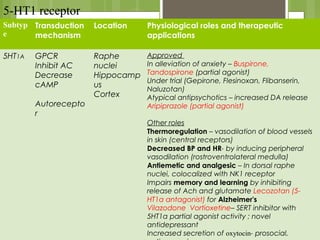
5HT1A GPCR
Inhibit AC
Decrease
cAMP
Autorecepto
r
Raphe
nuclei
Hippocamp
us
Cortex
Approved
In alleviation of anxiety – Buspirone,
Tandospirone (partial agonist)
Under trial (Gepirone, Flesinoxan, Flibanserin,
Naluzotan)
Atypical antipsychotics – increased DA release
Aripiprazole (partial agonist)
Other roles
Thermoregulation – vasodilation of blood vessels
in skin (central receptors)
Decreased BP and HR- by inducing peripheral
vasodilation (rostroventrolateral medulla)
Antiemetic and analgesic – In dorsal raphe
nuclei, colocalized with NK1 receptor
Impairs memory and learning by inhibiting
release of Ach and glutamate Lecozotan (5-
HT1a antagonist) for Alzheimer's
Vilazodone Vortioxetine– SERT inhibitor with
5HT1a partial agonist activity ; novel
antidepressant
Increased secretion of oxytocin- prosocial,
5-HT1 receptor
Subtyp
e
Transduction
mechanism
Location Physiological roles and
therapeutic applications
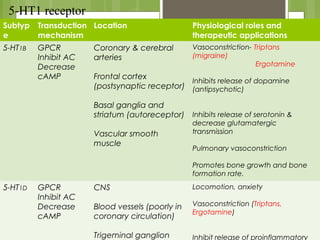
5-HT1B GPCR
Inhibit AC
Decrease
cAMP
Coronary & cerebral
arteries
Frontal cortex
(postsynaptic receptor)
Basal ganglia and
striatum (autoreceptor)
Vascular smooth
muscle
Vasoconstriction- Triptans
(migraine)
Ergotamine
Inhibits release of dopamine
(antipsychotic)
Inhibits release of serotonin &
decrease glutamatergic
transmission
Pulmonary vasoconstriction
Promotes bone growth and bone
formation rate.
5-HT1D GPCR
Inhibit AC
Decrease
cAMP
CNS
Blood vessels (poorly in
coronary circulation)
Trigeminal ganglion
Locomotion, anxiety
Vasoconstriction (Triptans,
Ergotamine)
Inhibit release of proinflammatory
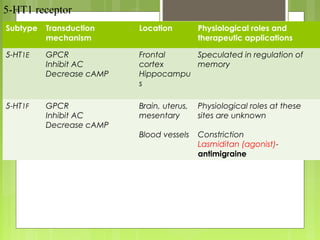
5-HT1 receptor
Subtype Transduction
mechanism
Location Physiological roles and
therapeutic applications
5-HT1E GPCR
Inhibit AC
Decrease cAMP
Frontal
cortex
Hippocampu
s
Speculated in regulation of
memory
5-HT1F GPCR
Inhibit AC
Decrease cAMP
Brain, uterus,
mesentary
Blood vessels
Physiological roles at these
sites are unknown
Constriction
Lasmiditan (agonist)-
antimigraine
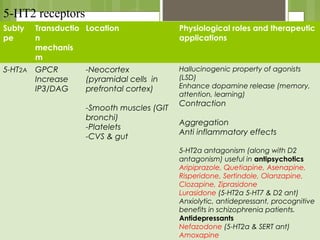
5-HT2 receptors
Subty
pe
Transductio
n
mechanis
m
Location Physiological roles and therapeutic
applications
5-HT2A GPCR
Increase
IP3/DAG
-Neocortex
(pyramidal cells in
prefrontal cortex)
-Smooth muscles (GIT
bronchi)
-Platelets
-CVS & gut
Hallucinogenic property of agonists
(LSD)
Enhance dopamine release (memory,
attention, learning)
Contraction
Aggregation
Anti inflammatory effects
5-HT2a antagonism (along with D2
antagonism) useful in antipsychotics
Aripiprazole, Quetiapine, Asenapine,
Risperidone, Sertindole, Olanzapine,
Clozapine, Ziprasidone
Lurasidone (5-HT2a 5-HT7 & D2 ant)
Anxiolytic, antidepressant, procognitive
benefits in schizophrenia patients.
Antidepressants
Nefazodone (5-HT2a & SERT ant)
Amoxapine
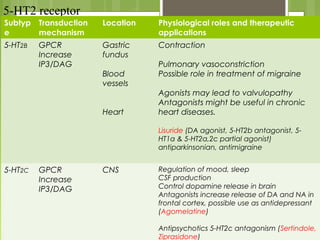
5-HT2 receptor
Subtyp
e
Transduction
mechanism
Location Physiological roles and therapeutic
applications
5-HT2B GPCR
Increase
IP3/DAG
Gastric
fundus
Blood
vessels
Heart
Contraction
Pulmonary vasoconstriction
Possible role in treatment of migraine
Agonists may lead to valvulopathy
Antagonists might be useful in chronic
heart diseases.
Lisuride (DA agonist, 5-HT2b antagonist, 5-
HT1a & 5-HT2a,2c partial agonist)
antiparkinsonian, antimigraine
5-HT2C GPCR
Increase
IP3/DAG
CNS Regulation of mood, sleep
CSF production
Control dopamine release in brain
Antagonists increase release of DA and NA in
frontal cortex, possible use as antidepressant
(Agomelatine)
Antipsychotics 5-HT2c antagonism (Sertindole,
Ziprasidone)
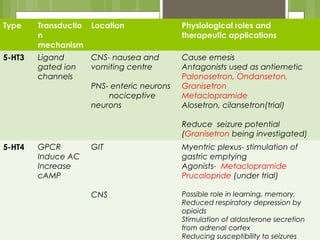
Type Transductio
n
mechanism
Location Physiological roles and
therapeutic applications
5-HT3 Ligand
gated ion
channels
CNS- nausea and
vomiting centre
PNS- enteric neurons
nociceptive
neurons
Cause emesis
Antagonists used as antiemetic
Palonosetron, Ondanseton,
Granisetron
Metaclopramide
Alosetron, cilansetron(trial)
Reduce seizure potential
(Granisetron being investigated)
5-HT4 GPCR
Induce AC
Increase
cAMP
GIT
CNS
Myentric plexus- stimulation of
gastric emptying
Agonists- Metaclopramide
Prucalopride (under trial)
Possible role in learning, memory,
Reduced respiratory depression by
opioids
Stimulation of aldosterone secretion
from adrenal cortex
Reducing susceptibility to seizures
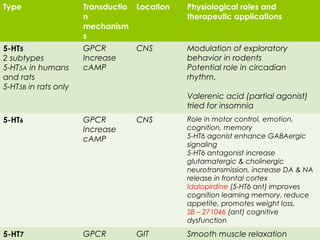
Type Transductio
n
mechanism
s
Location Physiological roles and
therapeutic applications
5-HT5
2 subtypes
5-HT5A in humans
and rats
5-HT5B in rats only
GPCR
Increase
cAMP
CNS Modulation of exploratory
behavior in rodents
Potential role in circadian
rhythm.
Valerenic acid (partial agonist)
tried for insomnia
5-HT6 GPCR
Increase
cAMP
CNS Role in motor control, emotion,
cognition, memory
5-HT6 agonist enhance GABAergic
signaling
5-HT6 antagonist increase
glutamatergic & cholinergic
neurotransmission, increase DA & NA
release in frontal cortex
Idalopirdine (5-HT6 ant) improves
cognition learning memory, reduce
appetite, promotes weight loss.
SB – 271046 (ant) cognitive
dysfunction
5-HT7 GPCR GIT Smooth muscle relaxation
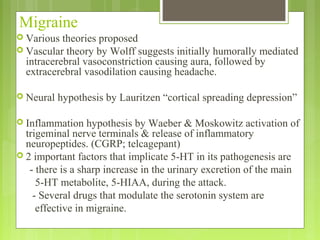
Migraine
 Various theories proposed
 Vascular theory by Wolff suggests initially humorally mediated
intracerebral vasoconstriction causing aura, followed by
extracerebral vasodilation causing headache.
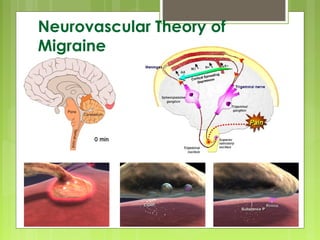
 Neural hypothesis by Lauritzen “cortical spreading depression”
 Inflammation hypothesis by Waeber & Moskowitz activation of
trigeminal nerve terminals & release of inflammatory
neuropeptides. (CGRP; telcagepant)
 2 important factors that implicate 5-HT in its pathogenesis are
- there is a sharp increase in the urinary excretion of the main
5-HT metabolite, 5-HIAA, during the attack.
- Several drugs that modulate the serotonin system are
effective in migraine.
Neurovascular Theory of
Migraine
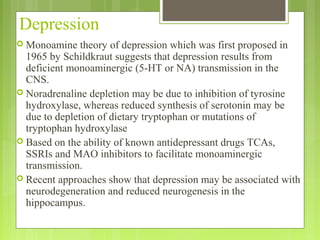
Depression
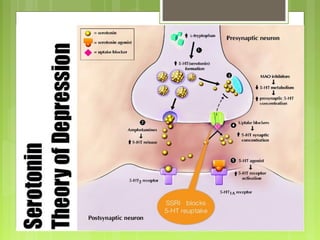
 Monoamine theory of depression which was first proposed in
1965 by Schildkraut suggests that depression results from
deficient monoaminergic (5-HT or NA) transmission in the
CNS.
 Noradrenaline depletion may be due to inhibition of tyrosine
hydroxylase, whereas reduced synthesis of serotonin may be
due to depletion of dietary tryptophan or mutations of
tryptophan hydroxylase
 Based on the ability of known antidepressant drugs TCAs,
SSRIs and MAO inhibitors to facilitate monoaminergic
transmission.
 Recent approaches show that depression may be associated with
neurodegeneration and reduced neurogenesis in the
hippocampus.
 Stress & hypothalamic-pituitary-adrenal axis
-The hypothalamic-pituitary-cortisol hypothesis
postulates that
depression is associated with elevated cortisol levels
in
response to stress.
 Other possible disease mechanisms
- Reduced level GABA & dopamine
- Melatonin dysfunction - Abnormal circadian rhythms
- Neuronal loss and reduced neurogenesis
SSRIs
 Selectively block 5-HT reuptake by the neurons
 Include Citalopram, Fluoxetine, Paroxetine, Sertraline and
Fluvoxamine
 Increase synaptic 5-HT availability stimulates post-synaptic
neurons and contributes to mood elevating and anxiolytic
properties
 Other uses OCD, Panic disorder , social phobia , PTSD.
Other new drugs for depression
 Newer mixed 5-HT and noradrenaline reuptake inhibitors
Venlafaxine
Desvenlafaxine
Duloxetine
Milnacipran
 5-HT2a receptor antagonist – Trazodone, Mianserin
Other Drugs affecting 5-HT system
 Precursors of serotonin-
- s-adenyl-l-methionine, tryptophan
 Inhibit synthesis
 p-chlorophenylalanine (irreversible)
 Inhibit neuronal re-uptake
 SSRI (e.g. fluoxetine), TCA (e.g. imipramine)
 Inhibit storage-deplete:
 Reserpine
 Inhibit metabolism:
 MAO inhibitors
 Promote release:
 p-chloroamphetamine (e.g. fenfluramine to ↓ appetite)
Serotonin syndrome
 Serotonin syndrome is a symptom complex of varying drug
interactions which may lead to excess serotonin in body.
 These are toxic and potentially fatal effects.
 Require a combination of serotonergic drugs such as SSRIs
with MAO inhibitors.
 Other drugs implicated are TCAs, meperidine, MDMA.
 Symptoms- mental status changes, confusion, agitation,
hypomania, myoclonus, hyperreflexia, diaphoresis, shivering,
tremor, diarrhoea, incoordination, fever.
 Treatment
Remove suspected agent
BZDs Propranolol
THANK YOU

Serotonin : diseases and therapeutics

  • 1.
    SEROTONIN : DISEASESAND THERAPEUTICS By: Dr. Gaurav Yadav
  • 2.
    Source & Chemistry 3-(β-aminoethyl)-5-hydroxyindole  Widely distributed in animals and plants.  Present in sea food, meat, nuts, seeds, various grains.  It is also present in venoms; common stinging nettles and of wasps and scorpions.  In humans it is found in high concentrations in enterochromaffin cells throughout the gastrointestinal tract, in storage granules in platelets and broadly throughout the CNS.
  • 3.
    HISTORY  1930s Erspamerstudied distribution of enterochromaffin cells.  1948 Page and colleagues isolated and chemically characterized vasoconstrictor substance from platelets as 5-HT.  1957 Gaddum and Piccarelli classified 5-HT receptors into M and D type.  1959 Udenfriend discovered biosynthetic and degradative pathways.  1976 Page coined term SEROTONIN.  1979 Peroutka &Snyder identified 5HT1 and 5HT2 receptors by radioligand binding studies.
  • 4.
    Synthesis and Metabolism 5-HT is synthesized by a two step pathway from the essential amino acid tryptophan.  Tryptophan is actively transported into the brain by a carrier protein.  Tryptophan hydroxylase is rate limiting enzyme .  Rate limiting enzyme not saturated by substrate.  5-OHTr decarboxylase same as DOPA decarboxylase  Breakdown mainly by MAO (MAO-A and MAO-B)  5-HIAA actively extruded from CNS and excreted in urine.
  • 5.
    N C N C NH2 COOH COOH NH2 OH N CNH2 OH H Tryptophan 5-Hydroxytryptophan 5-Hydroxytryptamine N C COOH 5-OH Indole Acetaldehyde 5-Hydroxy Indole Acetic Acid Tryptophan hydroxylase 5-OH Tryptophan decarboxylase M AO Aldehyde dehydrogenase (Rate limiting) In diet. Active CNS transport
  • 6.
    Serotonin Receptors There are7 families (5-HT1-7) with further subtypes of 5- HT1(A,B,D,E,F) and 5-HT2(A-C) Multiple transduction mechanisms All are G-protein coupled receptors, except 5-HT3 which is a ligand gated cation channel 5-HT1 acts by decreasing cAMP, while 5-HT4-7 act by increasing cAMP. 5-HT2 acts by phospholipase C/inositol triphosphate pathway.
  • 7.
    5-HT1 receptor Subtyp e Transduction mechanism Location Physiologicalroles and therapeutic applications 5HT1A GPCR Inhibit AC Decrease cAMP Autorecepto r Raphe nuclei Hippocamp us Cortex Approved In alleviation of anxiety – Buspirone, Tandospirone (partial agonist) Under trial (Gepirone, Flesinoxan, Flibanserin, Naluzotan) Atypical antipsychotics – increased DA release Aripiprazole (partial agonist) Other roles Thermoregulation – vasodilation of blood vessels in skin (central receptors) Decreased BP and HR- by inducing peripheral vasodilation (rostroventrolateral medulla) Antiemetic and analgesic – In dorsal raphe nuclei, colocalized with NK1 receptor Impairs memory and learning by inhibiting release of Ach and glutamate Lecozotan (5- HT1a antagonist) for Alzheimer's Vilazodone Vortioxetine– SERT inhibitor with 5HT1a partial agonist activity ; novel antidepressant Increased secretion of oxytocin- prosocial,
  • 8.
    5-HT1 receptor Subtyp e Transduction mechanism Location Physiologicalroles and therapeutic applications 5-HT1B GPCR Inhibit AC Decrease cAMP Coronary & cerebral arteries Frontal cortex (postsynaptic receptor) Basal ganglia and striatum (autoreceptor) Vascular smooth muscle Vasoconstriction- Triptans (migraine) Ergotamine Inhibits release of dopamine (antipsychotic) Inhibits release of serotonin & decrease glutamatergic transmission Pulmonary vasoconstriction Promotes bone growth and bone formation rate. 5-HT1D GPCR Inhibit AC Decrease cAMP CNS Blood vessels (poorly in coronary circulation) Trigeminal ganglion Locomotion, anxiety Vasoconstriction (Triptans, Ergotamine) Inhibit release of proinflammatory
  • 9.
    5-HT1 receptor Subtype Transduction mechanism LocationPhysiological roles and therapeutic applications 5-HT1E GPCR Inhibit AC Decrease cAMP Frontal cortex Hippocampu s Speculated in regulation of memory 5-HT1F GPCR Inhibit AC Decrease cAMP Brain, uterus, mesentary Blood vessels Physiological roles at these sites are unknown Constriction Lasmiditan (agonist)- antimigraine
  • 10.
    5-HT2 receptors Subty pe Transductio n mechanis m Location Physiologicalroles and therapeutic applications 5-HT2A GPCR Increase IP3/DAG -Neocortex (pyramidal cells in prefrontal cortex) -Smooth muscles (GIT bronchi) -Platelets -CVS & gut Hallucinogenic property of agonists (LSD) Enhance dopamine release (memory, attention, learning) Contraction Aggregation Anti inflammatory effects 5-HT2a antagonism (along with D2 antagonism) useful in antipsychotics Aripiprazole, Quetiapine, Asenapine, Risperidone, Sertindole, Olanzapine, Clozapine, Ziprasidone Lurasidone (5-HT2a 5-HT7 & D2 ant) Anxiolytic, antidepressant, procognitive benefits in schizophrenia patients. Antidepressants Nefazodone (5-HT2a & SERT ant) Amoxapine
  • 11.
    5-HT2 receptor Subtyp e Transduction mechanism Location Physiologicalroles and therapeutic applications 5-HT2B GPCR Increase IP3/DAG Gastric fundus Blood vessels Heart Contraction Pulmonary vasoconstriction Possible role in treatment of migraine Agonists may lead to valvulopathy Antagonists might be useful in chronic heart diseases. Lisuride (DA agonist, 5-HT2b antagonist, 5- HT1a & 5-HT2a,2c partial agonist) antiparkinsonian, antimigraine 5-HT2C GPCR Increase IP3/DAG CNS Regulation of mood, sleep CSF production Control dopamine release in brain Antagonists increase release of DA and NA in frontal cortex, possible use as antidepressant (Agomelatine) Antipsychotics 5-HT2c antagonism (Sertindole, Ziprasidone)
  • 12.
    Type Transductio n mechanism Location Physiologicalroles and therapeutic applications 5-HT3 Ligand gated ion channels CNS- nausea and vomiting centre PNS- enteric neurons nociceptive neurons Cause emesis Antagonists used as antiemetic Palonosetron, Ondanseton, Granisetron Metaclopramide Alosetron, cilansetron(trial) Reduce seizure potential (Granisetron being investigated) 5-HT4 GPCR Induce AC Increase cAMP GIT CNS Myentric plexus- stimulation of gastric emptying Agonists- Metaclopramide Prucalopride (under trial) Possible role in learning, memory, Reduced respiratory depression by opioids Stimulation of aldosterone secretion from adrenal cortex Reducing susceptibility to seizures
  • 13.
    Type Transductio n mechanism s Location Physiologicalroles and therapeutic applications 5-HT5 2 subtypes 5-HT5A in humans and rats 5-HT5B in rats only GPCR Increase cAMP CNS Modulation of exploratory behavior in rodents Potential role in circadian rhythm. Valerenic acid (partial agonist) tried for insomnia 5-HT6 GPCR Increase cAMP CNS Role in motor control, emotion, cognition, memory 5-HT6 agonist enhance GABAergic signaling 5-HT6 antagonist increase glutamatergic & cholinergic neurotransmission, increase DA & NA release in frontal cortex Idalopirdine (5-HT6 ant) improves cognition learning memory, reduce appetite, promotes weight loss. SB – 271046 (ant) cognitive dysfunction 5-HT7 GPCR GIT Smooth muscle relaxation
  • 14.
    Migraine  Various theoriesproposed  Vascular theory by Wolff suggests initially humorally mediated intracerebral vasoconstriction causing aura, followed by extracerebral vasodilation causing headache.  Neural hypothesis by Lauritzen “cortical spreading depression”  Inflammation hypothesis by Waeber & Moskowitz activation of trigeminal nerve terminals & release of inflammatory neuropeptides. (CGRP; telcagepant)  2 important factors that implicate 5-HT in its pathogenesis are - there is a sharp increase in the urinary excretion of the main 5-HT metabolite, 5-HIAA, during the attack. - Several drugs that modulate the serotonin system are effective in migraine.
  • 15.
  • 16.
    Depression  Monoamine theoryof depression which was first proposed in 1965 by Schildkraut suggests that depression results from deficient monoaminergic (5-HT or NA) transmission in the CNS.  Noradrenaline depletion may be due to inhibition of tyrosine hydroxylase, whereas reduced synthesis of serotonin may be due to depletion of dietary tryptophan or mutations of tryptophan hydroxylase  Based on the ability of known antidepressant drugs TCAs, SSRIs and MAO inhibitors to facilitate monoaminergic transmission.  Recent approaches show that depression may be associated with neurodegeneration and reduced neurogenesis in the hippocampus.
  • 17.
     Stress &hypothalamic-pituitary-adrenal axis -The hypothalamic-pituitary-cortisol hypothesis postulates that depression is associated with elevated cortisol levels in response to stress.  Other possible disease mechanisms - Reduced level GABA & dopamine - Melatonin dysfunction - Abnormal circadian rhythms - Neuronal loss and reduced neurogenesis
  • 19.
    SSRIs  Selectively block5-HT reuptake by the neurons  Include Citalopram, Fluoxetine, Paroxetine, Sertraline and Fluvoxamine  Increase synaptic 5-HT availability stimulates post-synaptic neurons and contributes to mood elevating and anxiolytic properties  Other uses OCD, Panic disorder , social phobia , PTSD.
  • 20.
    Other new drugsfor depression  Newer mixed 5-HT and noradrenaline reuptake inhibitors Venlafaxine Desvenlafaxine Duloxetine Milnacipran  5-HT2a receptor antagonist – Trazodone, Mianserin
  • 21.
    Other Drugs affecting5-HT system  Precursors of serotonin- - s-adenyl-l-methionine, tryptophan  Inhibit synthesis  p-chlorophenylalanine (irreversible)  Inhibit neuronal re-uptake  SSRI (e.g. fluoxetine), TCA (e.g. imipramine)  Inhibit storage-deplete:  Reserpine  Inhibit metabolism:  MAO inhibitors  Promote release:  p-chloroamphetamine (e.g. fenfluramine to ↓ appetite)
  • 22.
    Serotonin syndrome  Serotoninsyndrome is a symptom complex of varying drug interactions which may lead to excess serotonin in body.  These are toxic and potentially fatal effects.  Require a combination of serotonergic drugs such as SSRIs with MAO inhibitors.  Other drugs implicated are TCAs, meperidine, MDMA.  Symptoms- mental status changes, confusion, agitation, hypomania, myoclonus, hyperreflexia, diaphoresis, shivering, tremor, diarrhoea, incoordination, fever.  Treatment Remove suspected agent BZDs Propranolol
  • 23.

Editor's Notes

  • #4 M - parasympathetic nerve endings, controlling the release of Ach. morphine D – located on smooth muscle. dibenzyline
  • #5 L amino acid decarboxylase
  • #8 Aripiprazole- aripiprazole acts as a D2 partial agonist, partial agonist at the 5-HT1A receptor, and like the other atypical antipsychotics displays an antagonist profile at the 5-HT2A receptor.It also antagonizes the 5-HT7 receptor and acts as a partial agonist at the 5-HT2C receptor, both with high affinity.
  • #10 Lasmiditan – no action at 5-HT1b/1d receptors, therefore no cardiac side effects.
  • #11 Al34662 devoid of hallucinatory effects due to non crossing of bbb. Aripiprazole- D2 partial agonist, partial agonist at the 5-HT1A receptor, antagonist profile at the 5-HT2A receptor.It also antagonizes the 5-HT7 receptor and acts as a partial agonist at the 5-HT2C receptor Quetiapine- D1 D2 D3 D4 antagonist, 5-HT1a partial agonist, 5-HT2a 2c 5-HT7 antagonist, α1 α2 H1 mAch antagonist Asenapine – 5-HT1a partial agonist, antagonist at 5-HT1b, 2a, 2b, 2c, H1, D1 D2 Sertindole – 5-HT2c antagonism in addition to D2 and 5-HT2a antagonism
  • #12 5ht2c agonist –POMC production, satiety
  • #16 Migraine trigger initiates CSD(Excitation f/b depression; 3-5 mm/min). CSD is followed by a phase of hyperoxygenation, which is believed to cause aura. The claims that hypoxemia/ischemia induced by vasoconstriction causes aura are unsupported. Following CSD, release of H+,K+ will stimulate meningeal nociceptors: neuronal bodies in the trigeminal nucleus stimulated. Release of mediators-subP,CGRP,NK-1, NO, 5HT-from trigeminal nerve endings innervating blood vessels. Vasodilatation, plasma extravasation and a sterile, neurogenic inflammation at the trigemino-vascular complex in the brainstem. Pain producing cranial structures: scalp, middle meningeal artery, dural sinuses, falx cerebri, and proximal segments of the large pial arteries