BASIC CONCEPT OF
EPIDEMIOLOGY
NOIDA INTERNATIONAL UNIVERSITY
SCHOOL OF NURSING AND HEALTH SCIENCE
CONTENTS
 1. INTRODUCTION
 2. DEFINITION
 3. AIMS OF EPIDEMIOLOGY
 4. USES OF EPIDEMIOLOGY
 5. EPIDEMIOLOGIC APPROACH
 6. BASIC MEASUREMENTS IN EPIDEMIOLOGY
 7. TOOLS OF MEASUREMENT
INTRODUCTION
 Epidemiology is the basic of preventive and social medicine derived from the
word EPIDEMIC (Epi= Among, Demos= People, Logos= Study) which is a very
old word dating back to the 3rd century BC.
 The foundation of epidemiology was laid in the 19th century, when a few classic
studies made a major contribution to the saving of life.
 Epidemiology is the study and analysis of the patterns, causes, and effects of
health and disease conditions in defined populations. It is the cornerstone of
public health, and shapes policy decisions and evidence-based practice by
identifying risk factors for disease and targets for preventive healthcare
 Epidemiologists help with study design, collection, and statistical analysis of
data, amend interpretation and dissemination of results (including peer review
and occasional systematic review). Epidemiology has helped develop
methodology used in clinical research, public health studies, and, to a lesser
extent, basic research in the biological sciences.
DEFINITION
Epidemiology is the study of the determinants, distribution and frequency of
disease
 Epidemiology study sick people and healthy people
 Epidemiology study exposed and non-exposed
 Determine the crucial effect of the exposure.
John M. Last
“The study of the distribution and determinants of health-related states or events
in specific population and the application of this study to the control of diseases
and other health problems.”
There are 3 components of Epidemiology
 Disease Frequency
 Distribution of Disease
 Determinant of Disease
Definition Cont.
 Disease frequency- involve quantifying the existence or occurrence of
disease.
 Distribution of disease- study the distribution of disease
Who is getting the disease within a population
Where and when the disease is occurring
TPP ( Time, Place, Person)
 Determinant of disease- derived from the first 2 components to test or
epidemiologic hypothesis.
AIMS OF EPIDEMIOLOGY
 According to the International Epidemiology Association (IEA),
epidemiology has 3 main Aims
1. To describe the distribution & magnitude of health and disease in human
population
2. To identify risk factor in the pathogenesis of disease ; AND
3. To provide the data essential to planning, implementation and evaluation
of service for the prevention , control & treatment of disease and to the
setting up of priorities among those services.
The ultimate aim of epidemiology is to lead effective action
 To eliminate or reduce the health problem or its consequence
 To promote the health & wellbeing of society as a whole.
EPIDEMIOLOGIC APPROACH
 The epidemiologic approach to problem of health & disease is based on 2
major foundation
a. Asking questions
Related to health; What is the event? (problem)
What is its magnitude?
Why, Where & When did it happen?
Who are affected?
b. Making comparisons
The basic approach in epidemiology is to make comparisons and draw
inference. This may be comparing of 2 (or more groups)
One group having the disease(or exposed a to risk factor)
One group not having disease (or not exposed to a risk factor)
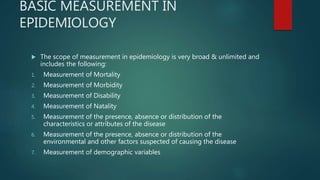
BASIC MEASUREMENT IN
EPIDEMIOLOGY
 The scope of measurement in epidemiology is very broad & unlimited and
includes the following:
1. Measurement of Mortality
2. Measurement of Morbidity
3. Measurement of Disability
4. Measurement of Natality
5. Measurement of the presence, absence or distribution of the
characteristics or attributes of the disease
6. Measurement of the presence, absence or distribution of the
environmental and other factors suspected of causing the disease
7. Measurement of demographic variables
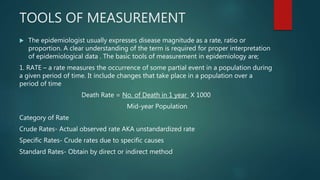
TOOLS OF MEASUREMENT
 The epidemiologist usually expresses disease magnitude as a rate, ratio or
proportion. A clear understanding of the term is required for proper interpretation
of epidemiological data . The basic tools of measurement in epidemiology are;
1. RATE – a rate measures the occurrence of some partial event in a population during
a given period of time. It include changes that take place in a population over a
period of time
Death Rate = No. of Death in 1 year X 1000
Mid-year Population
Category of Rate
Crude Rates- Actual observed rate AKA unstandardized rate
Specific Rates- Crude rates due to specific causes
Standard Rates- Obtain by direct or indirect method
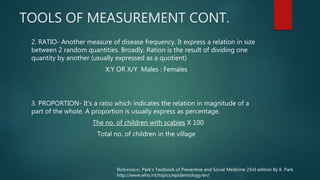
TOOLS OF MEASUREMENT CONT.
2. RATIO- Another measure of disease frequency. It express a relation in size
between 2 random quantities. Broadly, Ration is the result of dividing one
quantity by another (usually expressed as a quotient)
X:Y OR X/Y Males : Females
3. PROPORTION- It’s a ratio which indicates the relation in magnitude of a
part of the whole. A proportion is usually express as percentage.
The no. of children with scabies X 100
Total no. of children in the village
Reference; Park’s Textbook of Preventive and Social Medicine 23rd edition By K. Park
http://www.who.int/topics/epidemiology/en/

Basic Concept of Epidemiology

  • 1.
    BASIC CONCEPT OF EPIDEMIOLOGY NOIDAINTERNATIONAL UNIVERSITY SCHOOL OF NURSING AND HEALTH SCIENCE
  • 2.
    CONTENTS  1. INTRODUCTION 2. DEFINITION  3. AIMS OF EPIDEMIOLOGY  4. USES OF EPIDEMIOLOGY  5. EPIDEMIOLOGIC APPROACH  6. BASIC MEASUREMENTS IN EPIDEMIOLOGY  7. TOOLS OF MEASUREMENT
  • 3.
    INTRODUCTION  Epidemiology isthe basic of preventive and social medicine derived from the word EPIDEMIC (Epi= Among, Demos= People, Logos= Study) which is a very old word dating back to the 3rd century BC.  The foundation of epidemiology was laid in the 19th century, when a few classic studies made a major contribution to the saving of life.  Epidemiology is the study and analysis of the patterns, causes, and effects of health and disease conditions in defined populations. It is the cornerstone of public health, and shapes policy decisions and evidence-based practice by identifying risk factors for disease and targets for preventive healthcare  Epidemiologists help with study design, collection, and statistical analysis of data, amend interpretation and dissemination of results (including peer review and occasional systematic review). Epidemiology has helped develop methodology used in clinical research, public health studies, and, to a lesser extent, basic research in the biological sciences.
  • 4.
    DEFINITION Epidemiology is thestudy of the determinants, distribution and frequency of disease  Epidemiology study sick people and healthy people  Epidemiology study exposed and non-exposed  Determine the crucial effect of the exposure. John M. Last “The study of the distribution and determinants of health-related states or events in specific population and the application of this study to the control of diseases and other health problems.” There are 3 components of Epidemiology  Disease Frequency  Distribution of Disease  Determinant of Disease
  • 5.
    Definition Cont.  Diseasefrequency- involve quantifying the existence or occurrence of disease.  Distribution of disease- study the distribution of disease Who is getting the disease within a population Where and when the disease is occurring TPP ( Time, Place, Person)  Determinant of disease- derived from the first 2 components to test or epidemiologic hypothesis.
  • 6.
    AIMS OF EPIDEMIOLOGY According to the International Epidemiology Association (IEA), epidemiology has 3 main Aims 1. To describe the distribution & magnitude of health and disease in human population 2. To identify risk factor in the pathogenesis of disease ; AND 3. To provide the data essential to planning, implementation and evaluation of service for the prevention , control & treatment of disease and to the setting up of priorities among those services. The ultimate aim of epidemiology is to lead effective action  To eliminate or reduce the health problem or its consequence  To promote the health & wellbeing of society as a whole.
  • 7.
    EPIDEMIOLOGIC APPROACH  Theepidemiologic approach to problem of health & disease is based on 2 major foundation a. Asking questions Related to health; What is the event? (problem) What is its magnitude? Why, Where & When did it happen? Who are affected? b. Making comparisons The basic approach in epidemiology is to make comparisons and draw inference. This may be comparing of 2 (or more groups) One group having the disease(or exposed a to risk factor) One group not having disease (or not exposed to a risk factor)
  • 8.
    BASIC MEASUREMENT IN EPIDEMIOLOGY The scope of measurement in epidemiology is very broad & unlimited and includes the following: 1. Measurement of Mortality 2. Measurement of Morbidity 3. Measurement of Disability 4. Measurement of Natality 5. Measurement of the presence, absence or distribution of the characteristics or attributes of the disease 6. Measurement of the presence, absence or distribution of the environmental and other factors suspected of causing the disease 7. Measurement of demographic variables
  • 9.
    TOOLS OF MEASUREMENT The epidemiologist usually expresses disease magnitude as a rate, ratio or proportion. A clear understanding of the term is required for proper interpretation of epidemiological data . The basic tools of measurement in epidemiology are; 1. RATE – a rate measures the occurrence of some partial event in a population during a given period of time. It include changes that take place in a population over a period of time Death Rate = No. of Death in 1 year X 1000 Mid-year Population Category of Rate Crude Rates- Actual observed rate AKA unstandardized rate Specific Rates- Crude rates due to specific causes Standard Rates- Obtain by direct or indirect method
  • 10.
    TOOLS OF MEASUREMENTCONT. 2. RATIO- Another measure of disease frequency. It express a relation in size between 2 random quantities. Broadly, Ration is the result of dividing one quantity by another (usually expressed as a quotient) X:Y OR X/Y Males : Females 3. PROPORTION- It’s a ratio which indicates the relation in magnitude of a part of the whole. A proportion is usually express as percentage. The no. of children with scabies X 100 Total no. of children in the village Reference; Park’s Textbook of Preventive and Social Medicine 23rd edition By K. Park http://www.who.int/topics/epidemiology/en/