


WELCOME…
Daffodil Institute of IT
Presentation on Flip-Flops
Manimay Adhikary ;ID:180084
Asadullahil Galib ;ID:180094
Presented By:
MD Hasan Shemon ; ID:180088
Md Hasan Al Zabed; ID:180062
Nawshad Jaman ; ID:180066
Presented to
Tahmina Aktar Trisha
Lecturer
Department of Computer Science &
Engineering
Daffodil Institute of IT(DIIT)
64/3 & 64/4 Lake Circus (2nd-5th floor)
Mirpur Road Dhaka-1205, Bangladesh
What is Flip flop?
• In digital circuits, the flip-flop, is a kind of bi-stable
multivibrator.
• It is a Sequential Circuits / an electronic circuit which
has two stable states and thereby is capable of
serving as one bit of memory , bit 1 or bit 0
Introduction – Flip Flop
• They are 1 (HIGH) or 0 (LOW).
• Whenever we refer to the state
of flipflop, we refer to the state
of its normal output (Q).
• More complicated Flip flop use a
clock as the control input. These
clocked flip-flops are used
whenever the input and output
signals must occur within a
particular sequence
•They have two stable conditions
and can be switched from one to
the other by appropriate inputs.
Introduction: Types Of Flip Flop
• 1. SR Flip Flop
a.SR Flip Flop Active Low = NAND gate Latch
b. SR Flip Flop Active High = NOR gate Latch
• 2. Clocked SR Flip Flop
• 3. JK Flip Flop
• 4. JK Flip Flop With Pre-set And Clear
• 5. T Flip Flop
• 6. D Flip Flop
• 7. Master-Slave Edge-Triggered Flip-Flop
The Used of Flip Flop:
 For Memory circuits
 For Logic Control Devices
 For Counter Devices
 For Register Devices
SR Flip Flop
 The most basic Flip Flop is called SR Flip Flop
 These basic Flip Flop circuit can be constructed using two NAND
gates latch or two NOR gates latch.
 SR Flip FlopActive Low = NAND gate Latch
 SR FlipFlop Active High = NOR gate Latch
Reset
Set
The SR Flip Flop has two inputs,SET (S) and
RESET (R).
The SR Flip Flop has two outputs, Q and Q’
 The Q output is considered the normal output
and is the one most used.
 The other output Q’ is simply
the compliment of output Q.
R
S Q
Q’
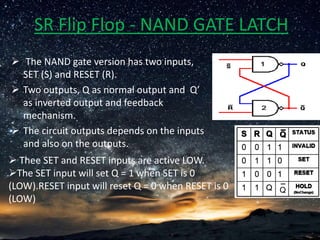
SR Flip Flop - NAND GATE LATCH
 The NAND gate version has two inputs,
SET (S) and RESET (R).
 Two outputs, Q as normal output and Q’
as inverted output and feedback
mechanism.
 The circuit outputs depends on the inputs
and also on the outputs.
 Thee SET and RESET inputs are active LOW.
The SET input will set Q = 1 when SET is 0
(LOW).RESET input will reset Q = 0 when RESET is 0
(LOW)
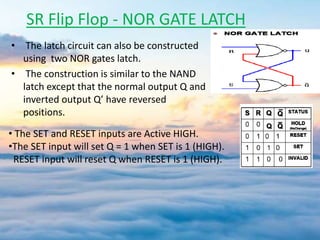
SR Flip Flop - NOR GATE LATCH
• The latch circuit can also be constructed
using two NOR gates latch.
• The construction is similar to the NAND
latch except that the normal output Q and
inverted output Q’ have reversed
positions.
• The SET and RESET inputs are Active HIGH.
•The SET input will set Q = 1 when SET is 1 (HIGH).
RESET input will reset Q when RESET is 1 (HIGH).
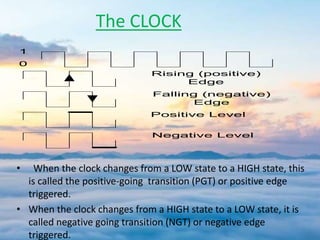
The CLOCK
• When the clock changes from a LOW state to a HIGH state, this
is called the positive-going transition (PGT) or positive edge
triggered.
• When the clock changes from a HIGH state to a LOW state, it is
called negative going transition (NGT) or negative edge
triggered.
0
1
Rising (positive)
Edge
Falling (negative)
Edge
Positive Level
Negative Level
Clocked SR Flip Flop
• Adding two NAND gates to the
basic S - R NAND latch gives
the clocked
S – R latch.
• Has a time sequence behavior
similar to the basic S-R latch
except that the S and R inputs
are only observed when the
line C is high.
• C means “control” or “clock”.
S
R
Q
Q
C
Clocked S - R Flip Flop
S
R
Q
Q
C
• The Clocked S-R Latch can be described by a table:
• The table describes
what happens after the
clock [at time (t+1)]
based on:
– current inputs (S,R) and
– current state Q(t).
Q(t) S R Q(t+1) Comment
0 0 0 0 No change
0 0 1 0 Clear Q
0 1 0 1 Set Q
0 1 1 ??? Indeterminate
1 0 0 1 No change
1 0 1 0 Clear Q
1 1 0 1 Set Q
1 1 1 ??? Indeterminate
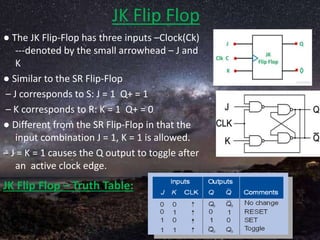
JK Flip Flop
● The JK Flip-Flop has three inputs –Clock(Ck)
---denoted by the small arrowhead – J and
K
● Similar to the SR Flip-Flop
– J corresponds to S: J = 1 Q+ = 1
– K corresponds to R: K = 1 Q+ = 0
● Different from the SR Flip-Flop in that the
input combination J = 1, K = 1 is allowed.
– J = K = 1 causes the Q output to toggle after
an active clock edge.
JK Flip Flop – Truth Table:
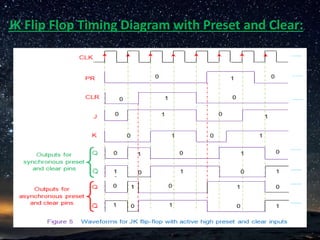
JK Flip Flop Timing Diagram with Preset and Clear:
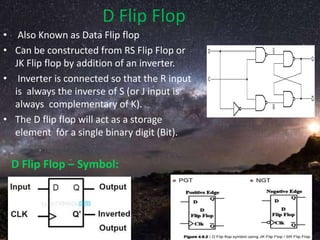
D Flip Flop
• Also Known as Data Flip flop
• Can be constructed from RS Flip Flop or
JK Flip flop by addition of an inverter.
• Inverter is connected so that the R input
is always the inverse of S (or J input is
always complementary of K).
• The D flip flop will act as a storage
element for a single binary digit (Bit).
D Flip Flop – Symbol:
Truth Table of D Flip floop:
Thank you for your Attention

Flip flop

  • 1.
  • 2.
    Daffodil Institute ofIT Presentation on Flip-Flops Manimay Adhikary ;ID:180084 Asadullahil Galib ;ID:180094 Presented By: MD Hasan Shemon ; ID:180088 Md Hasan Al Zabed; ID:180062 Nawshad Jaman ; ID:180066 Presented to Tahmina Aktar Trisha Lecturer Department of Computer Science & Engineering Daffodil Institute of IT(DIIT) 64/3 & 64/4 Lake Circus (2nd-5th floor) Mirpur Road Dhaka-1205, Bangladesh
  • 3.
    What is Flipflop? • In digital circuits, the flip-flop, is a kind of bi-stable multivibrator. • It is a Sequential Circuits / an electronic circuit which has two stable states and thereby is capable of serving as one bit of memory , bit 1 or bit 0
  • 4.
    Introduction – FlipFlop • They are 1 (HIGH) or 0 (LOW). • Whenever we refer to the state of flipflop, we refer to the state of its normal output (Q). • More complicated Flip flop use a clock as the control input. These clocked flip-flops are used whenever the input and output signals must occur within a particular sequence •They have two stable conditions and can be switched from one to the other by appropriate inputs.
  • 5.
    Introduction: Types OfFlip Flop • 1. SR Flip Flop a.SR Flip Flop Active Low = NAND gate Latch b. SR Flip Flop Active High = NOR gate Latch • 2. Clocked SR Flip Flop • 3. JK Flip Flop • 4. JK Flip Flop With Pre-set And Clear • 5. T Flip Flop • 6. D Flip Flop • 7. Master-Slave Edge-Triggered Flip-Flop The Used of Flip Flop:  For Memory circuits  For Logic Control Devices  For Counter Devices  For Register Devices
  • 6.
    SR Flip Flop The most basic Flip Flop is called SR Flip Flop  These basic Flip Flop circuit can be constructed using two NAND gates latch or two NOR gates latch.  SR Flip FlopActive Low = NAND gate Latch  SR FlipFlop Active High = NOR gate Latch Reset Set The SR Flip Flop has two inputs,SET (S) and RESET (R). The SR Flip Flop has two outputs, Q and Q’  The Q output is considered the normal output and is the one most used.  The other output Q’ is simply the compliment of output Q. R S Q Q’
  • 7.
    SR Flip Flop- NAND GATE LATCH  The NAND gate version has two inputs, SET (S) and RESET (R).  Two outputs, Q as normal output and Q’ as inverted output and feedback mechanism.  The circuit outputs depends on the inputs and also on the outputs.  Thee SET and RESET inputs are active LOW. The SET input will set Q = 1 when SET is 0 (LOW).RESET input will reset Q = 0 when RESET is 0 (LOW)
  • 8.
    SR Flip Flop- NOR GATE LATCH • The latch circuit can also be constructed using two NOR gates latch. • The construction is similar to the NAND latch except that the normal output Q and inverted output Q’ have reversed positions. • The SET and RESET inputs are Active HIGH. •The SET input will set Q = 1 when SET is 1 (HIGH). RESET input will reset Q when RESET is 1 (HIGH).
  • 9.
    The CLOCK • Whenthe clock changes from a LOW state to a HIGH state, this is called the positive-going transition (PGT) or positive edge triggered. • When the clock changes from a HIGH state to a LOW state, it is called negative going transition (NGT) or negative edge triggered. 0 1 Rising (positive) Edge Falling (negative) Edge Positive Level Negative Level
  • 10.
    Clocked SR FlipFlop • Adding two NAND gates to the basic S - R NAND latch gives the clocked S – R latch. • Has a time sequence behavior similar to the basic S-R latch except that the S and R inputs are only observed when the line C is high. • C means “control” or “clock”. S R Q Q C
  • 11.
    Clocked S -R Flip Flop S R Q Q C • The Clocked S-R Latch can be described by a table: • The table describes what happens after the clock [at time (t+1)] based on: – current inputs (S,R) and – current state Q(t). Q(t) S R Q(t+1) Comment 0 0 0 0 No change 0 0 1 0 Clear Q 0 1 0 1 Set Q 0 1 1 ??? Indeterminate 1 0 0 1 No change 1 0 1 0 Clear Q 1 1 0 1 Set Q 1 1 1 ??? Indeterminate
  • 12.
    JK Flip Flop ●The JK Flip-Flop has three inputs –Clock(Ck) ---denoted by the small arrowhead – J and K ● Similar to the SR Flip-Flop – J corresponds to S: J = 1 Q+ = 1 – K corresponds to R: K = 1 Q+ = 0 ● Different from the SR Flip-Flop in that the input combination J = 1, K = 1 is allowed. – J = K = 1 causes the Q output to toggle after an active clock edge. JK Flip Flop – Truth Table:
  • 13.
    JK Flip FlopTiming Diagram with Preset and Clear:
  • 14.
    D Flip Flop •Also Known as Data Flip flop • Can be constructed from RS Flip Flop or JK Flip flop by addition of an inverter. • Inverter is connected so that the R input is always the inverse of S (or J input is always complementary of K). • The D flip flop will act as a storage element for a single binary digit (Bit). D Flip Flop – Symbol:
  • 15.
    Truth Table ofD Flip floop:
  • 16.
    Thank you foryour Attention