SEPSIS AND SEPTIC SHOCK PATHOPHYSIOLOGY DIAGNOSIS  INITIAL MANAGEMENT Last update OCTOBER 2010
Spectrum of Disease Severity   With Progression    From Inflammation to Shock
What is Shock An abnormality of the circulatory system that results in decreased organ PERFUSION causing  HYPOXIA Lack of oxygen results in production of Lactic Acid  Shock has many causes: -Redistribution of blood flow via Vasodilation ( Sepsis , Anaphylaxis , Neurogenic ) -Restriction/blockage of blood flow  ( Impaired cardiac function , pulmonary embolus) -Volume Loss ( Hemorrhage , Severe dehydration )
How Does the Body Fight Shock? Adrenalin released   - Increased heart rate  - Peripheral vasoconstriction  shunts blood away from the muscles and skin to the brain, heart, & kidneys - Patient has pale skin that is cool & clammy BP may still be normal if early ; however pulse is elevated
Mean Arterial BP MAP MAP  is considered to be the perfusion pressure seen by organs in the body. It is believed that a  MAP  that is greater than 60 mmHg is enough to sustain perfusion to the organs. If the  MAP  falls significantly below 60 mmHg for an appreciable time, the end organs will not get enough blood flow, and will become ischemic.  Lactic acid is an excellent objective lab for assessment of perfusion. < 18 is normal. > 36 is compatible with severe sepsis MAP= DP + 1/3 (SYSTOLIC – DIASTOLIC) 90/60  = 60 + 1/3 x 30 =  MAP of 70 80/50  = 50 + 1/3 x 30 =  MAP of 60
Pathophysiology of Sepsis The release of mediators (Pro & Anti Inflammatory) by PMNs at the site of injury or infection is responsible for the cardinal signs of local inflammation: -Local  vasodilation and hyperemia -Increased microvascular permeability , resulting in protein-rich edema. Sepsis results when mediator release proceeds unchecked and exceeds the boundaries of local infection leading to a systemic response that may result in remote tissue and organ injury.  Severe sepsis & (MODS)
Determinants of Severity in Sepsis Bacterial factors  Degree of Hypoperfusion & Hypoxia Abnormal host response to infection  Site and type of infection  Timing and type of antimicrobial therapy  The development of shock    
Bacterial Factors  Endotoxin  is found in the cell wall of  gram negative  bacteria ( Pseudomonas aeruginosa, Klebsiella pneumoniae, Enterobacter, E coli )  Endotoxin can accelerate sepsis in gram negative bacterial infections. Elevated plasma levels of endotoxin are associated with  shock  and multiple organ dysfunction syndrome  (MODS) The coagulation, complement, and contact  fibrinolytic systems are all  activated by endotoxin  . This leads to the production of vasoactive substances which  enhance endothelial permeability . Activation of the coagulation system leads to  DIC
Hypotension= MAP< 60 / SBP< 90 Goals are adequate perfusion = Lactic acid < 18 or Urine Output responds to fluid   This is in part due to a 3 rd spacing caused by reduced  arterial vascular tone  and increased  endothelial permeability . Other changes that occur include  venous dilation  thereby diminishing venous return to the heart and ultimately causing decreased CO. Sepsis is associated with a decrease in the number of functional capillaries which results in hypoperfusion, hypoxia, and lactic acid production When prolonged hypotension (MAP <60) complicates sepsis remote organ injury results in Severe Sepsis and if prolonged or not corrected rapidly Septic Shock
Organs Commonly Affected Lung   -  ALI/ARDS  Kidney  -Acute renal failure due to acute tubular necrosis CNS  -Altered sensorium and peripheral neuropathy manifested as muscle weakness and loss of sensation to light touch Liver  -Liver dysfunction can prevent the elimination of endotoxin and bacteria-derived products via the RES thereby permitting direct spillover of these toxic products into the systemic circulation  Gut - Sepsis may depress the gut's normal barrier function, allowing translocation of bacteria and endotoxin into the systemic circulation Heart- Myocardial depression
DEGREES OF SEVERITY Inflammatory mediators & bacterial toxins spread systemically from a localized infection to affect remote tissues and organs of the body. PROGRESSIVE degrees of severity occur as the infection spirals out of control as below SIRS  7%  Mortality SEPSIS  16% Mortality SEVERE SEPSIS  20% Mortality SEPTIC SHOCK  46% Mortality Refractory shock  > 50%
Systemic Inflammatory Response Syndrome SIRS   TWO OR MORE  of the following conditions: KP Temp   >100.5 (38.1c) or < 96.8  (36.0c) Lit  Temp >101.3 (38.5c) or <  95.0 (35.0c) Heart rate of  >90 beats/min  Respiratory rate of >20 breaths/min  or PaCO2 of <32 mm Hg  and  WBC count  of  >12,000  <4000  OR  >10 percent immature (band) forms
Patients Who Present With   SIRS WHAT DO I DO Recognize the diagnosis of SIRS Determine the  SEVERITY  &  SOURCE  of Infection via  labs & cultures  ; including  Lactic Acid Start empiric / appropriate  antibiotics  Correct Fluid Deficit
Early Treatment for SIRS/SEPSIS Open sepsis order set SEPSIS ICU IP SCAL NATL AND ORDER LABS / BLOOD CULTURES / ANTIBIOTICS / FLUID BOLUS AS DIRECTED IN NEXT SLIDE
Early Treatment for SIRS/SEPSIS Address the Source of Infection Start Antibiotics within 1 Hr / Maintain SaO2 > 96%  IV NS  1-1.5  liter bolus within 1 hour ( 20-30 ml/Kg) CBC with Diff  /  Lactate STAT / Blood Cultures  INR/PTT/Fibrinogen /  LDH / LFT’s & Total bilirubin / BUN / Cr / Lytes  / Glucose / Calcium CXR  & Suspected  Source Cultures If lactate >/= to 18 but < 36 repeat Q 6 hours until < 18. Consider continuation of fluid bolus 500 ml NS Q 30 min until lactate < 18 or BP responds with goals MAP > 60 or SBP > 90 with a maximum of 40-60 ml NS / Kg or complication by pulmonary edema onset. Should goals not be met or pulmonary edema ensues an Arterial line and Central line in addition to ICU transfer recommended. Transfer to ICU for goal directed therapy if no  response to fluid boluses or severe sepsis is present Goal directed therapy requires an Arterial line & Central line within 2 hours of admission to guide further Tx Goals
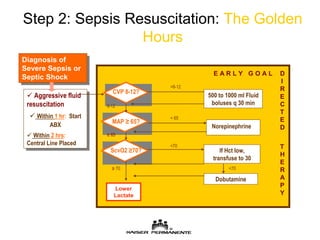
Fluid Goals/Endpoints INITIAL  rapid infusion (30min) of  1-1.5  liter NS  Start  with ~ 20-30  ml/Kg Continue with fluid Bolus NS 500 ml q 30 minutes until goals reached  Stop  @  40 - 60 ml/Kg or if perfusion goals not met or with Pulmonary Edema onset as a complication  AND Transfer to ICU TO FACILITATE GOAL DIRECTED THERAPY VIA ARTERIAL LINE & CENTRAL LINE Low threshold for RBC transfusion (goal of 30%) IF MAP < 60-65 & CVP < 8 and/or lactate > 18  Continue fluid Boluses  500 mL-1000mL  (Q 30 Min)  Evaluate before/after each fluid bolus/Achieve goal < 6 Hrs Volume Status  (CVP)  goal 8-12 Blood Pressure  (MAP)  goal >65 or SBP >90 Tissue Perfusion  (LA)  goal < 18 mg/dl
Empiric Antibiotics for  Suspected SIRS / Sepsis Suspect  Pyelonephritis START GENTAMICIN PLUS ONE OF EITHER  :   Fortaz ®   1g IV q8  OR  Zosyn® 3.375 g IV q 6  Suspect community acquired  Pneumonia  Ceftriaxone 2g IV q24hrs and  Zithromax 500mg IV Q 12 hrs  Suspect  GI SOURCE Vancomycin 1 g IV q 12hrs Zosyn 3.375 g IV q 6hrs
Sepsis LACTATE < 36 mg/dl  AND EVIDENCE OF ONLY 1 OR NONE signs of ORGAN DYSFUNCTION SEPSIS = SIRS with DOCUMENTED infection - Culture or Gram stain  of blood, sputum, urine, amniotic fluid etc,  positive for bacteria -OR focus of  Infection identified by visual inspection,  eg, purulent amniotic fluid or cervical discharge, infected incision If lactate >/= to 18 but < 36 repeat Lactate Q 6 hours until < 18. Consider continuation of fluid bolus 500 ml NS Q 30 min after initial fluid bolus of 20-30 ml NS /Kg until lactate < 18 or BP responds with goals MAP > 60 or SBP > 90 with a maximum of 40-60 ml NS / Kg or complication by pulmonary edema onset. An evaluation for pulmonary edema should be performed (lung ausculation/SaO2) prior to each fluid bolus. Should goals not be met or pulmonary edema ensues an Arterial line and Central line in addition to ICU transfer is recommended.
Severe Sepsis SEPSIS PLUS TWO OR MORE ABNORMAL VALUES REPRESENTING SEVERE ORGAN DYSFUNCTION  ADMIT TO ICU FOR GOAL DIRECTED THERAPY Serum  Lactate  >/= 36 mg/dl  Urine output <0.5 mL/kg after fluid bolus OR Cr >2.0  OR Cr incremental increase =/> than 0.5 above baseline INR>1.5 or PTT > 60 sec or Total bilirubin >4.0 Platelet count of <100,000 cells/mL  ARDS or Acute Lung Injury ( PaO2/FiO2 < 300 ) Mottled skin or capillary refill >or= to 3 seconds  Abrupt change in mental status  Cardiac dysfunction by echocardiography
Septic Shock    Severe Sepsis with Sx/Sx of 2 or more Organ Dysfunction  WITH   NO RESPONSE TO FLUID BOLUS ADMIT TO ICU FOR GOAL DIRECTED THERAPY   MAP of <60-65 mm Hg or SBP<90 AFTER   aggressive fluid resuscitation ~ 40-60 mL/kg NS  Sepsis causes systemic vasodilatation preventing the bodies normal response to peripherally vasoconstrict & shunt blood to the vital organs
Early Treatment for SIRS/SEPSIS Address the Source of Infection Start Antibiotics within 1 Hr / Maintain SaO2 > 96% IV NS  1-1.5  liter bolus within 1 hour ( 20-30 ml/Kg) CBC with Diff  /  Lactate STAT / Blood Cultures  INR/PTT/Fibrinogen /  LDH / LFT’s & Total bilirubin / BUN / Cr / Lytes  / Glucose / Calcium CXR  & Suspected  Source Cultures If lactate >/= to 18 but < 36 repeat Q 6 hours until < 18. Consider continuation of fluid bolus 500 ml NS Q 30 min until lactate < 18 or BP responds with goals MAP > 60 or SBP > 90 with a maximum of 40-60 ml NS / Kg or complication by pulmonary edema onset. Should goals not be met or pulmonary edema ensues an Arterial line and Central line in addition to ICU transfer recommended. Transfer to ICU for goal directed therapy if no  response to fluid boluses or severe sepsis is present Goal directed therapy requires an Arterial line & Central line within 2 hours of admission to guide further Tx Goals
SEPSIS & SEPTIC SHOCK  Even with optimal treatment mortality due to severe sepsis or septic shock can be > 40% Find Source and remove Infection if possible / Start Antibiotics < 1 hr /  IV fluids 1-1.5 Lite rs infused within 1hour  /  Goals Guide Tx ie Central &  A rt line if necessary should be in placed within 2 hours of presentation to guide Tx Consultation with IM and transfer to ICU Stabilize mother first and consider benefits of delivery Prevention is Key  with pyelo a leading cause of Sepsis in Ob
EARLY TREATMENT   FIND THE SOURCE Antibiotics Alone  Pyelonephritis Abortion / Chorio & Metritis Drainage AND/OR Excision/Removal  PPROM / Appy / Surgical complication  Necrotizing Fasciitis esp if IDDM
EARLY TREATMENT A  B  C A ntibiotics/ A irway The time to initiation of appropriate Antibiotics is a strong predictor of mortality. Each hour delay increases mortality by > 7.5%  THERFORE Start ATB within  1  Hr   Crit Care Med. 2006 Jun;34(6):1589-96
Empiric Antibiotics Should be initiated within  1  hour  If the potential bacteria or infection source is NOT immediately obvious Give  VANCOMYCIN   plus one  of the following: Beta-lactam / beta- lactamase inhibitor  eg. piperacillin-tazobactam ie  Zosyn®P  Cephalosporin 3rd or 4th generation (eg, ceftriaxone ie  Rocephin® or Ceftazidime ie Fortaz ®P   if Pseudomonas suspected ) Carbapenem (eg, meropenem ie  Merrem®P)
Empiric Antibiotics for  Suspected SIRS / Sepsis Suspect  Pyelonephritis START GENTAMICIN PLUS ONE OF EITHER  :   Fortaz ®   1g IV q8  OR  Zosyn® 3.375 g IV q 6  Suspect community acquired  Pneumonia  Ceftriaxone 2g IV q24hrs and  Zithromax 500mg IV Q 12 hrs  Suspect  GI SOURCE Vancomycin 1 g IV q 12hrs Zosyn 3.375 g IV q 6hrs
     AIRWAY & BREATHING Airway – O2 by face mask and document response with continuous pulse oximetry CXR and ABG should be obtained to help diagnose acute lung injury (ALI) or acute respiratory distress syndrome (ARDS) which frequently complicate sepsis.  Ventilator may be required to support the increased work of breathing that typically accompanies sepsis
Circulation / Hypoperfusion Hyp O perfusion can occur in the  absence of hypotension   (MAP<65) OR (SBP < 90)  especially during early sepsis. Peripheral BP Cuff  may be unreliable therefore place an arterial line Other Signs of Hyp O perfusion include: Serum  Lactate  >/= 36 mg/dl  Urine output of <0.5 mL/kg after fluid bolus OR Cr >2.0 INR>1.5 or PTT > 60 sec or Total bilirubin >4.0 Platelet count of <100,000 cells/mL  ARDS or Acute Lung Injury ( PaO2/FiO2 < 300 ) Mental status change ie Obtunded
Early Treatment for SIRS/SEPSIS Address the Source of Infection Start Antibiotics within 1 Hr / Maintain SaO2 > 96% IV NS  1-1.5  liter bolus within 1 hour ( 20-30 ml/Kg) CBC with Diff  /  Lactate STAT / Blood Cultures  INR/PTT/Fibrinogen /  LDH / LFT’s & Total bilirubin / BUN / Cr / Lytes  / Glucose / Calcium CXR  & Suspected  Source Cultures If lactate >/= to 18 but < 36 repeat Q 6 hours until < 18. Consider continuation of fluid bolus 500 ml NS Q 30 min until lactate < 18 or BP responds with goals MAP > 60 or SBP > 90 with a maximum of 40-60 ml NS / Kg or complication by pulmonary edema onset. Should goals not be met or pulmonary edema ensues an Arterial line and Central line in addition to ICU transfer recommended. Transfer to ICU for goal directed therapy if no  response to fluid boluses or severe sepsis is present Goal directed therapy requires an Arterial line & Central line within 2 hours of admission to guide further Tx Goals
Fluid Goals/Endpoints INITIAL  rapid infusion (30min) of  1-1.5  liter NS  Start  with ~ 20-30  ml/Kg Continue with fluid Bolus NS 500 ml q 30 minutes until goals reached  Stop  @  40 - 60 ml/Kg or if perfusion goals not met or with Pulmonary Edema onset as a complication  AND Transfer to ICU TO FACILITATE GOAL DIRECTED THERAPY VIA ARTERIAL LINE & CENTRAL LINE Low threshold for RBC transfusion (goal of 30%) IF MAP < 60-65 & CVP < 8 and/or lactate > 18  Continue fluid Boluses  500 mL-1000mL  (Q 30 Min)  Evaluate before/after each fluid bolus/Achieve goal < 6 Hrs Volume Status  (CVP)  goal 8-12 Blood Pressure  (MAP)  goal >65 or SBP >90 Tissue Perfusion  (LA)  goal < 18 mg/dl
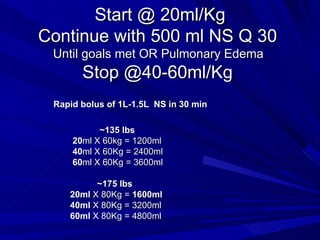
Start @ 20ml/Kg Continue with 500 ml NS Q 30  Until goals met OR Pulmonary Edema  Stop @40-60ml/Kg  Rapid bolus of 1L-1.5L  NS in 30 min ~135 lbs 20 ml X 60kg = 1200ml  40 ml X 60Kg = 2400ml  60 ml X 60Kg = 3600ml  ~175 lbs 20ml  X 80Kg =  1600ml 40ml  X 80Kg = 3200ml  60ml  X 80Kg = 4800ml
PULMONARY EDEMA    ARDS & ALI Diagnosis Acute onset Bilateral infiltrates (radiographically similar to pulmonary edema) No evidence of cardiogenic pulmonary edema  If necessary determine PCWP ≤18 mmHg  Determine ratio of arterial oxygen tension to fraction of inspired oxygen (PaO2/FiO2)
“ PULMONARY EDEMA”    ARDS & ALI Diagnosis  ALI  & ARDS The same except for PaO2 ratio ARDS  SpO2/FiO2 of < 235 or  PaO2/FiO2 is < 200 mmHg  vs  ALI  SpO2/FiO2 of > 315 or  PaO2/FiO2 >200 mmHg
FLUIDS FAIL TO IMPROVE BP/Perfusion Intravenous fluid boluses should be repeated until  MAP is > 65 or SBP  > 90  and Lactate is < 18  If  fluid therapy ( 40-60 ml/Kg) does not correct BP/perfusion or pulmonary edema ensues a vasoconstrictor Norepinephrine (Levophed) or Dopamine is indicated. Start with low dose  DOPAMINE   5-20 MCG/Kg/Min to maintain MAP > 65 mm Hg  OR  (Levophed)   <0.25 mcg/kg/min   Refractory Septic Shock is present when  > 0.25mcg/Kg/min is required to maintain MAP > 65
SEPSIS & SEPTIC SHOCK  Even with optimal treatment mortality due to severe sepsis or septic shock can be > 40% Find Source and remove Infection if possible / Start Antibiotics < 1 hr /  IV fluids 1-1.5 Lite rs  /  Goals Guide Tx ie Central &  A rt line necessary should be in place within 2 hours Consultation with IM and transfer to ICU Stabilize mother first and consider benefits of delivery Prevention is Key
Pyelonephritis As many as 20 percent of women with severe pyelonephritis develop complications that include septic shock syndrome and/or acute respiratory distress syndrome (ARDS)  Other complications include: Bacteremia 17 % Respiratory insufficiency 7 % Renal dysfunction 2 %  Anemia 23 %  (hemolysis mediated by endotoxin) Am J Obstet Gynecol 1991 Feb;164(2):587-90 Baillieres Clin Obstet Gynaecol 1994 Jun;8(2):353-73.
ANTIBIOTICS & PYELONEPHRITIS Pregnant women should have definite improvement within 24 to 48 hours. Once afebrile for 48 hours, patients can be switched to oral therapy (guided by culture susceptibility results) and discharged to complete 10 to 14 days of treatment If symptoms and fever persist beyond the first 24 to 48 hours of treatment, a repeat urine culture and urinary tract imaging studies should be performed to rule out renal / perinephric abscess or urinary tract pathology / anomalies.
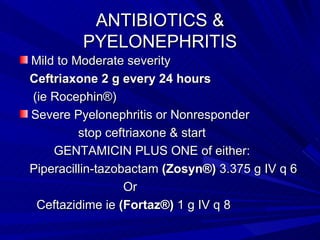
ANTIBIOTICS & PYELONEPHRITIS Mild to Moderate severity  Ceftriaxone 2 g every 24 hours   (ie Rocephin®) Severe Pyelonephritis or Nonresponder stop ceftriaxone & start  GENTAMICIN PLUS ONE of either: Piperacillin-tazobactam  (Zosyn®)  3.375 g IV q 6  Or Ceftazidime ie  (Fortaz®)  1 g IV q 8
Post treatment Suppression   Recurrent pyelonephritis during pregnancy occurs in 6 to 8 percent of women.  Therefore low dose antimicrobial prophylaxis is recommended  nitrofurantoin (50 to 100 mg orally at bedtime)  cephalexin (250 to 500 mg orally at bedtime) AND periodic urinary surveillance for infection are recommended for the remainder of the pregnancy
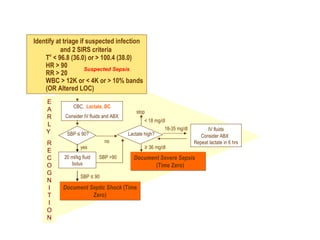
EARLY  RECOGN I T I ON Identify at triage if suspected infection and 2 SIRS criteria  T o  < 96.8 (36.0) or > 100.4 (38.0) HR > 90 RR > 20 WBC > 12K or < 4K or > 10% bands (OR Altered LOC) CBC,   Lactate, BC Consider IV fluids and ABX SBP ≤ 90? yes no Lactate high? 20 ml/kg fluid bolus 18-35 mg/dl IV fluids Consider ABX  Repeat lactate in 6 hrs < 18 mg/dl Document Septic Shock  (Time Zero) ≥  36 mg/dl SBP ≤ 90 SBP >90 stop Suspected Sepsis Document Severe Sepsis   (Time Zero)
Step 2: Sepsis Resuscitation:  The Golden Hours

Sepsis and septic shock

  • 1.
    SEPSIS AND SEPTICSHOCK PATHOPHYSIOLOGY DIAGNOSIS INITIAL MANAGEMENT Last update OCTOBER 2010
  • 2.
    Spectrum of DiseaseSeverity With Progression From Inflammation to Shock
  • 3.
    What is ShockAn abnormality of the circulatory system that results in decreased organ PERFUSION causing HYPOXIA Lack of oxygen results in production of Lactic Acid Shock has many causes: -Redistribution of blood flow via Vasodilation ( Sepsis , Anaphylaxis , Neurogenic ) -Restriction/blockage of blood flow ( Impaired cardiac function , pulmonary embolus) -Volume Loss ( Hemorrhage , Severe dehydration )
  • 4.
    How Does theBody Fight Shock? Adrenalin released - Increased heart rate - Peripheral vasoconstriction shunts blood away from the muscles and skin to the brain, heart, & kidneys - Patient has pale skin that is cool & clammy BP may still be normal if early ; however pulse is elevated
  • 5.
    Mean Arterial BPMAP MAP is considered to be the perfusion pressure seen by organs in the body. It is believed that a MAP that is greater than 60 mmHg is enough to sustain perfusion to the organs. If the MAP falls significantly below 60 mmHg for an appreciable time, the end organs will not get enough blood flow, and will become ischemic. Lactic acid is an excellent objective lab for assessment of perfusion. < 18 is normal. > 36 is compatible with severe sepsis MAP= DP + 1/3 (SYSTOLIC – DIASTOLIC) 90/60 = 60 + 1/3 x 30 = MAP of 70 80/50 = 50 + 1/3 x 30 = MAP of 60
  • 6.
    Pathophysiology of SepsisThe release of mediators (Pro & Anti Inflammatory) by PMNs at the site of injury or infection is responsible for the cardinal signs of local inflammation: -Local vasodilation and hyperemia -Increased microvascular permeability , resulting in protein-rich edema. Sepsis results when mediator release proceeds unchecked and exceeds the boundaries of local infection leading to a systemic response that may result in remote tissue and organ injury. Severe sepsis & (MODS)
  • 7.
    Determinants of Severityin Sepsis Bacterial factors Degree of Hypoperfusion & Hypoxia Abnormal host response to infection Site and type of infection Timing and type of antimicrobial therapy The development of shock    
  • 8.
    Bacterial Factors Endotoxin is found in the cell wall of gram negative bacteria ( Pseudomonas aeruginosa, Klebsiella pneumoniae, Enterobacter, E coli ) Endotoxin can accelerate sepsis in gram negative bacterial infections. Elevated plasma levels of endotoxin are associated with shock and multiple organ dysfunction syndrome (MODS) The coagulation, complement, and contact fibrinolytic systems are all activated by endotoxin . This leads to the production of vasoactive substances which enhance endothelial permeability . Activation of the coagulation system leads to DIC
  • 9.
    Hypotension= MAP< 60/ SBP< 90 Goals are adequate perfusion = Lactic acid < 18 or Urine Output responds to fluid This is in part due to a 3 rd spacing caused by reduced arterial vascular tone and increased endothelial permeability . Other changes that occur include venous dilation thereby diminishing venous return to the heart and ultimately causing decreased CO. Sepsis is associated with a decrease in the number of functional capillaries which results in hypoperfusion, hypoxia, and lactic acid production When prolonged hypotension (MAP <60) complicates sepsis remote organ injury results in Severe Sepsis and if prolonged or not corrected rapidly Septic Shock
  • 10.
    Organs Commonly AffectedLung - ALI/ARDS Kidney -Acute renal failure due to acute tubular necrosis CNS -Altered sensorium and peripheral neuropathy manifested as muscle weakness and loss of sensation to light touch Liver -Liver dysfunction can prevent the elimination of endotoxin and bacteria-derived products via the RES thereby permitting direct spillover of these toxic products into the systemic circulation Gut - Sepsis may depress the gut's normal barrier function, allowing translocation of bacteria and endotoxin into the systemic circulation Heart- Myocardial depression
  • 11.
    DEGREES OF SEVERITYInflammatory mediators & bacterial toxins spread systemically from a localized infection to affect remote tissues and organs of the body. PROGRESSIVE degrees of severity occur as the infection spirals out of control as below SIRS 7% Mortality SEPSIS 16% Mortality SEVERE SEPSIS 20% Mortality SEPTIC SHOCK 46% Mortality Refractory shock > 50%
  • 12.
    Systemic Inflammatory ResponseSyndrome SIRS TWO OR MORE of the following conditions: KP Temp >100.5 (38.1c) or < 96.8 (36.0c) Lit Temp >101.3 (38.5c) or < 95.0 (35.0c) Heart rate of >90 beats/min Respiratory rate of >20 breaths/min or PaCO2 of <32 mm Hg and WBC count of >12,000 <4000 OR >10 percent immature (band) forms
  • 13.
    Patients Who PresentWith SIRS WHAT DO I DO Recognize the diagnosis of SIRS Determine the SEVERITY & SOURCE of Infection via labs & cultures ; including Lactic Acid Start empiric / appropriate antibiotics Correct Fluid Deficit
  • 14.
    Early Treatment forSIRS/SEPSIS Open sepsis order set SEPSIS ICU IP SCAL NATL AND ORDER LABS / BLOOD CULTURES / ANTIBIOTICS / FLUID BOLUS AS DIRECTED IN NEXT SLIDE
  • 15.
    Early Treatment forSIRS/SEPSIS Address the Source of Infection Start Antibiotics within 1 Hr / Maintain SaO2 > 96% IV NS 1-1.5 liter bolus within 1 hour ( 20-30 ml/Kg) CBC with Diff / Lactate STAT / Blood Cultures INR/PTT/Fibrinogen / LDH / LFT’s & Total bilirubin / BUN / Cr / Lytes / Glucose / Calcium CXR & Suspected Source Cultures If lactate >/= to 18 but < 36 repeat Q 6 hours until < 18. Consider continuation of fluid bolus 500 ml NS Q 30 min until lactate < 18 or BP responds with goals MAP > 60 or SBP > 90 with a maximum of 40-60 ml NS / Kg or complication by pulmonary edema onset. Should goals not be met or pulmonary edema ensues an Arterial line and Central line in addition to ICU transfer recommended. Transfer to ICU for goal directed therapy if no response to fluid boluses or severe sepsis is present Goal directed therapy requires an Arterial line & Central line within 2 hours of admission to guide further Tx Goals
  • 16.
    Fluid Goals/Endpoints INITIAL rapid infusion (30min) of 1-1.5 liter NS Start with ~ 20-30 ml/Kg Continue with fluid Bolus NS 500 ml q 30 minutes until goals reached Stop @ 40 - 60 ml/Kg or if perfusion goals not met or with Pulmonary Edema onset as a complication AND Transfer to ICU TO FACILITATE GOAL DIRECTED THERAPY VIA ARTERIAL LINE & CENTRAL LINE Low threshold for RBC transfusion (goal of 30%) IF MAP < 60-65 & CVP < 8 and/or lactate > 18 Continue fluid Boluses 500 mL-1000mL (Q 30 Min) Evaluate before/after each fluid bolus/Achieve goal < 6 Hrs Volume Status (CVP) goal 8-12 Blood Pressure (MAP) goal >65 or SBP >90 Tissue Perfusion (LA) goal < 18 mg/dl
  • 17.
    Empiric Antibiotics for Suspected SIRS / Sepsis Suspect Pyelonephritis START GENTAMICIN PLUS ONE OF EITHER : Fortaz ® 1g IV q8 OR Zosyn® 3.375 g IV q 6 Suspect community acquired Pneumonia Ceftriaxone 2g IV q24hrs and Zithromax 500mg IV Q 12 hrs Suspect GI SOURCE Vancomycin 1 g IV q 12hrs Zosyn 3.375 g IV q 6hrs
  • 18.
    Sepsis LACTATE <36 mg/dl AND EVIDENCE OF ONLY 1 OR NONE signs of ORGAN DYSFUNCTION SEPSIS = SIRS with DOCUMENTED infection - Culture or Gram stain of blood, sputum, urine, amniotic fluid etc, positive for bacteria -OR focus of Infection identified by visual inspection, eg, purulent amniotic fluid or cervical discharge, infected incision If lactate >/= to 18 but < 36 repeat Lactate Q 6 hours until < 18. Consider continuation of fluid bolus 500 ml NS Q 30 min after initial fluid bolus of 20-30 ml NS /Kg until lactate < 18 or BP responds with goals MAP > 60 or SBP > 90 with a maximum of 40-60 ml NS / Kg or complication by pulmonary edema onset. An evaluation for pulmonary edema should be performed (lung ausculation/SaO2) prior to each fluid bolus. Should goals not be met or pulmonary edema ensues an Arterial line and Central line in addition to ICU transfer is recommended.
  • 19.
    Severe Sepsis SEPSISPLUS TWO OR MORE ABNORMAL VALUES REPRESENTING SEVERE ORGAN DYSFUNCTION ADMIT TO ICU FOR GOAL DIRECTED THERAPY Serum Lactate >/= 36 mg/dl Urine output <0.5 mL/kg after fluid bolus OR Cr >2.0 OR Cr incremental increase =/> than 0.5 above baseline INR>1.5 or PTT > 60 sec or Total bilirubin >4.0 Platelet count of <100,000 cells/mL ARDS or Acute Lung Injury ( PaO2/FiO2 < 300 ) Mottled skin or capillary refill >or= to 3 seconds Abrupt change in mental status Cardiac dysfunction by echocardiography
  • 20.
    Septic Shock Severe Sepsis with Sx/Sx of 2 or more Organ Dysfunction WITH NO RESPONSE TO FLUID BOLUS ADMIT TO ICU FOR GOAL DIRECTED THERAPY MAP of <60-65 mm Hg or SBP<90 AFTER aggressive fluid resuscitation ~ 40-60 mL/kg NS Sepsis causes systemic vasodilatation preventing the bodies normal response to peripherally vasoconstrict & shunt blood to the vital organs
  • 21.
    Early Treatment forSIRS/SEPSIS Address the Source of Infection Start Antibiotics within 1 Hr / Maintain SaO2 > 96% IV NS 1-1.5 liter bolus within 1 hour ( 20-30 ml/Kg) CBC with Diff / Lactate STAT / Blood Cultures INR/PTT/Fibrinogen / LDH / LFT’s & Total bilirubin / BUN / Cr / Lytes / Glucose / Calcium CXR & Suspected Source Cultures If lactate >/= to 18 but < 36 repeat Q 6 hours until < 18. Consider continuation of fluid bolus 500 ml NS Q 30 min until lactate < 18 or BP responds with goals MAP > 60 or SBP > 90 with a maximum of 40-60 ml NS / Kg or complication by pulmonary edema onset. Should goals not be met or pulmonary edema ensues an Arterial line and Central line in addition to ICU transfer recommended. Transfer to ICU for goal directed therapy if no response to fluid boluses or severe sepsis is present Goal directed therapy requires an Arterial line & Central line within 2 hours of admission to guide further Tx Goals
  • 22.
    SEPSIS & SEPTICSHOCK Even with optimal treatment mortality due to severe sepsis or septic shock can be > 40% Find Source and remove Infection if possible / Start Antibiotics < 1 hr / IV fluids 1-1.5 Lite rs infused within 1hour / Goals Guide Tx ie Central & A rt line if necessary should be in placed within 2 hours of presentation to guide Tx Consultation with IM and transfer to ICU Stabilize mother first and consider benefits of delivery Prevention is Key with pyelo a leading cause of Sepsis in Ob
  • 23.
    EARLY TREATMENT FIND THE SOURCE Antibiotics Alone Pyelonephritis Abortion / Chorio & Metritis Drainage AND/OR Excision/Removal PPROM / Appy / Surgical complication Necrotizing Fasciitis esp if IDDM
  • 24.
    EARLY TREATMENT A B C A ntibiotics/ A irway The time to initiation of appropriate Antibiotics is a strong predictor of mortality. Each hour delay increases mortality by > 7.5% THERFORE Start ATB within 1 Hr Crit Care Med. 2006 Jun;34(6):1589-96
  • 25.
    Empiric Antibiotics Shouldbe initiated within 1 hour If the potential bacteria or infection source is NOT immediately obvious Give VANCOMYCIN   plus one of the following: Beta-lactam / beta- lactamase inhibitor eg. piperacillin-tazobactam ie Zosyn®P Cephalosporin 3rd or 4th generation (eg, ceftriaxone ie Rocephin® or Ceftazidime ie Fortaz ®P if Pseudomonas suspected ) Carbapenem (eg, meropenem ie Merrem®P)
  • 26.
    Empiric Antibiotics for Suspected SIRS / Sepsis Suspect Pyelonephritis START GENTAMICIN PLUS ONE OF EITHER : Fortaz ® 1g IV q8 OR Zosyn® 3.375 g IV q 6 Suspect community acquired Pneumonia Ceftriaxone 2g IV q24hrs and Zithromax 500mg IV Q 12 hrs Suspect GI SOURCE Vancomycin 1 g IV q 12hrs Zosyn 3.375 g IV q 6hrs
  • 27.
      AIRWAY & BREATHING Airway – O2 by face mask and document response with continuous pulse oximetry CXR and ABG should be obtained to help diagnose acute lung injury (ALI) or acute respiratory distress syndrome (ARDS) which frequently complicate sepsis. Ventilator may be required to support the increased work of breathing that typically accompanies sepsis
  • 28.
    Circulation / HypoperfusionHyp O perfusion can occur in the absence of hypotension (MAP<65) OR (SBP < 90) especially during early sepsis. Peripheral BP Cuff may be unreliable therefore place an arterial line Other Signs of Hyp O perfusion include: Serum Lactate >/= 36 mg/dl Urine output of <0.5 mL/kg after fluid bolus OR Cr >2.0 INR>1.5 or PTT > 60 sec or Total bilirubin >4.0 Platelet count of <100,000 cells/mL ARDS or Acute Lung Injury ( PaO2/FiO2 < 300 ) Mental status change ie Obtunded
  • 29.
    Early Treatment forSIRS/SEPSIS Address the Source of Infection Start Antibiotics within 1 Hr / Maintain SaO2 > 96% IV NS 1-1.5 liter bolus within 1 hour ( 20-30 ml/Kg) CBC with Diff / Lactate STAT / Blood Cultures INR/PTT/Fibrinogen / LDH / LFT’s & Total bilirubin / BUN / Cr / Lytes / Glucose / Calcium CXR & Suspected Source Cultures If lactate >/= to 18 but < 36 repeat Q 6 hours until < 18. Consider continuation of fluid bolus 500 ml NS Q 30 min until lactate < 18 or BP responds with goals MAP > 60 or SBP > 90 with a maximum of 40-60 ml NS / Kg or complication by pulmonary edema onset. Should goals not be met or pulmonary edema ensues an Arterial line and Central line in addition to ICU transfer recommended. Transfer to ICU for goal directed therapy if no response to fluid boluses or severe sepsis is present Goal directed therapy requires an Arterial line & Central line within 2 hours of admission to guide further Tx Goals
  • 30.
    Fluid Goals/Endpoints INITIAL rapid infusion (30min) of 1-1.5 liter NS Start with ~ 20-30 ml/Kg Continue with fluid Bolus NS 500 ml q 30 minutes until goals reached Stop @ 40 - 60 ml/Kg or if perfusion goals not met or with Pulmonary Edema onset as a complication AND Transfer to ICU TO FACILITATE GOAL DIRECTED THERAPY VIA ARTERIAL LINE & CENTRAL LINE Low threshold for RBC transfusion (goal of 30%) IF MAP < 60-65 & CVP < 8 and/or lactate > 18 Continue fluid Boluses 500 mL-1000mL (Q 30 Min) Evaluate before/after each fluid bolus/Achieve goal < 6 Hrs Volume Status (CVP) goal 8-12 Blood Pressure (MAP) goal >65 or SBP >90 Tissue Perfusion (LA) goal < 18 mg/dl
  • 31.
    Start @ 20ml/KgContinue with 500 ml NS Q 30 Until goals met OR Pulmonary Edema Stop @40-60ml/Kg Rapid bolus of 1L-1.5L NS in 30 min ~135 lbs 20 ml X 60kg = 1200ml 40 ml X 60Kg = 2400ml 60 ml X 60Kg = 3600ml ~175 lbs 20ml X 80Kg = 1600ml 40ml X 80Kg = 3200ml 60ml X 80Kg = 4800ml
  • 32.
    PULMONARY EDEMA ARDS & ALI Diagnosis Acute onset Bilateral infiltrates (radiographically similar to pulmonary edema) No evidence of cardiogenic pulmonary edema If necessary determine PCWP ≤18 mmHg Determine ratio of arterial oxygen tension to fraction of inspired oxygen (PaO2/FiO2)
  • 33.
    “ PULMONARY EDEMA” ARDS & ALI Diagnosis ALI & ARDS The same except for PaO2 ratio ARDS SpO2/FiO2 of < 235 or PaO2/FiO2 is < 200 mmHg vs ALI SpO2/FiO2 of > 315 or PaO2/FiO2 >200 mmHg
  • 34.
    FLUIDS FAIL TOIMPROVE BP/Perfusion Intravenous fluid boluses should be repeated until MAP is > 65 or SBP > 90 and Lactate is < 18 If fluid therapy ( 40-60 ml/Kg) does not correct BP/perfusion or pulmonary edema ensues a vasoconstrictor Norepinephrine (Levophed) or Dopamine is indicated. Start with low dose DOPAMINE 5-20 MCG/Kg/Min to maintain MAP > 65 mm Hg OR (Levophed) <0.25 mcg/kg/min Refractory Septic Shock is present when > 0.25mcg/Kg/min is required to maintain MAP > 65
  • 35.
    SEPSIS & SEPTICSHOCK Even with optimal treatment mortality due to severe sepsis or septic shock can be > 40% Find Source and remove Infection if possible / Start Antibiotics < 1 hr / IV fluids 1-1.5 Lite rs / Goals Guide Tx ie Central & A rt line necessary should be in place within 2 hours Consultation with IM and transfer to ICU Stabilize mother first and consider benefits of delivery Prevention is Key
  • 36.
    Pyelonephritis As manyas 20 percent of women with severe pyelonephritis develop complications that include septic shock syndrome and/or acute respiratory distress syndrome (ARDS) Other complications include: Bacteremia 17 % Respiratory insufficiency 7 % Renal dysfunction 2 % Anemia 23 % (hemolysis mediated by endotoxin) Am J Obstet Gynecol 1991 Feb;164(2):587-90 Baillieres Clin Obstet Gynaecol 1994 Jun;8(2):353-73.
  • 37.
    ANTIBIOTICS & PYELONEPHRITISPregnant women should have definite improvement within 24 to 48 hours. Once afebrile for 48 hours, patients can be switched to oral therapy (guided by culture susceptibility results) and discharged to complete 10 to 14 days of treatment If symptoms and fever persist beyond the first 24 to 48 hours of treatment, a repeat urine culture and urinary tract imaging studies should be performed to rule out renal / perinephric abscess or urinary tract pathology / anomalies.
  • 38.
    ANTIBIOTICS & PYELONEPHRITISMild to Moderate severity Ceftriaxone 2 g every 24 hours (ie Rocephin®) Severe Pyelonephritis or Nonresponder stop ceftriaxone & start GENTAMICIN PLUS ONE of either: Piperacillin-tazobactam (Zosyn®) 3.375 g IV q 6 Or Ceftazidime ie (Fortaz®) 1 g IV q 8
  • 39.
    Post treatment Suppression  Recurrent pyelonephritis during pregnancy occurs in 6 to 8 percent of women. Therefore low dose antimicrobial prophylaxis is recommended nitrofurantoin (50 to 100 mg orally at bedtime) cephalexin (250 to 500 mg orally at bedtime) AND periodic urinary surveillance for infection are recommended for the remainder of the pregnancy
  • 40.
    EARLY RECOGNI T I ON Identify at triage if suspected infection and 2 SIRS criteria T o < 96.8 (36.0) or > 100.4 (38.0) HR > 90 RR > 20 WBC > 12K or < 4K or > 10% bands (OR Altered LOC) CBC, Lactate, BC Consider IV fluids and ABX SBP ≤ 90? yes no Lactate high? 20 ml/kg fluid bolus 18-35 mg/dl IV fluids Consider ABX Repeat lactate in 6 hrs < 18 mg/dl Document Septic Shock (Time Zero) ≥ 36 mg/dl SBP ≤ 90 SBP >90 stop Suspected Sepsis Document Severe Sepsis (Time Zero)
  • 41.
    Step 2: SepsisResuscitation: The Golden Hours