Presented by:
Dr Shashank Agrawal
MEDICINE JR2
SEPTIC SHOCK DIAGNOSIS
AND MANAGEMENT
Moderated by:
Dr Rajeev Choudhary
M.D MEDICINE
HISTORICALASPECT
 4th century BC , Hippocrates -- fever as a major symptoms
 1879-80 , Louis Pasteur – Bacteria in blood
 1991 – ACCP/SCCM – define , SIRS
 2001 – ACCP/SCCM/ESICM/SIS – Expanded
Diagnostic criteria
 2016 – SEPSIS-3
INFECTION
 Microbial phenomenon characterised by an inflammatory
response to the presence of micro organisms or the invasion
of normally sterile host tissue by these organisms.
BACTEREMIA
 Presence of bacteria in the blood, as evidenced by positive
blood culture.
SEPSIS AND SIRS
• The harmful host response to infection, systemic
response to proven or suspected infection.
• Systemic response to infection manifested by ≥ 2 of:
– Temp > 38oC or < 36oC
– HR > 90 bpm
– RR > 20 bpm or PaCO2 < 32 mmHg
– WBC > 12 x 109/L, < 4 x 10⁹/L or >10% band form
SEVERE SEPSIS
 Sepsis plus some degree of organ hypofunction, i.e
1. Cardiovascular: SBP ≤90 mmHg or MAP ≤70 mmHg
that responds to administration of IV fluids.
2. Renal: Urine output <0.5 mL/kg per hour for 1 hour
despite adequate fluid resuscitation.
3. Respiratory: Pao2/Fio2 ≤250.
4. Hematologic: Platelet count <80,000/μL or 50% decrease
in platelet count from highest value recorded over previous
3 days.
5.Metabolic acidosis: A pH ≤7.30 or a base deficit ≥5.0
mEq/L and a plasma lactate level >1.5 times upper limit.
SEPTIC SHOCK
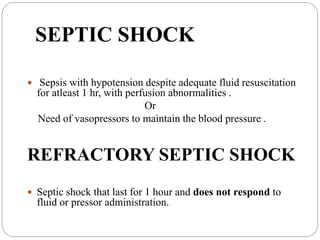
 Sepsis with hypotension despite adequate fluid resuscitation
for atleast 1 hr, with perfusion abnormalities .
Or
Need of vasopressors to maintain the blood pressure .
REFRACTORY SEPTIC SHOCK
 Septic shock that last for 1 hour and does not respond to
fluid or pressor administration.
GENERAL VARIABLES
• Fever (core temperature, >38.3°C) Hypothermia (core temperature, <36°C)
• Tachycardia (>90 beats per min or >2 SD above the upper limit of the normal range for age)
• Tachypnea
• Altered mental status Substantial edema or positive fluid balance (>20 ml/kg of BW over a 24-hr
• Hyperglycemia (plasma glucose, >120 mg/dl in the absence of diabetes
INFLAMMATORY VARIABLES
• Leukocytosis (white-cell count, >12,000/mm3)
• Leukopenia (white-cell count, <4000/mm3)
• Normal white-cell count with >10% immature forms
• Elevated plasma C-reactive protein (>2 SD above the upper limit of the normal range)
• Elevated plasma procalcitonin (>2 SD above the upper limit of the normal range)
HEMODYNAMIC VARIABLES
• Arterial hypotension (SBP, <90 mm Hg,; MAP <70 mm Hg; or dcrease in SBP>40 mm Hg in adults or
to >2 SD below the lower limit of the normal range for age)
• Elevated mixed venous oxygen saturation (>70%)
• Elevated cardiac index (>3.5 liters/min/square meter of body-surface area)
Diagnostic Criteria for Sepsis, Severe
Sepsis, and Septic Shock
SEPSIS (DOCUMENTED OR SUSPECTED INFECTION PLUS ≥1 OF THE
FOLLOWING)
ORGAN-DYSFUNCTION VARIABLES
• Arterial hypoxemia (ratio of the PaO2 to FIO2, <300)
• Acute oliguria (urine output, <0.5 ml/kg/hr or 45 ml/hr for at least 2 hr)
• Increase in creatinine level of >0.5 mg/dl (>44 μmol/liter)
• Coagulation abnormalities (INR, >1.5; or APTT >60 sec)
• Paralytic ileus (absence of bowel sounds)
• Thrombocytopenia (platelet count, <100,000/mm3)
• Hyperbilirubinemia (plasma total bilirubin, >4 mg/dl [68 μmol/liter])
TISSUE-PERFUSION VARIABLES
• Hyperlactatemia (lactate, >1 mmol/liter)
• Decreased capillary refill or mottling
SEVERE SEPSIS (SEPSIS PLUS ORGAN DYSFUNCTION)
SEPTIC SHOCK (SEPSIS PLUS EITHER HYPOTENSION [REFRACTORY TO
INTRAVENOUS FLUIDS] OR HYPERLACTATEMIA)
INTENSIVE CARE MEDICINE 2003
Newer definition and criteria
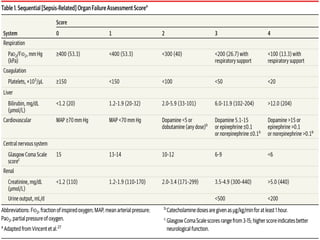
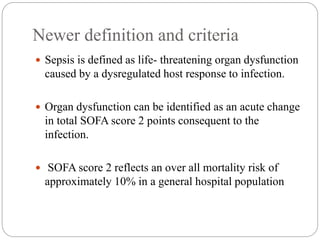
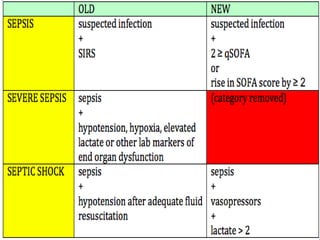
 Sepsis is defined as life- threatening organ dysfunction
caused by a dysregulated host response to infection.
 Organ dysfunction can be identified as an acute change
in total SOFA score 2 points consequent to the
infection.
 SOFA score 2 reflects an over all mortality risk of
approximately 10% in a general hospital population
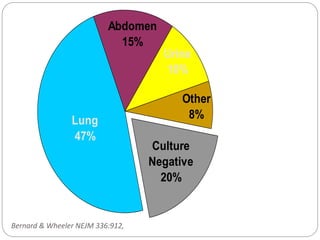
ETIOLOGY
Abdomen
15%
Culture
Negative
20%
Lung
47%
Urine
10%
Other
8%
Bernard & Wheeler NEJM 336:912,
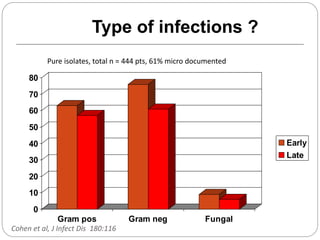
Type of infections ?
0
10
20
30
40
50
60
70
80
Gram pos Gram neg Fungal
Early
Late
Pure isolates, total n = 444 pts, 61% micro documented
Cohen et al, J Infect Dis 180:116
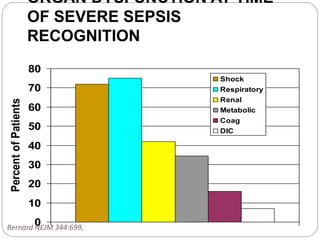
ORGAN DYSFUNCTION AT TIME
OF SEVERE SEPSIS
RECOGNITION
0
10
20
30
40
50
60
70
80
PercentofPatients
Shock
Respiratory
Renal
Metabolic
Coag
DIC
Bernard NEJM 344:699,
PATHOGENESIS
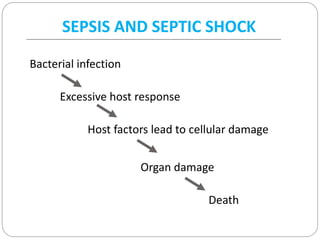
Bacterial infection
SEPSIS AND SEPTIC SHOCK
Excessive host response
Host factors lead to cellular damage
Organ damage
Death
DIAGNOSIS
 Cultures should be sent before starting antimicrobial
therapy .
 At least 2 sets of blood cultures (both aerobic and
anaerobic bottles) should be obtained before antimicrobial
therapy with at least 1 drawn percutaneously and 1 drawn
through each vascular access device, unless the device was
recently (<48 hrs) inserted .
MANAGMENT
INITIAL RESUSCITATION
Goals during the first 6 hrs of resuscitation:
a) Central venous pressure (CVP) 8–12 mm Hg
b) Mean arterial pressure (MAP) ≥ 65 mm Hg
c) Urine output ≥ 0.5 mL/kg/hr
d) Central venous (superior vena cava) or mixed venous
oxygen saturation 70% or 65%, respectively
e) In patients with elevated lactate levels targeting
resuscitation to normalize lactate.
ANTI- MICROBIAL
THERAPY
GOAL-- To administer effective intravenous antimicrobials
within the first hour of recognition of septic shock and severe
sepsis .
a) Initial empiric anti-infective therapy should include one or
more drugs that have activity against all likely pathogens and that
penetrate in adequate concentrations into tissues presumed to be
the source of sepsis.
b) Antimicrobial regimen should be reassessed daily .
c) Use of low procalcitonin or other biomarkers to assist in the
discontinuation of antibiotics in patients who initially appeared
septic, but have no subsequent evidence of infection.
a) Combination empirical therapy for neutropenic
patients with severe sepsis, MDR pathogens such as
Acinetobacter and Pseudomonas spp.
b) Patients with severe infections associated with
respiratory failure and septic shock, combination
therapy with an extended spectrum beta-lactam and
either an aminoglycoside or a fluoroquinolones.
c) Empiric combination therapy should not be
administered for more than 3–5 days.
 De-escalation to the most appropriate single
therapy should be performed as soon as the
susceptibility profile is known .
 Duration of therapy typically 7–10 days; longer
courses may be appropriate in patients who
have a slow clinical response, undrainable foci
of infection, bacteremia with S. aureus; some
fungal and viral infections or immunologic
deficiencies, including neutropenia .
 Antiviral therapy should be initiated as early
as possible in patients with sepsis of viral
origin.
 Antimicrobial agents should not be used in
patients with severe inflammatory states
determined to be of noninfectious cause.
Source control
1) Source control should be sought as rapidly as
possible, and intervention should be undertaken for
source control within the first 12 hr after the
diagnosis is made.
2) When infected necrosis is identified as a source of
infection, definitive intervention is delayed until
adequate demarcation of viable and nonviable
tissues has occurred .
3) If intravascular access devices are a possible source
of sepsis, they should be removed after other
vascular access has been established .
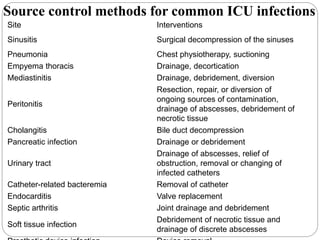
Site Interventions
Sinusitis Surgical decompression of the sinuses
Pneumonia Chest physiotherapy, suctioning
Empyema thoracis Drainage, decortication
Mediastinitis Drainage, debridement, diversion
Peritonitis
Resection, repair, or diversion of
ongoing sources of contamination,
drainage of abscesses, debridement of
necrotic tissue
Cholangitis Bile duct decompression
Pancreatic infection Drainage or debridement
Urinary tract
Drainage of abscesses, relief of
obstruction, removal or changing of
infected catheters
Catheter-related bacteremia Removal of catheter
Endocarditis Valve replacement
Septic arthritis Joint drainage and debridement
Soft tissue infection
Debridement of necrotic tissue and
drainage of discrete abscesses
Source control methods for common ICU infections
FLUID THERAPY OF SEVERE SEPSIS
• Crystalloids are preferred as the initial fluid of choice.
• Albumin is used in fluid resuscitation when patients
require substantial amounts of crystalloids .
• Initial fluid challenge in patients with sepsis-induced
tissue hypoperfusion with suspicion of hypovolemia to
achieve a minimum of 30 mL/kg of crystalloids.
Fluid challenge technique should be applied and is
continued as long as there is hemodynamic improvement
either based on dynamic (eg, change in pulse pressure,
stroke volume variation) or static (eg, arterial pressure,
heart rate).
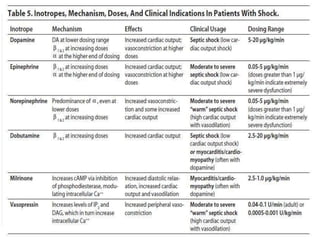
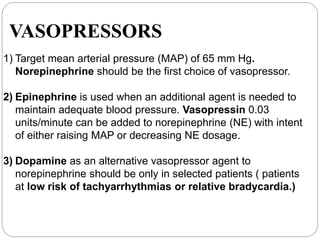
VASOPRESSORS
1) Target mean arterial pressure (MAP) of 65 mm Hg.
Norepinephrine should be the first choice of vasopressor.
2) Epinephrine is used when an additional agent is needed to
maintain adequate blood pressure. Vasopressin 0.03
units/minute can be added to norepinephrine (NE) with intent
of either raising MAP or decreasing NE dosage.
3) Dopamine as an alternative vasopressor agent to
norepinephrine should be only in selected patients ( patients
at low risk of tachyarrhythmias or relative bradycardia.)
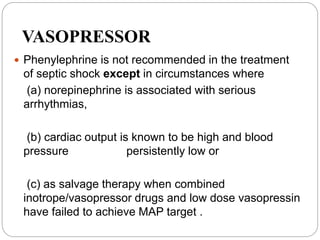
VASOPRESSOR
 Phenylephrine is not recommended in the treatment
of septic shock except in circumstances where
(a) norepinephrine is associated with serious
arrhythmias,
(b) cardiac output is known to be high and blood
pressure persistently low or
(c) as salvage therapy when combined
inotrope/vasopressor drugs and low dose vasopressin
have failed to achieve MAP target .
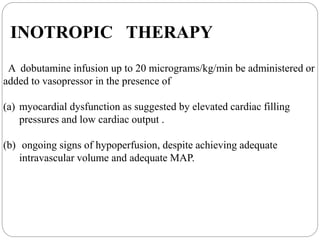
INOTROPIC THERAPY
A dobutamine infusion up to 20 micrograms/kg/min be administered or
added to vasopressor in the presence of
(a) myocardial dysfunction as suggested by elevated cardiac filling
pressures and low cardiac output .
(b) ongoing signs of hypoperfusion, despite achieving adequate
intravascular volume and adequate MAP.
OTHER SUPPORTIVE
THERAPY OF
SEVERE SEPSIS
BLOOD PRODUCT ADMINISTRATION
 Once tissue hypoperfusion has resolved and in the absence of
extenuating circumstances, such as myocardial ischemia, severe
hypoxemia, acute hemorrhage, or ischemic heart disease, we
recommend that red blood cell transfusion occur only when
hemoglobin concentration decreases to <7.0 g/dL to target a
hemoglobin concentration of 7.0 –9.0 g/dL in adults .
 Not using erythropoietin as a specific treatment of anemia associated
with severe sepsis .
 Fresh frozen plasma not be used to correct laboratory clotting
abnormalities in the absence of bleeding or planned invasive
procedures .
 Not using antithrombin for the treatment of severe sepsis and septic
shock .
 Administer platelets when counts are <10,000/mm3 in the absence of
apparent bleeding. We suggest prophylactic platelet transfusion when
counts are < 20,000/mm3 if the patient has a significant risk of
bleeding. Higher platelet counts ≥50,000/mm3 are advised for active
bleeding, surgery, or invasive procedures .
CORTICOSTEROIDS
 I/V hydrocortisone should not be used to treat adult septic
shock patients if adequate fluid resuscitation and
vasopressor therapy are able to restore hemodynamic
stability.
 In case this is not achieved, i/v hydrocortisone alone at a
dose of 200 mg per day is used.
 ACTH stimulation test should not be used in adults with
septic shock who receive hydrocortisone.
 In treated patients hydrocortisone should be tapered when
vasopressors are no longer required.
 Corticosteroids should not be administered for the
treatment of sepsis in the absence of shock, if
hydrocortisone is given, use continuous flow.
EXTERNAL COOLING
 Controlling fever during severe sepsis and septic shock has
potential benefits and adverse effects. the net effects of
which are uncertain.
 External cooling consists of using either an automatic
cooling blanket, or ice-cold bed sheets and ice packs, to
achieve a core body temperature of 36.5 to 37ºC for 48
hours
 RCT- was performed to compare the effects of external
cooling with no external cooling.
Patients in the external cooling group had lower 14-day
mortality (19 versus 34 percent) and were more likely to
have their vasopressor dose lowered by 50 percent (54
versus 20 percent)
Am J Respir Crit Care Med 2012; 185:1088.
PROTOCOL BASED TREATMENT
 Greater like lihood that the initial antibiotic regimen targeted the
culprit microorganism (87 versus 72 percent), shorter hospital
stay (9 versus 12 days), and lower 28-day mortality (30 versus
48 percent), compared to historical controls. It is impossible to
determine which component or components of the protocol
conferred the benefit.
 Crit Care Med 2006; 34:2707.
Current controversies
 Low dose steroids ? / Not confirmed
 Intensive insulin therapy ? / Not
confirmed – safety concerns
 Activated protein C Licensed but ?
requires confirmation
 Goal directed therapy ?/ Requires
confirmation
Thiamine as a Metabolic Resuscitator in
Septic Shock
 Conclusion: Administration of thiamine did not improve
lactate levels or other outcomes in the overall group of
patients with septic shock and elevated lactate.
 In those with baseline thiamine deficiency, patients in the
thiamine group had significantly lower lactate levels at 24
hours and a possible decrease in mortality over time.
 Crit Care Med. 2016;44(2):360367
Treating Septic Shock: The VANISH Trial
 Neither of the two tested doses of AVP reliably produced a
clinically important improvement when administered with
the aim of preventing kidney failure in patients with septic
shock.
The VANISH Randomized Clinical Trial. JAMA.
NOV 2016;316:509518.
Take home message…
 Identify sepsis early
 More and faster fluid
 Send cultures early
 Antibiotic Fast <1 hr, consider early
antifungals, use biomarkers to deescalate or
stop
 Earlier Inotropes, Use norepineprine
 PROTOCOL Based treatment.
THANK YOU

Septic shock management (1)

  • 1.
    Presented by: Dr ShashankAgrawal MEDICINE JR2 SEPTIC SHOCK DIAGNOSIS AND MANAGEMENT Moderated by: Dr Rajeev Choudhary M.D MEDICINE
  • 2.
    HISTORICALASPECT  4th centuryBC , Hippocrates -- fever as a major symptoms  1879-80 , Louis Pasteur – Bacteria in blood  1991 – ACCP/SCCM – define , SIRS  2001 – ACCP/SCCM/ESICM/SIS – Expanded Diagnostic criteria  2016 – SEPSIS-3
  • 3.
    INFECTION  Microbial phenomenoncharacterised by an inflammatory response to the presence of micro organisms or the invasion of normally sterile host tissue by these organisms. BACTEREMIA  Presence of bacteria in the blood, as evidenced by positive blood culture.
  • 4.
    SEPSIS AND SIRS •The harmful host response to infection, systemic response to proven or suspected infection. • Systemic response to infection manifested by ≥ 2 of: – Temp > 38oC or < 36oC – HR > 90 bpm – RR > 20 bpm or PaCO2 < 32 mmHg – WBC > 12 x 109/L, < 4 x 10⁹/L or >10% band form
  • 5.
    SEVERE SEPSIS  Sepsisplus some degree of organ hypofunction, i.e 1. Cardiovascular: SBP ≤90 mmHg or MAP ≤70 mmHg that responds to administration of IV fluids. 2. Renal: Urine output <0.5 mL/kg per hour for 1 hour despite adequate fluid resuscitation. 3. Respiratory: Pao2/Fio2 ≤250. 4. Hematologic: Platelet count <80,000/μL or 50% decrease in platelet count from highest value recorded over previous 3 days. 5.Metabolic acidosis: A pH ≤7.30 or a base deficit ≥5.0 mEq/L and a plasma lactate level >1.5 times upper limit.
  • 6.
    SEPTIC SHOCK  Sepsiswith hypotension despite adequate fluid resuscitation for atleast 1 hr, with perfusion abnormalities . Or Need of vasopressors to maintain the blood pressure . REFRACTORY SEPTIC SHOCK  Septic shock that last for 1 hour and does not respond to fluid or pressor administration.
  • 7.
    GENERAL VARIABLES • Fever(core temperature, >38.3°C) Hypothermia (core temperature, <36°C) • Tachycardia (>90 beats per min or >2 SD above the upper limit of the normal range for age) • Tachypnea • Altered mental status Substantial edema or positive fluid balance (>20 ml/kg of BW over a 24-hr • Hyperglycemia (plasma glucose, >120 mg/dl in the absence of diabetes INFLAMMATORY VARIABLES • Leukocytosis (white-cell count, >12,000/mm3) • Leukopenia (white-cell count, <4000/mm3) • Normal white-cell count with >10% immature forms • Elevated plasma C-reactive protein (>2 SD above the upper limit of the normal range) • Elevated plasma procalcitonin (>2 SD above the upper limit of the normal range) HEMODYNAMIC VARIABLES • Arterial hypotension (SBP, <90 mm Hg,; MAP <70 mm Hg; or dcrease in SBP>40 mm Hg in adults or to >2 SD below the lower limit of the normal range for age) • Elevated mixed venous oxygen saturation (>70%) • Elevated cardiac index (>3.5 liters/min/square meter of body-surface area) Diagnostic Criteria for Sepsis, Severe Sepsis, and Septic Shock SEPSIS (DOCUMENTED OR SUSPECTED INFECTION PLUS ≥1 OF THE FOLLOWING)
  • 8.
    ORGAN-DYSFUNCTION VARIABLES • Arterialhypoxemia (ratio of the PaO2 to FIO2, <300) • Acute oliguria (urine output, <0.5 ml/kg/hr or 45 ml/hr for at least 2 hr) • Increase in creatinine level of >0.5 mg/dl (>44 μmol/liter) • Coagulation abnormalities (INR, >1.5; or APTT >60 sec) • Paralytic ileus (absence of bowel sounds) • Thrombocytopenia (platelet count, <100,000/mm3) • Hyperbilirubinemia (plasma total bilirubin, >4 mg/dl [68 μmol/liter]) TISSUE-PERFUSION VARIABLES • Hyperlactatemia (lactate, >1 mmol/liter) • Decreased capillary refill or mottling SEVERE SEPSIS (SEPSIS PLUS ORGAN DYSFUNCTION) SEPTIC SHOCK (SEPSIS PLUS EITHER HYPOTENSION [REFRACTORY TO INTRAVENOUS FLUIDS] OR HYPERLACTATEMIA) INTENSIVE CARE MEDICINE 2003
  • 10.
    Newer definition andcriteria  Sepsis is defined as life- threatening organ dysfunction caused by a dysregulated host response to infection.  Organ dysfunction can be identified as an acute change in total SOFA score 2 points consequent to the infection.  SOFA score 2 reflects an over all mortality risk of approximately 10% in a general hospital population
  • 12.
  • 13.
  • 14.
    Type of infections? 0 10 20 30 40 50 60 70 80 Gram pos Gram neg Fungal Early Late Pure isolates, total n = 444 pts, 61% micro documented Cohen et al, J Infect Dis 180:116
  • 15.
    ORGAN DYSFUNCTION ATTIME OF SEVERE SEPSIS RECOGNITION 0 10 20 30 40 50 60 70 80 PercentofPatients Shock Respiratory Renal Metabolic Coag DIC Bernard NEJM 344:699,
  • 17.
  • 18.
    Bacterial infection SEPSIS ANDSEPTIC SHOCK Excessive host response Host factors lead to cellular damage Organ damage Death
  • 20.
  • 21.
     Cultures shouldbe sent before starting antimicrobial therapy .  At least 2 sets of blood cultures (both aerobic and anaerobic bottles) should be obtained before antimicrobial therapy with at least 1 drawn percutaneously and 1 drawn through each vascular access device, unless the device was recently (<48 hrs) inserted .
  • 22.
  • 23.
    INITIAL RESUSCITATION Goals duringthe first 6 hrs of resuscitation: a) Central venous pressure (CVP) 8–12 mm Hg b) Mean arterial pressure (MAP) ≥ 65 mm Hg c) Urine output ≥ 0.5 mL/kg/hr d) Central venous (superior vena cava) or mixed venous oxygen saturation 70% or 65%, respectively e) In patients with elevated lactate levels targeting resuscitation to normalize lactate.
  • 24.
  • 25.
    GOAL-- To administereffective intravenous antimicrobials within the first hour of recognition of septic shock and severe sepsis . a) Initial empiric anti-infective therapy should include one or more drugs that have activity against all likely pathogens and that penetrate in adequate concentrations into tissues presumed to be the source of sepsis. b) Antimicrobial regimen should be reassessed daily . c) Use of low procalcitonin or other biomarkers to assist in the discontinuation of antibiotics in patients who initially appeared septic, but have no subsequent evidence of infection.
  • 26.
    a) Combination empiricaltherapy for neutropenic patients with severe sepsis, MDR pathogens such as Acinetobacter and Pseudomonas spp. b) Patients with severe infections associated with respiratory failure and septic shock, combination therapy with an extended spectrum beta-lactam and either an aminoglycoside or a fluoroquinolones. c) Empiric combination therapy should not be administered for more than 3–5 days.
  • 27.
     De-escalation tothe most appropriate single therapy should be performed as soon as the susceptibility profile is known .  Duration of therapy typically 7–10 days; longer courses may be appropriate in patients who have a slow clinical response, undrainable foci of infection, bacteremia with S. aureus; some fungal and viral infections or immunologic deficiencies, including neutropenia .
  • 28.
     Antiviral therapyshould be initiated as early as possible in patients with sepsis of viral origin.  Antimicrobial agents should not be used in patients with severe inflammatory states determined to be of noninfectious cause.
  • 29.
    Source control 1) Sourcecontrol should be sought as rapidly as possible, and intervention should be undertaken for source control within the first 12 hr after the diagnosis is made. 2) When infected necrosis is identified as a source of infection, definitive intervention is delayed until adequate demarcation of viable and nonviable tissues has occurred . 3) If intravascular access devices are a possible source of sepsis, they should be removed after other vascular access has been established .
  • 30.
    Site Interventions Sinusitis Surgicaldecompression of the sinuses Pneumonia Chest physiotherapy, suctioning Empyema thoracis Drainage, decortication Mediastinitis Drainage, debridement, diversion Peritonitis Resection, repair, or diversion of ongoing sources of contamination, drainage of abscesses, debridement of necrotic tissue Cholangitis Bile duct decompression Pancreatic infection Drainage or debridement Urinary tract Drainage of abscesses, relief of obstruction, removal or changing of infected catheters Catheter-related bacteremia Removal of catheter Endocarditis Valve replacement Septic arthritis Joint drainage and debridement Soft tissue infection Debridement of necrotic tissue and drainage of discrete abscesses Source control methods for common ICU infections
  • 31.
    FLUID THERAPY OFSEVERE SEPSIS • Crystalloids are preferred as the initial fluid of choice. • Albumin is used in fluid resuscitation when patients require substantial amounts of crystalloids . • Initial fluid challenge in patients with sepsis-induced tissue hypoperfusion with suspicion of hypovolemia to achieve a minimum of 30 mL/kg of crystalloids. Fluid challenge technique should be applied and is continued as long as there is hemodynamic improvement either based on dynamic (eg, change in pulse pressure, stroke volume variation) or static (eg, arterial pressure, heart rate).
  • 33.
    VASOPRESSORS 1) Target meanarterial pressure (MAP) of 65 mm Hg. Norepinephrine should be the first choice of vasopressor. 2) Epinephrine is used when an additional agent is needed to maintain adequate blood pressure. Vasopressin 0.03 units/minute can be added to norepinephrine (NE) with intent of either raising MAP or decreasing NE dosage. 3) Dopamine as an alternative vasopressor agent to norepinephrine should be only in selected patients ( patients at low risk of tachyarrhythmias or relative bradycardia.)
  • 34.
    VASOPRESSOR  Phenylephrine isnot recommended in the treatment of septic shock except in circumstances where (a) norepinephrine is associated with serious arrhythmias, (b) cardiac output is known to be high and blood pressure persistently low or (c) as salvage therapy when combined inotrope/vasopressor drugs and low dose vasopressin have failed to achieve MAP target .
  • 35.
    INOTROPIC THERAPY A dobutamineinfusion up to 20 micrograms/kg/min be administered or added to vasopressor in the presence of (a) myocardial dysfunction as suggested by elevated cardiac filling pressures and low cardiac output . (b) ongoing signs of hypoperfusion, despite achieving adequate intravascular volume and adequate MAP.
  • 36.
  • 37.
    BLOOD PRODUCT ADMINISTRATION Once tissue hypoperfusion has resolved and in the absence of extenuating circumstances, such as myocardial ischemia, severe hypoxemia, acute hemorrhage, or ischemic heart disease, we recommend that red blood cell transfusion occur only when hemoglobin concentration decreases to <7.0 g/dL to target a hemoglobin concentration of 7.0 –9.0 g/dL in adults .  Not using erythropoietin as a specific treatment of anemia associated with severe sepsis .  Fresh frozen plasma not be used to correct laboratory clotting abnormalities in the absence of bleeding or planned invasive procedures .  Not using antithrombin for the treatment of severe sepsis and septic shock .  Administer platelets when counts are <10,000/mm3 in the absence of apparent bleeding. We suggest prophylactic platelet transfusion when counts are < 20,000/mm3 if the patient has a significant risk of bleeding. Higher platelet counts ≥50,000/mm3 are advised for active bleeding, surgery, or invasive procedures .
  • 38.
    CORTICOSTEROIDS  I/V hydrocortisoneshould not be used to treat adult septic shock patients if adequate fluid resuscitation and vasopressor therapy are able to restore hemodynamic stability.  In case this is not achieved, i/v hydrocortisone alone at a dose of 200 mg per day is used.  ACTH stimulation test should not be used in adults with septic shock who receive hydrocortisone.  In treated patients hydrocortisone should be tapered when vasopressors are no longer required.  Corticosteroids should not be administered for the treatment of sepsis in the absence of shock, if hydrocortisone is given, use continuous flow.
  • 39.
    EXTERNAL COOLING  Controllingfever during severe sepsis and septic shock has potential benefits and adverse effects. the net effects of which are uncertain.  External cooling consists of using either an automatic cooling blanket, or ice-cold bed sheets and ice packs, to achieve a core body temperature of 36.5 to 37ºC for 48 hours  RCT- was performed to compare the effects of external cooling with no external cooling. Patients in the external cooling group had lower 14-day mortality (19 versus 34 percent) and were more likely to have their vasopressor dose lowered by 50 percent (54 versus 20 percent) Am J Respir Crit Care Med 2012; 185:1088.
  • 40.
    PROTOCOL BASED TREATMENT Greater like lihood that the initial antibiotic regimen targeted the culprit microorganism (87 versus 72 percent), shorter hospital stay (9 versus 12 days), and lower 28-day mortality (30 versus 48 percent), compared to historical controls. It is impossible to determine which component or components of the protocol conferred the benefit.  Crit Care Med 2006; 34:2707.
  • 41.
    Current controversies  Lowdose steroids ? / Not confirmed  Intensive insulin therapy ? / Not confirmed – safety concerns  Activated protein C Licensed but ? requires confirmation  Goal directed therapy ?/ Requires confirmation
  • 42.
    Thiamine as aMetabolic Resuscitator in Septic Shock  Conclusion: Administration of thiamine did not improve lactate levels or other outcomes in the overall group of patients with septic shock and elevated lactate.  In those with baseline thiamine deficiency, patients in the thiamine group had significantly lower lactate levels at 24 hours and a possible decrease in mortality over time.  Crit Care Med. 2016;44(2):360367
  • 43.
    Treating Septic Shock:The VANISH Trial  Neither of the two tested doses of AVP reliably produced a clinically important improvement when administered with the aim of preventing kidney failure in patients with septic shock. The VANISH Randomized Clinical Trial. JAMA. NOV 2016;316:509518.
  • 44.
    Take home message… Identify sepsis early  More and faster fluid  Send cultures early  Antibiotic Fast <1 hr, consider early antifungals, use biomarkers to deescalate or stop  Earlier Inotropes, Use norepineprine  PROTOCOL Based treatment.
  • 45.