Understanding Visual
Impairment
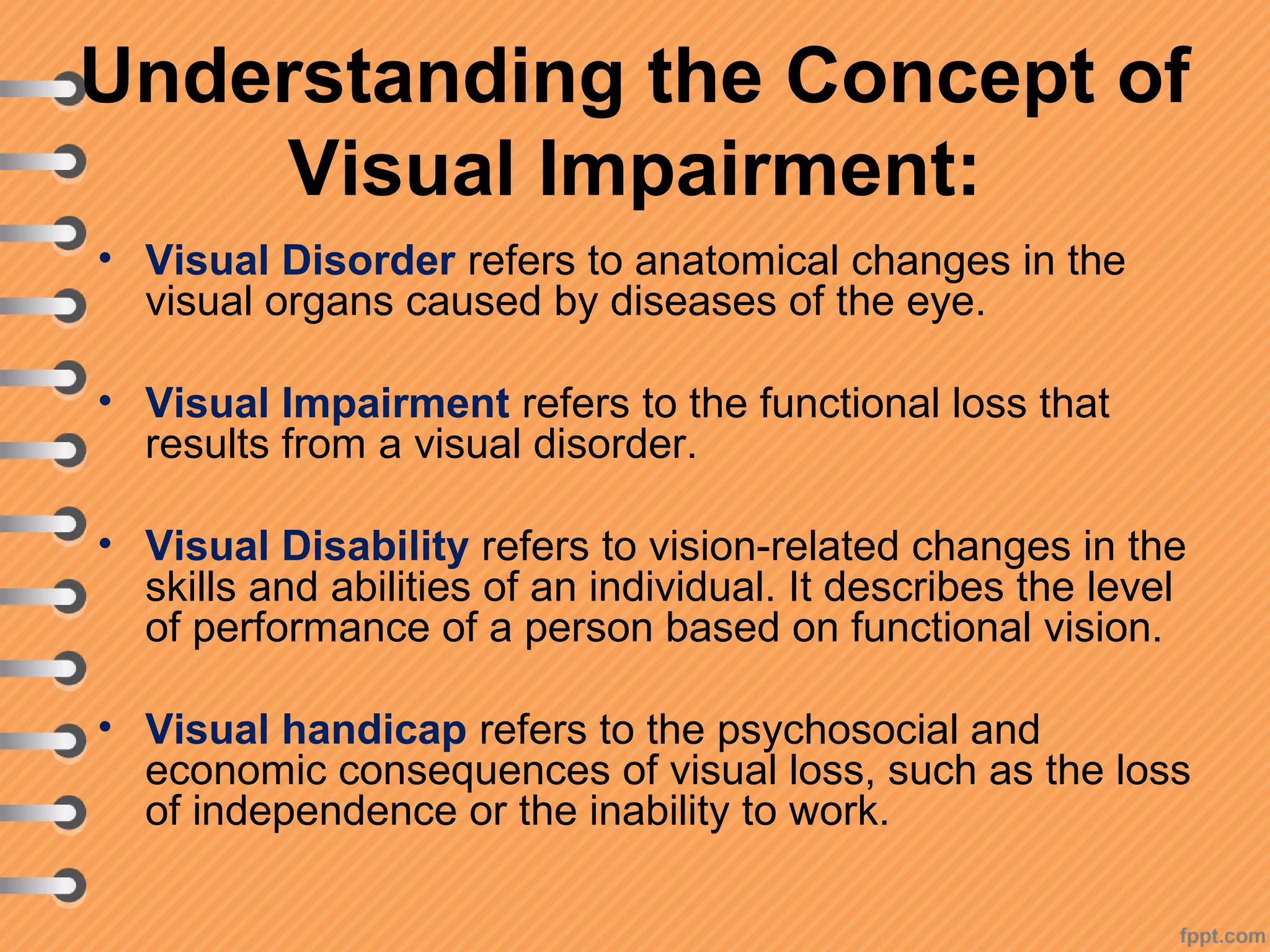
Understanding the Concept of
Visual Impairment:
• Visual Disorder refers to anatomical changes in the
visual organs caused by diseases of the eye.
• Visual Impairment refers to the functional loss that
results from a visual disorder.
• Visual Disability refers to vision-related changes in the
skills and abilities of an individual. It describes the level
of performance of a person based on functional vision.
• Visual handicap refers to the psychosocial and
economic consequences of visual loss, such as the loss
of independence or the inability to work.
Functional categories of
visual impairments:
Low Vision
• print users
• may require special devices or aids
Blind
Low Vision defined:
• Partial vision loss that cannot be
corrected by regular eyeglasses or
contact lenses, and cannot be fully
restored by surgery or use of drugs or
medicine.
• Can be mild, moderate, severe and
profound.
• "Low vision is not
no vision."
Visual Disturbances
Produced by Loss of Vision
Central Visual Field Loss
• affects the ability to see the objects or
people in direct line of vision
• color vision may be affected
• difficulty in seeing details
• distorted vision
Peripheral Visual Field Loss
• difficulty with individual travel
• banging with obstacles on the sides such
as furniture
• difficulty engaging in steps
Over-all Blur
• affects ability to perceive sharpness of
details due to alteration in the refractive
media of the eye
• may suffer from double vision
• poor night vision
• poor contrast
• glare
Functional Vision
• The amount of remaining vision an individual
has and the manner in which he/she uses it
• Functional vision can vary depending on
environmental situations and activities (lighting,
glare, contrast)
• Individuals can be considered to have low
vision or legal blindness and still have a
significant amount of functional vision
Education of the Student
with a Visual Impairment
Who are students that are
Blind or Visually Impaired?
• Students that are blind and visually
impaired have a wide range of skills and
abilities.
• Many students with visual impairments
may not appear to have an impairment at
all
Goals for Students with
Visual Impairments
• The general goal for students with visual
impairments is to allow them to
experience their surroundings, make
friends with their peers and become as
independent as possible.
Goals for Educators
• To provide support and scaffolding
• To prevent situations where the student
becomes overly dependent on an adult for
support
• To help create students who are comfortable
taking chances and are willing to explore
(educationally, socially and environmentally)
Student Rights
Students with visual impairments should
have:
• Equal access to learning environments
(including materials)
• Same opportunities to access social
situations with peers
• Be able to move around safely and
independently
Expectations
• Students who are visually impaired
should be held to the same expectations
of work quality as their sighted peers.
• Work quantity may be modified, because
it may take longer to complete specific
tasks.
General Courtesy
• Speak to the class upon entering and leaving
the room or site.
• Call the student with a vision impairment by
name if you want his/her attention.
• Seat the student away from glaring lights (e.g.
by the window) and preferably in front of the
class.
• Use descriptive words such as straight,
forward, left, etc. in relation to the student's
body orientation. Be specific in directions and
avoid the use of vague terms with unusable
information, such as "over there", "here", "this",
etc.
• Describe, in detail, pertinent visual
occurrences of the learning activities.
• Describe and tactually familiarize the student
to the classroom, laboratory, equipment,
supplies, materials, field sites, etc.
• Give verbal notice of room changes, special
meetings, or assignments.
• Offer to read written information for a person
with a visual impairment, when appropriate.
• Order the appropriate text books for the
students in their preferred medium.
• Identify yourself by name, don't assume that
the student who is visually impaired will
recognize you by your voice even though you
have met before.
• If you are asked to guide a student with a
visual impairment, identify yourself, offer your
services and, if accepted, offer your arm to the
student's hand. Tell them if they have to step
up or step down, let them know if the door is to
their left or right, and warn them of possible
hazards.
• Orally, let the student know if you need to
move or leave or need to end a conversation.
.
• Do not pet or touch a guide dog. Guide dogs
are working animals. It can be hazardous for
the visually impaired person if the dog is
distracted.
• Also use an auditory or tactile signal where a
visual signal is normally used..
• Words and phrases that refer to sight, such as
"I'll see you later," are commonly used
expressions and usually go unnoticed unless
the speaker is particularly self-conscious.
Students with vision loss can still "see" what is
meant by such expressions and may not be
offended by them. They may be embarrassed,
however, by clumsy attempts to avoid such
common usage.
Roselle Rodriguez Ambubuyog is the first visuallyimpaired Filipina to become summa cum laude at the
Ateneo de Manila University (ADMU) in 2001. She was
able to achieve academic excellence despite her
handicap and has inspired people with her life story of
triumph over the odds.
Helen Adams Keller (June 27, 1880 – June 1,
1968) was an American author, political activist,
and lecturer. She was the first deafblind person
to earn a Bachelor of Arts degree
Alone we can do so little;
together we can do so
much.
- Helen Keller 
understanding visual impairment

understanding visual impairment

  • 1.
  • 2.
    Understanding the Conceptof Visual Impairment: • Visual Disorder refers to anatomical changes in the visual organs caused by diseases of the eye. • Visual Impairment refers to the functional loss that results from a visual disorder. • Visual Disability refers to vision-related changes in the skills and abilities of an individual. It describes the level of performance of a person based on functional vision. • Visual handicap refers to the psychosocial and economic consequences of visual loss, such as the loss of independence or the inability to work.
  • 4.
    Functional categories of visualimpairments: Low Vision • print users • may require special devices or aids Blind
  • 5.
    Low Vision defined: •Partial vision loss that cannot be corrected by regular eyeglasses or contact lenses, and cannot be fully restored by surgery or use of drugs or medicine. • Can be mild, moderate, severe and profound.
  • 6.
    • "Low visionis not no vision."
  • 7.
  • 8.
    Central Visual FieldLoss • affects the ability to see the objects or people in direct line of vision • color vision may be affected • difficulty in seeing details • distorted vision
  • 9.
    Peripheral Visual FieldLoss • difficulty with individual travel • banging with obstacles on the sides such as furniture • difficulty engaging in steps
  • 10.
    Over-all Blur • affectsability to perceive sharpness of details due to alteration in the refractive media of the eye • may suffer from double vision • poor night vision • poor contrast • glare
  • 11.
    Functional Vision • Theamount of remaining vision an individual has and the manner in which he/she uses it • Functional vision can vary depending on environmental situations and activities (lighting, glare, contrast) • Individuals can be considered to have low vision or legal blindness and still have a significant amount of functional vision
  • 12.
    Education of theStudent with a Visual Impairment
  • 13.
    Who are studentsthat are Blind or Visually Impaired? • Students that are blind and visually impaired have a wide range of skills and abilities. • Many students with visual impairments may not appear to have an impairment at all
  • 14.
    Goals for Studentswith Visual Impairments • The general goal for students with visual impairments is to allow them to experience their surroundings, make friends with their peers and become as independent as possible.
  • 15.
    Goals for Educators •To provide support and scaffolding • To prevent situations where the student becomes overly dependent on an adult for support • To help create students who are comfortable taking chances and are willing to explore (educationally, socially and environmentally)
  • 16.
    Student Rights Students withvisual impairments should have: • Equal access to learning environments (including materials) • Same opportunities to access social situations with peers • Be able to move around safely and independently
  • 17.
    Expectations • Students whoare visually impaired should be held to the same expectations of work quality as their sighted peers. • Work quantity may be modified, because it may take longer to complete specific tasks.
  • 18.
    General Courtesy • Speakto the class upon entering and leaving the room or site. • Call the student with a vision impairment by name if you want his/her attention. • Seat the student away from glaring lights (e.g. by the window) and preferably in front of the class. • Use descriptive words such as straight, forward, left, etc. in relation to the student's body orientation. Be specific in directions and avoid the use of vague terms with unusable information, such as "over there", "here", "this", etc.
  • 19.
    • Describe, indetail, pertinent visual occurrences of the learning activities. • Describe and tactually familiarize the student to the classroom, laboratory, equipment, supplies, materials, field sites, etc. • Give verbal notice of room changes, special meetings, or assignments. • Offer to read written information for a person with a visual impairment, when appropriate. • Order the appropriate text books for the students in their preferred medium.
  • 20.
    • Identify yourselfby name, don't assume that the student who is visually impaired will recognize you by your voice even though you have met before. • If you are asked to guide a student with a visual impairment, identify yourself, offer your services and, if accepted, offer your arm to the student's hand. Tell them if they have to step up or step down, let them know if the door is to their left or right, and warn them of possible hazards. • Orally, let the student know if you need to move or leave or need to end a conversation.
  • 21.
    . • Do notpet or touch a guide dog. Guide dogs are working animals. It can be hazardous for the visually impaired person if the dog is distracted. • Also use an auditory or tactile signal where a visual signal is normally used.. • Words and phrases that refer to sight, such as "I'll see you later," are commonly used expressions and usually go unnoticed unless the speaker is particularly self-conscious. Students with vision loss can still "see" what is meant by such expressions and may not be offended by them. They may be embarrassed, however, by clumsy attempts to avoid such common usage.
  • 23.
    Roselle Rodriguez Ambubuyogis the first visuallyimpaired Filipina to become summa cum laude at the Ateneo de Manila University (ADMU) in 2001. She was able to achieve academic excellence despite her handicap and has inspired people with her life story of triumph over the odds.
  • 24.
    Helen Adams Keller(June 27, 1880 – June 1, 1968) was an American author, political activist, and lecturer. She was the first deafblind person to earn a Bachelor of Arts degree
  • 25.
    Alone we cando so little; together we can do so much. - Helen Keller