http://aicra.ac.in
NODEMCU
An Open Source IOT Platform
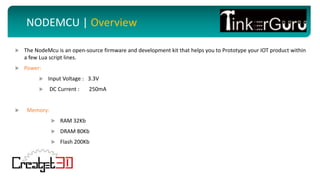
NODEMCU | Overview
 The NodeMcu is an open-source firmware and development kit that helps you to Prototype your IOT product within
a few Lua script lines.
 Power:
 Input Voltage : 3.3V
 DC Current : 250mA
 Memory:
 RAM 32Kb
 DRAM 80Kb
 Flash 200Kb
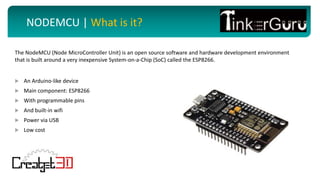
NODEMCU | What is it?
 An Arduino-like device
 Main component: ESP8266
 With programmable pins
 And built-in wifi
 Power via USB
 Low cost
The NodeMCU (Node MicroController Unit) is an open source software and hardware development environment
that is built around a very inexpensive System-on-a-Chip (SoC) called the ESP8266.
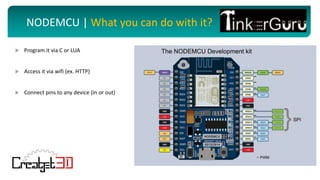
NODEMCU | What you can do with it?
 Program it via C or LUA
 Access it via wifi (ex. HTTP)
 Connect pins to any device (in or out)
http://aicra.ac.in
NODEMCU | MAIN COMPONENT
http://aicra.ac.in
NODEMCU | PIN DESCRIPTION
http://aicra.ac.in
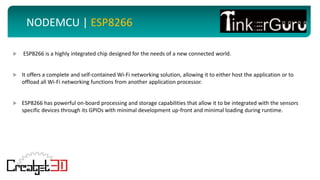
NODEMCU | ESP8266
 ESP8266 is a highly integrated chip designed for the needs of a new connected world.
 It offers a complete and self-contained Wi-Fi networking solution, allowing it to either host the application or to
offload all Wi-Fi networking functions from another application processor.
 ESP8266 has powerful on-board processing and storage capabilities that allow it to be integrated with the sensors
specific devices through its GPIOs with minimal development up-front and minimal loading during runtime.
http://aicra.ac.in
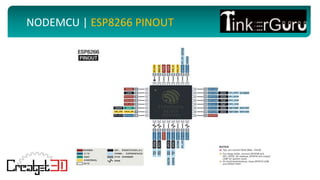
NODEMCU | ESP8266 PINOUT
NODEMCU | Features
 Open-source
 Interactive
 Programmable
 Low cost
 Simple
 Smart
 WI-FI enabled
http://aicra.ac.in
NODEMCU | Features
 I/O Pins:
 Digital Pins: Pin D0 – Pin D10 Digital Pins
 PWM Pins : 12 PWM Pins
 Analog Pins : Pin A0
 Power PINS
 Ground : 5 Pins
 3.3V : 3
 Vin Pin : 1 Adding external supply of +5V (is not connected to USB)
http://aicra.ac.in
NODEMCU | Specifications
The Development Kit based on ESP8266, integrates GPIO, PWM, IIC, 1-Wire and ADC all in one board. USB-TTL included, plug&play
 10 GPIO, every GPIO can be PWM, I2C, 1-wire
 USB-TTL included, plug & play
 PCB antenna
http://aicra.ac.in
NODEMCU | Getting started
 Install the Arduino IDE: https://www.Arduino.cc/en/Main/Software
 Install the ESP8266 Addon
 Go!
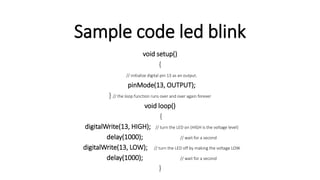
Sample code led blink
void setup()
{
// initialize digital pin 13 as an output.
pinMode(13, OUTPUT);
} // the loop function runs over and over again forever
void loop()
{
digitalWrite(13, HIGH); // turn the LED on (HIGH is the voltage level)
delay(1000); // wait for a second
digitalWrite(13, LOW); // turn the LED off by making the voltage LOW
delay(1000); // wait for a second
}

Wi-Fi Esp8266 nodemcu

  • 1.
  • 2.
    NODEMCU | Overview The NodeMcu is an open-source firmware and development kit that helps you to Prototype your IOT product within a few Lua script lines.  Power:  Input Voltage : 3.3V  DC Current : 250mA  Memory:  RAM 32Kb  DRAM 80Kb  Flash 200Kb
  • 3.
    NODEMCU | Whatis it?  An Arduino-like device  Main component: ESP8266  With programmable pins  And built-in wifi  Power via USB  Low cost The NodeMCU (Node MicroController Unit) is an open source software and hardware development environment that is built around a very inexpensive System-on-a-Chip (SoC) called the ESP8266.
  • 4.
    NODEMCU | Whatyou can do with it?  Program it via C or LUA  Access it via wifi (ex. HTTP)  Connect pins to any device (in or out)
  • 5.
  • 6.
  • 7.
    http://aicra.ac.in NODEMCU | ESP8266 ESP8266 is a highly integrated chip designed for the needs of a new connected world.  It offers a complete and self-contained Wi-Fi networking solution, allowing it to either host the application or to offload all Wi-Fi networking functions from another application processor.  ESP8266 has powerful on-board processing and storage capabilities that allow it to be integrated with the sensors specific devices through its GPIOs with minimal development up-front and minimal loading during runtime.
  • 8.
  • 9.
    NODEMCU | Features Open-source  Interactive  Programmable  Low cost  Simple  Smart  WI-FI enabled
  • 10.
    http://aicra.ac.in NODEMCU | Features I/O Pins:  Digital Pins: Pin D0 – Pin D10 Digital Pins  PWM Pins : 12 PWM Pins  Analog Pins : Pin A0  Power PINS  Ground : 5 Pins  3.3V : 3  Vin Pin : 1 Adding external supply of +5V (is not connected to USB)
  • 11.
    http://aicra.ac.in NODEMCU | Specifications TheDevelopment Kit based on ESP8266, integrates GPIO, PWM, IIC, 1-Wire and ADC all in one board. USB-TTL included, plug&play  10 GPIO, every GPIO can be PWM, I2C, 1-wire  USB-TTL included, plug & play  PCB antenna
  • 12.
    http://aicra.ac.in NODEMCU | Gettingstarted  Install the Arduino IDE: https://www.Arduino.cc/en/Main/Software  Install the ESP8266 Addon  Go!
  • 13.
    Sample code ledblink void setup() { // initialize digital pin 13 as an output. pinMode(13, OUTPUT); } // the loop function runs over and over again forever void loop() { digitalWrite(13, HIGH); // turn the LED on (HIGH is the voltage level) delay(1000); // wait for a second digitalWrite(13, LOW); // turn the LED off by making the voltage LOW delay(1000); // wait for a second }