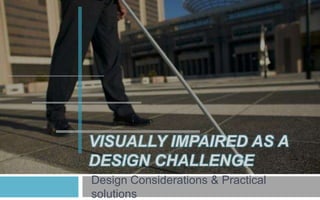
VISUALLY IMPAIRED AS A
DESIGN CHALLENGE
Design Considerations & Practical
solutions
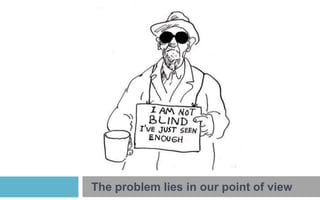
The problem lies in our point of view
Content List
Overview
Design Considerations

Design Ideas & Practical solutions
Case Studies
Overview
Overview


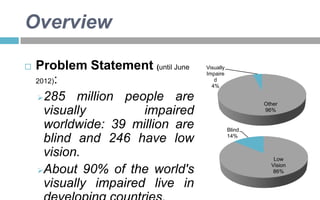
Problem Statement (until June
2012):
285 million people
are
visually
impaired
worldwide: 39 million are
blind and 246 have low
vision.
About 90% of the world's
visually impaired live in

Visually
Impaire
d
4%
Other
96%

Blind
14%

Low
Vision
86%
Overview


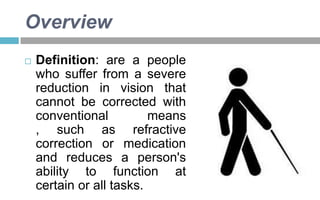
Definition: are a people
who suffer from a severe
reduction in vision that
cannot be corrected with
conventional
means
, such as refractive
correction or medication
and reduces a person's
ability to function at
certain or all tasks.
Overview


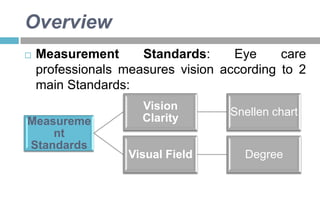
Measurement
Standards:
Eye
care
professionals measures vision according to 2
main Standards:

Measureme
nt
Standards

Vision
Clarity

Snellen chart

Visual Field

Degree
Overview

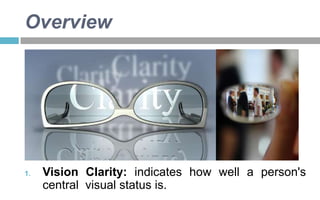
1.

Vision Clarity: indicates how well a person's
central visual status is.
Visually Impaired - Overview


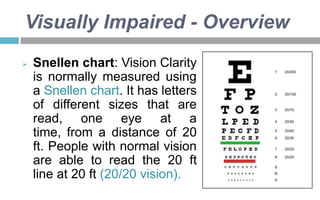
Snellen chart: Vision Clarity
is normally measured using
a Snellen chart. It has letters
of different sizes that are
read, one eye at a
time, from a distance of 20
ft. People with normal vision
are able to read the 20 ft
line at 20 ft (20/20 vision).
Overview

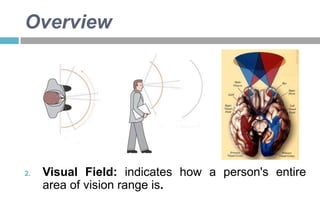
2.

Visual Field: indicates how a person's entire
area of vision range is.
Overview


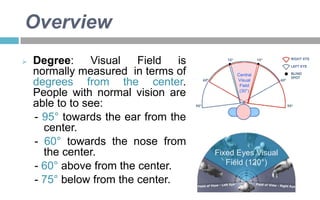
Degree:
Visual
Field
is
normally measured in terms of
degrees from the center.
People with normal vision are
able to to see:
- 95° towards the ear from the
center.
- 60° towards the nose from
the center.
- 60° above from the center.
- 75° below from the center.

Central
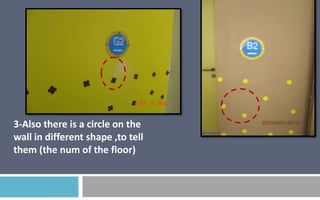
Visual
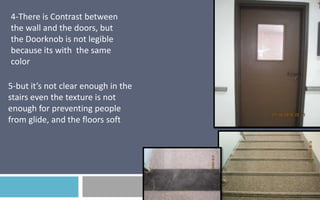
Field
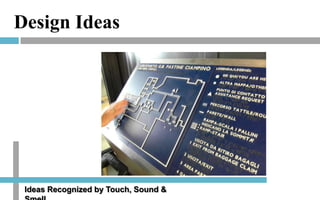
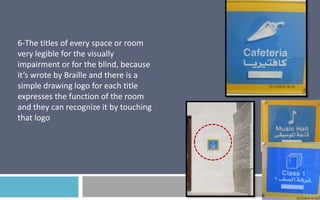
(30°)

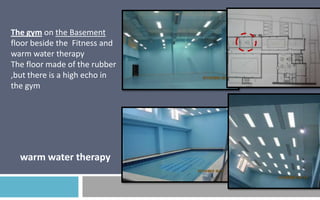
Fixed Eyes Visual
Field (120°)
Overview

1.

2.

3.

4.
5.

6.
7.

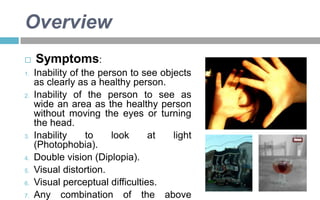
Symptoms:
Inability of the person to see objects
as clearly as a healthy person.
Inability of the person to see as
wide an area as the healthy person
without moving the eyes or turning
the head.
Inability
to
look
at
light
(Photophobia).
Double vision (Diplopia).
Visual distortion.
Visual perceptual difficulties.
Any combination of the above
Overview


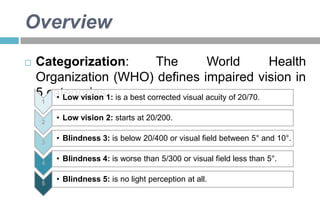
Categorization:
The
World
Health
Organization (WHO) defines impaired vision in
5 categories: is a best corrected visual acuity of 20/70.
• Low vision 1:
1

2
3
4
5

• Low vision 2: starts at 20/200.
• Blindness 3: is below 20/400 or visual field between 5° and 10°.

• Blindness 4: is worse than 5/300 or visual field less than 5°.
• Blindness 5: is no light perception at all.
Design Considerations


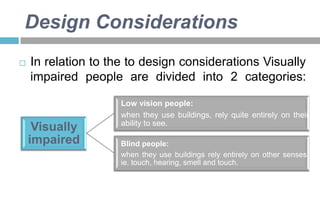
In relation to the to design considerations Visually
impaired people are divided into 2 categories:

Visually
impaired

Low vision people:
when they use buildings, rely quite entirely on their
ability to see.
Blind people:
when they use buildings rely entirely on other senses,
ie. touch, hearing, smell and touch.
Design Considerations


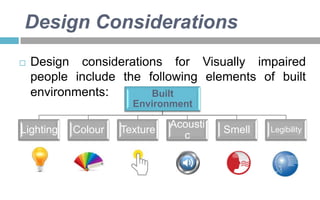
Design considerations for Visually impaired
people include the following elements of built
environments:
Built
Environment

Lighting

Colour

Texture

Acousti
c

Smell

Legibility
Design Considerations


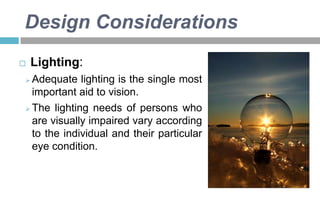
Lighting:

Adequate lighting is the single most
important aid to vision.
 The lighting needs of persons who
are visually impaired vary according
to the individual and their particular
eye condition.

Design Considerations


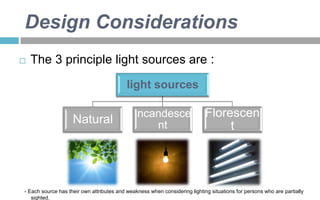
The 3 principle light sources are :
light sources

Natural

Incandesce
nt

Florescen
t

- Each source has their own attributes and weakness when considering lighting situations for persons who are partially
sighted.
Design Considerations


The key for the designer is to utilize these light
sources optimally and considering the following:
Design Considerations

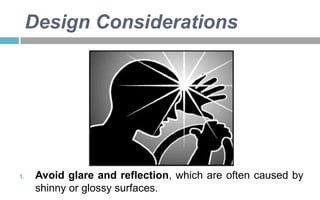
1.

Avoid glare and reflection, which are often caused by
shinny or glossy surfaces.
Design Considerations

2.

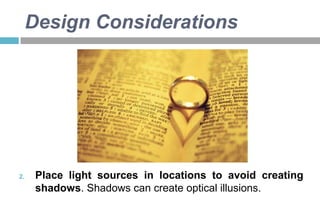
Place light sources in locations to avoid creating
shadows. Shadows can create optical illusions.
Design Considerations

3.

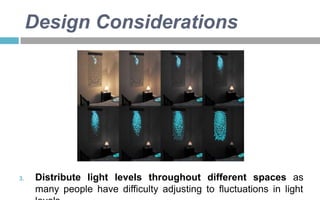
Distribute light levels throughout different spaces as
many people have difficulty adjusting to fluctuations in light
Design Considerations

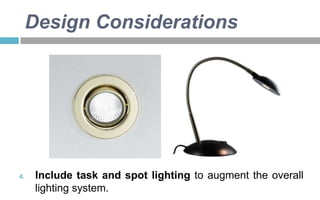
4.

Include task and spot lighting to augment the overall
lighting system.
Design Considerations

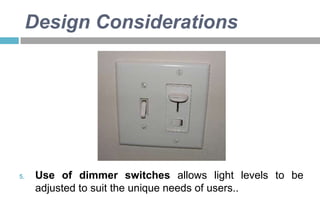
5.

Use of dimmer switches allows light levels to be
adjusted to suit the unique needs of users..
Design Considerations


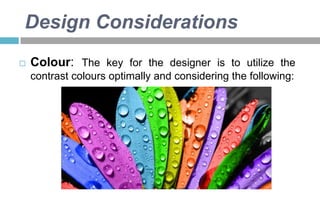
Colour: The key for the designer is to utilize the
contrast colours optimally and considering the following:
Design Considerations

1.

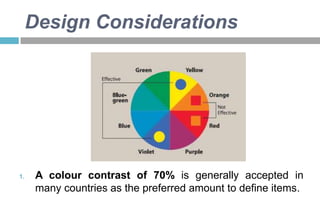
A colour contrast of 70% is generally accepted in
many countries as the preferred amount to define items.
Design Considerations

2.

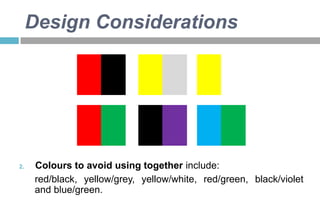
Colours to avoid using together include:
red/black, yellow/grey, yellow/white, red/green, black/violet
and blue/green.
Design Considerations

3.

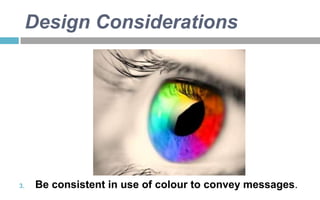
Be consistent in use of colour to convey messages.
Design Considerations

4.

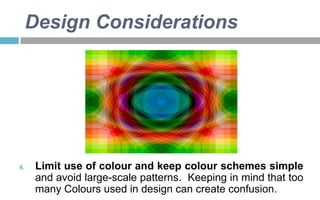
Limit use of colour and keep colour schemes simple
and avoid large-scale patterns. Keeping in mind that too
many Colours used in design can create confusion.
Design Considerations


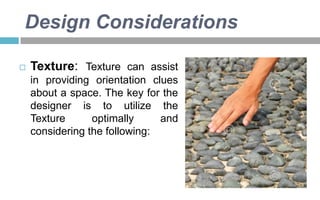
Texture: Texture can assist
in providing orientation clues
about a space. The key for the
designer is to utilize the
Texture
optimally
and
considering the following:
Design Considerations

1.

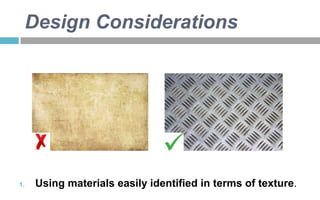
Using materials easily identified in terms of texture.
Design Considerations

2.

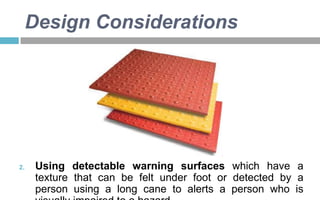
Using detectable warning surfaces which have a
texture that can be felt under foot or detected by a
person using a long cane to alerts a person who is
Design Considerations

3.

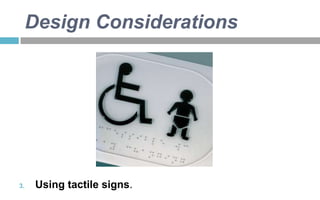
Using tactile signs.
Design Considerations


Acoustics: Sounds can assist in providing orientation
clues about a space. The key for the designer is to
utilize the Acoustics optimally and considering the
following:
Design Considerations

1.

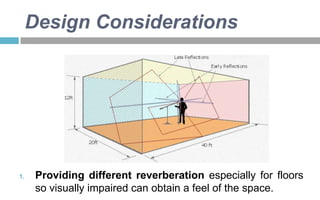
Providing different reverberation especially for floors
so visually impaired can obtain a feel of the space.
Design Considerations

2.

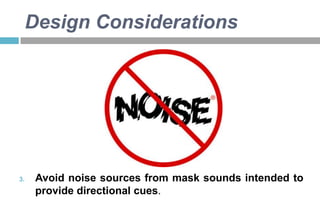
Provide acoustically well-defined position items
such as escalators, fountains, and elevators to create
Design Considerations

3.

Avoid noise sources from mask sounds intended to
provide directional cues.
Design Considerations


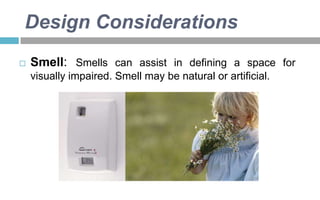
Smell: Smells can assist in defining a space for
visually impaired. Smell may be natural or artificial.
Design Considerations


Legibility: its refers to the
degree to which building is
understandable
or
recognizable. The key for the
designer is to making the
building easy to understand
and considering the following:
Design Considerations

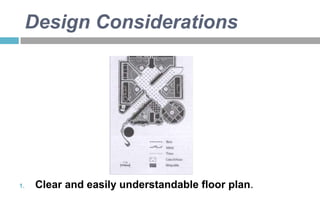
1.

Clear and easily understandable floor plan.
Design Considerations

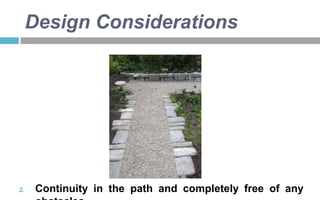
2.

Continuity in the path and completely free of any
Design Considerations

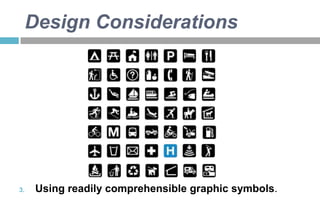
3.

Using readily comprehensible graphic symbols.
Design Ideas
Design Ideas
Ideas recognized by feet

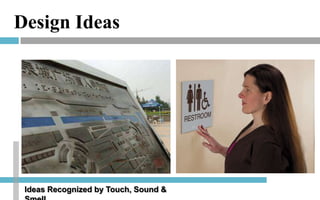
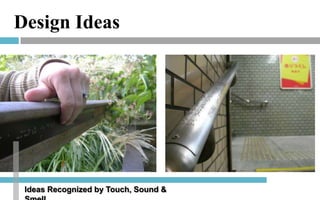
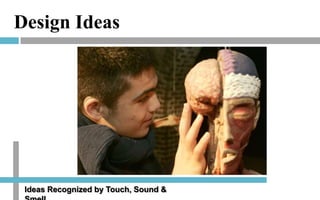
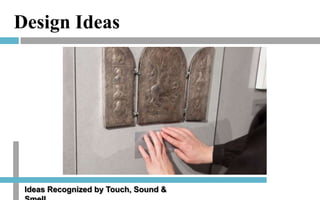
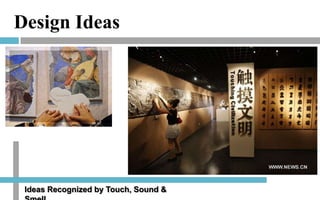
Ideas Recognized by Touch, Sound & Smell
Ideas Recognized by contrast colors
Ideas Recognized by borders

Visual impaired facilities
Design Ideas
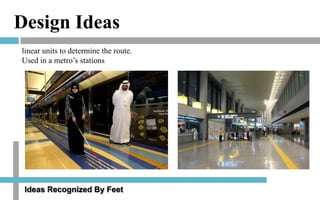
linear units to determine the route.
Used in a metro’s stations

Ideas Recognized By Feet
Design Ideas
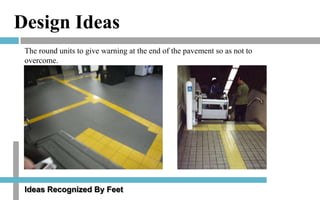
The round units to give warning at the end of the pavement so as not to
overcome.

Ideas Recognized By Feet
Design Ideas
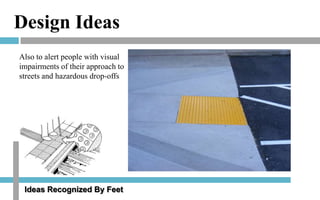
Also to alert people with visual
impairments of their approach to
streets and hazardous drop-offs

Ideas Recognized By Feet
Design Ideas
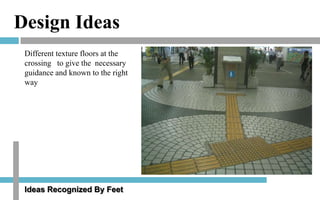
Different texture floors at the
crossing to give the necessary
guidance and known to the right
way

Ideas Recognized By Feet
Design Ideas

Ideas Recognized by Touch, Sound &
Design Ideas

Ideas Recognized by Touch, Sound &
Design Ideas

Ideas Recognized by Touch, Sound &
Design Ideas

Ideas Recognized by Touch, Sound &
Design Ideas

Ideas Recognized by Touch, Sound &
Design Ideas

Ideas Recognized by Touch, Sound &
Design Ideas

Ideas Recognized by Touch, Sound &
Design Ideas

Ideas Recognized by Touch, Sound &
Design Ideas
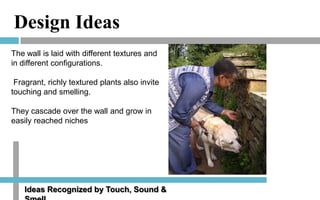
The wall is laid with different textures and
in different configurations.
Fragrant, richly textured plants also invite
touching and smelling.
They cascade over the wall and grow in
easily reached niches

Ideas Recognized by Touch, Sound &
Design Ideas
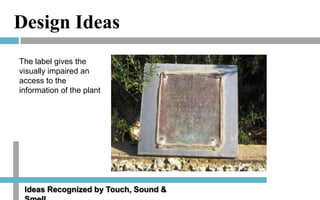
The label gives the
visually impaired an
access to the
information of the plant

Ideas Recognized by Touch, Sound &
Design Ideas
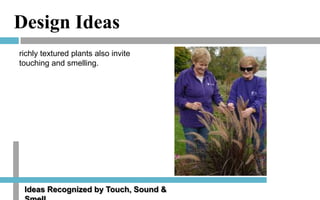
richly textured plants also invite
touching and smelling.

Ideas Recognized by Touch, Sound &
Design Ideas
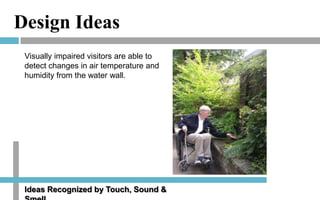
Visually impaired visitors are able to
detect changes in air temperature and
humidity from the water wall.

Ideas Recognized by Touch, Sound &
Design Ideas
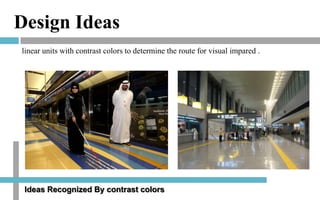
linear units with contrast colors to determine the route for visual impared .

Ideas Recognized By contrast colors
Design Ideas
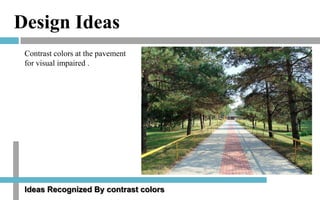
Contrast colors at the pavement
for visual impaired .

Ideas Recognized By contrast colors
Design Ideas
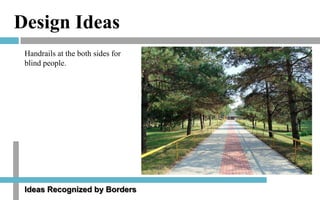
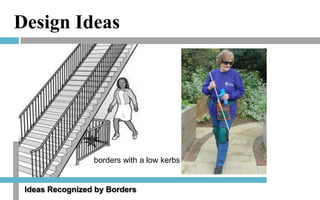
Handrails at the both sides for
blind people.

Ideas Recognized by Borders
Design Ideas

borders with a low kerbs

Ideas Recognized by Borders
Design Ideas
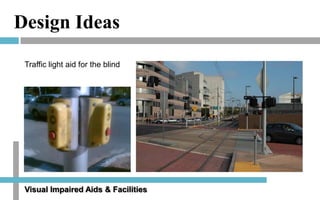
Traffic light aid for the blind

Visual Impaired Aids & Facilities
Design Ideas

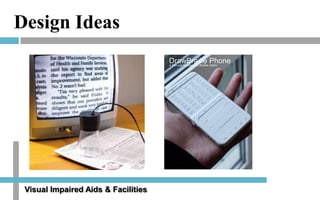
Visual Impaired Aids & Facilities
Design Ideas

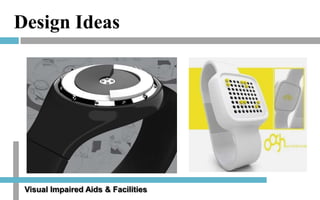
Visual Impaired Aids & Facilities
Design Ideas
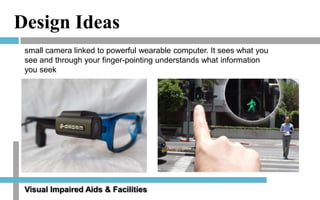
small camera linked to powerful wearable computer. It sees what you
see and through your finger-pointing understands what information
you seek

Visual Impaired Aids & Facilities
Case Studies
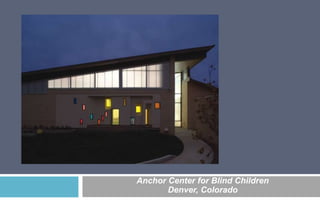
Anchor Center for Blind Children
Denver, Colorado
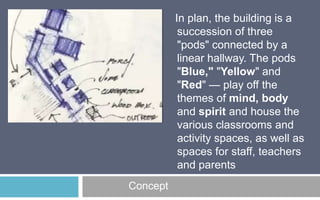
In plan, the building is a
succession of three
"pods" connected by a
linear hallway. The pods
"Blue," "Yellow" and
"Red" — play off the
themes of mind, body
and spirit and house the
various classrooms and
activity spaces, as well as
spaces for staff, teachers
and parents
Concept




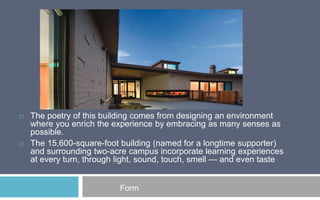
The poetry of this building comes from designing an environment
where you enrich the experience by embracing as many senses as
possible.
The 15,600-square-foot building (named for a longtime supporter)
and surrounding two-acre campus incorporate learning experiences
at every turn, through light, sound, touch, smell — and even taste

Form


form

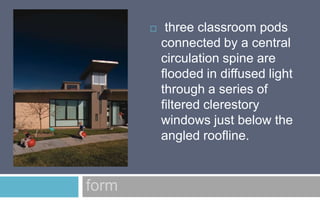
three classroom pods
connected by a central
circulation spine are
flooded in diffused light
through a series of
filtered clerestory
windows just below the
angled roofline.
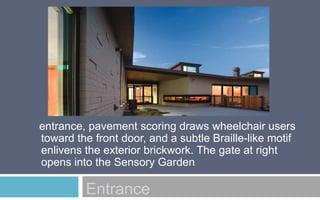
entrance, pavement scoring draws wheelchair users
toward the front door, and a subtle Braille-like motif
enlivens the exterior brickwork. The gate at right
opens into the Sensory Garden

Entrance
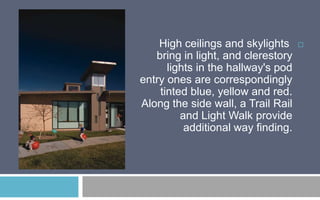
High ceilings and skylights
bring in light, and clerestory
lights in the hallway's pod
entry ones are correspondingly
tinted blue, yellow and red.
Along the side wall, a Trail Rail
and Light Walk provide
additional way finding.


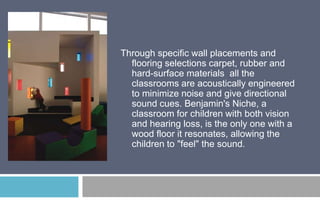
Through specific wall placements and
flooring selections carpet, rubber and
hard-surface materials all the
classrooms are acoustically engineered
to minimize noise and give directional
sound cues. Benjamin's Niche, a
classroom for children with both vision
and hearing loss, is the only one with a
wood floor it resonates, allowing the
children to "feel" the sound.
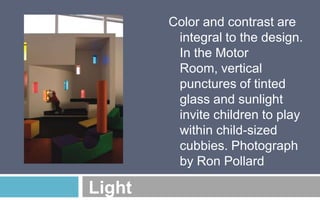
Color and contrast are
integral to the design.
In the Motor
Room, vertical
punctures of tinted
glass and sunlight
invite children to play
within child-sized
cubbies. Photograph
by Ron Pollard

Light
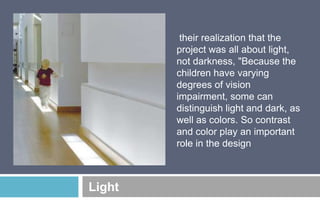
their realization that the
project was all about light,
not darkness, "Because the
children have varying
degrees of vision
impairment, some can
distinguish light and dark, as
well as colors. So contrast
and color play an important
role in the design

Light
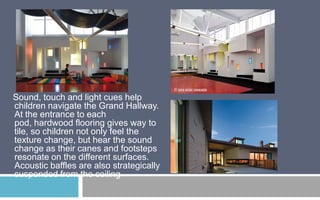
Sound, touch and light cues help
children navigate the Grand Hallway.
At the entrance to each
pod, hardwood flooring gives way to
tile, so children not only feel the
texture change, but hear the sound
change as their canes and footsteps
resonate on the different surfaces.
Acoustic baffles are also strategically
suspended from the ceiling
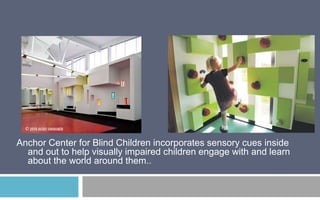
Anchor Center for Blind Children incorporates sensory cues inside
and out to help visually impaired children engage with and learn
about the world around them..
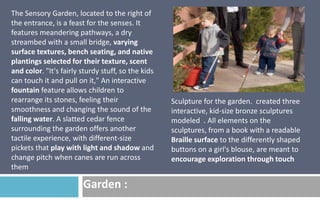
The Sensory Garden, located to the right of
the entrance, is a feast for the senses. It
features meandering pathways, a dry
streambed with a small bridge, varying
surface textures, bench seating, and native
plantings selected for their texture, scent
and color. "It's fairly sturdy stuff, so the kids
can touch it and pull on it," An interactive
fountain feature allows children to
rearrange its stones, feeling their
smoothness and changing the sound of the
falling water. A slatted cedar fence
surrounding the garden offers another
tactile experience, with different-size
pickets that play with light and shadow and
change pitch when canes are run across
them

Garden :

Sculpture for the garden. created three
interactive, kid-size bronze sculptures
modeled . All elements on the
sculptures, from a book with a readable
Braille surface to the differently shaped
buttons on a girl's blouse, are meant to
encourage exploration through touch
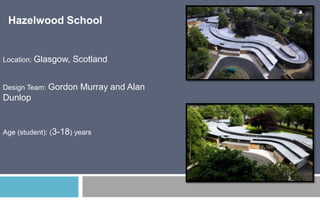
Hazelwood School

Location: Glasgow,

Scotland

Design Team: Gordon

Murray and Alan

Dunlop

Age (student): (3-18) years
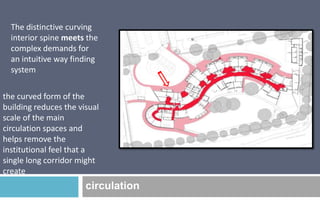
The distinctive curving
interior spine meets the
complex demands for
an intuitive way finding
system
the curved form of the
building reduces the visual
scale of the main
circulation spaces and
helps remove the
institutional feel that a
single long corridor might
create

circulation
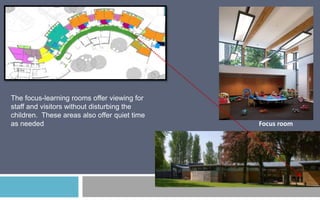
The focus-learning rooms offer viewing for
staff and visitors without disturbing the
children. These areas also offer quiet time
as needed

Focus room
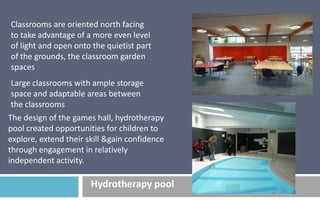
Classrooms are oriented north facing
to take advantage of a more even level
of light and open onto the quietist part
of the grounds, the classroom garden
spaces
Large classrooms with ample storage
space and adaptable areas between
the classrooms
The design of the games hall, hydrotherapy
pool created opportunities for children to
explore, extend their skill &gain confidence
through engagement in relatively
independent activity.

Hydrotherapy pool
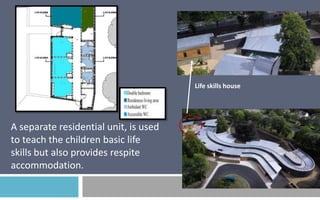
Life skills house

A separate residential unit, is used
to teach the children basic life
skills but also provides respite
accommodation.
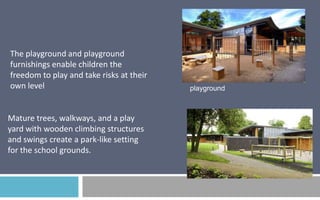
The playground and playground
furnishings enable children the
freedom to play and take risks at their
own level

Mature trees, walkways, and a play
yard with wooden climbing structures
and swings create a park-like setting
for the school grounds.

playground
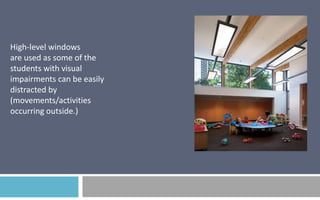
High-level windows
are used as some of the
students with visual
impairments can be easily
distracted by
(movements/activities
occurring outside.)
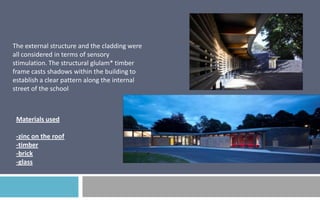
The external structure and the cladding were
all considered in terms of sensory
stimulation. The structural glulam* timber
frame casts shadows within the building to
establish a clear pattern along the internal
street of the school

Materials used
-zinc on the roof
-timber
-brick
-glass
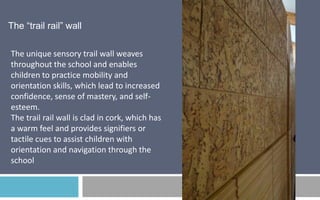
The “trail rail” wall
The unique sensory trail wall weaves
throughout the school and enables
children to practice mobility and
orientation skills, which lead to increased
confidence, sense of mastery, and selfesteem.
The trail rail wall is clad in cork, which has
a warm feel and provides signifiers or
tactile cues to assist children with
orientation and navigation through the
school
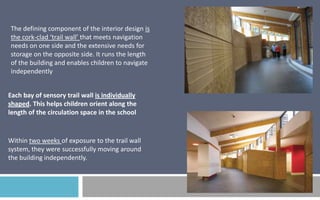
The defining component of the interior design is
the cork-clad ‘trail wall’ that meets navigation
needs on one side and the extensive needs for
storage on the opposite side. It runs the length
of the building and enables children to navigate
independently
Each bay of sensory trail wall is individually
shaped. This helps children orient along the
length of the circulation space in the school

Within two weeks of exposure to the trail wall
system, they were successfully moving around
the building independently.
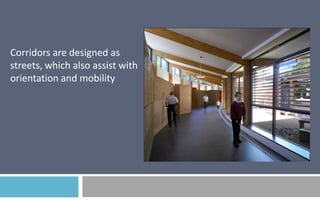
Corridors are designed as
streets, which also assist with
orientation and mobility
Educational Method

The school evaluates pupils' skills & likes
but focuses particularly on English
Language & communication and
mathematics
Royal Academy for the visually
disabled people
Location: Tabarbour- Amman
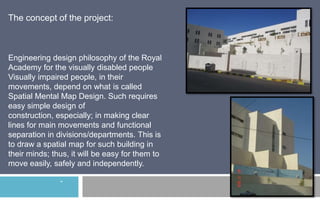
The concept of the project:

Engineering design philosophy of the Royal
Academy for the visually disabled people
Visually impaired people, in their
movements, depend on what is called
Spatial Mental Map Design. Such requires
easy simple design of
construction, especially; in making clear
lines for main movements and functional
separation in divisions/departments. This is
to draw a spatial map for such building in
their minds; thus, it will be easy for them to
move easily, safely and independently.
-
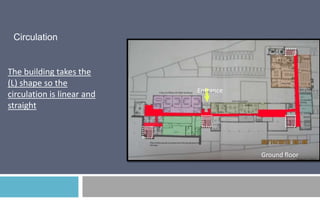
Circulation

The building takes the
(L) shape so the
circulation is linear and
straight

Entrance

Ground floor
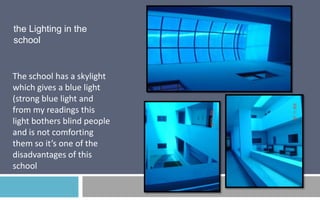
the Lighting in the
school

The school has a skylight
which gives a blue light
(strong blue light and
from my readings this
light bothers blind people
and is not comforting
them so it’s one of the
disadvantages of this
school
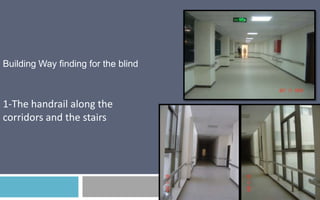
Building Way finding for the blind

1-The handrail along the
corridors and the stairs
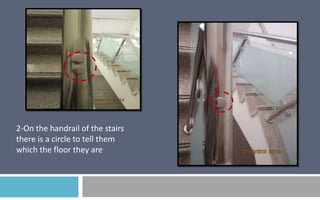
2-On the handrail of the stairs
there is a circle to tell them
which the floor they are
3-Also there is a circle on the
wall in different shape ,to tell
them (the num of the floor)
4-There is Contrast between
the wall and the doors, but
the Doorknob is not legible
because its with the same
color
5-but it’s not clear enough in the
stairs even the texture is not
enough for preventing people
from glide, and the floors soft
6-The titles of every space or room
very legible for the visually
impairment or for the blind, because
it’s wrote by Braille and there is a
simple drawing logo for each title
expresses the function of the room
and they can recognize it by touching
that logo
The gym on the Basement
floor beside the Fitness and
warm water therapy
The floor made of the rubber
,but there is a high echo in
the gym

warm water therapy
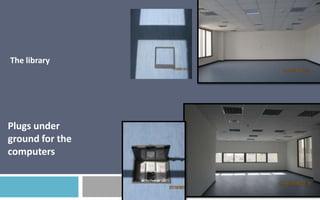
The library

Plugs under
ground for the
computers
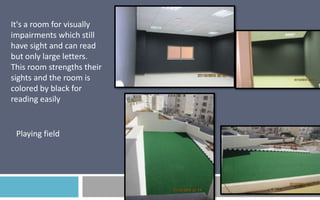
It's a room for visually
impairments which still
have sight and can read
but only large letters.
This room strengths their
sights and the room is
colored by black for
reading easily

Playing field
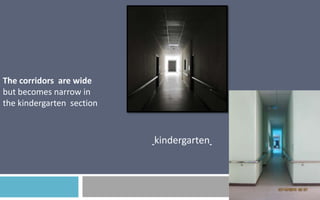
The corridors are wide
but becomes narrow in
the kindergarten section

kindergarten
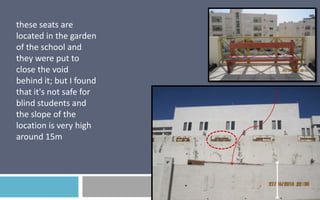
these seats are
located in the garden
of the school and
they were put to
close the void
behind it; but I found
that it's not safe for
blind students and
the slope of the
location is very high
around 15m
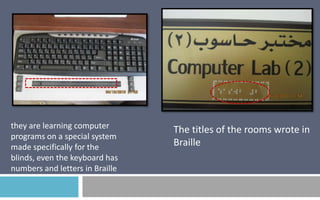
they are learning computer
programs on a special system
made specifically for the
blinds, even the keyboard has
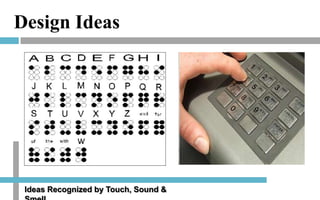
numbers and letters in Braille

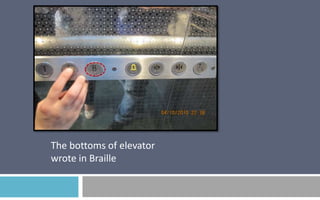
The titles of the rooms wrote in
Braille
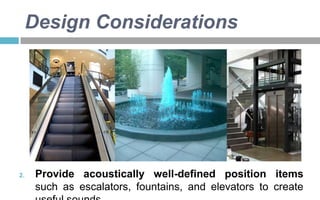
The bottoms of elevator
wrote in Braille

Visually impaired as a design challenge

  • 1.
    VISUALLY IMPAIRED ASA DESIGN CHALLENGE Design Considerations & Practical solutions
  • 2.
    The problem liesin our point of view
  • 3.
    Content List Overview Design Considerations DesignIdeas & Practical solutions Case Studies
  • 4.
  • 5.
    Overview  Problem Statement (untilJune 2012): 285 million people are visually impaired worldwide: 39 million are blind and 246 have low vision. About 90% of the world's visually impaired live in Visually Impaire d 4% Other 96% Blind 14% Low Vision 86%
  • 6.
    Overview  Definition: are apeople who suffer from a severe reduction in vision that cannot be corrected with conventional means , such as refractive correction or medication and reduces a person's ability to function at certain or all tasks.
  • 7.
    Overview  Measurement Standards: Eye care professionals measures visionaccording to 2 main Standards: Measureme nt Standards Vision Clarity Snellen chart Visual Field Degree
  • 8.
    Overview 1. Vision Clarity: indicateshow well a person's central visual status is.
  • 9.
    Visually Impaired -Overview  Snellen chart: Vision Clarity is normally measured using a Snellen chart. It has letters of different sizes that are read, one eye at a time, from a distance of 20 ft. People with normal vision are able to read the 20 ft line at 20 ft (20/20 vision).
  • 10.
    Overview 2. Visual Field: indicateshow a person's entire area of vision range is.
  • 11.
    Overview  Degree: Visual Field is normally measured interms of degrees from the center. People with normal vision are able to to see: - 95° towards the ear from the center. - 60° towards the nose from the center. - 60° above from the center. - 75° below from the center. Central Visual Field (30°) Fixed Eyes Visual Field (120°)
  • 12.
    Overview  1. 2. 3. 4. 5. 6. 7. Symptoms: Inability of theperson to see objects as clearly as a healthy person. Inability of the person to see as wide an area as the healthy person without moving the eyes or turning the head. Inability to look at light (Photophobia). Double vision (Diplopia). Visual distortion. Visual perceptual difficulties. Any combination of the above
  • 13.
    Overview  Categorization: The World Health Organization (WHO) definesimpaired vision in 5 categories: is a best corrected visual acuity of 20/70. • Low vision 1: 1 2 3 4 5 • Low vision 2: starts at 20/200. • Blindness 3: is below 20/400 or visual field between 5° and 10°. • Blindness 4: is worse than 5/300 or visual field less than 5°. • Blindness 5: is no light perception at all.
  • 14.
  • 15.
    Design Considerations  In relationto the to design considerations Visually impaired people are divided into 2 categories: Visually impaired Low vision people: when they use buildings, rely quite entirely on their ability to see. Blind people: when they use buildings rely entirely on other senses, ie. touch, hearing, smell and touch.
  • 16.
    Design Considerations  Design considerationsfor Visually impaired people include the following elements of built environments: Built Environment Lighting Colour Texture Acousti c Smell Legibility
  • 17.
    Design Considerations  Lighting: Adequate lightingis the single most important aid to vision.  The lighting needs of persons who are visually impaired vary according to the individual and their particular eye condition. 
  • 18.
    Design Considerations  The 3principle light sources are : light sources Natural Incandesce nt Florescen t - Each source has their own attributes and weakness when considering lighting situations for persons who are partially sighted.
  • 19.
    Design Considerations  The keyfor the designer is to utilize these light sources optimally and considering the following:
  • 20.
    Design Considerations 1. Avoid glareand reflection, which are often caused by shinny or glossy surfaces.
  • 21.
    Design Considerations 2. Place lightsources in locations to avoid creating shadows. Shadows can create optical illusions.
  • 22.
    Design Considerations 3. Distribute lightlevels throughout different spaces as many people have difficulty adjusting to fluctuations in light
  • 23.
    Design Considerations 4. Include taskand spot lighting to augment the overall lighting system.
  • 24.
    Design Considerations 5. Use ofdimmer switches allows light levels to be adjusted to suit the unique needs of users..
  • 25.
    Design Considerations  Colour: Thekey for the designer is to utilize the contrast colours optimally and considering the following:
  • 26.
    Design Considerations 1. A colourcontrast of 70% is generally accepted in many countries as the preferred amount to define items.
  • 27.
    Design Considerations 2. Colours toavoid using together include: red/black, yellow/grey, yellow/white, red/green, black/violet and blue/green.
  • 28.
    Design Considerations 3. Be consistentin use of colour to convey messages.
  • 29.
    Design Considerations 4. Limit useof colour and keep colour schemes simple and avoid large-scale patterns. Keeping in mind that too many Colours used in design can create confusion.
  • 30.
    Design Considerations  Texture: Texturecan assist in providing orientation clues about a space. The key for the designer is to utilize the Texture optimally and considering the following:
  • 31.
    Design Considerations 1. Using materialseasily identified in terms of texture.
  • 32.
    Design Considerations 2. Using detectablewarning surfaces which have a texture that can be felt under foot or detected by a person using a long cane to alerts a person who is
  • 33.
  • 34.
    Design Considerations  Acoustics: Soundscan assist in providing orientation clues about a space. The key for the designer is to utilize the Acoustics optimally and considering the following:
  • 35.
    Design Considerations 1. Providing differentreverberation especially for floors so visually impaired can obtain a feel of the space.
  • 36.
    Design Considerations 2. Provide acousticallywell-defined position items such as escalators, fountains, and elevators to create
  • 37.
    Design Considerations 3. Avoid noisesources from mask sounds intended to provide directional cues.
  • 38.
    Design Considerations  Smell: Smellscan assist in defining a space for visually impaired. Smell may be natural or artificial.
  • 39.
    Design Considerations  Legibility: itsrefers to the degree to which building is understandable or recognizable. The key for the designer is to making the building easy to understand and considering the following:
  • 40.
    Design Considerations 1. Clear andeasily understandable floor plan.
  • 41.
    Design Considerations 2. Continuity inthe path and completely free of any
  • 42.
    Design Considerations 3. Using readilycomprehensible graphic symbols.
  • 43.
  • 44.
    Design Ideas Ideas recognizedby feet Ideas Recognized by Touch, Sound & Smell Ideas Recognized by contrast colors Ideas Recognized by borders Visual impaired facilities
  • 45.
    Design Ideas linear unitsto determine the route. Used in a metro’s stations Ideas Recognized By Feet
  • 46.
    Design Ideas The roundunits to give warning at the end of the pavement so as not to overcome. Ideas Recognized By Feet
  • 47.
    Design Ideas Also toalert people with visual impairments of their approach to streets and hazardous drop-offs Ideas Recognized By Feet
  • 48.
    Design Ideas Different texturefloors at the crossing to give the necessary guidance and known to the right way Ideas Recognized By Feet
  • 49.
  • 50.
  • 51.
  • 52.
  • 53.
  • 54.
  • 55.
  • 56.
  • 57.
    Design Ideas The wallis laid with different textures and in different configurations. Fragrant, richly textured plants also invite touching and smelling. They cascade over the wall and grow in easily reached niches Ideas Recognized by Touch, Sound &
  • 58.
    Design Ideas The labelgives the visually impaired an access to the information of the plant Ideas Recognized by Touch, Sound &
  • 59.
    Design Ideas richly texturedplants also invite touching and smelling. Ideas Recognized by Touch, Sound &
  • 60.
    Design Ideas Visually impairedvisitors are able to detect changes in air temperature and humidity from the water wall. Ideas Recognized by Touch, Sound &
  • 61.
    Design Ideas linear unitswith contrast colors to determine the route for visual impared . Ideas Recognized By contrast colors
  • 62.
    Design Ideas Contrast colorsat the pavement for visual impaired . Ideas Recognized By contrast colors
  • 63.
    Design Ideas Handrails atthe both sides for blind people. Ideas Recognized by Borders
  • 64.
    Design Ideas borders witha low kerbs Ideas Recognized by Borders
  • 65.
    Design Ideas Traffic lightaid for the blind Visual Impaired Aids & Facilities
  • 66.
  • 67.
  • 68.
    Design Ideas small cameralinked to powerful wearable computer. It sees what you see and through your finger-pointing understands what information you seek Visual Impaired Aids & Facilities
  • 69.
  • 70.
    Anchor Center forBlind Children Denver, Colorado
  • 71.
    In plan, thebuilding is a succession of three "pods" connected by a linear hallway. The pods "Blue," "Yellow" and "Red" — play off the themes of mind, body and spirit and house the various classrooms and activity spaces, as well as spaces for staff, teachers and parents Concept
  • 72.
      The poetry ofthis building comes from designing an environment where you enrich the experience by embracing as many senses as possible. The 15,600-square-foot building (named for a longtime supporter) and surrounding two-acre campus incorporate learning experiences at every turn, through light, sound, touch, smell — and even taste Form
  • 73.
     form three classroom pods connectedby a central circulation spine are flooded in diffused light through a series of filtered clerestory windows just below the angled roofline.
  • 74.
    entrance, pavement scoringdraws wheelchair users toward the front door, and a subtle Braille-like motif enlivens the exterior brickwork. The gate at right opens into the Sensory Garden Entrance
  • 75.
    High ceilings andskylights bring in light, and clerestory lights in the hallway's pod entry ones are correspondingly tinted blue, yellow and red. Along the side wall, a Trail Rail and Light Walk provide additional way finding. 
  • 76.
    Through specific wallplacements and flooring selections carpet, rubber and hard-surface materials all the classrooms are acoustically engineered to minimize noise and give directional sound cues. Benjamin's Niche, a classroom for children with both vision and hearing loss, is the only one with a wood floor it resonates, allowing the children to "feel" the sound.
  • 77.
    Color and contrastare integral to the design. In the Motor Room, vertical punctures of tinted glass and sunlight invite children to play within child-sized cubbies. Photograph by Ron Pollard Light
  • 78.
    their realization thatthe project was all about light, not darkness, "Because the children have varying degrees of vision impairment, some can distinguish light and dark, as well as colors. So contrast and color play an important role in the design Light
  • 79.
    Sound, touch andlight cues help children navigate the Grand Hallway. At the entrance to each pod, hardwood flooring gives way to tile, so children not only feel the texture change, but hear the sound change as their canes and footsteps resonate on the different surfaces. Acoustic baffles are also strategically suspended from the ceiling
  • 80.
    Anchor Center forBlind Children incorporates sensory cues inside and out to help visually impaired children engage with and learn about the world around them..
  • 81.
    The Sensory Garden,located to the right of the entrance, is a feast for the senses. It features meandering pathways, a dry streambed with a small bridge, varying surface textures, bench seating, and native plantings selected for their texture, scent and color. "It's fairly sturdy stuff, so the kids can touch it and pull on it," An interactive fountain feature allows children to rearrange its stones, feeling their smoothness and changing the sound of the falling water. A slatted cedar fence surrounding the garden offers another tactile experience, with different-size pickets that play with light and shadow and change pitch when canes are run across them Garden : Sculpture for the garden. created three interactive, kid-size bronze sculptures modeled . All elements on the sculptures, from a book with a readable Braille surface to the differently shaped buttons on a girl's blouse, are meant to encourage exploration through touch
  • 82.
    Hazelwood School Location: Glasgow, Scotland DesignTeam: Gordon Murray and Alan Dunlop Age (student): (3-18) years
  • 83.
    The distinctive curving interiorspine meets the complex demands for an intuitive way finding system the curved form of the building reduces the visual scale of the main circulation spaces and helps remove the institutional feel that a single long corridor might create circulation
  • 84.
    The focus-learning roomsoffer viewing for staff and visitors without disturbing the children. These areas also offer quiet time as needed Focus room
  • 85.
    Classrooms are orientednorth facing to take advantage of a more even level of light and open onto the quietist part of the grounds, the classroom garden spaces Large classrooms with ample storage space and adaptable areas between the classrooms The design of the games hall, hydrotherapy pool created opportunities for children to explore, extend their skill &gain confidence through engagement in relatively independent activity. Hydrotherapy pool
  • 86.
    Life skills house Aseparate residential unit, is used to teach the children basic life skills but also provides respite accommodation.
  • 87.
    The playground andplayground furnishings enable children the freedom to play and take risks at their own level Mature trees, walkways, and a play yard with wooden climbing structures and swings create a park-like setting for the school grounds. playground
  • 88.
    High-level windows are usedas some of the students with visual impairments can be easily distracted by (movements/activities occurring outside.)
  • 89.
    The external structureand the cladding were all considered in terms of sensory stimulation. The structural glulam* timber frame casts shadows within the building to establish a clear pattern along the internal street of the school Materials used -zinc on the roof -timber -brick -glass
  • 90.
    The “trail rail”wall The unique sensory trail wall weaves throughout the school and enables children to practice mobility and orientation skills, which lead to increased confidence, sense of mastery, and selfesteem. The trail rail wall is clad in cork, which has a warm feel and provides signifiers or tactile cues to assist children with orientation and navigation through the school
  • 91.
    The defining componentof the interior design is the cork-clad ‘trail wall’ that meets navigation needs on one side and the extensive needs for storage on the opposite side. It runs the length of the building and enables children to navigate independently Each bay of sensory trail wall is individually shaped. This helps children orient along the length of the circulation space in the school Within two weeks of exposure to the trail wall system, they were successfully moving around the building independently.
  • 92.
    Corridors are designedas streets, which also assist with orientation and mobility
  • 93.
    Educational Method The schoolevaluates pupils' skills & likes but focuses particularly on English Language & communication and mathematics
  • 94.
    Royal Academy forthe visually disabled people Location: Tabarbour- Amman
  • 95.
    The concept ofthe project: Engineering design philosophy of the Royal Academy for the visually disabled people Visually impaired people, in their movements, depend on what is called Spatial Mental Map Design. Such requires easy simple design of construction, especially; in making clear lines for main movements and functional separation in divisions/departments. This is to draw a spatial map for such building in their minds; thus, it will be easy for them to move easily, safely and independently. -
  • 96.
    Circulation The building takesthe (L) shape so the circulation is linear and straight Entrance Ground floor
  • 97.
    the Lighting inthe school The school has a skylight which gives a blue light (strong blue light and from my readings this light bothers blind people and is not comforting them so it’s one of the disadvantages of this school
  • 98.
    Building Way findingfor the blind 1-The handrail along the corridors and the stairs
  • 99.
    2-On the handrailof the stairs there is a circle to tell them which the floor they are
  • 100.
    3-Also there isa circle on the wall in different shape ,to tell them (the num of the floor)
  • 101.
    4-There is Contrastbetween the wall and the doors, but the Doorknob is not legible because its with the same color 5-but it’s not clear enough in the stairs even the texture is not enough for preventing people from glide, and the floors soft
  • 102.
    6-The titles ofevery space or room very legible for the visually impairment or for the blind, because it’s wrote by Braille and there is a simple drawing logo for each title expresses the function of the room and they can recognize it by touching that logo
  • 103.
    The gym onthe Basement floor beside the Fitness and warm water therapy The floor made of the rubber ,but there is a high echo in the gym warm water therapy
  • 104.
  • 105.
    It's a roomfor visually impairments which still have sight and can read but only large letters. This room strengths their sights and the room is colored by black for reading easily Playing field
  • 106.
    The corridors arewide but becomes narrow in the kindergarten section kindergarten
  • 107.
    these seats are locatedin the garden of the school and they were put to close the void behind it; but I found that it's not safe for blind students and the slope of the location is very high around 15m
  • 108.
    they are learningcomputer programs on a special system made specifically for the blinds, even the keyboard has numbers and letters in Braille The titles of the rooms wrote in Braille
  • 109.
    The bottoms ofelevator wrote in Braille