MAYUR KARODIA
EN. NO. 10110036
Centre for blinds and
Visually impaired Indore
• Name: School For Visually Impaired
• Type: Institutional
• Location: Indore
• Client: Indore Development Authority
Site Area: 7.5 Acres
Ground Coverage: 35%
FAR : 1.5
Max. No. of Floors: 4
Setbacks:
Front: 12m
Sides and rear: 4.5m
AIM
• To design educational infrastructure for blind to facilitate
them to be the part of mainstream society.
• to educate the blind so as to make them independent
• To rehabilitate the blind so that they can earn for their
livelihood and be the part of society
• To help them emotionally, mentally, physically,
psychologically and economically.
ARCHITECTURAL CHALLENGES OF THE PROJECT:
• To explore the ways in which the design could be made barrier free.
• To study of senses used by the blinds.
• To provide simple and free circulation in an around building to make
movement easy and negotiable
• To give a rich environment in sensory stimulation such as texture,
smell,
sound, shapes, sizes and colors.
• To segregate pedestrian and vehicular traffic within the campus to
ensure extra safety.
Indore: Indore is a major city and commercial
center of the state of Madhya Pradesh,located
190km west of the state capital Bhopal.
It is also the commercial capital of the state and
has both an IIM and IIT located in the city. It has a
rich history and various historical buildings.
LOCATION: Indore, MP
POPULATION:
It has a populationof 25,24,912. It is the largest
city in MP, the 15th largest city in india and the
147th largest city in
the world.
INDORE MASTERPLAN
SITE
N
MP TOURISM OFFICE
VIEW 1- AGRICULTURE
COLLEGE
VIEW 2- ROBERT
NURSING HOME
RED CHURCH
N
SWOT ANALYSIS
Strength:
Location: Located in one of the prime institutional areas with
several colleges and schools in close proximity
Access Roads: Lies at the two (major and minor ) cross roads which
make it easily accessible by the blinds. Moreover the frontage and
visibility is ample.
Approach: Easy accessibility through the developed road network
via car, bus, taxis.
Weakness:
Heavy traffic during morning and evening due to schools and
colleges.
Far from the main city.
Opportunities
• As surrounded by other institutes, good possibility of developing
a community space through it.
• Site lies on a corner plot having ample frontage hence good
views can be provided.
• With the inclusion of ultra modern technologies and design,
have a scope to be the best blind school in the whole Indore
district.
Threats
• Increased residential settlements may cause problem of encroachments.
CASE STUDIES
National Association for the Blind (NAB)- New Delhi
National Association for the Blind (NAB)- Mumbai
NAB Rehabilitation Center - Mumbai
NATIONAL ASSOCIATION FOR THE BLIND -
DELHI
The Delhi center is the head of all the NAB centers in India. An example
wherein the form of the building challenges its workability for a blind
institute.
SITE SPECIFICATIONS
Location: Sector 5, RK Puram, Delhi
Client: NAB
Site area: 3456 𝑚2
Orientation: East-West Orientation
Climate : Hot and Dry Climate
Topography : Flat land
Ground coverage : 1053 sq.m
Built up area : 1912.5 sq.m
Circulation area : 20%
ZONING
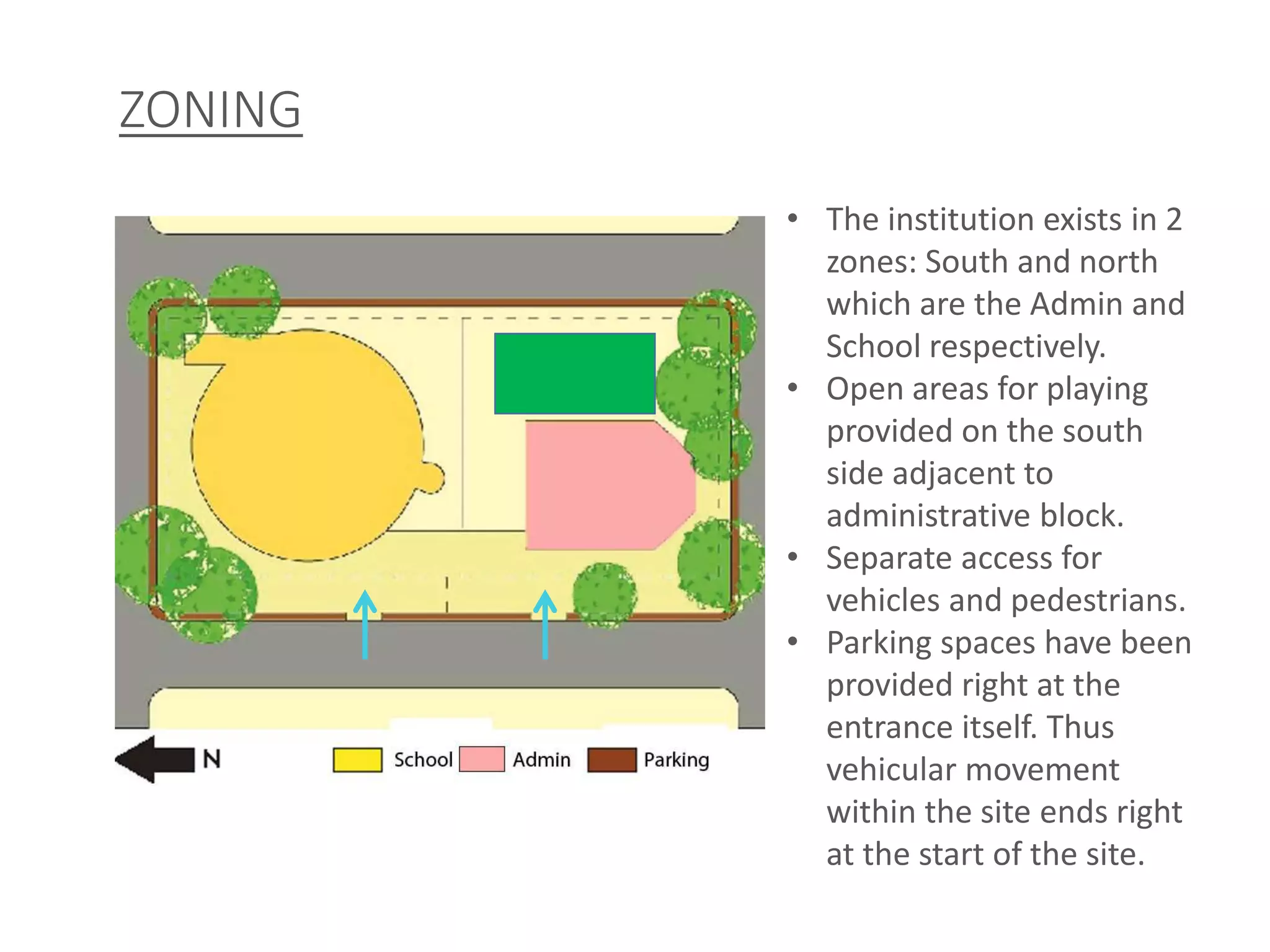
• The institution exists in 2
zones: South and north
which are the Admin and
School respectively.
• Open areas for playing
provided on the south
side adjacent to
administrative block.
• Separate access for
vehicles and pedestrians.
• Parking spaces have been
provided right at the
entrance itself. Thus
vehicular movement
within the site ends right
at the start of the site.
KEY OBSERVATIONS:
•Circular planning , easy to understand.
• Courtyards, also serving as play area.
•Well seperated residential and school block.
•Introvert planning, children under constant vigil.
CASE STUDY: NAB, DELHI
LEGENDS:
1. Lobby 7. Toilet
2. Principle office 8. Open Court
3. Office 9. Ramp
4. Classroom
5. Toilet
6. Library
LEGENDS:
1. Office (warden)
2. Dormitory
3. Entertainment room
4. Kitchen
5. Toilet
6. Dining
INFERENCES :
• Separate vehicular and pedestrian entries.
• Parking restricted at the entrance.
• Efficient zoning of different blocks.
• Planning: Simple circular planning, easily
understandable.
• Central court for physical training and other activities
• Non-parallel walls, good for acoustics.
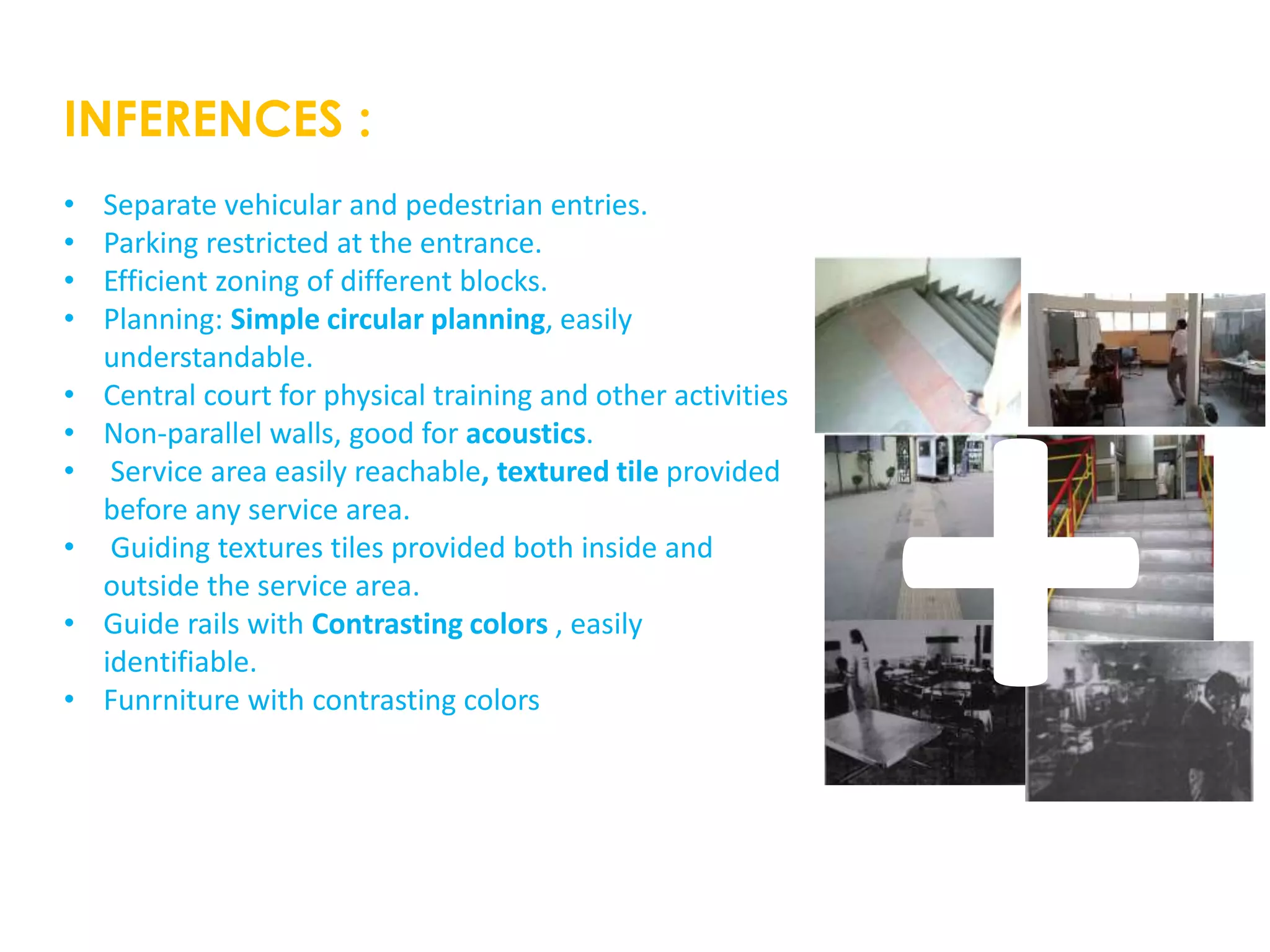
• Service area easily reachable, textured tile provided
before any service area.
• Guiding textures tiles provided both inside and
outside the service area.
• Guide rails with Contrasting colors , easily
identifiable.
• Funrniture with contrasting colors
INFERENCES :
• Column in between passages create obstructions.
• Furniture not designed according to the circular plan.
• Cross ventilation is difficult due to disorganized arrangement of the
furniture.
NATIONAL ASSOCIATION FOR THE BLIND-
MUMBAI
The institute is a combination of a training, schooling and
a residential centre.
Being a state centre, it comprises a braille printing press
and a talking library which is a unique feature of the
institute along with its school and training centre.
SITE SPECIFICATIONS
Site area- 3240 𝑚2
Orientation- North-East and South-
West
Climate - Humid
Topography - Slightly Sloping
Ground coverage- 1242.93 𝑚2
Built up area - 3671.63 𝑚2
Circulation area - 183 𝑚2
Architect - I.M. Kadri
Renovation / additions - Kapadia associates
ZONING
ZONING:
• Divided among 2 wings, A & B with different
functions on different floors.
• Connected on 1st floor through skywalk.
ACCESS:
• Single access point used by both vehicles and
pedestrians( 6 m wide entrance)
• There is a distance of about 15 - 18 mts which
has to covered to reach the built
mass.
CIRCULATION WITHIN THE SITE:
• The architect has tried to maintain a similar
circulation pattern (linear)
throughout the site and the built mass.
VEHICULAR AND PEDESTRIAN MOVEMENT:
• Parking for vehicles is provided all around the
built form and is taken deeper inside the site-
disadvantage for visually impaired.
Ground Floor Plan- Wing A
Ground floor plan- Wing B
SERVICES
PUBLIC AREAS
PRIVATE AREAS
CIRCULATION
Ground floor plan- Wing A
Ground floor plan- Wing B
SERVICES
PUBLIC AREAS
PRIVATE AREAS
CIRCULATION
First Floor Plan- Wing A
First Floor Plan- Wing B
• Access to site is linear without obstructions.
• Inside the building also circulation is linear
and simple.
• Braille printing machines at basement
utilizing the slopy site and also cant disturb
the other department.
• The passage width is the same on every floor
and there is a lobby space (slightly wider
than the passage) at the start of each
passage area.
• The arrangements of the rooms is also done
in a linear pattern.
• Braille signings are installed outside every
room/ area, Helping the blind to recognize
the room.
INFERENCES :
• Important areas like studio etc. are not
easily accessible
• No special wall or floor finishes used.
• The design is very simple.
• No color contrast provided for visually
impaired people.
• Not enough storage for Braille papers.
• No guide rails provided with the
staircases.
• No indicators or beepers at the
entrance or near the lifts.
INFERENCES :
NAB REHABILITATION CENTRE- MUMBAI
• The center trains both the blind
and visually impaired for a normal life.
• This has been done by addressing the issue
at the psychological, social and vocational level
SITE SPECIFICATION
Site Area: 1580
Orientation: North East- South West
Climate: Humid
Topography: Slightly Sloping
Ground Coverage: 1500
Built Up Area: 1500
Circulation Area: 20%
Architect: Ar. Arvind Mamania
ZONING
Court
Landscape
Passage
Wall
Circulation
LEGENDS:
N
ZONING
Court
Landscape
Passage
Wall
Circulation
LEGENDS:
N
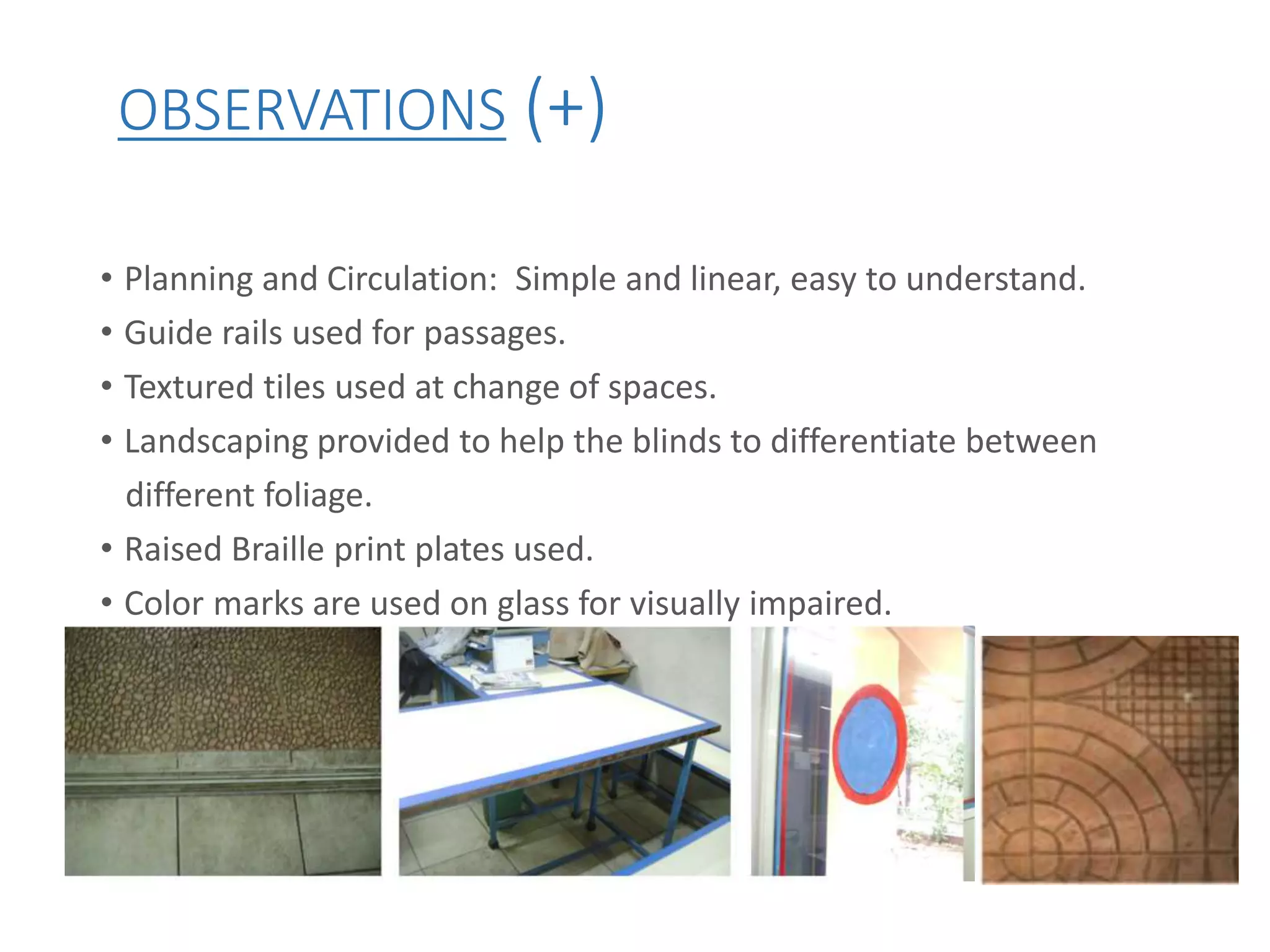
OBSERVATIONS (+)
• Planning and Circulation: Simple and linear, easy to understand.
• Guide rails used for passages.
• Textured tiles used at change of spaces.
• Landscaping provided to help the blinds to differentiate between
different foliage.
• Raised Braille print plates used.
• Color marks are used on glass for visually impaired.
OBSERVATIONS (-)
• Due to less space as compared to the number of occupants bunk
beds have been used
• Unable to assign different rooms for different activities of vocational
training, like, physical training.
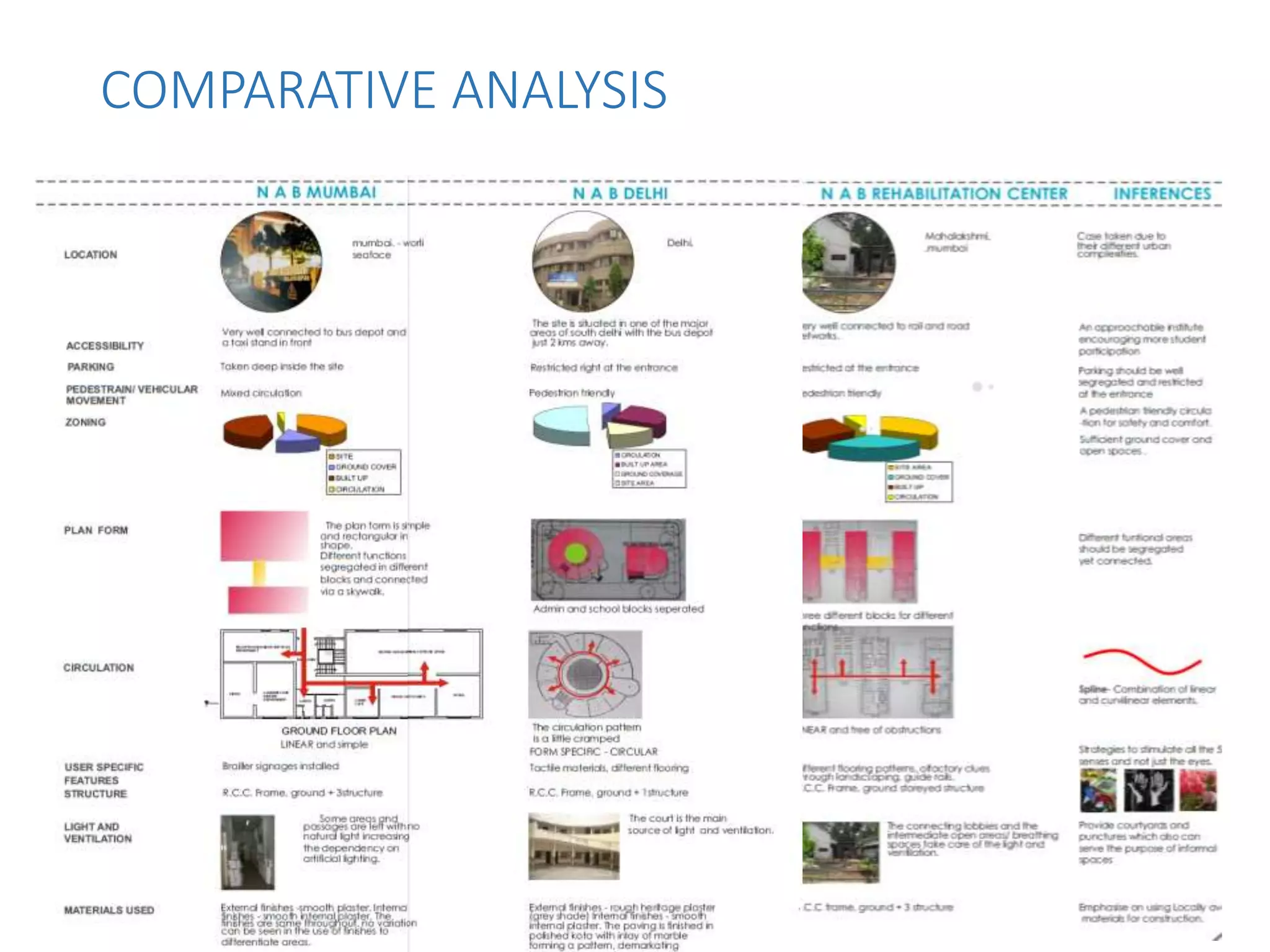
COMPARATIVE ANALYSIS
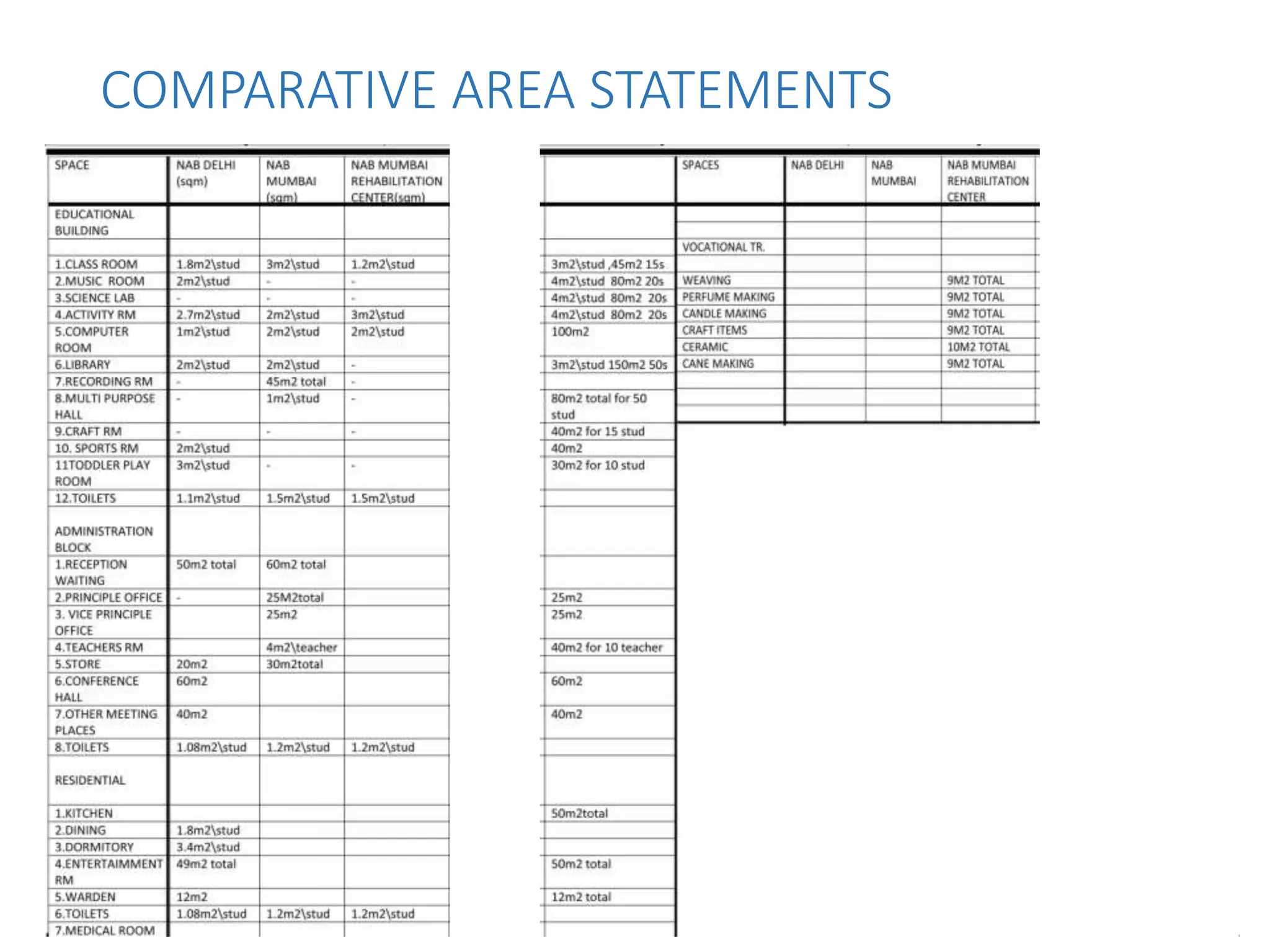
COMPARATIVE AREA STATEMENTS
PUBLIC
Restaurant: 120
Kitchen: 30
Store: 15
TOTAL: 245
Conference room(2 in no.): 100
Administration(2 in no.): 120
Waiting room: 25
Director's room: 30
Exhibition area: 100
Entrance lobby: 50
TOTAL: 547
ADMINISTRATION
Reception + waiting area : 50
Toilets (4 in no.): 120
Dining area(Boys) : 175
Kitchen (Total): 120
DORMITORY
Playgrounds (2 in no.):
Staff-room: 100
Principal's cabin: 30
Toilet (boys, 3 in no.): 90
Toilet (girls, 3 in no.): 90
Store (2 in no.): 40
Computer lab (school area): 120
Braille library: 250
Classrooms (15 in no.): 525
TOTAL: 2205
SCHOOL
Candle making workshop: 60
Cane making workshop: 60
H.O.D training wing: 35
Staff Room: 50
Tailoring room: 60
Loom weaving workshop: 75
Toilet (gents): 30
Toilet (ladies): 30
Classrooms (3 in no.): 120
TOTAL: 970
TRAINING
GRAND TOTAL: 5900
CIRCULATION AND WALLS: (~40%) 2400
TOTAL BUILT UP AREA: 8300
Store (Total): 30
Common Room: 80
Total: 2015
Dormitories (Total) 900
Dining area(Girls) : 130
Guest Rooms (Total) 150
Shops (4 in no.): 80
Store 20
Interactive classrooms(2 in no.): 60
Talking book library 180
Listening booth 90
Recording studio 180
900
Pantry 30
Computer lab 30
Library 50
Store 12
Warden’s residence (2 in no.) 170
Caretaker’s residence (2 in no.) 90
AREASTATEMENT
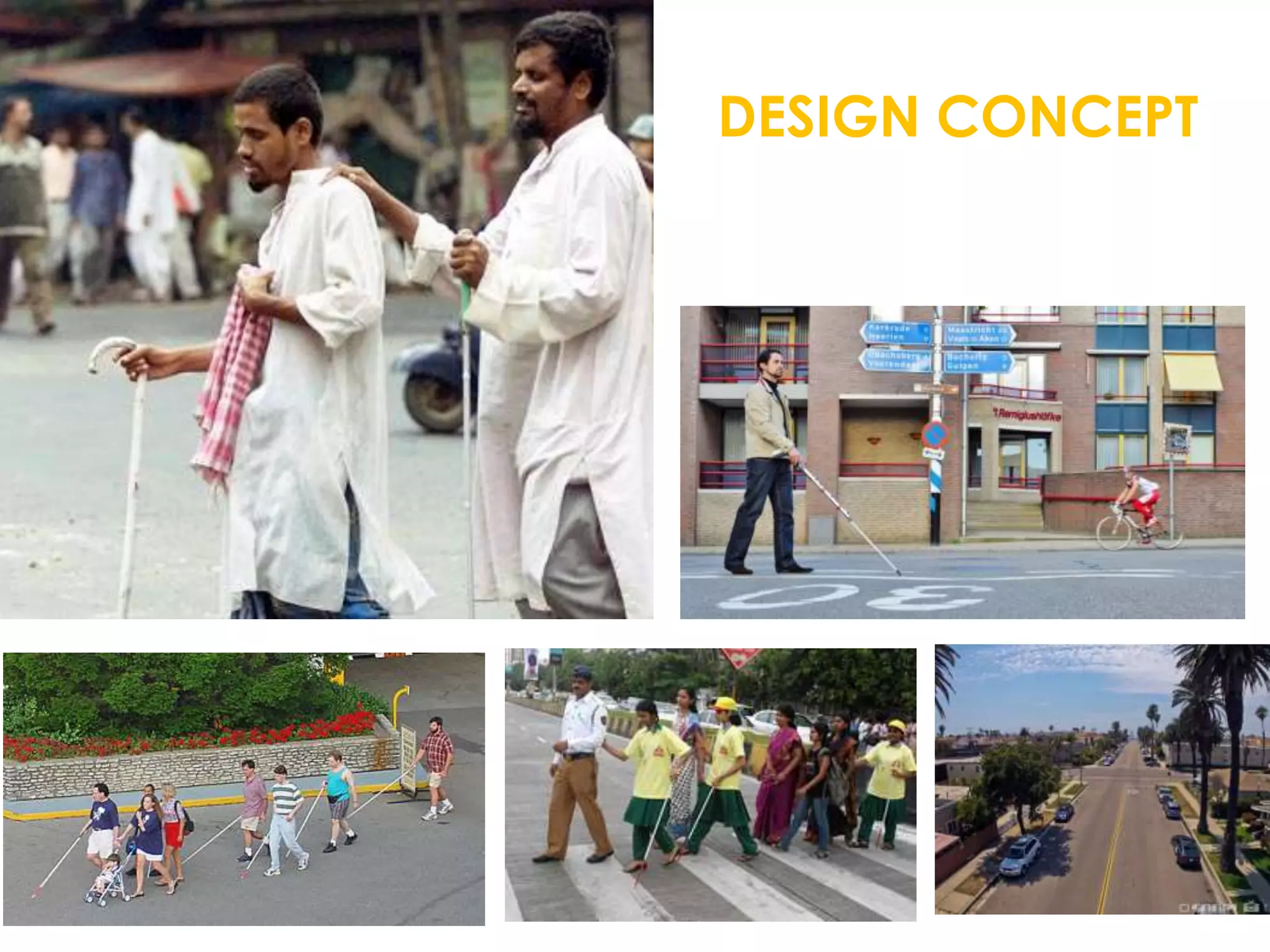
DESIGN CONCEPT
DESIGN CONCEPT
CONTEXTUAL
INSPIRATION
DOME- GANDHI HALL
ARCADE- KRISHNAPURA CHHATRIS
SITE PLAN
PEDESTRIAN ENTRY
N
GROUND FLOOR PLAN
N
ADMIN BLOCK GROUND FLOOR PLAN
N
ADMIN BLOCK FIRST FLOOR PLAN
N
GROUND FLOOR PLAN
N
TRAINING BLOCK GROUND FLOOR
PLAN
N
N
GROUND FLOOR PLAN
CORRIDOR
3MWIDE N
N
SECONDARY SCHOOL BLOCK
GROUND FLOOR PLAN
CORRIDOR
3MWIDE
N
GROUND FLOOR PLAN
N
CORRIDOR
3MWIDE
N
GROUND FLOOR PLAN
N
BOYS HOSTEL GROUND FLOOR PLAN
N
BOYS HOSTEL FIRST FLOOR PLAN
N
GROUND FLOOR PLAN
N
N
GIRLS HOSTEL GROUND FLOOR PLAN
GIRLS HOSTEL FIRST FLOOR PLAN
N
ELEVATIONS
ELEVATIONS
SECTIONS
SECTIONS
ELEVATIONS
PERSPECTIVE VIEWS
PERSPECTIVE VIEWS
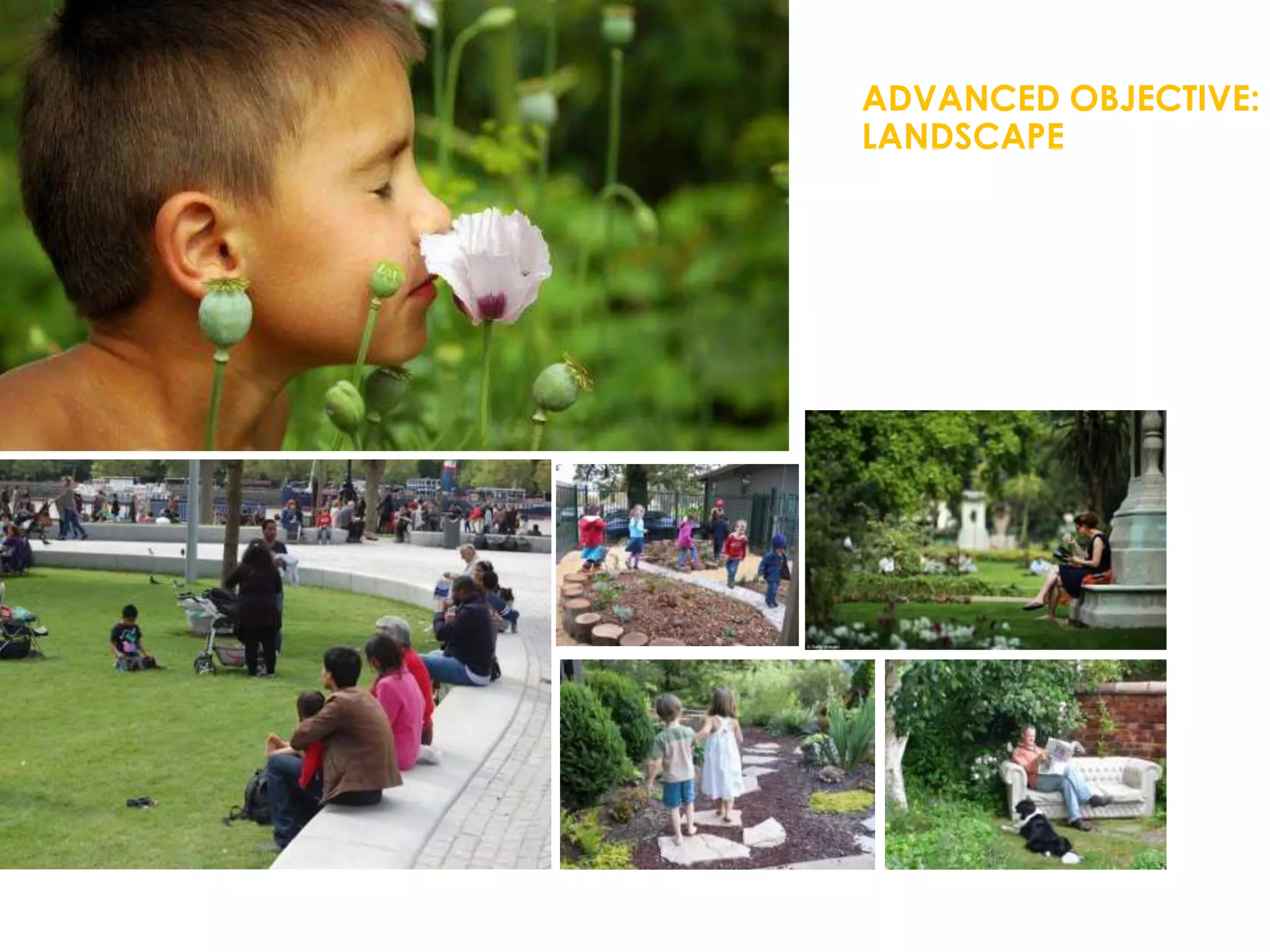
ADVANCED OBJECTIVE:
LANDSCAPE
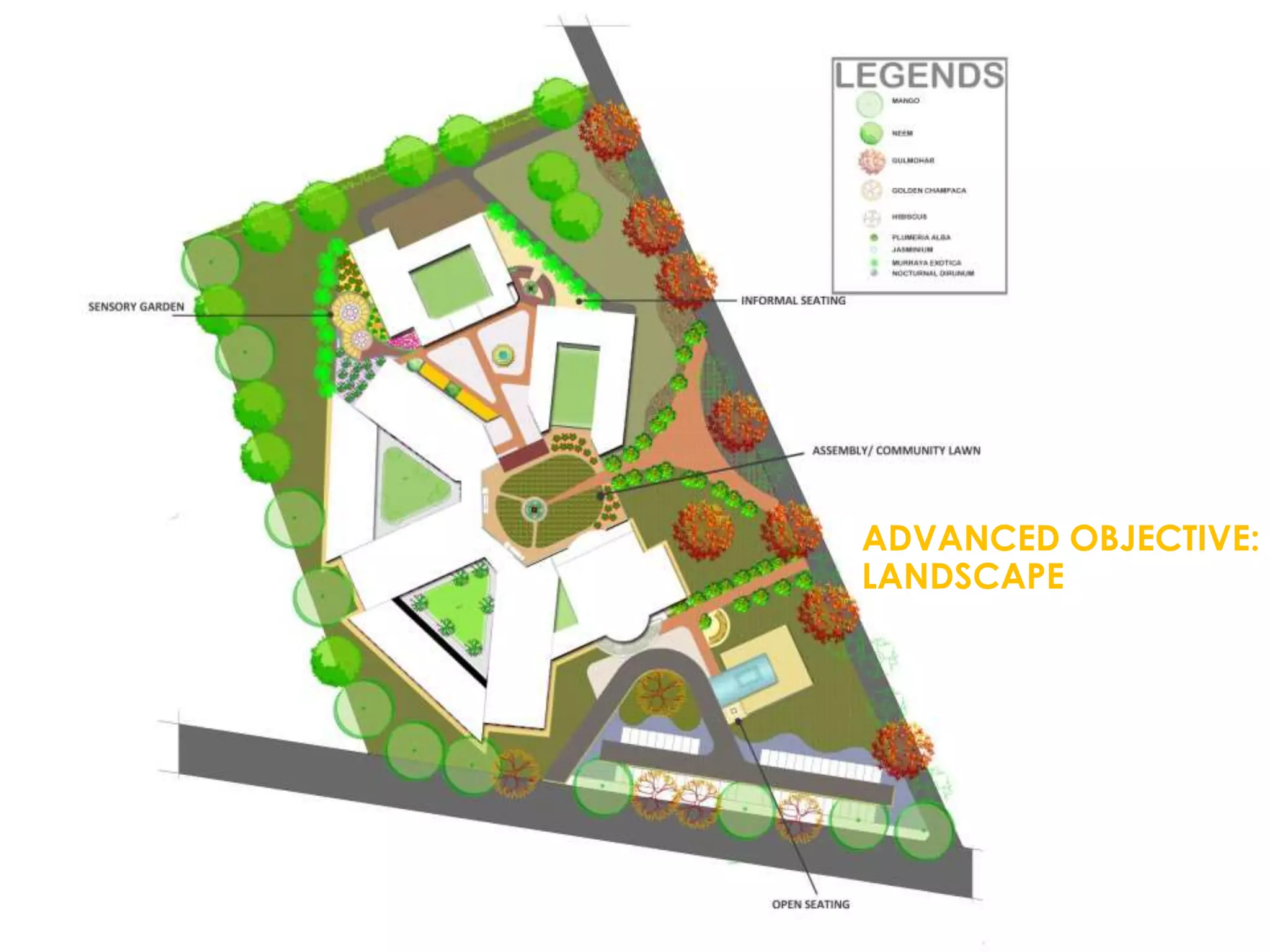
ADVANCED OBJECTIVE:
LANDSCAPE
SENSORY GARDEN
ADVANCED OBJECTIVE:
LANDSCAPE
• Gardenia Latifolia (Cape jasmine –Doodh mogra)
- Small deciduous tree
- Tree- leafless in March – April.
- Flowering-April
- Flowers make the night atmosphere charming with their fragrance during
summer.
• Eucalyptus Maculata (Nilgiri)
- Deciduous in patches giving trunk a spotted appearance.
- Flowers appears in April- July.
• Azadirachta Indica (Neemtree)
- Deciduous tree
- Flowering season – March – April
- Gives dense shade
- Gives smell
VEGETATION STUDY
VEGETATION STUDY
SHRUBS:
• Nyctanthes abor-tristis (Night Jasmine – parijatak)
- Large shrub or small tree
- Tree flowers profusely in autumn, which open at night and fall before
sunrise
- Forms a white carpet below in the morning
- Gives sweet smell
• Millintonia Hortensis(Indian cork tree)
- Evergreen, columnar.
- Flowering – Autumn and spring.
- Flowers open during night and fall down in early part of the day
• Murraya Exotica (Chinese box – Madhumalati)
- Evergreen shrub
- Numerous clusters of flowers appear at intervals in summer and rains.
THANK YOU

Centre for blinds and visually impaired

  • 1.
    MAYUR KARODIA EN. NO.10110036 Centre for blinds and Visually impaired Indore
  • 2.
    • Name: SchoolFor Visually Impaired • Type: Institutional • Location: Indore • Client: Indore Development Authority Site Area: 7.5 Acres Ground Coverage: 35% FAR : 1.5 Max. No. of Floors: 4 Setbacks: Front: 12m Sides and rear: 4.5m
  • 3.
    AIM • To designeducational infrastructure for blind to facilitate them to be the part of mainstream society. • to educate the blind so as to make them independent • To rehabilitate the blind so that they can earn for their livelihood and be the part of society • To help them emotionally, mentally, physically, psychologically and economically. ARCHITECTURAL CHALLENGES OF THE PROJECT: • To explore the ways in which the design could be made barrier free. • To study of senses used by the blinds. • To provide simple and free circulation in an around building to make movement easy and negotiable • To give a rich environment in sensory stimulation such as texture, smell, sound, shapes, sizes and colors. • To segregate pedestrian and vehicular traffic within the campus to ensure extra safety.
  • 4.
    Indore: Indore isa major city and commercial center of the state of Madhya Pradesh,located 190km west of the state capital Bhopal. It is also the commercial capital of the state and has both an IIM and IIT located in the city. It has a rich history and various historical buildings. LOCATION: Indore, MP POPULATION: It has a populationof 25,24,912. It is the largest city in MP, the 15th largest city in india and the 147th largest city in the world. INDORE MASTERPLAN
  • 5.
  • 6.
    MP TOURISM OFFICE VIEW1- AGRICULTURE COLLEGE VIEW 2- ROBERT NURSING HOME RED CHURCH N
  • 7.
    SWOT ANALYSIS Strength: Location: Locatedin one of the prime institutional areas with several colleges and schools in close proximity Access Roads: Lies at the two (major and minor ) cross roads which make it easily accessible by the blinds. Moreover the frontage and visibility is ample. Approach: Easy accessibility through the developed road network via car, bus, taxis. Weakness: Heavy traffic during morning and evening due to schools and colleges. Far from the main city.
  • 8.
    Opportunities • As surroundedby other institutes, good possibility of developing a community space through it. • Site lies on a corner plot having ample frontage hence good views can be provided. • With the inclusion of ultra modern technologies and design, have a scope to be the best blind school in the whole Indore district. Threats • Increased residential settlements may cause problem of encroachments.
  • 9.
    CASE STUDIES National Associationfor the Blind (NAB)- New Delhi National Association for the Blind (NAB)- Mumbai NAB Rehabilitation Center - Mumbai
  • 10.
    NATIONAL ASSOCIATION FORTHE BLIND - DELHI The Delhi center is the head of all the NAB centers in India. An example wherein the form of the building challenges its workability for a blind institute. SITE SPECIFICATIONS Location: Sector 5, RK Puram, Delhi Client: NAB Site area: 3456 𝑚2 Orientation: East-West Orientation Climate : Hot and Dry Climate Topography : Flat land Ground coverage : 1053 sq.m Built up area : 1912.5 sq.m Circulation area : 20%
  • 11.
    ZONING • The institutionexists in 2 zones: South and north which are the Admin and School respectively. • Open areas for playing provided on the south side adjacent to administrative block. • Separate access for vehicles and pedestrians. • Parking spaces have been provided right at the entrance itself. Thus vehicular movement within the site ends right at the start of the site.
  • 12.
    KEY OBSERVATIONS: •Circular planning, easy to understand. • Courtyards, also serving as play area. •Well seperated residential and school block. •Introvert planning, children under constant vigil. CASE STUDY: NAB, DELHI LEGENDS: 1. Lobby 7. Toilet 2. Principle office 8. Open Court 3. Office 9. Ramp 4. Classroom 5. Toilet 6. Library LEGENDS: 1. Office (warden) 2. Dormitory 3. Entertainment room 4. Kitchen 5. Toilet 6. Dining
  • 13.
    INFERENCES : • Separatevehicular and pedestrian entries. • Parking restricted at the entrance. • Efficient zoning of different blocks. • Planning: Simple circular planning, easily understandable. • Central court for physical training and other activities • Non-parallel walls, good for acoustics. • Service area easily reachable, textured tile provided before any service area. • Guiding textures tiles provided both inside and outside the service area. • Guide rails with Contrasting colors , easily identifiable. • Funrniture with contrasting colors
  • 14.
    INFERENCES : • Columnin between passages create obstructions. • Furniture not designed according to the circular plan. • Cross ventilation is difficult due to disorganized arrangement of the furniture.
  • 15.
    NATIONAL ASSOCIATION FORTHE BLIND- MUMBAI The institute is a combination of a training, schooling and a residential centre. Being a state centre, it comprises a braille printing press and a talking library which is a unique feature of the institute along with its school and training centre. SITE SPECIFICATIONS Site area- 3240 𝑚2 Orientation- North-East and South- West Climate - Humid Topography - Slightly Sloping Ground coverage- 1242.93 𝑚2 Built up area - 3671.63 𝑚2 Circulation area - 183 𝑚2 Architect - I.M. Kadri Renovation / additions - Kapadia associates
  • 16.
    ZONING ZONING: • Divided among2 wings, A & B with different functions on different floors. • Connected on 1st floor through skywalk. ACCESS: • Single access point used by both vehicles and pedestrians( 6 m wide entrance) • There is a distance of about 15 - 18 mts which has to covered to reach the built mass. CIRCULATION WITHIN THE SITE: • The architect has tried to maintain a similar circulation pattern (linear) throughout the site and the built mass. VEHICULAR AND PEDESTRIAN MOVEMENT: • Parking for vehicles is provided all around the built form and is taken deeper inside the site- disadvantage for visually impaired.
  • 17.
    Ground Floor Plan-Wing A Ground floor plan- Wing B SERVICES PUBLIC AREAS PRIVATE AREAS CIRCULATION
  • 18.
    Ground floor plan-Wing A Ground floor plan- Wing B SERVICES PUBLIC AREAS PRIVATE AREAS CIRCULATION First Floor Plan- Wing A First Floor Plan- Wing B
  • 19.
    • Access tosite is linear without obstructions. • Inside the building also circulation is linear and simple. • Braille printing machines at basement utilizing the slopy site and also cant disturb the other department. • The passage width is the same on every floor and there is a lobby space (slightly wider than the passage) at the start of each passage area. • The arrangements of the rooms is also done in a linear pattern. • Braille signings are installed outside every room/ area, Helping the blind to recognize the room. INFERENCES :
  • 20.
    • Important areaslike studio etc. are not easily accessible • No special wall or floor finishes used. • The design is very simple. • No color contrast provided for visually impaired people. • Not enough storage for Braille papers. • No guide rails provided with the staircases. • No indicators or beepers at the entrance or near the lifts. INFERENCES :
  • 21.
    NAB REHABILITATION CENTRE-MUMBAI • The center trains both the blind and visually impaired for a normal life. • This has been done by addressing the issue at the psychological, social and vocational level SITE SPECIFICATION Site Area: 1580 Orientation: North East- South West Climate: Humid Topography: Slightly Sloping Ground Coverage: 1500 Built Up Area: 1500 Circulation Area: 20% Architect: Ar. Arvind Mamania
  • 22.
  • 23.
  • 24.
    OBSERVATIONS (+) • Planningand Circulation: Simple and linear, easy to understand. • Guide rails used for passages. • Textured tiles used at change of spaces. • Landscaping provided to help the blinds to differentiate between different foliage. • Raised Braille print plates used. • Color marks are used on glass for visually impaired.
  • 25.
    OBSERVATIONS (-) • Dueto less space as compared to the number of occupants bunk beds have been used • Unable to assign different rooms for different activities of vocational training, like, physical training.
  • 26.
  • 27.
  • 28.
    PUBLIC Restaurant: 120 Kitchen: 30 Store:15 TOTAL: 245 Conference room(2 in no.): 100 Administration(2 in no.): 120 Waiting room: 25 Director's room: 30 Exhibition area: 100 Entrance lobby: 50 TOTAL: 547 ADMINISTRATION Reception + waiting area : 50 Toilets (4 in no.): 120 Dining area(Boys) : 175 Kitchen (Total): 120 DORMITORY Playgrounds (2 in no.): Staff-room: 100 Principal's cabin: 30 Toilet (boys, 3 in no.): 90 Toilet (girls, 3 in no.): 90 Store (2 in no.): 40 Computer lab (school area): 120 Braille library: 250 Classrooms (15 in no.): 525 TOTAL: 2205 SCHOOL Candle making workshop: 60 Cane making workshop: 60 H.O.D training wing: 35 Staff Room: 50 Tailoring room: 60 Loom weaving workshop: 75 Toilet (gents): 30 Toilet (ladies): 30 Classrooms (3 in no.): 120 TOTAL: 970 TRAINING GRAND TOTAL: 5900 CIRCULATION AND WALLS: (~40%) 2400 TOTAL BUILT UP AREA: 8300 Store (Total): 30 Common Room: 80 Total: 2015 Dormitories (Total) 900 Dining area(Girls) : 130 Guest Rooms (Total) 150 Shops (4 in no.): 80 Store 20 Interactive classrooms(2 in no.): 60 Talking book library 180 Listening booth 90 Recording studio 180 900 Pantry 30 Computer lab 30 Library 50 Store 12 Warden’s residence (2 in no.) 170 Caretaker’s residence (2 in no.) 90 AREASTATEMENT
  • 29.
  • 30.
  • 31.
  • 32.
  • 33.
  • 34.
    ADMIN BLOCK GROUNDFLOOR PLAN N
  • 35.
    ADMIN BLOCK FIRSTFLOOR PLAN N
  • 36.
  • 37.
  • 38.
  • 39.
  • 40.
  • 41.
    SECONDARY SCHOOL BLOCK GROUNDFLOOR PLAN CORRIDOR 3MWIDE N
  • 42.
  • 43.
  • 44.
  • 45.
    BOYS HOSTEL GROUNDFLOOR PLAN N
  • 46.
    BOYS HOSTEL FIRSTFLOOR PLAN N
  • 47.
  • 48.
  • 49.
    GIRLS HOSTEL FIRSTFLOOR PLAN N
  • 50.
  • 51.
  • 52.
  • 53.
  • 54.
  • 55.
  • 56.
  • 57.
  • 58.
  • 60.
  • 61.
  • 62.
    • Gardenia Latifolia(Cape jasmine –Doodh mogra) - Small deciduous tree - Tree- leafless in March – April. - Flowering-April - Flowers make the night atmosphere charming with their fragrance during summer. • Eucalyptus Maculata (Nilgiri) - Deciduous in patches giving trunk a spotted appearance. - Flowers appears in April- July. • Azadirachta Indica (Neemtree) - Deciduous tree - Flowering season – March – April - Gives dense shade - Gives smell VEGETATION STUDY
  • 63.
    VEGETATION STUDY SHRUBS: • Nyctanthesabor-tristis (Night Jasmine – parijatak) - Large shrub or small tree - Tree flowers profusely in autumn, which open at night and fall before sunrise - Forms a white carpet below in the morning - Gives sweet smell • Millintonia Hortensis(Indian cork tree) - Evergreen, columnar. - Flowering – Autumn and spring. - Flowers open during night and fall down in early part of the day • Murraya Exotica (Chinese box – Madhumalati) - Evergreen shrub - Numerous clusters of flowers appear at intervals in summer and rains.
  • 64.