Keratoconus
 ALKASR ALAINY MEDICAL SCHOOL
 Ophthalmology 4th Round 2017-2018
 Prof.Dr.Tarek Katamish Unit
 Under supervision of Dr.Safaa Galal
 Done By :
 Baraa Wajeeh
 Bahaa Emad
 Badea Nedal
 Bashar ALodat
 Monis Hasan
 Jamila Dayoub
 Basil Anwar
 Hazem Mawazini
‫الرحيم‬ ‫الرحمن‬ ‫هللا‬ ‫بسم‬
What is Keratoconus?
 Keratoconus is a progressive eye disease in which the normally round cornea
thins and begins to bulge into a cone-like shape.
Management of keratoconus
Diagnosis
HISTORY
 Patients with keratoconus often report decreasing vision .
 The patient complains from :
o Distortions
o Glare/flare
o Monocular diplopia or ghost images
 With multiple unsatisfactory attempts in obtaining
optimum spectacle correction.
Examination
 Keratoconus is differentiated into mild, moderate, and
advanced disease, as well as by shape.
Early
 External and corneal signs are often absent or minimal.
 A history of multiple inadequate spectacle corrections of one or both
eyes may be noted and may include oblique astigmatism on refraction
as well as moderate-to-high myopia.
Late
 One or more corneal signs of keratoconus are often
present, as follows:
o Enhanced appearance of the corneal nerves is noted.
o Approximately 40% of eyes in patients with moderate
keratoconus develop Vogt striae .
o Approximately 50% develop Fleischer ring.
o Approximately 20% develop corneal scarring.
o Scissoring
o Munson sign
Investigation
 Imaging Studies
Corneal topography, OCT pachymetry, and diagnostic use of rigid
contact lenses are sometimes required, especially when the typical
biomicroscopy signs of Vogt striae and Fleischer ring are absent.
Pentacam
Does reconstruction of the anterior segment and provides data
concerning the anterior surface, posterior surface and thickness of the
cornea.
Corneal topography
OCT pachymetry
Pentacam
Rabinowitz diagnostic criteria for keratoconus include the
following indices :
 K value - Measures central steepening of the cornea; a value of 47.20 D or
greater suggests keratoconus
 I-S value - Measures inferior-versus-superior corneal dioptric asymmetry; a
value of 1.4 D or greater suggests keratoconus
 KISA% - Incorporates K and I-S values with a measure quantifying regular and
irregular astigmatism into a single index; a value in the range of 60-100%
suggests keratoconus, and a value exceeding 100% strongly suggests frank
keratoconus
 Pachymetry/asymmetry (PA)/I-S index - The minimum pachymetry value
divided by the I-S value ; identifies keratoconus suspects and forme fruste
keratoconus when the PA/I-S index is less than 105
Treatment
 1. Eyeglasses
 Treatment usually starts with new eyeglasses, For visual improvement and
astigmatism management.
 If eyeglasses don't provide adequate vision, then contact lenses
 2. Contact Lenses
 usually rigid gas permeable contact lenses, may be recommended, With mild
cases to neutralize the irregular corneal astigmatism.
 3. Corneal Collagen Crosslinking
 Corneal cross-linking involves administering riboflavin (vitamin B2) eye
drops and UVA light in carefully selected parameters that strengthen the
front layers of the cornea and avoid damage to the back part of the eye.
 Crosslinking is used to help stop the progression of keratoconus. The
procedure may not improve vision; the main objective is to stop vision from
getting worse to the point of needing a cornea transplant.
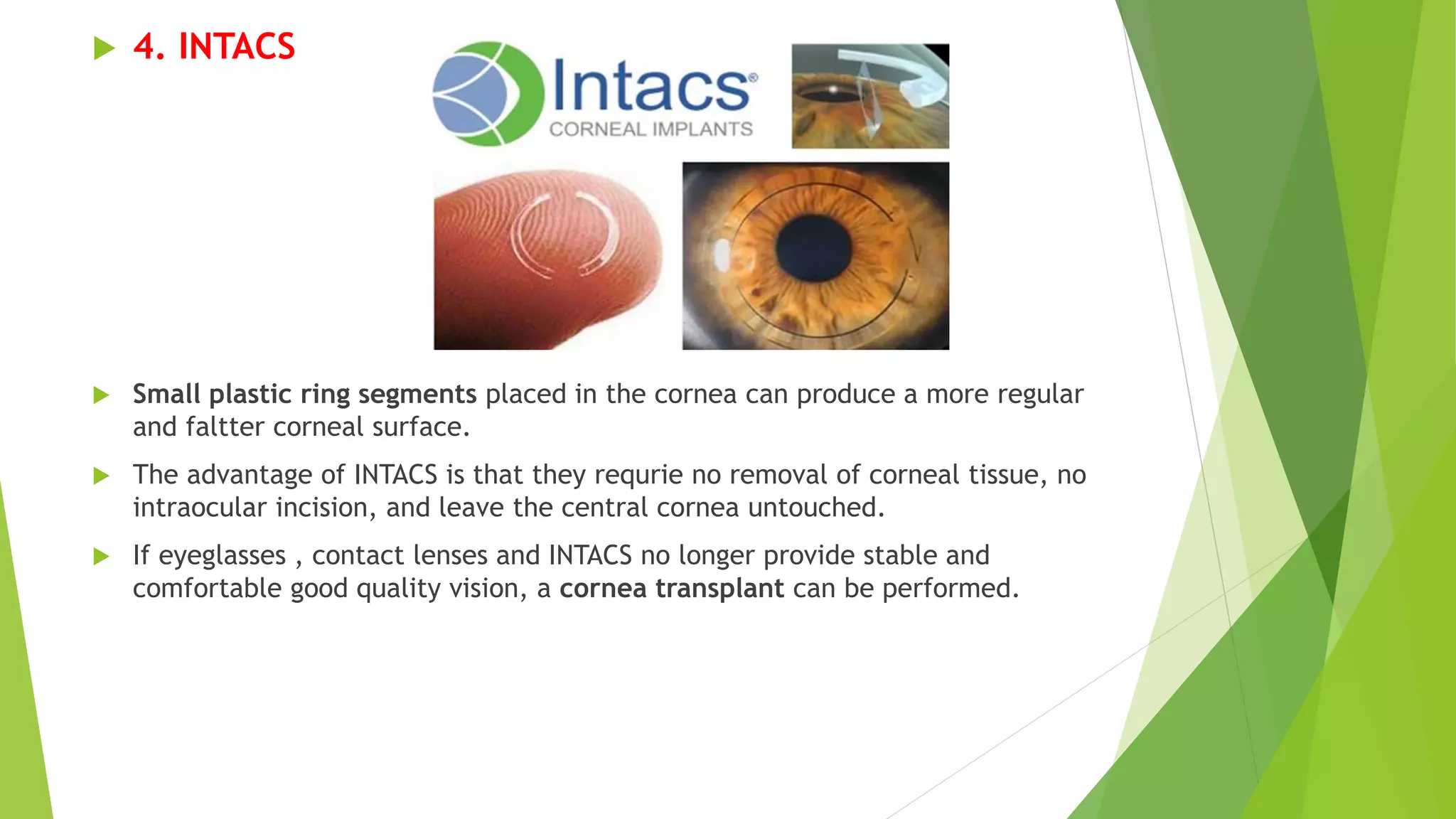
 4. INTACS
 Small plastic ring segments placed in the cornea can produce a more regular
and faltter corneal surface.
 The advantage of INTACS is that they requrie no removal of corneal tissue, no
intraocular incision, and leave the central cornea untouched.
 If eyeglasses , contact lenses and INTACS no longer provide stable and
comfortable good quality vision, a cornea transplant can be performed.
A. Deep Anterior Lamellar Keratoplasty (DALK)
 It involves replacement of the central anterior cornea, leaving the patient’s
endothelium intact. The advantags are that the risk of endothelial graft rejection
is eliminated, and there is less risk of traumatic rupture of the globe in the incision,
since the endothelium and Descemet’s and some stroma are left intact, and faster
visual rehabilitation.
 DALK is the treatment of choice for keratoconus or corneal scars, as long as the
inner cell layer of the cornea (the endothelium) is healthy.
 There are several techniques utilitzed including, deep anterior lamellar
keratoplasty (DALK) and big bubble keratoplasty(BBK) to remove the anterior
stroma, while leaving Descemet’s layer and endothelium untouched.
5. Cornea Transplant
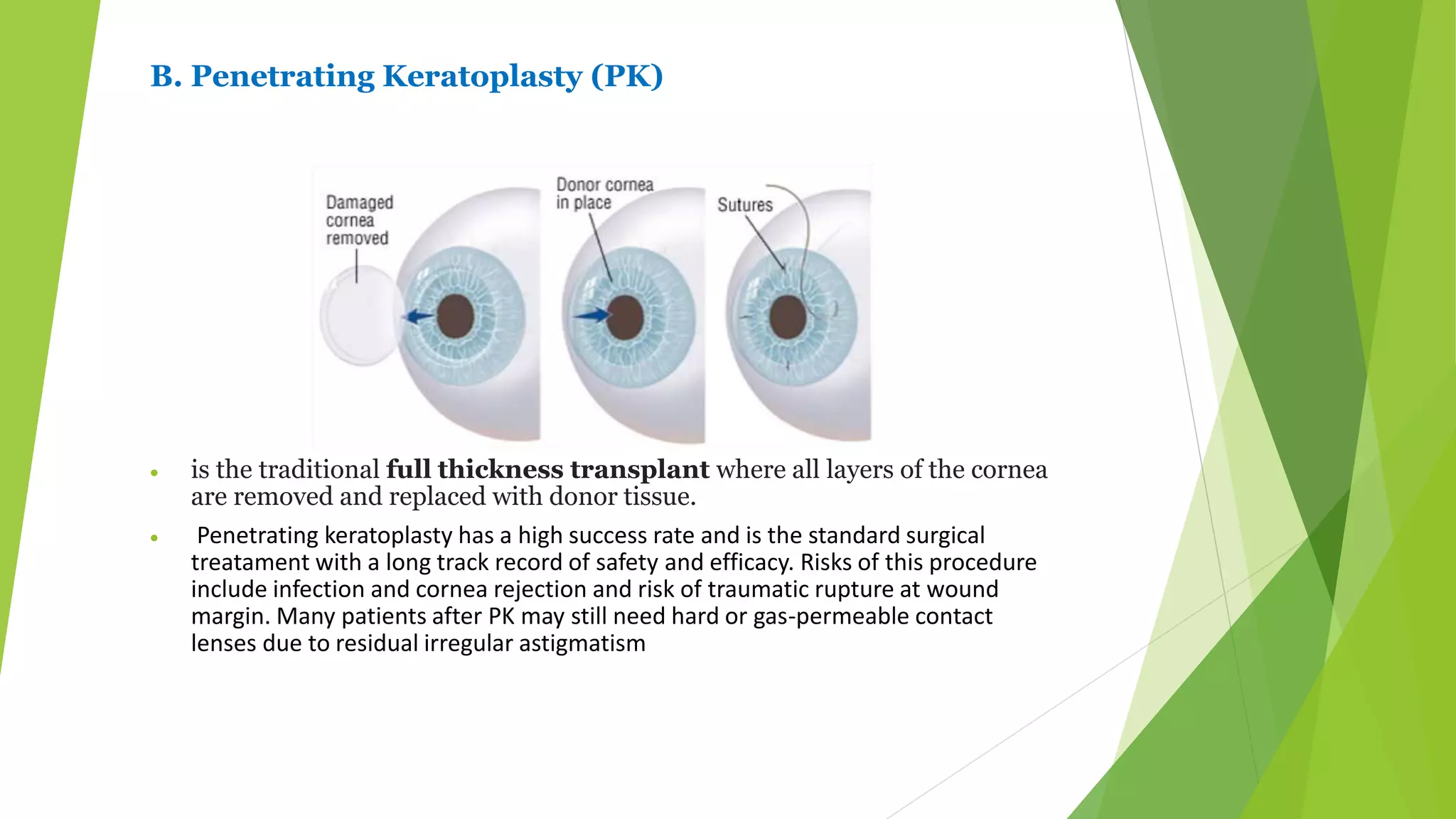
B. Penetrating Keratoplasty (PK)
 is the traditional full thickness transplant where all layers of the cornea
are removed and replaced with donor tissue.
 Penetrating keratoplasty has a high success rate and is the standard surgical
treatament with a long track record of safety and efficacy. Risks of this procedure
include infection and cornea rejection and risk of traumatic rupture at wound
margin. Many patients after PK may still need hard or gas-permeable contact
lenses due to residual irregular astigmatism
Keratoconus ,diagnosis and treatment

Keratoconus ,diagnosis and treatment

  • 1.
    Keratoconus  ALKASR ALAINYMEDICAL SCHOOL  Ophthalmology 4th Round 2017-2018  Prof.Dr.Tarek Katamish Unit  Under supervision of Dr.Safaa Galal  Done By :  Baraa Wajeeh  Bahaa Emad  Badea Nedal  Bashar ALodat  Monis Hasan  Jamila Dayoub  Basil Anwar  Hazem Mawazini
  • 2.
    ‫الرحيم‬ ‫الرحمن‬ ‫هللا‬‫بسم‬ What is Keratoconus?  Keratoconus is a progressive eye disease in which the normally round cornea thins and begins to bulge into a cone-like shape.
  • 3.
  • 4.
  • 5.
    HISTORY  Patients withkeratoconus often report decreasing vision .  The patient complains from : o Distortions o Glare/flare o Monocular diplopia or ghost images  With multiple unsatisfactory attempts in obtaining optimum spectacle correction.
  • 6.
    Examination  Keratoconus isdifferentiated into mild, moderate, and advanced disease, as well as by shape.
  • 7.
    Early  External andcorneal signs are often absent or minimal.  A history of multiple inadequate spectacle corrections of one or both eyes may be noted and may include oblique astigmatism on refraction as well as moderate-to-high myopia.
  • 8.
    Late  One ormore corneal signs of keratoconus are often present, as follows: o Enhanced appearance of the corneal nerves is noted. o Approximately 40% of eyes in patients with moderate keratoconus develop Vogt striae . o Approximately 50% develop Fleischer ring. o Approximately 20% develop corneal scarring. o Scissoring o Munson sign
  • 11.
    Investigation  Imaging Studies Cornealtopography, OCT pachymetry, and diagnostic use of rigid contact lenses are sometimes required, especially when the typical biomicroscopy signs of Vogt striae and Fleischer ring are absent. Pentacam Does reconstruction of the anterior segment and provides data concerning the anterior surface, posterior surface and thickness of the cornea.
  • 12.
  • 13.
  • 14.
  • 15.
    Rabinowitz diagnostic criteriafor keratoconus include the following indices :  K value - Measures central steepening of the cornea; a value of 47.20 D or greater suggests keratoconus  I-S value - Measures inferior-versus-superior corneal dioptric asymmetry; a value of 1.4 D or greater suggests keratoconus  KISA% - Incorporates K and I-S values with a measure quantifying regular and irregular astigmatism into a single index; a value in the range of 60-100% suggests keratoconus, and a value exceeding 100% strongly suggests frank keratoconus  Pachymetry/asymmetry (PA)/I-S index - The minimum pachymetry value divided by the I-S value ; identifies keratoconus suspects and forme fruste keratoconus when the PA/I-S index is less than 105
  • 16.
  • 17.
     1. Eyeglasses Treatment usually starts with new eyeglasses, For visual improvement and astigmatism management.  If eyeglasses don't provide adequate vision, then contact lenses
  • 18.
     2. ContactLenses  usually rigid gas permeable contact lenses, may be recommended, With mild cases to neutralize the irregular corneal astigmatism.
  • 19.
     3. CornealCollagen Crosslinking  Corneal cross-linking involves administering riboflavin (vitamin B2) eye drops and UVA light in carefully selected parameters that strengthen the front layers of the cornea and avoid damage to the back part of the eye.  Crosslinking is used to help stop the progression of keratoconus. The procedure may not improve vision; the main objective is to stop vision from getting worse to the point of needing a cornea transplant.
  • 20.
     4. INTACS Small plastic ring segments placed in the cornea can produce a more regular and faltter corneal surface.  The advantage of INTACS is that they requrie no removal of corneal tissue, no intraocular incision, and leave the central cornea untouched.  If eyeglasses , contact lenses and INTACS no longer provide stable and comfortable good quality vision, a cornea transplant can be performed.
  • 21.
    A. Deep AnteriorLamellar Keratoplasty (DALK)  It involves replacement of the central anterior cornea, leaving the patient’s endothelium intact. The advantags are that the risk of endothelial graft rejection is eliminated, and there is less risk of traumatic rupture of the globe in the incision, since the endothelium and Descemet’s and some stroma are left intact, and faster visual rehabilitation.  DALK is the treatment of choice for keratoconus or corneal scars, as long as the inner cell layer of the cornea (the endothelium) is healthy.  There are several techniques utilitzed including, deep anterior lamellar keratoplasty (DALK) and big bubble keratoplasty(BBK) to remove the anterior stroma, while leaving Descemet’s layer and endothelium untouched. 5. Cornea Transplant
  • 22.
    B. Penetrating Keratoplasty(PK)  is the traditional full thickness transplant where all layers of the cornea are removed and replaced with donor tissue.  Penetrating keratoplasty has a high success rate and is the standard surgical treatament with a long track record of safety and efficacy. Risks of this procedure include infection and cornea rejection and risk of traumatic rupture at wound margin. Many patients after PK may still need hard or gas-permeable contact lenses due to residual irregular astigmatism