PRESENTED BY : AMRITA CHANDRAN
Seminar  is, generally, a form of academic instruction, either at a university or offered by a commercial or professional organization. The word  seminar  is derived from the Latin word  seminarium , meaning "seed plot"
It has the function of bringing together small groups for recurring meetings, focusing each time on some particular subject, in which everyone present is requested to actively participate.  This is often accomplished through an ongoing socratic dialogue with a seminar leader or instructor, or through a more formal presentation of research Normally, participants must not be beginners in the field under discussion The idea behind the seminar system is to familiarize students more extensively with the methodology of their chosen subject and also to allow them to interact with examples of the practical problems.
It is essentially a place where assigned readings are discussed, questions can be raised and debates can be conducted It is relatively informal, at least compared to the lecture system of academic instruction.
Provides  information which is really useful and needed. Provides  information which is practical, how-to and specific rather than conceptual and   theoretical. Minimizes  time required to obtain information.  
Provides  support materials which enhances learning during and after the program. Is as entertaining  as it is informational. Utilizes humor  within context but not just for humor’s sake.
Informs participants  where they are headed and tells them where they have been on a  regular  basis. Provides  an opportunity for presentation of  ideas and practice of learned skills. Pays close attention  to the learning environment and to participants comfort.
Provides  a means by which questions can be answered
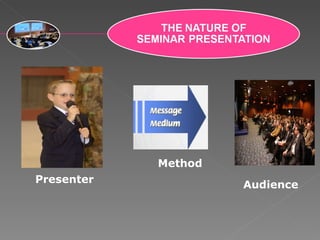
Presenter Method Audience
INFORMATIVE The audience learns about a new subject or learns new information about a familiar subject
PERSUASIVE Intended to change the audience's attitudes or behaviors ENTERTAINING Simply tries to gain and keep the audience's attention
Show critical thought about a topic Express this thought clearly and effectively Stimulate inquiry and discussion Show that the presenter can respond intellectually to others
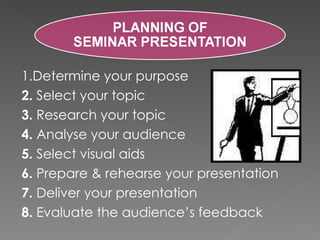
1.Determine your purpose 2.  Select your topic 3.  Research your topic 4.  Analyse your audience 5.  Select visual aids 6.  Prepare & rehearse your presentation 7.  Deliver your presentation 8.  Evaluate the audience’s feedback
1.THE INTRODUCTION/BACKGROUND Get the audience's attention 2. THE MAIN BODY: RESULTS/ANALYSIS/DISCUSSION Contain all detailed information 3. THE CONCLUSION/SUMMARY Recap the main ideas
THE IMPORTANCE OF INTRODUCTION To Get the audience's attention What question or issue you investigated Why it is important Outline the rest of your presentation
THE IMPORTANCE OF CONCLUSION To Recap the main ideas Summarize key points, suggest future research or applications, etc. Restate the importance of the presentation Answer the question/issue you raised in the introduction Clearly signal that you're finished End with a cordial, polite statement
PURPOSES OF VISUAL AIDS The back up to a presentation To keep the audience's attention To reinforce the understanding To communicate special concepts To highlight specific points To provide structure and order To express equations/formulas To provide notes and headings
Readable Clear Well organized Attractive Non-distractive Memorable Consistent KISS = Keep It Short & Simple KILL = Keep It Large & Legible
1.  Tell them what you are going to tell them  2.  Tell them, and 3.  Tell them what you have told them!
The title is a very important aspect    Always dress better than your audience.  Body language is important.     Come early.  Always keep the pace with the crowd.  Make sure your slides and handouts are legible to everyone.
Don't assume everybody knows what you know.  Never take a presentation as though you are reading a book.  Taking the presentation is just the beginning.  Never ever say you are not an expert. Always start on a positive note..  Convince the crowd why you are the right person to talk on the topic and then follow it up with a great presentation.
Encourages students to learn actively and to participate in class. Provides a forum for deeper and more critical engagement with a topic. Allows the tutor to give feedback and support to individuals. Requires the students to take responsibility for their own preparation and learning.  Facilitates collaboration and group learning.  Develops many forms of communication, analytical and problem-solving skills.

Allows a greater amount of interaction between teacher and students - it is the place you get to know your students.  Allows students to explore a topic, and guided by the learning outcomes for the course, take responsibility for their own learning In style the teacher or tutor is aiming to guide and facilitate class discussions and interactions, rather than instruct or lecture.    Students' structured engagement in learning tasks, is common in seminars.  
Requires significant investment of resources especially in tutor time.  Depends on the facilitation skills of the tutor and so may be variable in quality. Needs to be organised and well managed to allow discussion but to also ensure coverage of specific learning outcomes in a limited timeframe. Requires all students to participate and be encouraged and supported to do so. May be less effective if all students do not prepare adequately.
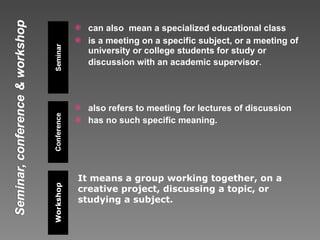
can also  mean a specialized educational class is a meeting on a specific subject, or a meeting of university or college students for study or discussion with an academic supervisor . also refers to meeting for lectures of discussion has no such specific meaning. It means a group working together, on a creative project, discussing a topic, or studying a subject.
 
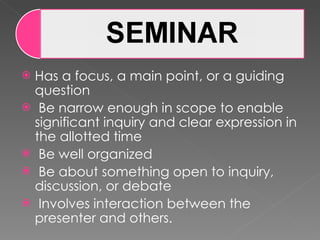
Has a focus, a main point, or a guiding question Be narrow enough in scope to enable significant inquiry and clear expression in the allotted time Be well organized Be about something open to inquiry, discussion, or debate Involves interaction between the presenter and others.


SEMINAR

  • 1.
  • 2.
    PRESENTED BY :AMRITA CHANDRAN
  • 3.
    Seminar is,generally, a form of academic instruction, either at a university or offered by a commercial or professional organization. The word seminar is derived from the Latin word seminarium , meaning "seed plot"
  • 4.
    It has thefunction of bringing together small groups for recurring meetings, focusing each time on some particular subject, in which everyone present is requested to actively participate. This is often accomplished through an ongoing socratic dialogue with a seminar leader or instructor, or through a more formal presentation of research Normally, participants must not be beginners in the field under discussion The idea behind the seminar system is to familiarize students more extensively with the methodology of their chosen subject and also to allow them to interact with examples of the practical problems.
  • 5.
    It is essentiallya place where assigned readings are discussed, questions can be raised and debates can be conducted It is relatively informal, at least compared to the lecture system of academic instruction.
  • 6.
    Provides informationwhich is really useful and needed. Provides information which is practical, how-to and specific rather than conceptual and   theoretical. Minimizes time required to obtain information.  
  • 7.
    Provides supportmaterials which enhances learning during and after the program. Is as entertaining as it is informational. Utilizes humor within context but not just for humor’s sake.
  • 8.
    Informs participants where they are headed and tells them where they have been on a regular  basis. Provides an opportunity for presentation of ideas and practice of learned skills. Pays close attention to the learning environment and to participants comfort.
  • 9.
    Provides ameans by which questions can be answered
  • 10.
  • 11.
    INFORMATIVE The audiencelearns about a new subject or learns new information about a familiar subject
  • 12.
    PERSUASIVE Intended tochange the audience's attitudes or behaviors ENTERTAINING Simply tries to gain and keep the audience's attention
  • 13.
    Show critical thoughtabout a topic Express this thought clearly and effectively Stimulate inquiry and discussion Show that the presenter can respond intellectually to others
  • 14.
    1.Determine your purpose2. Select your topic 3. Research your topic 4. Analyse your audience 5. Select visual aids 6. Prepare & rehearse your presentation 7. Deliver your presentation 8. Evaluate the audience’s feedback
  • 15.
    1.THE INTRODUCTION/BACKGROUND Getthe audience's attention 2. THE MAIN BODY: RESULTS/ANALYSIS/DISCUSSION Contain all detailed information 3. THE CONCLUSION/SUMMARY Recap the main ideas
  • 16.
    THE IMPORTANCE OFINTRODUCTION To Get the audience's attention What question or issue you investigated Why it is important Outline the rest of your presentation
  • 17.
    THE IMPORTANCE OFCONCLUSION To Recap the main ideas Summarize key points, suggest future research or applications, etc. Restate the importance of the presentation Answer the question/issue you raised in the introduction Clearly signal that you're finished End with a cordial, polite statement
  • 18.
    PURPOSES OF VISUALAIDS The back up to a presentation To keep the audience's attention To reinforce the understanding To communicate special concepts To highlight specific points To provide structure and order To express equations/formulas To provide notes and headings
  • 19.
    Readable Clear Wellorganized Attractive Non-distractive Memorable Consistent KISS = Keep It Short & Simple KILL = Keep It Large & Legible
  • 20.
    1. Tellthem what you are going to tell them 2. Tell them, and 3. Tell them what you have told them!
  • 21.
    The title isa very important aspect   Always dress better than your audience. Body language is important.   Come early. Always keep the pace with the crowd. Make sure your slides and handouts are legible to everyone.
  • 22.
    Don't assume everybodyknows what you know. Never take a presentation as though you are reading a book. Taking the presentation is just the beginning. Never ever say you are not an expert. Always start on a positive note.. Convince the crowd why you are the right person to talk on the topic and then follow it up with a great presentation.
  • 23.
    Encourages students tolearn actively and to participate in class. Provides a forum for deeper and more critical engagement with a topic. Allows the tutor to give feedback and support to individuals. Requires the students to take responsibility for their own preparation and learning. Facilitates collaboration and group learning. Develops many forms of communication, analytical and problem-solving skills.
  • 24.
    Allows a greateramount of interaction between teacher and students - it is the place you get to know your students. Allows students to explore a topic, and guided by the learning outcomes for the course, take responsibility for their own learning In style the teacher or tutor is aiming to guide and facilitate class discussions and interactions, rather than instruct or lecture.   Students' structured engagement in learning tasks, is common in seminars.  
  • 25.
    Requires significant investmentof resources especially in tutor time. Depends on the facilitation skills of the tutor and so may be variable in quality. Needs to be organised and well managed to allow discussion but to also ensure coverage of specific learning outcomes in a limited timeframe. Requires all students to participate and be encouraged and supported to do so. May be less effective if all students do not prepare adequately.
  • 26.
    can also mean a specialized educational class is a meeting on a specific subject, or a meeting of university or college students for study or discussion with an academic supervisor . also refers to meeting for lectures of discussion has no such specific meaning. It means a group working together, on a creative project, discussing a topic, or studying a subject.
  • 27.
  • 28.
    Has a focus,a main point, or a guiding question Be narrow enough in scope to enable significant inquiry and clear expression in the allotted time Be well organized Be about something open to inquiry, discussion, or debate Involves interaction between the presenter and others.
  • 29.
  • 30.