Instructional Strategies
for the Classroom
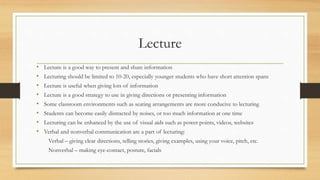
Lecture
• Lecture is a good way to present and share information
• Lecturing should be limited to 10-20, especially younger students who have short attention spans
• Lecture is useful when giving lots of information
• Lecture is a good strategy to use in giving directions or presenting information
• Some classroom environments such as seating arrangements are more conducive to lecturing
• Students can become easily distracted by noises, or too much information at one time
• Lecturing can be enhanced by the use of visual aids such as power points, videos, websites
• Verbal and nonverbal communication are a part of lecturing:
Verbal – giving clear directions, telling stories, giving examples, using your voice, pitch, etc.
Nonverbal – making eye-contact, posture, facials
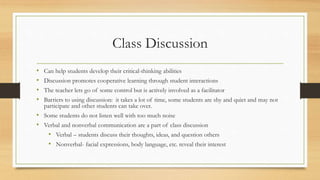
Class Discussion
• Can help students develop their critical-thinking abilities
• Discussion promotes cooperative learning through student interactions
• The teacher lets go of some control but is actively involved as a facilitator
• Barriers to using discussion: it takes a lot of time, some students are shy and quiet and may not
participate and other students can take over.
• Some students do not listen well with too much noise
• Verbal and nonverbal communication are a part of class discussion
• Verbal – students discuss their thoughts, ideas, and question others
• Nonverbal- facial expressions, body language, etc. reveal their interest
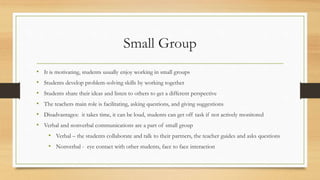
Small Group
• It is motivating, students usually enjoy working in small groups
• Students develop problem-solving skills by working together
• Students share their ideas and listen to others to get a different perspective
• The teachers main role is facilitating, asking questions, and giving suggestions
• Disadvantages: it takes time, it can be loud, students can get off task if not actively monitored
• Verbal and nonverbal communications are a part of small group
• Verbal – the students collaborate and talk to their partners, the teacher guides and asks questions
• Nonverbal - eye contact with other students, face to face interaction
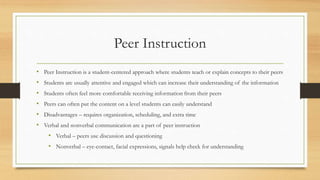
Peer Instruction
• Peer Instruction is a student-centered approach where students teach or explain concepts to their peers
• Students are usually attentive and engaged which can increase their understanding of the information
• Students often feel more comfortable receiving information from their peers
• Peers can often put the content on a level students can easily understand
• Disadvantages – requires organization, scheduling, and extra time
• Verbal and nonverbal communication are a part of peer instruction
• Verbal – peers use discussion and questioning
• Nonverbal – eye-contact, facial expressions, signals help check for understanding

Instructional strategies 2

  • 1.
  • 2.
    Lecture • Lecture isa good way to present and share information • Lecturing should be limited to 10-20, especially younger students who have short attention spans • Lecture is useful when giving lots of information • Lecture is a good strategy to use in giving directions or presenting information • Some classroom environments such as seating arrangements are more conducive to lecturing • Students can become easily distracted by noises, or too much information at one time • Lecturing can be enhanced by the use of visual aids such as power points, videos, websites • Verbal and nonverbal communication are a part of lecturing: Verbal – giving clear directions, telling stories, giving examples, using your voice, pitch, etc. Nonverbal – making eye-contact, posture, facials
  • 3.
    Class Discussion • Canhelp students develop their critical-thinking abilities • Discussion promotes cooperative learning through student interactions • The teacher lets go of some control but is actively involved as a facilitator • Barriers to using discussion: it takes a lot of time, some students are shy and quiet and may not participate and other students can take over. • Some students do not listen well with too much noise • Verbal and nonverbal communication are a part of class discussion • Verbal – students discuss their thoughts, ideas, and question others • Nonverbal- facial expressions, body language, etc. reveal their interest
  • 4.
    Small Group • Itis motivating, students usually enjoy working in small groups • Students develop problem-solving skills by working together • Students share their ideas and listen to others to get a different perspective • The teachers main role is facilitating, asking questions, and giving suggestions • Disadvantages: it takes time, it can be loud, students can get off task if not actively monitored • Verbal and nonverbal communications are a part of small group • Verbal – the students collaborate and talk to their partners, the teacher guides and asks questions • Nonverbal - eye contact with other students, face to face interaction
  • 5.
    Peer Instruction • PeerInstruction is a student-centered approach where students teach or explain concepts to their peers • Students are usually attentive and engaged which can increase their understanding of the information • Students often feel more comfortable receiving information from their peers • Peers can often put the content on a level students can easily understand • Disadvantages – requires organization, scheduling, and extra time • Verbal and nonverbal communication are a part of peer instruction • Verbal – peers use discussion and questioning • Nonverbal – eye-contact, facial expressions, signals help check for understanding