
Submitted by:-
VIVEK RANJAN
12EREEC085
ECE IV YEAR (7TH SEM)
A
PRACTICAL TRAINING SEMINAR REPORT
ON
“EMBEDDED SYSTEM”
TRAINEE AT
CMC ACADEMY , JAIPUR
Submitted to:-
Dr. PAWAN WHIG
Dean Academics
RIET,JAIPUR
TOPICS TO BE COVERED
 COMPANY PROFILE
 WHAT IS EMBEDDED SYSTEM ?
 HARDWARE
• COMPONENTS & DEVICES
• INTRODUCTION TO MICRO CONTROLLER & MICRO PROCESSOR
• 8051
 SOFTWARE
• CIRCUITS & CODING LOGICS
• KEIL
• PROTEUS
 DIFFERENT ASPECTS
COMPANY PROFILE
 CMC Limited, an ISO 9001:2000 is a leading IT solutions company
and a subsidiary of Tata Consultancy Services Limited (TCS Ltd).
 CMC Limited started grooming IT professionals’ way back in 1978.
 some of the major projects undertaken by CMC:
• Indian Railways online reservation system
• Bombay Stock exchange online share trading
• London underground time table scheduling
& signal data generation system .
• Port of Penang Container Handling System .
• Singapore Airport landing light system
WHAT IS EMBEDDED SYSETM ?
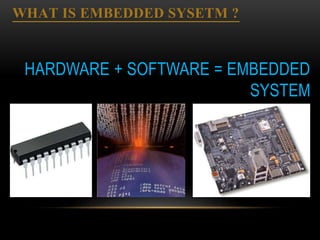
HARDWARE + SOFTWARE = EMBEDDED
SYSTEM
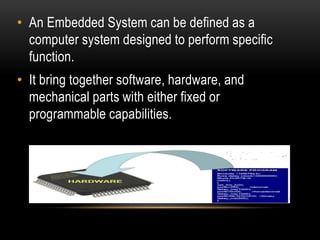
• An Embedded System can be defined as a
computer system designed to perform specific
function.
• It bring together software, hardware, and
mechanical parts with either fixed or
programmable capabilities.
HARDWARE
It comprises of physical electronics devices, components, sensors, and micro processor,
micro controllers etc.
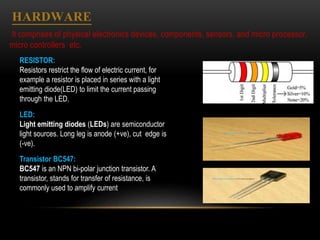
RESISTOR:
Resistors restrict the flow of electric current, for
example a resistor is placed in series with a light
emitting diode(LED) to limit the current passing
through the LED.
LED:
Light emitting diodes (LEDs) are semiconductor
light sources. Long leg is anode (+ve), cut edge is
(-ve).
Transistor BC547:
BC547 is an NPN bi-polar junction transistor. A
transistor, stands for transfer of resistance, is
commonly used to amplify current
Seven Segment Display:
A seven segment display is the most basic
electronic display device that can display digits from
0-9. They find wide application in devices that display
numeric information like digital clocks, radio,
microwave ovens etc.
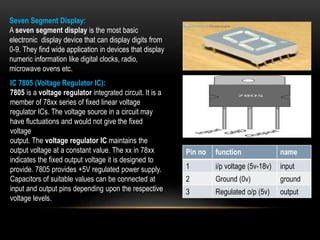
IC 7805 (Voltage Regulator IC):
7805 is a voltage regulator integrated circuit. It is a
member of 78xx series of fixed linear voltage
regulator ICs. The voltage source in a circuit may
have fluctuations and would not give the fixed
voltage
output. The voltage regulator IC maintains the
output voltage at a constant value. The xx in 78xx
indicates the fixed output voltage it is designed to
provide. 7805 provides +5V regulated power supply.
Capacitors of suitable values can be connected at
input and output pins depending upon the respective
voltage levels.
Pin no function name
1 i/p voltage (5v-18v) input
2 Ground (0v) ground
3 Regulated o/p (5v) output
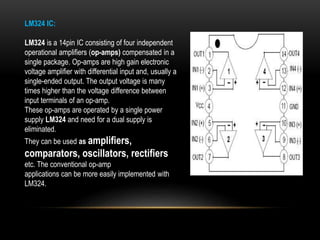
LM324 IC:
LM324 is a 14pin IC consisting of four independent
operational amplifiers (op-amps) compensated in a
single package. Op-amps are high gain electronic
voltage amplifier with differential input and, usually a
single-ended output. The output voltage is many
times higher than the voltage difference between
input terminals of an op-amp.
These op-amps are operated by a single power
supply LM324 and need for a dual supply is
eliminated.
They can be used as amplifiers,
comparators, oscillators, rectifiers
etc. The conventional op-amp
applications can be more easily implemented with
LM324.
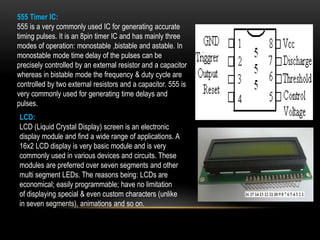
555 Timer IC:
555 is a very commonly used IC for generating accurate
timing pulses. It is an 8pin timer IC and has mainly three
modes of operation: monostable ,bistable and astable. In
monostable mode time delay of the pulses can be
precisely controlled by an external resistor and a capacitor
whereas in bistable mode the frequency & duty cycle are
controlled by two external resistors and a capacitor. 555 is
very commonly used for generating time delays and
pulses.
LCD:
LCD (Liquid Crystal Display) screen is an electronic
display module and find a wide range of applications. A
16x2 LCD display is very basic module and is very
commonly used in various devices and circuits. These
modules are preferred over seven segments and other
multi segment LEDs. The reasons being: LCDs are
economical; easily programmable; have no limitation
of displaying special & even custom characters (unlike
in seven segments), animations and so on.
INTRODUCTION TO MICROPROCESSORS
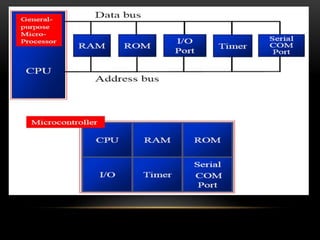
“A Microprocessor is a general purpose chip
used to create multifunction device ”
 No RAM, ROM, I/O ports on CPU chip itself
 CPU is stand-alone, Must add RAM, ROM, I/O ports, and timers
externally to make them functional
 Designer can decide on the amount of ROM, RAM and I/O ports
 Example:Intel’s x86, Motorola’s 680x0
INTRODUCTION TO MICROCONTROLLERS
“A Microcontroller is a specific computer-on-a-
chip optimized to control Electronic devices”
 CPU + I/O + Timer(s) [+ ROM] [+ RAM] All on single chip
 Limited RAM space, ROM space and I/O pins
 Low chip-count to implement a small system
 Low-cost at large quantities
 Development tools readily available at reasonable cost
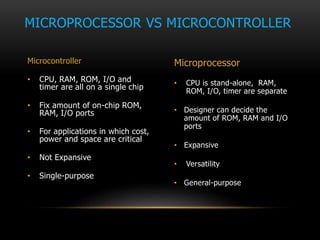
Microcontroller
• CPU, RAM, ROM, I/O and
timer are all on a single chip
• Fix amount of on-chip ROM,
RAM, I/O ports
• For applications in which cost,
power and space are critical
• Not Expansive
• Single-purpose
Microprocessor
• CPU is stand-alone, RAM,
ROM, I/O, timer are separate
• Designer can decide the
amount of ROM, RAM and I/O
ports
• Expansive
• Versatility
• General-purpose
MICROPROCESSOR VS MICROCONTROLLER
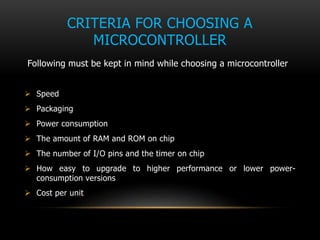
CRITERIA FOR CHOOSING A
MICROCONTROLLER
Following must be kept in mind while choosing a microcontroller
 Speed
 Packaging
 Power consumption
 The amount of RAM and ROM on chip
 The number of I/O pins and the timer on chip
 How easy to upgrade to higher performance or lower power-
consumption versions
 Cost per unit
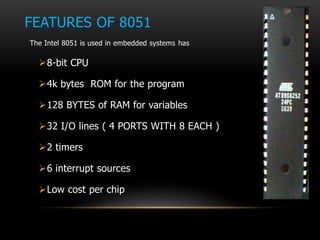
FEATURES OF 8051
The Intel 8051 is used in embedded systems has
8-bit CPU
4k bytes ROM for the program
128 BYTES of RAM for variables
32 I/O lines ( 4 PORTS WITH 8 EACH )
2 timers
6 interrupt sources
Low cost per chip
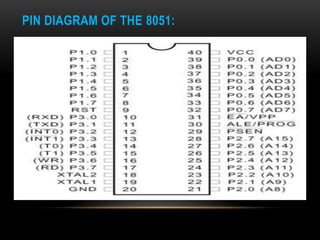
PIN DIAGRAM OF THE 8051:
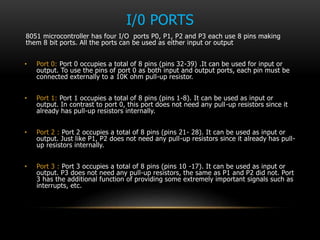
I/0 PORTS
8051 microcontroller has four I/O ports P0, P1, P2 and P3 each use 8 pins making
them 8 bit ports. All the ports can be used as either input or output
• Port 0: Port 0 occupies a total of 8 pins (pins 32-39) .It can be used for input or
output. To use the pins of port 0 as both input and output ports, each pin must be
connected externally to a 10K ohm pull-up resistor.
• Port 1: Port 1 occupies a total of 8 pins (pins 1-8). It can be used as input or
output. In contrast to port 0, this port does not need any pull-up resistors since it
already has pull-up resistors internally.
• Port 2 : Port 2 occupies a total of 8 pins (pins 21- 28). It can be used as input or
output. Just like P1, P2 does not need any pull-up resistors since it already has pull-
up resistors internally.
• Port 3 : Port 3 occupies a total of 8 pins (pins 10 -17). It can be used as input or
output. P3 does not need any pull-up resistors, the same as P1 and P2 did not. Port
3 has the additional function of providing some extremely important signals such as
interrupts, etc.
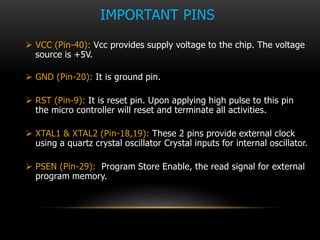
IMPORTANT PINS
 VCC (Pin-40): Vcc provides supply voltage to the chip. The voltage
source is +5V.
 GND (Pin-20): It is ground pin.
 RST (Pin-9): It is reset pin. Upon applying high pulse to this pin
the micro controller will reset and terminate all activities.
 XTAL1 & XTAL2 (Pin-18,19): These 2 pins provide external clock
using a quartz crystal oscillator Crystal inputs for internal oscillator.
 PSEN (Pin-29): Program Store Enable, the read signal for external
program memory.
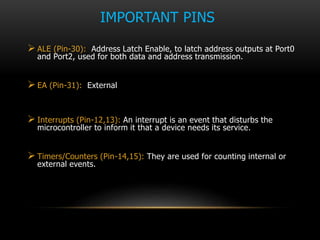
IMPORTANT PINS
 ALE (Pin-30): Address Latch Enable, to latch address outputs at Port0
and Port2, used for both data and address transmission.
 EA (Pin-31): External Access pin should be connected to Vcc in order
to fetch code from internal program memory and to fetch code from
external program memory EA is connected to Ground.
 Interrupts (Pin-12,13): An interrupt is an event that disturbs the
microcontroller to inform it that a device needs its service.
 Timers/Counters (Pin-14,15): They are used for counting internal or
external events.
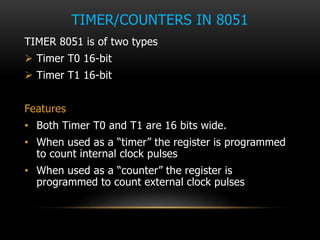
TIMER/COUNTERS IN 8051
TIMER 8051 is of two types
 Timer T0 16-bit
 Timer T1 16-bit
Features
• Both Timer T0 and T1 are 16 bits wide.
• When used as a “timer” the register is programmed
to count internal clock pulses
• When used as a “counter” the register is
programmed to count external clock pulses
INTERRUPT
Interrupt is an event that causes program to change its normal
execution and branch up to specific subroutine putting normal
program on hold.
Whenever any device needs its service, the device
notifies the microcontroller by sending it an
interrupt signal.
Upon receiving an interrupt signal, the
microcontroller interrupts whatever it is doing and
serves the device.
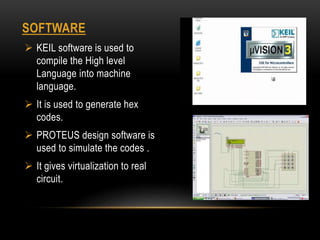
SOFTWARE
 KEIL software is used to
compile the High level
Language into machine
language.
 It is used to generate hex
codes.
 PROTEUS design software is
used to simulate the codes .
 It gives virtualization to real
circuit.
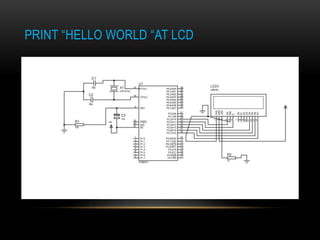
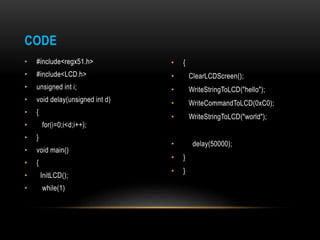
PRINT “HELLO WORLD “AT LCD
• #include<regx51.h>
• #include<LCD.h>
• unsigned int i;
• void delay(unsigned int d)
• {
• for(i=0;i<d;i++);
• }
• void main()
• {
• InitLCD();
• while(1)
• {
• ClearLCDScreen();
• WriteStringToLCD("hello");
• WriteCommandToLCD(0xC0);
• WriteStringToLCD("world");
• delay(50000);
• }
• }
CODE
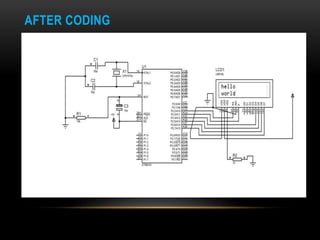
AFTER CODING
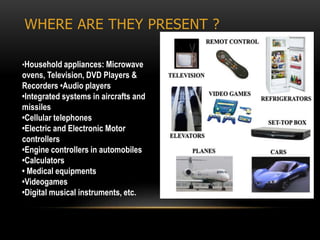
WHERE ARE THEY PRESENT ?
•Household appliances: Microwave
ovens, Television, DVD Players &
Recorders •Audio players
•Integrated systems in aircrafts and
missiles
•Cellular telephones
•Electric and Electronic Motor
controllers
•Engine controllers in automobiles
•Calculators
• Medical equipments
•Videogames
•Digital musical instruments, etc.
CONCLUSION:
Next generation is totally based on
EMBEDDED SYSTEM.
Where there is sensor ,there is embedded.
THANKU…

embedded system

  • 1.
    Submitted by:- VIVEK RANJAN 12EREEC085 ECEIV YEAR (7TH SEM) A PRACTICAL TRAINING SEMINAR REPORT ON “EMBEDDED SYSTEM” TRAINEE AT CMC ACADEMY , JAIPUR Submitted to:- Dr. PAWAN WHIG Dean Academics RIET,JAIPUR
  • 2.
    TOPICS TO BECOVERED  COMPANY PROFILE  WHAT IS EMBEDDED SYSTEM ?  HARDWARE • COMPONENTS & DEVICES • INTRODUCTION TO MICRO CONTROLLER & MICRO PROCESSOR • 8051  SOFTWARE • CIRCUITS & CODING LOGICS • KEIL • PROTEUS  DIFFERENT ASPECTS
  • 3.
    COMPANY PROFILE  CMCLimited, an ISO 9001:2000 is a leading IT solutions company and a subsidiary of Tata Consultancy Services Limited (TCS Ltd).  CMC Limited started grooming IT professionals’ way back in 1978.  some of the major projects undertaken by CMC: • Indian Railways online reservation system • Bombay Stock exchange online share trading • London underground time table scheduling & signal data generation system . • Port of Penang Container Handling System . • Singapore Airport landing light system
  • 4.
    WHAT IS EMBEDDEDSYSETM ? HARDWARE + SOFTWARE = EMBEDDED SYSTEM
  • 5.
    • An EmbeddedSystem can be defined as a computer system designed to perform specific function. • It bring together software, hardware, and mechanical parts with either fixed or programmable capabilities.
  • 6.
    HARDWARE It comprises ofphysical electronics devices, components, sensors, and micro processor, micro controllers etc. RESISTOR: Resistors restrict the flow of electric current, for example a resistor is placed in series with a light emitting diode(LED) to limit the current passing through the LED. LED: Light emitting diodes (LEDs) are semiconductor light sources. Long leg is anode (+ve), cut edge is (-ve). Transistor BC547: BC547 is an NPN bi-polar junction transistor. A transistor, stands for transfer of resistance, is commonly used to amplify current
  • 7.
    Seven Segment Display: Aseven segment display is the most basic electronic display device that can display digits from 0-9. They find wide application in devices that display numeric information like digital clocks, radio, microwave ovens etc. IC 7805 (Voltage Regulator IC): 7805 is a voltage regulator integrated circuit. It is a member of 78xx series of fixed linear voltage regulator ICs. The voltage source in a circuit may have fluctuations and would not give the fixed voltage output. The voltage regulator IC maintains the output voltage at a constant value. The xx in 78xx indicates the fixed output voltage it is designed to provide. 7805 provides +5V regulated power supply. Capacitors of suitable values can be connected at input and output pins depending upon the respective voltage levels. Pin no function name 1 i/p voltage (5v-18v) input 2 Ground (0v) ground 3 Regulated o/p (5v) output
  • 8.
    LM324 IC: LM324 isa 14pin IC consisting of four independent operational amplifiers (op-amps) compensated in a single package. Op-amps are high gain electronic voltage amplifier with differential input and, usually a single-ended output. The output voltage is many times higher than the voltage difference between input terminals of an op-amp. These op-amps are operated by a single power supply LM324 and need for a dual supply is eliminated. They can be used as amplifiers, comparators, oscillators, rectifiers etc. The conventional op-amp applications can be more easily implemented with LM324.
  • 9.
    555 Timer IC: 555is a very commonly used IC for generating accurate timing pulses. It is an 8pin timer IC and has mainly three modes of operation: monostable ,bistable and astable. In monostable mode time delay of the pulses can be precisely controlled by an external resistor and a capacitor whereas in bistable mode the frequency & duty cycle are controlled by two external resistors and a capacitor. 555 is very commonly used for generating time delays and pulses. LCD: LCD (Liquid Crystal Display) screen is an electronic display module and find a wide range of applications. A 16x2 LCD display is very basic module and is very commonly used in various devices and circuits. These modules are preferred over seven segments and other multi segment LEDs. The reasons being: LCDs are economical; easily programmable; have no limitation of displaying special & even custom characters (unlike in seven segments), animations and so on.
  • 10.
    INTRODUCTION TO MICROPROCESSORS “AMicroprocessor is a general purpose chip used to create multifunction device ”  No RAM, ROM, I/O ports on CPU chip itself  CPU is stand-alone, Must add RAM, ROM, I/O ports, and timers externally to make them functional  Designer can decide on the amount of ROM, RAM and I/O ports  Example:Intel’s x86, Motorola’s 680x0
  • 11.
    INTRODUCTION TO MICROCONTROLLERS “AMicrocontroller is a specific computer-on-a- chip optimized to control Electronic devices”  CPU + I/O + Timer(s) [+ ROM] [+ RAM] All on single chip  Limited RAM space, ROM space and I/O pins  Low chip-count to implement a small system  Low-cost at large quantities  Development tools readily available at reasonable cost
  • 12.
    Microcontroller • CPU, RAM,ROM, I/O and timer are all on a single chip • Fix amount of on-chip ROM, RAM, I/O ports • For applications in which cost, power and space are critical • Not Expansive • Single-purpose Microprocessor • CPU is stand-alone, RAM, ROM, I/O, timer are separate • Designer can decide the amount of ROM, RAM and I/O ports • Expansive • Versatility • General-purpose MICROPROCESSOR VS MICROCONTROLLER
  • 14.
    CRITERIA FOR CHOOSINGA MICROCONTROLLER Following must be kept in mind while choosing a microcontroller  Speed  Packaging  Power consumption  The amount of RAM and ROM on chip  The number of I/O pins and the timer on chip  How easy to upgrade to higher performance or lower power- consumption versions  Cost per unit
  • 15.
    FEATURES OF 8051 TheIntel 8051 is used in embedded systems has 8-bit CPU 4k bytes ROM for the program 128 BYTES of RAM for variables 32 I/O lines ( 4 PORTS WITH 8 EACH ) 2 timers 6 interrupt sources Low cost per chip
  • 16.
    PIN DIAGRAM OFTHE 8051:
  • 17.
    I/0 PORTS 8051 microcontrollerhas four I/O ports P0, P1, P2 and P3 each use 8 pins making them 8 bit ports. All the ports can be used as either input or output • Port 0: Port 0 occupies a total of 8 pins (pins 32-39) .It can be used for input or output. To use the pins of port 0 as both input and output ports, each pin must be connected externally to a 10K ohm pull-up resistor. • Port 1: Port 1 occupies a total of 8 pins (pins 1-8). It can be used as input or output. In contrast to port 0, this port does not need any pull-up resistors since it already has pull-up resistors internally. • Port 2 : Port 2 occupies a total of 8 pins (pins 21- 28). It can be used as input or output. Just like P1, P2 does not need any pull-up resistors since it already has pull- up resistors internally. • Port 3 : Port 3 occupies a total of 8 pins (pins 10 -17). It can be used as input or output. P3 does not need any pull-up resistors, the same as P1 and P2 did not. Port 3 has the additional function of providing some extremely important signals such as interrupts, etc.
  • 18.
    IMPORTANT PINS  VCC(Pin-40): Vcc provides supply voltage to the chip. The voltage source is +5V.  GND (Pin-20): It is ground pin.  RST (Pin-9): It is reset pin. Upon applying high pulse to this pin the micro controller will reset and terminate all activities.  XTAL1 & XTAL2 (Pin-18,19): These 2 pins provide external clock using a quartz crystal oscillator Crystal inputs for internal oscillator.  PSEN (Pin-29): Program Store Enable, the read signal for external program memory.
  • 19.
    IMPORTANT PINS  ALE(Pin-30): Address Latch Enable, to latch address outputs at Port0 and Port2, used for both data and address transmission.  EA (Pin-31): External Access pin should be connected to Vcc in order to fetch code from internal program memory and to fetch code from external program memory EA is connected to Ground.  Interrupts (Pin-12,13): An interrupt is an event that disturbs the microcontroller to inform it that a device needs its service.  Timers/Counters (Pin-14,15): They are used for counting internal or external events.
  • 20.
    TIMER/COUNTERS IN 8051 TIMER8051 is of two types  Timer T0 16-bit  Timer T1 16-bit Features • Both Timer T0 and T1 are 16 bits wide. • When used as a “timer” the register is programmed to count internal clock pulses • When used as a “counter” the register is programmed to count external clock pulses
  • 21.
    INTERRUPT Interrupt is anevent that causes program to change its normal execution and branch up to specific subroutine putting normal program on hold. Whenever any device needs its service, the device notifies the microcontroller by sending it an interrupt signal. Upon receiving an interrupt signal, the microcontroller interrupts whatever it is doing and serves the device.
  • 22.
    SOFTWARE  KEIL softwareis used to compile the High level Language into machine language.  It is used to generate hex codes.  PROTEUS design software is used to simulate the codes .  It gives virtualization to real circuit.
  • 23.
  • 24.
    • #include<regx51.h> • #include<LCD.h> •unsigned int i; • void delay(unsigned int d) • { • for(i=0;i<d;i++); • } • void main() • { • InitLCD(); • while(1) • { • ClearLCDScreen(); • WriteStringToLCD("hello"); • WriteCommandToLCD(0xC0); • WriteStringToLCD("world"); • delay(50000); • } • } CODE
  • 25.
  • 26.
    WHERE ARE THEYPRESENT ? •Household appliances: Microwave ovens, Television, DVD Players & Recorders •Audio players •Integrated systems in aircrafts and missiles •Cellular telephones •Electric and Electronic Motor controllers •Engine controllers in automobiles •Calculators • Medical equipments •Videogames •Digital musical instruments, etc.
  • 27.
    CONCLUSION: Next generation istotally based on EMBEDDED SYSTEM. Where there is sensor ,there is embedded.
  • 28.